Relying on Engine Power Limitation to meet IMO mandates is no longer a viable strategy for a competitive fleet. While many operators are still asking what is EEXI and CII for ships, the reality is that the 2026 reduction factor of 11% has transformed these technical and operational benchmarks into urgent commercial imperatives. You’re likely concerned about the risk of forced speed reductions or the escalating costs of mechanical retrofits as the EU ETS reaches full implementation this year. These regulations aren’t just administrative hurdles; they’re performance metrics that directly impact your bottom line and chartering potential.
This guide will help you master the complexities of these carbon intensity regulations and demonstrate how optimizing hull surface efficiency allows you to maintain compliance without sacrificing operational speed. We’ll examine the technical distinctions between EEXI and CII, provide a roadmap for securing a high rating, and explain why advanced hard-film technology like Sea-Speed V 10 X Ultra is the most cost-effective path to long-term vessel viability. By focusing on fluid dynamics and reducing frictional resistance, you can move beyond temporary fixes toward a permanent, scientifically proven solution for your entire fleet.
Key Takeaways
- Differentiate between the one-time EEXI design certification and the continuous annual CII operational rating to establish a clear regulatory baseline for your fleet.
- Master what is EEXI and CII for ships to effectively manage the 11% reduction factor required in 2026 and secure a competitive A or B rating.
- Identify why optimizing hull surface efficiency is a more viable commercial strategy than Engine Power Limitation for maintaining required vessel speeds and chartering potential.
- Explore the role of advanced Silane-Siloxane technology, such as Sea-Speed V 10 X Ultra, in reducing frictional drag and lowering carbon intensity without toxic additives.
- Develop a roadmap for SEEMP Part III implementation that prioritizes long-term material performance and scientific evidence over temporary mechanical fixes.
The IMO Decarbonization Framework: Understanding EEXI and CII
The International Maritime Organization (IMO) has established a rigorous path toward decarbonization, targeting a reduction in carbon intensity of international shipping by at least 40% by 2030 compared to 2019 levels. To achieve this, two primary regulatory mechanisms were implemented: the Energy Efficiency Existing Ship Index (EEXI) and the Carbon Intensity Indicator (CII). Understanding what is EEXI and CII for ships is essential for any maritime stakeholder, as these mandates dictate both technical design and operational viability. 2026 represents a critical juncture in this timeline. It’s the year the IMO will conduct a formal review of these measures, potentially tightening requirements to ensure the 2030 targets remain within reach. This review will likely address the effectiveness of current implementation strategies and could introduce more stringent reduction factors for the following decade.
EEXI vs. CII: The Technical vs. Operational Divide
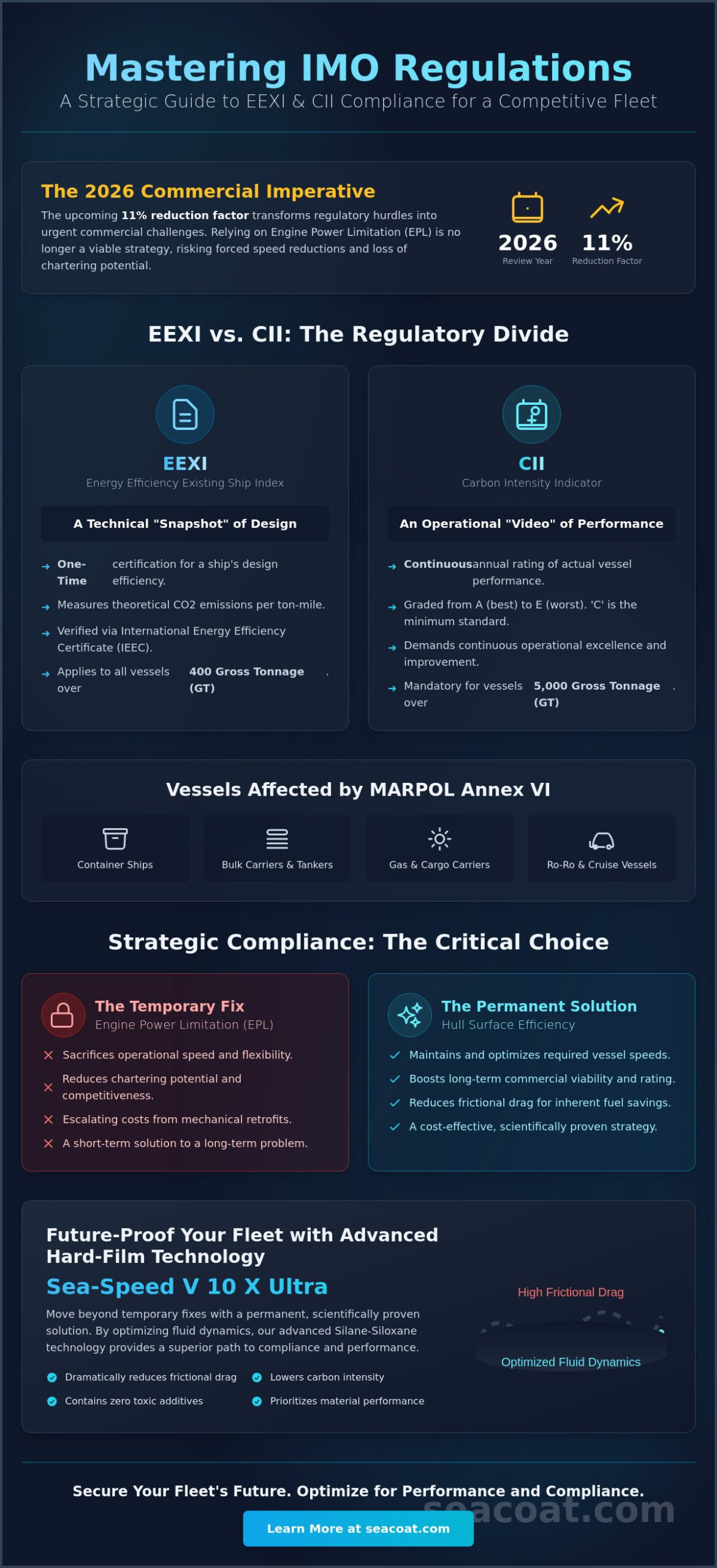
The primary distinction between these two regulations lies in their focus. EEXI is a technical “snapshot” of a vessel’s design efficiency. It’s a one-time certification that ensures a ship’s physical configuration meets specific carbon emission standards relative to its deadweight and speed. In contrast, CII is an ongoing “video” of a ship’s actual performance. It measures how efficiently a vessel operates on an annual basis, resulting in a rating from A (best) to E (worst). While EEXI forces technical upgrades to the vessel’s hardware or power limits, CII demands continuous operational excellence. Together, they create a regulatory ecosystem where design efficiency and real-world performance must align to maintain fleet compliance and commercial access to major ports.
Vessels Affected by MARPOL Annex VI Amendments
These regulations are enforced through the MARPOL Convention, specifically within the amendments to Annex VI. The scope is broad, encompassing several vessel categories that are vital to global trade:
- Bulk carriers and tankers
- Container ships and gas carriers
- Cruise vessels and refrigerated cargo ships
- General cargo and ro-ro vessels
While EEXI applies to all ships over 400 gross tonnage (GT), the CII rating system is mandatory for vessels of 5,000 GT and above. This threshold is significant because it covers the vast majority of the global fleet’s total emissions. Some exceptions exist for specialized vessels, but for the mainstream commercial sector, 2026 marks the beginning of a stricter enforcement phase. This phase introduces more stringent oversight and mandatory corrective action plans for ships that consistently fail to meet a “C” rating. Owners can’t afford to view these as mere administrative tasks; they’re the new benchmarks for commercial survival in a high-stakes industry.
EEXI Compliance: Measuring Technical Efficiency
While the broader industry discussion often centers on operational ratings, understanding what is EEXI and CII for ships starts with the technical baseline. The Energy Efficiency Existing Ship Index (EEXI) is a mandatory framework that evaluates a vessel’s design efficiency. It’s a one-time hurdle that every ship over 400 gross tonnage must clear to remain in service. Compliance is verified through the International Energy Efficiency Certificate (IEEC), which is issued once a vessel proves its Attained EEXI is equal to or lower than the Required EEXI set by the IMO.
The calculation of the Attained EEXI involves a formula that balances the ship’s installed power, specific fuel consumption, and capacity against its reference speed. This technical value represents the grams of CO2 emitted per ton-mile. To document this, owners must maintain a comprehensive EEXI Technical File. If mechanical changes like power limiters are installed, an Onboard Management Manual (OMM) is also required to guide the crew in maintaining the vessel’s certified state and ensuring the ship doesn’t exceed its permitted power envelope during normal operations.
The Relationship Between EEDI and EEXI
EEXI is essentially “EEDI for existing ships.” While the Energy Efficiency Design Index (EEDI) has governed newbuilds since 2013, the EEXI was introduced to bring older tonnage under similar scrutiny. The math is nearly identical, but the reduction factors applied to the baseline are adjusted based on the ship type and size. This ensures that older vessels aren’t unfairly penalized compared to modern designs, while still forcing necessary technical improvements to the global fleet. Transitioning from these static design indices to real-world performance is where the regulatory pressure truly intensifies.
Common Pathways to EEXI Compliance
Most operators achieve compliance through Engine Power Limitation (EPL) or Shaft Power Limitation (SHAPOLI). These are mechanical or electronic solutions that restrict the maximum power a ship can use, effectively lowering its calculated CO2 output. While these are the fastest routes to compliance, they often result in reduced top speeds, which can impact commercial viability in certain charter markets. Beyond the basic question of what is EEXI and CII for ships, operators must decide which technical modifications offer the best return on investment.
Energy Saving Devices (ESDs) like Mewis ducts or pre-swirl fins offer a way to improve a ship’s hydrodynamic efficiency without sacrificing power. Similarly, optimizing the hull surface plays a vital role. A smoother hull reduces frictional resistance, allowing the vessel to maintain higher speeds at lower power settings. This technical advantage can be a deciding factor in the EEXI calculation. For those looking to maximize these design efficiencies, implementing a high-performance hull coating provides a sustainable foundation for long-term compliance and improved baseline metrics.
CII Ratings: The Annual Operational Performance Race
If EEXI is the technical gateway for a vessel’s entry into the modern regulatory era, the Carbon Intensity Indicator (CII) is the ongoing race that determines its commercial survival. Unlike the one-time certification of design, the CII is a dynamic operational metric that rates ships from A to E based on their actual carbon emissions per unit of cargo capacity and distance traveled. For shipowners asking what is EEXI and CII for ships in a practical sense, the answer lies in the shifting baseline. The required CII reduction factor for 2026 is set at 11% relative to the 2019 baseline. This is a sharp increase from the 5% required in 2023, and the trajectory continues to steepen. By 2030, vessels must achieve a 21.5% reduction, making the operational window for compliance narrower every year.
Data collection for this rating is managed through the Ship Energy Efficiency Management Plan (SEEMP) Part III. This document is a mandatory operational manual that outlines exactly how a vessel will meet its required CII targets. By December 31, 2025, owners must have revised their SEEMP Part III to include an approved implementation plan for the 2026 to 2028 period. The IMO is scheduled to conduct a comprehensive review in 2026 to assess the effectiveness of these measures. This review could lead to even stricter thresholds or the introduction of new enforcement mechanisms, reinforcing the need for a proactive approach to fleet management.
The Consequences of Underperformance (D and E Ratings)
Falling into the lower tiers of the CII scale carries significant operational and financial risks. A vessel that receives a “D” rating for three consecutive years, or a single “E” rating, must develop a mandatory Corrective Action Plan. This plan becomes a primary focus for Port State Control inspections, increasing the likelihood of detentions or operational restrictions. Beyond the regulatory pressure, the commercial impact is immediate. Charterers are increasingly using these ratings to filter their fleets, often refusing to hire vessels with low scores to meet their own corporate sustainability targets. A low rating doesn’t just mean a ship is less efficient; it means it’s less marketable.
Factors Influencing Your Annual CII Score
Maintaining a high rating requires a multi-faceted strategy that goes beyond simple speed reduction. While fuel choice and the use of carbon factors for biofuels or LNG are significant, they aren’t the only variables. Route optimization and weather routing can improve efficiency, but they’re often at the mercy of global supply chain demands. The “silent killer” of a CII rating is hull fouling and the resulting frictional drag. As biological growth accumulates on the hull, the engine must work harder and burn more fuel to maintain the same speed. This increased consumption directly inflates the vessel’s carbon intensity. Managing surface efficiency through advanced material science is the most reliable way to prevent this performance decay and protect your annual score.
Strategic Compliance: Why Surface Efficiency Beats Engine Limitation
Many owners investigating what is EEXI and CII for ships immediately turn to Engine Power Limitation (EPL) as a primary solution. It’s a binary technical fix that satisfies the EEXI Technical File, but it introduces a hidden commercial cost that many operators overlook. By artificially capping a vessel’s top speed, you risk becoming uncompetitive in high-freight markets where transit time is a premium. It’s a reactive measure that doesn’t address the underlying issue of operational efficiency. In contrast, focusing on fluid dynamics offers a proactive way to lower carbon intensity without sacrificing the ship’s ability to perform at its design capacity.
The physics of maritime transport are unforgiving, as frictional resistance accounts for up to 80% of a vessel’s total drag. When a hull surface is compromised by roughness or biofouling, the engine must consume more energy to overcome that resistance and maintain speed. This increased energy demand directly inflates your annual fuel consumption and degrades your CII rating. Hard-film foul release coatings provide a passive efficiency gain by creating an ultra-smooth, low-friction surface. Unlike mechanical retrofits, these coatings work continuously without requiring complex maintenance or operational downtime, making them a strategic asset for long-term fleet management.
Mechanical vs. Passive Efficiency Solutions
Energy Saving Devices (ESDs) like Mewis ducts require precise installation and structural checks, whereas advanced Environmental Marine Coatings offer a maintenance-free performance enhancement that addresses the entire wetted surface area. Optimizing the hull surface provides a dual benefit: it improves the reference speed for EEXI calculations and lowers the real-world fuel burn for annual CII reporting. It’s a synergistic approach that addresses both technical and operational mandates simultaneously.
The Impact of Biofouling on Carbon Intensity
Biofouling is a significant contributor to carbon intensity, as even a light layer of slime can increase fuel consumption by 10% to 15% on large commercial vessels. Traditional antifouling paints rely on the leaching of biocides, a process that inherently slows down over a five-year dry-dock cycle, leading to performance decay just when you need it most. For a detailed breakdown of how material science impacts your bottom line, consult The Definitive Guide to Boat Hull Paint.
Investing in a one-time coating upgrade is a strategic move that avoids the perpetual financial burden of fuel surcharges and escalating EU ETS allowances. It’s about moving from a culture of reactive maintenance to one of intelligent performance management. To secure your fleet’s future and explore the benefits of advanced surface technology, evaluate our high-performance silane-siloxane solutions.
Future-Proofing Your Fleet with Sea-Speed V 10 X Ultra
Managing the long-term implications of what is EEXI and CII for ships requires moving beyond administrative compliance toward strategic asset management. Sea-Speed V 10 X Ultra represents a paradigm shift in hull performance, offering a non-toxic Silane-Siloxane solution that aligns with the IMO’s 2030 decarbonization goals. By creating an exceptionally smooth, hard-film surface, this technology minimizes frictional drag, which is the primary driver of excess fuel consumption. Unlike traditional methods, this approach provides a permanent performance gain that doesn’t diminish over time. This ensures your vessel maintains a competitive rating throughout the entire dry-dock interval, protecting both its environmental standing and its commercial value.
The transition away from toxic, copper-based antifouling is no longer just an ethical choice; it’s a regulatory necessity as the EU ETS and FuelEU Maritime standards tighten. Sea-Speed V 10 X Ultra contains no biocides or volatile organic compounds, eliminating the risk of toxic leaching into sensitive marine ecosystems. This absence of chemical depletion means the coating doesn’t become rough or porous as it ages. Instead, the surface remains slick and intact, providing a consistent baseline for your annual CII data collection. It’s a strategic asset that transforms the hull from a maintenance liability into a performance-enhancing tool.
The Science of Silane-Siloxane in Regulatory Compliance
The efficacy of Sea-Speed lies in its low-surface-energy film, which prevents the strong adhesion of biofouling organisms without the use of poisons. This “Slickness Factor” is achieved through a sophisticated molecular structure that is significantly more durable than soft silicone coatings. While soft silicones are prone to tearing and mechanical damage during port operations or hull cleanings, our hard-film Silane-Siloxane technology withstands rigorous scrubbing. Real-world applications have demonstrated fuel savings and carbon reduction metrics that directly contribute to maintaining an “A” rating, even in challenging trading routes where fouling pressure is high.
Implementation and Global Support
Achieving fleet-wide compliance requires a solution that’s both scalable and easy to implement. Sea-Speed V 10 X Ultra is available worldwide for commercial and military fleets, ensuring that your vessels can be serviced at major global shipyards. The system is fully compatible with existing hull structures and can be applied over specific high-performance primers like Seapoxy 73 to ensure maximum adhesion and longevity. Because the coating is a permanent film rather than a depleting layer, it offers a superior return on investment by extending service windows and reducing the frequency of full hull blasting. To secure your fleet’s future and develop a bespoke performance roadmap, consult with Seacoat experts for a custom compliance strategy.
Securing Your Fleet’s Competitive Edge Through Surface Science
The 2026 regulatory landscape demands a shift from reactive compliance to proactive performance management. By distinguishing between technical design standards and annual operational metrics, you can implement a strategy that protects both your environmental rating and your commercial speed. Understanding what is EEXI and CII for ships is the first step toward building a resilient fleet management strategy that prioritizes long-term asset value. Relying on power limitations is a temporary fix; the real solution lies in the fluid dynamics of the hull surface.
Since 2001, our Silane-Siloxane technology has provided a scientifically proven path to reducing frictional drag and greenhouse gas emissions. These non-toxic, biocide-free solutions ensure that your vessels remain compliant without the environmental or operational trade-offs of traditional coatings. You can maintain a high rating while significantly lowering annual fuel consumption across the entire service life of your asset. It’s a strategic investment in the longevity and intelligence of your operations.
Optimize your fleet’s CII rating with Sea-Speed V 10 X Ultra and lead the transition toward a more efficient, sustainable maritime future. Your commitment to advanced material science today will dictate your fleet’s viability for years to come.
Frequently Asked Questions
Does EEXI and CII apply to all ships regardless of size?
No, these regulations are threshold-dependent based on gross tonnage. EEXI mandates apply to existing ships over 400 gross tonnage (GT), while the CII operational rating system is required for vessels of 5,000 GT and above. These size categories are defined by the IMO to target the vessels most responsible for global maritime emissions.
How often is the CII rating calculated for a vessel?
The CII rating is calculated annually based on data collected over the previous calendar year. This ongoing assessment ensures that a vessel’s operational efficiency is monitored continuously rather than being a one-time design certification. The annual nature of the rating forces operators to maintain consistent performance standards throughout the ship’s service life.
What is the difference between EEDI and EEXI?
The primary difference lies in the age of the vessel at the time of regulation. EEDI is a design index for newbuilds constructed after 2013, whereas EEXI serves as the equivalent technical standard for existing ships. While both measure CO2 emissions per ton-mile based on design, EEXI was introduced to ensure older tonnage meets modern efficiency baselines.
Can a ship with a “D” rating still operate legally in 2026?
Yes, a vessel with a “D” rating can operate legally, but it’s subject to increased regulatory scrutiny. If a ship receives a “D” rating for three consecutive years, the owner must submit a mandatory Corrective Action Plan within the SEEMP Part III. This plan must detail how the vessel will achieve a “C” rating or higher in subsequent years.
How do hull coatings specifically improve a ship’s CII rating?
Hull coatings improve a vessel’s CII rating by reducing frictional resistance, which can account for up to 80% of total drag. By maintaining a smooth, hard-film surface with technology like Sea-Speed V 10 X Ultra, the engine requires less power to maintain speed. This reduction in fuel consumption directly lowers the carbon intensity metric used to calculate the annual rating.
Is Engine Power Limitation (EPL) mandatory for EEXI compliance?
EPL is not mandatory, though it’s the most common pathway chosen by owners for its simplicity. Other compliance routes include Shaft Power Limitation (SHAPOLI) or the installation of Energy Saving Devices (ESDs). Some operators choose to optimize hull efficiency or use alternative fuels to meet the required design index without sacrificing top-end engine performance.
What happens if a ship fails to meet its required EEXI by the first survey?
If a vessel fails to demonstrate compliance by the first scheduled survey after the implementation date, it won’t receive its International Energy Efficiency Certificate (IEEC). Without a valid IEEC, the ship is technically non-compliant with MARPOL Annex VI and may be detained by Port State Control. This makes the EEXI Technical File a critical document for legal operation.
How does the IMO review in 2026 affect current CII ratings?
The 2026 review is a planned assessment to determine if the current reduction factors are effectively meeting decarbonization goals. This review could lead to a tightening of the A-E rating thresholds or the introduction of more stringent reduction targets for the 2027 to 2030 period. Owners should understand what is EEXI and CII for ships in the context of this evolving framework to avoid future compliance gaps.