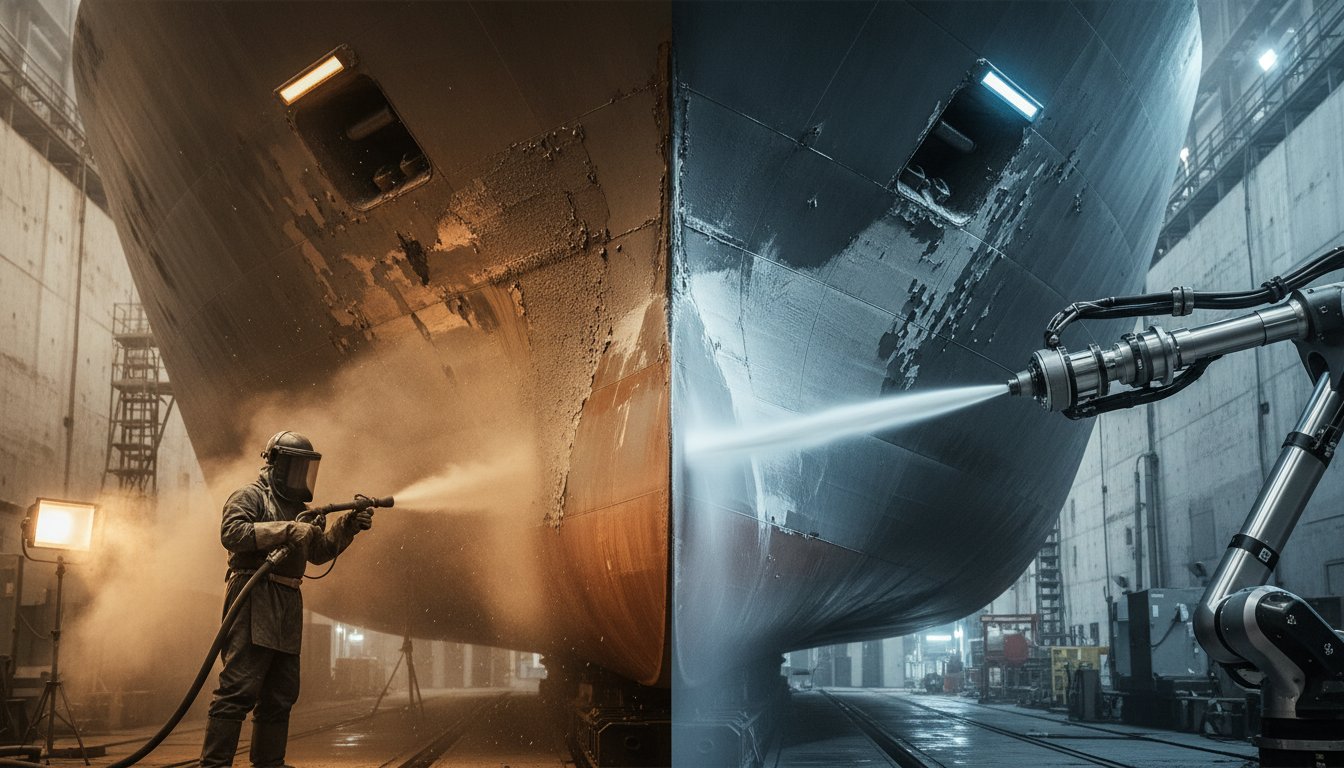
The most aggressive method for surface preparation might actually be the primary obstacle to your vessel’s long-term hydrodynamic efficiency. While traditional dry sandblasting remains a common industry standard, the high costs of abrasive media disposal and the risk of altering the hull’s original steel profile are becoming unsustainable. When evaluating water jetting vs sandblasting for hull preparation, shipyards must weigh the immediate mechanical impact against the long-term integrity of the substrate. You likely understand the pressure to maintain strict dry-dock schedules while managing the escalating costs of waste remediation, which can reach $4.50 per square foot for dry abrasive methods.
Discover how to optimize your vessel’s coating longevity and hydrodynamic performance by choosing a preparation method that preserves the hull’s original profile. This technical comparison details how ultra-high pressure water jetting, which costs as little as $1.00 per square foot, aligns with the Brazil NORMAM-401 regulations that entered full enforcement on February 1, 2026. We’ll examine the specific data behind surface roughness, the 95% reduction in water usage reported by Derc Salotech, and how these choices influence the performance of high-durability systems like Sea-Speed V 10 X Ultra Clear. This guide provides the framework for achieving a 10-year coating cycle while maintaining zero-discharge environmental compliance.
Key Takeaways
- Identify why shifting focus from mechanical roughness to hydrodynamic smoothness can mitigate the technical factors responsible for 80% of maritime coating failures.
- Analyze the mechanical differences in water jetting vs sandblasting for hull preparation, focusing on how 40,000+ PSI shearing preserves steel integrity compared to abrasive erosion.
- Recognize the critical importance of removing non-visible salt contaminants to ensure the chemical bonding and long-term performance of advanced foul release systems.
- Assess the operational ROI of dust-free UHP water jetting, which facilitates concurrent shipyard operations and eliminates the logistical burden of contaminated media remediation.
- Implement a strategic transition plan for your fleet to leverage Sea-Speed V 10 X Ultra technology for optimized drag reduction and extended maintenance intervals.
The Critical Role of Surface Preparation in Marine Hull Performance
Surface preparation is the technical foundation of every successful maritime maintenance cycle. Industry data confirms that 80% of coating failures result directly from inadequate substrate treatment. When we compare water jetting vs sandblasting for hull preparation, we aren’t just discussing how to remove old paint; we’re determining the hydrodynamic future of the vessel. Traditional Abrasive Blasting has long focused on creating a jagged anchor profile to facilitate mechanical adhesion. However, the 2026 maritime industry is shifting toward a smoothness for hydrodynamics model. For modern environmental marine coatings, the goal is to maximize the surface’s chemical bond while minimizing frictional drag.
The choice of preparation method influences the entire life cycle of the vessel’s coating. A perfectly prepared substrate ensures that high-performance systems, such as Sea-Speed V 10 X Ultra, can reach their full 10-year performance potential. If the surface isn’t chemically clean, even the most advanced siloxane technology will struggle to provide the intended fuel savings and foul release properties. Cleanliness isn’t just about what you can see; it’s about the microscopic removal of chlorides and non-visible contaminants that trigger osmotic blistering and premature coating detachment.
Defining Surface Preparation Goals for 2026
The objectives for current dry-dock operations have evolved beyond simple cleaning. Fleet managers must now achieve total removal of spent antifouling layers and biological contaminants to meet strict compliance standards like Brazil’s NORMAM-401, which began full enforcement on February 1, 2026. Key goals include:
- Meeting precise ISO 8501-1 or SSPC cleanliness levels without compromising the substrate’s integrity.
- Total elimination of soluble salts that lead to coating degradation.
- Preserving the original steel or aluminum profile to maintain structural longevity.
Every micron of metal lost to over-blasting represents a reduction in the vessel’s lifespan. By utilizing methods that clean the existing profile rather than carving a new one, operators protect their capital assets while preparing for high-efficiency coating application.
The Relationship Between Prep and Frictional Drag
Frictional drag is directly influenced by the quality of the initial preparation. Residual abrasive grit or uneven blasting patterns increase the Average Hull Roughness (AHR), which forces the propulsion system to consume more energy to maintain cruising speed. While a traditional merchant ship might have tolerated a higher AHR in the past, modern high-performance vessels require a precision approach to reach peak efficiency. Research from Derc Salotech indicates that improper prep can lead to significant power losses. Precision preparation ensures the hull remains as close to its designed hydrodynamic DNA as possible, providing the smooth interface necessary for a low-drag, biocide-free finish.
Mechanics of Removal: Abrasive Blasting vs. UHP Water Jetting
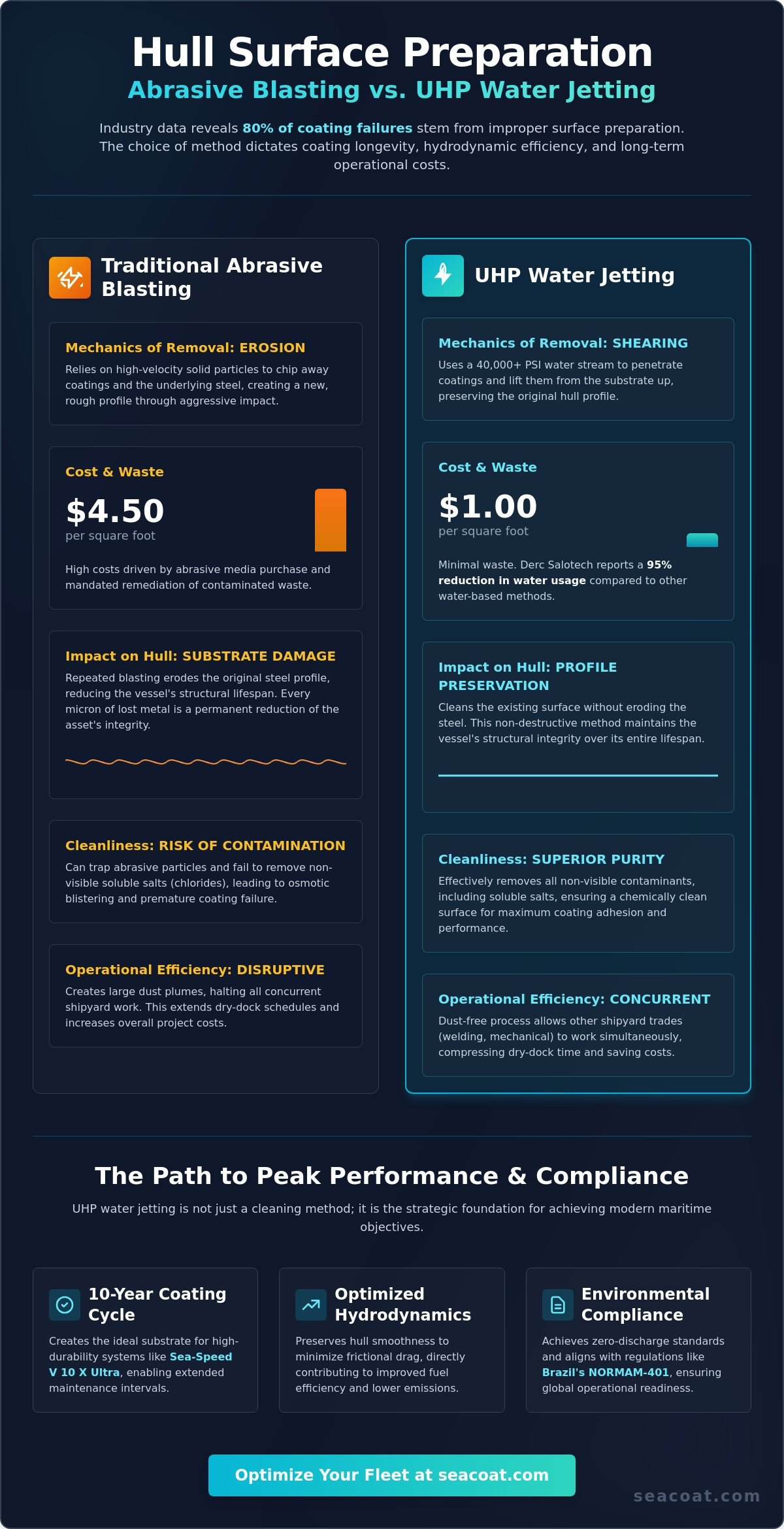
The fundamental difference between these two methods lies in the physics of how they interact with the substrate. Abrasive blasting relies on the kinetic energy of solid particles to erode coating layers from the top down. In contrast, ultra-high pressure (UHP) water jetting utilizes hydraulic shearing to lift coatings from the bottom up. Understanding these mechanical distinctions is vital when deciding on water jetting vs sandblasting for hull preparation, as the choice determines whether you are preserving the vessel’s original steel profile or creating a new, potentially irregular one.
While traditional methods have dominated the industry for decades, the Association for Materials Protection and Performance emphasizes The Critical Role of Surface Preparation in ensuring long-term asset integrity. Choosing the wrong mechanical approach can lead to substrate fatigue or entrapment of contaminants that eventually cause delamination. For owners looking to maximize the 10-year life cycle of their assets, the “bottom-up” approach of water jetting offers a level of cleanliness that abrasive media simply cannot replicate.
The Abrasive Blasting Process (Sandblasting)
Modern shipyards typically utilize garnet, coal slag, or steel shot as abrasive media. These particles are propelled at high velocities to impact the hull, effectively grinding away old paint and rust. However, this “top-down” erosion often results in embedded grit, where microscopic fragments of the abrasive become lodged in the steel. This contamination can interfere with the chemical bond of high-performance primers. Additionally, abrasive blasting is highly sensitive to environmental conditions. High humidity can lead to “flash rusting” before the first coat is even applied, while windy conditions make dust containment almost impossible in open-air docks. With costs for dry sandblasting ranging from $2.00 to $4.50 per square foot, the logistical burden of media recovery adds significant overhead to the project.
Ultra-High Pressure (UHP) Water Jetting Mechanics
UHP water jetting operates at pressures exceeding 30,000 PSI, often reaching up to 40,000 PSI (approximately 2,750 bar) in specialized maritime applications. Instead of grinding the surface, the water penetrates the microscopic pores of the coating. This creates a pressurized cushion between the substrate and the film, shearing the bond and lifting the coating away in large flakes. Because water is a liquid, it reaches into the deepest valleys of the existing profile to flush out non-visible contaminants like soluble salts. This is a critical advantage, as residual chlorides are the leading cause of osmotic blistering. By utilizing filtered fresh water, this method leaves the original factory profile intact, providing an ideal surface for the application of Sea-Speed V 10 X Ultra, which relies on a clean, salt-free substrate for maximum adhesion. With hydro blasting costs ranging from $1.00 to $2.50 per square foot, it represents a more efficient mechanical and financial solution for modern fleet management.
Comparative Analysis: Profiling, Cleanliness, and Substrate Integrity
The technical superiority of a preparation method is measured by its impact on the substrate’s long-term health and the resulting surface geometry. When analyzing water jetting vs sandblasting for hull preparation, we must look beyond visual cleanliness to examine profilometry and chemical purity. Sandblasting creates an anchor profile by physically deforming the metal through high-velocity impact. While this mechanical tooth was necessary for older, high-build epoxy systems, it’s often detrimental to the performance of modern, high-efficiency coatings. Repeated abrasive blasting leads to the “cold-working” of steel, a process that hardens the surface and can induce microscopic stress fractures over multiple maintenance cycles.
UHP water jetting avoids this mechanical trauma by utilizing hydraulic shearing rather than kinetic impact. It preserves the vessel’s original factory profile and mill scale, ensuring the hull’s structural integrity remains uncompromised. A common critique of water-based methods is the appearance of flash rust. However, the maritime industry utilizes standardized grades, ranging from WJ-1 to WJ-4, to manage this. WJ-1 represents a surface cleaned to a “bare metal” visual standard, while WJ-4 allows for light flash rust. Modern moisture-tolerant primers, such as Seapoxy 73, are specifically engineered to bond with these surfaces, turning a perceived aesthetic flaw into a manageable technical variable.
Profilometry and Surface Texture
Preserving the original profile isn’t just about substrate health; it’s a strategic hydrodynamic advantage. Sandblasting creates a new, high-surface-area profile with sharp peaks and deep valleys. This increased roughness requires more coating material to achieve a smooth finish and can lead to a higher Average Hull Roughness (AHR) metric. In contrast, water jetting cleans the existing profile without adding unnecessary texture. This precision is vital for the application of Sea-Speed V 10 X Ultra, which achieves its peak foul release performance on surfaces that are hydrodynamically optimized. By maintaining the original smoothness of the steel, operators reduce the energy required to propel the vessel through the water.
Salt and Chemical Cleanliness
Soluble salts are the primary cause of osmotic blistering and premature coating detachment. Abrasives can inadvertently trap these chlorides by hammering them into the metal’s pores during the blasting process. Technical data indicates that UHP water jetting removes up to 98% of soluble salts, whereas dry abrasive methods often leave behind residual levels that exceed the 5 µg/cm² threshold recommended by many coating manufacturers. This superior level of chemical cleanliness is essential when transitioning from traditional antifouling boat paint to advanced silane-siloxane technology. Without the total removal of these non-visible contaminants, the 10-year life cycle of a high-performance coating system cannot be guaranteed.
- Water Jetting: Flushes pores to remove deep-seated chlorides.
- Sandblasting: Risks embedding salts under the deformed metal surface.
- Result: Water jetting provides a chemically superior substrate for long-term adhesion.
Operational and Environmental Considerations for Modern Shipyards
Shipyards are under increasing pressure to balance operational speed with stringent environmental stewardship. When evaluating water jetting vs sandblasting for hull preparation, the decision often hinges on the Total Cost of Ownership (TCO) rather than just the initial equipment outlay. Traditional abrasive blasting carries a massive logistical burden, specifically regarding waste remediation and the suspension of concurrent shipyard activities. In contrast, ultra-high pressure (UHP) water jetting aligns with the maritime industry’s 2026 shift toward zero-discharge standards and optimized dry-dock schedules.
The regulatory landscape has evolved to include the IMO’s Energy Efficiency Existing Ship Index (EEXI) and the Carbon Intensity Indicator (CII). These frameworks don’t just measure fuel consumption; they indirectly penalize vessels with high hull roughness. Because sandblasting can increase surface profile through repeated erosion, it may inadvertently lower a vessel’s CII rating over time. Transitioning to water jetting ensures that you maintain the substrate’s original hydrodynamic DNA while meeting the latest EPA and IMO discharge requirements.
The Economic Reality of Waste Disposal
Abrasive blasting a large vessel can generate hundreds of tons of spent media. If the existing coating contains legacy biocides or heavy metals, this material is classified as hazardous waste. In many US and European ports, the cost of disposing of contaminated garnet or copper slag now rivals the cost of the media itself. UHP water jetting eliminates this burden. Modern systems can reduce water usage by 95% through integrated filtration units that separate paint chips from the water. This allows for the recycling of the water and reduces the total hazardous waste volume to a few drums of concentrated paint solids rather than mountains of grit.
Concurrent Activity and Dry-Dock Efficiency
One of the most significant hidden costs of sandblasting is the “total blackout” it requires. The resulting dust cloud is a safety hazard that halts all other hull maintenance, including mechanical repairs, valve servicing, and welding. This isolation can extend dry-dock stays by several days. UHP water jetting is a localized, dust-free process. It allows multiple crews to work on the vessel simultaneously, which is essential for maintaining a tight 10-year maintenance cycle. By reducing the duration of the dry-docking, fleet managers can return their assets to service faster, directly improving the vessel’s ROI. To see how these efficiencies translate into long-term performance, explore our technical data on Sea-Speed V 10 X Ultra coatings.
- Dust Containment: Water jetting keeps the air clear, allowing for concurrent mechanical and electrical repairs.
- Noise and Safety: While UHP systems require specialized operator training, they eliminate the respiratory risks associated with airborne silica and abrasive dust.
- Compliance: Zero-discharge filtration systems ensure that no contaminated runoff enters the marine ecosystem, satisfying the strictest local environmental regulations.
Optimizing Surface Preparation for Sea-Speed V 10 X Ultra Systems
The transition to a high-performance foul release system requires a shift in how we perceive the hull’s surface. While traditional coatings relied on the mechanical grip provided by a roughened substrate, the silane-siloxane technology from Seacoat SCT, LLC thrives on chemical bonding at a molecular level. When evaluating water jetting vs sandblasting for hull preparation, the choice directly dictates the efficacy of the siloxane cross-linking process. A water-jetted surface, free from the microscopic shadows and embedded grit common in abrasive blasting, allows Sea-Speed V 10 X Ultra to form a monolithic, hard-film barrier that maximizes hydrodynamic efficiency.
This synergy between UHP cleanliness and the hard-film durability offered by Seacoat SCT, LLC is what enables a 10-year maintenance cycle. By utilizing a preparation method that focuses on total contaminant removal rather than substrate deformation, fleet managers ensure that the underlying Seapoxy 73 primer can bond directly to the clean metal or original mill scale. This foundation is critical for the long-term ROI of the vessel, as it prevents the sub-film corrosion that often leads to premature coating failure in less precisely prepared hulls.
Why Seacoat SCT, LLC Recommends UHP Water Jetting
Maximizing the performance of the V 10 X Ultra system requires a substrate that is both chemically pure and physically consistent. Abrasive particles can leave behind dust or fines that interfere with the clear coat’s ability to provide a perfectly smooth interface. By choosing UHP water jetting, you ensure zero contamination from external media, allowing the siloxane molecules to cross-link without interference. By removing accumulated foulants and spent coatings without altering the substrate’s original mill scale, water jetting preserves the hydrodynamic DNA of the hull for peak operational efficiency. This precision is what allows the coatings from Seacoat SCT, LLC to maintain their low-friction properties throughout the entire dry-dock interval.
Transitioning from Ablative Systems
Moving away from traditional, toxic ablative bottom paint requires the total removal of all sacrificial layers. UHP water jetting is the most effective way to strip these soft, biocide-heavy films without creating the massive hazardous waste streams associated with sandblasting. This is especially vital for aluminum vessels. Aluminum hulls are highly sensitive to the kinetic impact of abrasives, which can cause work-hardening or surface pitting. Water jetting is the superior choice for boat paint for aluminum boats, providing a non-destructive cleaning action that maintains the metal’s structural integrity while preparing it for a permanent, non-toxic finish from Seacoat SCT, LLC.
To ensure your shipyard is ready for a high-performance Sea-Speed application, follow this final technical checklist:
- Verify Pressure Ratings: Ensure the UHP equipment is capable of maintaining a consistent 40,000 PSI to achieve a WJ-1 cleanliness standard.
- Chloride Testing: Conduct salt contamination tests to confirm levels are below 5 µg/cm²; water jetting typically achieves this more reliably than abrasives.
- Surface Profile Inspection: Confirm that the existing profile is clean and hasn’t been rounded off by previous over-blasting.
- Environmental Controls: Ensure the dry-dock has integrated filtration to capture 100% of the removed paint solids for responsible disposal.
- Moisture Management: While Seapoxy 73 is moisture-tolerant, the surface should be free of standing water before the priming phase begins.
Securing the Hydrodynamic Future of Your Fleet
The decision regarding water jetting vs sandblasting for hull preparation is a strategic choice that dictates a vessel’s operational efficiency for the next decade. As the maritime industry adapts to the 2026 regulatory environment, the technical advantages of UHP water jetting become undeniable. By prioritizing the total removal of non-visible chlorides and preserving the original steel profile, fleet managers ensure the highest possible adhesion for advanced coating systems. This approach doesn’t just meet the zero-discharge standards required by modern shipyards; it provides the smooth substrate necessary for maximizing long-term fuel savings.
The Proprietary Silane-Siloxane Technology from Seacoat SCT, LLC is engineered to thrive on these chemically clean surfaces. Our Zero VOC, non-toxic formulations offer a Proven 10-Year Life Cycle Performance that traditional sacrificial coatings can’t match. Transitioning to a high-performance foul release system is a commitment to both asset longevity and environmental stewardship. Optimize your fleet’s performance with a technical consultation from Seacoat SCT, LLC. We’re ready to help you navigate the complexities of modern hull maintenance with data-backed solutions that prioritize your bottom line and the marine ecosystem.
Frequently Asked Questions
Is water jetting or sandblasting faster for a 300-meter vessel?
UHP water jetting typically offers superior operational speed for a 300-meter vessel because it permits concurrent work across the hull. Unlike sandblasting, which requires a total blackout of other maintenance tasks due to dust clouds, water jetting allows mechanical and electrical teams to work alongside the prep crew. This reduces the total dry-dock duration significantly. When comparing water jetting vs sandblasting for hull preparation on large-scale assets, the elimination of grit recovery time further accelerates the schedule.
Does water jetting cause flash rust that interferes with coating adhesion?
Flash rust is a standard outcome of water-based preparation, but it doesn’t compromise coating integrity when managed correctly. The industry uses WJ-1 through WJ-4 standards to categorize the level of oxidation. High-performance, moisture-tolerant primers like Seapoxy 73 are specifically formulated to bond with these surfaces. Scientific data confirms that chemically clean metal with light flash rust often provides better long-term adhesion than a grit-contaminated surface produced by traditional dry blasting.
Can I use sandblasting if I am applying a non-toxic foul release coating?
You can use sandblasting, but it often compromises the hydrodynamic benefits of a non-toxic foul release system. Sandblasting creates a jagged anchor profile that increases the Average Hull Roughness (AHR). This additional texture can create turbulence and increase drag, which counteracts the fuel-saving properties of siloxane coatings. For the best results with Sea-Speed V 10 X Ultra, preserving the original mill scale through water jetting is the technically superior choice.
How much water is typically used during a UHP hull preparation?
Modern UHP systems are remarkably efficient, often consuming 95% less water than older hydraulic cleaning methods. Advanced equipment from manufacturers like Derc Salotech utilizes high-velocity, low-volume streams to achieve removal. For a typical hull preparation project, this equates to a manageable volume that can be processed through closed-loop filtration units. These systems separate paint solids from the effluent, allowing shipyards to recycle the water and minimize the total environmental footprint of the operation.
What is the difference between hydroblasting and UHP water jetting?
The primary difference is the operating pressure. Hydroblasting is a broad term that includes low-pressure washing, whereas UHP water jetting specifically refers to pressures exceeding 30,000 PSI (2,000 bar). At these ultra-high pressures, the water acts as a precision cutting tool that shears the coating bond from the substrate. This specialized mechanical action is what distinguishes UHP from standard hydro-cleaning, providing the required cleanliness for high-durability maritime coating systems.
Will water jetting remove heavy marine growth like barnacles as effectively as sandblasting?
UHP water jetting is exceptionally effective at removing hard marine growth like barnacles and tubeworms. While sandblasting grinds away the growth from the top down, UHP water penetrates the interface between the organism and the hull. This hydraulic action shears the biological cement that barnacles use to attach themselves, leaving the underlying steel or aluminum completely clean. It achieves this without the risk of embedding biological fragments into the substrate’s profile.
Which method is safer for the structural integrity of thin-gauge aluminum hulls?
Water jetting is the only recommended method for preserving the structural integrity of thin-gauge aluminum hulls. Abrasive blasting can cause oil-canning or work-hardening, which makes the aluminum brittle and prone to stress cracking. Because UHP water jetting doesn’t rely on kinetic impact, it removes coatings and contaminants without thinning the metal or altering its mechanical properties. It’s the safest way to prepare aluminum for high-performance systems like Sea-Speed V 10 X Ultra Clear.
How do I ensure my shipyard meets environmental standards for blasting waste?
Compliance with environmental standards like Brazil’s NORMAM-401, enforced since February 1, 2026, requires integrated waste management. Shipyards should utilize vacuum-shrouded UHP tools and closed-loop filtration systems to capture all runoff. This technology separates hazardous paint chips and biocides from the water, reducing waste volume to a few drums of solids. By treating wastewater as a linked compliance burden, operators ensure they meet zero-discharge requirements while protecting the local marine ecosystem.