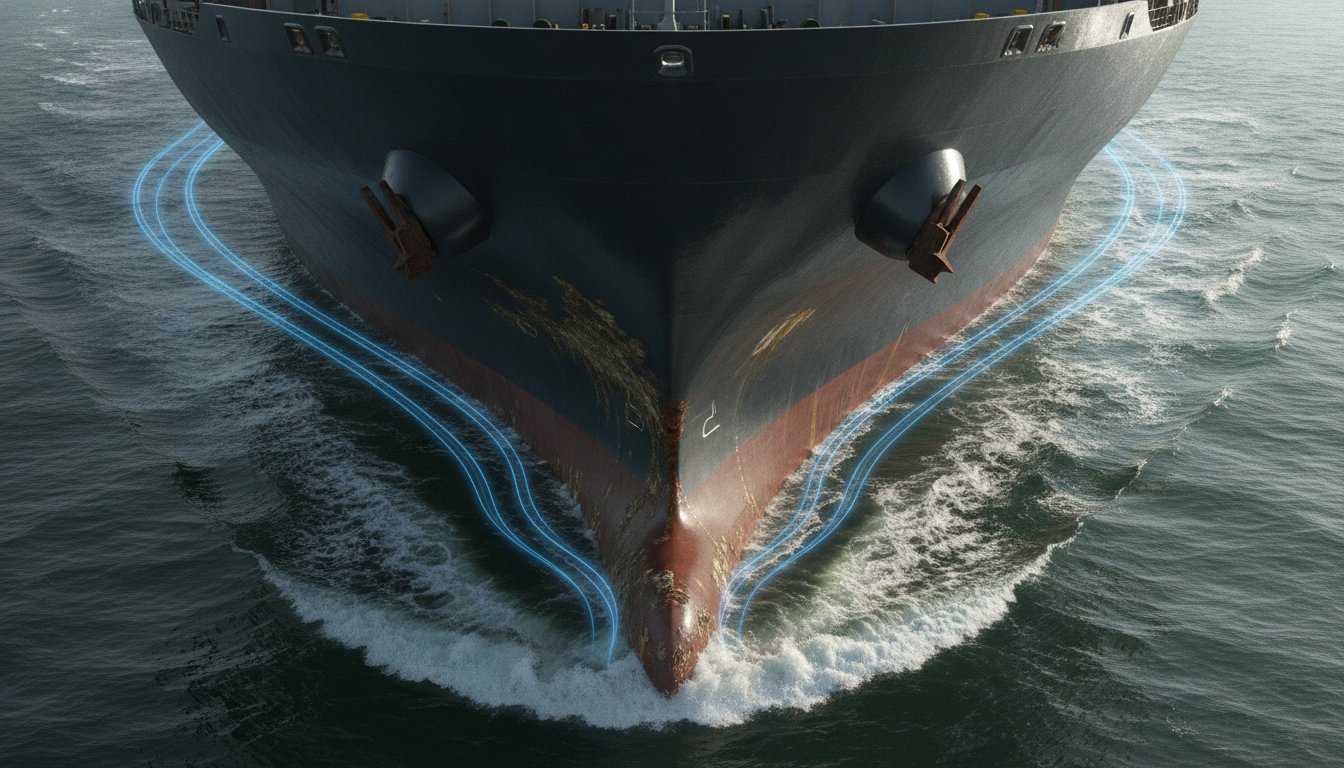
Nearly 45% of the global tanker, bulker, and container fleet is currently at risk of falling into the “D” or “E” category under the 2026 Carbon Intensity Indicator (CII) regulations. This looming non-compliance is often rooted in a microscopic reality: the impact of hull roughness on fuel consumption. As an operator, you’re likely feeling the pressure of an 11% carbon reduction target while managing rising fuel expenses and the constant cycle of hull maintenance. It’s a high-stakes environment where the margin for error has narrowed significantly.
This article examines the scientific correlation between hull surface texture and operational costs, demonstrating how advanced coating technology mitigates frictional drag. You’ll learn how decoupling durability from surface smoothness can lead to lower operational expenses and extended dry-dock intervals. We’ll analyze the technical mechanisms that allow for regulatory compliance through superior efficiency, moving beyond temporary fixes toward permanent, sophisticated material solutions that serve as strategic assets for your fleet.
Key Takeaways
- Learn why viscous resistance is the primary driver of wasted energy and how surface texture influences fluid dynamics at a microscopic level.
- Master the mathematical correlation between surface degradation and energy loss to accurately predict the impact of hull roughness on fuel consumption.
- Compare the long-term roughness progression of various coating types to determine which chemistry maintains peak efficiency over a five-year service window.
- Identify the strategic advantages of hard-film technology for maintaining CII compliance and avoiding the common pitfalls of soft-film maintenance cycles.
- Discover how the specialized Silane-Siloxane chemistry of Sea-Speed V 10 X Ultra provides a permanent solution for reducing operational overhead and carbon footprints.
Understanding the Fluid Dynamics of Hull Roughness
In marine engineering, the surface of a ship’s hull is rarely as smooth as it appears to the naked eye. Hull roughness refers to the physical irregularities on the wetted surface of the vessel, ranging from microscopic coating textures to macroscopic biological growth. These irregularities dictate how water interacts with the vessel, fundamentally altering the fluid dynamics of the voyage. When a ship moves, it must overcome various forms of resistance, with viscous resistance, or skin friction, acting as the primary deterrent to efficient propulsion.
Viscous Resistance and the Skin Friction Coefficient
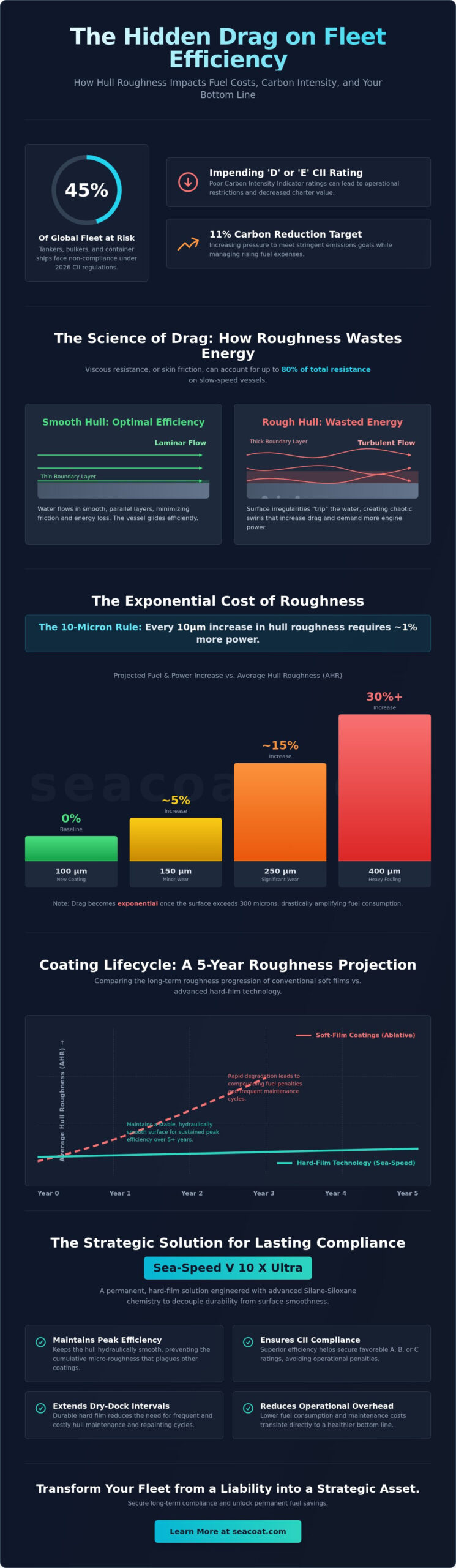
Viscous resistance is the force generated by the friction of water sliding over the hull’s surface. For slow-speed vessels like tankers and bulkers, this component can account for as much as 80% of the total resistance encountered. The magnitude of this resistance is directly tied to the skin friction coefficient, which increases as the surface peak-to-valley height grows. Even minor irregularities act as obstacles. As water molecules encounter these surface peaks, they “trip” and lose their orderly, laminar flow. This transition into turbulent flow consumes energy that would otherwise contribute to forward momentum, directly amplifying the impact of hull roughness on fuel consumption.
The Boundary Layer: Where Efficiency is Lost
The boundary layer is a critical, thin region of water immediately adjacent to the hull that moves at a velocity similar to the ship itself. In an ideal scenario, this layer remains thin and controlled. However, surface roughness disrupts this delicate balance. Roughness effectively thickens the boundary layer, forcing the vessel to “pull” a larger volume of water along with it as it moves. This added mass increases the energy required to maintain speed. Distinguishing between types of roughness is essential for fleet management:
- Micro-roughness: Often caused by poor coating application or the inherent texture of traditional ablative paints.
- Macro-roughness: Resulting from biofouling such as slime, algae, or calcareous growth like barnacles.
While macro-roughness causes immediate and severe performance drops, the cumulative effect of micro-roughness over a five-year interval is often the silent driver of escalating operational costs. Maintaining a hydraulically smooth surface isn’t just about aesthetics; it’s about preserving the integrity of the boundary layer to ensure every kilogram of fuel translates into distance traveled. This precision in surface management is what separates high-performing assets from those struggling with regulatory compliance and excessive overhead.
Quantifying the Correlation: Roughness vs. Fuel Consumption
Establishing a precise mathematical link between surface condition and energy expenditure is vital for modern fleet management. The industry relies on the Townsin Formula as the definitive standard for calculating the power penalty associated with hull degradation. This formula demonstrates that as the Average Hull Roughness (AHR) increases, the vessel encounters a corresponding rise in total resistance. To compensate for this drag and maintain a constant service speed, the propulsion system must increase engine RPM. This mechanical adjustment leads to a higher fuel mass flow rate, directly scaling the operational cost of the voyage. A recent ship fuel consumption study underscores how these theoretical penalties translate into measurable energy losses under diverse sea states.
The 10-Micron Rule and Power Demand
Naval architects utilize the “1% for 10 microns” rule of thumb to estimate performance loss. For every 10-micron increase in AHR beyond the delivery benchmark, the ship requires approximately 1% more power. A newly coated vessel typically presents an AHR between 75 and 100 microns. Once the surface exceeds 300 microns, the drag curve becomes exponential, drastically amplifying the impact of hull roughness on fuel consumption. The following table illustrates the projected relationship between surface condition and energy demand:
| Average Hull Roughness (AHR) | Projected Fuel/Power Increase |
|---|---|
| 100 microns (Benchmark) | Baseline (0%) |
| 150 microns | ~5% |
| 250 microns | ~15% |
| 400 microns (Heavy Fouling/Damage) | 30% or higher |
Translating Drag into Operational Costs
For a Very Large Crude Carrier (VLCC) or a major container ship, a 5% increase in drag is not merely a technical deviation; it represents hundreds of thousands of dollars in annual fuel surcharges. Roughness also triggers “speed loss,” where the engine cannot safely generate enough torque to overcome resistance and meet tight port schedules. By 2026, these inefficiencies carry even heavier penalties. With the EU Emissions Trading System (ETS) covering 100% of intra-EU voyages and 50% of voyages entering or leaving the EU, every ton of excess fuel burned also incurs a carbon tax. Managing these variables requires moving beyond reactive maintenance. Implementing an advanced surface management strategy is now a prerequisite for protecting the bottom line in a high-stakes, low-margin industry.
Hard-Film vs. Soft-Film: The Roughness Lifecycle
Selecting a hull coating based solely on its initial out-of-dock smoothness is a common oversight in maritime procurement. While many coatings present a low Average Hull Roughness (AHR) immediately after application, their performance over a 60-month service interval varies drastically. Traditional ablative paints, designed to erode and expose fresh biocides, often develop uneven surface textures as they “polish” in seawater. This erosion can lead to “orange peel” effects or localized thinning, which significantly increases the impact of hull roughness on fuel consumption as the vessel ages. Mechanical stressors, such as contact with fenders, tugs, or ice, further exacerbate surface degradation by creating gouges and ridges that disrupt laminar flow.
The Fragility of Soft Silicone Systems
Soft foul-release coatings are often marketed as the smoothest available option, yet they possess an inherent physical vulnerability. These elastomeric films are susceptible to tearing and detachment when subjected to the mechanical pressures of commercial operations. Even during the application phase, these systems can suffer from “silicone sag,” a phenomenon where the coating’s low viscosity leads to microscopic waves or “curtaining” before it cures. These irregularities create unintended micro-roughness that thickens the boundary layer. Once a silicone film is torn, the resulting “flaps” create massive turbulence. Repairing these defects is technically demanding and costly, often requiring the complete removal of the damaged section to restore surface integrity.
The Stability of Silane-Siloxane Hard Films
In contrast, hard-film technology provides a permanent, stable surface that resists the typical cycle of degradation. Sea-Speed V 10 X Ultra utilizes a unique Silane-Siloxane chemistry to create a non-porous, glass-like finish that is chemically bonded to the substrate. Unlike soft silicones, this hard film does not sag or tear. Its molecular structure is engineered for maximum durability, allowing it to maintain an exceptionally low AHR throughout its entire service life. It’s a strategic asset that withstands the following:
- Mechanical Abrasion: Resistance to damage from dock contact, fenders, and debris.
- Cleaning Cycles: The ability to undergo frequent grooming or cleaning without loss of film thickness or surface smoothness.
- Ice Resistance: Structural integrity that remains uncompromised even in polar or sub-polar transit conditions.
By maintaining a consistent surface profile, hard-film systems decouple the vessel’s performance from the length of time since its last dry-docking. This stability ensures that the impact of hull roughness on fuel consumption remains minimized, providing a predictable and efficient operational baseline for the entire five-year cycle.
Strategic Mitigation: Maintaining a Smooth Hull for EEXI Compliance
The maritime industry’s transition into the 2026 regulatory landscape has transformed hull maintenance from a routine task into a critical pillar of compliance. The IMO’s Carbon Intensity Indicator (CII) now requires an 11% reduction in carbon intensity relative to the 2019 baseline. Because CII ratings are derived from actual operational data, the impact of hull roughness on fuel consumption is a primary determinant of whether a vessel remains commercially viable. A ship that begins its service interval with a high-performance coating but suffers from rapid surface degradation can quickly drop from a “B” rating to a “D” or “E.” This decline doesn’t just hurt the environment; it triggers mandatory Corrective Action Plans and port state interventions.
Regulatory Pressure: EEXI and CII
While the Energy Efficiency Existing Ship Index (EEXI) focuses on technical design, the CII is a relentless measure of operational reality. Maintaining a hydraulically smooth surface is the most accessible “low-hanging fruit” for fleet managers aiming to meet these targets. Data from Clarksons Research indicates that 45% of the global tanker and container fleet is at risk of poor ratings in 2026 if they don’t improve technical specifications. Investing in surface smoothness allows operators to maximize their technical efficiency without the massive capital expenditure required for alternative fuel retrofits. It’s a strategic move that preserves the asset’s value in an increasingly bifurcated charter market.
The Cleaning Paradox
Operators often attempt to mitigate drag through reactive in-water cleaning, but this strategy frequently backfires with traditional coatings. This “cleaning paradox” is a significant hidden cost in vessel management. When ablative or self-polishing paints are scrubbed, the process removes the soft biocidal layer but often exposes larger pigment particles and uneven substrate. This increases the Average Hull Roughness (AHR) over time, ensuring that the vessel never returns to its original out-of-dock performance. To avoid this cycle, consider the following requirements for a high-ROI coating:
- Grooming Compatibility: The coating must be hard enough to withstand frequent light cleaning (grooming) to remove slime before it becomes calcareous growth.
- Film Integrity: It shouldn’t thin or “polish” away, ensuring the surface profile remains constant for 60 months or more.
- Non-Porous Finish: A dense molecular structure prevents organisms from anchoring, making cleaning more effective and less abrasive.
Hard-film technology breaks the paradox by allowing for aggressive grooming without increasing surface roughness. This stability ensures that the vessel’s fuel consumption remains predictable and low throughout the entire docking cycle. If you’re looking to secure your fleet’s future against tightening emissions standards, it’s time to transition to a permanent Sea-Speed V 10 X Ultra surface solution.
Optimizing Fleet Performance with Sea-Speed V 10 X Ultra
Addressing the technical challenges of viscous resistance requires a departure from traditional, sacrificial coating methodologies. Sea-Speed V 10 X Ultra represents a paradigm shift in surface management, utilizing a proprietary Silane-Siloxane chemistry to create a permanent, non-stick surface. Unlike ablative paints that rely on constant erosion or soft silicones that risk mechanical failure, this hard-film system provides a stable, glass-like finish. By maintaining this level of macro-smoothness, operators can effectively neutralize the impact of hull roughness on fuel consumption over the long term, rather than just the first few months after dry-docking.
The Science of the Sea-Speed Surface
The molecular structure of Sea-Speed is engineered for extreme density and low surface energy. This non-porous nature prevents biofouling organisms from establishing a strong mechanical bond, allowing the vessel’s movement to act as a natural cleaning mechanism. During application, the material’s flow characteristics ensure a finish that is significantly smoother than traditional coatings, often achieving an initial AHR that exceeds industry benchmarks. Because the film is a thermoset plastic rather than a soft elastomer, it doesn’t suffer from the “orange peel” or sagging issues that plague other systems. It’s a durable barrier that stays smooth, resisting the roughing effect caused by standard wear and tear.
Long-Term Economic and Ecological Impact
The Total Cost of Ownership (TCO) for a Sea-Speed application is substantially lower than that of conventional systems due to its extended service life. While traditional paints require re-application every 36 to 60 months, Sea-Speed V 10 X Ultra remains effective for 10 years or more. This longevity is matched by a commitment to environmental stewardship; the coating is completely free of biocides, heavy metals, and volatile organic compounds. By reducing drag and fuel mass flow rate, the system directly lowers Greenhouse Gas (GHG) emissions, aiding in the transition toward a decarbonized maritime sector. We invite you to consult with Seacoat SCT, LLC for a fleet-wide efficiency analysis and optimize your vessel performance with Sea-Speed V 10 X Ultra to secure a strategic advantage in a high-stakes regulatory environment.
Securing Future-Proof Fleet Efficiency through Surface Science
The maritime sector has reached a critical juncture where technical precision in surface management is no longer optional. We’ve analyzed how the impact of hull roughness on fuel consumption can dictate a vessel’s CII rating and its overall commercial viability. By moving away from sacrificial, eroding paints toward permanent hard-film solutions, operators can effectively decouple asset performance from the traditional 60-month degradation cycle. This shift represents a move toward intelligent stewardship of both financial and natural resources, ensuring that technical efficiency remains a constant rather than a variable.
Our non-toxic, zero-VOC silane-siloxane formula has been in commercial use since 2001, offering a proven alternative to traditional methods. This durable hard-film finish withstands aggressive mechanical cleaning and maintains its macro-smoothness for over a decade, ensuring that your efficiency gains remain constant. Transitioning to an advanced surface profile is the most direct path to meeting 2026 carbon targets while protecting long-term ROI. It’s a strategic investment that transforms a maintenance requirement into a performance-enhancing asset for your entire fleet.
Calculate the fuel savings for your fleet with Sea-Speed and take the first step toward a more resilient, low-emission operation. We’re ready to help you navigate these high-stakes regulatory shifts with proven, evidence-based innovation that honors your commitment to the global ecosystem.
Frequently Asked Questions
How much does hull roughness increase fuel consumption?
Hull roughness increases fuel consumption by approximately 1% for every 10-micron increase in Average Hull Roughness (AHR). For a vessel transitioning from a clean 100-micron baseline to a degraded 300-micron state, the power penalty can exceed 20%. This direct correlation makes surface management a primary lever for controlling operational expenditure and meeting carbon reduction targets. Precise measurement and management are essential for maintaining thin profit margins in high-stakes shipping sectors.
What is the difference between micro and macro hull roughness?
Micro-roughness refers to the microscopic texture of the coating system and application defects like “orange peel” or overspray. Macro-roughness involves biological growth such as slime, algae, or calcareous organisms like barnacles. While macro-roughness causes sudden and severe drag, the long-term impact of hull roughness on fuel consumption often stems from the gradual, cumulative increase in micro-roughness over multiple years. Both forms of resistance disrupt the boundary layer and increase viscous drag.
Can hull cleaning reduce roughness permanently?
Cleaning only provides a permanent reduction in roughness if the vessel is protected by a hard-film coating system. In-water cleaning of ablative or self-polishing paints often backfires by exposing larger pigment particles and creating an uneven surface profile. This paradoxical effect increases the long-term AHR. Conversely, hard-film coatings like Sea-Speed V 10 X Ultra allow for frequent grooming that restores the original smooth finish without damaging the film or increasing frictional resistance.
How do I measure the roughness of my ship hull?
Technical teams measure surface irregularities using a handheld hull roughness gauge, recording the Maximum Peak-to-Valley height (Rt) across several hundred points on the wetted surface. These measurements are averaged to determine the vessel’s Average Hull Roughness (AHR). Following the ISO 19030 standard provides a consistent framework for tracking these changes. This data allows shipowners to verify the performance of their coating systems and quantify the impact of hull roughness on fuel consumption over time.
Which coating type provides the lowest long-term roughness?
Hard-film Silane-Siloxane coatings provide the lowest roughness profiles over multi-year service intervals. Unlike soft silicones that are prone to tearing or ablative paints that erode unevenly, hard films create a permanent, non-porous barrier. This structural stability prevents the surface from “roughing” due to mechanical wear or cleaning cycles. It’s a strategic asset that maintains its out-of-dock efficiency for 10 years or more, ensuring predictable energy costs across the entire docking cycle.
How does hull roughness affect EEXI and CII ratings?
Hull roughness directly degrades a vessel’s Carbon Intensity Indicator (CII) rating by increasing the total fuel mass flow required to maintain service speed. Since CII is an annual operational metric based on real-world emissions, poor surface condition can cause a ship to drop into non-compliant “D” or “E” categories. Maintaining a smooth hull is an essential strategy for meeting the 11% carbon reduction target required by 2026. It’s the most accessible technical enhancement for regulatory compliance.
Is a smooth hull more important for fast or slow vessels?
Surface smoothness is critical for all vessel types, though the underlying physics vary slightly. For slow-speed vessels like tankers, viscous resistance accounts for up to 80% of total drag, making smoothness the primary driver of efficiency. For faster container ships, the absolute energy lost to friction increases exponentially with speed. Whether you’re preserving the margins of slow steaming or preventing fuel spikes on a tight schedule, minimizing surface resistance is a prerequisite for operational success.
Does Sea-Speed V 10 X Ultra require special application to be smooth?
Sea-Speed V 10 X Ultra is applied using standard airless spray equipment, but its proprietary chemistry ensures superior flow and leveling compared to traditional paints. This results in a glass-like finish that is inherently smoother than the textured surfaces of ablative coatings. The application process doesn’t require specialized tools, but adhering to the technical specifications ensures the extremely low coefficient of friction necessary for maximum fuel savings. It’s a sophisticated solution designed for high-scale industrial reliability.