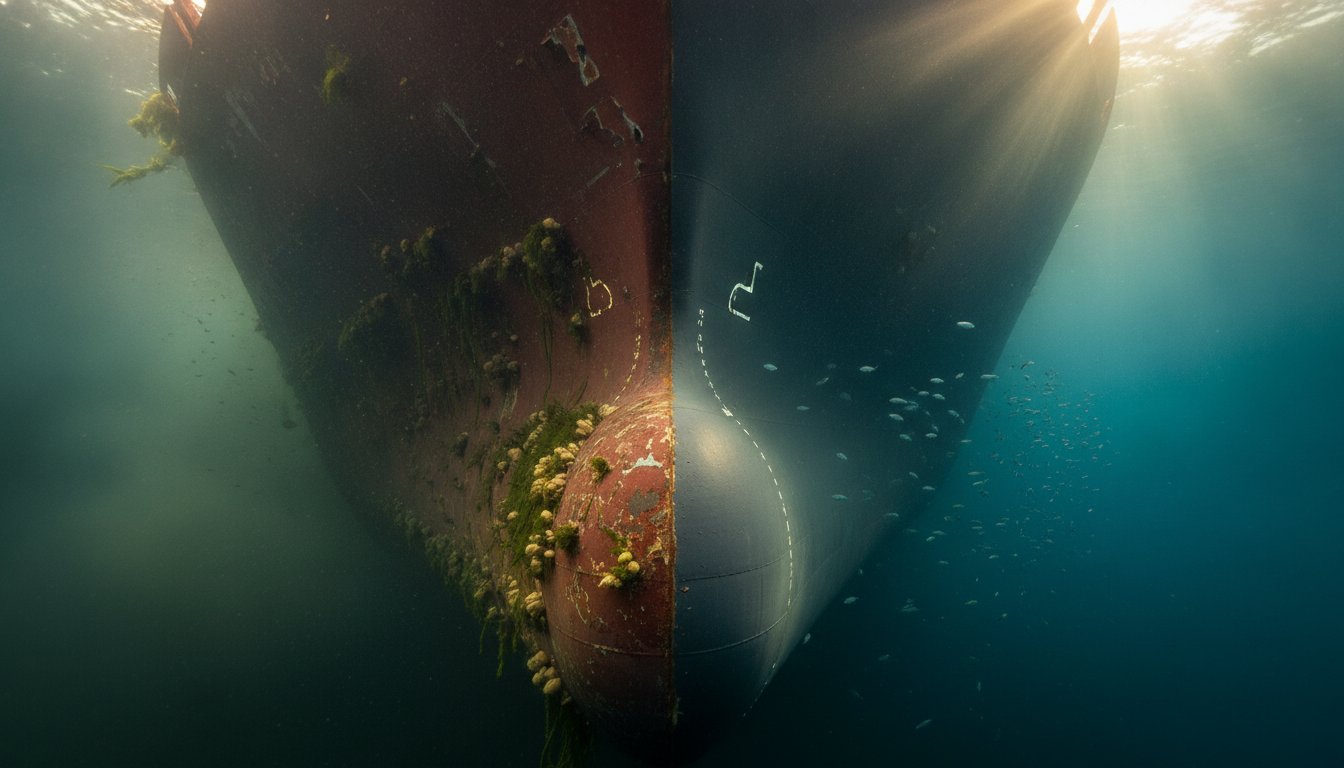
The 2026 regulatory environment marks the definitive end of the toxic leaching era, transforming hull coatings from a simple maintenance task into a high-stakes strategic asset. You’re likely feeling the mounting pressure of the 2023 Cybutryne ban and the looming September 30, 2026, deadline for the EU Emissions Trading System, which requires companies to surrender allowances for 70% of verified emissions. Achieving commercial vessel compliance with antifouling regulations is no longer just about avoiding legal penalties; it’s a critical component of managing a fleet where carbon intensity reduction factors have surged to 11% relative to 2019 baselines.
We understand that the patchwork of regional biocide bans and evolving IMO standards can be overwhelming for technical managers focused on operational reliability. This article provides a clear roadmap to handle these complex global mandates while highlighting biocide-free alternatives that ensure vessel efficiency. We’ll explore how advanced silane-siloxane technology, such as Sea-Speed V 10 X Ultra, offers a hard-film solution that eliminates leaching while significantly reducing frictional drag. By the end of this guide, you’ll see why moving toward permanent, sophisticated coatings is the only way to secure a superior return on investment and meet the rigorous environmental demands of the modern maritime sector.
Key Takeaways
- Understand the mandatory transition toward biocide-free maritime operations driven by the IMO AFS Convention and the global prohibition of substances like Cybutryne.
- Ensure long-term commercial vessel compliance with antifouling regulations by aligning hull coating strategies with mandatory EEXI and CII performance targets.
- Identify the fundamental mechanical differences between unsustainable toxic leaching paints and advanced, non-toxic foul release systems.
- Discover how silane-siloxane technology, specifically Sea-Speed V 10 X Ultra, provides a durable hard-film surface that reduces frictional drag and fuel consumption.
- Learn how to optimize the multi-year service cycle of your assets by selecting coatings that prioritize both ecological safety and operational ROI.
The Global Landscape of Toxic Antifouling Paint Bans in 2026
The maritime industry is undergoing a fundamental shift in how it approaches hull maintenance and environmental stewardship. The year 2026 represents a critical juncture for shipowners and operators, as the focus moves from simple biofouling management to ensuring absolute commercial vessel compliance with antifouling regulations. This isn’t just a minor update to existing rules; it’s a comprehensive transition toward biocide-free operations. For decades, the history and development of antifouling paints has been defined by the controlled release of toxic substances to kill marine organisms. However, the cumulative environmental impact of these leaching biocides has forced a global regulatory response. By 2026, the era of regional suggestions will end, replaced by a unified, international enforcement framework that treats toxic coatings as a strategic liability.
The IMO AFS Convention and Cybutryne Enforcement
The International Maritime Organization (IMO) Anti-Fouling Systems (AFS) Convention has set a definitive timeline for the total elimination of Cybutryne. While the initial prohibition on new applications began in early 2023, 2026 serves as the hard deadline for existing vessels. Any ship carrying Cybutryne on its hull must either remove the coating entirely or apply a verified sealer coat to prevent further leaching. It’s a binary requirement: by the end of 2026, ships must have the necessary documentation to prove their hulls are compliant. Failure to provide an updated International Anti-Fouling System Certificate (IAFSC) during port state control inspections will lead to significant operational delays and potential exclusion from major trade routes.
Regional Variations: US EPA and EU BPR Standards
Global compliance is further complicated by regional nuances, particularly between the US Environmental Protection Agency (EPA) and the European Biocidal Products Regulation (BPR). In North America, the cancellation of Irgarol-the commercial name for Cybutryne-is already impacting coastal water management and vessel maintenance schedules. Meanwhile, the EU continues to tighten restrictions on copper-based systems in sensitive brackish zones and high-traffic ports. Specifically, the EPA is targeting the phase-out of various triazine-based herbicides and specific copper-thiocyanate compounds that have shown high levels of persistence in aquatic sediments. These regional shifts mean that commercial vessel compliance with antifouling regulations requires a proactive approach that exceeds the minimum IMO standards. Shipowners must now look toward biocide-free solutions that operate globally without the risk of local exclusion or port-specific fines.
- Hard Deadlines: 2026 marks the 60-month window limit for vessels that last coated in 2021 to address existing Cybutryne layers.
- Documentary Proof: Port entry now hinges on verified, biocide-free coating declarations.
- Operational Risk: Regional bans in the EU and US are becoming increasingly granular, targeting specific chemical compounds rather than broad categories.
Identifying Prohibited Substances: Cybutryne, TBT, and Beyond
The chemical composition of marine coatings is no longer a matter of simple performance; it’s a legal and environmental mandate. For decades, the industry relied on biocides designed to leach toxins into the surrounding water column. This “poisoning” strategy was effective at preventing growth but catastrophic for non-target marine life. The legacy of Tributyltin (TBT) serves as the primary cautionary tale. Although the global ban on TBT took effect years ago, the compound’s extreme persistence means it still resides in seabed sediments and remains a focal point for modern regulatory monitoring. TBT caused severe endocrine disruption in mollusks, leading to population collapses that fundamentally altered coastal ecosystems. Today’s regulations are an evolution of these hard-learned lessons, moving beyond organotins to target a new generation of harmful additives.
Ensuring commercial vessel compliance with antifouling regulations requires a technical understanding of why these substances are being removed. We’ve moved past the “booster biocide” era, where secondary chemicals were added to copper paints to handle resistant algae. These temporary fixes are no longer legally viable as global authorities recognize the cumulative risk of bioaccumulation and coral bleaching. This shift is codified in the IMO’s Anti-Fouling Systems (AFS) Convention, which provides the framework for identifying and prohibiting substances that pose an unacceptable risk to the marine environment.
Cybutryne: The 2026 Zero-Tolerance Policy
Cybutryne, often known by the trade name Irgarol 1051, is a potent herbicide that inhibits photosynthesis. While it effectively prevents algae attachment, it also leaches from hulls and devastates seagrass meadows and coral reef structures. By 2026, the international maritime community will enforce a zero-tolerance policy for this substance. Carrying non-compliant coatings on international commercial voyages will expose operators to detention and heavy fines. To maintain operational readiness, vessels must secure updated International Anti-fouling System Certificates (IAFSC) that verify the absence of Cybutryne or the application of an approved sealer coat.
The Growing Case Against Copper-Based Biocides
While Cybutryne is the immediate target, copper-based biocides are facing increased scrutiny. Copper leaches continuously, leading to high concentrations in stagnant basins and marinas where water exchange is limited. We’re already seeing proactive restrictions in Washington State and California, which often serve as precursors to broader federal action. Commercial fleets are beginning to recognize that traditional copper paints are a diminishing asset. The transition toward biocide-free, non-leaching alternatives is the only way to future-proof a fleet against the next wave of environmental mandates. For those seeking a permanent solution, adopting a hard-film system like Sea-Speed V 10 X Ultra eliminates the risk of biocide non-compliance while enhancing hull efficiency.
- Endocrine Disruption: Legacy compounds like TBT still impact marine reproductive health.
- Photosynthesis Inhibition: Cybutryne’s primary mechanism of action threatens the foundation of the marine food web.
- Sediment Accumulation: Heavy metals like copper don’t disappear; they settle in ports, creating long-term environmental liabilities.
Foul Release Systems vs. Toxic Leaching Paints
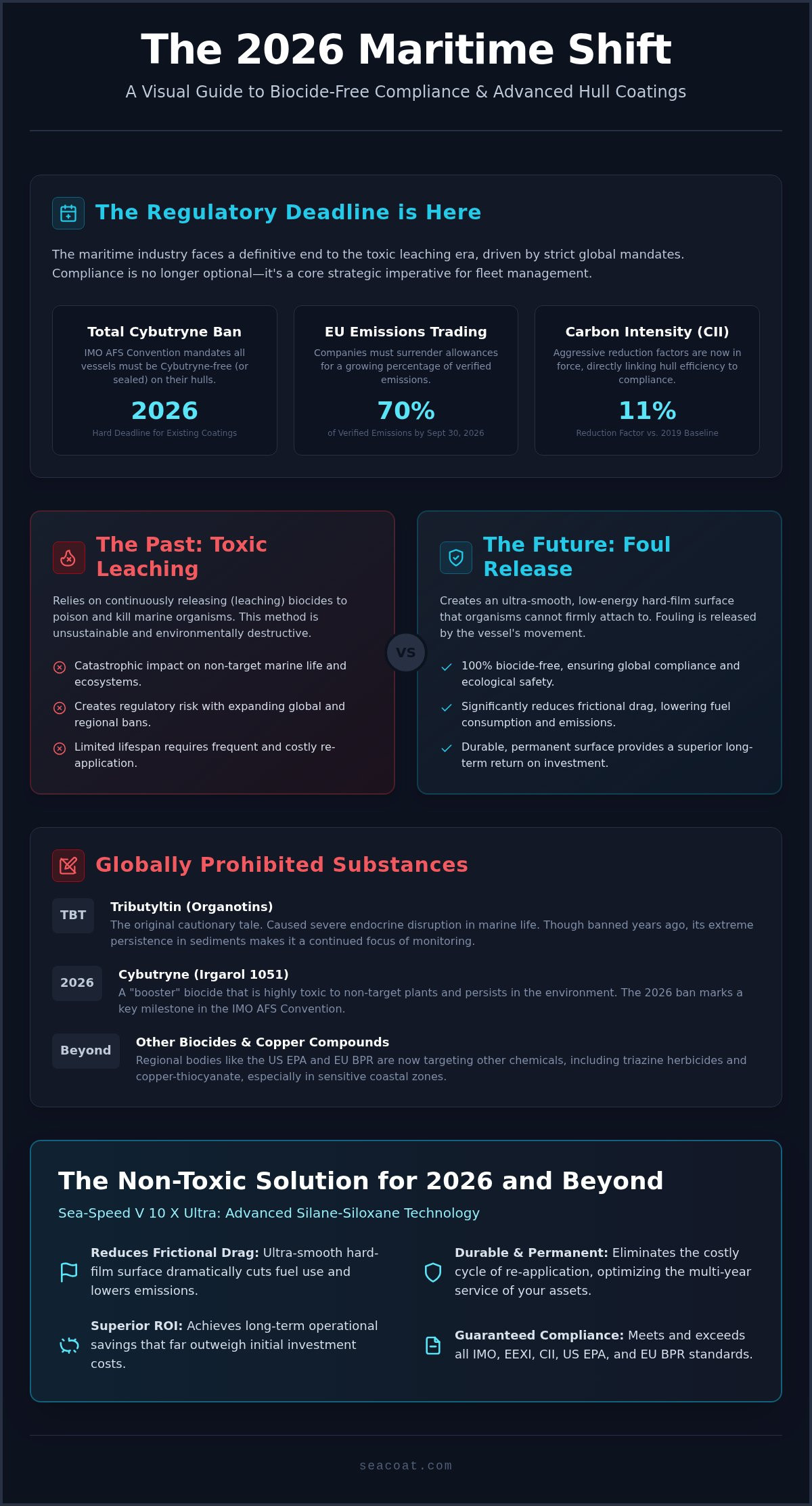
The transition from traditional biocidal coatings to modern foul release systems represents a fundamental shift from chemical warfare to advanced mechanical engineering. Traditional paints rely on a leaching mechanism, where biocides are continuously released into the water column to kill settling organisms. This process is most evident in ablative bottom paint, which functions through a sacrificial cycle that sheds layers of coating and toxins over time. This method is inherently unsustainable; it requires frequent reapplication and causes permanent damage to the marine environment. In contrast, hard-film technology utilizes silane-siloxane to create a non-stick surface that marine life simply cannot grip. While toxic paints may only offer a service life of 2 years before performance degrades, advanced hard films are engineered for 10 or more years of continuous service.
Achieving commercial vessel compliance with antifouling regulations through hard-film systems eliminates the risk of biocide leaching entirely. This approach moves away from the temporary “poisoning” of the hull’s immediate surroundings and toward a permanent physical solution. Operators no longer need to worry about the chemical composition of their paint wearing thin; the protection is a function of the surface’s physical properties rather than its toxicity. This durability is why the industry is moving toward these systems as the primary strategy for long-term fleet management.
Silane-Siloxane: The Science of Surface Energy
Marine organisms use biological adhesives to anchor themselves to hulls, but these adhesives require a high-energy surface to form a bond. Silane-siloxane technology works by fundamentally lowering the surface energy of the hull, making it physically impossible for barnacles or tubeworms to secure a foothold at a molecular level. During vessel transit, fluid dynamics play a crucial role; the water moving across the hull generates enough shear force to wash away any soft fouling that might have temporarily settled. The silane-siloxane molecules form a permanent covalent bond with the hull substrate, ensuring the coating doesn’t peel or flake under high-pressure conditions. This chemical integration creates a resilient, hydrophobic barrier that remains effective regardless of how many years the vessel stays in the water.
Operational Efficiency and Fuel ROI
The economic benefits of foul release systems extend far beyond avoiding fines. By maintaining a smooth, ultra-low-friction surface, these coatings reduce frictional drag, which translates to a fuel consumption reduction of 5-10% for most commercial vessels. This efficiency is a cornerstone of The Definitive Guide to Antifouling Boat Paint, which highlights how surface smoothness directly impacts Carbon Intensity Indicator (CII) ratings. Over a 10-year cycle, the extended service life of hard-film coatings drastically reduces maintenance labor costs and dry-docking frequency. Ensuring commercial vessel compliance with antifouling regulations through these systems creates a synergistic effect: the vessel operates more efficiently while remaining fully protected against evolving environmental mandates.
- Surface Longevity: Hard films last 5x longer than traditional ablative systems.
- Drag Reduction: Smoother hulls lead to measurable fuel savings and lower greenhouse gas emissions.
- Reduced Maintenance: Fewer dry-docking cycles translate to higher vessel availability and lower operational overhead.
Compliance Strategies: Integrating Non-Toxic Coatings with EEXI and CII
Modern ship management requires a multi-dimensional approach to regulation. Commercial vessel compliance with antifouling regulations is no longer a siloed maintenance concern; it’s intrinsically linked to the industry’s broader decarbonization roadmap. By selecting advanced, biocide-free systems, operators address two regulatory fronts simultaneously: the toxic substance bans and mandatory carbon intensity reductions. This integrated strategy transforms a compliance requirement into a competitive advantage during commercial chartering and tender processes, as charterers increasingly prioritize vessels with verified green credentials and superior fuel performance profiles.
Strategic adoption of non-toxic technology also mitigates the financial impact of the EU Emissions Trading System (ETS). By September 30, 2026, shipping companies must surrender allowances for 70% of their verified emissions. Because hull condition is the single greatest variable in vessel efficiency, a “surface-first” approach to compliance is the most logical path for technical managers. Reducing the carbon footprint at the hull level directly lowers the number of allowances required, turning an environmental investment into a direct operational saving.
EEXI and CII Compliance Frameworks
The Energy Efficiency Existing Ship Index (EEXI) and the Carbon Intensity Indicator (CII) have redefined success for heavy industry at sea. These frameworks demand a measurable reduction in CO2 emissions per transport work, a goal that’s fundamentally supported by hull slickness. A hull coated with high-performance silane-siloxane maintains its hydrodynamic profile over years of service, preventing the micro-fouling that causes frictional drag. This mechanical efficiency is critical for meeting annual carbon intensity reduction factors, which have increased to 11% for 2026 relative to the 2019 baseline. You can explore the technical specifics of these shifts in our detailed report on Environmental Marine Coatings.
Future-Proofing Your Fleet
Proactive adoption of biocide-free technology protects against the risk of stranded assets. As global authorities move toward a total phase-out of all leaching biocides, vessels relying on traditional copper or “booster” additives face a shrinking operational window. Investing in a hard-film system provides economic stability through extended service windows of up to 10 years, drastically reducing the total cost of ownership compared to the biennial reapplication cycle of toxic paints. This long-term approach ensures your fleet remains compliant and efficient, regardless of future shifts in chemical restrictions or the eventual global phase-out of all leaching substances. To secure your fleet’s future and optimize your CII ratings, evaluate our biocide-free Sea-Speed V 10 X Ultra technology today.
- Emissions Reduction: Improved hull efficiency directly correlates to lower fuel consumption and reduced ETS allowance costs.
- Asset Longevity: Hard-film coatings eliminate the cycle of paint buildup and stripping, preserving the hull’s structural integrity.
- Market Competitiveness: High CII ratings (A or B) increase a vessel’s marketability in a decarbonizing global economy.
Sea-Speed V 10 X Ultra: The Non-Toxic Solution for 2026
Sea-Speed V 10 X Ultra represents the pinnacle of silane-siloxane technology, a system Seacoat SCT, LLC has refined and deployed since 2001. As operators face the final 2026 deadlines for Cybutryne removal and emissions reporting, this biocide-free, hard-film system emerges as the logical successor to banned toxic paints. It isn’t a temporary fix or a sacrificial coating. It’s a permanent engineering solution that ensures commercial vessel compliance with antifouling regulations while simultaneously boosting hull performance. Unlike soft silicone coatings that are prone to tearing and mechanical failure, Sea-Speed provides a resilient, glass-like finish that optimizes fluid dynamics and resists the harsh realities of heavy industrial use.
The versatility of this technology allows it to serve a diverse range of maritime assets, from high-speed military craft to global commercial shipping fleets. By moving beyond the “poisoning” model of traditional paints, Sea-Speed utilizes low surface energy to prevent the molecular adhesion of marine organisms. This mechanical approach results in measurable speed increases and significant fuel savings, addressing the core operational concerns of technical managers. It’s a strategic asset that provides a high-performance alternative to the increasingly restricted biocidal market.
The Sea-Speed Advantage
This technology offers a unique combination of mechanical durability and ecological safety. Because it’s a hard-film system, it withstands rigorous in-water cleaning protocols without shedding material or losing its non-stick properties. This is a critical distinction for fleets operating in regions with strict biofouling management plans, such as Brazil or Australia, where hull cleanliness is strictly enforced. The zero-VOC and zero-biocide formulation makes it safe for application in sensitive or protected marine ecosystems. Real-world fleet data consistently demonstrates that the ultra-smooth surface reduces frictional drag, proving that environmental responsibility and operational ROI aren’t mutually exclusive.
Transitioning to Seacoat SCT, LLC Systems
Transitioning to a biocide-free fleet requires a reliable foundation. Sea-Speed V 10 X Ultra is designed to work in tandem with Seapoxy 73, a high-solids epoxy primer that ensures maximum adhesion and superior corrosion protection. This integrated system approach provides a strategic asset for large-scale management, offering global availability for both military and commercial procurement. Whether you’re managing a single vessel or a global fleet, our technical support teams provide the expertise needed to handle these complex regulatory shifts. Don’t wait for the 2026 enforcement window to close. Consult with our experts on Sea-Speed V 10 X Ultra to secure your fleet’s compliance and efficiency for the next decade.
- Zero Leaching: 100% biocide-free and zero-VOC for absolute global port acceptance.
- Mechanical Strength: A durable hard-film surface that resists damage from debris and underwater cleaning.
- Proven ROI: Enhanced surface efficiency leads to lower fuel costs and improved CII ratings.
Future-Proofing Fleet Operations Through Advanced Surface Engineering
The 2026 regulatory landscape represents a permanent transition away from the sacrificial cycle of toxic leaching. By integrating biocide-free technology, operators resolve the immediate challenges of Cybutryne bans while simultaneously addressing mandatory carbon intensity targets. Commercial vessel compliance with antifouling regulations is no longer a recurring maintenance expense; it’s a strategic investment in the long-term efficiency of the hull. Silane-siloxane technology, proven in the field since 2001, eliminates the environmental liability of leaching biocides while providing a durable hard-film surface that significantly reduces frictional drag.
This shift toward permanent, non-toxic solutions ensures your assets remain operational in all global waters without the risk of future chemical restrictions or performance degradation. The convergence of EEXI and CII requirements means that surface efficiency is now a primary metric of success. We invite you to Secure your fleet’s compliance with Sea-Speed V 10 X Ultra and experience the synergy of ecological safety and reduced fuel costs. Aligning your fleet with these sophisticated standards is the most reliable path toward a sustainable and profitable maritime future.
Frequently Asked Questions
What is the 2026 Cybutryne ban?
The 2026 Cybutryne ban is the final enforcement deadline for vessels carrying existing anti-fouling systems that contain this specific biocide. While the application of new Cybutryne coatings has been prohibited since 2023, the 2026 mandate requires ships to either remove the substance entirely or apply an approved sealer coat. This is a vital milestone for ensuring commercial vessel compliance with antifouling regulations under the IMO AFS Convention.
Is copper bottom paint being banned in 2026?
There is no global ban on copper-based antifouling paints scheduled for 2026. However, regional restrictions are tightening significantly, with California and Washington state implementing specific limits on copper leaching rates in recreational and commercial basins. These local mandates often serve as a precursor to broader federal or international regulations, making biocide-free alternatives a more stable long-term investment.
How do I know if my current hull paint is compliant with IMO 2026 standards?
You can verify compliance by reviewing your vessel’s International Anti-Fouling System Certificate (IAFSC) and the associated Material Safety Data Sheets (MSDS) provided by the manufacturer. If your current system contains Cybutryne (CAS No. 28159-98-0), action is required before the 2026 cutoff. Technical managers should consult with coating experts to determine if the existing layer needs full removal or if a barrier coat is a viable solution.
Can I apply a non-toxic foul release coating over old antifouling paint?
Applying a high-performance system like Sea-Speed V 10 X Ultra requires a stable, clean substrate for proper covalent bonding. You shouldn’t apply these advanced hard films over old, leaching ablative paints because the underlying layers lack the structural integrity to support a permanent system. The standard procedure involves full removal of the old paint followed by a high-solids primer like Seapoxy 73 to ensure maximum adhesion.
What is the difference between biocide-free and non-toxic coatings?
Biocide-free coatings contain no active pesticides designed to kill marine life, while “non-toxic” refers to the absence of any harmful leaching chemicals or heavy metals. Sea-Speed V 10 X Ultra is both biocide-free and non-toxic, utilizing silane-siloxane technology to prevent fouling through surface energy rather than chemical toxicity. This distinction is critical for vessels operating in sensitive ecosystems where any form of chemical leaching is prohibited.
How does hull coating affect my vessel’s CII rating?
Hull coatings directly impact a vessel’s Carbon Intensity Indicator (CII) by determining the level of hydrodynamic resistance. A smooth, non-leaching surface reduces frictional drag, which can lower fuel consumption by 5% to 10% for most commercial vessels. This efficiency gain is essential for meeting the 11% carbon intensity reduction factor required in 2026, as it directly reduces the CO2 emissions per transport work.
Are non-toxic coatings as effective as traditional biocides for barnacle prevention?
Modern non-toxic coatings are highly effective, but they utilize mechanical rather than chemical mechanisms. By creating an ultra-smooth, low-energy surface, these systems make it physically difficult for barnacles and tubeworms to secure a permanent foothold. This mechanical approach is a core component of commercial vessel compliance with antifouling regulations, offering a durable solution that doesn’t lose its effectiveness as biocides leach away over time.
What are the penalties for non-compliance with the AFS Convention in 2026?
Penalties for non-compliance can include port detention, significant financial fines, and the potential for a vessel to be barred from entering specific international waters. Beyond direct legal sanctions, a lack of valid anti-fouling certification can lead to the loss of insurance coverage and exclusion from commercial chartering opportunities. Maintaining updated documentation and compliant coatings is a prerequisite for operational reliability in the modern maritime sector.