
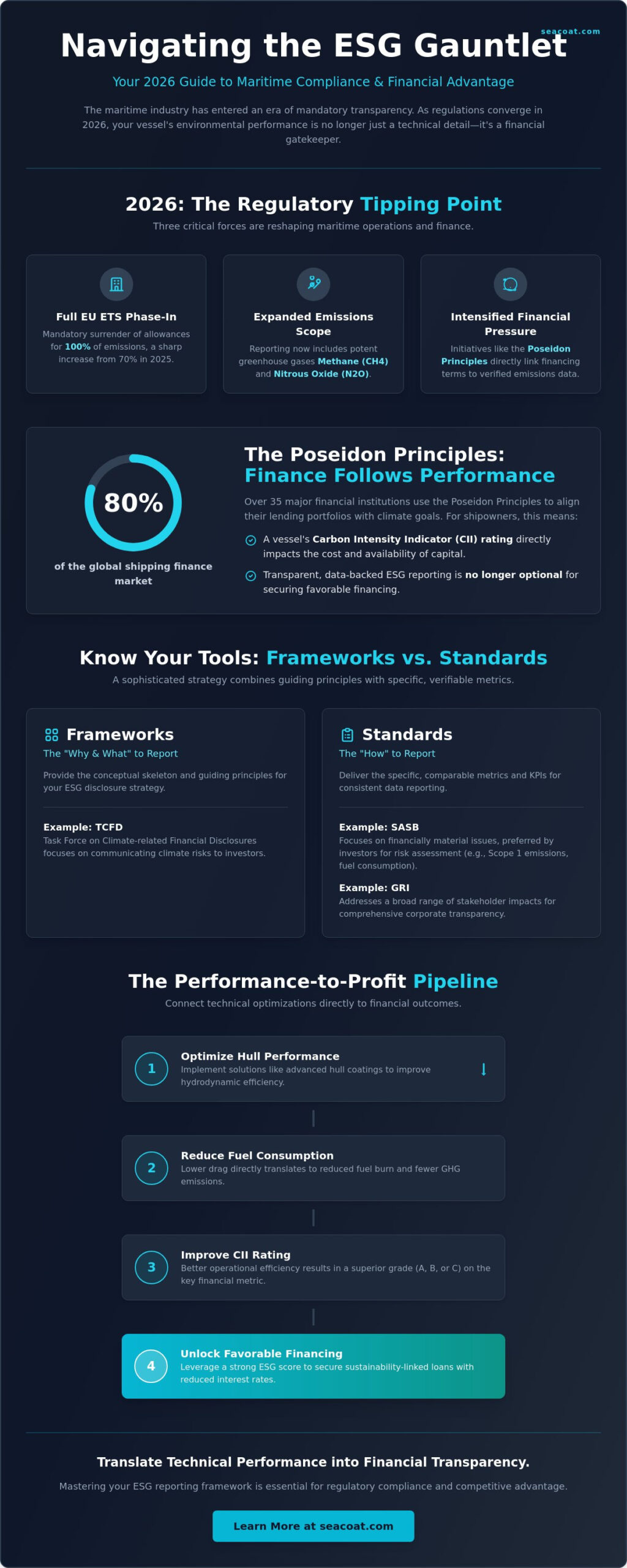
Over 80% of the global shipping finance market is now governed by the Poseidon Principles, which means your vessel’s carbon intensity is no longer just a regulatory hurdle; it’s a financial gatekeeper. As of 2026, the industry faces a critical convergence of mandates, from the 100% phase-in of the EU Emissions Trading System to the inclusion of methane and nitrous oxide in emissions surrenders. Selecting a robust ESG reporting framework for shipping companies is the only way to translate technical performance into the transparency that modern lenders demand.
It’s understandable if you feel the strain of regulatory fragmentation while preparing for the first FuelEU Maritime reporting deadline on January 31, 2026. We’ll show you how to master this landscape to ensure both regulatory compliance and long-term operational excellence. You’ll gain a clear map of applicable frameworks and understand how specific technical choices, such as optimizing hydrodynamic efficiency to reduce fuel consumption, directly impact your ESG scores and help secure more favorable financing terms.
Key Takeaways
- Differentiate between voluntary standards like GRI and mandatory regulations to select the optimal ESG reporting framework for shipping companies.
- Learn how to quantify the relationship between hydrodynamic efficiency and Carbon Intensity Indicator (CII) ratings to improve your environmental scoring.
- Follow a structured roadmap for materiality assessments to identify which ESG metrics most significantly impact your specific maritime operations.
- Gain a competitive edge in maritime financing by leveraging transparent data to secure sustainability-linked loans with reduced interest rates.
- Master the transition from simple fuel logging to comprehensive Scope 1 reporting to meet the rigorous 2026 regulatory demands.
Defining the ESG Reporting Framework for Shipping in 2026
The maritime industry is no longer operating in a period of voluntary disclosure; we’ve entered an era of mandatory transparency. An Environmental, social, and corporate governance (ESG) reporting framework for shipping companies functions as a structured system designed to disclose critical data regarding a fleet’s ecological impact, social responsibility, and internal oversight. While previous years focused on high-level commitments, the landscape in 2026 is defined by the rigorous requirements of the IMO 2023 GHG Strategy and the full implementation of the EU Emissions Trading System (ETS). A maritime ESG framework is a strategic tool for aligning vessel operations with global sustainability standards.
Frameworks vs. Standards: Knowing the Difference
Understanding the distinction between these two components is essential for technical accuracy and regulatory alignment. Frameworks, such as the Task Force on Climate-related Financial Disclosures (TCFD), provide the conceptual skeleton or principles that guide the direction of what a company should report. In contrast, standards like the SASB Marine Transportation Standard deliver the specific metrics and Key Performance Indicators (KPIs) necessary for data consistency across the global fleet. Most sophisticated shipping firms now adopt a hybrid approach; they utilize the broad stakeholder focus of the Global Reporting Initiative (GRI) alongside the financially material metrics of SASB to satisfy both environmental regulators and institutional lenders. This dual-layered strategy ensures that technical data, such as hydrodynamic efficiency and carbon intensity, is translated into a language that financial stakeholders can verify.
The Driving Forces: Why 2026 is a Turning Point
This year represents a significant regulatory peak for the sector. As of 2026, shipping companies must surrender allowances for 100% of their emissions under the EU ETS, which is a sharp escalation from the 70% requirement seen in 2025. This regulation has expanded to include methane and nitrous oxide, which demands more sophisticated monitoring systems than traditional fuel logs. Financial pressure has intensified alongside these laws. Over 35 major financial institutions, representing 80% of the global shipping finance market, now adhere to the Poseidon Principles. These lenders link the cost of capital directly to a vessel’s Carbon Intensity Indicator (CII) rating, making an ESG reporting framework for shipping companies a fundamental requirement for liquidity. Additionally, charterers participating in the Sea Cargo Charter now require transparent carbon accounting as a condition for contract awards, which reinforces the need for permanent, data-backed solutions for hull performance and emissions mitigation.
Primary ESG Frameworks and Standards for Maritime Operations
Selecting the most effective ESG reporting framework for shipping companies depends heavily on which stakeholders require the data. In 2026, the industry has moved beyond a one size fits all approach. While the Global Reporting Initiative (GRI) remains the gold standard for broad corporate transparency, specialized maritime frameworks provide the technical granularity needed for operational optimization. Large scale operators often favor GRI for its holistic scope; however, smaller fleets or those seeking debt funded expansion typically prioritize SASB and the Poseidon Principles to satisfy specific financial requirements.
The Poseidon Principles now include 35 leading financial institutions that represent over 80% of the global shipping finance market. These lenders use the framework to ensure their portfolios align with the IMO’s goal of net zero emissions by 2050. Similarly, the UN Sustainable Development Goals (SDGs) act as a high level compass for the industry, specifically SDG 13 (Climate Action) and SDG 14 (Life Below Water). Aligning with these global 2030 targets is no longer optional for companies seeking to maintain a social license to operate.
SASB: The Investor-Preferred Choice
The Sustainability Accounting Standards Board (SASB) Marine Transportation Standard focuses strictly on issues that are financially material to the business. Investors look at this data to assess risk and determine long term asset value. In 2026, the most critical SASB metrics include Scope 1 greenhouse gas emissions, air quality, and ecological impacts from ballast water or hull coatings. Data points like the average Energy Efficiency Design Index (EEDI) for new ships and fleet wide fuel consumption are vital. High performance in these areas correlates directly with higher vessel resale potential and lower insurance premiums. It’s a technical reality that asset value is now intrinsically linked to environmental efficiency.
The Sea Cargo Charter: A Framework for Charterers
The Sea Cargo Charter provides a standardized methodology for calculating and reporting the climate alignment of chartering activities. This framework allows charterers to see exactly how their shipping choices impact their own carbon footprints. For ship owners, securing high value contracts in 2026 requires a competitive “climate alignment score.” These scores are highly sensitive to operational choices. Hull performance and surface roughness are significant variables here; excessive drag leads to higher fuel consumption and poorer alignment scores. Optimizing hull conditions through advanced foul release technologies directly improves these climate alignment scores by reducing fuel consumption and associated emissions. Implementing a robust ESG reporting framework for shipping companies ensures these technical gains are transparently communicated to chartering partners.
The “Environmental” Pillar: Decarbonization and Hull Efficiency
Scope 1 greenhouse gas emissions represent the most critical metric within any ESG reporting framework for shipping companies because they offer a direct quantification of operational efficiency. In 2026, these emissions are no longer just internal data points; they’re the foundation of Carbon Intensity Indicator (CII) ratings. A vessel’s CII rating, which ranges from A to E, serves as a real-time proxy for its ESG environmental score. Ships rated D for three consecutive years or an E rating for a single year must implement corrective action plans, which can significantly impact their commercial viability. International shipping is responsible for approximately 2-3% of global greenhouse gas emissions, and the 2026 inclusion of methane and nitrous oxide in the EU ETS means that monitoring accuracy is more vital than ever.
Hydrodynamic drag reduction provides a permanent operational efficiency gain that applies regardless of the fuel type used. Reducing surface roughness minimizes the energy required to propel the vessel through the water. By utilizing environmental marine coatings, operators can achieve a measurable reduction in fuel consumption. This facilitates immediate alignment with EEXI and CII requirements while providing a data-backed solution for decarbonization. It’s a strategic move that moves beyond temporary fixes toward permanent, sophisticated hull management.
Mitigating Ecological Impact and Biofouling
The “Environmental” pillar extends beyond carbon to include the management of invasive aquatic species (IAS). ESG reporting now requires tracking how a fleet mitigates the transfer of IAS through biofouling management. Traditional antifouling paints rely on toxic biocide leaching to prevent growth, which introduces heavy metals and harmful chemicals into marine ecosystems. Transitioning to biocide-free, foul release systems represents a significant shift in environmental stewardship. The adoption of non-toxic marine hull coatings eliminates the risk of toxic discharge. This reduces the environmental liability of the fleet and enhances the “Life Below Water” (SDG 14) component of an ESG profile.
Quantifying Fuel Savings in ESG Metrics
Precision in ESG reporting requires the quantification of reductions across several key atmospheric pollutants. Surface roughness optimization is a primary lever for these reductions, impacting the following metrics:
- Carbon Dioxide (CO2): Direct reduction through lower fuel consumption.
- Sulfur Oxides (SOx) and Nitrogen Oxides (NOx): Decreased emissions as a result of improved engine efficiency.
- Methane and Nitrous Oxide: Essential for 2026 EU ETS compliance.
Unlike ablative paints that degrade and increase drag over time, “hard film” siloxane-based coatings maintain a smooth profile throughout their service life. This stability provides a more consistent ESG data set over 10-year cycles, as the performance metrics don’t fluctuate with coating depletion. When evaluating the long-term ROI of boat hull paint, stakeholders must consider the cumulative fuel savings and the resulting lower carbon footprint as strategic assets for sustainability reporting.
Practical Steps to Implementing a Maritime ESG Strategy
Implementing a robust ESG reporting framework for shipping companies requires a methodical transition from high level policy to granular, verifiable data sets. This process begins with a materiality assessment to identify which specific issues exert the greatest impact on your business value and stakeholder interests. By 2026, the industry has moved beyond generalities; operators must now establish clear baselines using historical fuel logs, safety records, and maintenance schedules to inform their future trajectory. Setting Science Based Targets (SBTi) aligned with the 1.5°C pathway provides the necessary technical rigor to satisfy both institutional lenders and international regulators.
Stakeholder Mapping and Materiality
Mapping involves identifying the distinct requirements of investors, crew, regulators, and coastal communities. Within the maritime materiality matrix, safety and emissions consistently dominate due to their direct link to operational risk and regulatory compliance. Effective governance requires integrating these ESG metrics into the core corporate structure rather than treating them as a peripheral marketing effort. It’s a fundamental shift in how vessel assets are managed over their entire lifecycle. Prioritizing these issues ensures that resources are allocated to the technical improvements that yield the highest environmental and financial returns.
Closing the Data Gap
Legacy fleets often struggle with fragmented data collection, which poses a significant risk during third party verification. Moving from estimated fuel consumption to real time sensor monitoring is essential for meeting the 2026 EU ETS and FuelEU Maritime standards. Digital twin technology now allows operators to predict future CII performance based on current hull conditions and hydrodynamic efficiency. Ensuring data integrity is paramount for annual sustainability reports, as verification partners will scrutinize the methodology behind every reported metric. This level of precision transforms raw data into a strategic asset for fleet management.
To achieve long term targets, technical solutions must provide stable performance that doesn’t degrade between drydocking intervals. For instance, selecting advanced siloxane based hull coatings ensures that your hydrodynamic data remains consistent over a ten year cycle, preventing the performance drop off typically seen with traditional ablative systems. Once your technical baseline is secure, selecting a consistent reporting cadence and a reputable third party verification partner will finalize your ESG infrastructure. This structured approach ensures that your fleet remains compliant, efficient, and attractive to the global capital markets.
Strategic Advantage: Leveraging ESG for Maritime Financing
A robust ESG reporting framework for shipping companies serves as more than a compliance ledger; it’s a critical instrument for reducing the cost of capital. In 2026, the financial sector has fully integrated sustainability metrics into its risk assessment protocols. Lenders now offer sustainability linked loans where interest rates are directly indexed to a fleet’s Carbon Intensity Indicator (CII) performance and verified emissions reductions. Companies that fail to demonstrate a clear path toward decarbonization face higher premiums or exclusion from Tier 1 capital. By maintaining transparent, high quality ESG data, operators can secure favorable financing terms that provide a distinct competitive edge in a capital intensive industry.
Future proofing assets is equally vital to long term solvency. As the industry moves toward a low carbon economy, vessels with poor environmental ratings risk becoming “stranded assets” that are difficult to charter and even harder to sell. Implementing a sophisticated Sea-Speed V 10 X Ultra foul release system ensures that a vessel maintains superior hydrodynamic performance throughout its service life. This permanent technical solution stabilizes the environmental data set, preventing the performance degradation that typically triggers a downgrade in ESG scores and asset valuation.
The Poseidon Principles and Lender Expectations
Banks participating in the Poseidon Principles assess climate alignment by comparing a fleet’s carbon intensity against the IMO’s trajectory for net zero emissions. These institutions, representing 80% of the global shipping finance market, increasingly favor durable, long term technical solutions over temporary operational fixes like slow steaming. Lenders recognize that hard film, biocide free coatings provide a more reliable ROI because they don’t require frequent reapplication to maintain efficiency. In a recent 2025 case study, a bulk carrier fleet achieved a 12% improvement in its ESG rating after optimizing hull surfaces, which subsequently allowed the operator to refinance its debt under a green financing framework with significantly lower margins.
Reputational Value with Global Charterers
Transparent ESG disclosure is now a prerequisite for winning “Preferred Supplier” status with major global charterers. The industry’s shift toward “Green Corridors” requires high efficiency vessels that can prove their environmental credentials through rigorous data. Beyond the environmental benefits, using non-toxic technology also mitigates social and governance risks. Traditional biocidal coatings present environmental liabilities and health risks for shipyard workers, which can negatively impact the “Social” and “Governance” pillars of a report. Moving to a biocide free standard demonstrates a commitment to ecosystem preservation and worker safety, fulfilling the broader requirements of a modern ESG reporting framework for shipping companies.
Technical excellence in hull management is the most direct route to achieving top tier ESG scores and securing the future of your fleet. To begin optimizing your environmental performance and financial attractiveness, contact Seacoat SCT, LLC to discuss a strategic transition to high performance, non-toxic hull solutions.
Building a Resilient Maritime Legacy
The implementation of a comprehensive ESG reporting framework for shipping companies is no longer a peripheral administrative task; it’s a core requirement for commercial survival in 2026. We’ve explored how the convergence of EU ETS mandates and the Poseidon Principles has transformed technical vessel performance into a primary financial indicator. By prioritizing hydrodynamic efficiency and data transparency, operators can mitigate the risk of stranded assets while securing access to lower cost green capital. Success in this new era requires a shift from reactive maintenance to proactive, data-driven stewardship.
Seacoat SCT, LLC’s proprietary Silane-Siloxane technology provides the technical foundation needed to meet these rigorous reporting standards. Our zero-biocide foul release systems deliver documented fuel savings and a stable 10-year life cycle, ensuring your environmental data remains consistent across multiple drydock intervals. This transition from temporary biocidal fixes to permanent, high-performance solutions is the most direct path to aligning your fleet with global net-zero targets. Contact our technical experts to optimize your fleet’s ESG performance and lead the transition toward a more sustainable and profitable maritime future. With the right technology, your commitment to stewardship becomes your greatest operational advantage.
Frequently Asked Questions
What is the most widely used ESG reporting framework for shipping?
The SASB Marine Transportation Standard and the Global Reporting Initiative (GRI) are the most prevalent choices. While GRI offers a broad view for stakeholders, the SASB standard is preferred by investors for its focus on financially material data. Selecting a robust ESG reporting framework for shipping companies allows operators to consolidate technical metrics into a format that satisfies both regulatory bodies and institutional lenders.
How does the IMO Carbon Intensity Indicator (CII) relate to ESG reporting?
The Carbon Intensity Indicator (CII) serves as the primary quantitative metric for the “Environmental” pillar of maritime ESG. It measures how efficiently a vessel transports goods per capacity and distance. A ship’s rating, from A to E, provides a standardized score that lenders and charterers use to assess climate alignment. Vessels with consistently low ratings face commercial penalties and higher financing costs.
Are shipping companies required by law to report ESG data in 2026?
Yes, several mandates take full effect this year. The EU Emissions Trading System (ETS) requires 100% emissions surrenders for voyages within the EU starting in 2026. Additionally, the first FuelEU Maritime emissions report is due by January 31, 2026. While the Corporate Sustainability Reporting Directive (CSRD) has staggered implementation, regional port requirements already demand high levels of data transparency for all vessels calling at EU docks.
How can hull coatings impact a shipping company’s ESG score?
Hull coatings influence the “Environmental” pillar by determining hydrodynamic efficiency. Advanced foul release systems can reduce fuel consumption and associated Scope 1 emissions by up to 10% compared to traditional paints. Biocide-free siloxane coatings also mitigate environmental liability by preventing toxic leaching. This contributes to a higher ESG score by addressing both carbon intensity and ecological impact through a single technical application.
What are the Poseidon Principles and who do they apply to?
The Poseidon Principles are a global framework used by financial institutions to align their loan portfolios with IMO decarbonization targets. Currently, over 35 banks representing 80% of the global shipping finance market have signed these principles. They apply to lenders, who require ship owners to provide verified emissions data to ensure the vessels they fund meet strict climate alignment benchmarks before approving capital.
What is the difference between Scope 1, 2, and 3 emissions in maritime ESG?
Scope 1 covers direct greenhouse gas emissions from fuel combustion on board vessels. Scope 2 accounts for indirect emissions from purchased electricity used in shore-side offices or drydock facilities. Scope 3 encompasses the entire value chain, including emissions from shipbuilding, recycling, and the production of fuels. For most operators, Scope 1 represents the most significant portion of their ESG reporting framework for shipping companies.
How does biofouling management fit into an ESG framework?
Biofouling management is a critical component of ecological stewardship and operational efficiency. It addresses Sustainable Development Goal 14, Life Below Water, by preventing the transfer of invasive aquatic species (IAS) across marine ecosystems. Effective management through non-toxic coatings also reduces hydrodynamic drag. This directly lowers the fuel consumption and carbon footprint reported in the environmental section of a fleet’s ESG disclosure.
What is a materiality assessment in the context of shipping?
A materiality assessment is a strategic exercise used to prioritize ESG issues based on their importance to stakeholders and their impact on business value. In shipping, this typically identifies decarbonization, maritime safety, and crew welfare as the most critical factors. By focusing on these material issues, companies ensure their reporting and resource allocation address the risks that most significantly affect their long-term financial performance and regulatory standing.