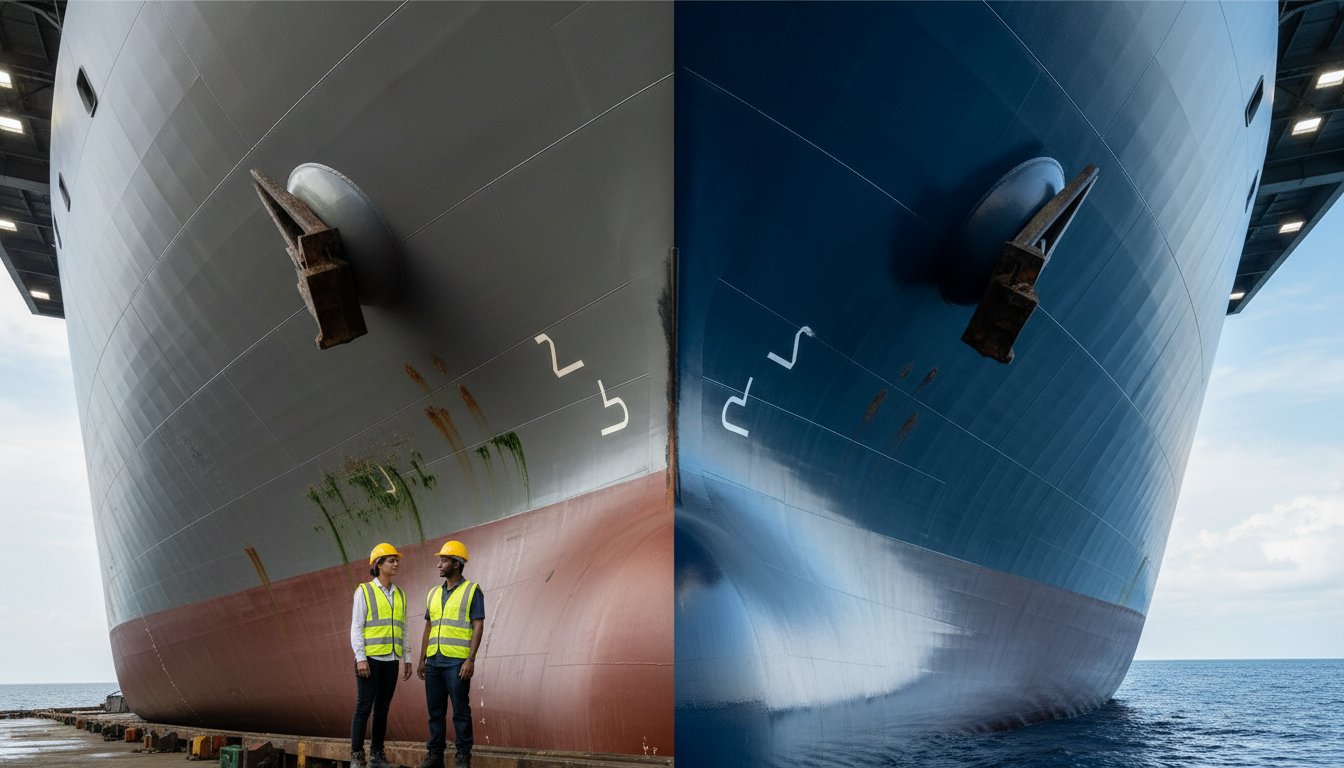
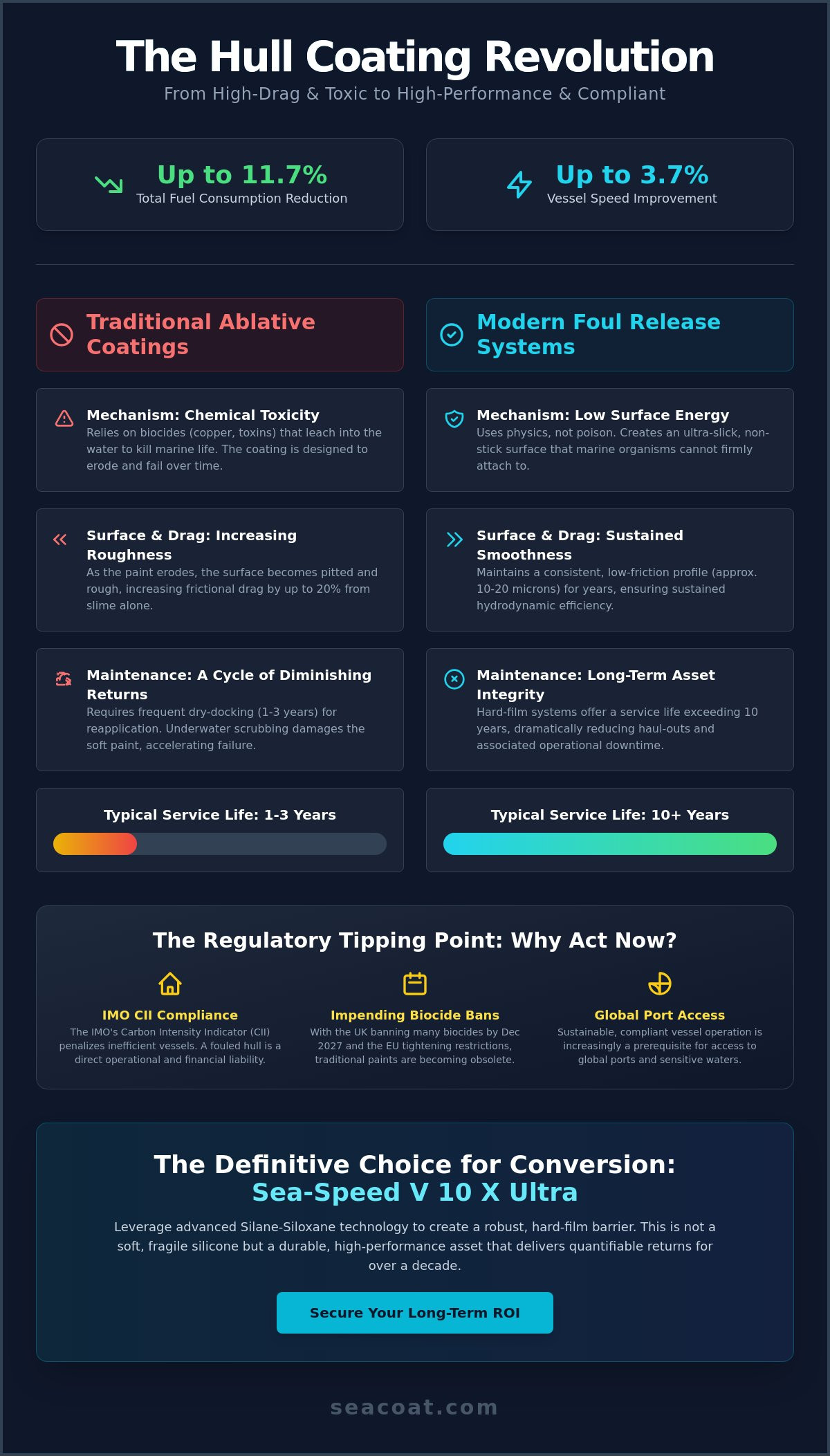
Did you know that optimizing your hull surface with a drag-reducing coating can improve vessel speed by 3.7% while reducing fuel consumption by approximately 11.7%? For many operators, switching from ablative to foul release represents the most significant opportunity to reclaim lost margins and meet tightening decarbonization targets. You’ve likely felt the pressure of rising bunker costs and the looming December 2027 UK biocide bans, which make the traditional cycle of sacrificial painting look increasingly obsolete.
We understand that maintaining a fleet requires balancing immediate costs with long-term asset integrity. This technical guide offers a comprehensive roadmap for transitioning from biocidal paints to advanced, hard-film systems like Sea-Speed V 10 X Ultra. We’ll analyze the mechanics of surface roughness, explore how to navigate evolving IMO biofouling frameworks, and detail the conversion process that turns your hull into a high-performance asset with a service life exceeding 10 years.
Key Takeaways
- Understand the mechanical limitations of the biocidal cycle and why sacrificial coatings inherently lead to increased frictional drag and escalating fuel costs.
- Discover the scientific advantages of silane-siloxane technology, which utilizes low surface energy instead of environmental toxins to mitigate marine organism adhesion.
- Identify the critical technical milestones for switching from ablative to foul release, from total substrate remediation to the application of specialized primers like Seapoxy 73.
- Quantify the long-term return on investment through measurable metrics, including fuel savings of 5-12% and the transition to a 10-year service life.
- Ensure operational alignment with tightening global environmental regulations, such as the IMO’s Carbon Intensity Indicator (CII) and upcoming biocide bans.
The Failure of the Biocidal Cycle: Why Ablative Paint is Obsolete in 2026
Traditional maritime maintenance has long relied on the erosion of biocidal layers. This sacrificial mechanism requires the paint to physically wear away to release toxins, which means the coating is designed to fail from the moment it is applied. As the active biocide depletes, the hull becomes increasingly susceptible to colonization by marine organisms. This creates a surface that is rough, inefficient, and costly to maintain. For vessel owners, switching from ablative to foul release is the first step in moving away from a surface that degrades toward one that maintains its hydrodynamic profile over the long term.
Even a thin layer of slime on traditional anti-fouling paints can increase frictional resistance by up to 20%. This drag forces engines to work harder, which consumes more fuel and accelerates mechanical wear. The industry is collectively moving toward a more sustainable model. Switching from ablative to foul release systems allows for a shift from reactive maintenance to strategic surface engineering.
The standard response to fouling is often underwater scrubbing. However, this mechanical action strips away the soft paint layers prematurely. This dumps concentrated biocides into the water column and leaves the hull unprotected. It’s a cycle of diminishing returns that results in more frequent dry-docking and higher maintenance overhead. It’s time to move beyond the “reapply and pray” mindset that has dominated the sector for decades.
The Hidden Costs of Traditional Antifouling
Haul-outs aren’t just about the price of the kit. You must account for lost operational time, yard fees, and the labor required for surface preparation. Beyond the balance sheet, the environmental cost of leaching copper and other heavy metals is coming under intense scrutiny. Regulatory bodies now view these toxins as liabilities rather than solutions. Fines in sensitive waters are becoming a reality for vessels with high-leaching coatings, adding another layer of financial risk to traditional methods.
Why 2026 is the Turning Point for Hull Coatings
The current regulatory environment has made hull efficiency a mandatory performance metric. Performance metrics like the IMO’s Carbon Intensity Indicator (CII) penalize vessels for excessive fuel consumption, making a foul hull a significant operational liability. With the UK banning many biocidal paints by the end of 2027 and the EU tightening copper approvals, the window for traditional methods is closing. Sustainable vessel operation is now a prerequisite for global port access and maintaining the long-term value of your maritime assets.
The Mechanics of Foul Release: Silane-Siloxane vs. Traditional Coatings
Foul release coatings operate on the principle of low surface energy rather than chemical toxicity. While traditional biocidal paints rely on the controlled leaching of active ingredients to kill marine growth, foul release systems create a surface so slick that organisms simply cannot establish a permanent bond. This represents a fundamental shift in hull management. When switching from ablative to foul release, you move from a chemical deterrent to a mechanical one that utilizes physics to maintain a clean hull.
The effectiveness of this technology is rooted in fluid dynamics. At operational speeds, the movement of water across the low-friction surface creates a self-cleaning effect, shedding any loose bio-matter that may have settled while the vessel was stationary. Unlike ablative paints that become increasingly pitted and irregular as they erode, foul release systems maintain a consistent surface roughness of approximately 10-20 microns over several years. This sustained smoothness is a primary driver of the eco-efficiency benefits associated with modern hull coatings, including reduced fuel consumption and lower greenhouse gas emissions.
Silane-Siloxane: The Chemistry of Permanent Performance
Silane-siloxane technology represents a significant leap forward in material science. While many foul release options on the market are soft silicone coatings, which are fragile and prone to tearing during dockings or mechanical grooming, a silane-siloxane system like Sea-Speed V 10 X Ultra creates a robust, hard-film barrier. These silane molecules form a covalent bond with the substrate, ensuring superior adhesion and structural integrity. Because the film is hard, it resists physical damage from debris or fenders. You can safely clean a hull treated with this technology without stripping away the protection, which is a major advantage for vessels operating in high-fouling environments.
Foul Release vs. Antifouling: A Performance Paradigm Shift
Traditional antifouling works by killing organisms; foul release denies them a foothold from the start. By maintaining extremely low surface tension, these coatings prevent barnacles and grass from establishing a permanent bond. This lack of adhesion has a direct impact on hull speed and maneuverability. For operators switching from ablative to foul release, the transition eliminates the need for sacrificial biocides entirely. If you are looking for a high-performance finish that preserves the aesthetic of your hull, Sea-Speed V 10 X Ultra Clear provides the same hard-film protection while maintaining the original substrate appearance. This technology ensures that your vessel remains a high-performance asset rather than a maintenance liability.
The Conversion Roadmap: Technical Steps for a Successful Transition
Transitioning to a high-efficiency hull requires a methodical approach that moves beyond the “clean and coat” mentality. Switching from ablative to foul release is a technical conversion that fundamentally changes how your vessel interacts with the marine environment. This roadmap ensures that the new surface achieves the necessary adhesion and durability to outperform modern antifouling paint technologies that rely on biocidal depletion. It’s a strategic engineering project that secures the long-term integrity of your asset.
Surface Preparation: The Critical Success Factor
The success of a foul release system depends entirely on the quality of the bond to the substrate. You must completely remove all existing ablative layers. Any residual paint will compromise the system; because ablative paint is designed to erode, any coating applied over it will eventually flake off as the old layers fail. Sandblasting is the preferred method for achieving a consistent anchor profile on steel or aluminum hulls. For fiberglass, soda blasting or specialized chemical stripping provides a clean surface without damaging the gelcoat. The goal is to reach the original substrate and address any underlying issues like osmotic blistering or localized corrosion before proceeding.
Once the hull is bare, the application of a high-build epoxy primer like Seapoxy 73 is essential. This layer acts as the foundation, providing a robust moisture barrier and a chemical bridge for the topcoat. Precision is mandatory here. You must monitor environmental conditions, specifically humidity and dew point, to prevent moisture entrapment between layers. This ensures the primer provides the maximum possible adhesion for the subsequent silane-siloxane layers.
Professional Application vs. DIY
While some vessel owners attempt a DIY approach, the technical requirements for silane-siloxane systems often favor professional equipment. Achieving the correct Dry Film Thickness (DFT) is vital for the coating’s longevity. High-pressure airless sprayers are typically required to ensure a smooth, uniform finish that minimizes hydrodynamic drag. This isn’t a simple repaint. It’s a precise application that requires careful masking and controlled conditions to ensure surface continuity.
The conversion timeline is longer than a standard haul-out. You should account for the time required for total stripping and the specific curing windows for the epoxy and the Sea-Speed V 10 X Ultra topcoat. However, this investment of time at the dock translates into years of operational efficiency. Switching from ablative to foul release moves you from a two-year maintenance cycle to a decade of reliable performance. Final inspections should verify there are no holidays or pinholes in the film, ensuring a seamless, low-energy barrier against marine growth.
Quantifying the Shift: ROI, Fuel Savings, and Environmental Compliance
The financial justification for switching from ablative to foul release is found in the intersection of operational efficiency and regulatory risk management. While traditional coatings represent a recurring maintenance expense, a silane-siloxane system is a capital investment in the vessel’s performance profile. By significantly reducing skin friction, these systems allow for immediate fuel savings, typically ranging between 5% and 12%. Verified industry data suggests that a Panamax-sized vessel can realize annual savings of $150,000 to $300,000 through fuel reduction alone. These metrics demonstrate that the transition isn’t merely an environmental choice but a fiscal necessity for modern fleet management.
The adoption of environmental marine coatings also has a positive impact on asset valuation. As second-hand buyers prioritize vessels with lower operational overhead and proven compliance records, a hull protected by a 10-year system becomes a more attractive strategic asset. This long-term durability directly correlates with a reduced carbon footprint, as lower fuel consumption leads to a proportional decrease in greenhouse gas emissions. This alignment with decarbonization goals is essential for maintaining a high Carbon Intensity Indicator (CII) rating under IMO mandates.
The 10-Year Cost Comparison
A direct cost analysis reveals that while the initial application of a foul release system requires a higher upfront expenditure, the break-even point is often reached within the first 24 months. Traditional ablative maintenance involves a two-year cycle of haul-outs, surface preparation, and paint reapplication. Over a decade, these costs accumulate significantly. In contrast, a hard-film foul release system eliminates the need for repeated painting. You save on labor, material costs, and the substantial revenue lost during extended dry-docking intervals. For both commercial operators and private owners, the total cost of ownership favors the permanent solution over the sacrificial one.
Meeting Global Environmental Standards
Regulatory ROI is becoming as critical as fuel ROI. Vessels must now comply with EEXI and CII regulations that penalize technical inefficiency. By maintaining a consistently smooth hull, operators can achieve compliance without resorting to costly engine power limitations. The 100% non-toxic nature of Sea-Speed coatings allows for unrestricted access to marine sanctuaries and ports where biocidal leaching is strictly prohibited. Understanding The Science of Antifouling and Foul Release Systems is the first step toward future-proofing your vessel against upcoming biocide bans and carbon taxes. To optimize your fleet’s economic and ecological performance, consider the advantages of Sea-Speed V 10 X Ultra for your next scheduled dry-docking.
Sea-Speed V 10 X Ultra: The Definitive Choice for Foul Release Conversion
Sea-Speed V 10 X Ultra is the culmination of advanced silane-siloxane engineering, designed specifically to address the inherent failures of traditional biocidal systems. For operators switching from ablative to foul release, this coating provides a permanent, hard-film solution that is entirely non-toxic and VOC-free. Unlike soft silicone alternatives that are prone to tearing and mechanical failure, its robust molecular structure withstands the physical rigors of heavy industrial use while maintaining an exceptionally low-energy surface. It’s the preferred choice for vessel protection and performance because it treats the hull as a strategic asset rather than a recurring maintenance burden.
The material’s versatility allows for seamless application across diverse substrates, including steel, fiberglass, and aluminum. This compatibility is crucial for mixed fleets or specialized vessels where substrate integrity is a priority. Real-world performance data consistently demonstrates that vessels transitioning to Sea-Speed experience sustained hydrodynamic efficiency, often outperforming their original speed-power curves. By eliminating the biocide leaching cycle, you aren’t just complying with international regulations; you’re setting a new standard for operational excellence and environmental stewardship.
A Solution for Every Vessel Type
Commercial shipping operations benefit from reduced overhead and optimized fluid dynamics, ensuring that long-haul routes remain profitable despite fluctuating fuel prices. Military and government agencies rely on the coating to meet rigorous durability standards, where asset readiness and performance under pressure are non-negotiable. For yachts and pleasure craft, the system offers a clean aesthetic and minimal maintenance requirements, allowing owners to focus on navigation rather than the constant need for hull scrubbing and paint touch-ups.
Technical Support and Global Availability
Accessing this technology is straightforward through Seacoat’s global network of authorized distributors and applicators. This infrastructure ensures that technical guidance and material availability are consistent wherever your vessel is docked. For high-stakes racing environments where every micron of surface roughness matters, Sea-Speed V 10 X Ultra Clear provides an ultra-smooth finish that maximizes speed without altering the hull’s visual profile. This clear variant is particularly effective for maintaining the original gelcoat or paint finish while adding a high-performance foul release layer.
The process of switching from ablative to foul release starts with a technical assessment of your current hull condition and operational profile. Seacoat provides the data-driven insights necessary to plan a successful conversion that aligns with your next dry-docking schedule. To secure the future of your fleet’s performance and ensure compliance with upcoming environmental mandates, Contact Seacoat SCT for a custom conversion quote and move toward a permanent hull optimization strategy.
Future-Proofing Your Hull for a Decarbonized Industry
Transitioning away from the biocidal cycle is no longer just an environmental preference; it’s a strategic necessity for maintaining operational efficiency in a regulated landscape. We’ve detailed how silane-siloxane technology creates a permanent, hard-film barrier that resists the physical and chemical degradation inherent in traditional systems. This shift moves your vessel from a cycle of sacrificial maintenance toward a model of long-term surface engineering that preserves the hydrodynamic profile of your asset.
Switching from ablative to foul release allows you to replace a recurring two-year maintenance window with a decade of reliable, low-drag performance. This transition ensures your asset remains compliant with tightening global biocide bans while providing measurable fuel savings that directly enhance your bottom line. Seacoat’s proprietary technology is already trusted by global commercial and military fleets, providing a 100% non-toxic and VOC-free solution with up to 10 years of service life. It’s a strategic asset for large-scale management that values longevity and stewardship.
Transition to Sea-Speed V 10 X Ultra for superior hull performance. By investing in high-performance surface integrity today, you’re securing a more efficient and sustainable operational future for your fleet.
Frequently Asked Questions
Can I apply foul release coating directly over my old ablative paint?
No, you cannot apply these systems over existing ablative layers. Because ablative paint is designed to erode and slough off over time, any coating applied on top of it will eventually delaminate as the underlying paint fails. A successful transition requires the complete removal of all old antifouling down to the original substrate to ensure the new system bonds correctly.
How much fuel can I really save by switching to a foul release system?
Vessel operators typically see fuel savings between 5% and 12% after the conversion. This efficiency gain is the result of a significantly smoother hull surface, which reduces frictional drag compared to the rough, pitted profile of aged biocidal paint. By maintaining a consistent surface roughness of 10 to 20 microns, the engine requires less power to maintain operational speeds.
Is foul release coating effective for boats that sit in the water for long periods?
Yes, hard-film foul release systems are highly effective for stationary vessels. While marine organisms may settle on the hull while it’s idle, they’re unable to form a permanent bond with the low-energy surface. Any accumulated silt or light growth is easily shed once the vessel reaches operational speed or through simple mechanical grooming without damaging the coating.
What is the life expectancy of a Silane-Siloxane coating like Sea-Speed?
You can expect a service life of up to 10 years from a properly applied silane-siloxane system. Unlike traditional biocidal coatings that require reapplication every 12 to 24 months as their active ingredients deplete, Sea-Speed V 10 X Ultra provides a permanent, non-sacrificial barrier. This longevity significantly reduces the frequency of costly dry-docking intervals and total maintenance overhead.
Do I need special equipment to clean a hull coated with foul release?
No specialized equipment is necessary, but you should use non-abrasive cleaning methods. Because the film is exceptionally hard and durable, you can use soft brushes or high-pressure water washes to remove light fouling. This is a major advantage over soft silicone coatings, which are easily torn by standard cleaning tools or mechanical hull grooming equipment.
Is switching to foul release compliant with new EEXI maritime regulations?
Yes, switching from ablative to foul release is a recognized technical strategy for meeting EEXI and CII requirements. By improving the vessel’s hydrodynamic efficiency, these coatings help reduce the total energy output required for transit. This allows fleet managers to achieve regulatory compliance and improve their carbon intensity ratings without necessarily resorting to permanent engine power limitations.
How does the initial cost of foul release compare to high-end ablative paints?
The upfront investment for a foul release system is higher than standard painting due to the intensive surface preparation required. However, you must view this as a capital improvement rather than a maintenance expense. When you account for the 10-year service life and the cumulative fuel savings, the system typically pays for itself within the first 18 to 24 months of operation.
Will foul release work on aluminum hulls without causing corrosion?
Yes, silane-siloxane coatings are ideal for aluminum because they’re non-metallic and non-conductive. When you use Sea-Speed V 10 X Ultra in conjunction with a high-build epoxy primer like Seapoxy 73, it creates an effective dielectric barrier. This prevents the galvanic corrosion often associated with copper-based biocidal paints, making it a safer and more durable choice for aluminum vessels.