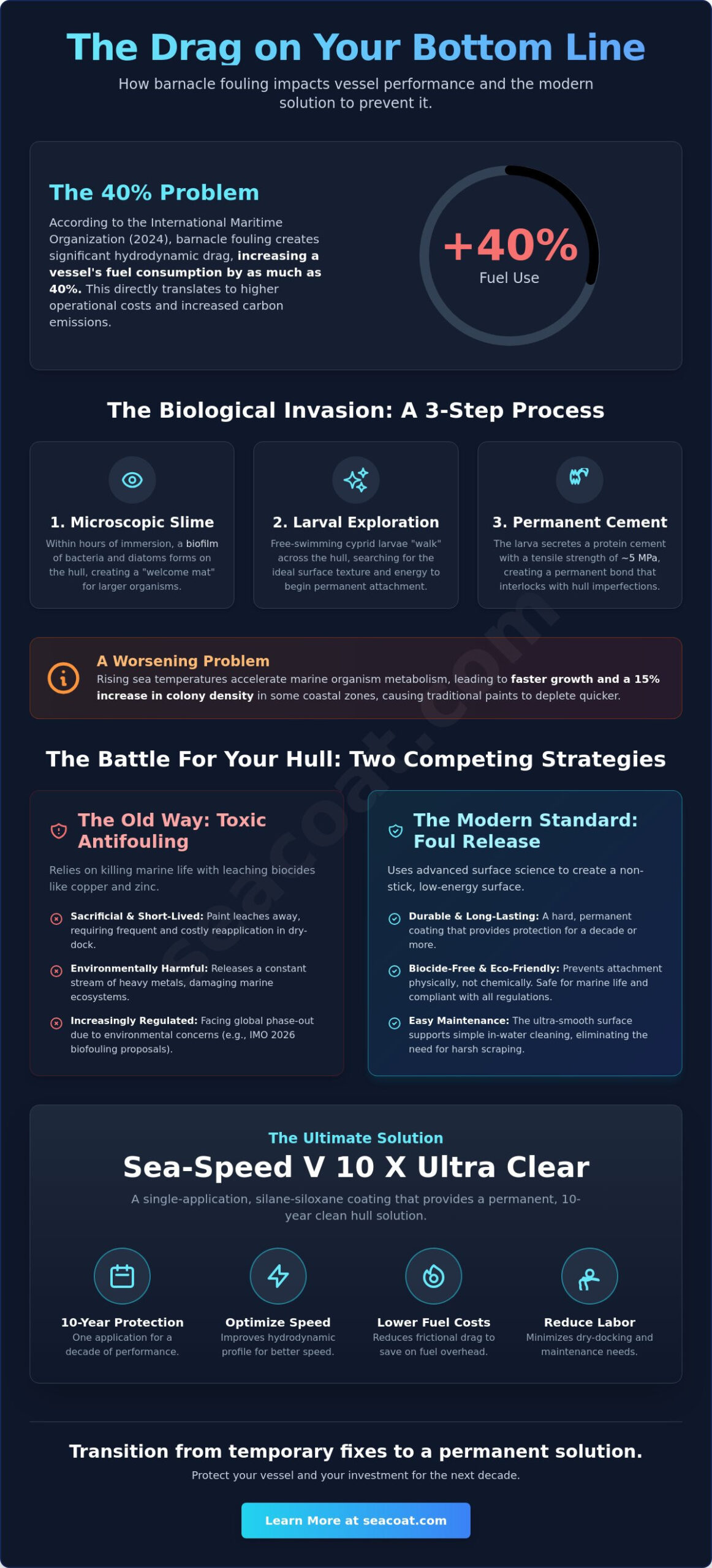
Did you know that barnacle fouling can increase your vessel’s fuel consumption by as much as 40%, according to a 2024 International Maritime Organization report? This drag isn’t just a minor operational nuisance; it’s a direct hit to your bottom line and a primary driver of carbon emissions. Most mariners agree that the traditional cycle of scraping and reapplying toxic antifouling paint is both exhausting and environmentally unsustainable. If you’re tired of frequent dry-docking and rising fuel costs, you aren’t alone. We understand that preventing barnacle growth on boats requires a shift from chemical toxicity to advanced surface science.
You’ll discover how advanced silane-siloxane technology creates a high-performance foul release surface that stops organisms from adhering while improving vessel speed. We’ll examine the data behind Sea-Speed V 10 X Ultra Clear and explain why a move toward biocide-free coatings is the only logical choice for the 2026 regulatory landscape. This guide details the transition from temporary fixes to a permanent, 10-year clean hull solution that optimizes your vessel’s hydrodynamic profile and reduces long-term maintenance labor.
Key Takeaways
- Understand the biological mechanism of barnacle adhesion and how protein-based cement creates a permanent bond with untreated hull surfaces.
- Discover why low-surface-energy foul release coatings are the modern standard for preventing barnacle growth on boats while maintaining strict environmental compliance.
- Evaluate the economic advantages of a clean hull, focusing on the reduction of frictional drag to lower fuel overhead and extend engine life.
- Identify the maintenance benefits of hard-film coatings, which support simplified in-water cleaning without the risk of releasing toxic heavy metals.
- Gain insight into the performance metrics of silane-siloxane technology and how a single application of Sea-Speed V 10 X Ultra provides a decade of protection.
The Biological Mechanism of Barnacle Adhesion
The biological sequence of attachment is a sophisticated process that begins within minutes of a vessel entering the water. While boat owners recognize the end result as a hard, calcified shell, the initial stages are microscopic and driven by specialized proteins. The process of biofouling involves a transition from a free-swimming nauplius to a cyprid larva, the stage specifically designed for site selection and permanent attachment. This larva doesn’t just stumble onto a hull; it actively scans for optimal conditions using sensory organs that detect surface energy and chemical signals from established colonies.
Once a cyprid identifies a suitable location, it secretes what marine biologists define as “barnacle cement.” This substance isn’t a simple glue but a complex matrix of at least six distinct proteins that cross-link to form a resilient, waterproof bond. This natural adhesive possesses a tensile strength of approximately 5 megapascals, making it one of the most durable substances in the marine environment. For those focused on preventing barnacle growth on boats, understanding this protein bond is vital. The adhesive flows into microscopic peaks and valleys on the hull, creating a mechanical interlock that traditional cleaning methods can’t easily break without risking damage to the hull substrate.
A primary precursor to this hard fouling is the formation of a biofilm, commonly known as a slime layer. This layer consists of bacteria and diatoms that colonize the surface within hours of immersion. This biological carpet alters the hull’s chemical signature, signaling to barnacle larvae that the site is hospitable. Without a coating engineered to mitigate this initial settlement, the transition from microscopic slime to macro-fouling becomes inevitable.
The Role of Cyprid Larvae in Site Selection
Cyprid larvae use their antennules to “walk” across the hull, testing the surface energy at each step. They’re searching for specific chemical cues and a physical “grip” that allows them to withstand water current. This exploratory window is the most critical phase for prevention. If the surface energy is sufficiently low or the texture is too smooth for the antennules to gain purchase, the larva cannot initiate the cement secretion process. It’s during this brief phase that foul release technology denies the physical grip required for permanent settlement.
Environmental Factors Accelerating Growth in 2026
As of May 2026, maritime operators are facing intensified biofouling pressure due to rising sea surface temperatures. Warmer water accelerates the metabolic rates of marine organisms, leading to shorter reproductive cycles and faster calcification of barnacle shells. In many nutrient-rich coastal zones, colony density has increased by 15% over the last three years. These conditions mean that traditional biocide-based paints, which rely on a steady leaching rate, often deplete their active ingredients faster than expected. This leaves the hull vulnerable to rapid colonization well before the scheduled maintenance interval, making the task of preventing barnacle growth on boats more difficult with legacy methods.
Antifouling vs. Foul Release: Choosing a Preventative Strategy
The maritime industry’s approach to hull protection is undergoing a fundamental shift from chemical warfare to surface physics. Traditional antifouling relies on the controlled release of biocides, primarily copper and zinc compounds, to create a toxic halo around the hull that kills settling larvae. While effective in the short term, this method is inherently limited by its sacrificial nature. In contrast, foul release systems focus on preventing barnacle growth on boats by manipulating surface energy, making it physically impossible for organisms to secure a permanent grip. This transition isn’t merely a preference; it’s a response to a global regulatory environment that increasingly views heavy metal leaching as an unacceptable ecological risk.
As of May 2026, the International Maritime Organization (IMO) has recommended the development of a legally binding instrument for biofouling management, signaling that the era of toxic coatings is nearing its end. While Washington State has postponed its copper-based paint restriction until June 30, 2029, the trend toward biocide-free technology is accelerating. The economic impact of biofouling extends beyond simple fuel consumption; it encompasses the accelerated depreciation of the hull and the rising costs of regulatory non-compliance. Transitioning to a high-performance foul release system allows operators to move from annual recoating cycles to a 10-year service life, fundamentally altering the ROI of vessel maintenance.
The Failure of Ablative and Leaching Paints
Ablative coatings are designed to wear away over time, a process intended to expose fresh biocides. However, this creates a “depletion zone” where the paint remains on the hull but no longer possesses enough toxicity to deter growth. This physical degradation is particularly problematic for high-speed vessels, where the friction of water flow can strip the coating faster than intended. This leads to a cycle of waste where toxic microplastics are shed into the water column without providing adequate protection. Choosing a modern alternative to ablative bottom paint eliminates this sacrificial cycle and provides a stable, permanent surface that doesn’t thin or lose efficacy over time.
Silane-Siloxane Technology: The Modern Standard
Silane-siloxane systems like Sea-Speed V 10 X Ultra represent the pinnacle of current marine chemistry. These coatings create a molecularly smooth, low-energy surface that denies the “barnacle cement” mentioned in previous sections the microscopic grip it requires. Unlike soft silicone coatings that are easily torn by debris or fenders, these are hard-film systems with high impact resistance. They offer a “self-cleaning” effect; when the vessel reaches speeds of 10 to 12 knots, the hydrodynamic pressure is often sufficient to shear off any slime or light growth that managed to settle while the boat was stationary. Selecting a high-durability foul release system ensures your vessel remains compliant with evolving global standards while maximizing hydrodynamic efficiency.
Hydrodynamics and the Economic Impact of a Clean Hull
The physics of maritime transport dictate that nearly 80% of a vessel’s total resistance is caused by skin friction. While earlier sections detailed the biological mechanisms of attachment, the economic reality is that even microscopic surface changes drastically alter this friction. A 2023 International Maritime Organization report stated that biofouling can increase a vessel’s drag by up to 60%. This isn’t just about large barnacles; even a thin layer of slime, or “micro-fouling,” creates enough turbulence to disrupt laminar flow. For operators focused on preventing barnacle growth on boats, the primary goal is maintaining the lowest possible hull roughness over the asset’s entire service life.
When drag increases, the propulsion system must work harder to maintain speed, leading to a direct spike in operational costs. A 2024 IMO report noted that barnacle fouling can increase a vessel’s fuel consumption by 20% to 40%. This inefficiency has a secondary environmental cost: higher fuel burn translates directly into increased greenhouse gas emissions. In an era of strict carbon intensity indicators and tightening emissions regulations, a fouled hull isn’t just a maintenance issue; it’s a regulatory liability that impacts a fleet’s global environmental footprint.
Calculating ROI for Premium Coatings
Investing in a high-performance siloxane system requires a shift from viewing paint as an annual expense to treating it as a strategic asset. When you factor in fuel savings over a five-year period, the initial cost of a premium foul release coating is often offset within the first 18 to 24 months of operation. By extending the interval between dry-dockings from the typical two-year cycle to a 10-year life cycle, you significantly reduce labor costs and lost charter time. Additionally, keeping the hull clean prevents the physical pitting and osmosis that occur when barnacles bypass the coating to damage the underlying substrate. Marine industry data suggests that hull repairs from barnacle damage can cost between $500 and $5,000, representing a preventable loss.
Impact on Vessel Maneuverability and Speed
The benefits of a low-friction surface extend to the operational handling of the craft. Racing yachts and military vessels prioritize advanced coatings because a smoother hull translates to measurable gains in knots. Preventing barnacle growth on boats ensures that the vessel responds predictably to helm inputs and maintains its designed cruise speed without overstressing the engine. Reducing this constant strain extends the service life of propulsion systems, from the transmission to the propeller shafts. There’s also a clear psychological benefit for the crew; a high-performance vessel that glides through the water provides a superior experience compared to a sluggish, fouled hull struggling against its own drag.
Maintenance and Longevity of Hard-Film Coatings
The maritime industry often misinterprets “foul release” as a maintenance-free solution. While these systems are the most effective method for preventing barnacle growth on boats, they still require periodic attention to maintain their hydrodynamic properties. The primary advantage of a hard-film siloxane system is that it’s designed to be cleaned without the risk of damaging the coating or releasing toxins into the water column. Unlike soft silicone coatings, which are susceptible to tearing from fenders or debris, hard-film surfaces remain intact even under rigorous operational conditions. Over a 10-year performance horizon, the coating maintains its low-surface-energy characteristics, provided the biofilm is managed through regular movement or light cleaning.
In-water cleaning becomes a streamlined process with a hard-film system and is a core component of a long-term strategy for preventing barnacle growth on boats. Divers can remove light slime or early-stage barnacles with minimal effort because the barnacle cement discussed in earlier sections cannot achieve a permanent mechanical bond. This efficiency reduces the time a vessel spends idle and lowers the total cost of maintenance labor. Regular inspections allow for the identification of mechanical damage, such as scrapes from grounding or impact, which can be addressed with localized touch-ups rather than a full hull recoat.
Safe Cleaning Practices for Foul Release Systems
Maintaining a siloxane surface requires a departure from traditional scrubbing techniques. You don’t need abrasive steel brushes or high-pressure washers that might compromise the film’s integrity. Instead, a simple wipe with a soft sponge or a low-pressure water jet is usually sufficient to restore the hull’s slick properties. The frequency of these cleanings depends on environmental variables; vessels stationed in high-salinity, warm coastal waters may require monthly inspections to prevent the accumulation of heavy biofilm. In contrast, vessels with high operational frequency often stay clean through the self-cleaning hydrodynamic effect alone.
Transitioning from Traditional Paint to Modern Systems
The successful adoption of a foul release strategy begins with meticulous hull preparation. All traces of old, failing antifouling paint must be removed to ensure the new system bonds correctly to the substrate. Utilizing a high-performance primer like Seapoxy 73 provides the necessary chemical bridge between the hull and the siloxane topcoat. This ensures long-term adhesion and prevents the osmotic blistering often seen with inferior systems. During this transition, it’s vital to maintain environmental compliance by capturing all removed waste, a standard practice as of May 2026. You can view our full technical specifications to ensure your next dry-docking procedure meets these high standards.
The Sea-Speed V 10 X Ultra Solution
Sea-Speed V 10 X Ultra isn’t just a coating; it’s a strategic asset for modern vessel management. While traditional methods rely on chemical depletion, this hard-film siloxane system provides a permanent solution for preventing barnacle growth on boats. It’s engineered with zero VOCs and contains no biocides, ensuring that your operations remain compliant with the strictest environmental standards of 2026. This non-leaching technology has been proven over decades of service in both commercial shipping and military sectors, where asset uptime is the primary performance metric. Whether your fleet consists of aluminum fast-ferries, fiberglass yachts, or steel-hulled tankers, this versatile solution adapts to the specific hydrodynamic needs of each substrate.
The durability of this system is unmatched in the industry. Unlike soft silicone-based foul release products that require delicate handling, Sea-Speed V 10 X Ultra forms a resilient, hard film that resists mechanical abrasion and impact. This is particularly critical for high-speed vessels that experience significant water pressure and potential debris impact. By choosing this biocide-free path, you aren’t just protecting your hull; you’re contributing to the preservation of marine ecosystems while optimizing your vessel’s long-term ROI.
Why Sea-Speed Leads the Industry
The primary differentiator lies in surface energy. Sea-Speed provides a superior level of smoothness compared to standard antifouling boat paint, resulting in a measurable reduction in hull roughness. On high-speed craft, this coating resists “burn-through,” a common failure where water friction strips away sacrificial layers. Real-world case studies have demonstrated that vessels using our siloxane technology maintain their speed and fuel efficiency over 10-year cycles, effectively preventing barnacle growth on boats without the need for periodic reapplication.
Getting Started with Your Hull Transformation
Moving toward a high-performance foul release strategy requires expert planning. We recommend consulting with specialists to determine the optimal configuration of marine coatings for your specific operating environment. To ensure a 10-year warranted finish, it’s essential to work with certified applicators who understand the nuances of surface preparation and siloxane application. This professional approach guarantees that your investment yields the maximum hydrodynamic and economic benefits. Experience the Sea-Speed difference for your vessel today.
Advancing Toward a High-Performance Maritime Future
The transition from sacrificial, toxic coatings to advanced siloxane technology represents a fundamental upgrade in vessel management. By focusing on surface energy rather than chemical toxicity, you ensure your operations remain ahead of the 2026 regulatory curve while significantly reducing the overhead associated with hull drag. We’ve examined how a clean hull isn’t just a maintenance goal; it’s a critical factor in maximizing your vessel’s speed and operational lifespan. Implementing a permanent strategy for preventing barnacle growth on boats allows you to move away from the expensive biennial dry-docking cycle toward a more sustainable, 10-year performance horizon.
Seacoat SCT, LLC remains committed to providing strategic assets that balance technical precision with environmental responsibility. Our Sea-Speed V 10 X Ultra system is trusted by global navies for its unmatched durability and is entirely biocide-free with zero VOCs. This isn’t a temporary fix but a sophisticated, long-term investment in your fleet’s efficiency and the health of our marine ecosystems. It’s time to optimize your asset’s hydrodynamic profile with a solution that delivers measurable ROI and peace of mind. Your vessel deserves a surface that performs as hard as your crew does.
Switch to Sea-Speed V 10 X Ultra and Stop Barnacles for Good
Frequently Asked Questions
Do barnacles grow faster on certain types of hull materials?
Barnacles prioritize surfaces with higher surface energy and microscopic porosity, which provide better mechanical grip for their adhesive proteins. While they settle on aluminum, steel, and fiberglass, unpainted metal surfaces often experience more rapid colonization due to their chemical signatures. Utilizing a high-performance siloxane system creates a uniform, low-energy barrier across any substrate, effectively neutralizing the material’s natural attraction for larvae.
Can I apply foul release coating over my existing bottom paint?
No, you cannot apply foul release coatings directly over traditional antifouling paint because the chemical bond will fail. For successful results in preventing barnacle growth on boats, the hull must be stripped to the original substrate or a stable epoxy base. We recommend using Seapoxy 73 as a specialized primer to ensure the siloxane topcoat achieves the necessary molecular adhesion for a 10-year service life.
Is it true that copper-based paints are being banned globally?
Regulatory pressure is mounting, with Washington State’s copper-based paint restriction now scheduled for June 30, 2029. Additionally, as of February 2026, the International Maritime Organization is developing legally binding instruments to manage biofouling more strictly. These shifts reflect a global move toward biocide-free technology to protect sensitive marine ecosystems from heavy metal accumulation.
How much speed can I actually gain by switching to a slicker hull coating?
Vessel operators typically observe speed increases of 2% to 10% after transitioning from a fouled or rough antifouling surface to a smooth siloxane film. Since biofouling can increase drag by up to 60%, according to 2023 industry data, reducing surface roughness directly translates into higher knots at the same RPM. This improvement in hydrodynamic efficiency also reduces engine strain and overall fuel overhead.
What happens if a barnacle does manage to attach to a foul release surface?
Any organism that settles while the vessel is stationary will fail to form a permanent mechanical bond with the siloxane matrix. Because the “barnacle cement” cannot penetrate the hard-film surface, the attachment remains superficial and weak. These organisms are typically sheared off by water pressure once the vessel reaches speeds of 10 to 12 knots or can be removed with a simple soft-cloth wipe.
Does the color of the bottom paint affect barnacle growth?
While some marine biology studies suggest that certain larvae are phototactic and may be slightly less attracted to lighter colors, surface energy is a far more dominant factor. The chemical and physical properties of a siloxane coating override any minor influence that color might have on settlement patterns. The primary mechanism for preventing barnacle growth on boats remains the low-friction, non-stick nature of the film itself.
How often should I inspect my hull if I have a 10-year coating?
Quarterly inspections are the professional standard for maintaining a 10-year foul release system. Although the coating doesn’t lose its properties like leaching paint, you must still monitor for biofilm accumulation or mechanical damage from debris. Regular movement or light cleaning ensures the surface remains at peak hydrodynamic efficiency, especially in warm coastal waters where biological pressure is highest as of May 2026.
Are non-toxic coatings really as effective as traditional poisons?
Non-toxic foul release coatings are often more effective over long periods because they don’t rely on a depleting supply of biocides. Traditional paints lose their toxicity as the copper leaches out, whereas a siloxane system maintains its physical “slickness” for a decade or more. This provides a consistent level of protection and a superior ROI by eliminating the need for frequent, expensive recoating cycles.