
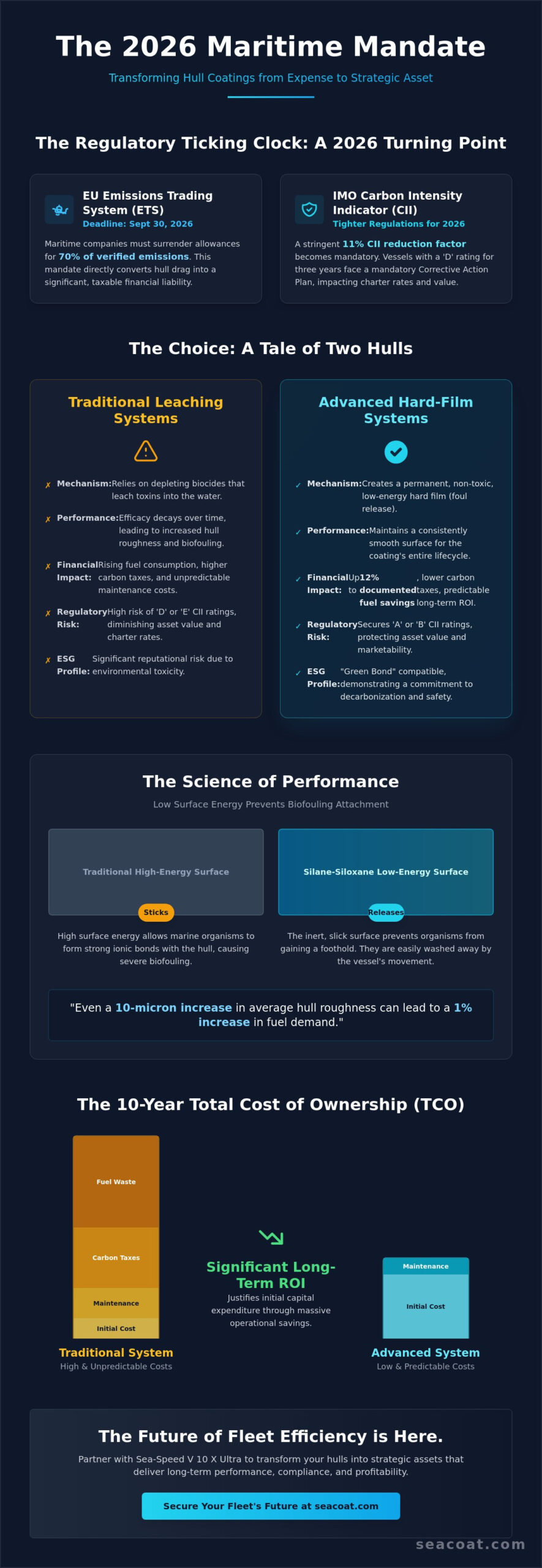
By September 30, 2026, maritime companies must surrender allowances for 70% of their verified emissions under the EU ETS, effectively transforming hull drag into a direct, taxable liability. When presenting new hull technology to stakeholders, you’re no longer just discussing paint; you’re proposing a critical hedge against rising operational costs. It’s understandable that boards often view the higher initial cost of silane-siloxane systems with skepticism, especially when compared to the familiar price points of traditional toxic paints.
This article ensures you’ll learn how to master the technical and financial narrative required to secure buy-in for advanced, non-toxic hull coating systems like Sea-Speed V 10 X Ultra. We’ll demonstrate how to pivot the conversation from maintenance expense to strategic asset performance by highlighting the 11% CII reduction factor required for 2026. This framework provides the data-driven evidence needed to prove long-term ROI through documented fuel savings and the elimination of the three-year D rating corrective action cycle.
Key Takeaways
- Learn to reposition hull efficiency as a measurable financial asset that directly impacts your organization’s carbon intensity ratings.
- Understand the mechanical advantages of hard-film silane-siloxane technology over traditional leaching systems to achieve superior surface efficiency.
- Master a structured framework for presenting new hull technology to stakeholders by aligning material durability with long-term ESG performance metrics.
- Discover how to mitigate perceived risks by utilizing a 10-year Total Cost of Ownership (TCO) model to justify initial capital expenditure.
- Explore the operational benefits of utilizing a non-toxic, industrial-scale coating like Sea-Speed V 10 X Ultra to ensure global regulatory compliance.
The 2026 Maritime Mandate: Why Stakeholders Prioritize Hull Efficiency
The maritime industry faces a definitive pivot point in 2026. With the EU ETS requiring 70% emissions coverage and the IMO’s Carbon Intensity Indicator (CII) reduction factor tightening to 11%, the hull is no longer a passive component. It’s a performance variable. When presenting new hull technology to stakeholders, the argument must center on how surface efficiency offsets these mounting regulatory costs. Traditional self-polishing copolymers often fail to maintain the necessary smoothness over long intervals. This creates a performance penalty that manifests as increased fuel consumption and higher carbon taxes. Operators can’t afford to ignore the drag caused by degrading biocidal surfaces.
The shift from reactive maintenance to proactive asset management is now a commercial necessity. Historically, hull coating was a “paint and forget” line item, addressed only during dry-docking. In the 2026 landscape, real-time monitoring of fuel consumption reveals that even minor biofouling results in immediate financial penalties under the EU ETS. Presenting new hull technology to stakeholders requires showing how a permanent, non-toxic solution transforms the hull into a primary lever for greenhouse gas reduction. It’s about moving from temporary fixes to a strategic asset that delivers consistent, measurable returns through every nautical mile.
The Impact of EEXI and CII on Fleet Valuation
Vessels that fail to meet the 2026 targets must submit a Corrective Action Plan by April 30, 2026. This isn’t just about compliance; it’s about fleet valuation. A ship with a “D” or “E” rating suffers lower charter rates and diminished resale value because it represents a higher operational risk. By integrating advanced coatings into fundamental hull design principles, operators can secure “A” or “B” ratings that protect the asset’s marketability. Hard-film systems like Sea-Speed V 10 X Ultra provide the durable surface finish required to keep hydrodynamic drag at a minimum throughout the entire docking cycle, ensuring the vessel remains a top-tier commercial asset.
The Environmental Social Governance (ESG) Pressure
Institutional investors are scrutinizing maritime operations through an ESG lens. The use of toxic, biocidal paints is increasingly seen as a reputational risk, particularly in sensitive marine ecosystems where heavy metals can accumulate. Stakeholders are now looking for “Green Bond” compatible investments that demonstrate a commitment to both decarbonization and ecological safety. Moving away from leaching toxins isn’t just a moral choice; it’s a strategic move to align with global financial trends that prioritize sustainable industrial practices. Non-toxic coatings like Sea-Speed V 10 X Ultra offer a way to meet these demands without sacrificing the physical durability or protection the fleet requires.
Translating Silane-Siloxane Science into Stakeholder Value
Effective communication with decision-makers requires a shift from discussing generic “paint” to presenting material science as a strategic asset. When presenting new hull technology to stakeholders, it’s vital to explain that silane-siloxane systems represent a mechanical shift in vessel protection. Unlike traditional antifouling paints that rely on a depleting chemical leaching mechanism, these advanced coatings create a permanent hard film. This distinction is the foundation of the ROI case. A leaching system loses its efficacy as the biocides exhaust; a hard-film system maintains its performance characteristics for the life of the coating. This permanence eliminates the performance decay typically seen between dry-dock cycles.
The core of this value proposition lies in the “slickness” factor, or more technically, the reduction of surface energy. High surface energy allows marine organisms to form strong ionic bonds with the hull. In contrast, silane-siloxane coatings create a surface so inert that biofouling cannot gain a permanent foothold. This lack of attachment directly influences the boundary layer of the vessel. Research indicates that even a 10-micron increase in average hull roughness can lead to a 1% increase in fuel demand. By maintaining a microscopically smooth profile, technologies like Sea-Speed V 10 X Ultra have been documented to provide up to a 12% reduction in fuel consumption compared to traditional systems. You can explore the full range of high-efficiency coatings to see how these metrics apply to different vessel types.
The Mechanics of Foul Release Systems
Silane-siloxane technology functions as a non-toxic foul release system. It doesn’t kill organisms; it simply makes the hull too slick for them to stay attached. At operational speeds, the hydrodynamic pressure of the water provides a self-cleaning effect, stripping away any nascent bio-film. This mechanical process is detailed extensively in the science of silane-siloxane marine coatings, which serves as an excellent technical peer review for skeptical engineering departments. It’s a clean, elegant solution that bypasses the need for volatile environmental contaminants.
Hard-Film Durability vs. Soft Silicone Fragility
A common hurdle when presenting new hull technology to stakeholders is the fear that “slick” implies “fragile.” Many decision-makers have had negative experiences with soft silicone coatings that tear during tug contact or hull cleaning. It’s important to clarify that silane-siloxane is a hard-film system. Sea-Speed V 10 X Ultra offers significant impact resistance against debris and abrasive contact. This durability allows the coating to be treated as a capital expense that is amortized over a 10-year warranted life, rather than a recurring maintenance cost. It provides the longevity of a hard epoxy with the performance of a premium foul-release system.
Risk Mitigation: Addressing the “Safety Gap” in New Technology
Stakeholders in the maritime sector are naturally risk-averse, often viewing “green” technologies as experimental or operationally fragile. This perception creates a “safety gap” where decision-makers hesitate to move away from proven, albeit toxic, traditional coatings. When presenting new hull technology to stakeholders, it’s essential to bridge this gap by positioning hard-film silane-siloxane systems as a robust middle ground. Unlike soft silicone foul-release coatings that are prone to tearing and mechanical failure, hard-film systems provide the physical durability of a traditional epoxy. This ensures that the transition to non-toxic solutions doesn’t introduce new vulnerabilities into fleet operations.
One of the most significant risks eliminated by this technology is the “ablative failure” cycle. Traditional coatings are designed to wear away, which leads to inconsistent hull roughness and unpredictable performance as the material thins. By moving to a permanent film, you remove the risk of peeling, cracking, or premature depletion. This stability simplifies dry-docking procedures and reduces the likelihood of human error during application. Presenting new hull technology to stakeholders as a way to standardize maintenance protocols offers a level of operational security that aging, biocide-based systems simply cannot match.
Comparing Coating Systems for Risk-Averse Boards
To effectively communicate value, boards need a direct comparison of the mechanical and regulatory risks associated with different coating categories. A logical evaluation reveals clear distinctions:
- Toxic Antifouling: High regulatory liability due to leaching biocides; requires frequent re-application; performance degrades as the film depletes.
- Soft Silicone: Excellent eco-performance but high mechanical risk; easily damaged by tugs or debris; difficult to repair in-situ.
- Hard Film (Sea-Speed V 10 X Ultra): Combines the impact resistance of industrial epoxy with a non-toxic, low-surface-energy finish; warranted for 10 years.
Traditional ablative bottom paint is becoming a liability because its sacrificial nature is fundamentally at odds with the strict emission and efficiency mandates of 2026.
Operational Reliability and Predictability
Reliability in high-stakes shipping is measured by the consistency of the speed-to-power ratio. When a hull coating maintains its original smoothness over several years, fuel budgeting becomes a predictable science rather than a series of educated guesses. Silane-siloxane coatings ensure that the power required to maintain a specific knots-per-hour remains stable, even as the vessel approaches the end of its docking interval. This predictability extends to maintenance; the hard film allows for frequent in-water cleaning using standard equipment without the risk of stripping the coating or releasing harmful contaminants into the water column. It’s a system built for the long-term stewardship of heavy industrial assets.
The Stakeholder Presentation Framework: Building the ROI Case
Securing capital for fleet-wide upgrades requires a transition from material science to rigorous financial modeling. When presenting new hull technology to stakeholders, the objective is to demonstrate that the initial investment is a hedge against volatile fuel prices and tightening environmental taxes. This framework provides a methodical path to move a board from skepticism to approval by focusing on the Total Cost of Ownership (TCO) rather than the upfront price per liter. It’s about showing that the most expensive choice is often the one that requires the most frequent maintenance.
The process begins with baselining current fleet metrics. By establishing a clear record of fuel consumption and historical maintenance expenses, you create the benchmark for comparison. Next, project the 10-year TCO. Traditional paints require re-application every 3 to 5 years, whereas Sea-Speed V 10 X Ultra is designed for a decade of service. This longevity significantly reduces the frequency of dry-docking and material costs over the asset’s life cycle. Quantifying the “Regulatory Insurance” is the third critical step. With the EU ETS requiring 100% intra-EU coverage in 2026, the cost of carbon is no longer theoretical. A ship that maintains its CII “A” rating through superior hull smoothness avoids the mandatory corrective action plans required for “D” and “E” rated vessels. Finally, present the performance dividend and a clear implementation roadmap to ensure stakeholders that the transition will minimize operational downtime.
Quantifying the Fuel Savings Dividend
The financial core of the presentation rests on the speed-to-power ratio. Documented data for silane-siloxane systems like Sea-Speed V 10 X Ultra shows fuel consumption reductions of up to 12%. When calculating ROI, combine these fuel savings with the mitigation of carbon tax liabilities under the EU ETS. For a detailed breakdown of these calculations, consult our definitive guide to boat hull paint. It provides the performance science necessary to validate these projections to a skeptical CFO and demonstrates the direct link between surface energy and fuel spend.
Visualizing the ESG Narrative
Beyond the balance sheet, stakeholders are increasingly sensitive to corporate reputation. Position the upgrade as a commitment to “Zero-VOC” and “Biocide-Free” operations. This narrative transforms the hull coating from a maintenance requirement into a core pillar of the company’s ESG strategy. Highlighting successful deployments in high-stakes commercial sectors builds confidence in the technology’s reliability. A “Clean Hull” status simplifies interactions with port authorities and regulators, who are increasingly monitoring the ecological impact of vessel biofouling and leaching toxins. It’s a proactive stance that appeals to both investors and environmental stewards.
To begin building your fleet’s financial and environmental case, review the technical specifications for Sea-Speed V 10 X Ultra.
Partnering with Seacoat SCT, LLC: Strategic Assets for Global Fleets
Selecting a technology partner is the final, critical component of the strategic framework for 2026. Successfully presenting new hull technology to stakeholders requires more than just data; it requires a partner with the industrial capacity to execute fleet-wide transitions. Sea-Speed V 10 X Ultra isn’t merely a coating. It’s a performance-enhancing tool designed to integrate with modern energy-saving devices and digital performance monitoring systems. By partnering with Seacoat SCT, LLC, operators gain a strategic asset that preserves the physical integrity of the vessel while ensuring long-term compliance with evolving carbon intensity mandates.
Reliability in the maritime sector is built on certification and global reach. Seacoat SCT, LLC maintains the industrial-scale supply capabilities necessary to support large-scale fleet management across major global hubs. Our systems carry recognized certifications, including recognition from Lloyd’s Register, providing boards with the necessary assurance that the technology meets rigorous international standards for safety and performance. This technical backing is essential when addressing the “safety gap” and proving that non-toxic solutions can withstand the harsh realities of heavy industrial use. We invite stakeholders to initiate a technical pilot program to validate these performance gains within their specific operational profiles.
The Seacoat SCT, LLC Advantage: Expert Innovation
The transition to silane-siloxane technology is backed by a 20+ year track record of successful commercial use. This longevity defines our persona as the Expert Innovator; we provide permanent, sophisticated solutions rather than temporary fixes. Our material science expertise extends to specialized applications, including the unique requirements for aluminum boats and high-speed craft where traditional coatings often fail due to cavitation or electrolysis. This specialized knowledge ensures that every vessel in a diverse fleet receives the maximum level of protection and efficiency possible.
Next Steps for Implementation
Moving from a strategic framework to active deployment involves a structured assessment of your fleet’s current performance baseline. Seacoat SCT, LLC provides board-level technical briefings to help decision-makers understand the nuances of surface energy and its impact on the bottom line. We offer a direct channel for technical assessments that project the specific ROI for your assets. This methodical approach ensures that when you’re presenting new hull technology to stakeholders, you’re doing so with a roadmap that is both technically sound and financially compelling. Schedule a consultation with Seacoat SCT, LLC for your fleet assessment to begin the transition toward a more efficient and sustainable operational future.
Securing the Future of Fleet Performance
The 2026 regulatory landscape isn’t just a challenge; it’s a catalyst for strategic modernization. By shifting from reactive maintenance to a performance-based asset model, you protect both your fleet’s valuation and the marine ecosystems they traverse. Mastering the technical narrative when presenting new hull technology to stakeholders allows you to bridge the gap between material science and corporate financial goals. You’ve seen how silane-siloxane systems provide a durable, hard-film alternative to the fragility of soft silicones and the toxicity of traditional paints.
With 20+ years of commercial application and the assurance of being Lloyd’s Register Certified, these solutions are proven strategic assets. They offer a Zero VOC and non-toxic path to meeting the 11% CII reduction factor required for 2026 while driving down fuel consumption. Now is the time to transition from temporary fixes to permanent efficiency. Download our Stakeholder ROI Presentation Template to begin building your case for a high-performance, sustainable fleet. Your path to 2026 compliance starts with a single, data-driven decision.
Frequently Asked Questions
How does new hull technology impact EEXI and CII ratings?
Advanced hull technology directly improves EEXI and CII ratings by reducing the hydrodynamic drag that forces engines to work harder. Since the 2026 CII reduction factor requires an 11% improvement from the 2019 baseline, maintaining a smooth hull surface is the most efficient technical method to achieve compliance without reducing operational speeds. This allows vessels to remain commercially competitive while meeting strict greenhouse gas intensity energy requirements.
What is the primary difference between foul release and traditional antifouling?
The primary difference lies in the mechanism of protection. Traditional antifouling paints rely on a sacrificial leaching process to release biocides, which eventually leads to surface roughness and performance decay. In contrast, foul release systems like Sea-Speed V 10 X Ultra utilize a non-toxic hard film with low surface energy. This creates a surface so inert that marine organisms cannot form a permanent bond, allowing the hull to remain clean through hydrodynamic shear during transit.
Is non-toxic hull coating as durable as biocidal paint?
Modern hard-film coatings are engineered to be significantly more durable than traditional biocidal paints. While ablative coatings are designed to wear away over time, silane-siloxane systems create a permanent, impact-resistant barrier that does not peel or crack. This material science provides a robust surface that withstands the mechanical stresses of high-stakes shipping, ensuring the hull remains protected for a full 10-year service life.
How much fuel can a fleet realistically save with Sea-Speed V 10 X Ultra?
Real-world data across various vessel types indicates that fleets can achieve fuel consumption reductions between 3% and 12%. When presenting new hull technology to stakeholders, it’s important to clarify that these savings are a direct result of maintaining a microscopically smooth surface energy. These gains are documented and contribute immediately to reducing the financial burden of the EU ETS carbon taxes that take full effect in 2026.
Do hard-film coatings require specialized application equipment?
Hard-film coatings do not require proprietary or specialized application machinery. They are formulated to be applied using standard industrial airless spray equipment that is readily available at any commercial shipyard. The focus is on the precision of the application environment and adherence to technical specifications rather than the need for new equipment, making it a scalable solution for global fleet management.
Can Silane-Siloxane coatings be applied over existing epoxy primers?
Silane-siloxane coatings can be applied over existing epoxy primers provided the substrate is stable and has been prepared according to technical standards. For optimal results and to secure the full warranted life of the system, we recommend using a high-performance foundation like Seapoxy 73. This ensures a consistent chemical bond between the primer and the hard-film topcoat, maximizing the efficiency of the protective system.
What is the typical lifespan of a premium foul release system?
A premium foul release system like Sea-Speed V 10 X Ultra is designed with a 10-year service life in mind. This longevity allows ship owners to move away from the traditional 3 to 5-year re-application cycle, significantly reducing the Total Cost of Ownership (TCO). Because the film is permanent and does not leach, the performance characteristics remain stable from the day of application until the next major dry-docking interval.
Are there specific regulations banning toxic antifouling in certain regions?
Global regulatory bodies are increasingly moving toward the prohibition of toxic biocides. The IMO has already implemented a ban on Cybutryne, and several regional jurisdictions in Europe and North America have strict limits on copper leaching to protect sensitive marine ecosystems. Seacoat SCT, LLC provides a future-proof alternative that satisfies these evolving environmental mandates while maintaining the industrial durability required for global operations.