For decades, the maritime industry has accepted a cycle of decay and re-application as the unavoidable cost of doing business; however, this sacrificial approach is now a primary driver of operational instability. Vessel owners are increasingly burdened by the volatility of fuel prices and the tightening grip of international standards, such as the IMO PSPC-2026 Annex IV requirements. It’s understandable to feel anxiety over unpredictable dry-docking schedules and the looming threat of toxic paint bans that render traditional solutions obsolete. Finding a genuine peace of mind marine coating is no longer just a maintenance preference; it’s a critical strategy for securing the long-term viability of your fleet.
This guide explores how advanced foul release technology delivers a decade of operational reliability, verified fuel efficiency, and total regulatory compliance. You’ll learn how hard-film systems achieve a surface roughness of less than 5 microns to reduce drag and how these non-toxic solutions eliminate environmental risk. We will detail the transition from temporary fixes to permanent, high-durability assets that offer a service life of 10 years or more, ensuring your operations remain both profitable and ecologically responsible.
- Define how a true peace of mind marine coating serves as a strategic risk mitigation tool rather than a temporary maintenance requirement.
- Analyze the chemical superiority of silane-siloxane hard-film matrices over traditional antifouling paints and soft silicone alternatives.
- Evaluate the direct correlation between ultra-low surface roughness and sustained fuel ROI, ensuring your vessel maintains its design speed throughout the service cycle.
- Understand the impact of evolving IMO regulations and the global shift toward biocide-free technology to ensure your fleet remains compliant and future-proof.
- Discover why Sea-Speed V 10 X Ultra is positioned as the definitive foul release solution for owners who prioritize long-term asset integrity and operational certainty.
What Does Peace of Mind Marine Coating Actually Mean?
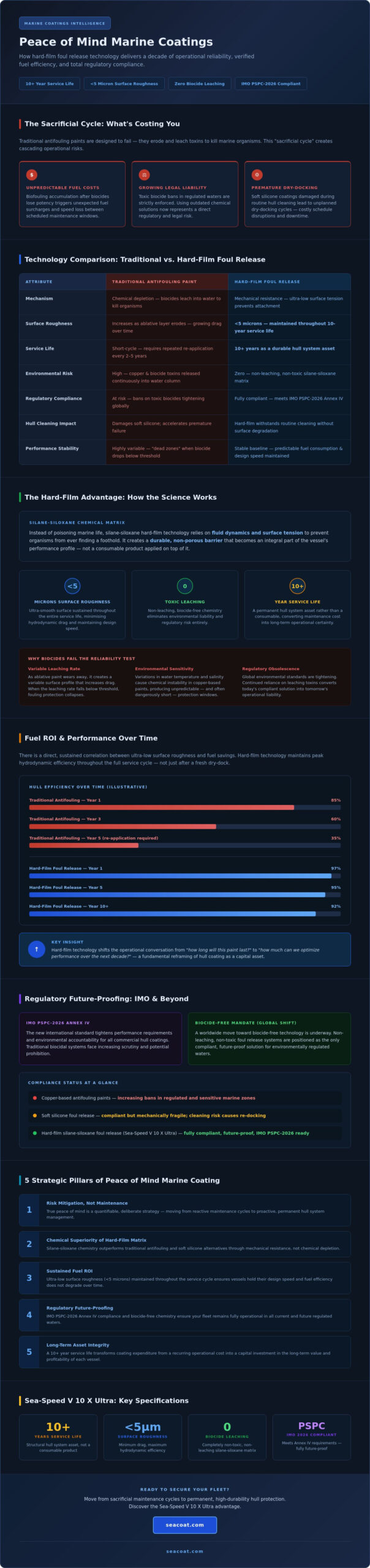
In the maritime sector, “peace of mind” is often dismissed as a subjective marketing term, but for vessel owners managing high-value assets, it represents a quantifiable state of risk mitigation. A true peace of mind marine coating is the deliberate choice to move beyond the traditional sacrificial cycle of maintenance. For decades, the industry relied on coatings designed to fail; they functioned by slowly eroding and releasing toxins into the water column. While this approach managed biofouling in the short term, it created a perpetual state of uncertainty regarding hull efficiency and environmental liability.
The science of antifouling paints has historically focused on these biocidal mechanisms, yet modern operations require a shift toward permanent, non-leaching solutions. Reliability isn’t found in a fresh coat of paint that begins degrading the moment the vessel leaves the dry dock. Instead, it’s a function of material science, specifically the engineering of surfaces that resist attachment without chemical depletion. This transition provides a psychological and financial buffer. You don’t have to wonder if your hull is accumulating drag between scheduled maintenance windows because the protection is mechanical, not chemical.
The Stressors of Traditional Hull Maintenance
Traditional hull management is fraught with variables that disrupt operational schedules. Unexpected fuel surcharges are a primary concern, often triggered by rapid biofouling accumulation that occurs when biocides lose their potency. The legal landscape is also shifting. Using toxic biocides presents a growing liability in regulated waters, where bans on specific harmful substances are strictly enforced. Even contemporary soft silicone coatings present challenges; their delicate surfaces are easily damaged during routine hull cleanings, leading to premature failure and expensive, unplanned dry-docking cycles.
Reliability Through Hard-Film Technology
Achieving operational certainty requires a distinction between temporary surface protection and structural hull systems. Hard-film foul release technology, such as the silane-siloxane chemistry used in Sea-Speed V 10 X Ultra, creates a durable, non-porous barrier that becomes an integral part of the vessel performance profile. This permanence reduces the unknowns of vessel management by providing a stable baseline for fuel consumption and speed. It moves the conversation from how long a paint will last to how much you can optimize performance over the next decade. These advancements are central to meeting new environmental marine coatings standards that prioritize sustainability alongside power. Peace of mind is the intersection where physical durability meets peak hydrodynamic efficiency.
The Science of Reliability: Hard-Film Foul Release vs. Antifouling
The mechanical integrity of a hull coating determines its long-term performance far more than its chemical potency. Traditional methods rely on a depletion model, where biocides are slowly released to kill settling organisms. This process is inherently unstable because it depends on a steady leaching rate that is difficult to maintain. By contrast, a peace of mind marine coating utilizes a silane-siloxane chemical matrix to create a hard, non-porous surface. Instead of poisoning marine life, this technology relies on fluid dynamics and surface tension to prevent organisms from ever finding a foothold. It’s a shift from chemical warfare to mechanical resistance.
Why Traditional Biocides Fail the Reliability Test
Traditional coatings face a fundamental flaw: they are designed to disappear. As ablative bottom paint wears away, it creates a variable surface profile that increases drag. This “sacrificial cycle” leads to dead zones in performance where the biocide leaching rate falls below the threshold required to prevent fouling. These systems are also highly sensitive to environmental variables. Variations in water temperature and salinity can cause chemical instability in copper-based paints, leading to unpredictable protection windows. As global environmental regulations on marine coatings become more stringent, the liability of using these leaching toxins becomes an operational risk that many vessel owners can no longer justify.
The non-porous nature of silane-siloxane systems prevents the microscopic attachment of marine organisms at the cellular level. Because the surface roughness is verified at less than 5 microns, there are no “hooks” for barnacles or tubeworms to grasp. When the vessel moves, the laminar flow of water effectively shears off any incipient bio-growth. This mechanism doesn’t degrade over time, ensuring that the hull remains as efficient in year five as it was on day one. For those seeking to stabilize their operational costs, investigating a permanent foul release system is the most logical step toward long-term asset protection.
The Durability of Silane-Siloxane Systems
Durability in the marine environment is often compromised by mechanical impact. Soft silicone coatings, while effective at foul release, are notoriously fragile. They can be easily torn by fenders, floating debris, or even routine grooming. Silane-siloxane systems solve this through a covalent bonding process. This chemical bond ensures the coating becomes an integral part of the hull structure rather than just a superficial layer. This results in superior impact resistance, allowing the coating to withstand the harsh realities of commercial ports and icy waters. With a 10-year service life now serving as the industry benchmark for these hard-film systems, the era of biennial repainting is effectively over.
Operational Confidence: Performance, Speed, and Fuel ROI
Operational confidence in the maritime sector is a byproduct of predictable hydrodynamic performance. When a vessel’s hull maintains its design specifications over multiple years, owners can forecast fuel expenditure and arrival times with high precision. This level of certainty is exactly what defines a peace of mind marine coating. Unlike traditional systems that suffer from surface degradation and increasing drag, advanced foul release technology ensures that the hull remains a performance-enhancing asset rather than a growing liability. By stabilizing the friction coefficient of the hull, operators can achieve a level of schedule reliability that is otherwise impossible with degrading biocidal paints.
The Economic Impact of a Slick Hull
Frictional drag is the primary obstacle to vessel efficiency, often accounting for 70% to 90% of total resistance for many commercial ship types. Traditional antifouling surfaces are inherently rough and become increasingly irregular as they age or undergo abrasive cleaning. Sea-Speed V 10 X Ultra addresses this by providing an ultra-smooth finish with a verified surface roughness of less than 5 microns. This extreme smoothness directly correlates to increased speed and fuel savings of up to 12% compared to standard coatings. Adopting these systems also aligns with tightening environmental regulations for marine coatings, which increasingly restrict the use of high-VOC and biocidal products that compromise both the ecosystem and hull efficiency.
The reduction in engine strain is a vital but frequently overlooked benefit of high-durability foul release systems. When a hull remains smooth, the propulsion system operates within its optimal efficiency range, preventing the excessive heat and vibration caused by overcoming unnecessary drag. This preservation of machinery extends the lifecycle of critical engine components and reduces the frequency of unplanned repairs. Over a 5-to-10-year horizon, the return on investment is realized not just through fuel savings, but through the significant mitigation of long-term machinery maintenance costs.
Extending the Dry-Docking Interval
The financial viability of a vessel is intrinsically linked to its time spent in the water generating revenue. Frequent dry-docking for hull repainting is a significant drain on resources. Because silane-siloxane systems are chemically stable and mechanically durable, they support extended service windows of 60 months or more. In many cases, a 10-year service life is achievable, allowing owners to skip entire maintenance cycles that would be mandatory with sacrificial paints. This longevity transforms the coating from a recurring expense into a strategic investment. Maintaining a clean hull through a peace of mind marine coating ensures that commercial fleets can meet strict schedule requirements without the “drag penalty” that typically accumulates between traditional maintenance intervals.
Future-Proofing Your Assets: Regulation and Environment
Navigating the complex landscape of international maritime law requires more than just compliance; it demands a strategic shift toward permanent, non-leaching technology. The global ban on harmful biocides like Cybutryne and the increasing scrutiny on copper-based leaching paints have made traditional methods a significant regulatory liability. A true peace of mind marine coating eliminates this risk by offering a biocide-free profile that remains consistent regardless of future legislative changes. By choosing a system that is inherently non-toxic, vessel owners can ensure uninterrupted port access and avoid the costly retrofitting required when once-legal substances are banned.
Environmental performance is now inextricably linked to operational legality through the IMO’s EEXI and CII frameworks. These regulations penalize carbon intensity, making hull efficiency a primary tool for meeting decarbonisation targets. A clean, smooth hull is the most cost-effective way to improve a vessel’s CII rating without requiring major mechanical overhauls. Adopting advanced environmental marine coatings allows operators to maintain high performance while meeting the 2026 shift toward sustainable hull standards. This zero-liability approach provides the certainty needed to manage large-scale assets in an era of rapid environmental transition.
Meeting IMO and Local Regulatory Standards
The transition from being “compliant for now” to “compliant forever” is a hallmark of the Expert Innovator. Local regulations in sensitive ecological zones often exceed international standards, creating “dead zones” for vessels using traditional antifouling paints. Non-toxic coatings are the only way to guarantee global mobility. Because these systems don’t rely on chemical depletion, they don’t contribute to heavy metal accumulation in harbor sediments. This makes them a primary decarbonisation tool, reducing the energy required for propulsion and lowering the total carbon footprint of the fleet.
Sustainability as a Competitive Advantage
Corporate social responsibility is no longer a peripheral concern for major maritime stakeholders. The “Green Marine” movement has transformed sustainability into a tangible competitive advantage. Environmentally conscious charterers and investors prioritize vessels that demonstrate a commitment to ecological stewardship. Beyond the water, the absence of Volatile Organic Compounds (VOCs) in systems like Sea-Speed V 10 X Ultra ensures a safer environment for application crews. This holistic approach to safety and sustainability strengthens the brand equity of vessel owners. To secure your fleet’s regulatory future, consider how a sustainable hull protection strategy can mitigate long-term operational risks.
The Sea-Speed Standard: A Strategic Asset for Your Vessel
The transition from sacrificial maintenance to a permanent performance strategy culminates in the adoption of a technical standard that balances durability with hydrodynamic efficiency. Sea-Speed V 10 X Ultra represents the definitive solution for vessel owners who view their hull as a strategic asset rather than a recurring expense. By utilizing a sophisticated silane-siloxane matrix, this system provides a level of reliability that traditional biocidal paints or fragile silicone alternatives cannot match. For the Expert Innovator, this isn’t merely a coating; it’s a commitment to long-term asset integrity and a genuine peace of mind marine coating.
Choosing a silane-siloxane system over traditional alternatives is a decision rooted in evidence-based performance metrics. While the industry has historically accepted the trade-off between protection and environmental safety, the Sea-Speed standard treats these as synergistic. The versatility of the Seacoat product line, including specialized solutions like Sea-Speed V 10 X Ultra Clear and Armor-Sil R/G, ensures that this technology is accessible across commercial, military, and recreational sectors. Taking the first step toward a worry-free hull maintenance strategy involves moving away from the “unknowns” of biocide depletion and toward a stable, mechanical foul release mechanism.
Technical Superiority of Sea-Speed V 10 X Ultra
The hard-film advantage is central to the system’s performance profile. While soft silicones are prone to tearing and mechanical failure, the covalent bond formed by Sea-Speed V 10 X Ultra ensures a surface that is both resilient and ultra-smooth. This system utilizes the Seapoxy 73 primer to achieve maximum adhesion to the substrate, creating a unified barrier against corrosion and biofouling. With over 20 years of commercial and military use, the technology is verified by decades of empirical data. It outperforms soft alternatives in every critical metric, from impact resistance to the maintenance of a sub-5-micron surface roughness.
Securing Your Investment
Transitioning your fleet to a Sea-Speed system is a methodical process designed to maximize the service life of the vessel. The long-term support and expertise provided by Seacoat SCT, LLC ensure that the application process is as precise as the material science itself. By securing your investment with a 10-year warranty, you eliminate the anxiety of frequent repainting and unpredictable hull drag. This strategic shift allows you to focus on core operations while the coating maintains peak efficiency beneath the waterline. To begin your transition toward a high-durability, biocide-free future, explore Sea-Speed V 10 X Ultra for your vessel today.
Securing Your Fleet’s Operational Future
Securing your fleet’s future requires a shift from sacrificial maintenance to a permanent, high-durability strategy. We’ve established that true reliability is a result of advanced material science, specifically the non-toxic, biocide-free Silane-Siloxane chemistry that’s been in commercial use since 2001. By prioritizing a hard-film system, you achieve a significant reduction in frictional drag and fuel costs while ensuring total compliance with tightening international regulations. This transition provides the certainty needed to manage large-scale assets without the anxiety of biocide bans or performance decay.
Finding a genuine peace of mind marine coating isn’t just about protection; it’s about optimizing the entire lifecycle of your vessel. The evidence-based results of Sea-Speed technology offer a clear path toward ten years of operational stability and ecological stewardship. It’s time to replace temporary fixes with a permanent strategic asset that delivers measurable returns. Your commitment to efficiency and sustainability starts with the right surface.
Upgrade to Sea-Speed V 10 X Ultra for long-term hull reliability and experience the benefits of a cleaner, faster, and more compliant operation.
Frequently Asked Questions
Is a non-toxic marine coating as effective as traditional copper paint?
Non-toxic foul release coatings are objectively more effective over a multi-year service window than traditional copper-based paints. While copper relies on chemical leaching that depletes over time, a peace of mind marine coating like Sea-Speed uses mechanical properties to prevent attachment. This ensures consistent performance from the first day of application through the entire ten-year service life; unlike biocidal paints that lose potency as they erode.
How long does a foul release coating like Sea-Speed typically last?
Sea-Speed V 10 X Ultra is engineered for a service life of 10 years or more, which is supported by a 10-year warranty. This longevity is a significant departure from traditional antifouling paints that typically require replacement every 24 to 36 months. Because the silane-siloxane matrix is permanent and non-depleting, the physical coating remains intact and functional through multiple operational cycles without the need for re-application.
Can Sea-Speed V 10 X Ultra be applied over existing bottom paint?
Sea-Speed V 10 X Ultra cannot be applied directly over existing ablative or sacrificial bottom paints. To ensure maximum adhesion and performance, the old coating must be removed to the original substrate. The system then utilizes the Seapoxy 73 primer to create a permanent bond between the hull and the foul release topcoat. This process eliminates the risk of delamination that occurs when applying hard films over unstable, eroding layers.
How does a hard-film coating reduce fuel consumption compared to ablative paint?
Hard-film coatings reduce fuel consumption by maintaining an ultra-smooth surface profile that minimizes frictional drag. Sea-Speed V 10 X Ultra has a verified surface roughness of less than 5 microns, whereas traditional ablative paints are inherently porous and become rougher as they leach biocides. This sustained smoothness can result in fuel savings of up to 12%, significantly reducing the energy required to maintain design speeds.
What maintenance is required for a silane-siloxane marine coating?
Maintenance for a silane-siloxane coating is significantly less intensive than traditional systems and usually involves simple in-water grooming. Because the surface is non-porous, marine growth cannot firmly attach and is often removed simply by the vessel’s movement through the water. For vessels with extended idle times, a light cleaning with a soft brush or sponge is sufficient to restore the hull to its original hydrodynamic efficiency.
Is Sea-Speed V 10 X Ultra compliant with the latest IMO environmental regulations?
Sea-Speed V 10 X Ultra is fully compliant with the latest International Maritime Organization (IMO) standards, including the PSPC-2026 Annex IV requirements. It is a biocide-free and zero-VOC solution, which eliminates the regulatory risks associated with toxic paint bans. This compliance ensures that your vessel maintains uninterrupted access to all global ports, even those with the most stringent environmental protections for sensitive marine ecosystems.
Can this coating be used on aluminum hulls without causing corrosion?
This coating is an ideal solution for aluminum hulls because it is non-metallic and non-conductive. Unlike copper-based paints, which can trigger galvanic corrosion on aluminum surfaces, silane-siloxane technology is chemically inert. It provides a protective barrier that prevents corrosion while offering superior foul release properties, making it a safe and effective choice for high-speed aluminum commercial and military craft.
How does the initial cost of foul release compare to the long-term ROI?
While the upfront investment in a peace of mind marine coating is higher than traditional paint, the long-term ROI is substantially greater. The return is realized through the elimination of multiple dry-docking cycles over a decade and consistent fuel savings of up to 12%. When factoring in reduced engine maintenance and the absence of regulatory fines, the total cost of ownership is significantly lower than sacrificial biocidal systems.