The 11% carbon intensity reduction factor mandated for 2026 means that passive compliance measures are no longer sufficient for global fleet operations. You’ve likely realized that traditional ablative paints and fragile silicone options can’t keep pace with the rigorous demands of the IMO’s Phase 2 CII ratings or the FuelEU Maritime greenhouse gas intensity targets. This shift transforms the hull surface from a mere maintenance concern into a critical mechanical component of your vessel’s energy efficiency profile.
By integrating a high-performance non-toxic marine hull coating for commercial fleets, you can secure a measurable reduction in greenhouse gas emissions while eliminating the constant cycle of costly reapplication. We’ll demonstrate how advanced silane-siloxane systems, such as Sea-Speed V 10 X Ultra, provide the durability needed for in-water cleaning and an extended 10-year service life. This guide details the transition from regulatory risk to long-term operational superiority through superior fluid dynamics and material science, ensuring your fleet remains compliant and profitable in an increasingly scrutinized environment.
Key Takeaways
- Understand why the 2026 IMO CII reduction factors and FuelEU Maritime regulations make traditional biocidal paints a significant financial and operational liability.
- Learn how the hard-film molecular structure of a non-toxic marine hull coating for commercial fleets allows for aggressive in-water cleaning without the surface damage common in soft silicone options.
- Discover the mechanical mechanism behind silane-siloxane technology that enables an extended 10-year service life and measurable reductions in frictional drag.
- Evaluate how implementing Sea-Speed V 10 X Ultra over a Seapoxy 73 base coat directly improves EEXI and CII scores through enhanced surface efficiency and reduced fuel consumption.
The Shift to Non-Toxic Marine Hull Coatings in Commercial Shipping
The maritime industry’s reliance on chemical deterrence is reaching a definitive conclusion. For decades, the primary defense against Biofouling involved the slow release of toxic agents into the water column. However, a true non-toxic marine hull coating for commercial fleets is now defined by its biocide-free, zero-leaching composition. This isn’t merely a “low-toxicity” label, which often implies a reduced but still present chemical load. Instead, it represents a total shift toward inert, hard-film technologies that interact with the marine environment through mechanical properties rather than chemical poisoning.
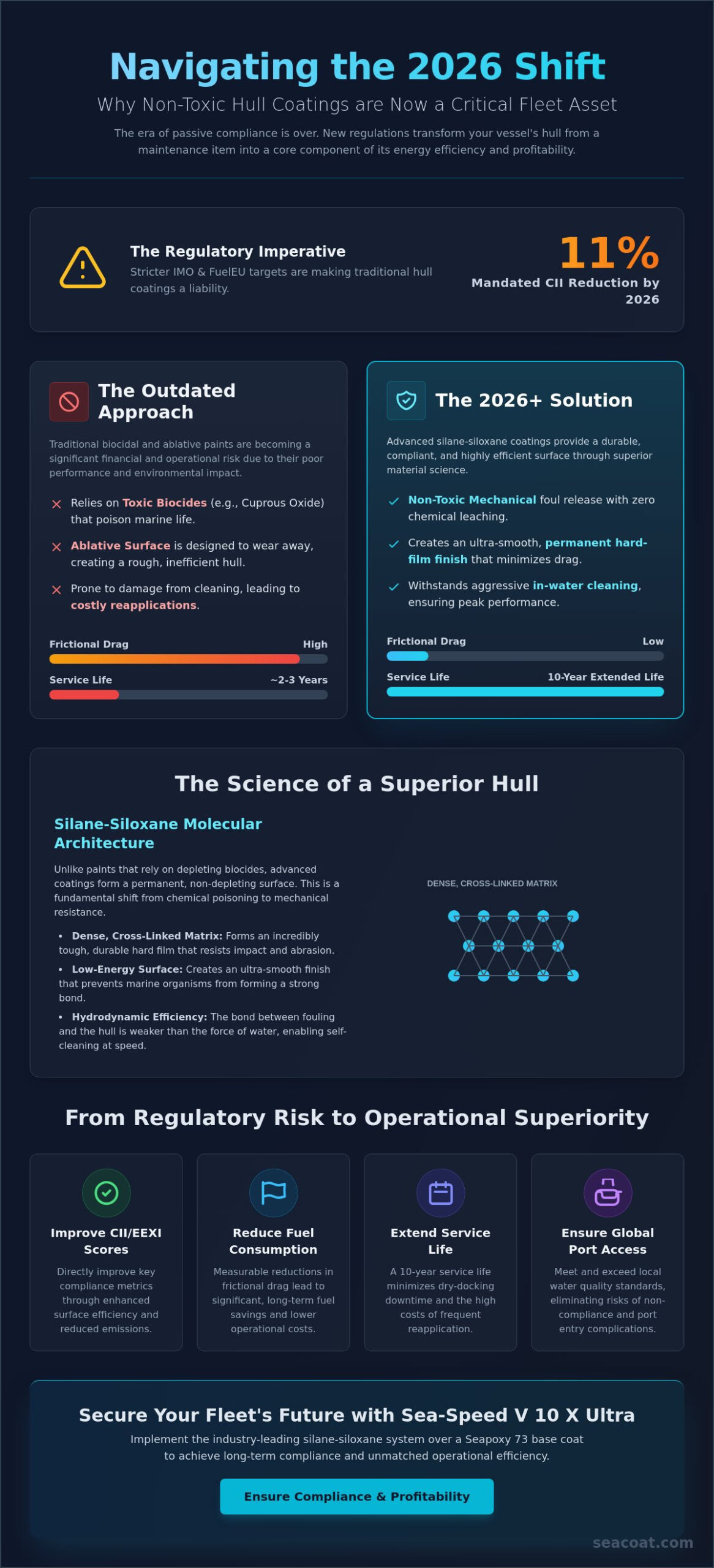
By 2026, the regulatory landscape has evolved from suggestion to strict enforcement. With the IMO’s Carbon Intensity Indicator (CII) requiring an 11% reduction factor relative to 2019 baselines, vessel operators can’t afford the frictional drag inherent in traditional coatings. Toxic leaching is also facing increased scrutiny at the port level. Vessels that continue to shed heavy metals risk non-compliance with local water quality standards, which can complicate port entry and increase operational overhead. Transitioning to a biocide-free system is no longer a peripheral environmental choice; it’s a core requirement for maintaining global port access.
The End of the Biocidal Era
Traditional antifouling relies on cuprous oxides and co-biocides to kill organisms upon contact. These substances don’t simply stay on the hull; they leach into the sediment of global harbors, disrupting entire marine ecosystems. Ablative systems are particularly problematic for commercial fleets because they’re designed to wear away over time to reveal fresh toxins. At commercial speeds, this erosion happens unevenly. This creates a rough surface that increases fuel consumption and greenhouse gas emissions. As global bans on copper-based bottom paints expand, these systems have transitioned from a standard practice to a significant regulatory liability.
Defining the New Standard for 2026
The modern standard for hull protection focuses on mechanical foul release. This approach utilizes an ultra-smooth, low-energy surface that prevents organisms from forming a permanent bond. Within this framework, environmental marine coatings serve as a strategic asset for Environmental, Social, and Governance (ESG) reporting. A non-toxic marine hull coating for commercial fleets must meet three criteria: it must be biocide-free, it must provide a service life exceeding five years, and it must withstand routine in-water cleaning without losing its physical integrity. This transition ensures that fleet managers aren’t just complying with the law but are actively improving the operational efficiency of their heavy assets.
The Material Science of Silane-Siloxane vs. Traditional Antifouling
The efficacy of a non-toxic marine hull coating for commercial fleets depends entirely on its molecular architecture. Unlike traditional antifouling that relies on the controlled depletion of biocides, silane-siloxane technology creates a permanent, non-depleting surface. This material science represents a fundamental shift from chemical poisoning to mechanical resistance. The proprietary molecular structure forms a dense, cross-linked matrix that results in a hard-film finish. This ultra-smooth, low-energy surface ensures that the bond between the hull and any potential biofouling is weaker than the hydrodynamic force of the water moving past the vessel.
Durability is a non-negotiable requirement in heavy industry. While biocidal paints are designed to erode and soft silicones are prone to tearing, silane-siloxane coatings are engineered for impact and abrasion resistance. They don’t peel or blister under the high-pressure conditions of commercial transit. This physical toughness allows for routine in-water cleaning without compromising the coating’s integrity. It’s a strategic asset for operators who need to maintain peak efficiency between dry-docking cycles. This technology aligns with the standards set by the IMO’s AFS Convention, which continues to drive the industry away from hazardous chemical solutions.
The Silane-Siloxane Advantage
The primary benefit of this technology lies in its superior bonding capabilities. It doesn’t merely adhere to the surface; it integrates with the substrate through a high-strength physical bond. Silane-siloxane polymers orient themselves to create a permanent hydrophobic barrier that reduces surface tension and prevents water penetration at the molecular level. This barrier remains stable even when exposed to intense UV radiation and the complex chemical pollutants found in modern harbor waters. Fleet managers looking to optimize these performance metrics often start with a transition to Sea-Speed V 10 X Ultra for its proven durability in high-stakes environments.
Compatibility with Diverse Hull Materials
Material compatibility is a significant hurdle for mixed-asset fleets. Aluminum hulls are particularly sensitive to copper-based paints, which can trigger rapid galvanic corrosion and structural failure. This makes choosing the correct boat paint for aluminum boats a technical necessity rather than a preference. Silane-siloxane is inherently non-conductive, acting as a high-performance isolator that prevents corrosive electrical currents. When applied over a robust primer like Seapoxy 73, it provides steel hulls with an additional layer of protection against corrosion without the need for heavy metal additives. This versatility makes it the preferred non-toxic marine hull coating for commercial fleets operating across diverse sectors, including military and specialized shipping.
Performance Comparison: Hard-Film Foul Release vs. Soft Silicone
Choosing a non-toxic marine hull coating for commercial fleets often involves a choice between two distinct technologies: soft silicone foul release and hard-film silane-siloxane. While both aim to reduce adhesion through low surface energy, their physical durability profiles are radically different. Soft silicone coatings are frequently characterized by the ‘Silicone Dilemma.’ They offer exceptional initial foul release performance but are notoriously fragile. This fragility creates a significant operational risk in commercial environments where fender contact, debris impact, or aggressive docking maneuvers are common.
In contrast, hard-film systems like Sea-Speed V 10 X Ultra provide a robust alternative that eliminates the risk of surface tearing. Because these coatings cure to a high-density, glass-like finish, they can withstand the mechanical stresses of heavy industry. This physical resilience translates directly into extended service intervals. While silicone systems typically require reapplication every three to five years due to cumulative physical damage, a well-maintained silane-siloxane system can achieve a 10-year service life. This longevity reduces dry-docking frequency and lowers the total cost of ownership for fleet managers.
Mechanical Resilience and Maintenance
The operational reality of commercial shipping involves harsh physical interactions. Soft silicone coatings are prone to ‘tearing’ or ‘delamination’ when subjected to the friction of tugboat fenders or the impact of floating debris. Once the surface is breached, biofouling quickly colonizes the exposed substrate. Hard-film coatings solve this by providing a surface that is compatible with modern maintenance tools. They are designed to withstand scrubbers and robotic hull cleaners without losing film thickness or surface smoothness. This allows for a shift from a reactive re-painting cycle to a proactive cleaning strategy; this ensures the hull remains at peak performance throughout its entire service life.
Frictional Drag and Speed Optimization
Hydrodynamic efficiency is the primary driver of fuel savings in the 2026 regulatory environment. The skin friction coefficient of a hull is largely determined by its surface roughness, which is measured in microns. Silane-siloxane coatings create an ultra-slick profile that minimizes turbulent flow. When compared to traditional antifouling boat paint, which often develops a rough texture as it ablates, hard-film foul release systems maintain their smoothness over time. This consistent reduction in drag allows vessels to maintain higher speeds at lower RPMs, directly impacting the bottom line through significant fuel burn reductions. By optimizing the hull’s mechanical interaction with the water, operators can achieve the speed gains necessary to meet tightening CII requirements.
Strategic ROI: EEXI/CII Compliance and Fuel Efficiency
The 2026 maritime regulatory environment has shifted the focus from static design efficiency to continuous operational performance. For fleet managers, the annual 11% carbon intensity reduction factor required by the IMO’s CII regulation presents a significant hurdle. A high-performance non-toxic marine hull coating for commercial fleets offers a “low-hanging fruit” solution to meet these benchmarks without necessitating expensive engine modifications or power limitations. By reducing hydrodynamic drag, these coatings allow vessels to maintain required service speeds while consuming less fuel; this directly translates into a more favorable CII rating.
Economic gains extend far beyond simple fuel burn metrics. A 10% reduction in frictional drag can save hundreds of thousands of dollars in annual fuel costs for a single large vessel. These savings are compounded by the reduction in dry-docking frequency. While traditional paints require reapplication every 36 to 60 months, the 10-year service life of a silane-siloxane system like Sea-Speed V 10 X Ultra significantly increases the asset’s time at sea. This durability also facilitates better access to green financing and carbon credits, as financial institutions increasingly tie lending rates to a vessel’s environmental performance and ESG transparency.
Meeting IMO Decarbonization Targets
Vessel efficiency is no longer optional. Under the current CII framework, ships receiving a “D” rating for three consecutive years or an “E” rating in a single year face mandatory Corrective Action Plans. Using a non-toxic marine hull coating for commercial fleets provides a passive efficiency gain that helps operators avoid the drastic measure of Engine Power Limitation (EPL). By future-proofing hulls against tightening carbon taxes and the FuelEU Maritime GHG intensity targets, operators ensure their assets remain competitive in a decarbonizing global market.
Quantifying the Investment
Evaluating the ROI of a hull coating requires looking at the total cost of ownership (TCO) rather than just the initial application expense. The payback period for a premium silane-siloxane foul release system is often achieved within 18 months through fuel savings alone. When you factor in the elimination of two dry-docking cycles over a decade, the financial argument becomes undeniable. To see how these metrics apply to your specific vessel type, you can explore the technical performance data of Sea-Speed V 10 X Ultra. Case studies across the commercial sector demonstrate that retrofitting older hulls with advanced coatings is one of the most cost-effective ways to ensure long-term fleet viability.
Optimizing Fleet Operations with Sea-Speed V 10 X Ultra
Integrating a non-toxic marine hull coating for commercial fleets into a large-scale operation requires a system designed for industrial integration rather than just a simple paint application. Sea-Speed V 10 X Ultra stands as the premier solution for this transition. It provides a permanent, non-depleting surface that aligns with the rigorous performance requirements of the 2026 maritime environment. This system doesn’t just protect the hull; it acts as a strategic asset that stabilizes fuel consumption and simplifies long-term maintenance cycles over a decade of service.
The success of any high-performance coating is fundamentally tied to its adhesion and substrate preparation. Seapoxy 73 serves as the critical foundation in this process. As a high-build, strontium chromate-free epoxy primer, it provides the necessary corrosion resistance and mechanical bond required for steel and aluminum hulls. By creating a stable, non-porous base, Seapoxy 73 ensures that the Sea-Speed topcoat remains intact even under the extreme hydrodynamic pressures of deep-sea transit. This layered approach eliminates the risk of delamination common in lower-tier systems.
The Sea-Speed Product Ecosystem
The versatility of the Sea-Speed line allows for tailored solutions across diverse vessel types. While the standard V 10 X Ultra is the workhorse for global shipping, Sea-Speed V 10 X Ultra Clear offers a specialized solution for high-performance commercial craft and racing hulls where visual inspection of the substrate is required. For a deeper analysis of how these materials interact with different hull designs, you can consult our guide on boat hull paint. This ecosystem ensures that every asset in a fleet benefits from the same silane-siloxane efficiency.
Implementation and Global Support
Managing a global fleet requires a logistics partner capable of supporting multi-vessel procurement and shipyard coordination. Seacoat SCT, LLC provides the industrial-scale supply contracts necessary for large-scale management, ensuring product availability across major global maritime hubs. Our technical support teams work directly with shipyard application personnel to verify that every stage of the process meets our rigorous performance standards. This oversight is vital for ensuring the extended service life that defines our technology. To begin the transition, fleet managers can request a comprehensive performance audit to identify the specific ROI available through a non-toxic marine hull coating for commercial fleets.
Securing Fleet Viability in the Decarbonization Era
The transition toward a carbon-neutral maritime sector is no longer a distant objective; it’s an immediate operational requirement. As the 2026 IMO reduction factors take effect, the choice of hull surface technology becomes a defining factor in vessel profitability. Moving beyond the limitations of biocidal paints and the fragility of soft silicones, a non-toxic marine hull coating for commercial fleets provides the necessary mechanical resilience to maintain peak hydrodynamic efficiency. This shift ensures that your assets remain compliant with CII and EEXI standards while significantly reducing the overhead associated with frequent dry-docking cycles.
Sea-Speed’s proprietary Silane-Siloxane technology offers a proven 10+ year service life, a standard already trusted by military and commercial fleets worldwide. By prioritizing surface integrity and environmental stewardship, you’re investing in a strategic asset that delivers measurable ROI through fuel savings and reduced maintenance. It’s time to move toward permanent, sophisticated solutions that protect both your bottom line and the marine ecosystems we share. Optimize your fleet’s performance with Sea-Speed V 10 X Ultra and lead the industry into a more efficient future.
Frequently Asked Questions
Is silane-siloxane coating truly non-toxic for all marine life?
Yes, silane-siloxane technology is inherently non-toxic because it’s formulated without biocides or heavy metals. Unlike traditional coatings that release toxins into the water column, these systems are zero-leaching and chemically inert. They function through mechanical foul release, meaning they rely on surface energy rather than chemical deterrence. This protects delicate marine ecosystems while ensuring compliance with increasingly strict global environmental standards.
How does a foul release coating differ from traditional antifouling paint?
Traditional antifouling paints rely on the controlled depletion of biocides to kill organisms that attempt to settle on the hull. In contrast, a non-toxic marine hull coating for commercial fleets uses a foul release mechanism. This creates an ultra-smooth, low-energy surface that prevents organisms from forming a permanent bond. Biofouling is simply washed away by the hydrodynamic forces of the water as the vessel moves.
Can Sea-Speed V 10 X Ultra be applied over existing bottom paint?
Sea-Speed V 10 X Ultra can’t be applied directly over existing antifouling paints. To ensure maximum adhesion and performance, the hull must be cleaned to the original substrate. We recommend using Seapoxy 73 as the primary foundation. This high-build epoxy primer creates a stable, non-porous surface that’s essential for the long-term durability of the silane-siloxane topcoat.
What is the expected lifespan of a non-toxic hull coating on a commercial ship?
You can expect a service life of 10 years or more when using a high-performance non-toxic marine hull coating for commercial fleets. This significantly exceeds the 3 to 5-year cycle typical of traditional ablative paints. Because the coating is a hard-film system that doesn’t ablate or deplete, it maintains its physical integrity and hydrodynamic efficiency throughout multiple dry-docking intervals.
How much fuel can a commercial fleet save by switching to a low-friction coating?
Fleet operators report measurable fuel savings of up to 10% after transitioning to a low-friction silane-siloxane system. This reduction in fuel burn is a direct result of the ultra-slick surface, which minimizes skin friction and turbulent flow. These gains are critical for improving a vessel’s Carbon Intensity Indicator (CII) rating and reducing the total cost of ownership across a decade of operations.
Does a hard-film coating require special cleaning equipment?
No, hard-film coatings don’t require specialized cleaning tools and are fully compatible with standard shipyard equipment. Unlike soft silicone coatings that tear under mechanical stress, silane-siloxane is highly abrasion-resistant. It can withstand robotic hull cleaners and rotating brush systems without sustaining damage. This durability allows for frequent in-water cleaning to maintain peak hydrodynamic performance without compromising the coating’s thickness.
Are non-toxic coatings compliant with IMO EEXI and CII regulations?
Yes, advanced non-toxic coatings are a strategic tool for meeting the IMO’s EEXI and CII requirements. By reducing drag and lowering fuel consumption, these systems directly decrease the vessel’s carbon intensity. This helps operators achieve better ratings under the 2026 standards and avoids the need for mandatory corrective action plans or engine power limitations that can impact operational speed.
Can silane-siloxane coatings be used on aluminum commercial vessels?
Silane-siloxane coatings are ideal for aluminum commercial vessels because they’re non-conductive. Traditional copper-based paints often cause rapid galvanic corrosion when applied to aluminum, leading to structural degradation. Because silane-siloxane is chemically inert and acts as an electrical isolator, it provides superior protection without the risk of corrosive reactions, making it a safe choice for mixed-material fleets.