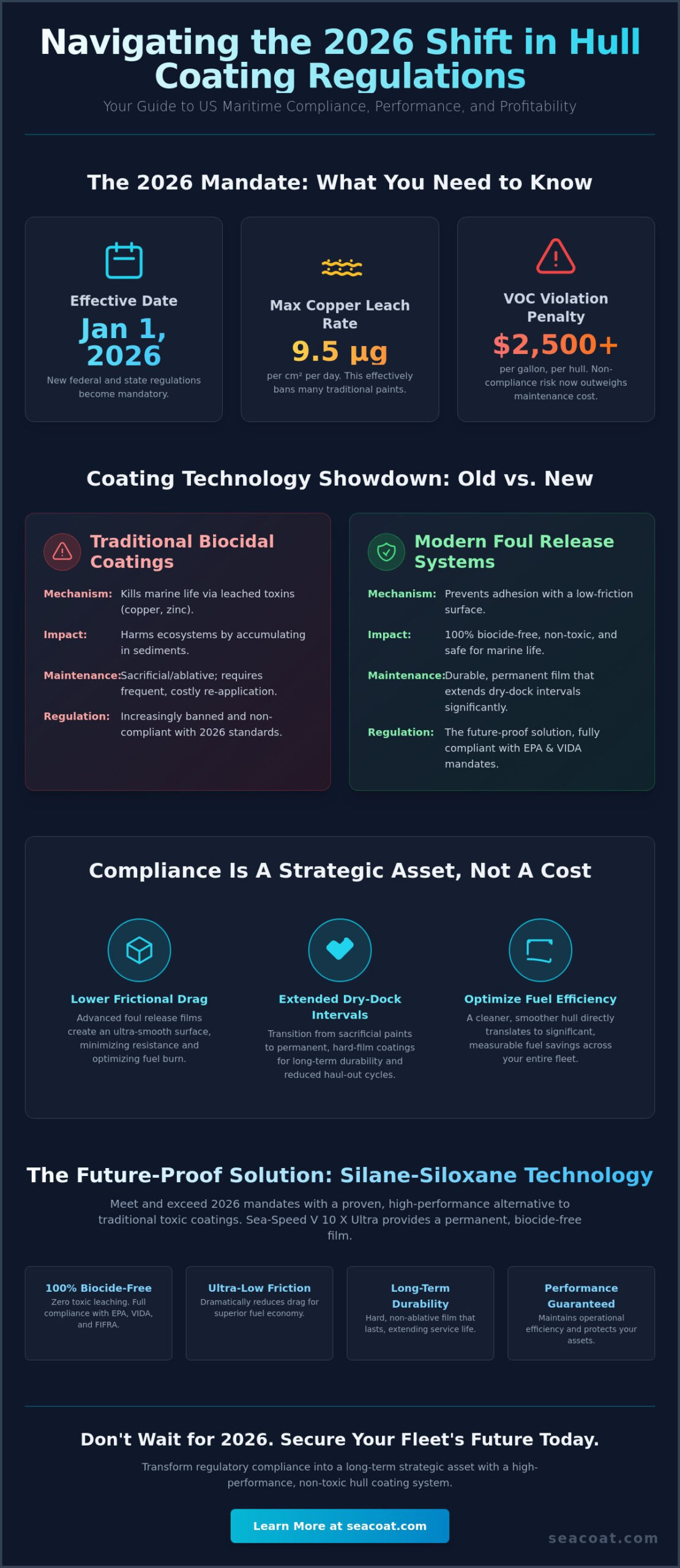
With VOC violation penalties reaching up to $2,500 per gallon per hull, the financial risk of non-compliance has officially eclipsed the cost of premium maintenance. As of January 1, 2026, the mandate limiting copper leach rates to 9.5 micrograms per square centimeter per day is the new legal standard for vessel operators across the country. You’ve likely encountered the mounting pressure of non-toxic hull coating USA regulations while remaining skeptical about whether eco-friendly solutions can deliver the physical durability your fleet requires.
It’s a valid concern, as the transition away from traditional biocides shouldn’t come at the expense of your operational efficiency or fuel economy. This guide clarifies the complex 2026 regulatory landscape, ensuring you can navigate EPA mandates and the Vessel Incidental Discharge Act (VIDA) with scientific certainty. We’ll explore how modern, biocide-free technologies allow you to eliminate toxic leaching, minimize surface friction, and significantly extend your dry-dock intervals. By aligning your maintenance strategy with these high-performance standards, you can transform regulatory compliance into a long-term strategic asset.
Key Takeaways
- Identify the specific 2026 EPA mandates and copper leach limits that dictate legal operation and help you avoid heavy VOC-related fines.
- Master the technical distinctions between biocidal antifouling and biocide-free foul release systems to ensure your vessel meets non-toxic hull coating USA regulations.
- Evaluate the economic impact of transitioning from sacrificial ablative paints to permanent films that lower frictional drag and optimize fuel efficiency.
- Develop a data-driven implementation strategy for fleet-wide transitions, focusing on hull profile optimization and long-term coating durability.
- Learn how advanced silane-siloxane solutions like Sea-Speed V 10 X Ultra provide a future-proof alternative to traditional silicone and toxic coatings.
The Evolving Landscape of USA Hull Coating Regulations in 2026
The transition from voluntary environmental stewardship to mandatory legal compliance has reached a critical juncture. For decades, the Clean Water Act (CWA) has served as the foundation for protecting U.S. navigable waters, but the specific mechanisms governing vessel hulls have grown increasingly complex. In 2026, the industry is moving beyond the broad directives of the EPA’s Vessel General Permit (VGP) toward a more nuanced, performance-driven era. Compliance with non-toxic hull coating USA regulations is no longer a matter of corporate social responsibility; it’s a prerequisite for operational viability in a landscape where heavy metal restrictions are strictly enforced.
Federal Oversight: EPA and the Vessel Incidental Discharge Act (VIDA)
The implementation of the Vessel Incidental Discharge Act (VIDA) marks a fundamental change in how national standards are applied. By consolidating the VGP into a streamlined federal framework, VIDA reduces the regulatory friction caused by overlapping state and federal rules. It establishes clear discharge limits for biocides and heavy metals, particularly for commercial hulls that frequent multiple jurisdictions. Vessel operators must now adhere to rigorous reporting requirements when entering U.S. waters, ensuring that their coating systems don’t exceed established leaching thresholds. This federal oversight aims to mitigate the long-term environmental impact of traditional biocides, which have historically accumulated in benthic sediments and disrupted local ecosystems.
State-Level Mandates: The California and Washington Precedents
While federal standards provide a baseline, state-level mandates in California and Washington have accelerated the phase-out of high-leach coatings. California’s Department of Pesticide Regulation (DPR) led this movement by establishing a maximum copper leach rate of 9.5 micrograms per square centimeter per day. This regulation, which became fully effective for applications on January 1, 2026, effectively bans many traditional antifouling products that rely on high concentrations of cuprous oxide. Similarly, Washington State has enacted bans on copper-based coatings for recreational vessels to address rising toxicity in the Salish Sea.
These state actions often utilize Total Maximum Daily Load (TMDL) limits to manage water quality in specific impaired water bodies. For example, the compliance extension for Marina del Rey Harbor expires on March 26, 2026, leaving operators with a narrow window to transition their assets. Failing to meet these localized standards can result in restricted port access or significant financial penalties. The shift toward non-toxic alternatives is a direct response to these pressures, as operators seek to avoid the $2,500 per gallon VOC violation fines that have become a standard enforcement tool in several jurisdictions. Choosing a compliant system is now a strategic necessity for maintaining access to the nation’s most vital maritime hubs.
Defining ‘Non-Toxic’ vs. ‘Biocide-Free’ Under U.S. Law
In the context of non-toxic hull coating USA regulations, the choice of terminology is a legal minefield. Most operators assume that “biocide-free” is a synonym for environmental safety. This is a dangerous misconception. Under the Federal Insecticide, Fungicide, and Rodenticide Act (FIFRA), the distinction rests entirely on the intended mechanism of action. If a coating is designed to chemically kill, repel, or mitigate marine organisms, the EPA classifies it as a pesticide. These products require formal registration and must adhere to strict leaching thresholds. Conversely, true non-toxic systems utilize physical surface properties to prevent adhesion mechanically rather than chemically.
The regulatory landscape in 2026 demands a higher level of scrutiny regarding what constitutes a “pesticide.” Traditional antifouling paints rely on the controlled release of toxins, usually heavy metals like copper or zinc, to create a zone of toxicity around the hull. Foul release systems, however, are not intended to kill. They create a low-surface-energy environment where organisms cannot gain a secure foothold. It’s a distinction between chemical warfare and mechanical resistance. For vessel owners, understanding this legal boundary is vital for avoiding the compliance pitfalls associated with mislabeled products.
The Biocide-Free Marketing Trap
Many products marketed as “biocide-free” still contain chemical additives that pose significant ecological risks. Soft silicone coatings are a primary example. While they may not contain copper, they frequently utilize organotin derivatives, such as dibutyltin (DBT), as catalysts in the curing process. These compounds can leach into the water column, causing endocrine disruption in marine life. A truly compliant, non-toxic solution must maintain a 0% leachable chemical profile. This ensures that no toxic residues, whether active biocides or “exempt” catalysts, enter the ecosystem. For operators seeking a strategic asset that avoids these hidden toxins, a silane-siloxane system like Sea-Speed V 10 X Ultra provides a chemically inert, permanent film that exceeds federal safety standards.
Verifying Non-Toxicity: Certifications to Look For
Relying on a manufacturer’s marketing brochure is insufficient for modern regulatory audits. Verification requires objective, third-party laboratory data. Vessel operators should prioritize coatings that have been tested according to ASTM or ISO standards for leaching rates and environmental impact. When reviewing a Safety Data Sheet (SDS), pay close attention to Section 3 (Composition) and Section 12 (Ecological Information). If a product contains zinc pyrithione or other “booster” biocides, it’s a pesticide under U.S. law, regardless of how it’s marketed. True compliance is found in evidence-based metrics, not vague environmental claims.
Performance Analysis: Comparing Non-Toxic Systems to Traditional Biocides
The transition toward compliance with non-toxic hull coating USA regulations often prompts concerns regarding the trade-off between ecological safety and mechanical performance. Historically, the industry relied on the “sacrificial cycle” of traditional ablative paints. These systems function by constantly eroding to expose fresh biocides, a process that inherently increases hull roughness over time. This rising surface profile creates turbulence and increases the frictional drag coefficient, forcing engines to work harder to maintain speed. In contrast, modern non-toxic films are permanent and non-depleting. They maintain their original surface smoothness throughout their service life, providing a consistent hydrodynamic advantage that traditional biocides cannot match.
Hard-Film Silane-Siloxane vs. Soft Silicone Coatings
While soft silicone foul-release systems were an early alternative to toxic paints, they often fail in the demanding high-fouling environments of USA coastal waters. Their low mechanical strength makes them susceptible to tearing and detachment during routine operations or pier-side impacts. Once the soft film is compromised, localized fouling accelerates, and the coating cannot be easily repaired.
Hard-film silane-siloxane technology, such as Sea-Speed V 10 X Ultra, offers a superior mechanical alternative. It provides the durability of a traditional epoxy with the surface energy of a foul-release system. This allows for:
- Resistance to mechanical damage from fenders, ice, or debris.
- The ability to withstand aggressive in-water cleaning without stripping the coating.
- Extended service lives that can exceed ten years, far outlasting the three-year cycle of most ablatives.
These systems don’t just protect the hull; they serve as a performance-enhancing tool that remains intact under the most rigorous commercial and military duty cycles.
Fuel Efficiency and Greenhouse Gas (GHG) Reduction
The link between hull hydrodynamics and carbon intensity is now a primary driver for fleet management. As the International Maritime Organization (IMO) tightens EEXI and CII ratings, vessel operators must find every possible efficiency gain. Traditional biocidal coatings often suffer from “roughness penalty” as they age, which degrades a vessel’s efficiency rating. By maintaining an ultra-smooth surface profile, these systems provide a drag reduction benefit that translates into a measurable 4-10% fuel saving for most commercial hull types. This reduction in fuel consumption directly lowers greenhouse gas emissions, helping operators meet both environmental mandates and internal ESG goals. When you factor in the extended dry-dock intervals and reduced fuel spend, the long-term ROI of a permanent, non-toxic film far outweighs the recurring costs of sacrificial toxic paints.
Implementation Strategy: Navigating Compliance and Application
Transitioning a fleet to meet non-toxic hull coating USA regulations involves more than a simple change in product selection; it requires a comprehensive overhaul of maintenance protocols. The process begins with the complete removal of existing biocidal layers, which must be handled according to VGP guidelines to prevent secondary contamination. Shipyards must employ strict environmental containment strategies, such as high-pressure water blasting with closed-loop filtration systems, to capture heavy metal residues before they enter local waterways. Once the substrate is bare, the focus shifts to creating a precise anchor profile that ensures long-term coating integrity.
Surface preparation is the most critical variable in the longevity of a non-toxic system. Unlike traditional ablative paints that rely on relatively simple chemical bonds, advanced silane-siloxane coatings require a specific mechanical profile for optimal adhesion. This often necessitates a high-performance primer, such as Seapoxy 73, which provides the necessary chemical bridge between the metal or fiberglass hull and the topcoat. Ensuring primer compatibility and correct film thickness is essential for avoiding delamination in high-stress areas like the bow or rudder during high-speed operations.
Compliance documentation serves as your primary defense during EPA or port authority inspections. Vessel operators must maintain meticulous records that include Safety Data Sheets (SDS), application logs detailing the surface preparation, and certified leach rate data. These documents prove that the vessel is operating within the 9.5 microgram copper limit or is utilizing a completely biocide-free system. In 2026, inspectors are increasingly focused on the chemical composition of the coating, looking for hidden organotins or unlisted “booster” biocides that could trigger a violation. Accurate record-keeping is no longer optional; it’s a core component of your operational license.
The Transition Process: Removal and Re-coating
Safe removal of toxic layers is the first step in a successful transition. Operators should coordinate with shipyards that possess the specialized equipment required for VGP-compliant waste disposal. After the old paint is stripped, the hull must be inspected for osmotic blistering or corrosion that could compromise the new non-toxic film. Applying a high-build epoxy primer ensures a stable foundation, protecting the hull’s structural integrity while providing the smooth surface necessary for the final non-toxic application.
Port-Specific Compliance and Maintenance
In-water cleaning regulations have become significantly more restrictive in sensitive U.S. harbors. In regions like California and Washington, cleaning a biocidal hull can release a concentrated pulse of toxins, often leading to immediate port-side fines. Hard-film non-toxic coatings mitigate this risk. Because they don’t rely on a soft, sacrificial layer, they can be cleaned using mechanical brushes or high-pressure systems without discharging harmful chemicals. This mechanical durability also plays a vital role in managing Invasive Aquatic Species (IAS). A smooth, hard surface is less hospitable to macro-fouling, ensuring the vessel meets the biosecurity standards required for entry into international and sensitive domestic ports.
The Seacoat Solution: Silane-Siloxane Technology for 2026
Sea-Speed V 10 X Ultra represents the apex of material science applied to maritime efficiency. While many manufacturers struggle to modify existing biocidal formulas to meet the 9.5 microgram copper leach cap, Seacoat has engineered a solution that bypasses the toxicity debate entirely. This silane-siloxane technology creates a chemically inert, non-polar surface that prevents biofouling through mechanical resistance rather than chemical mitigation. By adopting this system, operators don’t just comply with non-toxic hull coating USA regulations; they insulate their fleet from the inevitable tightening of environmental standards through 2030 and beyond. It’s a permanent solution for a high-stakes industry.
Meeting the IMO’s Energy Efficiency Existing Ship Index (EEXI) and Carbon Intensity Indicator (CII) requires more than engine optimization. Hull performance is a critical lever. Traditional coatings degrade, increasing drag and carbon intensity over their short service lives. Sea-Speed V 10 X Ultra maintains its ultra-smooth profile, ensuring that a vessel’s CII rating remains stable across extended operational windows. This stability is a strategic asset for commercial fleets looking to avoid the “roughness penalty” that typically degrades ROI in the second and third years of a standard paint cycle. Evidence from military and commercial success stories confirms that transitioning to silane-siloxane systems isn’t just about compliance; it’s about superior hydrodynamics.
Sea-Speed V 10 X Ultra: A Strategic Asset
The hard-film foul release mechanism of Sea-Speed V 10 X Ultra provides a level of durability that soft silicones can’t match. Its non-stick surface properties are inherent to the polymer matrix, meaning they won’t leach out or deplete over time. This makes it the ideal choice for environmental marine coatings that must perform in diverse U.S. coastal waters. When you evaluate longevity metrics, the shift is clear. Moving toward a 10-year hull maintenance cycle reduces dry-dock frequency and eliminates the recurring costs of stripping sacrificial layers. It’s a smarter way to manage heavy assets.
Expert Support and Global Availability
Implementing a fleet-wide transition requires more than a product; it requires technical precision. Seacoat provides global distribution and specialized consultation to ensure your coating selection aligns with your specific duty cycle and port requirements. Whether you’re navigating the Salish Sea or the Gulf Coast, our team offers the evidence-based data needed for marine coatings selection. Don’t leave your 2026 compliance to chance. Consult with Seacoat SCT for a customized compliance roadmap.
Securing Operational Longevity in a Regulated Maritime Environment
The 2026 maritime landscape demands a permanent departure from the high-maintenance, high-toxicity cycles of the past. Aligning your fleet with non-toxic hull coating USA regulations requires a rigorous understanding of both federal VIDA standards and localized state mandates. By moving toward chemically inert, hard-film technologies, vessel operators can eliminate the risk of VOC-related fines while simultaneously improving hydrodynamic efficiency. This transition is a strategic shift from reactive maintenance to proactive asset management.
Seacoat technology has been in commercial use since 2001, providing a proven track record of reliability in high-stakes industrial applications. These systems meet all current EPA VGP and state-level requirements, ensuring your assets remain compliant in every U.S. jurisdictional water. Beyond regulatory safety, the transition to silane-siloxane films has demonstrated fuel savings of up to 10% in commercial trials; this directly enhances your bottom-line ROI and supports global carbon reduction goals. The path forward is defined by scientific precision and environmental stewardship. By choosing a permanent solution over temporary fixes, you ensure the long-term viability and performance of your maritime assets.
Optimize Your Fleet with Seacoat’s Non-Toxic Solutions
Frequently Asked Questions
Are copper-based hull paints banned in the USA in 2026?
Copper-based paints aren’t entirely banned, but they’re subject to strict leach rate limits under 2026 mandates. As of January 1, 2026, coatings applied to recreational vessels cannot exceed a copper leach rate of 9.5 micrograms per square centimeter per day. Manufacturers were required to stop producing paints exceeding this threshold by September 30, 2025. For commercial operators, these restrictions signal a broader federal shift toward biocide-free alternatives.
What is the difference between foul release and antifouling coatings?
Antifouling coatings use biocides or pesticides to chemically kill or repel marine organisms, while foul release coatings use surface energy to prevent adhesion mechanically. Antifouling systems are sacrificial and deplete over time, often increasing hull roughness. Foul release systems, particularly hard-film versions, provide a permanent, non-depleting surface that remains smooth throughout its service life, offering a superior hydrodynamic profile without environmental leaching.
How do non-toxic coatings impact a ship’s fuel efficiency?
Non-toxic coatings improve fuel efficiency by maintaining an ultra-smooth surface that reduces frictional drag. Traditional biocidal paints roughen as they age and erode, which creates turbulence and forces engines to consume more fuel. Evidence from commercial trials shows that permanent films like Sea-Speed V 10 X Ultra can deliver fuel savings of up to 10% compared to traditional ablative systems, directly lowering operational costs.
Does the EPA Vessel General Permit (VGP) require non-toxic coatings?
The EPA Vessel General Permit doesn’t explicitly mandate the use of non-toxic coatings, but it strictly regulates the discharge of biocides incidental to vessel operation. Adhering to non-toxic hull coating USA regulations through VIDA standards is the most effective way to ensure long-term compliance. By eliminating the discharge of heavy metals, operators simplify their reporting requirements and avoid the legal risks associated with exceeding localized limits in sensitive harbors.
Can non-toxic coatings be used on aluminum hulls without corrosion?
Yes, non-toxic coatings are ideal for aluminum hulls because they’re chemically inert and don’t contain copper. Copper-based antifouling paints cause severe galvanic corrosion when applied to aluminum substrates. Silane-siloxane systems like Sea-Speed provide a protective barrier that doesn’t react with the hull material, ensuring structural integrity while providing effective foul release performance without the need for complex isolation primers.
What are the maintenance requirements for a hard-film non-toxic coating?
Maintenance for hard-film non-toxic coatings involves periodic mechanical cleaning to remove surface slime and light biofouling. Unlike soft silicone systems that tear easily, hard films are durable enough to withstand aggressive scrubbing and high-pressure water tools. This durability allows for efficient in-water cleaning in ports where the discharge of biocides from traditional paints is strictly prohibited, ensuring the vessel maintains its peak hydrodynamic performance.
How long does a Silane-Siloxane coating like Sea-Speed typically last?
A high-performance silane-siloxane coating like Sea-Speed typically provides a service life of 10 years or more. This longevity is a result of its non-depleting structure, which doesn’t rely on the sacrificial erosion seen in traditional ablative paints. While standard antifouling systems often require re-application every 24 to 36 months, these permanent films significantly extend dry-dock intervals and reduce the total cost of ownership for fleet managers.
Will using a non-toxic coating help with EEXI and CII compliance?
Using a non-toxic coating directly assists with EEXI and CII compliance by minimizing frictional drag across the hull. Because these coatings maintain an ultra-smooth surface profile over their entire service life, they reduce the energy required for propulsion. This efficiency gain helps vessels maintain higher CII ratings and lower carbon intensity scores, helping operators meet International Maritime Organization targets without sacrificing operational speed or capacity.