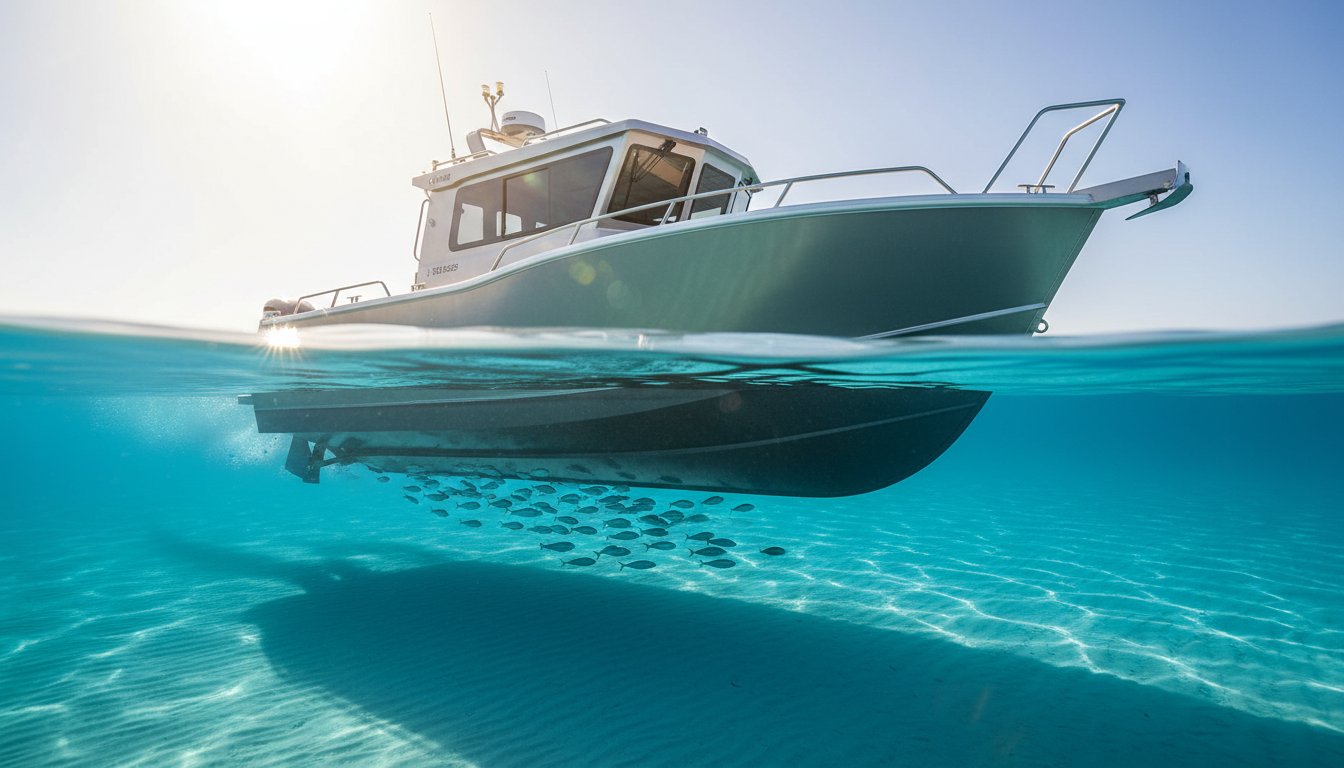
If you’re still relying on traditional biocides to protect your aluminum hull, you aren’t just fighting marine growth; you’re managing a slow-motion chemical reaction that threatens the structural integrity of your vessel. You understand the persistent anxiety of galvanic corrosion and the exhausting, annual cycle of scraping and repainting. Finding an effective non-toxic bottom paint for aluminum boats is no longer just an environmental preference. It’s a technical necessity. As regulatory bodies like the California Department of Pesticide Regulation move toward a 2029 re-evaluation of copper-based paints, the industry is shifting toward more sophisticated, inert solutions.
You deserve a hull protection strategy that prioritizes long-term asset integrity over temporary chemical fixes. This guide explores how advanced foul-release technology, such as Sea-Speed V 10 X Ultra, creates an ultra-slick, biocide-free surface that prevents attachment without leaching toxins into the water. You’ll learn how these hard-film coatings improve fuel efficiency and provide up to ten years of service life. We’ll break down the scientific advantages of moving beyond traditional antifouling to achieve a permanent, high-performance solution that balances operational excellence with rigorous ecological stewardship.
Key Takeaways
- Understand the electrochemical risks of traditional copper coatings and why aluminum requires a completely different protective approach to prevent galvanic corrosion.
- Differentiate between standard biocidal alternatives and truly inert non-toxic bottom paint for aluminum boats that utilizes silane-siloxane technology for a glass-like finish.
- Evaluate the performance metrics of hard-film foul release systems that offer a ten-year service life and significantly reduce frictional drag compared to traditional ablative paints.
- Learn how to establish a permanent dielectric shield using Seapoxy 73 to ensure the structural integrity of your hull while maximizing coating adhesion.
- Explore the operational benefits of Sea-Speed V 10 X Ultra, a biocide-free solution designed for high-stakes marine environments where reliability and environmental compliance are paramount.
The Unique Challenges of Aluminum Hull Protection
Aluminum hulls offer an exceptional strength-to-weight ratio and inherent durability, yet they are uniquely vulnerable to the chemical compositions found in standard marine coatings. Unlike fiberglass or steel, aluminum sits high on the galvanic series. This position makes it highly reactive when paired with nobler metals in a conductive environment. For the vessel owner, this means the choice of coating isn’t just about preventing barnacles; it’s a critical decision regarding the structural survival of the hull itself. Applying a high-performance non-toxic bottom paint for aluminum boats is the only way to avoid this electrochemical trap while maintaining a clean hull.
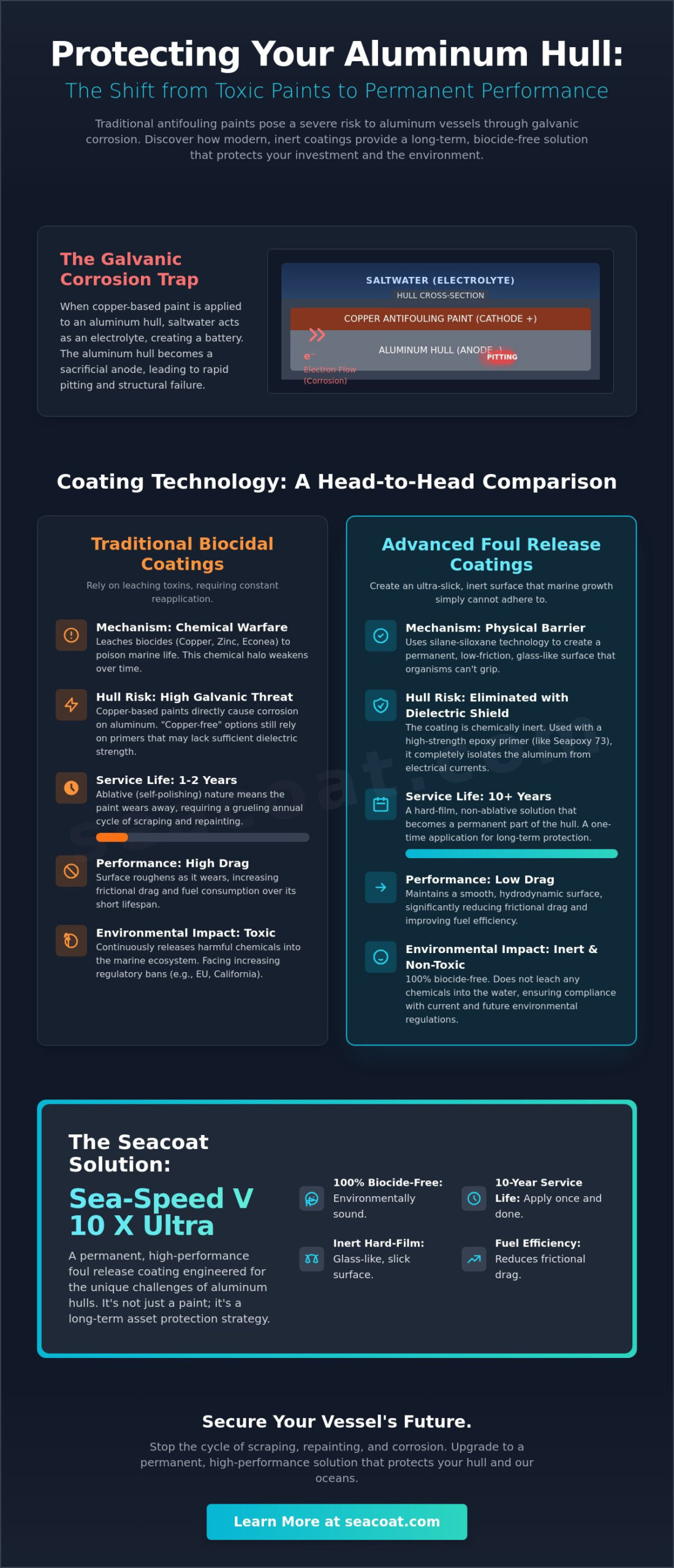
The primary conflict arises from the use of Anti-fouling paint that relies on cuprous oxide. When copper-based biocides are applied to an aluminum surface, the saltwater acts as an electrolyte to complete a galvanic circuit. In this scenario, the aluminum hull becomes a sacrificial anode, donating electrons to the copper cathode. This process leads to rapid, localized corrosion known as pitting. Pitting can penetrate deep into the alloy, compromising the hull’s integrity long before the damage is visible on the surface.
Understanding Galvanic Corrosion in Aluminum Hulls
Galvanic corrosion is an electrochemical process where one metal corrodes preferentially when it’s in electrical contact with another, more noble metal in the presence of an electrolyte. In marine settings, seawater provides the perfect medium for this electron flow. Even if you don’t use copper paint, stray current from shore power or neighboring boats can accelerate this degradation. Traditional primers often lack the necessary dielectric strength to fully insulate the hull, leaving the metal exposed to microscopic electrical exchanges that cause structural fatigue over time.
The Limitations of Traditional Antifouling Methods
Many “aluminum-safe” biocidal paints have entered the market, typically replacing copper with zinc pyrithione or organic biocides like Econea. While these formulations prevent immediate galvanic disaster, they remain sacrificial, ablative solutions. They’re designed to wear away, meaning they require frequent scraping and reapplication. This cycle is both labor-intensive and environmentally taxing. Regulatory pressure is also mounting. Following the EU’s 2023 ban on cybutryne and Germany’s 2025 ChemBiozidDV ordinance, the industry is moving away from chemical leaching entirely. Choosing a truly non-toxic bottom paint for aluminum boats is no longer a niche preference; it’s a strategic move to ensure long-term regulatory compliance and hull longevity.
Decoding ‘Non-Toxic’: Copper-Free vs. Truly Inert Coatings
The marine industry often uses “copper-free” as a synonym for “safe,” but this is a technical oversimplification that boat owners should scrutinize. While removing copper eliminates the immediate risk of galvanic corrosion, many copper-free alternatives still rely on chemical biocides to function. Finding a high-performance non-toxic bottom paint for aluminum boats requires looking beyond the absence of heavy metals to the presence of truly inert technology. The distinction lies in the mechanism of action: one kills, while the other simply denies adhesion.
Choosing an inert coating isn’t merely an environmental gesture; it’s a significant performance upgrade. Traditional biocidal paints are designed to be chemically active, which means they’re fundamentally unstable. They’re engineered to leach, wear away, and eventually fail. In contrast, an inert hard-film coating provides a stable, glass-like surface that doesn’t change over time. This stability ensures that the hull remains protected and hydrodynamic for years, rather than months. For operators seeking a long-term strategic asset, transitioning to Sea-Speed V 10 X Ultra represents a move toward permanent hull efficiency.
The Problem with Biocides (Econea and Zinc)
Most copper-free paints currently on the market utilize biocides like Econea (tralopyril) or zinc pyrithione. These chemicals work by creating a toxic “halo” around the hull to poison marine organisms before they can attach. While biocidal paints work by continuously releasing chemical agents to kill potential settlers, inert coatings utilize physical surface energy to prevent attachment without biological impact. In 2026, the environmental footprint of these leaching chemicals is under increased scrutiny, as even copper-free toxins can accumulate in sediment and affect non-target aquatic species. Furthermore, because these paints must leach to work, they’re inherently temporary and require frequent reapplication.
Silane-Siloxane: The Science of Non-Stick Hulls
The technology behind Sea-Speed V 10 X Ultra utilizes a sophisticated silane-siloxane chemistry that creates a molecular bond with the hull. This process results in a hard-film surface with extremely low surface energy. Organisms like barnacles and algae simply can’t find a mechanical grip on the glass-like finish. This 100% solids, zero-VOC (Volatile Organic Compound) formulation offers several advantages:
- Zero Degradation: Because the coating is inert, it doesn’t lose thickness or “chalk” over time like ablative paints.
- Mechanical Durability: The hard-film finish resists damage from floating debris and can be scrubbed without releasing toxins.
- Hydrodynamic Efficiency: The ultra-smooth surface reduces frictional drag, leading to measurable fuel savings and higher top speeds.
By moving away from the “leach and replace” cycle, aluminum boat owners can achieve a level of protection that is both structurally superior and ecologically responsible. The transition to biocide-free technology isn’t just about compliance; it’s about optimizing the vessel’s operational life.
Hard-Film Foul Release vs. Traditional Ablative Paints
Choosing between a hard-film foul release and a traditional ablative paint is a decision between long-term asset management and short-term maintenance cycles. Ablative paints operate on a “self-polishing” principle, where the coating slowly erodes to reveal fresh biocide. While this prevents paint buildup, it creates a surface that becomes increasingly rough at a microscopic level. This roughness increases frictional drag. In contrast, a high-performance non-toxic bottom paint for aluminum boats provides a permanent, hard-film finish that remains smooth throughout its service life. This fundamental difference in surface topography dictates the vessel’s speed, fuel efficiency, and overall operational cost.
The durability of these systems is the most significant factor for return on investment. Most ablative coatings require annual or biennial reapplication, involving costly haul-outs, hull preparation, and labor. A hard-film system like Sea-Speed V 10 X Ultra is engineered for a 10-year service life. This longevity eliminates the repetitive expenses associated with traditional bottom maintenance. Instead of seasonal repainting, maintenance shifts to simple in-water cleaning; the slick surface allows biofouling to be wiped away with minimal effort. This shift from a “leach and replace” model to a “clean and maintain” strategy provides a predictable, long-term return on investment.
The Hidden Costs of Ablative Bottom Paint
Traditional bottom paints carry liabilities that extend beyond the initial purchase price. As the paint wears away, it releases toxic particles into the marina environment, creating a hazardous byproduct that is increasingly regulated. The performance penalty is equally concerning. As the hull surface roughens due to uneven erosion, the engine must work harder to overcome drag. This results in a measurable increase in fuel consumption. For aluminum vessel operators, the cumulative cost of extra fuel and frequent dry-docking often exceeds the upfront investment of a superior foul-release coating.
Performance Gains with Sea-Speed V 10 X Ultra
Optimizing the hydrodynamic profile of an aluminum hull leads to immediate gains in vessel speed. Because Sea-Speed V 10 X Ultra creates an exceptionally smooth finish, it reduces the energy required to move the boat through the water. Owners of aluminum powerboats and tenders often report significant speed increases and reduced engine strain. This efficiency is a direct result of the coating’s low surface energy and physical durability. For a deeper analysis of the relationship between surface science and operational costs, consult The Definitive Guide to Boat Hull Paint. Switching to a non-toxic bottom paint for aluminum boats isn’t just an ecological choice; it’s a performance strategy that enhances the vessel’s capabilities while protecting the environment.
Application and Maintenance for Maximum Longevity
Successful installation of a high-performance non-toxic bottom paint for aluminum boats begins with rigorous surface engineering. It isn’t enough to simply apply the coating; you must create a stable, chemically receptive substrate. For aluminum, this means more than just cleanliness. It requires total isolation of the metal from the marine environment. This process transforms the hull from a reactive alloy into a stable, protected asset capable of withstanding the harshest conditions.
Before the final foul-release layer is applied, establishing a dielectric barrier is mandatory. We recommend Seapoxy 73 for this critical role. It serves as a high-build epoxy insulator that prevents electrical exchange between the hull and the water. Without this foundational layer, even the most advanced foul-release technology cannot protect against the stray currents that lead to structural pitting. Proper application requires a controlled environment where relative humidity stays below 85% and the substrate temperature remains at least 5 degrees above the dew point. These parameters ensure the molecular bonding process occurs correctly, resulting in the glass-like finish required for peak efficiency.
Surface Preparation: The Key to Adhesion
Complete removal of existing antifouling is mandatory. Hard-film coatings like Sea-Speed V 10 X Ultra cannot be applied over soft, ablative paints because the underlying layer will eventually delaminate and compromise the entire system. Mechanical preparation through abrasive blasting or sanding is preferred over chemical stripping to ensure the metal is free of oxidation and contaminants. Achieving a specific surface profile, or anchor pattern, of 1.5 to 2.5 mils is essential to ensure a permanent mechanical bond between the aluminum and the primer.
Long-Term Maintenance and In-Water Cleaning
Maintaining a foul-release surface is significantly easier than managing traditional paints, but it requires a specific technique. You should never use abrasive brushes, metal scrapers, or high-pressure washers. These tools can micro-scratch the silane-siloxane surface, creating sites where organisms can eventually gain a foothold. Instead, utilize the “wipe-away” method with a soft sponge or cloth to remove light biofouling and slime. This gentle approach preserves the low-surface-energy properties of the coating. For more detailed insights on selecting the right product for your vessel, see our guide on the Best Boat Paint for Aluminum Boats.
To secure a durable, biocide-free future for your vessel and ensure maximum hull longevity, explore our full range of protective coatings today. Transitioning to a professional-grade system is a one-time investment that pays dividends through reduced maintenance and enhanced performance for years to come.
The Seacoat Solution: Sea-Speed V 10 X Ultra for Aluminum
For operators of aluminum vessels, the search for a high-performance non-toxic bottom paint for aluminum boats concludes with a shift toward advanced silane-siloxane technology. Sea-Speed V 10 X Ultra isn’t merely a coating; it’s a strategic asset designed to solve the inherent conflicts between aluminum and the marine environment. By creating a permanent dielectric shield, this system provides a level of isolation that traditional biocidal paints cannot match. This shield prevents the electrochemical exchange that leads to pitting, ensuring the metal remains structurally sound throughout its operational life.
The confidence in this technology is backed by a 10-year warranty, a testament to the hard-film durability of the silane-siloxane matrix. Unlike ablative coatings that require seasonal maintenance, this biocide-free solution resists UV degradation and mechanical abrasion. It maintains its glass-like finish for a decade, providing a predictable and high-ROI lifecycle for the vessel owner. Transitioning to such a system represents a move away from the “planned obsolescence” of traditional marine paints toward a permanent, performance-enhancing tool.
Why Commercial and Military Fleets Trust Seacoat
Commercial and military sectors operate under the most demanding conditions, where downtime is a significant financial liability. These fleets have increasingly adopted Sea-Speed V 10 X Ultra to meet strict environmental regulations without sacrificing top-end speed or fuel efficiency. Performance data from aluminum military craft and commercial tenders demonstrate that these vessels maintain their hydrodynamic profile over extended dry-docking intervals. The low-friction surface reduces drag, allowing engines to operate at lower RPMs while maintaining mission-critical speeds. This strategic advantage is essential for high-stakes operations where reliability and regulatory compliance are non-negotiable.
Getting Started with Your Hull Upgrade
Upgrading your vessel to a non-toxic bottom paint for aluminum boats requires a calculated approach to material application. To determine the quantity of coating needed, you must first calculate the wetted surface area of your hull. A standard formula for this is (Length at Waterline x (Beam + Draft) x 0.85), though specific hull shapes may require more precise measurements. Once you have established the surface area, you can choose between working with authorized applicators for large-scale projects or utilizing DIY kits for smaller vessels.
Establishing a sustainable hull protection strategy is a critical component of modern vessel management. To understand the broader industry transition toward biocide-free technology, explore our comprehensive analysis of Environmental Marine Coatings. By adopting these advanced materials today, you ensure that your aluminum vessel remains efficient, compliant, and structurally secure for the next decade of service.
Securing the Future of Your Aluminum Hull
Transitioning from sacrificial, leaching biocides to an inert hard-film system is a fundamental shift in marine asset management. By prioritizing a dielectric barrier and a low-friction surface, you eliminate the threat of galvanic corrosion while optimizing the hydrodynamic profile of your vessel. Choosing a non-toxic bottom paint for aluminum boats is no longer just about environmental compliance; it’s about the technical preservation of the alloy and the long-term efficiency of your operations.
Our Zero-VOC, biocide-free technology delivers proven speed and fuel efficiency gains that traditional paints cannot match. With a 10-year service life warranty, Sea-Speed V 10 X Ultra provides a permanent solution for stakeholders who value long-term return on investment and ecological stewardship. You don’t have to sacrifice durability for environmental safety; the two are synergistic in a well-engineered hull protection strategy. It’s time to move beyond temporary fixes and invest in a strategic asset that protects both your vessel and the marine ecosystem.
Upgrade your aluminum boat with Sea-Speed V 10 X Ultra today to ensure your vessel remains a high-performance, structurally sound asset for years to come.
Frequently Asked Questions
Is copper-free bottom paint truly safe for all aluminum boats?
Yes, copper-free formulations are significantly safer than traditional copper-based paints because they eliminate the primary catalyst for galvanic corrosion. However, many copper-free options still utilize active biocides that require a thick barrier coat to protect the hull. A truly non-toxic bottom paint for aluminum boats is the optimal choice since it’s chemically inert and doesn’t rely on leaching toxins to prevent fouling.
How does non-toxic foul release paint actually stop barnacles?
Non-toxic coatings stop barnacles by creating a surface with extremely low surface energy that prevents mechanical adhesion. Instead of poisoning marine life, the silane-siloxane technology creates a glass-like finish that is too slick for larvae to grip. When the boat moves through the water, the resulting hydrodynamic pressure causes any loosely attached growth to simply slide off the hull.
Can I apply Sea-Speed V 10 X Ultra over my existing bottom paint?
No, you cannot apply this hard-film coating over existing ablative or soft antifouling paints. The underlying layers must be completely removed to ensure a permanent bond with the aluminum substrate. Applying a high-performance system over unstable, old paint would eventually lead to delamination. Successful installation requires a clean, mechanically prepared surface to achieve the necessary molecular adhesion.
Does a non-toxic coating require a special primer for aluminum?
Yes, a high-performance dielectric primer is essential when coating aluminum hulls to ensure total electrical insulation. We recommend Seapoxy 73 to establish a robust barrier that prevents galvanic activity. This primer layer acts as the foundation for the foul-release system, providing the specific surface profile needed for the final coating to bond effectively while protecting the metal from pitting.
How much fuel can I realistically save with a hard-film coating?
Fuel savings depend on vessel type and usage, but the reduction in frictional drag typically leads to measurable efficiency gains. By maintaining an ultra-smooth hull surface, the engine requires less energy to overcome water resistance. Many commercial operators report significant fuel reductions compared to traditional ablative paints, which become progressively rougher and less efficient as they wear away over time.
What happens if the coating gets scratched or damaged?
If the hard-film coating is scratched, the damaged area should be cleaned and touched up to maintain the dielectric shield. Unlike soft silicone coatings that can peel away once compromised, Sea-Speed V 10 X Ultra is a durable finish that remains localized if impacted. Minor surface scratches usually don’t affect the overall foul-release properties of the surrounding area.
Is Sea-Speed V 10 X Ultra compliant with 2026 environmental regulations?
Yes, it’s fully compliant with global standards, including the 2026 environmental landscape. Because it’s a biocide-free and zero-VOC formulation, it exceeds the requirements set by the EU’s ban on cybutryne and California’s copper leach rate limits. It provides a future-proof solution for boat owners navigating the increasing regulatory pressure to eliminate toxic discharges in sensitive marine ecosystems.
How do I clean my boat hull if it has a non-toxic foul release coating?
Cleaning a non-toxic bottom paint for aluminum boats requires only a soft sponge or cloth and gentle wiping. You must avoid abrasive brushes or high-pressure washers that could micro-scratch the surface finish. Because the coating is inert and non-stick, light biofouling and slime don’t firmly attach and can be removed easily while the boat is in the water without releasing harmful chemicals.