
What if the most effective way to eliminate Port State Control detention risk isn’t found in a digital logbook, but in the molecular structure of your hull coating? As the December 31, 2026, deadline for enhanced enforcement approaches, navigating EU ship recycling regulation for coatings has become a critical challenge for fleet managers facing a 15% rise in IHM-related survey expenses. You’re likely already feeling the pressure of tracking hazardous substances across a global fleet while managing the threat of unexpected detentions due to minor documentation errors.
We agree that the current regulatory landscape is increasingly fragmented and technically demanding for even the most experienced naval engineers. This guide will show you how to master the complexities of EU SRR and IHM compliance by demonstrating how your choice of hull coating dictates your long-term regulatory burden. We’ll examine how transitioning to biocide-free, siloxane-based technologies simplifies IHM documentation and reduces long-term operational risk before the 2026 inspection cycle begins.
Key Takeaways
- Understand the critical intersection between EU SRR frameworks and the Inventory of Hazardous Materials (IHM) to ensure seamless fleet operations through 2026.
- Master the complexities of navigating EU ship recycling regulation for coatings by implementing standardized protocols for collecting Material Declarations and Supplier’s Declarations of Conformity.
- Identify the prohibited substances and restricted biocides that increase regulatory overhead and complicate long-term asset life-cycle management.
- Discover how transitioning from traditional ablative paints to hard-film foul release systems can significantly reduce the administrative burden and cost of IHM maintenance.
- Learn why biocide-free Silane-Siloxane technology offers an inherently compliant, zero-declaration solution for future-proofing your vessel’s environmental and operational profile.
Understanding the EU Ship Recycling Regulation (EU SRR) and IHM
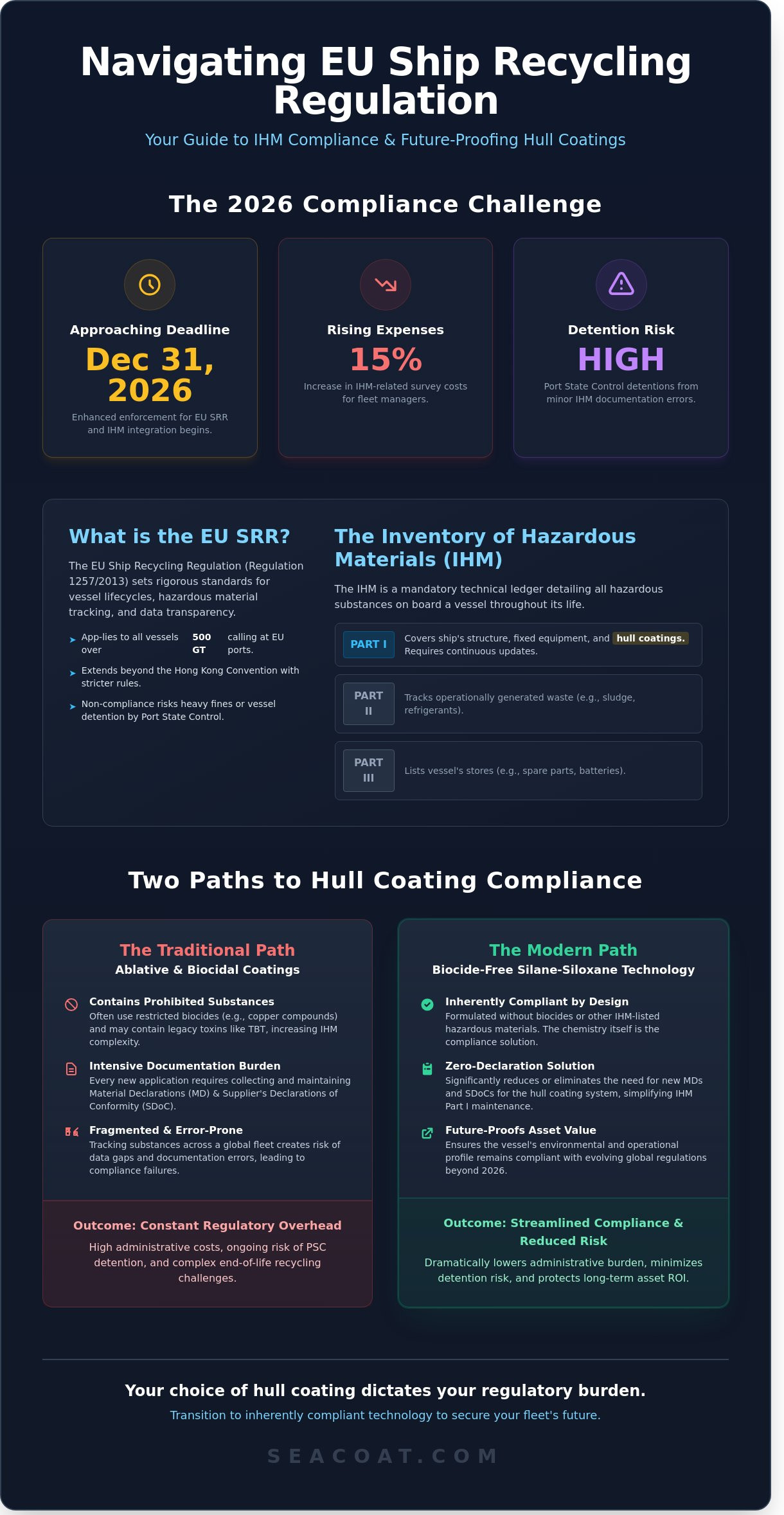
The EU Ship Recycling Regulation (EU SRR) represents a strategic shift in how the maritime industry manages vessel lifecycles. It builds upon the 2009 Hong Kong Convention but introduces more rigorous standards for data transparency and hazardous material tracking. For shipowners, navigating EU ship recycling regulation for coatings isn’t a peripheral concern; it’s a core operational requirement. By the start of 2026, the industry will face a regulatory climate defined by digital IHM integration and enhanced Port State Control (PSC) scrutiny. This shift ensures that every gram of hazardous material is accounted for long before a ship reaches a recycling facility.
The framework establishes a clear link between a vessel’s current performance and its eventual decommissioning. Understanding Ship Recycling and the environmental risks associated with legacy coating systems is foundational for modern fleet management. As global standards align, the 2026 landscape will prioritize vessels that utilize biocide-free, non-toxic technologies. This isn’t just about compliance. It’s about protecting the long-term ROI of the asset by ensuring it remains welcome in any international port.
What is the Inventory of Hazardous Materials (IHM)?
The IHM acts as a technical ledger for every hazardous substance onboard. It’s divided into three distinct sections. Part I covers the ship’s structure and fixed equipment. Part II tracks operationally generated waste, and Part III lists stores. Hull coatings are a central focus of Part I documentation because legacy anti-fouling systems often contained harmful biocides. Under the current framework, owners must maintain a continuous update cycle. When a vessel undergoes a dry-docking cycle, every new coating layer must be documented with a Material Declaration (MD) and a Supplier’s Declaration of Conformity (SDoC). This ensures the vessel’s documentation remains accurate throughout its service life.
Jurisdictional Reach of EU SRR
The reach of the EU SRR extends far beyond European borders. While EU-flagged ships must comply regardless of their location, third-party vessels calling at EU ports or anchorages are also subject to these rules. This includes any vessel over 500 GT. Non-EU operators risk heavy fines or vessel detention during PSC inspections if their IHM is outdated or missing. Recognized Organizations (ROs) play a critical role here, as they’re responsible for verifying IHM Part I and issuing the Statement of Compliance (SoC). Precise documentation is the only way to avoid the administrative bottlenecks that occur when coating chemistry is poorly defined. Navigating EU ship recycling regulation for coatings requires a proactive approach to chemical transparency from the moment a coating is specified.
- Regulation 1257/2013: The primary EU legislation governing ship recycling and hazardous material inventories.
- 500 GT Threshold: The minimum vessel size required to maintain a certified IHM for EU port entry.
- Maintenance Cycle: The mandatory process of updating the IHM whenever equipment or coatings are replaced.
Hazardous Materials in Marine Coatings: Prohibitions and Restrictions
Navigating EU ship recycling regulation for coatings demands more than just a surface-level review of current inventory. It’s a deep dive into the chemical composition of every layer applied over a vessel’s lifespan. The EU Ship Recycling Regulation (EU SRR) extends beyond the global IMO AFS Convention by mandating a comprehensive Inventory of Hazardous Materials (IHM) that includes substances like Polychlorinated Biphenyls (PCBs) and specific heavy metals often ignored in standard anti-fouling discussions. This regulatory framework ensures that when a ship reaches its end-of-life, the recycling facility can manage the toxicological profile of the hull without risking worker safety or environmental leakage.
Prohibited Anti-Fouling Systems
Organotin compounds, specifically Tributyltin (TBT), represent the most notorious entry on the prohibited list. These biocides were engineered for extreme toxicity to marine growth but caused catastrophic endocrine disruption in non-target species. While the 2008 global ban stopped new applications, TBT remains a legacy hazard trapped beneath layers of newer paint. The regulatory focus has now shifted to Cybutryne, a triazine herbicide used to control algal fouling. Effective January 1, 2023, the ban on Cybutryne requires vessels to either remove the coating or apply a sealer coat by the next scheduled dry-docking, with full compliance mandated by 2026. Transitioning to biocide-free foul release systems eliminates these toxicological risks entirely while optimizing hydrodynamic performance.
Restricted Substances: PCBs and Heavy Metals
The EU SRR requires the declaration of substances that traditional maintenance cycles often overlook. PCBs were frequently used as plasticizers in anti-corrosive coatings and cable insulation before being phased out in the late 20th century. Under current guidelines, any coating containing PCBs at a concentration at or above 50 mg/kg must be documented in the IHM. Heavy metals pose a similar challenge for compliance officers. Lead, Mercury, and Hexavalent Chromium are common in legacy primers and specialized coatings. For instance, Lead must be declared if it exceeds the threshold value of 1,000 mg/kg (0.1% by weight). These materials aren’t just environmental hazards; they’re liabilities that increase the complexity of recycling and maintenance.
Volatile Organic Compounds (VOCs) also represent a hidden operational risk. Traditional systems often rely on high-solvent formulations that off-gas during application and curing. Modern siloxane-based technologies mitigate these risks by providing a non-toxic, zero VOC alternative. This shift doesn’t just satisfy the IHM requirements; it simplifies the entire regulatory reporting process by removing hazardous chemistry from the ship’s profile. Choosing a high-performance, biocide-free coating is a strategic decision that secures the asset’s value through its final voyage.
Step-by-Step: Navigating IHM Compliance for Hull Coatings
Compliance isn’t a one-time event; it’s a continuous data-management exercise. For shipowners and fleet managers, navigating EU ship recycling regulation for coatings requires a shift from reactive maintenance to proactive asset management. This begins with establishing a procurement protocol that prioritizes non-toxic, siloxane-based technologies over traditional biocidal systems. By 2026, the margin for error in inventory management will vanish, making it essential to vet every gallon of paint against the prohibited list of hazardous materials.
Effective IHM management starts during the specification phase. Owners must demand transparency from their coating partners, ensuring that every product delivered to the shipyard includes a verified chemical profile. This isn’t just about environmental stewardship; it’s about protecting the vessel’s residual value. A “clean” Inventory of Hazardous Materials (IHM) makes the eventual recycling process safer and more cost-effective, preventing the heavy financial penalties associated with contaminated hulls.
The Documentation Trail: MDs and SDoCs
The Material Declaration (MD) and Supplier’s Declaration of Conformity (SDoC) serve as the primary evidence for regulatory audits. These documents must adhere to the standardized formats defined by the International Maritime Organization guidelines under Resolution MEPC.379(80). When navigating EU ship recycling regulation for coatings, technical teams must verify that suppliers aren’t just claiming biocide-free status but are providing the specific chemical breakdowns to prove it. A robust archive of these records must follow the vessel throughout its service life. This documentation is vital during ownership transfers or flag changes, where missing records can trigger expensive delays or mandatory re-sampling of the entire hull surface.
Sampling and Analysis Protocols
Visual inspections rarely suffice for hull coatings. Laboratory analysis becomes mandatory if documentation is missing or if the vessel was built before 2011. Certified IHM Experts conduct onboard surveys, taking physical scrapings of the coating system to check for organotin compounds or prohibited anti-fouling agents. Legacy layers present the greatest risk. Simply over-coating a hazardous layer with a modern foul release system doesn’t remove the liability. During dry-docking intervals, management must decide between full grit-blasting to achieve a clean hull or maintaining detailed records of encapsulated hazardous materials.
Managing the IHM during maintenance intervals requires strict supervision. Every time a vessel enters dry-dock, the inventory must be updated to reflect new applications. If a crew applies an unverified coating for minor repairs, the entire IHM certificate could be invalidated. For vessels aiming for 10-year life cycles, using a hard-film, zero-VOC solution minimizes the need for frequent touch-ups, thereby reducing the volume of new documentation required. This strategic approach ensures the vessel remains compliant while optimizing hydrodynamic performance and reducing long-term maintenance costs.
The Strategic Impact of Coating Choice on Life-Cycle Compliance
Shipowners are recognizing that surface treatment choice dictates more than just hull integrity. It defines the complexity of the Inventory of Hazardous Materials (IHM) under the EU Ship Recycling Regulation (SRR). Navigating EU ship recycling regulation for coatings requires a shift from viewing paint as a consumable to treating it as a long-term compliance asset. When a vessel reaches its end-of-life stage, the presence of heavy metals or prohibited biocides in the coating layers can transform a routine recycling process into a high-cost hazardous waste mitigation project.
Ablative vs. Permanent Coatings
Traditional ablative bottom paint operates on a sacrificial cycle, constantly shedding layers to reveal fresh biocides. This mechanism creates a moving target for IHM documentation. Each dry-docking requires meticulous recording of new chemical compositions, increasing the administrative burden on expert surveyors. In contrast, permanent foul-release systems provide a stable 10-year life cycle. These non-toxic, hard-film systems don’t leach regulated substances, which simplifies the IHM maintenance process and provides a predictable ROI through reduced recoating frequency and streamlined regulatory audits.
The link between environmental marine coatings and EEXI/CII compliance is equally critical for operational efficiency. Data from industry trials shows that silicone-based foul release systems can maintain a surface roughness as low as 20-30 microns, whereas traditional ablative coatings often exceed 150 microns after several years of service. This hydrodynamic advantage reduces drag, potentially lowering fuel consumption and carbon emissions by 6% to 10%. For vessels struggling to meet their Carbon Intensity Indicator (CII) targets, the right coating isn’t just an environmental choice; it’s a performance necessity.
Reducing the Terminal Recycling Cost
Toxic coatings significantly inflate the cost of shipbreaking at EU-approved facilities. When a hull is coated with biocide-heavy materials, the resulting scrapings must be handled as hazardous waste, often incurring disposal fees that are 40% higher than non-toxic waste streams. By maintaining a biocide-free hull, owners facilitate safer dismantling conditions for shipyard workers, protecting them from the respiratory risks associated with grinding organotin or copper-based residues. A clean IHM, often referred to as a Green Passport, ensures the vessel retains higher residual value at the end of its service life.
- Reduced Survey Costs: Non-toxic hulls require fewer laboratory samples during IHM re-certifications.
- Operational Simplicity: Smooth hulls satisfy the “Clean Hull” requirements for recycling facilities more easily than pitted, fouled surfaces.
- Worker Safety: Eliminating biocides reduces the need for specialized PPE and containment during the dismantling phase.
Navigating EU ship recycling regulation for coatings is a strategic exercise in risk mitigation. By selecting high-performance, non-toxic systems today, fleet managers ensure their vessels remain compliant with both current emissions standards and future recycling mandates.
Future-Proofing with SeaCoat: Inherently Compliant Hull Technology
Sea-Speed V 10 X Ultra represents a fundamental shift in how the maritime industry approaches hull protection. As a biocide-free Silane-Siloxane solution, it doesn’t function through the depletion of toxic chemicals or heavy metals. Instead, its non-stick properties rely on a sophisticated molecular structure that prevents biofouling through physical rather than chemical means. This distinction is critical when navigating EU ship recycling regulation for coatings. Because the formulation is inherently inert, SeaCoat products require zero IHM hazardous material declarations. You won’t need to document the presence of organotin compounds, cybutryne, or other prohibited substances because they aren’t part of the chemistry.
The technical superiority of Sea-Speed V 10 X Ultra lies in its hard-film durability. While traditional soft-foul release systems are often prone to mechanical damage during port operations or hull cleaning, this silane-based technology creates a robust finish that resists abrasion. It’s a zero-VOC solution that prioritizes environmental safety without compromising on physical protection. By integrating non-toxic marine hull coatings into your fleet, you’re streamlining your 2026 compliance strategy from the start. You’re moving away from a cycle of continuous monitoring toward a state of inherent regulatory alignment.
The Silane-Siloxane Advantage
Chemical stability is the hallmark of the Silane-Siloxane bond. These coatings don’t leach substances into the marine ecosystem, ensuring that your vessel remains compliant with EMSA and IMO standards throughout its entire service life. Beyond compliance, the performance metrics are quantifiable. The ultra-smooth surface reduces hydrodynamic drag, which can lead to fuel savings of up to 12% in specific vessel classes. It’s a permanent solution that maintains its integrity for over ten years, providing a clear ROI through reduced maintenance intervals and optimized fuel consumption. It turns a regulatory requirement into a performance advantage.
Implementation for Fleet Managers
Transitioning your fleet to Sea-Speed is most effective during scheduled dry-docks. The application process is straightforward, but the long-term administrative benefits are where technical superintendents find the most value. You’ll eliminate the need for recurring hazardous material testing and the associated paperwork required by the EUSRR for the underwater hull. This proactive approach ensures that when a vessel eventually reaches the end of its life, the hull coating isn’t a liability. It’s a clean asset that simplifies the recycling process. Consult with SeaCoat experts on your IHM compliance strategy to begin your transition to a biocide-free future.
Securing Compliance and Performance for the 2026 Regulatory Landscape
Compliance with the EU Ship Recycling Regulation isn’t just a paperwork exercise; it’s a fundamental shift in how we manage vessel lifecycles. By 2026, the maritime industry must move beyond reactive maintenance toward proactive material management. Successfully navigating EU ship recycling regulation for coatings requires a precise understanding of the Inventory of Hazardous Materials (IHM) and a commitment to eliminating restricted substances like organotin and cybutryne. These regulatory hurdles offer a distinct opportunity to adopt superior technology that benefits both the balance sheet and the environment.
SeaCoat has pioneered this transition since 2001, offering a siloxane-based technology that’s been in commercial use for over two decades. Our formulations are entirely biocide-free and contain zero VOCs, ensuring they meet the strictest global environmental standards without sacrificing hydrodynamic efficiency. With a documented 10-year life cycle performance, these coatings provide the long-term reliability required for modern fleet management. Choosing the right surface technology today ensures your vessels remain compliant throughout their entire operational life. Download our Technical Guide to IHM-Compliant Coatings to optimize your fleet’s regulatory strategy. Transitioning to inherently compliant technology protects your assets and the oceans they navigate.
Frequently Asked Questions
Does the EU Ship Recycling Regulation apply to vessels registered outside the EU?
Yes, the EU Ship Recycling Regulation (EU SRR) applies to all third-party vessels exceeding 500 GT that call at an EU port or anchorage. While the flag state might be outside the European Union, these ships must carry a valid Inventory of Hazardous Materials (IHM) that meets the standards of Regulation (EU) No 1257/2013. Non-compliance risks operational delays during Port State Control inspections across the 27 EU member states.
What is the difference between the IHM and the Green Passport?
The Inventory of Hazardous Materials (IHM) replaced the obsolete Green Passport under the Hong Kong Convention and EU SRR frameworks. While the Green Passport was a voluntary guideline, the IHM is a mandatory, dynamic document that tracks hazardous substances throughout a ship’s lifecycle. Since December 31, 2020, the Green Passport is no longer recognized as a valid compliance document for vessels entering EU waters.
Which specific hull coating biocides are currently banned under EU SRR?
Organotin compounds, specifically Tributyltin (TBT), and Cybutryne are the primary prohibited substances under current regulations. TBT has been banned globally since 2008, while Cybutryne application was prohibited as of January 1, 2023. Navigating EU ship recycling regulation for coatings requires selecting biocide-free or compliant siloxane technologies that don’t utilize these restricted chemical compounds, ensuring both regulatory adherence and hydrodynamic efficiency.
How often does a ship’s IHM need to be updated for hull coatings?
You must update the IHM throughout the vessel’s entire operational life whenever a change in the coating system occurs. If 100% of the hull coating in a specific area is replaced during dry-docking, the inventory must reflect the new chemical composition via a Material Declaration. Maintaining an accurate IHM is a strategic asset for fleet managers who prioritize long-term asset value and seamless regulatory transitions.
Can a ship be detained in an EU port for IHM non-compliance?
Yes, Port State Control (PSC) officers have the legal authority to detain any vessel that fails to produce a valid IHM or Statement of Compliance. In 2021 alone, multiple vessels faced significant fines or detention for failing to meet the December 2020 deadline. Ensuring your coatings are documented with a Material Declaration (MD) is critical to avoiding these costly administrative and operational bottlenecks.
How do I obtain a Material Declaration (MD) for my marine paint?
You must request a Material Declaration (MD) and a Supplier’s Declaration of Conformity (SDoC) directly from your coating manufacturer. These documents should follow the format specified in IMO Resolution MEPC.379(80). At SeaCoat, we provide comprehensive technical data and MDs for our foul-release systems, ensuring that your IHM remains compliant with the latest environmental standards and chemical restrictions.
What are the IHM requirements for newbuilds compared to existing ships?
Newbuilds must have a certified IHM that identifies all hazardous materials listed in Appendices 1 and 2 of the EU SRR at the time of delivery. Existing ships were required to comply by December 31, 2020, by developing an IHM based on a sampling plan and expert survey. While newbuilds integrate this data during construction, existing vessels often require more intensive retrospective analysis of their coating history.
Is Cybutryne banned in all marine coatings as of 2026?
Cybutryne is prohibited, and by 2026, all vessels must either have no Cybutryne on their hulls or apply a sealer coat to prevent leaching. According to IMO Resolution MEPC.331(76), this must be completed by the next scheduled survey after January 1, 2023, but no later than 60 months after the last application. Transitioning to advanced, non-toxic coatings ensures your fleet meets these 2026 requirements without additional remediation costs.