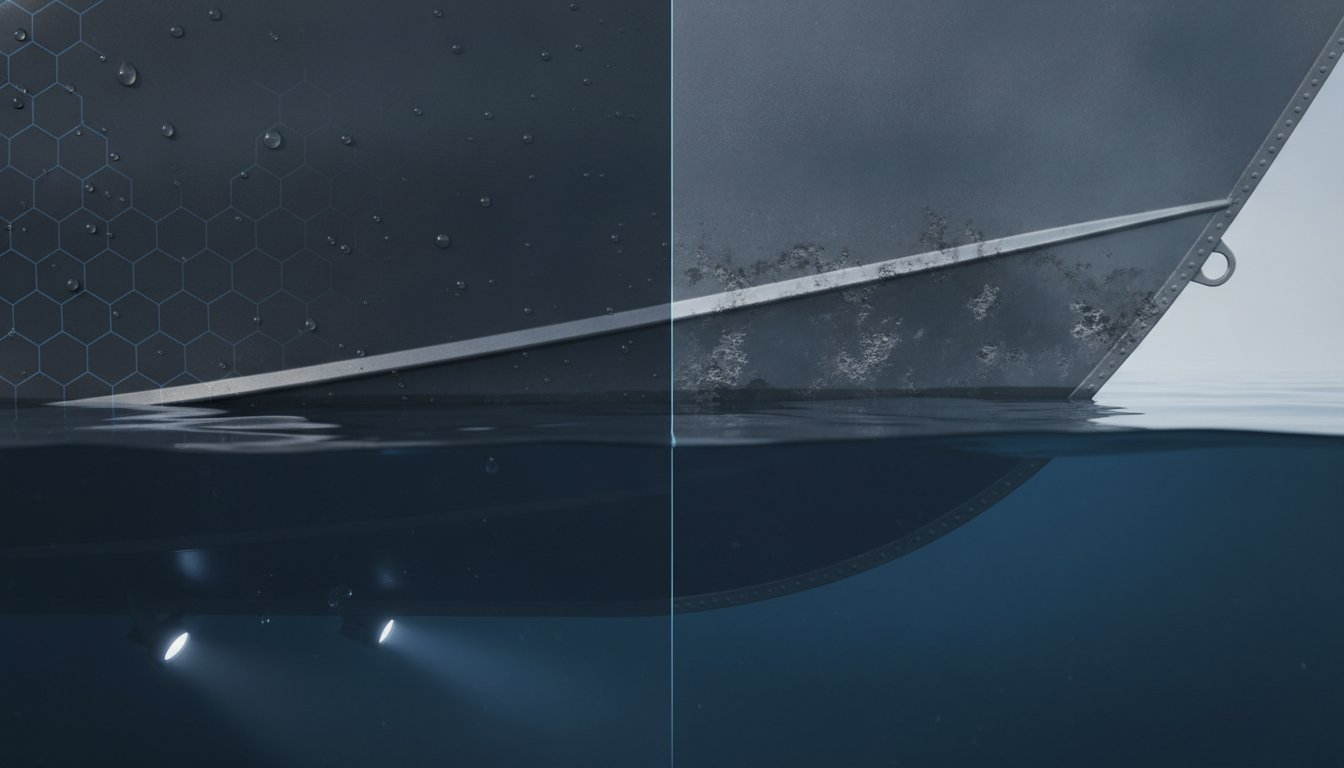
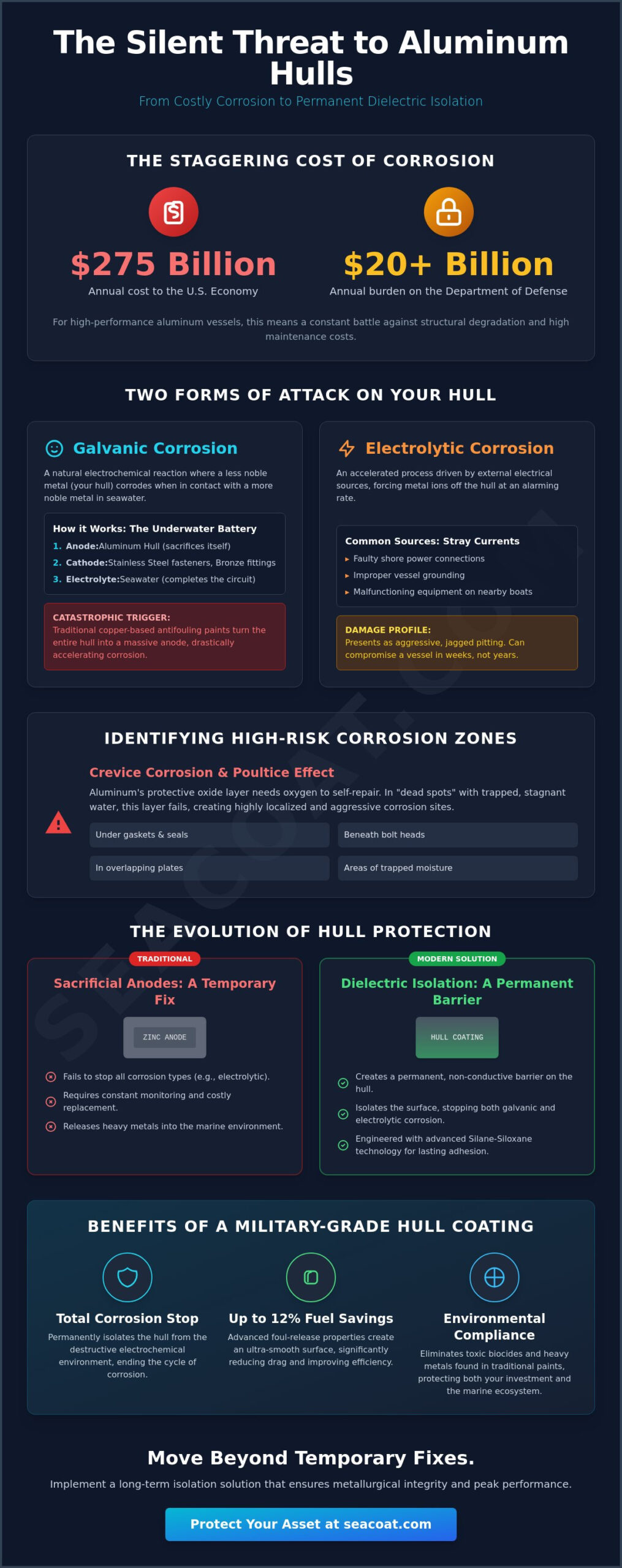
Corrosion costs the U.S. economy over $275 billion annually, with more than $20 billion of that burden falling on the Department of Defense alone. For high-performance aluminum vessels, these figures translate to a constant battle against structural degradation and the high maintenance costs of sacrificial anodes. If you’ve discovered unexplained pitting on your hull bottom despite regular maintenance, you’re facing a systemic failure of traditional protection methods. Transitioning to a high-dielectric military grade hull coating is the only way to move beyond temporary fixes and achieve permanent surface isolation.
It’s understandable to feel anxious about the long-term integrity of your assets when traditional paints fail to stop the electrochemical process. You’ll discover the precise scientific mechanisms behind aluminum corrosion and the advanced coating technologies required to isolate and protect hulls permanently. We’ll examine the chemistry of galvanic versus electrolytic corrosion, the performance metrics of silane-siloxane systems, and how to achieve up to 12% fuel savings while ensuring full environmental compliance. This technical overview provides the data-driven foundation needed to implement a long-term isolation solution that protects both your investment and the marine ecosystem.
Key Takeaways
- Analyze the electrochemical differences between galvanic and electrolytic processes to understand why the aluminum natural oxide layer fails in high-salinity environments.
- Identify high-risk zones where stagnant water and trapped chlorides create aggressive chemical environments through crevice corrosion and the poultice effect.
- Evaluate the transition from sacrificial anodes to permanent dielectric isolation using a military grade hull coating engineered with silane-siloxane technology.
- Master the critical hull preparation and application protocols necessary to achieve permanent chemical bonding on specialized aluminum substrates.
- Implement a long-term protection strategy that eliminates toxic biocides, ensuring both metallurgical integrity and compliance with evolving environmental regulations.
The Science of Aluminum Corrosion: Galvanic vs. Electrolytic Processes
Aluminum possesses an inherent ability to self-passivate, creating a thin, protective oxide layer when exposed to oxygen. This defense mechanism is remarkably effective in terrestrial environments but fails under the relentless chemical pressure of high-salinity marine conditions. In seawater, chloride ions penetrate the oxide film, initiating a localized breakdown that exposes the raw metal to aggressive oxidation. The rate of this degradation is dictated by the electrolyte’s properties. Increased salinity and higher temperature gradients significantly lower electrical resistance, facilitating a more rapid exchange of electrons between the hull and its environment.
The chemical stability of the hull depends entirely on its position within the galvanic series. Aluminum is a highly active metal, meaning it’s often the sacrificial victim when paired with more noble materials. When stainless steel fasteners or bronze fittings are installed without proper isolation, the aluminum substrate becomes the anode in a massive, underwater battery. This relationship results in a steady flow of electrons away from the aluminum, leading to rapid material loss and compromised structural integrity. To prevent this, engineers must look beyond simple barriers and implement a solution that offers total dielectric isolation.
Understanding the Galvanic Cell on Your Hull
A galvanic cell requires three distinct components: an anode, a cathode, and an electrical path provided by an electrolyte. In the study of Galvanic vs. Electrolytic Processes, it’s clear that the marine environment provides a perfect medium for these circuits to form. When dissimilar metals touch in the presence of salt water, the resulting current causes localized pitting, which can eat through a hull plate with surgical precision. This is why traditional copper-based antifouling paints are catastrophic for aluminum hulls. The copper in the paint acts as a cathode across the entire submerged surface, turning the aluminum hull into a massive anode. Utilizing a military grade hull coating like Sea-Speed V 10 X Ultra is the only scientifically sound method to break this circuit, as its non-conductive properties prevent the exchange of ions at the molecular level.
Stray Current Corrosion: A Hidden Threat
While galvanic corrosion is a natural chemical reaction, electrolytic corrosion is an accelerated process driven by external electrical sources. Modern marinas are often saturated with stray currents from faulty shore power connections, improper grounding, or malfunctioning bilge pumps on neighboring vessels. These currents turn the hull into an active participant in an external circuit, forcing metal ions off the substrate at an alarming rate. You can identify electrolytic damage by its visual characteristics; it often presents as aggressive, jagged pitting rather than the uniform surface thinning seen in natural oxidation. The speed of this destruction is far greater than natural processes, often compromising a vessel in weeks. Protecting against this requires a military grade hull coating that functions as a high-dielectric barrier, ensuring that external electrical paths cannot penetrate the protective film to reach the aluminum substrate.
Identifying High-Risk Areas: Crevice Corrosion and Poultice Effects
Aluminum’s survival in marine environments is a paradox of chemistry. While the metal relies on its natural oxide layer for protection, this defense mechanism requires a constant supply of oxygen to remain stable and self-repairing. When this supply is restricted in tight spaces or under saturated materials, the oxide layer fails to reform. This creates a highly localized anodic site where corrosion proceeds at an accelerated rate. These “dead spots” are often invisible from a distance but represent a significant threat to the vessel’s long-term structural integrity.
Crevice corrosion occurs in areas where stagnant water is trapped, such as under gaskets, bolt heads, or overlapping plates. In these micro-environments, the chemistry of the water changes as oxygen is consumed. The pH drops and chloride ions concentrate, turning the trapped fluid into an aggressive acid. Because the surrounding hull remains oxygenated and cathodic, the small anodic area in the crevice suffers deep, rapid pitting. Applying a military grade hull coating provides the necessary dielectric barrier to prevent these electrochemical circuits from ever establishing themselves in the first place.
The Bunk and Trailer Interface
The most common site for poultice corrosion is the interface between the hull and carpeted trailer bunks. Carpet acts as a sponge, holding salt-laden water against the metal long after the vessel has been pulled from the water. This creates a “poultice” that starves the aluminum of oxygen while maintaining a high concentration of chlorides. The problem is exacerbated by the use of CCA-treated lumber. The copper in the wood treatment is highly cathodic to aluminum, leading to a direct galvanic reaction that manifests as white, powdery deposits of aluminum hydroxide and deep, localized pits. Research from the Office of Scientific and Technical Information on Mitigation Strategies: Sacrificial Anodes and Dielectric Isolation confirms that without a permanent barrier, these areas remain in a state of constant decay. For those looking to secure these vulnerable zones, implementing a high-performance system like Sea-Speed V 10 X Ultra ensures the metal remains isolated from both moisture and treated timber.
Internal Corrosion: The Bilge and Structural Ribs
Internal corrosion is a hidden risk that many vessel operators ignore until structural failure occurs. Bilge water is rarely pure; it’s a cocktail of salt, fuel, and heavy metals that collects in the lowest points of the hull. As water evaporates, salt crystals concentrate beneath floorboards and along structural ribs, driving internal decay. In professional aluminum boat design, drainage and aeration are critical, yet stagnant pockets often persist around rivets and welds. These areas are prone to molecular stress corrosion, where the combination of chemical attack and mechanical vibration leads to cracks. Inspecting these zones requires a focus on the integrity of the joints and the presence of any surface irregularities that suggest the metal is being consumed from the inside out. A robust military grade hull coating applied during the build or a major refit is the most effective way to manage these internal risks permanently.
Mitigation Strategies: Sacrificial Anodes and Dielectric Isolation
Sacrificial protection operates on the fundamental principle of providing a more anodic material to the electrochemical circuit, effectively diverting the corrosive current away from the hull. While this has been the industry standard for decades, it’s essentially a strategy of managed failure. You’re allowing one metal to dissolve to save another. For aluminum hulls, the selection of the correct alloy is paramount. Using the wrong anode can either provide insufficient protection or cause over-protection issues, such as the formation of highly alkaline environments that actually attack the aluminum substrate. Modern engineering is shifting away from this reactive model toward proactive surface isolation.
The goal of a high-performance dielectric barrier is to break the electrical path between the metal and the seawater. When a hull is properly isolated, the demand on sacrificial anodes drops significantly, extending their service life and reducing maintenance costs. This approach moves the vessel’s defense from a consumable-based system to a permanent structural asset. By implementing a military grade hull coating, operators can achieve a level of protection that anodes alone cannot provide, especially in the presence of aggressive stray currents found in modern industrial harbors.
Anode Selection for Aluminum Hulls
Magnesium anodes are highly effective in freshwater due to their high driving voltage; however, they’re far too aggressive for saltwater use, where they can cause rapid coating delamination and hydrogen blistering. Aluminum-alloy anodes are generally preferred for aluminum vessels in salt and brackish water because they maintain a closer electrochemical potential to the hull itself. There’s a common myth that adding more anodes always provides better protection, but over-protection can lead to cathodic disbondment of existing coatings. Monitoring the consumption rate of these anodes serves as a vital diagnostic tool. If you’re replacing anodes more frequently than every six months, it’s a clear indicator of stray current issues or a failure in the hull’s primary isolation layer.
Barrier Coatings: The First Line of Defense
True protection requires breaking the galvanic circuit at the surface. This is where the engineering shift toward high-performance dielectric barriers becomes essential. Unlike standard epoxy primers that can be porous at a microscopic level, a military grade hull coating utilizing silane-siloxane technology creates a non-conductive, hard-film barrier. This layer prevents the electrolyte from ever reaching the metal. According to the Association for Materials Protection and Performance, identifying Advanced Foul Release as a Military Grade Hull Coating Barrier is a key step in mitigating long-term maintenance cycles. By selecting the boat paint for aluminum boats that prioritizes dielectric strength, operators can reduce their reliance on sacrificial systems. This transition not only preserves the hull’s structural integrity but also minimizes the environmental release of heavy metals from dissolving anodes, aligning operational efficiency with ecological responsibility.
Advanced Foul Release as a Military Grade Hull Coating Barrier
Traditional antifouling methods rely on the controlled leaching of biocides, such as cuprous oxide, to poison marine organisms. For aluminum metallurgy, this approach is fundamentally flawed because copper is highly cathodic to the hull, as established in our analysis of galvanic circuits. Advanced foul release technology represents a paradigm shift. It utilizes silane-siloxane chemistry to create a surface so physically slick that organisms cannot establish a permanent bond. This mechanism is purely mechanical rather than chemical. By eliminating toxic additives, a military grade hull coating ensures the aluminum substrate remains electrochemically stable while the vessel stays clean.
Surface roughness plays a critical role in both hydrodynamic drag and the initiation of corrosion. Standard bottom paints often exhibit a surface profile exceeding 25 microns, creating microscopic turbulence and anchoring sites for both bio-attachment and chloride ions. In contrast, Sea-Speed V 10 X Ultra achieves a surface roughness of less than 5 microns. This level of smoothness minimizes the surface area exposed to the electrolyte, effectively reducing the probability of localized pitting. The results are definitive. Efficiency follows protection.
The Dielectric Strength of Sea-Speed V 10 X Ultra
Silane-siloxane technology functions as a high-performance dielectric barrier that prevents ion transport to the hull. This non-conductive property is essential for stopping the electron exchange that drives both galvanic and electrolytic decay. Unlike soft silicone foul release systems, which are easily torn during trailering or high-speed maneuvers, Sea-Speed V 10 X Ultra is a hard-film system. It provides the impact resistance required for military craft and high-performance commercial vessels. This durability ensures the isolation layer remains intact, even in high-abrasion environments where softer coatings would fail and expose the aluminum to aggressive corrosion.
Fuel Efficiency and Environmental Stewardship
Reducing frictional drag is no longer just about speed; it’s a regulatory necessity. Advanced coatings help vessels meet modern EEXI and CII requirements by providing reported fuel savings of up to 12%. This performance gain occurs while maintaining superior cathodic protection. The transition toward environmental marine coatings reflects a global shift toward sustainable hull performance that avoids volatile contaminants. From a management perspective, the ROI is clear. A 10-year coating cycle replaces the costly and ecologically damaging cycle of annual bottom painting. Reliability and stewardship are now synergistic goals. To achieve these metrics, you must move beyond temporary fixes toward permanent engineering assets. Specify Sea-Speed V 10 X Ultra for your next hull refit to ensure long-term metallurgical integrity.
Engineering a Permanent Solution with Sea-Speed V 10 X Ultra
Aluminum’s unique surface chemistry demands a specialized approach to coating adhesion. Unlike steel, aluminum requires the complete removal of existing antifouling paints to prevent the galvanic risks discussed in earlier sections. The goal is to reach the raw substrate and create a specific surface profile that facilitates a permanent chemical bond. Implementing a military grade hull coating system is not merely about the topcoat; it’s about the integrity of the entire stack. This process begins with the elimination of traditional toxic coatings and the introduction of modern foul release technology that works with the metal metallurgy rather than against it.
Application protocols for Sea-Speed V 10 X Ultra are designed for high-performance substrates where reliability is the primary metric. The transition from sacrificial systems to a permanent barrier requires a steady, methodical approach to surface preparation. Once the hull is stripped and profiled, the application of a high-dielectric primer ensures that the aluminum remains isolated from the environment. This shift allows for simplified maintenance, as the hard-film surface can be cleaned in-water without releasing harmful biocides into the ecosystem. It’s a move away from consumable bottom paints toward a permanent engineering asset.
The Seacoat Application Advantage
The success of the silane-siloxane system depends on meeting precise surface profile requirements for maximum chemical bonding. We utilize Seapoxy 73 as the critical intermediate layer in the aluminum protection stack. This high-build epoxy provides the necessary dielectric strength to supplement the topcoat, creating a multi-layered defense against both galvanic and electrolytic attack. When used as part of a military grade hull coating specification, professional-grade kits outperform consumer-level aluminum paints because they’re engineered for the multi-year performance cycles required by heavy industry. This isn’t a temporary fix; it’s a strategic asset for asset management that addresses the root cause of surface degradation.
Long-Term Performance Metrics
Predicting the service life of a Sea-Speed treated aluminum hull involves monitoring both physical slickness and dielectric integrity over time. While traditional bottom paints require annual application, this system is designed for a 10-year service window. Regular inspections should focus on the film’s continuity and the absence of mechanical damage that could compromise the isolation barrier. For a detailed breakdown of the financial benefits of this transition, you should review the definitive guide to boat hull paint for a comprehensive ROI analysis. By focusing on surface efficiency and resistance, operators can ensure that their hulls remain performance-enhancing tools rather than maintenance liabilities. This commitment to advanced material science ensures both operational efficiency and environmental stewardship for the long-term lifecycle of the vessel.
Securing the Future of Aluminum Asset Integrity
Achieving long-term stability for high-performance hulls requires moving beyond the management of corrosion toward its total prevention. We’ve explored how the breakdown of the natural oxide layer and the presence of stray currents create systemic risks that sacrificial anodes alone can’t mitigate. The implementation of a military grade hull coating represents a shift toward permanent dielectric isolation, ensuring that the electrochemical circuits driving material loss are fundamentally broken at the surface. By prioritizing hard-film durability and high-dielectric strength, you protect the structural integrity of your vessel while significantly reducing lifecycle maintenance requirements.
Our proprietary Silane-Siloxane technology has been utilized in demanding commercial and naval applications since 2001. These non-toxic, zero-VOC formulations meet the rigorous environmental standards of 2026, providing a durable finish with a potential 10-year service life. This isn’t just a bottom paint; it’s a strategic investment in operational efficiency and ecological responsibility. Request a technical consultation for your aluminum vessel protection today. We’re ready to help you transition your fleet toward a more resilient and sustainable future.
Frequently Asked Questions
Can I use copper-based bottom paint on an aluminum boat?
You shouldn’t use copper-based bottom paint on aluminum hulls because copper is highly cathodic to aluminum. This pairing creates a massive galvanic cell where the hull plate becomes the anode and suffers rapid material loss. This reaction often results in severe pitting and structural failure within a single season. It’s essential to use non-conductive, biocide-free alternatives to maintain metallurgical integrity.
How often should I replace anodes on an aluminum hull?
You should replace sacrificial anodes once they’ve reached approximately 50% of their original mass. For most vessels, this occurs every 6 to 12 months, though high-activity environments may require more frequent changes. If your anodes dissolve faster, it’s a sign of stray current issues or a failure in your primary isolation layer that requires immediate investigation.
What is the best way to clean an aluminum hull without damaging the coating?
The best way to clean a coated aluminum hull is using low-pressure water or a soft-bristled brush. Hard-film systems like Sea-Speed V 10 X Ultra allow for easy removal of bio-fouling without the need for aggressive scrapers or toxic acid washes. This methodical cleaning preserves the dielectric integrity of the barrier while maintaining the hydrodynamic efficiency of the vessel’s surface.
Does shore power at a marina increase the risk of aluminum corrosion?
Shore power significantly increases the risk of electrolytic corrosion by introducing stray currents into the water. Faulty grounding on your vessel or neighboring boats turns the hull into an active electrical path, accelerating metal loss at a much higher rate than natural galvanic processes. Installing a galvanic isolator is a standard mitigation step for any aluminum vessel berthed in a modern marina.
Is pitting on an aluminum hull repairable?
Pitting on an aluminum hull is repairable if the damage hasn’t compromised the structural thickness of the plate beyond engineering safety margins. The process involves mechanically cleaning the pits to bright metal and filling them with a high-strength epoxy like Seapoxy 73. Once the surface is leveled, applying a military grade hull coating prevents the electrochemical conditions that caused the pitting from returning.
What is the difference between oxidation and corrosion on aluminum?
Oxidation is a natural passivation process that creates a thin, protective film of aluminum oxide, while corrosion is the destructive electrochemical breakdown of the metal. While oxidation actually helps protect the hull from the atmosphere, saltwater chlorides penetrate this film and initiate the aggressive material loss known as corrosion. Understanding this distinction is vital for implementing effective long-term protection strategies.
Why is my aluminum boat corroding near the outboard motor?
Corrosion near the outboard motor is typically caused by the proximity of noble metals, such as stainless steel propellers, combined with electrical grounding through the engine block. This creates a localized galvanic cell where the aluminum transom or motor bracket becomes the sacrificial anode. Ensuring proper electrical isolation and maintaining fresh aluminum anodes on the motor’s mounting bracket are essential for preventing this damage.
Can I apply Sea-Speed V 10 X Ultra over existing bottom paint?
You cannot apply Sea-Speed V 10 X Ultra over existing bottom paint. Achieving a permanent chemical bond requires the complete removal of old coatings to expose the raw aluminum substrate for proper profiling. This preparation is a critical part of the military grade hull coating protocol, as it ensures the new silane-siloxane barrier can fully isolate the metal and prevent trapped corrosion beneath the surface.