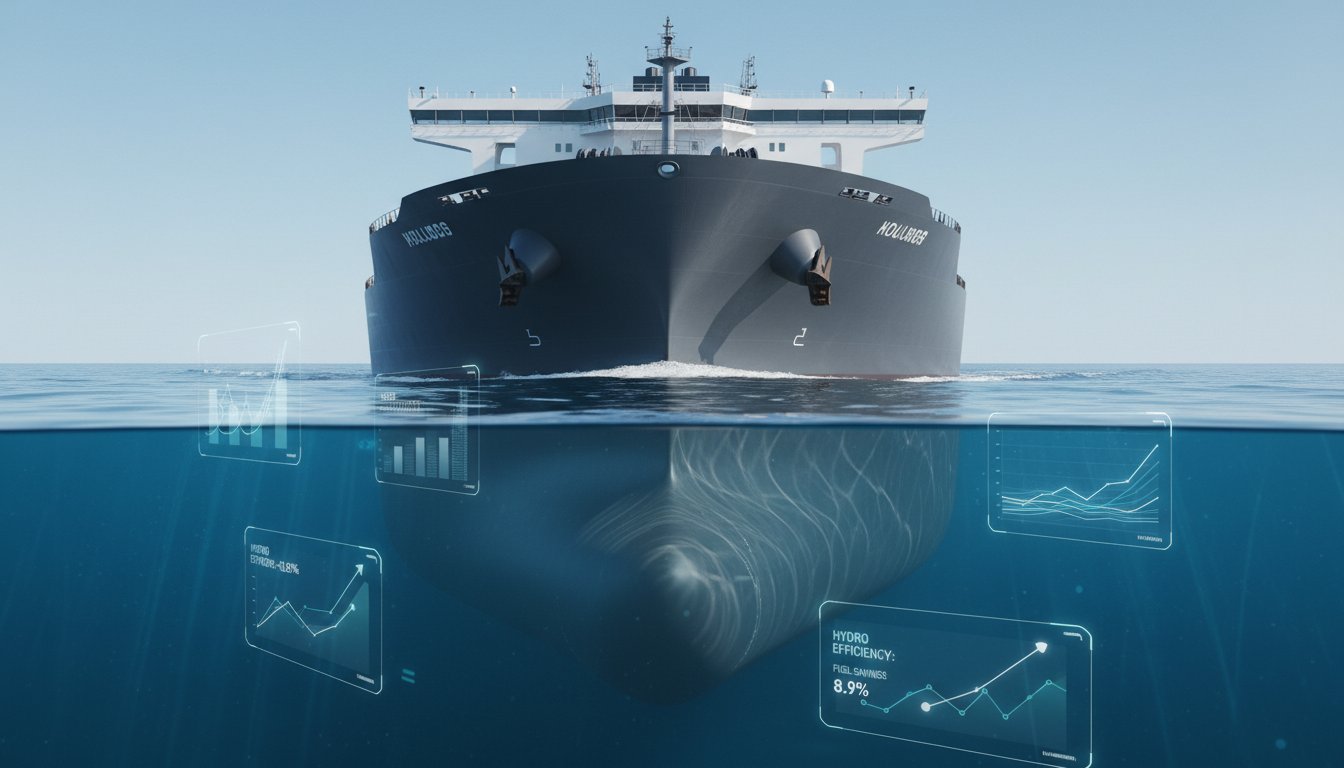
For a typical 300,000 DWT VLCC, even a 10-micron increase in average hull roughness results in a 1% rise in fuel consumption. You likely recognize that maintaining a smooth hull is vital for operational efficiency, yet filtering out the environmental noise of wind, waves, and currents often makes measuring fuel savings from hull coating feel like an exercise in statistical guesswork. It’s a common frustration for technical managers who must justify the premium investment of biocide-free, siloxane-based systems to stakeholders focused on the bottom line.
This technical guide empowers you to master the scientific methodologies and international standards, such as ISO 19030, required to quantify the hydrodynamic impact of advanced foul release systems with precision. You’ll gain a standardized framework for performance monitoring that provides clear evidence of fuel reduction over a 10-year life cycle. We’ll explore how these data-backed strategies ensure regulatory compliance with EEXI and CII requirements by optimizing vessel efficiency. This article details the transition from reactive maintenance to a strategic, performance-driven approach that secures long-term ROI and protects marine ecosystems.
Key Takeaways
- Understand the direct correlation between Average Hull Roughness (AHR) and hydrodynamic drag to identify exactly where your vessel is losing propulsive efficiency.
- Learn to implement the ISO 19030 framework to standardize performance data and eliminate anecdotal claims in favor of globally recognized, verifiable metrics.
- Master the technical process of measuring fuel savings from hull coating by isolating coating performance from environmental variables like sea state and cargo displacement.
- Identify why the structural integrity of hard-film silane-siloxane systems is critical for maintaining measurement stability and avoiding the data noise caused by soft silicone degradation.
- Build a comprehensive 10-year ROI framework that accounts for reduced maintenance frequency and fuel optimization to secure long-term operational profitability.
The Physics of Resistance: Why Hull Roughness Dictates Fuel Consumption
Vessel efficiency begins at the precise interface where steel meets seawater. The total resistance a ship encounters is generally divided into wave-making resistance and frictional resistance. While wave-making resistance is largely a function of hull geometry and speed, frictional resistance is dictated by the surface condition of the underwater hull. For most commercial vessels, especially slower-moving tankers and bulk carriers, frictional drag accounts for 60% to 90% of total resistance. This makes the texture of the hull the single most influential factor in operational fuel demand.
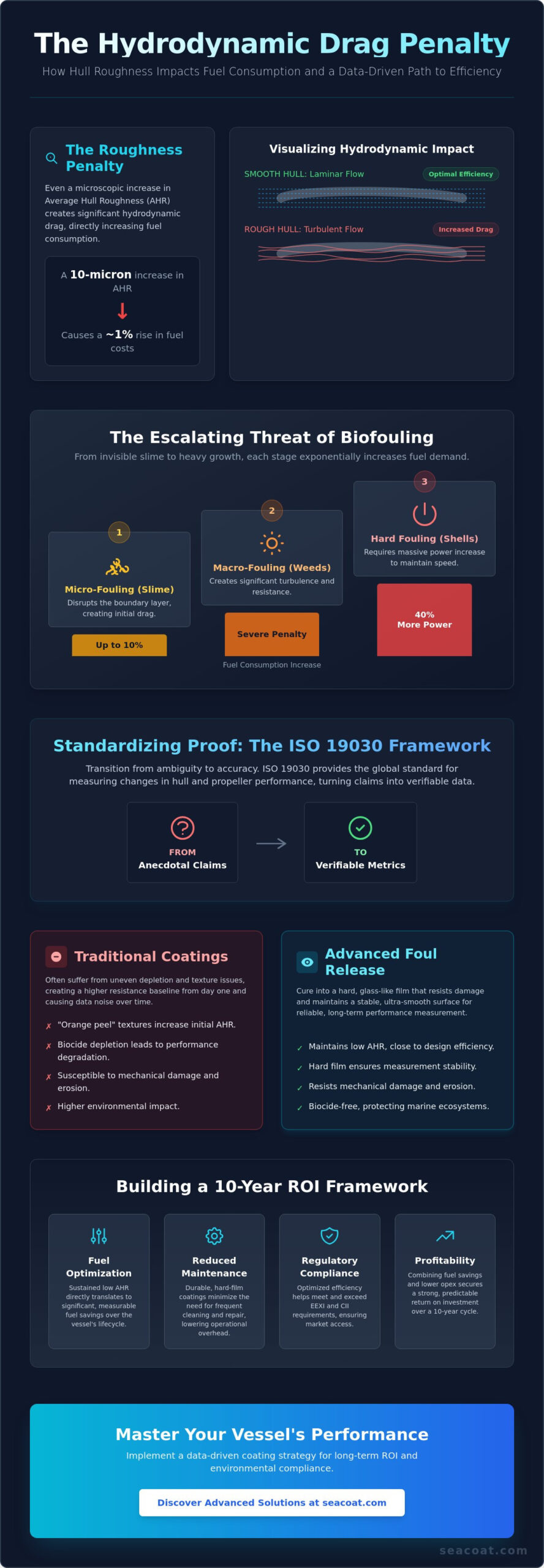
Measuring fuel savings from hull coating requires a rigorous focus on Average Hull Roughness (AHR). This metric quantifies the micro-peaks and valleys on the coating’s surface. Industry data confirms that a 10-micron increase in AHR typically results in a 1% increase in fuel consumption. Over a standard five-year docking cycle, the “performance gap” widens as the coating degrades or accumulates biological growth. This gap represents the lost efficiency between a clean sea-trial hull and the reality of an aged, fouled surface. Maintaining a low AHR isn’t just about aesthetics; it’s a direct intervention in the vessel’s energy balance.
The Hydrodynamic Impact of Biofouling
Biofouling disrupts the laminar flow of water across the hull, creating turbulence that increases drag. The process is progressive, starting with a biochemical conditioning film that attracts bacteria and diatoms. This micro-fouling, often dismissed as mere slime, can increase fuel consumption by up to 10% because it alters the boundary layer thickness. The Physics of Hull Fouling explains how these biological layers transition from soft slime to macro-fouling, such as weeds and shells. Macro-fouling creates a severe penalty on the speed-power curve, often requiring 40% more power to maintain the same speed. Advanced coatings mitigate this by optimizing surface energy, measured in millinewtons per meter (mN/m). By maintaining a surface energy level that organisms can’t easily bond to, the coating ensures that fouling is shed by the sheer force of water during transit.
Surface Profile and Frictional Drag
Quantifying the “slickness” of a hull involves the use of laser profilometers to map the surface profile at a microscopic level. Traditional biocidal coatings often suffer from uneven depletion or “orange peel” textures during application, which baseline the vessel at a higher resistance level from day one. Advanced silane-siloxane systems differ because they cure into a hard, glass-like film that resists the mechanical damage and erosion that typically increases AHR. This structural integrity is vital when measuring fuel savings from hull coating across a ten-year life cycle. For a deeper analysis of the technical metrics involved in these assessments, The Definitive Guide to Boat Hull Paint provides a benchmark for evaluating performance science and long-term ROI. Choosing a coating that maintains its initial smoothness ensures the vessel operates as close to its theoretical design efficiency as possible.
Standardizing Efficiency: The ISO 19030 Framework for Hull Performance
The maritime industry traditionally relied on fragmented data and subjective observations to validate efficiency gains. This ambiguity ended in 2016 with the publication of ISO 19030. This global standard provides a rigorous, transparent methodology for measuring changes in hull and propeller performance, effectively eliminating the “anecdotal” fuel savings claims that once clouded the market. By establishing a uniform process for data collection and analysis, the framework allows ship owners to verify that a specific coating actually delivers the promised hydrodynamic benefits. It shifts the conversation from marketing promises to verifiable engineering outcomes.
ISO 19030 operates through three distinct tiers of measurement to accommodate different vessel capabilities. The default method (Tier 1) utilizes noon-report data, while the advanced (Tier 2) and primary (Tier 3) methods integrate high-frequency data logging. Modern performance monitoring relies on these sensors to capture real-time variables such as shaft torque, speed through water, and wind resistance at intervals of 15 seconds or less. This level of precision is vital when Calculating Fuel Savings across diverse operating conditions. High-frequency logging filters out “noise” from environmental factors, ensuring that measuring fuel savings from hull coating is based on the vessel’s actual physical condition rather than external weather variables.
Key Performance Indicators (KPIs) in ISO 19030
The framework identifies three critical indicators for technical managers. Dry-Docking Performance measures the immediate efficiency gain achieved between the period before and after a coating application. In-Service Performance monitors the rate of degradation over a standard 60-month cycle, accounting for biofouling and physical wear. Maintenance Triggering uses real-time data to identify when performance drops below a specific threshold, signaling that in-water cleaning is required to maintain the vessel’s hydrodynamic profile. These KPIs transform hull maintenance from a scheduled expense into a data-driven strategy.
Regulatory Drivers: EEXI and CII Compliance
Measuring fuel savings from hull coating is no longer just about operational ROI; it’s a regulatory necessity for modern fleet management. The Carbon Intensity Indicator (CII) rating of a vessel depends heavily on its fuel consumption relative to the distance traveled. A high-performance hull coating reduces drag, which directly improves a ship’s CII grade and helps avoid the “E” ratings that trigger mandatory corrective actions. Similarly, these coatings assist in meeting Energy Efficiency Existing Ship Index (EEXI) targets by lowering the power required to maintain service speeds.
Strategic adoption of Environmental Marine Coatings provides a clear path toward 2026 compliance goals while ensuring long-term asset protection. Operators who prioritize these data-backed solutions position their fleets as leaders in the transition toward sustainable hull performance. You can explore how advanced siloxane technologies optimize your fleet’s efficiency through our technical specifications and performance data.
Data Normalization: How to Isolate Coating Impact from Environmental Noise
Raw performance data is rarely clean. When measuring fuel savings from hull coating, technical teams must account for “noise” factors that mask true hydrodynamic efficiency. These variables include wind speed, wave height, sea state, and cargo displacement. A vessel sailing against a 25-knot headwind while fully laden will consume significantly more fuel than the same ship in ballast during a calm sea, regardless of the coating’s quality. Without stripping away these external forces, the data remains a collection of anecdotes rather than actionable intelligence.
Correcting for Environmental Variables
Data normalization is the mathematical removal of external variables to isolate internal efficiency. To achieve this, operators rely on anemometers and GPS data to calculate true speed through water (STW) rather than speed over ground. Relying on traditional Noon Reports often introduces human error; these once-daily snapshots lack the granularity needed for precision analysis. Automated data collection systems provide high-frequency telemetry every 15 seconds, allowing for the filtration of outliers. By applying ISO 19030 standards, analysts filter data to ensure “apples-to-apples” comparisons, focusing only on periods where environmental conditions remain within a narrow, defined window.
Establishing a Reliable Baseline
Precision requires a control group. This is typically achieved by analyzing historical performance data from the vessel’s previous dry-dock cycles. This baseline must account for the propeller condition; a fouled or damaged propeller can increase power demand by 5% or more, potentially masking the benefits of a high-performance hull coating. For a comprehensive understanding of how different chemistries affect this baseline, consult this guide to Antifouling Boat Paint and Foul Release Systems.
Short-term trials are often misleading because they fail to account for seasonal bio-fouling pressure and varying water temperatures. Long-term data sets spanning 12 months or more are superior. They provide the statistical power necessary to validate the speed-power reference curve. This curve serves as the hydrodynamic fingerprint of the ship. When you’re measuring fuel savings from hull coating, any sustained shift in this curve toward lower power for the same speed indicates a genuine reduction in skin friction. This data-backed approach moves vessel management from guesswork to strategic asset optimization, ensuring that ROI calculations are based on physics rather than probability.
Hard-Film vs. Soft Silicone: Why Measurement Stability Matters
Accurately measuring fuel savings from hull coating requires a consistent physical baseline. If the hull’s surface profile changes erratically due to material failure, the resulting data becomes statistical noise. Soft silicone foul release coatings are inherently fragile and susceptible to delamination or “peeling” during high-speed operations or impact. When a coating tears, it creates localized turbulence and increased drag. This physical instability makes it impossible to isolate the efficiency gains provided by the coating from the losses caused by surface degradation.
Silane-Siloxane hard-film coatings, such as Sea-Speed, offer a fundamentally different technical profile. These coatings create a rigid, glass-like surface that doesn’t degrade under operational stress. By maintaining a stable hydrodynamic profile, hard-film technology ensures that the data collected by flow meters and torque sensors reflects actual vessel performance rather than the fluctuating state of a failing paint film. This stability is the cornerstone of a predictable ROI.
Durability and the 10-Year Life Cycle
Traditional maritime coatings often rely on a sacrificial mechanism that complicates long-term performance analysis. You can explore the technical drawbacks of these systems in our detailed comparison of Ablative Bottom Paint. Because ablative paints are designed to polish away over time, the hull’s surface roughness is constantly changing. This “polishing” effect introduces a variable that skews fuel consumption data over a multi-year period.
Hard-film coatings don’t require the frequent re-coating cycles associated with these legacy systems. A single application is engineered to last for 10 years without losing film thickness. This longevity provides a “clean” data set for owners. When the surface remains unchanged for a decade, measuring fuel savings from hull coating becomes a straightforward exercise in comparing baseline sea trials to long-term operational metrics. It removes the need to account for the gradual thinning of the protective layer.
In-Water Cleaning and Data Recovery
Mechanical cleaning is a vital part of vessel maintenance, but it often damages soft silicone surfaces. Standard grooming brushes can create micro-tears in silicone, which then act as “anchor” points for calcareous growth like barnacles. Once the surface is compromised, the drag coefficient increases permanently. Hard-film coatings possess a surface hardness that allows for aggressive in-water cleaning without damaging the hydrodynamic profile. This resilience ensures that the vessel’s fuel efficiency “recovers” to its original state immediately after a cleaning cycle.
- Surface Hardness: Prevents organisms from embedding into the coating matrix.
- Mechanical Integrity: Withstands brush pressures that would strip soft foul-release systems.
- Predictable Drag: Maintains a consistent Ra (roughness average) value throughout the service life.
For fleet managers, this means the performance dip caused by fouling is temporary. Once the hull is cleaned, the fuel consumption returns to the expected baseline. This predictability is essential for meeting EEXI and CII requirements, where even minor increases in drag can lead to regulatory non-compliance. To ensure your fleet maintains peak efficiency, consult with our naval engineers about transitioning to a hard-film system.
Calculating ROI: From Fuel Savings to Operational Profitability
Measuring fuel savings from hull coating remains the baseline metric for efficiency, but true profitability is realized through a comprehensive Total Cost of Ownership (TCO) analysis. While traditional ablative coatings require frequent re-application and intensive maintenance, a hard-film siloxane system like Sea-Speed V 10 X Ultra shifts the financial focus from short-term procurement to long-term asset optimization. This transition requires fleet managers to evaluate the cumulative impact of reduced drag, minimized dry-docking intervals, and lower mechanical stress over a 10-year horizon.
The 10-Year Economic Model
A single application of Sea-Speed V 10 X Ultra replaces the multiple application cycles inherent to traditional anti-fouling systems. While conventional coatings deplete over time, this non-depleting hard-film surface maintains its hydrodynamic profile for a decade or more. Data indicates that vessels utilizing this technology achieve a 6% to 12% efficiency gain compared to baseline performance. Over ten years, these fuel savings often exceed the initial application cost by a factor of five or more. Because the coating is biocide-free and contains zero VOCs, operators also mitigate the rising costs of environmental compliance and potential carbon taxes associated with EEXI and CII regulations.
Beyond the fuel pump, “hidden” savings contribute significantly to the bottom line. Lower hull friction reduces the torque required to maintain cruising speeds. This decreased load directly translates to reduced engine wear and tear, potentially extending the intervals between major overhauls. When you calculate the TCO, you must include these variables:
- Initial surface preparation and application costs.
- Cumulative fuel savings based on measuring fuel savings from hull coating performance.
- Elimination of mid-cycle dry-docking for coating replenishment.
- Reduced underwater cleaning requirements due to the slick, foul-release surface.
Next Steps for Fleet Optimization
Transitioning to a high-performance coating system should begin with a structured pilot program. Fleet managers can select a representative vessel to monitor performance metrics against historical baselines. This data-driven approach provides the empirical evidence needed to justify a fleet-wide rollout. Consulting with the technical team at SeaCoat SCT ensures that application specifications are tailored to the specific operational profile of your vessels, from high-speed ferries to deep-sea tankers. They provide the guidance necessary to move from legacy maintenance cycles to a proactive efficiency strategy.
Operational excellence isn’t achieved through incremental tweaks but through strategic technological shifts. Sea-Speed V 10 X Ultra represents that shift, providing a permanent solution to the age-old problem of hull fouling. Contact SeaCoat SCT to optimize your fleet efficiency with Sea-Speed V 10 X Ultra and begin the transition toward a more profitable, sustainable maritime operation.
Advancing Maritime Efficiency with Precision Engineering
Achieving operational excellence requires moving beyond anecdotal evidence toward rigorous data analysis. By adhering to the ISO 19030 framework and implementing precise data normalization, operators can isolate the specific variables that impact hydrodynamic drag. Accurate measuring fuel savings from hull coating depends on surface stability; soft silicones often lack the durability to maintain performance over extended docking cycles. Transitioning to a hard-film solution ensures that the initial ROI isn’t eroded by physical degradation or fouling attachment.
SeaCoat has led this technology shift since 2001 with our proprietary Silane-Siloxane chemistry. Our Sea-Speed V 10 X Ultra system provides a non-toxic, zero VOC barrier that combines hard-film resilience with exceptional foul-release properties. Commercial applications have documented fuel savings of up to 12% while significantly extending maintenance intervals. It’s a strategic asset designed for the ten-year life cycle of your vessel, ensuring you meet both environmental mandates and profitability targets.
Maximize your vessel ROI with Sea-Speed V 10 X Ultra and secure a more sustainable future for your fleet.
Frequently Asked Questions
How much fuel can I realistically save with a foul release coating?
High-performance foul release coatings typically yield fuel savings between 5% and 15% compared to traditional biocidal anti-foulings. These figures are substantiated by hydrodynamic studies showing a 40% reduction in surface roughness. For a bulk carrier operating at 14 knots, this efficiency gain translates to a measurable reduction in daily fuel consumption. Consistent monitoring ensures these gains persist throughout the coating’s ten-year lifecycle.
What is the difference between ISO 19030 and traditional fuel monitoring?
ISO 19030 establishes a rigorous, standardized framework for measuring hull and propeller performance, whereas traditional fuel monitoring often relies on raw bunker consumption data. While traditional methods fail to account for environmental variables like wind and swell, ISO 19030 uses data normalization to isolate the coating’s impact. This methodology allows for accurate measuring fuel savings from hull coating by comparing current performance against a primary baseline.
Can I measure fuel savings on smaller pleasure craft as accurately as commercial ships?
You can measure efficiency gains on pleasure craft with high precision using high-frequency flow meters and GPS speed-over-ground data. While commercial ships utilize shaft torque meters for 99% accuracy, smaller vessels can achieve reliable results by tracking fuel-to-speed ratios in calm water conditions. This data proves that reducing drag through siloxane-based coatings provides proportional benefits regardless of vessel displacement or engine size.
Does the type of fuel used affect the measurement of coating efficiency?
The specific fuel type, whether VLSFO or LNG, doesn’t alter the fundamental measurement of hydrodynamic efficiency. Scientists measure coating performance by calculating the power required to overcome resistance at a set speed. Because the coating reduces friction, the engine requires less energy to maintain velocity. This reduction in power demand remains constant even if the energy density of the fuel source varies.
How long does it take to see a return on investment for a premium hull coating?
Most commercial operators achieve a full return on investment within 12 to 24 months through reduced fuel expenditures. A 2022 industry report indicates that premium coatings also extend dry-docking intervals to 60 or even 120 months; this further amortizes the initial application cost. By minimizing biological adhesion, the vessel maintains its design speed longer, which prevents the costly performance degradation common with traditional coatings.
What happens to fuel savings data if the vessel operates in high-fouling tropical waters?
In tropical waters where biofouling pressure increases by 50% compared to temperate zones, fuel savings data highlights the superiority of non-toxic foul release systems. Traditional biocides often fail in these high-temperature environments, leading to rapid drag increases. Measuring fuel savings from hull coating in these regions typically shows that siloxane surfaces remain 98% clean, preventing the significant fuel penalties associated with hard-growth colonization.
Is automated data logging required to prove fuel savings for regulatory compliance?
Automated data logging isn’t a universal legal requirement, but it’s increasingly necessary for meeting IMO Carbon Intensity Indicator (CII) standards. Manual logs often contain 10% human error, which can jeopardize a vessel’s rating. By using automated sensors, operators provide transparent, verifiable evidence of efficiency improvements. This technological approach ensures that fuel savings are documented accurately for both environmental regulators and internal stakeholders.