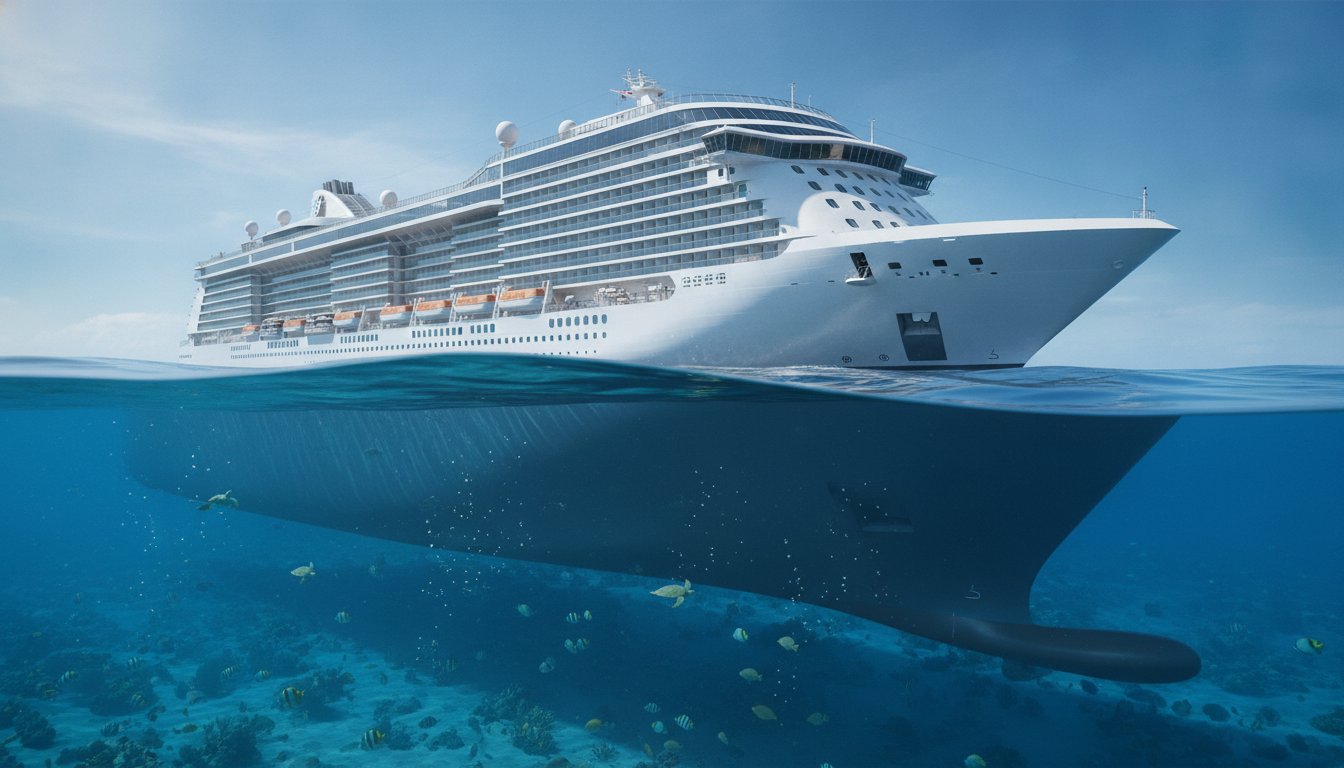
With Very Low Sulphur Fuel Oil prices reaching $962.55 per metric ton in mid-2026, even a microscopic increase in hull roughness is no longer just a maintenance issue; it’s a direct threat to your operational margins. You’re likely facing the mounting pressure of the IMO’s 11% carbon intensity reduction factor and the strict requirements of the EU Emissions Trading System. Traditional antifouling solutions and fragile soft silicones often fall short, either due to toxic leaching or physical vulnerability during hull grooming. This guide demonstrates how advanced silane-siloxane hard-film marine coatings for cruise ships provide a strategic solution for EEXI and CII compliance, delivering measurable 6-10% fuel savings alongside a 10-year non-toxic service life.
We’ll examine the material science that allows these coatings to withstand rigorous cleaning while maintaining an ultra-smooth profile. You’ll learn how shifting to a high-performance foul-release system transforms hull maintenance from a recurring expense into a long-term asset that exceeds environmental ESG targets without compromising vessel speed. This technical overview provides the evidence-based data you need to optimize your fleet’s performance through 2026 and beyond.
Key Takeaways
- Discover how to navigate the 2026 IMO carbon intensity updates by utilizing advanced marine coatings for cruise ships that move beyond traditional biocides.
- Understand the chemical distinction between fragile soft silicones and durable silane-siloxane hard-films that permit frequent in-water hull grooming without surface degradation.
- Learn the specific mechanisms that translate reduced hull roughness into a measurable 6-10% reduction in daily fuel consumption and a superior CII rating.
- Evaluate the long-term economic advantages of a 10-year service life, which significantly reduces dry-docking frequency and lowers the total cost of vessel ownership.
- Explore the strategic implementation of Sea-Speed V 10 X Ultra, a non-toxic system designed to meet both high-speed performance benchmarks and strict ESG targets.
The Evolution of Marine Coatings for Cruise Ships in 2026
Modern cruise fleet management has undergone a fundamental shift. Coatings are no longer viewed as a simple maintenance line item; they’re now strategic performance assets. The Evolution of Marine Coatings has moved away from chemical leaching toward sophisticated mechanical foul release systems. These biocide-free coatings are engineered specifically for large-scale hulls that require both aesthetic perfection and extreme hydrodynamic efficiency. In the current regulatory climate, an environmental coating is defined by its ability to remain non-leaching and completely free of toxins while optimizing the flow of water around the vessel.
Cruise operators face a unique set of challenges that distinguish them from the commercial cargo sector. Luxury vessels require high-gloss, durable finishes that maintain a clean white aesthetic even in nutrient-rich tropical waters. High operational speeds make frictional drag a critical variable in the fuel efficiency equation. When marine coatings for cruise ships fail to provide a smooth, low-energy surface, the resulting parasitic drag forces engines to work harder. This increases Very Low Sulphur Fuel Oil (VLSFO) consumption, which reached $962.55 per metric ton in mid-2026. Transitioning to a “Performance Asset” mindset means selecting a coating that dictates vessel ROI over a ten-year cycle rather than a two-year dry-docking window.
Why Traditional Antifouling is Failing the Cruise Sector
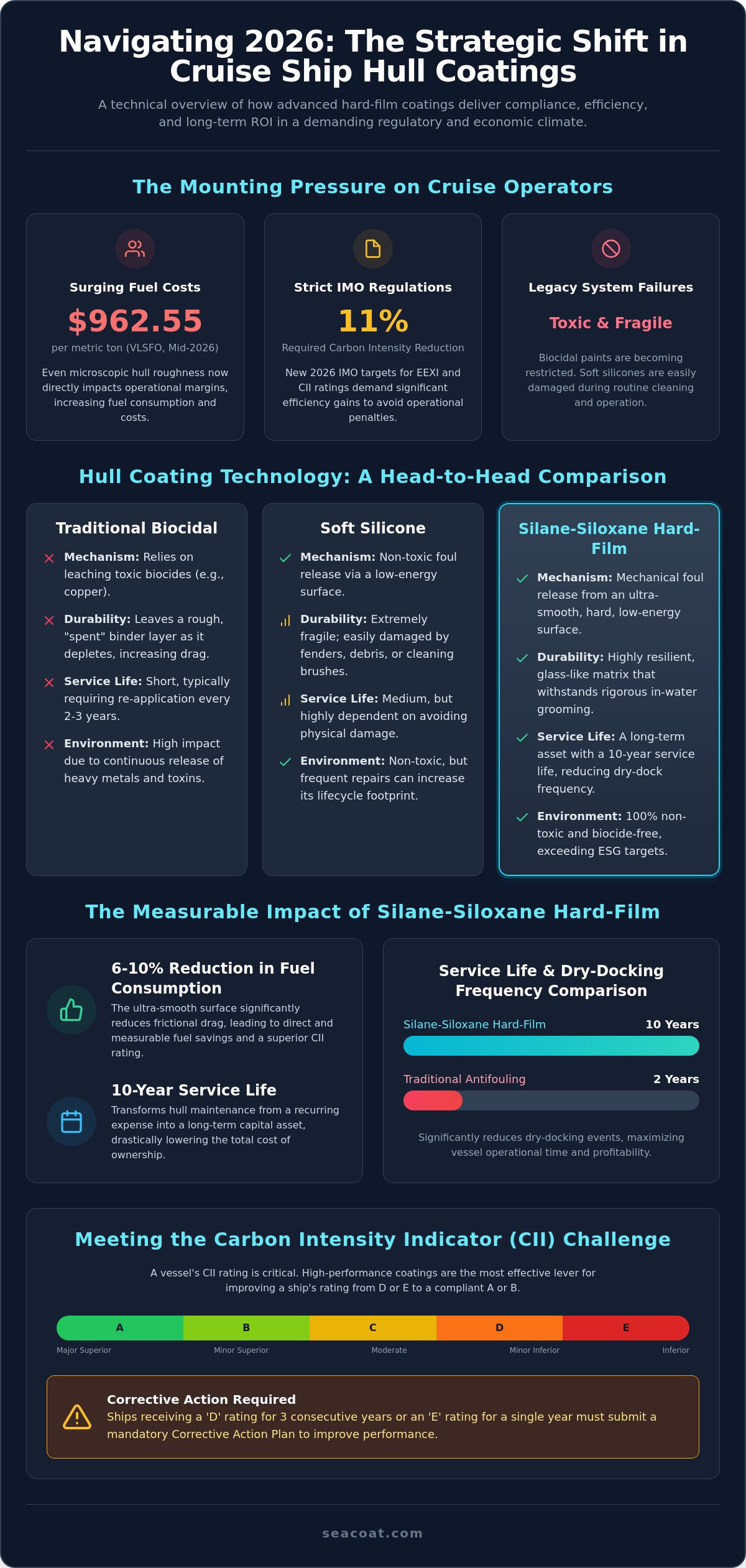
Traditional biocidal paints are failing because they’re fundamentally temporary. They rely on the depletion of active ingredients, which leaves behind a “spent” layer of binder that is physically rough. This roughness creates turbulence in the boundary layer of the water, killing fuel efficiency. As of July 18, 2026, the IMO mandates on-site verification of copper-based active substance release rates. This regulatory sunset of heavy-metal biocides makes self-polishing coatings a liability. In pristine cruise destinations, the environmental impact of leaching toxins is no longer acceptable to port authorities or eco-conscious passengers.
The Regulatory Hammer: IMO, EEXI, and CII
The Carbon Intensity Indicator (CII) is now the primary metric for cruise ship viability. For 2026, the IMO’s annual carbon intensity reduction factor has increased to 11% relative to the 2019 baseline. Ships receiving a D rating for three consecutive years or an E rating in 2025 must submit a Corrective Action Plan by April 30, 2026. High-performance marine coatings for cruise ships are the most effective lever for meeting these targets. By reducing frictional drag, these systems allow ships to meet Energy Efficiency Existing Ship Index (EEXI) requirements without sacrificing the speeds necessary for tight cruise itineraries. A poor rating can lead to operational restrictions, making the choice of hull coating a critical business decision.
The Science of Silane-Siloxane: Hard-Film vs. Soft Silicone
Silane-siloxane represents a fundamental shift away from the “leach and deplete” model of traditional hull protection. By integrating the structural rigidity of silanes with the low surface energy of siloxanes, these systems create a densely cross-linked, glass-like matrix. Unlike soft silicone-hydrogel coatings that rely on a delicate, easily damaged outer layer, silane-siloxane forms a genuine “hard-film.” This surface is inherently hydrophobic, which dramatically reduces the ability of marine organisms to establish a permanent bond. Because the mechanism is entirely mechanical rather than chemical, these marine coatings for cruise ships are 100% non-toxic and biocide-free. This technology ensures long-term compliance with evolving International Maritime Organization (IMO) regulations, offering a sustainable alternative that doesn’t compromise on physical defense.
Durability and In-Water Cleaning
The most significant operational hurdle for soft silicone systems is their extreme fragility. These “soft” coatings are prone to tearing and peeling when they encounter fenders, debris, or even the friction of a standard cleaning brush. Once the silicone skin is breached, the underlying hull is exposed to rapid biofouling, and dockside repairs are often complex and costly. In contrast, hard-film silane-siloxane coatings are engineered for resilience, allowing for proactive hull grooming without the risk of surface degradation. This durability enables fleet managers to implement frequent cleaning schedules that keep the hull in a “newly painted” state for years. While soft silicones often reach their performance limit within three to five years, a hard-film system delivers a service life of 10 years or more. To see how these metrics impact your fleet, review the performance data of silane-siloxane systems.
Microscopic Smoothness and Hydrodynamics
Frictional drag is directly proportional to hull roughness, which is typically measured at the micron level. Traditional antifouling paints become progressively rougher as biocides leach out, creating a “peaks and valleys” topography that disrupts water flow. Silane-siloxane technology creates an ultra-smooth, low-tension surface that facilitates a stable laminar flow and minimizes the energy required to move the vessel through the water. This permanent slickness is a result of the coating’s high cross-link density, which prevents the material from becoming porous or pitted over time. By maintaining this microscopic smoothness, cruise ships can achieve the 6-10% fuel savings required to meet the 2026 CII reduction factors. This hydrodynamic stability is the key to decoupling vessel speed from excessive carbon emissions.
Economic Impact: ROI, Fuel Efficiency, and TCO
The economic viability of a cruise vessel is inextricably linked to its hydrodynamic profile. As fuel prices remain volatile, with Very Low Sulphur Fuel Oil (VLSFO) reaching $962.55 per metric ton in mid-2026, the cost of frictional drag has become a primary driver of operational expenditure. High-performance marine coatings for cruise ships mitigate this drag by maintaining a smooth, non-porous surface that prevents the accumulation of biofouling. When analyzing the Total Cost of Ownership (TCO) over a 10-year cycle, the initial application cost of a silane-siloxane system is offset by the elimination of mid-cycle full-hull blasting. Unlike traditional coatings that require extensive surface preparation every few years, a hard-film system remains intact, allowing for simplified maintenance and significantly extended dry-docking intervals. This uptime is critical for passenger revenue; every day a ship spends in a shipyard represents a total loss of ticket and onboard spending potential.
Quantifying Fuel Savings and Emission Reductions
Empirical industry data consistently demonstrates that transitioning to high-performance foul release systems can yield between 6-10% in direct fuel savings. These metrics are crucial for fleet managers navigating the 2026 IMO carbon intensity reduction factor of 11%. For a standard 3,000-passenger cruise vessel, a 7% reduction in fuel consumption translates to thousands of tons of CO2 offset annually. This performance is a cornerstone of the strategies detailed in The Definitive Guide to Boat Hull Paint: Performance, Science, and ROI. Beyond the immediate fuel savings, these reductions directly lower the financial burden of carbon taxes. By September 30, 2026, shipping companies must surrender allowances for 70% of their verified emissions under the EU ETS, making hull efficiency a prerequisite for fiscal health.
Asset Longevity and Maintenance Savings
The shift toward hard-film technology eliminates the destructive “blast-and-paint” cycles that characterize traditional maintenance. Hard-film systems like Sea-Speed V 10 X Ultra are designed for a 10-year service life, requiring only minor spot repairs rather than the full removal often necessitated by the tearing of soft silicones. This durability also protects the mechanical integrity of the vessel. By lowering the required propulsion power to maintain cruising speeds, these marine coatings for cruise ships reduce the thermal and mechanical strain on engines. This results in lower long-term maintenance costs for the propulsion plant and ensures the vessel can meet its EEXI targets without expensive mechanical retrofits.
Implementation Guide: Transitioning a Cruise Fleet to Non-Toxic Systems
Converting a 100,000-ton asset from traditional biocidal systems to a silane-siloxane matrix is a strategic technical transition rather than a standard maintenance event. This process requires a shift from the “sacrificial” mindset of depleting paints to a permanent, high-performance surface. Successful implementation of marine coatings for cruise ships hinges on a one-time, rigorous substrate restoration that provides the foundation for a 10-year service life. By following a methodical application protocol, fleet managers can ensure that the transition minimizes vessel downtime while maximizing the long-term integrity of the hull’s protective barrier.
Surface Preparation and Substrate Integrity
The most common cause of coating failure is inadequate surface preparation. Attempting to “over-coat” existing antifouling layers with a non-toxic system is a recipe for catastrophic delamination, as the old, brittle paint will eventually detach from the hull, taking the new coating with it. To achieve the necessary adhesion, the hull must be abrasive blasted to an SSPC-SP 10 (Near-White Blast) standard. This step removes decades of accumulated paint and oxidation, creating the specific “anchor profile” required for chemical bonding. For a deeper analysis of why this transition is necessary, see our guide on Ablative Bottom Paint: Understanding the Sacrificial Cycle vs. Modern Alternatives. A pristine substrate ensures that the subsequent layers function as a unified, non-porous shield.
The Primer and Coating Process
Once the hull is blasted, a high-build epoxy primer like Seapoxy 73 is applied to create a permanent barrier against corrosion. This primer is essential because it seals the steel and provides the ideal surface for the silane-siloxane topcoat to bond. The application of Sea-Speed V 10 X Ultra is typically performed using industrial airless spray equipment to ensure a uniform, high-gloss finish across the massive surface area of a cruise ship. This method provides the industrial efficiency required to meet tight shipyard schedules. After application, the system requires a specific curing window before the vessel can be launched. Unlike traditional paints that continue to leach toxins upon immersion, these hard-film foul release systems are fully inert once cured, allowing the ship to return to service as a zero-emission performance asset. To begin your fleet’s technical transition, contact our engineering team for a project consultation.
- Blast Standard: SSPC-SP 10 Near-White Blast for all underwater hull areas.
- Barrier Layer: Seapoxy 73 high-build epoxy for corrosion resistance and adhesion.
- Topcoat: Sea-Speed V 10 X Ultra applied via airless spray for a hydrodynamic finish.
- Logistics: Coordinated shipyard timing to accommodate curing and launch protocols.
The Future of Cruise Sustainability: Sea-Speed V 10 X Ultra
As the maritime industry converges on the 2026 regulatory deadlines, Sea-Speed V 10 X Ultra emerges as the definitive strategic asset for cruise fleet managers. This system isn’t an experimental fix; it’s a mature technology with over two decades of proven performance since its introduction in 2001. The “Hard-Film Advantage” represents the synergy of extreme physical durability, hydrodynamic efficiency, and a zero-toxin chemical profile. By choosing a silane-siloxane matrix, operators secure a 10-year service life that directly addresses the volatility of modern fuel markets and the stringency of international environmental mandates. This transition from sacrificial antifouling to permanent foul release is the most effective way to protect both the hull’s integrity and the company’s fiscal future.
The choice of marine coatings for cruise ships is now a primary factor in determining a vessel’s long-term marketability. A coating that maintains its slickness for a decade without requiring a full blast-and-paint cycle provides a massive advantage in total cost of ownership. It allows cruise lines to move away from the maintenance-heavy model of the past toward a performance-first strategy. This intelligence-led approach to hull management ensures that the vessel remains a high-value asset that is fully compliant with the latest global standards for greenhouse gas intensity and carbon efficiency.
Proven Performance in Diverse Cruise Routes
The versatility of Sea-Speed V 10 X Ultra is evidenced by its success across vastly different operational environments. In nutrient-rich tropical waters where biofouling pressure is at its peak, the coating’s low surface energy prevents the permanent attachment of aggressive organisms. Conversely, on arctic routes, the hard-film’s abrasion resistance provides a critical defense against ice crystals and frigid conditions that would destroy softer silicone alternatives. You can explore the broader context of this industry-wide transition in our analysis of Environmental Marine Coatings: The 2026 Shift Toward Sustainable Hull Performance. Beyond technical metrics, the zero-toxin promise serves as a powerful marketing tool. Eco-conscious passengers increasingly scrutinize the environmental footprint of their travel, and a biocide-free hull demonstrates a genuine commitment to preserving the pristine ecosystems they visit.
Consulting for Fleet-Wide Efficiency
Optimizing marine coatings for cruise ships requires more than just a product purchase; it demands a partnership rooted in maritime engineering. Seacoat SCT, LLC experts provide detailed technical consultations to help fleet managers calculate the specific ROI for various vessel classes and route profiles. We analyze how reduced frictional drag translates into lower propulsion requirements, helping your fleet exceed EEXI and CII benchmarks without sacrificing speed or luxury. Selecting a coating is a high-stakes decision where reliability is paramount. It’s essential to partner with innovators who understand the fluid dynamics and chemical complexities of large-scale hull management. To begin optimizing your operations for the 2026 cycle, schedule a technical assessment for your fleet today.
Strategic Hull Management for the 2026 Regulatory Cycle
Navigating the 2026 regulatory landscape requires a fundamental shift from temporary maintenance fixes toward permanent, performance-driven assets. We’ve analyzed how the move away from toxic biocides to advanced silane-siloxane technology allows fleet managers to exceed strict EEXI and CII ratings while protecting the vessel’s operational margins. These marine coatings for cruise ships provide a unique synergy of extreme physical durability and zero-toxin environmental stewardship. By adopting a hard-film system, you secure a 10-year service life that withstands rigorous in-water grooming and diverse global routes. This strategy doesn’t just mitigate carbon intensity; it delivers up to 10% fuel savings by maintaining a microscopically smooth hull profile over the long term.
The transition to a sustainable, high-efficiency fleet is both a technical challenge and a strategic opportunity. Partnering with innovators who prioritize material science ensures your assets remain compliant, efficient, and reliable for the next decade of service. It’s time to decouple vessel performance from ecological impact and secure a superior return on investment for your fleet. Optimize your cruise fleet with Sea-Speed V 10 X Ultra and lead the industry toward a cleaner, more profitable future.
Frequently Asked Questions
Are non-toxic coatings as effective as copper-based paints for cruise ships?
Non-toxic coatings like Sea-Speed V 10 X Ultra are highly effective because they utilize a mechanical foul-release mechanism rather than chemical leaching. While copper-based paints rely on toxic depletion to kill organisms, silane-siloxane creates an ultra-low energy surface that prevents strong adhesion. This mechanical approach is particularly efficient for high-utilization vessels that maintain consistent operational speeds, ensuring the hull stays clean without releasing harmful heavy metals into the environment.
How much fuel can a cruise ship save by switching to Sea-Speed V 10 X Ultra?
Switching to Sea-Speed V 10 X Ultra can reduce frictional drag enough to deliver measurable fuel savings of up to 10%. These metrics are achieved by maintaining a microscopically smooth hull profile that minimizes turbulence in the boundary layer of the water. For large-scale cruise vessels, this efficiency gain directly translates into lower daily operational costs and a significant reduction in the ship’s overall carbon footprint.
Can silane-siloxane coatings be applied over existing antifouling paint?
Silane-siloxane systems cannot be applied directly over existing antifouling paint. To ensure permanent adhesion and prevent catastrophic delamination, the hull must be abrasive blasted to a near-white metal standard like SSPC-SP 10. This one-time investment in substrate integrity is what allows the marine coatings for cruise ships to achieve their multi-year performance benchmarks without the need for sacrificial paint cycles.
What is the expected service life of a hard-film foul release coating?
A hard-film foul release coating typically delivers a service life of 10 years or more. This longevity is a result of the densely cross-linked silane-siloxane matrix, which doesn’t leach, deplete, or become porous over time. This extended window significantly reduces the frequency and complexity of major dry-docking events, providing a clear advantage in total cost of ownership compared to traditional three-year paint cycles.
How does a non-toxic coating help with IMO CII ratings?
Non-toxic marine coatings for cruise ships improve Carbon Intensity Indicator (CII) ratings by lowering the total energy required for propulsion. By reducing hull roughness and frictional resistance, the vessel consumes less fuel to maintain its scheduled cruise speeds. This performance is essential for operators to meet the IMO’s 11% carbon reduction factor mandated for the 2026 cycle and avoid operational restrictions.
Is in-water cleaning safe for silane-siloxane hard-film coatings?
In-water cleaning is entirely safe and encouraged for silane-siloxane hard-film coatings. Unlike soft silicones that are easily torn or abraded by standard cleaning equipment, the hard-film structure is resilient enough to withstand frequent “hull grooming” without losing thickness. This allows fleet managers to maintain a pristine, low-drag surface between scheduled dry-dockings without the risk of damaging the coating’s protective integrity.
What is the difference between foul release and traditional antifouling?
Traditional antifouling uses biocides to kill marine life, while foul release is a mechanical system that makes the hull too slick for organisms to attach firmly. Antifouling paints become progressively rougher as they deplete their active ingredients. In contrast, foul release systems maintain their microscopic smoothness throughout their entire service life, which is fundamental to achieving long-term fuel efficiency and environmental compliance.
How does the initial cost of Sea-Speed compare to traditional marine coatings?
While the initial application of a high-performance system involves a technical transition, the total cost of ownership is lower than traditional systems. The return on investment is driven by the elimination of mid-cycle paint removal and the cumulative fuel savings over a decade. By viewing the coating as a performance asset rather than a recurring maintenance expense, operators secure better long-term fiscal health for their fleet.