If your marine coating warranty covers material adhesion but ignores the rising costs of fuel and carbon intensity ratings, it isn’t protecting your asset; it’s merely documenting its decline. Many vessel owners find themselves trapped in a cycle of frequent dry-docking because their current agreements don’t account for the operational realities of 2026. A comprehensive marine coating warranty comparison reveals a stark divide between traditional biocidal paints that offer limited product insurance and modern, hard-film systems designed for decade-long performance. You likely already know that hidden exclusions regarding cleaning methods or “normal wear” can render a guarantee worthless just when you need it most.
This guide provides a definitive framework for evaluating guarantees in an era defined by the IMO’s upgraded hydrolysis kinetics stability tests under ISO 21775:2026 and strict EPA biocide mandates. We’ll show you how to move beyond basic corrosion protection toward warranties that actually secure your CII and EEXI compliance. By the end of this analysis, you’ll understand how to identify strategic assets like Sea-Speed V 10 X Ultra that offer ten-year operational windows, ensuring your vessel remains efficient, compliant, and out of the dry-dock for longer intervals.
Key Takeaways
- Understand the transition of marine warranties from simple insurance against paint failure to strategic financial instruments that safeguard hull performance and fuel economy.
- Perform a rigorous marine coating warranty comparison to identify the critical differences between material integrity coverage and operational performance guarantees.
- Recognize the operational risks associated with “activity clauses” and mechanical vulnerability that can unexpectedly void warranties for traditional sacrificial or soft silicone coatings.
- Evaluate the technical requirements for surface preparation and anchor patterns to ensure your coating system meets stringent 2026 regulatory standards and manufacturer specifications.
- Explore how hard-film silane-siloxane technology provides a 10-year service life, offering a permanent solution that aligns with long-term operational efficiency goals.
The Evolution of Marine Coating Warranties: Beyond Corrosion Protection
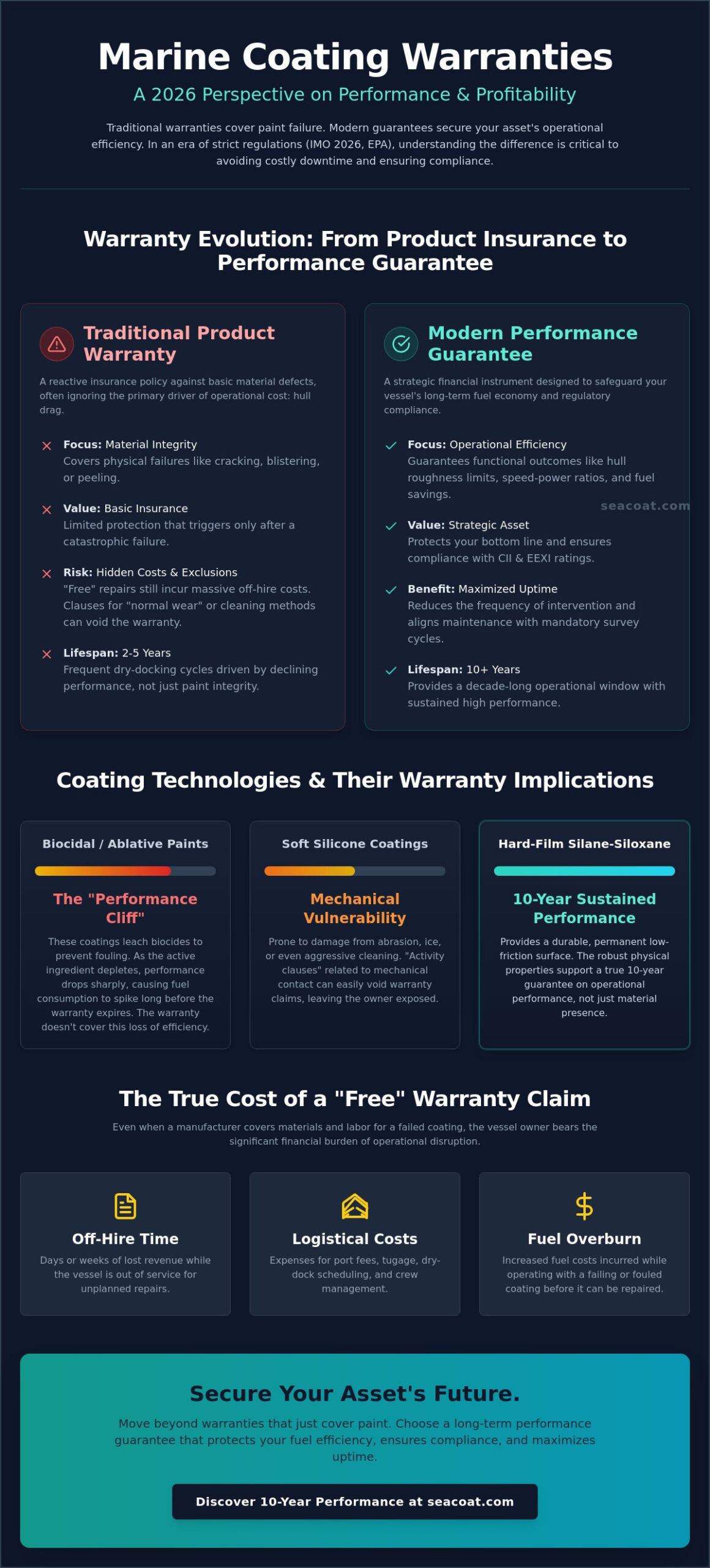
Historically, a marine coating warranty served as a basic insurance policy against catastrophic failure. If the paint didn’t peel off within 24 months, the manufacturer’s obligation was met. In 2026, this narrow focus is obsolete. Shipowners now view these agreements as strategic financial instruments that hedge against operational volatility. A modern marine coating warranty comparison must look past simple adhesion to evaluate how a coating maintains hull smoothness over a multi-year cycle. This shift reflects a broader industry transition where the coating is no longer a maintenance expense but a high-performance component of the propulsion system.
The industry is moving toward a holistic view of hull performance. Traditional anti-fouling paint technologies rely on the controlled release of biocides to prevent growth. However, these sacrificial systems are fundamentally limited by depletion rates. Once the active ingredients leach out, the protective function ceases; it doesn’t matter if the physical film remains intact. This creates a “performance cliff” where fuel consumption spikes long before the next scheduled dry-docking. Total Cost of Ownership (TCO) calculations now prioritize coatings that maintain a low-friction profile throughout the entire service life, rather than those that simply meet a minimum thickness requirement.
Material Integrity vs. Functional Performance
Standard product warranties typically cover mechanical failures like cracking, blistering, or spontaneous detachment. While these are critical, they don’t address the primary driver of operational cost: drag. Commercial fleets are increasingly demanding performance-based guarantees that specify hull roughness limits. A coating that stays attached but allows heavy calcareous fouling fails the operational test. Distinguishing between “paint on the hull” and “hydrodynamic efficiency” is the first step in a meaningful marine coating warranty comparison.
The Cost of a ‘Free’ Warranty Claim
Repairs under warranty are rarely truly cost-neutral. Even if the manufacturer provides free product and labor, the vessel owner bears the massive burden of off-hire time, tugage, and port fees. This is why a 10-year coating, such as Sea-Speed V 10 X Ultra, provides superior value even if the paper warranty matches a five-year competitor. Longevity reduces the frequency of intervention. If a coating requires a mid-cycle touch-up to maintain its guarantee, the “free” repair actually costs thousands in lost revenue and logistical friction. Real-world value is found in extended service windows that align with mandatory survey cycles, allowing owners to maximize uptime without the looming threat of warranty-related downtime.
Product Warranties vs. Performance Guarantees: What Is Actually Covered?
Understanding the distinction between a product warranty and a performance guarantee is the most critical step in any marine coating warranty comparison. A standard product warranty is essentially a guarantee of material integrity. It protects the owner against manufacturing defects that lead to cracking, flaking, or spontaneous detachment from the hull. While these protections are necessary, they are reactive. They only trigger a claim after the coating has physically failed, often leaving the shipowner to manage the secondary costs of fuel inefficiency and cleaning until the next dry-docking window opens.
Performance guarantees represent a more sophisticated tier of protection. These agreements focus on the functional outcome of the coating, such as maintaining a specific speed-power ratio or a maximum level of hull roughness. As the global standard-setting authority outlines, the regulatory landscape for biofouling management is tightening, making performance metrics just as critical as physical durability. For commercial operators, a coating that remains attached but fails to prevent drag is an operational liability. Performance guarantees are designed to hedge against this specific risk, ensuring the vessel remains within its designed efficiency parameters.
Antifouling Warranties: The Biocidal Limitation
Traditional antifouling warranties are often riddled with exclusions that limit their long-term utility. Most ablative and self-polishing coatings rely on a sacrificial mechanism where biocides leach into the water column. This process is inherently finite. Consequently, many manufacturers exclude performance coverage after the first 24 to 36 months, even if the physical film remains on the hull. These warranties also frequently include “stationary clauses” that void coverage if a vessel remains idle for more than 14 consecutive days. This limitation is a direct result of the coating’s reliance on water friction to refresh its biocidal surface, a mechanical requirement that doesn’t exist for modern foul-release technologies.
Foul Release Guarantees: The Silane-Siloxane Advantage
Hard-film silane-siloxane systems, such as Sea-Speed V 10 X Ultra, shift the warranty focus from chemical depletion to surface energy. Because these coatings are non-ablative and biocide-free, they don’t lose efficacy over time. This allows for much more aggressive performance claims compared to soft silicone coatings, which are highly susceptible to mechanical damage and subsequent warranty disputes. By utilizing a non-leaching, cross-linked molecular structure, silane-siloxane systems prevent the gradual increase in average hull roughness (AHR) that typically plagues traditional coatings over a 10-year service life. Operators looking to secure long-term fuel savings should prioritize these permanent surface profiles when conducting a marine coating warranty comparison to ensure their guarantees align with actual operational goals.
Comparing Ablative, Silicone, and Hard-Film Warranty Structures
Selecting a coating system requires a deep dive into the specific language governing its longevity. A marine coating warranty comparison reveals that the underlying technology dictates the manufacturer’s level of commitment. Ablative and self-polishing systems, for instance, are designed to erode. Because their efficacy depends on the thickness of the sacrificial layer and the vessel’s speed, warranties for these products are typically short-term, often covering only 12 to 36 months. They provide little more than a guarantee that the material will stay attached until it naturally wears away, offering no protection against the inevitable drag increase as the surface roughens.
Soft silicone foul-release systems offer higher theoretical performance but introduce significant warranty risks. These coatings are notoriously fragile. Most silicone warranties contain explicit exclusions for mechanical damage caused by tugs, fenders, ice, or even standard port operations. If a fender scrapes the hull, the warranty for that entire section is frequently voided. This creates a precarious situation for commercial operators who cannot guarantee a damage-free environment. In contrast, hard-film systems represent a move toward permanent hull protection, where the warranty reflects the material’s inherent mechanical strength rather than its chemical depletion rate.
The “Cleaning Clause” trap is perhaps the most overlooked element in traditional agreements. Many manufacturers require specialized, non-abrasive cleaning methods to maintain warranty validity. If a vessel owner uses standard commercial hull grooming equipment, they may inadvertently void their coverage. Hard-film coatings like Sea-Speed V 10 X Ultra eliminate this friction. Their glass-hard surface allows for aggressive in-water cleaning without compromising the film’s integrity or the manufacturer’s guarantee. This simplifies maintenance logistics and ensures that the warranty remains an active asset throughout the service life.
The Durability Gap: Hard Film vs. Soft Silicone
The mechanical resilience of a coating directly correlates to the reliability of its warranty. While soft silicones are easily torn, silane-siloxane technology creates a robust, cross-linked matrix that resists impact and abrasion. This durability means that claims are less likely to be denied due to “normal operational wear.” Sea-Speed V 10 X Ultra maintains its surface energy even after repeated cleanings, a feat that soft silicones cannot replicate without risking delamination or surface scarring. This difference is critical for vessels operating in high-traffic ports or challenging environments where physical contact is a constant reality.
Environmental Compliance as a Warranty Requirement
As regulations tighten, a warranty on a toxic product may soon become a liability. Modern agreements must align with the shift toward environmental marine coatings to ensure long-term viability. Investing in a biocide-free system is a form of future-proofing. If a specific toxic additive is banned mid-cycle, a warranty on that product becomes irrelevant. Non-toxic, hard-film systems are designed to comply with 2026 standards and beyond, ensuring that your marine coating warranty comparison accounts for both current performance and future regulatory hurdles.
Key Clauses to Evaluate in a 2026 Marine Coating Warranty
The fine print in a marine agreement can be the difference between a high-performing asset and a significant financial liability. In a 2026 marine coating warranty comparison, your evaluation must extend beyond the mere duration of coverage to the specific clauses that govern operational freedom. Surface preparation remains the fundamental pillar of any valid claim. Manufacturers typically mandate a precise anchor pattern and cleanliness standard, such as Sa 2.5, to ensure the mechanical bond is sufficient for decadal performance. In the current regulatory environment, these standards are also linked to the hull’s initial roughness, which directly impacts the vessel’s Energy Efficiency Existing Ship Index (EEXI) rating from day one.
Activity clauses represent another critical variable that can catch fleet managers off guard. Many traditional warranties require the vessel to maintain a minimum speed or spend a specific percentage of time at sea to facilitate the “self-cleaning” mechanism. If a ship sits idle in a high-fouling port for longer than the specified window, the warranty is often voided immediately. It’s essential to understand the legal distinction between fouling resistance, which relies on biocides to repel growth, and fouling release, which utilizes low surface energy to prevent permanent attachment. Fouling release systems like Sea-Speed V 10 X Ultra don’t rely on constant movement to remain effective, providing more robust legal protection for vessels with irregular schedules.
Transferability is a final but vital consideration for asset management. A warranty that remains valid upon the sale of the vessel adds tangible value to the resale price, as it guarantees the new owner a known operational efficiency. When these agreements are integrated with Carbon Intensity Indicator (CII) reporting, they transform the coating from a maintenance expense into a verifiable tool for regulatory compliance and carbon credit valuation.
The Importance of Application Oversight
A high-performance warranty is only as reliable as the documentation supporting its application. Most manufacturers mandate the presence of a Technical Service Representative (TSR) to oversee every stage of the process, from grit blasting to the final coat. This oversight is far more rigorous than what is typically required for ablative bottom paint, where the sacrificial nature of the product allows for a greater margin of error. The TSR’s report serves as the primary evidence in any future claim, making their expert presence a prerequisite for a valid performance guarantee.
Monitoring and Maintenance Clauses
Modern warranties are increasingly integrated with digital hull monitoring systems. In 2026, many agreements require regular data logging of speed-power ratios to verify that the coating is performing as promised. These clauses also specify the maximum allowable “idle time” before a professional cleaning is required to maintain the guarantee. By linking warranty validity to real-time performance data, manufacturers are helping owners turn their coating into a strategic asset. To ensure your next dry-docking investment is protected by a performance-driven agreement, contact our technical team for a detailed warranty consultation.
Seacoat SCT: Redefining Hull Performance and Warranty Longevity
A rigorous marine coating warranty comparison inevitably leads to the conclusion that traditional chemical-leaching systems are ill-equipped for the operational demands of the next decade. Seacoat SCT, LLC has pioneered a different path by treating the hull coating as a permanent strategic asset rather than a consumable maintenance item. The philosophy behind Sea-Speed V 10 X Ultra is rooted in the belief that a warranty should be a performance hedge, providing vessel owners with the confidence to extend dry-docking intervals without sacrificing fuel efficiency or environmental integrity. This approach aligns with the 2026 industry shift toward evidence-based descriptions and verifiable performance metrics.
The core of the Seacoat SCT, LLC guarantee is built upon three scientific pillars:
- Silane-Siloxane Durability: A molecularly stable, non-ablative film that provides a 10-year service life expectation.
- Environmental Stewardship: A completely non-toxic, zero-VOC formulation that exceeds current EPA biocide mandates.
- Operational Efficiency: Guaranteed surface energy levels that facilitate easy cleaning and maintain low frictional drag.
Case studies across commercial and military applications demonstrate that the ROI on a hard-film system far exceeds that of traditional antifouling. While standard biocidal paints require re-application every 36 to 60 months, Sea-Speed V 10 X Ultra users report sustained fuel savings and reduced emissions that persist well into the second half of a decade. These real-world outcomes prove that longevity and ecological safety are synergistic rather than mutually exclusive goals.
Sea-Speed V 10 X Ultra: The Strategic Asset
By utilizing a highly cross-linked silane-siloxane matrix, Sea-Speed V 10 X Ultra eliminates the need for sacrificial biocides while maintaining a slick surface that prevents permanent biofouling attachment. This glass-hard finish significantly reduces the risk of mechanical failure compared to soft silicone foul-release systems, which are often compromised by tug impacts or fender friction. The economic impact of this resilience is profound. Extending dry-docking intervals to a full 10 years allows fleet managers to reallocate millions in maintenance capital toward other decarbonization initiatives, all while maintaining a superior CII rating.
Securing Your Fleet’s Future
Transitioning a fleet to a high-performance foul release system requires a methodical approach to surface preparation and application oversight. Seacoat SCT, LLC provides the technical expertise necessary to ensure that every vessel meets the stringent standards required for a long-term performance guarantee. For specialized protection of running gear and propellers, Armor-Sil R/G offers the same silane-siloxane benefits, ensuring that every submerged surface contributes to the vessel’s overall efficiency. Reliability is the bottom line. To move beyond temporary fixes and secure your fleet’s operational future, Contact Seacoat SCT, LLC to evaluate your fleet’s hull performance and warranty options.
Securing Long-Term Operational Excellence
Navigating the complexities of modern maritime regulations requires a fundamental departure from traditional maintenance mentalities. As established throughout this marine coating warranty comparison, the transition from sacrificial biocides to permanent foul-release systems is not merely an environmental choice but a financial imperative. By prioritizing surface energy and mechanical durability, vessel owners can eliminate the hidden costs of short-term warranties and frequent dry-docking interventions. This strategic shift ensures that hull performance remains a constant factor in your operational success rather than a diminishing variable.
Seacoat SCT, LLC provides the technical expertise and proven chemistry needed to navigate this transition effectively. With silane-siloxane technology in commercial use since 2001, our solutions offer a non-toxic, zero-VOC alternative that delivers documented reductions in frictional drag and fuel consumption. It is time to treat your hull coating as a high-performance propulsion component rather than a recurring expense. Optimize Your Hull Performance with Seacoat SCT, LLC and ensure your fleet remains efficient, compliant, and profitable for the decade ahead.
Frequently Asked Questions
What is the difference between an antifouling warranty and a foul release guarantee?
Antifouling warranties generally cover the physical integrity of the film and its ability to repel organisms through chemical leaching. A foul release guarantee focuses on the hydrodynamic efficiency of the hull and its ability to shed growth through surface energy. This distinction is vital when performing a marine coating warranty comparison, as performance guarantees often include speed-power ratio benchmarks that traditional product warranties ignore.
Can a marine coating warranty be transferred if the vessel is sold?
Transferability varies by manufacturer but is a standard feature for high-performance assets. Most agreements allow for the transfer of the guarantee to a new owner provided that documentation of proper application and maintenance is presented. This ensures that the coating remains a value-add for the vessel’s resale price, specifically by guaranteeing the new operator lower fuel costs and compliance with environmental regulations.
Does in-water hull cleaning void my coating warranty?
In-water cleaning can void warranties for soft silicone or ablative systems if the brushes or tools used damage the delicate surface profile. Hard-film systems are designed to resist mechanical abrasion, meaning they don’t suffer the same restrictions. It’s essential to verify which cleaning technologies are approved in your specific agreement to prevent an accidental loss of coverage during routine maintenance.
How do silane-siloxane coatings like Sea-Speed compare to silicone warranties?
Silane-siloxane coatings from Seacoat SCT, LLC offer much broader mechanical protection than standard silicone warranties. Silicone agreements often exclude damage from ice, tugs, or fender contact because the material is prone to tearing. Seacoat SCT, LLC provides a glass-hard surface that withstands these physical impacts, allowing for a more robust and reliable warranty that isn’t easily voided by normal operational wear.
What are the common exclusions in a commercial ship paint warranty?
Common exclusions include mechanical damage from external objects, improper surface preparation by the shipyard, and prolonged idle periods. Many manufacturers include an “activity clause” that voids the warranty if the vessel sits stationary for more than 14 to 21 days. Understanding these limits is a critical part of any marine coating warranty comparison, as it determines the actual operational flexibility of your fleet.
How does hull coating performance impact EEXI and CII compliance?
Hull coatings directly influence the vessel’s carbon intensity by reducing frictional drag and fuel consumption. Modern performance guarantees are often linked to these metrics, ensuring the vessel maintains its required Energy Efficiency Existing Ship Index (EEXI) rating. By securing a performance-based warranty, owners can leverage hull smoothness as a verifiable component of their Carbon Intensity Indicator (CII) reporting and regulatory compliance strategy.
Why do most marine paint warranties only last 2 to 5 years?
Short warranty durations are typically due to the chemical depletion of traditional biocidal coatings. These systems rely on a sacrificial mechanism that has a finite operational life before the active ingredients are exhausted. Manufacturers cannot guarantee performance once the leaching process slows down. Permanent foul release systems bypass this limitation, allowing for extended 10-year service windows that aren’t possible with conventional paints.
What documentation is required to file a marine coating warranty claim?
Filing a claim requires a complete paper trail, including the original application report signed by a Technical Service Representative. You’ll also need to provide records of surface preparation, environmental conditions during application, and regular hull inspection data. Without these verified documents, manufacturers can easily deny claims by attributing failures to improper application or maintenance rather than product defects.