Why would a shipowner invest in a coating that is fundamentally designed to fail? Traditional sacrificial paints and soft silicones often require frequent, costly reapplication that disrupts operational windows and ignores the 2026 EPA mandates limiting copper leach rates to 9.5 micrograms. A comprehensive marine coating durability test provides the empirical evidence needed to move beyond these temporary fixes toward a permanent, hard-film solution.
It’s a common frustration to manage the rising costs of dry-docking while facing increased pressure to improve your Carbon Intensity Indicator (CII) rating. This article outlines the scientific protocols and performance metrics used to evaluate hull longevity and how these technical choices impact your vessel’s total cost of ownership. We will examine the latest ASTM B117-26 standards, the impact of surface efficiency on EEXI compliance, and how biocide-free technology can reduce frictional drag by 20% to 22% over a ten-year service life.
Key Takeaways
- Learn the critical importance of ASTM D751-06 and ASTM D6677 protocols for measuring adhesion and mechanical resilience in modern hull systems.
- Discover how a comprehensive marine coating durability test correlates surface integrity with operational efficiency, potentially lowering fuel costs by 10-15%.
- Contrast the longevity of hard-film silane-siloxane systems against biocidal paints that lose efficacy once their toxic layers leach into the environment.
- Understand how 2026 regulatory shifts like EEXI transform durability from a maintenance choice into a financial imperative for marine asset management.
- Identify why hard-film technology like Sea-Speed V 10 X Ultra provides a strategic advantage by resisting mechanical damage during high-pressure cleaning.
The Critical Role of Durability Testing in Marine Asset Management
Marine coating durability is the objective measure of a material’s capacity to maintain its physical integrity and peak surface smoothness while subjected to relentless hydrodynamic stress. In the high-stakes environment of 2026, this metric has evolved from a simple maintenance concern into a critical financial imperative. With the full implementation of the Energy Efficiency Existing Ship Index (EEXI) and Carbon Intensity Indicator (CII) regulations, a marine coating durability test now serves as a primary indicator of a vessel’s long-term compliance and profitability. If a coating cannot withstand the friction of transoceanic transit without degrading, the resulting increase in drag directly impacts fuel consumption and carbon emissions.
Traditional antifouling systems often rely on a sacrificial cycle where the coating is designed to erode or leach biocides over time. This mechanism is fundamentally at odds with long-term durability because the protection quite literally washes away. When these coatings fail their durability benchmarks, they leave the hull vulnerable to organism accumulation and mechanical damage. The Critical Role of Durability Testing becomes evident when you consider that even minor surface degradation can lead to significant colonization by marine life, which further compromises hull efficiency. We instead focus on functional durability, which is the ability of a hard-film system to maintain its foul-release properties and surface profile over a ten-year service window without requiring total removal or re-application.
Environmental Stresses on Marine Hulls
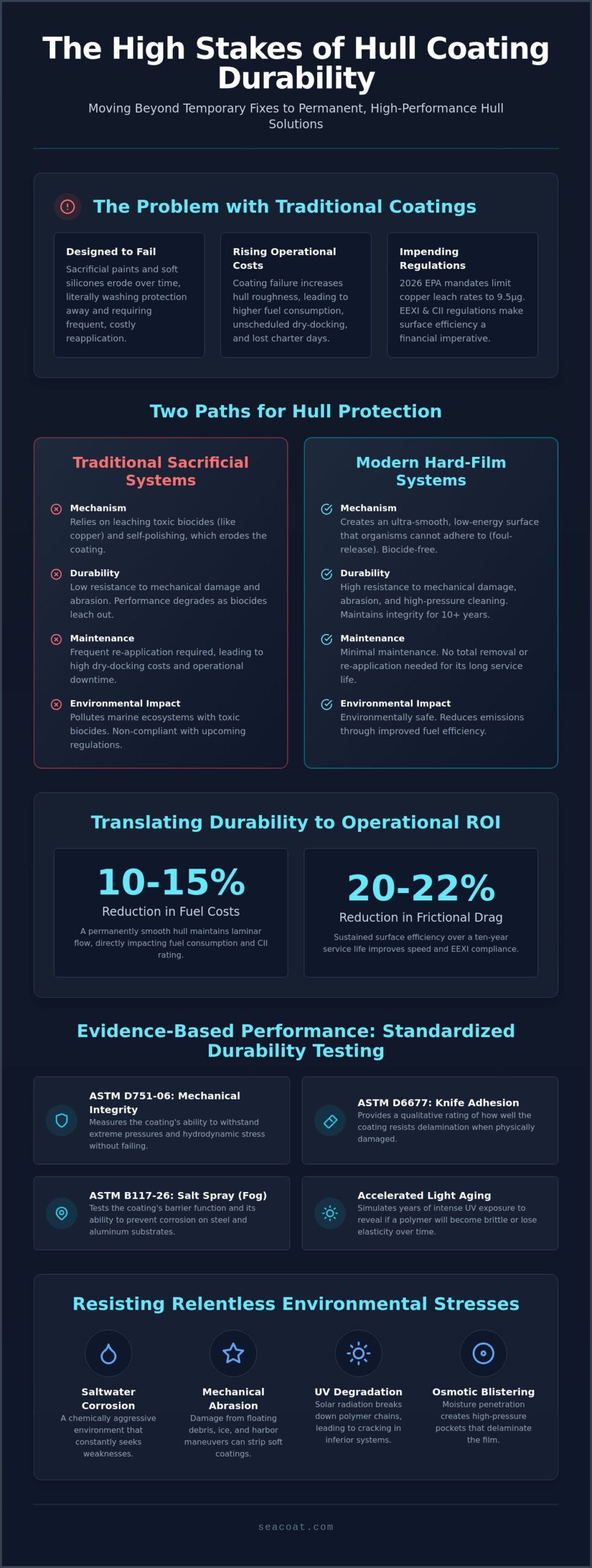
The ocean is a chemically aggressive environment where saltwater corrosion constantly seeks weaknesses in a hull’s defense. Osmotic blistering occurs when moisture penetrates a coating’s molecular structure, creating high-pressure pockets that delaminate the film from the substrate. Beyond chemistry, mechanical abrasion from floating debris, ice, and harbor maneuvers can strip away soft coatings in a single voyage. UV degradation also plays a quiet but destructive role, as solar radiation breaks down polymer chains, leading to a loss of elasticity and eventual cracking in inferior systems.
The Economic Impact of Coating Failure
Coating failure isn’t just a cosmetic issue; it’s an operational drain. As a coating loses its integrity, hull roughness increases, leading to exponential growth in fuel costs to maintain speed. The hidden expenses of unscheduled dry-docking, including labor, surface re-preparation, and lost charter days, can quickly exceed the initial price of the coating itself. Surface roughness refers to the micro-level irregularities on a hull’s finish that disrupt laminar flow, creating turbulent drag that forces engines to consume significantly more energy to maintain a constant speed. By utilizing a marine coating durability test to select high-performance materials, operators can avoid these costs and ensure their assets remain efficient for the duration of their service life.
Standardized Protocols for Measuring Marine Coating Resilience
To ensure that a hull coating provides a decade of service, engineers rely on rigorous, repeatable data. Standardized Protocols for Measuring resilience allow stakeholders to compare disparate technologies through a shared scientific lens. A standardized marine coating durability test removes the guesswork from asset management, replacing marketing claims with evidence-based performance metrics. This data is essential for predicting how a material will behave under the chaotic stresses of the open ocean.
ASTM D751-06 evaluates the mechanical integrity of coated surfaces, ensuring the film doesn’t fail under the extreme pressures of deep-sea transit. For hard-film systems, ASTM D6677 is equally vital. This knife adhesion test provides a qualitative rating of how well the coating resists delamination when physically compromised. It’s a “worst-case scenario” assessment. Beyond physical bonding, coatings must survive the sun. Accelerated Light Aging simulates years of intense UV exposure in a matter of weeks, revealing if a polymer will become brittle. Salt Spray (Fog) testing, specifically ASTM B117-26, measures the barrier’s ability to prevent corrosion on steel and aluminum substrates. It’s the ultimate test of impermeability.
Mechanical Integrity Tests: Adhesion and Abrasion
We utilize the ‘Pencil Hardness’ test to evaluate a surface’s resistance to scratching and gouging from floating debris. Taber Abrasion testing further quantifies durability by measuring how many cycles a coating can withstand before thinning. Finally, ASTM D4541 pull-off strength testing ensures the coating remains bonded even under the force of high-pressure cleaning. If you’re looking for a system that excels in these mechanical benchmarks, consider exploring the hard-film advantages of silane-siloxane technology. Rigorous execution of a marine coating durability test ensures that these mechanical properties translate into real-world longevity.
Hydrodynamic Durability: Frictional Drag Analysis
The ‘slickness’ of a hull is no longer a matter of feel. We use laser profilometry to measure surface topography at the micron level. Long-term immersion tests complement this by monitoring biofouling attachment strength over several months. ISO 19030 standards establish a methodology for measuring changes in hull and propeller performance, enabling operators to quantify how coating degradation impacts fuel efficiency over long-term deployment. This standard provides the bridge between laboratory durability and actual maritime ROI.
Comparing Durability: Hard-Film Foul Release vs. Traditional Systems
Selecting a hull system requires a clear distinction between coatings that provide a temporary barrier and those engineered for permanent resilience. Traditional biocidal paints often fail a long-term marine coating durability test because their efficacy is tied to the depletion of active ingredients. Once the toxic top layer leaches into the surrounding ecosystem, the remaining binder becomes porous and structurally weak. This degradation creates an ideal environment for biofouling, which necessitates frequent and aggressive maintenance cycles that further strip the coating away.
The “self-polishing” concept is frequently misunderstood within the industry. While these ablative paints are marketed as maintaining a smooth surface through controlled erosion, they actually increase drag as they age. The uneven wearing of the polymer matrix creates micro-turbulence. This forces the vessel to consume more fuel just to maintain cruising speed. By subjecting these different chemistries to a rigorous marine coating durability test, we can quantify exactly how long a system will maintain its hydrodynamic profile. Evidence suggests that hard-film systems retain their surface integrity far longer than their sacrificial counterparts.
A common objection among asset managers is whether a non-toxic coating can truly match the durability of heavy-metal paints. The reality is that the absence of copper and other biocides allows for a more robust and stable polymer backbone. Without the need for a leaching mechanism, the coating remains dense and impermeable. This results in a material that is not only environmentally responsible but also physically superior in resisting the mechanical stresses of high-speed transit and harbor maneuvers.
Silane-Siloxane: The Science of Molecular Bond Strength
Silane-siloxane technology utilizes high cross-linking density to create a non-porous, glass-like finish that resists mechanical penetration. This molecular structure effectively prevents the osmotic blistering often seen in lower-grade epoxies. The covalent bonds formed during the curing process ensure that the coating remains a strategic asset rather than a maintenance liability. For a deeper technical dive into these mechanisms, see The Science of Silane-Siloxane Marine Coatings Explained.
Soft Silicone Vulnerabilities in High-Traffic Ports
Soft silicone coatings are notoriously prone to tearing. Even minor contact with floating debris or fenders can cause a “silicone tear” that requires immediate and expensive repairs. These systems are too delicate for the aggressive in-water cleaning often required in high-fouling regions. Hard-film systems like Sea-Speed V 10 X Ultra provide a durable alternative that withstands mechanical cleaning without damage. You can find more data on this comparison in our guide, Hard Film vs. Soft Silicone Coatings: A Durability Test.
Beyond the Lab: Translating Durability Metrics to Operational ROI
Translating laboratory data into operational reality is where the true value of a marine coating durability test becomes apparent. While a lab report confirms chemical resistance, the shipowner sees that resistance as a 10-year service window. This longevity effectively eliminates at least two full dry-docking events over a vessel’s lifespan. Considering that labor and surface preparation often account for more than 80% of a dry-docking budget, extending the interval between applications provides a massive reduction in capital expenditure. It’s no longer just about the price of the paint; it’s about the cost of the downtime.
There is a direct, measurable correlation between the surface smoothness maintained by a durable coating and a 10% to 15% reduction in fuel costs. High-performance coatings can even reduce a vessel’s Carbon Intensity Indicator (CII) by 20% to 22% according to 2026 industry data. This efficiency isn’t just about saving fuel; it’s about maintaining a competitive EEXI rating that determines a ship’s charter value and regulatory standing. By utilizing a marine coating durability test to select materials that resist mechanical thinning, operators ensure these efficiency gains don’t evaporate after the first year of service.
Calculating the Total Cost of Ownership (TCO)
A strategic shift is occurring where owners prioritize lifecycle value over the initial price per gallon. We observe a significant “smoothness penalty” in the industry; for every 10 microns of added hull roughness, there is a corresponding increase in fuel consumption and engine strain. This happens because micro-irregularities create turbulent flow, forcing the propulsion system to work harder to overcome drag. By selecting a system that maintains its profile under hydrodynamic stress, you secure long-term savings that far outweigh the upfront investment. You can find a detailed breakdown in our guide on Calculating ROI on a Premium Foul Release Coating.
Durability and Environmental Stewardship
Durability is the foundation of modern environmental stewardship. A coating that lasts ten years produces significantly less waste and eliminates the need for the toxic leaching associated with traditional antifouling. This is particularly relevant as of January 1, 2026, with new EPA mandates prohibiting paints with a copper leach rate exceeding 9.5 micrograms per square centimeter per day. Hard-film, non-toxic systems allow operators to meet these stringent requirements without sacrificing hull performance. To learn more about this transition, explore The Environmental Benefits of Non-Toxic Hull Paint.
If you are ready to move beyond temporary fixes and invest in a strategic asset for your fleet, explore how our silane-siloxane technology delivers industry-leading durability.
Sea-Speed V 10 X Ultra: Engineered for Maximum Durability
Sea-Speed V 10 X Ultra represents the practical application of silane-siloxane technology, specifically designed to address the durability gaps left by traditional marine coatings. As a hard-film, foul-release system, it doesn’t rely on the gradual depletion of toxic additives to maintain performance. Instead, its molecular structure creates an exceptionally dense, non-porous barrier that has consistently excelled in every standardized marine coating durability test. This material is engineered for a ten-year service life, a claim supported by over a decade of successful deployment in both commercial shipping and rigorous military applications where mechanical resilience is non-negotiable.
One of the most significant advantages of this system is its resistance to high-pressure washing and mechanical cleaning. While soft silicone coatings are easily damaged by grooming equipment, Sea-Speed V 10 X Ultra maintains its integrity even under aggressive maintenance schedules. This physical toughness ensures that the surface profile remains smooth and efficient throughout the entire dry-docking cycle. For owners of performance hulls who require a specific aesthetic without compromising on these technical benefits, Sea-Speed V 10 X Ultra Clear offers the same level of durability in a transparent finish, allowing the original substrate or color to remain visible.
Why Sea-Speed Outperforms Traditional Biocides
The fundamental difference lies in the non-sacrificial nature of the film. Traditional biocidal paints are designed to thin out over time as they leach chemicals, whereas Sea-Speed remains at its applied thickness for the duration of its service life. This stability prevents the “ghosting” or permanent staining often seen when biofouling organisms attach to porous, degrading surfaces. The Sea-Speed application process serves as a strategic asset for fleet managers by establishing a stable, long-term surface profile that simplifies future maintenance and stabilizes fuel expenditure. By passing a marine coating durability test that simulates years of hydrodynamic friction, this technology proves it can maintain peak efficiency without the environmental cost of heavy metals.
Getting Started with a High-Durability System
Achieving maximum longevity begins with superior primary adhesion. We recommend the use of Seapoxy 73, a high-solids epoxy primer designed to create a permanent bond between the substrate and the foul-release topcoat. This foundation is critical for ensuring the system survives the mechanical stresses discussed in earlier sections. For operators looking to modernize their fleet, you can consult with Seacoat SCT, LLC for a fleet-wide durability audit to identify the most effective coating strategy based on specific vessel routes and operational profiles. Taking this data-driven approach allows you to transition from a cycle of constant repair to a model of long-term asset preservation.
Optimize your vessel’s performance with Sea-Speed V 10 X Ultra and secure a decade of hull efficiency.
Securing Long-Term Vessel Efficiency Through Scientific Durability
The maritime industry can no longer afford to accept the sacrificial cycle of traditional hull coatings. As 2026 regulations tighten requirements for both toxic leach rates and carbon intensity, the evidence provided by a marine coating durability test becomes the most reliable indicator of an asset’s future profitability. We’ve established that hard-film systems maintain their hydrodynamic profile far longer than ablative paints, providing a permanent solution that resists mechanical damage and biofouling without the need for constant reapplication.
Adopting a high-performance system is a strategic commitment to both your bottom line and global environmental stewardship. Sea-Speed V 10 X Ultra utilizes proprietary silane-siloxane technology to deliver a 10-year typical service life, a standard already trusted by global commercial and military fleets. By focusing on molecular bond strength and surface smoothness, you can significantly reduce fuel consumption and simplify your maintenance schedule for the next decade.
Upgrade to the industry’s most durable non-toxic hull coating; explore Sea-Speed V 10 X Ultra to ensure your fleet is ready for the challenges of tomorrow.
Frequently Asked Questions
What is the most important test for marine coating durability?
While several benchmarks matter, ASTM D4541 for pull-off strength and ASTM D6677 for knife adhesion are the most critical for verifying a coating’s bond to the substrate. These tests ensure the material won’t delaminate under intense hydrodynamic stress. A comprehensive marine coating durability test must also evaluate frictional drag over time to ensure that long-term vessel efficiency remains stable throughout the service window.
How long does a hard-film foul release coating actually last?
A high-performance hard-film system like Sea-Speed V 10 X Ultra typically provides a 10-year service life. Unlike sacrificial paints that thin out through leaching, these silane-siloxane coatings maintain their physical thickness and surface profile. This longevity is supported by evidence from both commercial and military deployments, where the coating remains functional through multiple cleaning cycles without requiring a total reapplication.
Can a non-toxic marine coating pass military-grade durability tests?
Yes, non-toxic hard-film coatings are frequently utilized by military fleets because they excel in mechanical durability benchmarks. Without the need for a leaching biocide mechanism, the polymer structure is denser and more resistant to impact and abrasion. These systems prove that ecological safety doesn’t require a compromise in physical protection or resistance to the harshest maritime conditions encountered during global operations.
Does in-water cleaning damage the durability of the hull paint?
The impact of cleaning depends entirely on the coating chemistry. Soft silicone coatings are easily torn or abraded by grooming equipment, which necessitates expensive repairs and compromises the hull’s integrity. In contrast, hard-film systems are engineered to withstand aggressive high-pressure washing and mechanical scrubbing. This mechanical resilience is a core metric in any marine coating durability test, ensuring the hull stays clean without surface degradation.
What is the difference between ASTM D751 and other marine tests?
ASTM D751 focuses on mechanical integrity and coated fabric properties, measuring the material’s resistance to bursting and tearing under tension. While other tests like ASTM B117-26 evaluate corrosion resistance in salt spray, D751 helps engineers understand how a film behaves under physical structural stress. It’s a vital component of a testing suite that determines if a coating can handle the high-scale pressures of heavy industry maritime operations.
How does coating durability affect a ship’s EEXI rating?
Durability directly impacts the EEXI rating by maintaining the hull’s hydrodynamic efficiency over several years. A coating that degrades or becomes rough increases drag, which forces the vessel to consume more fuel to maintain its speed. By preserving a smooth surface profile, a durable coating helps ensure the ship stays within its required carbon intensity limits, avoiding the regulatory penalties and financial losses associated with efficiency degradation.
Why do soft silicone coatings fail more often than hard-film systems?
Soft silicones are fundamentally vulnerable to mechanical damage due to their low cross-linking density and elastic nature. They’re prone to “silicone tears” from floating debris or harbor contact, which allows biofouling to take root in the damaged areas. Hard-film silane-siloxane systems create a glass-like barrier that’s much harder to penetrate, ensuring the protective layer remains intact even during high-traffic port maneuvers and frequent cleaning.
Can I apply a new durable coating over old antifouling paint?
We don’t recommend applying a high-durability foul release system directly over old ablative or biocidal paint. For a permanent bond, the old layers must be removed back to the original substrate or a compatible primer like Seapoxy 73. Proper surface preparation ensures that the new coating’s durability isn’t compromised by the eventual failure or delamination of the underlying, weaker paint layers.