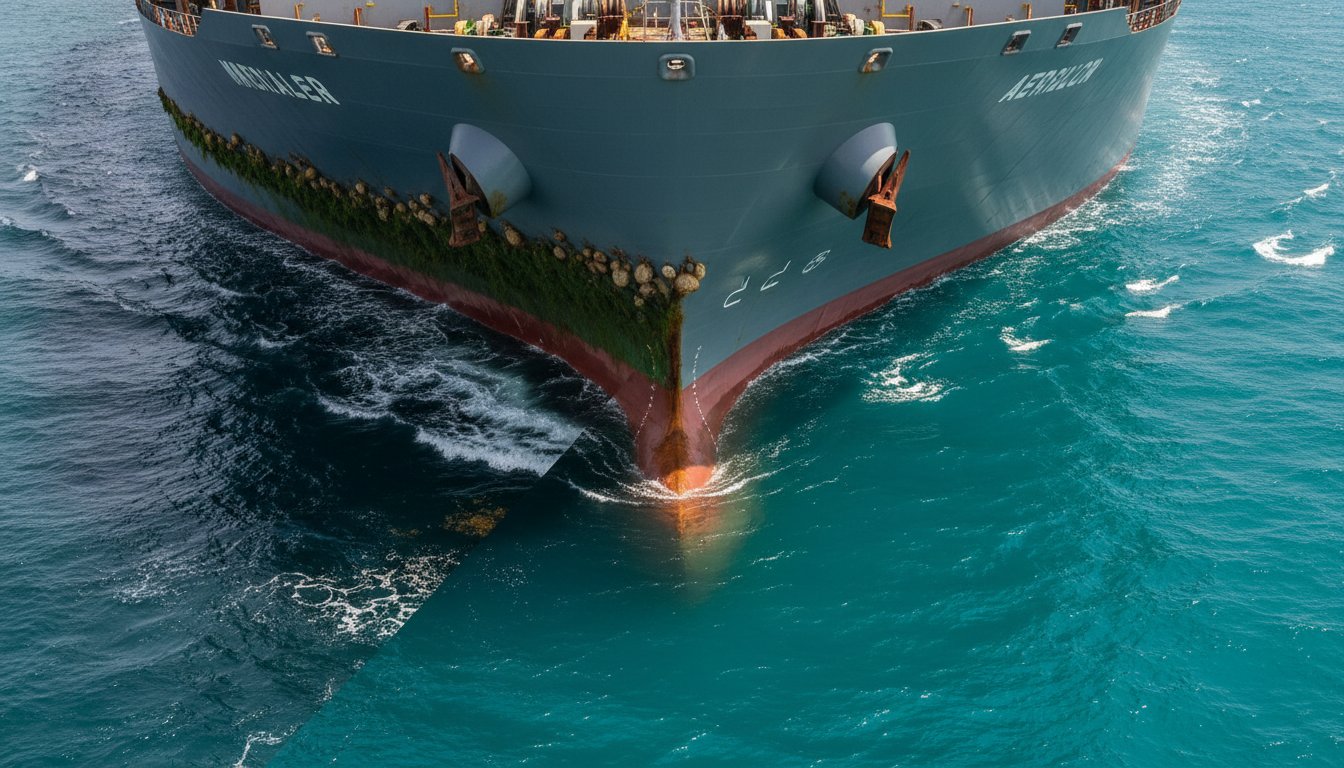
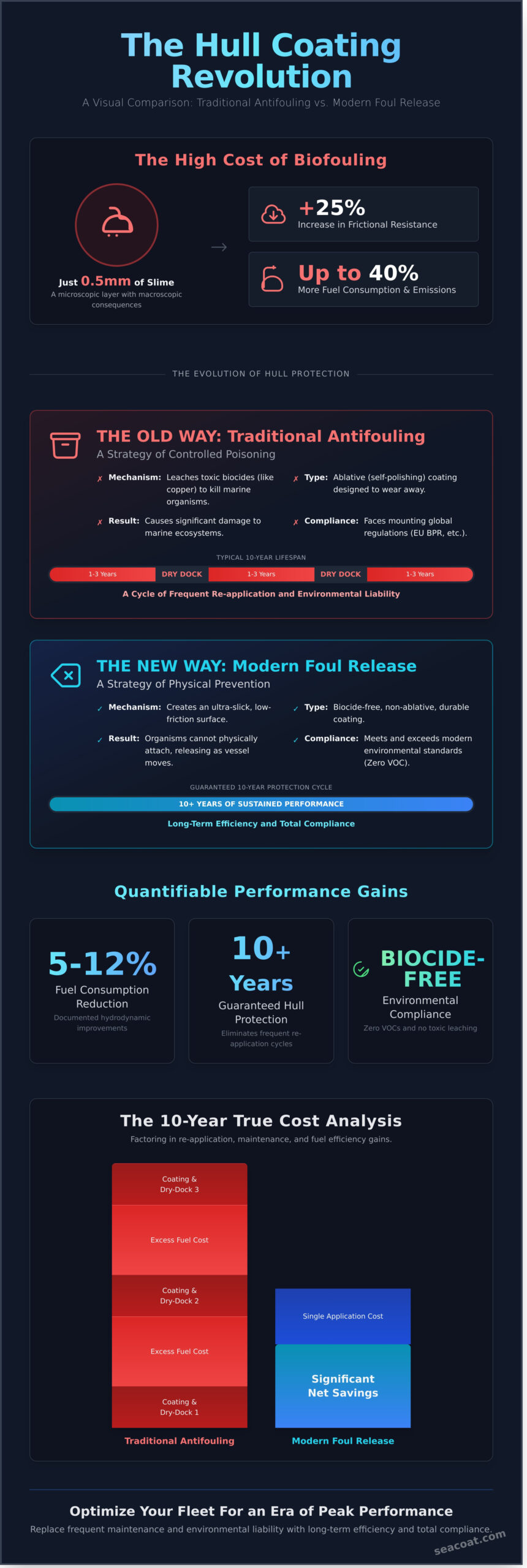
According to the International Maritime Organization, a mere 0.5 mm layer of slime on a hull can trigger a 25% increase in frictional resistance, directly impacting fuel expenditure and carbon emissions. For decades, fleet operators have navigated a difficult trade-off, accepting that effective biofouling control required toxic, ablative coatings with short service intervals and mounting regulatory scrutiny. It’s a compromise that is no longer operationally or environmentally viable.
This guide moves beyond that outdated paradigm. We will demonstrate how modern, biocide-free foul release technology is engineered to deliver superior hydrodynamic performance, resulting in a documented 5-12% reduction in fuel consumption while guaranteeing a 10-year hull protection cycle. You’ll learn how to replace frequent dry-docking and environmental liability with long-term efficiency. We will analyze the material science differentiating these advanced systems from traditional marine antifouling paint and provide a clear roadmap for optimizing your fleet for an era of peak performance and total compliance.
Key Takeaways
- Distinguish between traditional toxic antifouling and advanced foul release coatings to select a system that aligns with modern performance and environmental standards.
- Learn to calculate the true 10-year ROI of a high-performance hull coating by factoring in significant fuel efficiency gains and reduced maintenance cycles.
- Assess how the right marine antifouling paint strategy mitigates the severe operational penalties caused by biofouling, directly enhancing hydrodynamic efficiency.
- Identify the critical hull preparation and application steps required to maximize the durability and effectiveness of a next-generation foul release system.
Understanding Marine Antifouling Paint and the Challenge of Biofouling
At its core, marine antifouling paint is a specialized coating applied to a vessel’s hull, engineered with the primary function of preventing the attachment and growth of subaquatic organisms. This process, known as biofouling, is a relentless and predictable sequence. It begins within minutes of immersion as a microscopic biofilm, or slime, colonizes the surface. This initial layer creates a foundation for more complex life, including algae, tubeworms, and ultimately, hard-fouling organisms like barnacles and mussels. Left unmitigated, this biological accumulation transforms a vessel’s hull from a hydrodynamic surface into a complex, rough ecosystem.
The operational consequence of this colonization is a severe penalty in vessel efficiency. The transition from a smooth hull to one with even a light slime layer creates turbulent drag, disrupting the laminar flow of water across its surface. This disruption forces the propulsion systems to work harder to maintain speed. Industry data from organizations like the International Maritime Organization (IMO) confirms that a moderate level of biofouling can increase a vessel’s fuel consumption by up to 40%. This isn’t just a maintenance issue; it’s a direct and substantial drain on operational expenditure and a significant source of unnecessary emissions.
By 2026, the maritime industry faces a regulatory paradigm shift that elevates hull maintenance from an economic decision to a matter of global compliance. The legacy of highly effective yet environmentally toxic biocidal paints is ending. Decades of scientific evidence on their ecological impact have prompted stringent global regulations, forcing vessel operators to seek high-performance alternatives that protect both their assets and the marine environment.
The Hydrodynamic Impact of a Rough Hull
A vessel’s efficiency is fundamentally a function of its hydrodynamics. An optimally smooth hull allows for laminar flow, where water moves in parallel layers across the surface with minimal resistance. Biofouling introduces roughness that trips this flow into a state of turbulence, creating chaotic eddies and vortices that dramatically increase frictional drag. This direct relationship means that as hull roughness increases, so does the required engine power, leading to higher fuel consumption and a proportional rise in greenhouse gas (GHG) emissions, which currently constitute nearly 3% of the global total from shipping.
Traditional Antifouling vs. Modern Environmental Standards
The maritime industry’s history with antifouling is marked by a reliance on biocides. The global ban on organotins like Tributyltin (TBT) in 2008 was a landmark event, yet the industry largely pivoted to copper-based ablative paints. These formulations, which are detailed in this comprehensive overview of antifouling paint, function by continuously leaching metallic biocides to poison organisms that attempt to attach. This mechanism, while effective, causes significant collateral damage to marine ecosystems. Today, these copper-based systems face intense scrutiny under frameworks like the EU’s Biocidal Products Regulation (BPR), accelerating the critical shift toward biocide-free and Zero VOC (Volatile Organic Compound) maritime solutions.
The health of these ecosystems is not just an abstract regulatory concern; it’s the foundation for marine recreation and tourism worldwide. For a perspective on the vibrant reef life that sustainable maritime practices help protect, you can discover Cozumeldivehub.
The boat hire industry is another great example, thriving on pristine waterways and offering accessible ways for the public to connect with the marine environment. To see this in action, you can visit Boat4Hire.
The ferry industry is another key player, providing essential transport that links coastal communities and islands. In regions like Senegal, services such as Casa Ferry are vital for both local commuters and tourists exploring the area.
The Technical Evolution: Antifouling vs. Foul Release Coatings
The fundamental approach to hull protection has bifurcated into two distinct philosophies: chemical deterrence and physical prevention. Traditional marine antifouling paint operates on a principle of controlled toxicity, releasing biocides to poison marine organisms. In stark contrast, modern foul release systems engineer a surface so slick that organisms cannot physically attach. This evolution isn’t merely academic; it’s a direct response to increasing operational costs, performance demands, and stringent environmental mandates that govern the maritime industry.
Ablative and Hard Biocidal Paints
Conventional antifouling systems rely on a biocidal matrix. Ablative, or self-polishing, coatings are designed to wear away at a controlled rate, constantly exposing a fresh layer of active biocide, typically cuprous oxide. While effective for a limited period, this mechanism is one of planned obsolescence. The entire protective layer is engineered to disappear. Hard biocidal paints function differently, leaching toxins from a static, porous film. Their primary limitation is a rapid decline in efficacy once the surface-level biocides are exhausted, making them particularly vulnerable in high-fouling, low-activity conditions. The operational reality for both systems is a costly re-application cycle every 12 to 36 months, a model that is becoming increasingly unsustainable under tightening International Maritime Organization regulations that restrict harmful substances.
The Silane-Siloxane Advantage
Foul release technology represents a paradigm shift from chemical warfare to advanced materials science. The chemistry is based on a silane-siloxane polymer backbone that creates a non-porous, extremely low-surface-energy barrier. This ultra-smooth finish presents a surface that marine life simply cannot adhere to, especially once a vessel is underway. Unlike early-generation soft silicone coatings, which were easily damaged by abrasion or cleaning, advanced hard-film foul release systems offer superior mechanical durability. This resilience is critical. It allows for routine in-water cleaning without damaging the coating, a critical advantage over delicate silicones. As a direct result of this durable chemistry, the Sea-Speed V 10 X Ultra system achieves a proven 10-year service life with zero toxic leaching.
The operational differences are stark. Maintaining a biocidal coating often involves aggressive scrubbing that damages the paint and releases toxins into the harbor. Foul release systems, however, are maintained with simple, non-abrasive in-water cleaning. This preserves the coating’s integrity and prevents pollution. From a performance standpoint, the contrast is even more pronounced. An aging ablative paint surface becomes rough, increasing hydrodynamic drag and fuel consumption. A hard foul release coating maintains its low surface roughness, which directly correlates to optimized efficiency. Data from vessel performance monitoring indicates that a Silane-Siloxane hard film can reduce fuel consumption by up to 8% compared to a conventional self-polishing copolymer, delivering a clear and immediate return on investment. To determine the precise impact on your assets, you can explore our performance data and case studies.
Economic and Environmental ROI of Advanced Hull Coatings
Evaluating a high-performance marine antifouling paint requires a shift in perspective from short-term expenditure to long-term operational value. The initial application cost represents only a fraction of the total cost of ownership. A sophisticated, durable hull coating is not a maintenance line item; it’s a strategic capital investment that delivers quantifiable returns through optimized fuel consumption, regulatory certainty, and enhanced asset longevity over a 10-year service cycle.
The upfront investment in a premium foul-release or hard-film coating is systematically offset by profound operational savings. For a commercial vessel, extending dry-dock intervals from five years to ten immediately halves the associated costs for labor, logistics, and off-hire time, which can amount to millions of dollars. When you analyze the complete financial picture, the decision to implement advanced coating technology becomes a clear driver of profitability and fleet efficiency.
Fuel Savings and Carbon Footprint Reduction
The link between a vessel’s hull condition and its propulsive efficiency is absolute. A hydrodynamically smooth surface minimizes frictional drag, allowing the ship to move through water with less resistance. An increase of just 100 microns in average hull roughness can elevate the required shaft power by up to 6%, directly impacting fuel consumption. By maintaining an ultra-slick surface, advanced coatings can achieve a sustained fuel burn reduction between 5% and 12%. For a vessel consuming 40 tonnes of VLSFO daily, a 7% reduction translates to an annual saving of over 1,000 tonnes of fuel and a cost mitigation of more than $600,000 at current market rates. These fuel savings directly reduce a fleet’s carbon footprint, a critical factor for meeting the IMO’s stringent EEXI and CII decarbonization targets for 2026 and beyond.
Long-Term Asset Protection and Value
Beyond hydrodynamic performance, the primary function of a hull coating is to protect the steel substrate. Advanced biocide-free hard coatings form an inert, impermeable barrier that physically prevents corrosion and mitigates galvanic electrolysis. This robust protection preserves the structural integrity of the hull for decades, directly enhancing the vessel’s operational lifespan and resale value. A well-maintained hull, backed by a 10-year coating system, is a significant value multiplier in the second-hand market. This evolution in coating technology is a direct response to tightening environmental standards, including the globally enforced ban on organotins like TBT and evolving U.S. regulations on antifouling paints that increasingly scrutinize copper-based biocides. Furthermore, these durable systems eliminate the need for aggressive hull stripping during dry-dock, a process that generates tons of hazardous waste and incurs significant disposal costs.
Selecting the Right Coating for Specific Vessel Applications
The operational profile of a vessel dictates the performance requirements of its hull coating. A universal solution is not a viable strategy in the modern maritime industry, where efficiency, compliance, and mission-readiness are paramount. Selecting the optimal marine antifouling paint system requires a detailed analysis of the vessel’s construction, speed, and service environment. From global cargo fleets to high-speed patrol craft, the objectives vary, and the technology must align precisely with those goals.
For commercial shipping, the primary drivers are economic and logistical. A coating system must deliver a quantifiable reduction in hydrodynamic drag for a minimum of 10 years to maximize fuel efficiency and extend dry-docking intervals. A hard, inert film coating that maintains a surface roughness below 40 microns can reduce fuel consumption by 6-8% compared to conventional biocidal paints. Military and government craft operate under even more stringent parameters, where operational readiness and acoustic signature management are critical. A non-ablative, foul-release surface ensures consistent performance and minimal maintenance, which is essential for rapid deployment and sustained patrols in diverse global waters.
Special Considerations for Aluminum Boats
Applying copper-based antifouling paints to an aluminum hull initiates rapid and catastrophic galvanic corrosion. This electrochemical reaction uses seawater as an electrolyte, turning the hull itself into a sacrificial anode that dissolves to protect the more noble copper. To prevent this structural failure, a non-conductive barrier primer system is non-negotiable. SeaCoat’s Seapoxy 73 provides complete electrical isolation, forming an impermeable foundation for a copper-free, foul-release topcoat, a critical specification for high-speed aluminum ferries and patrol boats requiring sustained performance.
Performance Racing and Luxury Yachts
In the world of competitive racing and luxury yachting, performance is measured in fractions of a knot and aesthetic perfection. The Sea-Speed V 10 X Ultra Clear system is engineered for this exact purpose. As a transparent, non-toxic hard film, it preserves the visual integrity of carbon fiber or exotic wood hulls while creating an ultra-low-friction surface. This ‘easy-clean’ property allows for the simple removal of any slime layer before a race, ensuring the hull’s hydrodynamic profile is reset to its design optimum, a process that avoids the cumulative weight gain of 150-200 kg seen with ablative paint buildups over a 5-year period.
Ultimately, the coating is not just a protective layer; it’s a strategic asset integrated into the vessel’s performance and economic lifecycle. Your vessel has unique operational demands. Consult our technical experts to engineer a coating system specific to your hull material and mission profile.
Implementation and Maintenance: Transitioning to Sea-Speed
Adopting a high-performance foul release system like Sea-Speed V 10 X Ultra is more than a simple recoat; it’s a strategic transition to a new paradigm of vessel management. The ten-year performance life and significant operational efficiencies are predicated on a meticulous application process and a revised maintenance protocol. Unlike traditional, biocide-leaching marine antifouling paint which degrades by design, a hard film silane-siloxane coating is a permanent asset. Its success begins with a perfectly prepared substrate.
The Transition Process: From Old Paint to New Tech
The foundation for Sea-Speed’s exceptional durability and adhesion is an uncompromising approach to surface preparation. All old, failing, and incompatible coatings must be completely removed to achieve a Near-White Metal Blast Cleaning standard, compliant with SSPC-SP10/NACE No. 2. This process creates an optimal surface profile of 2-3 mils (50-75 microns), ensuring a mechanical bond far superior to what’s possible on a poorly prepared hull. Following surface preparation, a compatible anti-corrosive primer system is applied, tailored to the hull material—typically a high-solids epoxy for steel and aluminum or a specialized tie-coat for fiberglass. Application of the Sea-Speed system itself requires trained teams proficient with advanced coatings to achieve the specified Dry Film Thickness (DFT) of 10-12 mils (250-300 microns) for maximum foul release efficacy.
Maintenance and In-Water Cleaning Best Practices
Once cured, Sea-Speed V 10 X Ultra presents a slick, low-energy surface that fundamentally changes in-water maintenance. The system’s primary advantage is its hydrodynamic self-cleaning property. For vessels operating at speeds consistently above 10 knots, the water flow itself generates sufficient force to shear off marine bio-slime and other soft fouling. This passive cleaning mechanism drastically reduces the need for manual intervention and associated costs. For vessels with extended idle periods or operating in severe fouling zones, periodic light cleaning may be required. The objective is to preserve the film integrity, a stark contrast to the abrasive scrubbing that damages traditional ablative paints. This principle of specialized maintenance to protect valuable assets extends beyond the marine world; for a look at how professionals maintain property exteriors, you can explore Roof Cleaning.
- Mechanical Cleaning: Utilize soft, non-abrasive tools such as silicone-bladed scrapers or multi-head brushes with polypropylene bristles. Aggressive steel brushes must never be used.
- Hydro-Blasting: Employ high-volume, low-pressure water jets, maintaining a pressure below 1,500 PSI to dislodge growth without impacting the coating’s surface.
Ultimately, the transition to Sea-Speed V 10 X Ultra represents a calculated investment in long-term operational excellence. The rigorous upfront preparation unlocks a decade of predictable performance, eliminating the cycle of frequent dry-docking associated with conventional coatings. This shift from a consumable expense to a durable asset delivers quantifiable returns through fuel savings of 6-8%, zero biocide discharge, and unparalleled hull protection. It’s the logical conclusion for any fleet manager prioritizing asset longevity, regulatory compliance, and a competitive bottom line in 2026 and beyond. Contact Seacoat for a technical consultation on your fleet and engineer a superior performance profile for your vessels.
Secure a Decade of Peak Performance and Environmental Compliance
The era of temporary, biocide-leaching hull coatings is ending. Forward-thinking fleet management now demands a strategic shift toward technologies that deliver both long-term operational ROI and verifiable environmental stewardship. As this guide demonstrates, the financial and performance gains from advanced foul release systems aren’t incremental; they are transformative, driven by superior hydrodynamics and vastly reduced maintenance schedules. This is the new standard, moving far beyond traditional marine antifouling paint. Sea-Speed V 10 X Ultra stands at the forefront of this evolution. Engineered with proprietary Silane-Siloxane technology, it provides a documented 10-year life cycle of unparalleled protection. Embrace a Zero VOC, biocide-free solution that future-proofs your assets against tightening regulations. Optimize Your Vessel’s Performance with Sea-Speed V 10 X Ultra and lead the transition to a more efficient, sustainable maritime future.
Frequently Asked Questions About Marine Hull Coatings
Is marine antifouling paint toxic to the environment?
Yes, traditional marine antifouling paint is toxic because it relies on biocides like cuprous oxide to poison marine organisms. These biocides leach into the water, harming non-target species and accumulating in the ecosystem. In contrast, modern foul release coatings are biocide-free and non-toxic. They create an ultra-slick surface that prevents adhesion, offering an environmentally responsible solution that aligns with global sustainability goals and avoids the ecological damage caused by legacy chemical-based systems.
What is the difference between antifouling and foul release coatings?
The core difference is their mechanism of action. Traditional antifouling coatings are chemically active, releasing biocides to kill marine life that attempts to attach to the hull. Foul release coatings are physically active and biocide-free; their extremely low-friction surface makes it difficult for organisms to gain a firm hold. Any light fouling that does occur is typically dislodged by the vessel’s movement through the water, a self-cleaning hydrodynamic effect that maintains a smooth hull.
How much fuel can I save by using a high-performance hull coating?
Vessels can achieve fuel savings of up to 8% by using a high-performance foul release coating. This significant efficiency gain is a direct result of minimizing hydrodynamic drag. A smooth, foul-free hull moves through water with far less resistance than one colonized by marine growth. This reduction in drag directly lowers the engine power required to maintain a given speed, translating into quantifiable reductions in fuel consumption and associated operational expenditures over the vessel’s service life.
Can I apply foul release coating over my existing bottom paint?
No, you cannot apply a foul release coating directly over existing bottom paint. Proper adhesion and performance depend on a fully integrated coating system applied to a correctly prepared substrate. The existing paint must be completely removed down to the original gelcoat or barrier coat. Following removal, a specific tie-coat primer must be applied to create a chemical bond for the foul release topcoat, ensuring the system’s 10-year integrity and performance.
How long does Sea-Speed V 10 X Ultra last compared to standard paint?
Sea-Speed V 10 X Ultra is engineered for a service life exceeding 10 years with proper application and maintenance. This represents a substantial improvement over standard ablative or hard antifouling paints, which typically require complete reapplication every 1 to 3 years. The non-ablative, hard-film nature of our coating means it doesn’t deplete over time, providing a long-term capital investment in vessel performance rather than a recurring operational expense.
Is foul release coating suitable for aluminum boats?
Yes, foul release coatings are an ideal solution for aluminum hulls. Unlike conventional antifouling paints that contain copper, our biocide-free coatings are chemically inert and contain no metals, which completely eliminates the risk of galvanic corrosion that occurs when copper and aluminum are in proximity in a marine environment. This makes them the safest and most effective long-term hull protection strategy for aluminum vessels, from workboats to high-speed ferries.
What are the IMO regulations regarding hull coatings in 2026?
As of 2026, IMO regulations will intensify their focus on vessel efficiency to meet stringent Carbon Intensity Indicator (CII) rating thresholds. While no direct mandate on coating type exists, a vessel’s hull performance is a critical factor in its CII rating. High-performance, low-friction coatings that reduce drag and improve fuel efficiency by 5-8% are becoming essential tools for owners to ensure their fleets remain compliant and avoid operational penalties associated with poor energy efficiency ratings.
How do I clean a hull that has a hard-film foul release coating?
Cleaning a hard-film foul release coating is a simple, non-abrasive process. Regular in-water cleaning can be performed using low-pressure water jets or soft, non-metallic brushes to dislodge any light slime that may accumulate during long stationary periods. Because the coating is non-ablative and extremely durable, it withstands routine cleaning without degradation. Aggressive scraping or the use of metallic tools is unnecessary and should be avoided to protect the coating’s slick surface integrity.