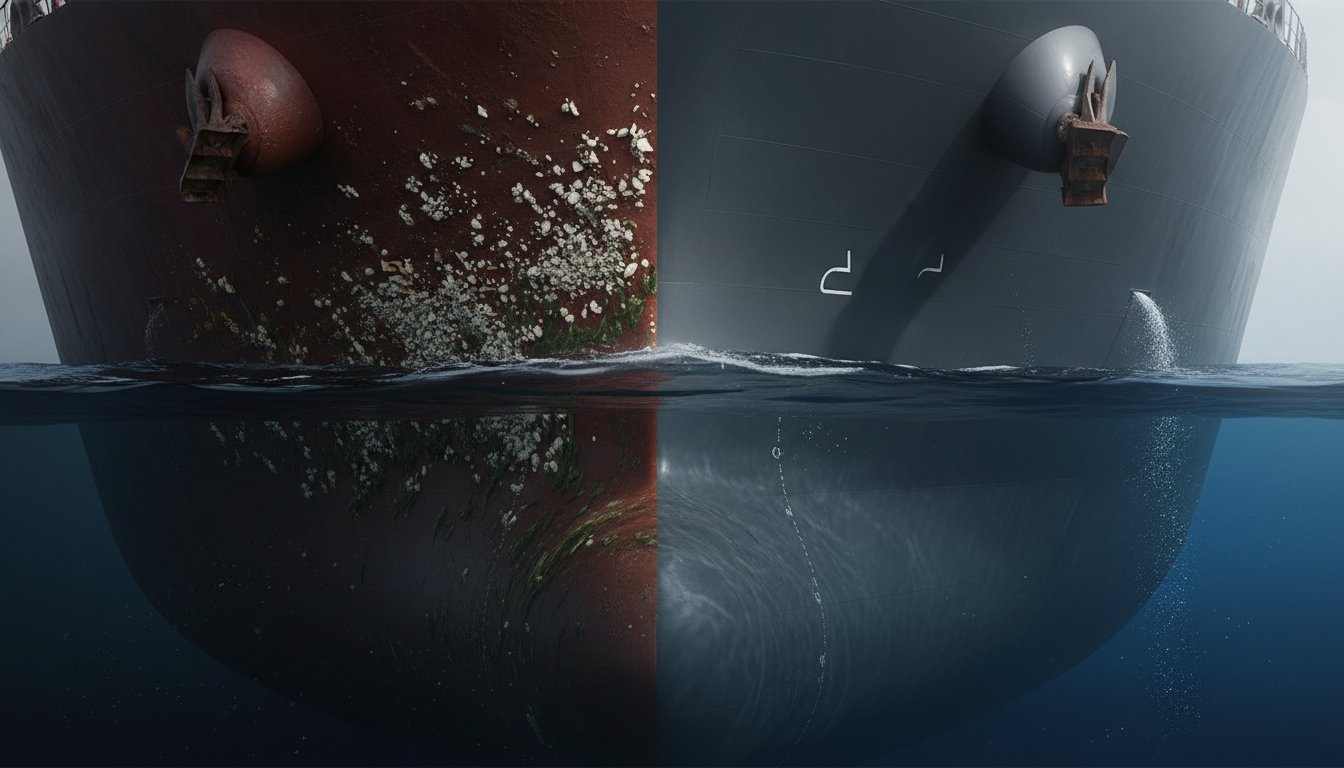
A mere 0.5 millimeters of hull roughness can trigger an 18% increase in fuel consumption, yet the industry often relies on sacrificial coatings that begin degrading the moment a vessel leaves dry-dock. You likely recognize that the era of heavy-metal biocides is closing as 2026 regulatory deadlines approach and environmental scrutiny intensifies. Maintaining a fleet’s operational readiness shouldn’t mean accepting the recurring costs of frequent repainting or the environmental liability of copper leaching. We understand that for maritime stakeholders, the priority is a balance between uncompromising protection and strict fiscal responsibility.
This guide explores how modern foul release technology is replacing traditional marine antifouling bottom paint to deliver a 10-year service life and significant drag reduction. You’ll discover how biocide-free siloxane systems provide a non-toxic, hydrodynamic surface that facilitates measurable fuel savings and ensures full compliance in all international waters. We’ll examine the technical shift from toxic ablation to high-durability surface engineering, providing the data you need to optimize your asset’s performance for the next decade of operations.
Key Takeaways
- Understand why global regulatory shifts are making biocide-free coatings essential for long-term fleet compliance and environmental stewardship in 2026.
- Compare the hydrodynamic performance of siloxane-based foul release systems against traditional marine antifouling bottom paint to optimize maintenance cycles and hull integrity.
- Quantify the correlation between hull surface roughness and fuel efficiency to realize substantial ROI through measurable drag reduction.
- Discover how advanced hard-film technology like Sea-Speed V 10 X Ultra delivers a ten-year protective life cycle while maintaining zero VOC emissions.
Understanding Marine Antifouling Bottom Paint in 2026
In the current maritime environment, Anti-fouling paint has evolved from a simple maintenance requirement into a critical component of vessel performance optimization. Marine biofouling, which involves the accumulation of microorganisms, plants, and animals on submerged surfaces, creates a physical barrier that compromises hull integrity and hydrodynamic efficiency. By 2026, the industry has largely pivoted away from reactive maintenance toward proactive surface management. This shift is driven by the need to mitigate the 40% increase in fuel consumption that can result from heavy shell growth. Using high-performance marine antifouling bottom paint isn’t just about preventing growth; it’s about maintaining a smooth, low-energy surface that ensures peak operational efficiency over a ten-year service life.
This industry-wide transition marks the end of the era of sacrificial coatings. For decades, ship owners relied on “self-polishing” systems that shed layers to reveal fresh biocides. Today, advanced hard-film technology has replaced these eroding layers. These modern coatings provide a permanent, non-porous barrier that protects the hull substrate from corrosion while offering a surface so slick that most organisms can’t find a foothold. This evolution represents a move toward strategic asset management, where the coating is treated as a long-term investment rather than a recurring dry-dock expense. The focus has shifted from chemical toxicity to physical durability and surface tension.
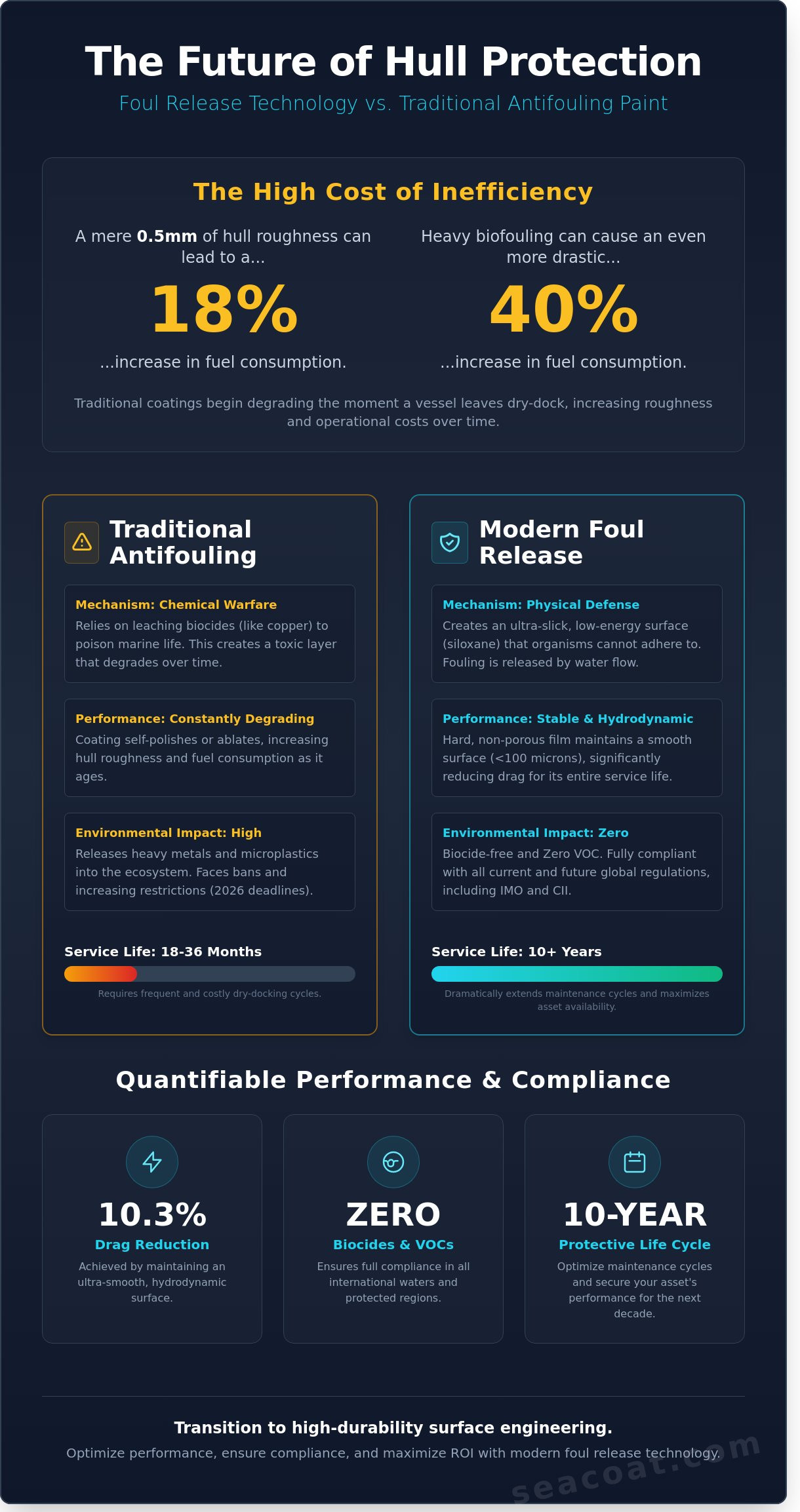
Global maritime authorities, including the International Maritime Organization (IMO), have tightened restrictions on biocidal leaching to protect vulnerable ecosystems. The 2023 implementation of the Carbon Intensity Indicator (CII) forced fleet managers to scrutinize every factor affecting fuel burn, placing hull performance at the top of the priority list. Traditional coatings that rely on the controlled release of toxins face localized bans in regions like the Baltic Sea and parts of the California coast. Transitioning to zero-VOC (Volatile Organic Compound) formulations allows operators to meet these stringent environmental standards without sacrificing the 10.3% drag reduction achieved by modern hydrodynamic coatings.
The Crisis of Traditional Biocides
Legacy systems primarily used Tributyltin (TBT) and copper oxides to poison settling larvae. These heavy metals persist in the sediment, disrupting the endocrine systems of non-target marine life. Ablative paints are now a significant liability because they function by eroding into the ocean, shedding microplastics and chemical agents. This constant degradation is incompatible with the 2026 push for sustainable shipping. Commercial fleets now require stable, non-leaching alternatives that don’t require re-application every 24 months.
This drive to protect marine ecosystems from industrial impact highlights a broader cultural appreciation for the ocean’s natural state. In a fascinating contrast to the maritime industry’s battle against biofouling, some artists find inspiration in the very elements that coatings aim to repel. For example, UK-based artist Kirsty Devlin celebrates the natural beauty of the coast by creating unique prints from seaweed.
Key Terminology: Antifouling vs. Foul Release
Distinguishing between chemical and physical protection strategies is vital for modern fleet management. Traditional marine antifouling bottom paint relies on biocides to create a toxic zone around the hull. In contrast, foul release systems utilize advanced siloxane or fluoropolymer technologies to create a hydrophobic surface with extremely low surface energy. Hydrodynamics remains the core focus; a surface with a roughness of less than 100 microns can significantly reduce total hull resistance, directly lowering carbon emissions and fuel costs.
Foul Release vs. Traditional Antifouling: A Technical Comparison
Traditional marine antifouling bottom paint operates through a mechanism of controlled depletion. These coatings rely on biocides, typically cuprous oxide, which leach into the surrounding water to create a toxic boundary layer that kills settling larvae and spores. This chemical approach is inherently finite; as the biocide reservoir exhausts, the hull’s protection vanishes. Most traditional ablative or self-polishing copolymers fail to provide adequate protection after 18 to 36 months of service. This degradation forces frequent dry-docking cycles and results in a steady increase in hull roughness, which can spike fuel consumption by 10% to 20% as the coating ages.
The transition to foul release technology represents a shift from chemical warfare to physical defense. Instead of poisoning marine life, these systems utilize low-energy surfaces to prevent organisms from adhering to the hull. Environmental compliance is a major driver of this shift. Adhering to International Maritime Organization (IMO) regulations, specifically the AFS Convention, has become a priority for global fleet managers. While traditional paints often struggle with evolving toxicity standards and VOC limits, advanced siloxane coatings offer a biocide-free alternative with zero VOC emissions, ensuring long-term regulatory certainty.
How Silane-Siloxane Technology Works
Silane-siloxane systems create a molecularly smooth, ultra-slick surface that minimizes the bond strength of biofouling. Unlike early silicone coatings that were soft and prone to tearing, modern siloxane hybrids form a cross-linked “hard film” that resists mechanical abrasion. The surface energy is so low that most organisms cannot find a foothold. For vessels operating at speeds above 10 knots, the hydrodynamic shear stress created by the water flow effectively “self-cleans” the hull, stripping away any accumulated slime or light fouling without manual intervention.
Service Life and Maintenance Cycles
Standard industry practices dictate a 2-year dry-docking interval to repair and recoat traditional systems. Advanced siloxane technology disrupts this cycle by offering a 10-year service life. Because the coating does not leach or erode, the film thickness remains constant over a decade of operation. This durability allows for a strategic approach to asset management where the coating is treated as a long-term capital investment rather than a recurring maintenance expense.
Hard coatings provide a distinct advantage during in-water cleaning procedures. Traditional soft paints are easily damaged by brushes or high-pressure tools, which releases concentrated biocides into the harbor and strips the paint’s protective layers. In contrast, the mechanical resilience of siloxane allows for aggressive cleaning of niche areas without compromising the integrity of the film. This ability to maintain a smooth, low-drag surface over 120 months significantly reduces the total cost of ownership. Optimizing your fleet’s hydrodynamic profile requires a shift toward permanent foul release solutions that prioritize both performance and ecological safety.
The economic impact of this technology is quantifiable. By maintaining a stable hull roughness of less than 100 micrometers over a 10-year period, operators can avoid the 4% to 6% fuel penalty typically associated with the aging of traditional marine antifouling bottom paint. This technical evolution ensures that vessel efficiency is dictated by engineering design rather than the biological degradation of the hull surface.
Calculating ROI: Fuel Savings and Drag Reduction
Ship owners frequently underestimate the financial penalty of a rough hull. Surface roughness acts like underwater sandpaper, increasing frictional resistance which accounts for up to 80% of a vessel’s total drag. Conventional marine antifouling bottom paint often degrades through chemical leaching, creating a porous, uneven profile that traps water and encourages micro-fouling. This degradation isn’t just a maintenance issue; it’s a direct drain on the fuel budget. When a hull’s average roughness increases by only 30 microns, it can lead to a 2% to 3% increase in fuel consumption.
Hydrodynamic Optimization and Surface Smoothness
The “hull factor” is a critical metric in propulsion efficiency. It measures how much power is lost strictly to frictional resistance against the water. Sea-Speed V 10-G delivers an initial surface profile of less than 75 microns, significantly lower than the 250 microns typical of aged self-polishing copolymers. In comparative sea trials, this superior smoothness has demonstrated drag reduction percentages ranging from 6% to 12% compared to standard biocidal systems. For a vessel cruising at 20 knots, a 5% reduction in drag can increase top-end speed by 0.6 knots without any increase in fuel consumption. This optimization directly impacts the vessel’s operational flexibility and schedule reliability.
The Total Cost of Ownership (TCO) Model
Fleet managers shouldn’t look at the sticker price of a coating in isolation. A premium foul release system requires a higher initial investment but eliminates the need for bi-annual repainting and hull stripping. Traditional copper coatings require frequent mechanical scrubbing, which further roughens the surface and releases heavy metals into the water column. This is becoming a major legal liability as the Washington State 2026 antifouling paint regulations move toward stricter limits on biocidal leaching. By switching to a non-toxic, siloxane-based hard film, operators can extend dry-dock intervals from 36 months to 60 or even 120 months, saving millions in yard fees and labor costs over the life of the ship.
This principle of using precise data to manage high-value assets extends beyond the maritime sector. In commercial property management, for example, obtaining detailed 1ESX Roof & Wall Reports ensures that maintenance and retrofitting projects are planned with the same focus on long-term ROI and material efficiency.
The payback period for Sea-Speed is often achieved within 14 to 18 months through fuel savings alone. Consider a commercial container ship burning 150 tons of fuel daily at $600 per ton. A 6% efficiency gain saves $5,400 every day at sea. Over a 280-day operational year, that’s $1.51 million in direct fuel savings. These figures don’t even include the reduced cost of hull cleaning or the elimination of hazardous waste disposal fees associated with biocidal paints.
Meeting EEXI and CII compliance targets is no longer optional for international shipping. These IMO regulations penalize inefficient vessels by restricting their operation or requiring power limitations. A smooth, clean hull is the most cost-effective way to improve a vessel’s CII rating without the need for expensive engine retrofits or carbon capture systems. It’s a strategic asset that preserves the vessel’s market value while protecting the marine environment. Using a high-performance marine antifouling bottom paint ensures that the ship stays in the “A” or “B” rating category, avoiding the operational restrictions that come with poor carbon intensity scores.
Selection Guide: Choosing the Right Coating for Your Vessel
Coating Requirements for Commercial Fleets
Commercial operators prioritize the Energy Efficiency Existing Ship Index (EEXI) and the Carbon Intensity Indicator (CII) introduced by the IMO in 2023. Implementing a high-performance coating can reduce hull drag by 6% to 12%, directly impacting these regulatory scores. Managing massive surface areas requires a robust system like Seapoxy 73. This siloxane-epoxy primer creates a permanent bond that withstands the mechanical stresses of long-haul voyages. It provides the essential stable base for foul-release topcoats, ensuring that the initial investment delivers returns over a 10-year service life.
- Regulatory Compliance: Meets EEXI requirements through verifiable drag reduction.
- Scale Efficiency: Seapoxy 73 allows for bulk application on hulls exceeding 300 meters.
- Economic ROI: Fuel savings of 5% can save hundreds of thousands of dollars annually per vessel.
The Yacht Owner’s Perspective
For pleasure craft and competitive racing hulls, the focus shifts toward a balance of aesthetics and extreme smoothness. Sea-Speed V 10 X Ultra provides a hard-film surface that doesn’t leach heavy metals into the water. This is critical in recreational marinas where copper concentrations are strictly regulated by local environmental agencies. For racing teams, clear coat options offer a distinct advantage, allowing for the inspection of specialized composite finishes while maintaining a surface roughness of less than 20 microns.
Aluminum hulls present a unique challenge that many traditional products can’t solve. If you apply a copper-based marine antifouling bottom paint to an aluminum hull, you’ll trigger rapid galvanic corrosion that can compromise the metal’s structural integrity within 18 months. Non-metallic siloxane coatings are non-conductive and chemically inert. They provide a protective barrier that prevents the hull from becoming an anode, effectively eliminating the risk of pitting and electrochemical decay.
- Aluminum Safety: Non-metallic formulas prevent catastrophic galvanic corrosion.
- Durability: Hard-film technology resists abrasion from fenders and debris.
- Eco-Responsibility: Zero VOCs and biocide-free chemistry protect marine biodiversity.
The transition from traditional ablative paints to permanent, hard-film technology represents a shift toward intelligence and stewardship. By selecting a coating based on scientific performance data rather than habit, you’re investing in the vessel’s long-term operational health and the preservation of the ecosystems through which it travels.
Explore the SeaCoat product line today.
Transitioning to Sea-Speed: The Future of Hull Protection
Traditional marine antifouling bottom paint has long relied on the controlled release of biocides to manage biofouling. This chemical-heavy approach creates a cycle of environmental degradation and steadily declining vessel performance as the paint depletes. Sea-Speed V 10 X Ultra offers a sophisticated alternative that prioritizes hydrodynamic efficiency and environmental stewardship. By moving beyond sacrificial coatings, operators can achieve long-term stability in their fuel consumption metrics and operational costs.
The Sea-Speed Advantage
Sea-Speed V 10 X Ultra is a silane-siloxane hard film foul release coating with a 10-year lifecycle. This technology eliminates the need for heavy metals or toxic leaching, providing a zero VOC, biocide-free solution that meets the strictest global environmental standards. While many competitors rely on soft silicone coatings that are prone to tearing, delamination, and the “soft silicone failure trap,” our hard-film finish is engineered for extreme durability. Soft silicones often fail when organisms “hook” into the pliable surface, making cleaning impossible without damaging the coating. In contrast, Sea-Speed creates a robust, non-porous barrier that withstands mechanical grooming and high-speed transit without losing its integrity.
The technical superiority of this system is evident in its surface profile. When applied correctly, Sea-Speed reduces surface roughness to less than 20 microns. This ultra-smooth finish minimizes frictional drag, which is a primary driver of fuel inefficiency. Because the coating doesn’t deplete or become rougher over time like traditional marine antifouling bottom paint, the fuel savings are sustained throughout the entire dry-dock cycle. Data from commercial applications show that vessels transitioning to this hard-film technology can expect fuel savings between 6% and 12% depending on their operational profile and hull condition.
Getting Started with Seacoat SCT, LLC
Transitioning a commercial or military fleet involves more than just a change in product; it requires a strategic overhaul of maintenance schedules and performance expectations. Seacoat SCT, LLC’s team provides technical oversight for global applications across six continents, ensuring that every hull achieves a precision finish. Our experts consult with fleet managers to analyze current fuel burn data and project the return on investment over the 10-year coating life. We’ve optimized a wide range of assets, from high-speed ferries and naval destroyers to massive container ships and tankers.
The Seacoat SCT, LLC commitment is backed by 20 years of proven performance technology. We don’t just sell a coating; we provide a strategic asset for vessel management. For smaller operators or private vessels, we offer specialized kits through our online store, making professional-grade foul release technology accessible to everyone. Achieving the perfect hard-film finish requires attention to detail during the application process, including strict adherence to temperature and humidity parameters to ensure a flawless cure. Seacoat SCT, LLC’s global support network is ready to assist with every stage of the transition, from surface preparation to final inspection.
Take the next step in optimizing your vessel’s performance and environmental profile.
Contact Seacoat SCT, LLC today for a custom hull efficiency analysis
Securing Operational Excellence Through 2026 Standards
Navigating the maritime landscape of 2026 requires a shift from short-term fixes to long-term strategic assets. Traditional coatings don’t meet the rigorous biocide-free mandates and Zero VOC standards now governing international waters. By prioritizing hydrodynamic efficiency through a hard-film finish, vessel owners achieve measurable drag reduction that directly lowers fuel consumption. Selecting the right marine antifouling bottom paint isn’t just a maintenance choice; it’s a commitment to operational longevity and environmental stewardship.
SeaCoat’s proprietary Silane-Siloxane technology bridges the gap between high-durability protection and ecological safety. With a proven 10-year lifecycle, this system eliminates the need for frequent reapplications while maintaining a non-toxic profile. It’s time to move beyond toxic biocides and embrace a coating that delivers both 100% regulatory compliance and superior ROI. The future of hull protection is here.
Optimize your vessel’s performance with Sea-Speed technology
Frequently Asked Questions
Is marine antifouling bottom paint toxic to sea life?
Traditional marine antifouling bottom paint is often toxic because it relies on the controlled release of biocides, such as cuprous oxide, to kill colonizing organisms. These heavy metals accumulate in marine sediments and disrupt local food chains. Sea-Speed V 10 X Ultra utilizes a non-toxic siloxane chemistry that provides a physical rather than chemical barrier. It contains zero VOCs and meets the 2023 IMO standards for environmental safety.
How often should I repaint the bottom of my boat?
You should repaint every 12 to 24 months if you use conventional ablative coatings that wear away over time. These systems lose their efficacy as the biocidal layer depletes during operation. Advanced siloxane coatings like Sea-Speed V 10 X Ultra are engineered for a 10-year service life. This extended interval reduces dry-docking frequency by 400 percent compared to standard industry cycles.
What is the difference between foul release and antifouling paint?
Antifouling paints use chemical toxins to prevent growth, while foul release coatings utilize low surface energy to prevent organisms from adhering. Foul release systems create a hydrophobic surface so slick that barnacles and biofilm detach when the vessel reaches speeds of 8 to 10 knots. This hydrodynamic optimization reduces skin friction by up to 10 percent. It turns the hull into a high-performance asset rather than just a protected surface.
Can I apply foul release coating over old bottom paint?
You cannot apply a foul release coating directly over existing marine antifouling bottom paint because the chemistries are incompatible and’ll lead to delamination. Successful application requires a near-white metal blast to SSPC-SP 10 standards to ensure a mechanical bond. Removing old layers eliminates accumulated surface roughness, which can account for a 5 percent increase in drag. A clean substrate is essential for achieving the full hydrodynamic benefits of the new film.
Does bottom paint actually improve fuel efficiency?
High-performance coatings improve fuel efficiency by reducing the hydrodynamic drag caused by hull fouling and surface roughness. A fouled hull can increase fuel consumption by 40 percent due to the extra power required to overcome resistance. Sea-Speed V 10 X Ultra has demonstrated fuel savings between 6 and 12 percent in real-world maritime trials. These savings directly translate to lower operational costs and a reduced carbon footprint for the fleet.
What is the best bottom paint for aluminum boats?
The best coating for aluminum hulls is a biocide-free, non-metallic foul release system that eliminates the risk of galvanic corrosion. Traditional copper-based paints react with aluminum, causing rapid pitting and structural degradation within 6 months of exposure. Sea-Speed V 10 X Ultra is chemically inert and safe for all aluminum alloys. Its hard-film durability provides a permanent protective barrier that resists impact and abrasion in harsh environments.
How long does Sea-Speed V 10 X Ultra last compared to traditional paint?
Sea-Speed V 10 X Ultra lasts for 10 years, which is five times longer than the average 2-year lifespan of traditional ablative paints. Conventional coatings require frequent scrubbing and reapplication because their active ingredients leach out into the water. Our siloxane technology doesn’t deplete or wear down. This longevity results in a 50 percent reduction in total lifetime maintenance costs for vessel owners and operators.
Are there regulations banning copper-based bottom paints?
Several jurisdictions have implemented bans or strict limits on copper-based paints to protect marine biodiversity. Washington State passed legislation to phase out copper in recreational boat paint by 2024 for specific categories. European REACH regulations also restrict various biocides used in maritime applications. Switching to biocide-free technology ensures your fleet remains compliant with evolving global environmental standards for the next decade.