
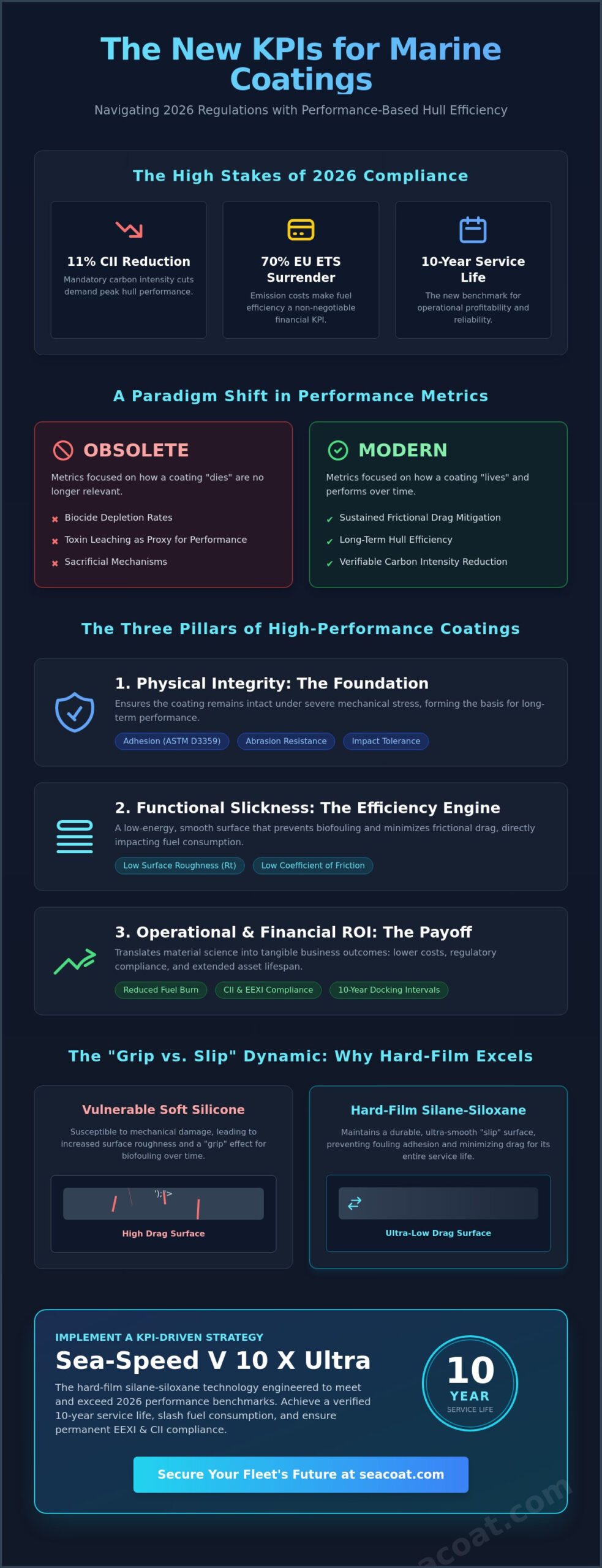
In 2026, the only marine coating KPIs that truly matter are those measuring the sustained mitigation of frictional drag over a multi-year service life. As the maritime industry faces the 11% Carbon Intensity Indicator (CII) reduction factor and the requirement to surrender 70% of verified emissions under the EU ETS, the margin for error in hull performance has vanished. You’ve likely felt the pressure of rising fuel costs and the persistent uncertainty surrounding the 10 year lifespan of non-toxic coatings. Understanding the key performance indicators for marine coatings is no longer just a maintenance task; it’s a strategic necessity for regulatory survival and operational profitability.
We understand that distinguishing between the technical requirements of ASTM D6990-20(2026) and ISO 11997-1:2026 can be complex when you’re simply trying to verify long-term fuel savings. This guide will help you master the technical and operational KPIs used to evaluate performance, from laboratory standards to real-world efficiency gains. We’ll examine how hard-film silane-siloxane technologies like Sea-Speed V 10 X Ultra provide a pathway to extended dry-docking intervals of up to 10 years while ensuring your fleet remains compliant with EEXI and CII mandates.
Key Takeaways
- Transition from obsolete biocide-release metrics to performance-based efficiency standards to meet 2026 environmental mandates.
- Identify the essential key performance indicators for marine coatings through technical ASTM verification, ensuring long-term adhesion and mechanical durability.
- Evaluate the “Grip vs. Slip” dynamic to understand why hard-film siloxane technology outperforms vulnerable soft silicone in high-stress maritime environments.
- Bridge the gap between material science and operational ROI by linking coating integrity to reduced fuel consumption and CII regulatory compliance.
- Implement a strategic maintenance cycle with Sea-Speed V 10 X Ultra to achieve a verified 10 year service life and extended dry-docking intervals.
Defining Key Performance Indicators for Modern Marine Coatings
The maritime sector’s reliance on biocide depletion rates as a proxy for performance is a relic of a less regulated era. Historically, Anti-fouling paint was judged by its ability to leach toxins into the surrounding water to prevent growth. In the 2026 regulatory environment, these sacrificial metrics have become obsolete. Modern ship owners must now prioritize key performance indicators for marine coatings that center on sustained hull efficiency and carbon intensity targets. The focus has moved from how a coating dies to how it lives and performs over a multi-year cycle.
This shift toward performance-based metrics reflects a deeper understanding of fluid dynamics and material science. We don’t just want a coating to stay on the hull; we want it to work. This requires a data-driven selection process that views the coating as a strategic asset rather than a maintenance expense. By focusing on three critical pillars-Physical, Functional, and Operational-operators can secure the 10-year service intervals necessary for modern fleet management. Reliability is the new benchmark for success in a high-stakes industrial sector.
Physical Integrity vs. Functional Slickness
Traditional metrics often stop at basic adhesion, assuming that if the film remains intact, the coating has performed its duty. This is a narrow and often costly perspective. Physical KPIs like impact resistance and abrasion tolerance are essential, but they only tell half the story. A coating that remains attached but has developed significant surface roughness (Rt) has failed its functional KPI. High roughness increases frictional drag, forcing the engine to work harder and burning more fuel. We evaluate functional slickness through the coefficient of friction and surface energy. A truly high-performance coating maintains a low-energy surface that prevents biofouling from taking hold, ensuring the hull remains “slick” for the entire service interval. If the surface becomes rough, the coating’s primary purpose is lost.
The Role of Environmental Compliance as a KPI
Environmental stewardship is no longer a secondary concern; it’s a core performance metric. We measure this through VOC content and the total absence of biocide leaching. Non-toxic silane-siloxane technologies represent the pinnacle of this shift. By eliminating harmful additives, these systems ensure compliance with the strictest 2026 global standards, including the IMO’s latest directives. Key performance indicators for marine coatings must now include the ecological footprint of the vessel. Choosing a non-toxic solution isn’t just about avoiding fines. It’s about aligning asset management with Corporate Social Responsibility (CSR) goals, providing a strategic advantage in a market that increasingly values sustainable operations. Efficiency and ecology are now inseparable and synergistic goals for the modern fleet manager.
Technical KPIs: Laboratory Standards and ASTM Verification
Laboratory validation provides the empirical foundation for any fleet-wide coating strategy. When evaluating key performance indicators for marine coatings, technical managers must look beyond marketing claims to standardized testing protocols that predict real-world endurance. ASTM D3359, the cross-cut tape test, remains the industry benchmark for evaluating initial and long-term film bonding. By scoring the coating and applying pressure-sensitive tape, technicians can quantify the risk of delamination under hydrodynamic pressure. Complementing this is ASTM D6677, which utilizes a knife-peel method to simulate the severe mechanical stresses encountered during docking or fender contact.
Rigorous Performance Testing of Marine Coatings also includes abrasion resistance, often measured through intensive scrub tests. These procedures are vital for vessels requiring frequent in-water cleaning, as they determine the point at which mechanical cleaning might compromise the film’s thickness. In tropical or high-salinity environments, UV exposure and accelerated salt spray testing help predict how quickly a polymer matrix will degrade. This ensures the 10-year service life isn’t cut short by environmental fatigue or chemical breakdown of the coating’s structure.
Measuring Surface Roughness and Hydrodynamics
Advanced laser profilometry allows us to establish a baseline for hull roughness before a vessel even leaves the dry dock. While traditional epoxies may appear smooth to the naked eye, microscopic peaks and valleys create turbulent flow that saps energy and increases drag. Flow tank testing provides the necessary data to quantify drag reduction, comparing the efficiency of silane-siloxane systems against standard industry coatings. A 10-micron reduction in average surface roughness typically correlates to a 1% reduction in total fuel consumption. For a deep-sea vessel, these marginal gains accumulate into substantial operational savings over the course of a single voyage.
Adhesion Science: The Molecular Bond
The transition from mechanical to chemical adhesion represents a significant leap in coating longevity. Unlike traditional paints that rely on surface profile for a “mechanical grip,” silane-siloxane systems create a molecular tether to the substrate. This chemical bond is particularly effective on diverse materials, including steel, composites, and specialized alloys. If you’re managing a fleet with mixed hull types, understanding the bond strength is critical, especially when selecting the best boat paint for aluminum boats where corrosion protection and adhesion are paramount. This molecular integration ensures the coating remains a permanent strategic asset rather than a temporary layer. For operators seeking to verify these technical benchmarks, reviewing detailed performance data is the first step toward a more efficient fleet.
Comparative KPIs: Hard-Film Durability vs. Soft Silicone Vulnerability
The “Grip vs. Slip” dynamic represents a fundamental divergence in how we measure the longevity of foul-release systems. Soft silicone coatings prioritize low surface energy to achieve foul-release properties, yet they frequently fail the most basic mechanical key performance indicators for marine coatings. Because these materials are inherently elastomeric and fragile, they are prone to mechanical tearing when subjected to the shear forces of high-speed transit or the friction of dockside contact. A single gouge in a soft silicone film can lead to catastrophic delamination, as the hydrodynamic pressure of moving water gets under the tear and peels the coating away in large sheets.
Hard-film siloxane systems provide a superior alternative by combining the low surface energy of a release coating with the physical toughness of a high-performance epoxy. These coatings exhibit exceptional resistance to fender rub, ice abrasion, and dockside debris, ensuring the hull remains protected even in the most demanding operational environments. This durability directly impacts the service life expectancy of the asset. When you amortize the cost of a 10-year system over its entire lifecycle, the ROI of a hard-film coating far exceeds that of a soft silicone that requires frequent repairs or premature replacement due to physical failure.
Mechanical Resistance in High-Stakes Environments
For military and ice-class vessels, impact resistance is a non-negotiable KPI. Hard-film coatings like Sea-Speed V 10 X Ultra are engineered to withstand the extreme pressures of ice-breaking and high-velocity debris without compromising film integrity. This prevents the phenomenon of “silicone ghosting,” where damaged soft coatings leave behind a patchy, inefficient surface that attracts heavy fouling. By maintaining a smooth, hard surface, these systems allow for aggressive mechanical grooming if necessary, which is impossible with delicate soft silicones. Understanding these differences is vital when moving away from traditional Ablative Bottom Paint vs. Modern Alternatives that rely on a sacrificial cycle rather than permanent protection.
Recoatability and Maintenance Logistics
Ease of repair is a critical operational KPI that is often overlooked during the initial selection process. Patching a hard-film siloxane is a straightforward procedure that requires minimal surface preparation, as the material bonds well to itself. In contrast, soft silicone is notoriously difficult to repair; the same low surface energy that sheds barnacles also prevents new layers of coating from adhering properly. This often necessitates a total strip-down to the primer, significantly increasing dry-docking costs and time. By choosing a system with high surface energy for maintenance bonding but low surface energy for fouling release, operators ensure that their key performance indicators for marine coatings reflect long-term “attachment” rather than a cycle of expensive “replacement.”
Operational KPIs: Bridging Coating Science and ROI
While laboratory data provides the “how,” operational metrics provide the “why.” For fleet owners, the ultimate key performance indicators for marine coatings are found in the daily fuel log. A hull that maintains its hydrodynamic efficiency over a multi-year cycle directly reduces the energy required for propulsion. This isn’t just a matter of saving money; it’s the primary mechanism for meeting the International Maritime Organization’s Carbon Intensity Indicator (CII) targets. In 2026, the CII reduction factor is set at 11% relative to the 2019 baseline. Sustained hull slickness ensures that a vessel’s EEXI rating remains stable, preventing the need for costly engine power limitations or operational slowdowns.
The financial impact of coating selection is most visible when analyzing dry-docking intervals. Traditional systems often dictate a 24-month or 36-month maintenance cycle. By contrast, a permanent silane-siloxane system allows for a transition to 120-month (10-year) service windows. This fivefold extension of the dry-docking cycle fundamentally changes the economics of vessel management. You’re not just buying paint; you’re investing in an asset that eliminates three to four major maintenance events over its lifespan. Reducing greenhouse gas (GHG) emissions through sustained hull slickness is the natural byproduct of this efficiency, turning environmental compliance into an economic driver.
Calculating Total Cost of Ownership (TCO)
A strategic evaluation of TCO balances the initial application premium against a decade of operational savings. While the upfront investment in a non-toxic, hard-film system may be higher than traditional biocidal paints, the reduction in fuel consumption quickly pays for itself. Additionally, the frequency and cost of hull grooming must be factored in. Hard-film surfaces are easier to clean and resist the damage that often occurs during mechanical grooming of softer materials. For a deeper analysis of these financial dynamics, consult The Definitive Guide to Boat Hull Paint Performance.
Environmental Stewardship as a Performance Metric
Modern key performance indicators for marine coatings now include the ecological impact of the vessel. Eliminating the leaching of heavy metals like copper and zinc into sensitive marine ecosystems is a critical KPI for operators working in regulated waters. Shipyard safety is equally important. A 100% VOC-free application ensures a safer environment for workers and reduces the regulatory burden associated with volatile emissions. This commitment to sustainability is detailed in our overview of Environmental Marine Coatings in 2026. If you’re ready to optimize your fleet’s operational efficiency, explore our silane-siloxane solutions today.
Implementing a KPI-Driven Strategy with Sea-Speed V 10 X Ultra
Deploying a high-performance hull strategy requires a material solution that excels across every technical and operational metric discussed in this guide. Sea-Speed V 10 X Ultra has emerged as the industry benchmark for silane-siloxane technology, providing a rare combination of physical durability and functional slickness. While traditional coatings struggle to maintain their integrity over a five-year docking cycle, this system offers verified performance with a 10-year service life in diverse global waters. It’s a strategic asset that moves beyond the limitations of sacrificial paints, offering a permanent solution for fleet managers who prioritize long-term return on investment.
The engineering behind Sea-Speed V 10 X Ultra allows for exceptional multi-substrate versatility. It is designed to bond effectively with steel, aluminum, and fiberglass, making it an ideal choice for mixed fleets. By standardizing key performance indicators for marine coatings across different vessel types, operators can streamline their maintenance protocols and ensure a consistent baseline of efficiency. This is achieved through a “Zero-Toxic” promise; the coating delivers superior foul-release KPIs without the use of biocides or heavy metals. You don’t have to compromise on environmental safety to achieve elite operational performance.
The Sea-Speed Performance Advantage
The primary advantage of this silane-siloxane system lies in its dual-nature chemistry. It combines epoxy-level hardness with ultra-low surface energy, creating a hull that is both resistant to mechanical damage and incredibly difficult for biofouling to grip. This has led to proven drag reduction results for both commercial and military fleets, where maintaining top-tier speed and fuel efficiency is critical. For a deeper technical exploration of how these materials protect your assets, see The Definitive Guide to Marine Coatings. The result is a hull that remains smooth and efficient for the duration of its 120-month service window.
Next Steps for Performance Optimization
Transitioning to a 10-year maintenance cycle begins with a comprehensive hull performance audit. We recommend reviewing your fleet’s historical fuel data and current dry-docking costs to establish a baseline for your key performance indicators for marine coatings. From there, you can request technical data sheets and ASTM verification documents to see how Sea-Speed products compare to your current systems. This evidence-based approach ensures that your final selection is rooted in scientific fact rather than marketing speculation. If you’re ready to modernize your fleet’s efficiency, contact Seacoat SCT, LLC for a technical KPI consultation and discover how our silane-siloxane technology can secure your operational future.
Securing Long-Term Fleet Efficiency Through Data-Driven Coating Selection
The transition toward a more efficient maritime future requires a fundamental reevaluation of how we define success at the hull level. By prioritizing key performance indicators for marine coatings that focus on sustained hydrodynamic slickness and mechanical durability, operators can move beyond the expensive cycle of sacrificial maintenance. We’ve seen that the synergy between technical ASTM standards and operational fuel savings creates a clear path toward regulatory compliance and significant long-term ROI.
Sea-Speed V 10 X Ultra represents the pinnacle of this evolution. Our technology has been in commercial use since 2001, providing a verified 10+ year service life in global shipping environments. Because it’s 100% biocide-free and VOC-free, it allows you to meet environmental mandates without sacrificing the physical protection your assets require. This silane-siloxane solution is a strategic tool for those ready to lead the industry in both profitability and stewardship.
Optimize your fleet’s performance with Sea-Speed V 10 X Ultra and ensure your vessels remain efficient for the next decade of operations.
Frequently Asked Questions
What are the most critical KPIs for a commercial vessel’s hull coating?
The most critical key performance indicators for marine coatings in the commercial sector are sustained fuel efficiency and regulatory compliance. Beyond simple adhesion, operators must track the Carbon Intensity Indicator (CII) impact and the total length of dry-docking intervals. A successful coating minimizes frictional drag over a 10-year period, ensuring the vessel meets the 11% carbon reduction factor required for 2026 while maximizing the return on investment.
How does ASTM D3359 testing ensure my boat’s paint won’t peel?
ASTM D3359 provides an empirical method to quantify the adhesion of a coating to its substrate through a cross-cut tape test. By scoring the film and applying pressure-sensitive tape, technicians can identify potential bonding weaknesses before the vessel enters service. This standardized testing predicts how a coating will behave under the intense hydrodynamic pressures of transit, ensuring that it won’t peel or delaminate during its multi-year operational cycle.
Can a non-toxic coating really provide a 10-year service life?
Modern silane-siloxane systems like Sea-Speed V 10 X Ultra achieve a 10-year service life because they aren’t sacrificial. Unlike traditional paints that rely on the steady depletion of biocides, these hard-film coatings are permanent and non-eroding. Their longevity is rooted in a stable molecular structure that maintains low surface energy for 120 months, allowing fleets to extend dry-docking intervals far beyond the industry’s traditional three-year maintenance cycles.
What is the difference between physical and functional durability in marine coatings?
Physical durability focuses on the coating’s ability to resist mechanical impacts, abrasion, and peeling from the hull. Functional durability, however, measures how well the surface maintains its slickness or low coefficient of friction over time. A coating can remain physically attached to the hull but still fail if its surface becomes rough. Functional failure leads to increased drag, higher fuel consumption, and a direct hit to operational profitability.
How do hull coatings impact my vessel’s CII rating and EEXI compliance?
Hull coatings are a primary lever for managing a vessel’s Carbon Intensity Indicator (CII) and ensuring EEXI compliance. By maintaining a smooth, foul-free surface, these coatings reduce the engine power required to maintain speed, which lowers total GHG emissions. In 2026, with the annual reduction factor increasing, the role of high-efficiency coatings becomes essential for vessels aiming to avoid D or E ratings and the associated mandatory corrective action plans.
Is hard-film siloxane or soft silicone better for high-speed vessels?
Hard-film siloxane is the superior choice for high-speed vessels due to its exceptional mechanical strength and impact resistance. Soft silicone coatings are often too fragile for high-velocity environments, leading to tearing and ghosting when they encounter debris or high shear forces. A hard-film system provides the same low-energy foul release benefits as silicone but with the physical toughness required to withstand the rigors of commercial and military operations.
How often should I clean a hard-film foul release coating?
While hard-film coatings are designed to shed fouling during transit, occasional light grooming is recommended to maintain peak efficiency. Because these films are mechanically robust, they can withstand more aggressive cleaning methods than delicate soft silicones. Regular wiping of the waterline and high-growth areas prevents the accumulation of micro-fouling, ensuring the hull continues to meet its key performance indicators for marine coatings throughout the entire service interval.
Does Sea-Speed V 10 X Ultra require a specific primer system for maximum adhesion?
Sea-Speed V 10 X Ultra is typically applied as part of a comprehensive system, often utilizing Seapoxy 73 as a high-performance primer. This combination ensures maximum chemical adhesion and corrosion protection across various substrates, including steel and aluminum. Using a dedicated primer system creates a unified molecular bond that is essential for achieving the 10-year service life and maintaining the physical integrity required for heavy-duty maritime applications.