
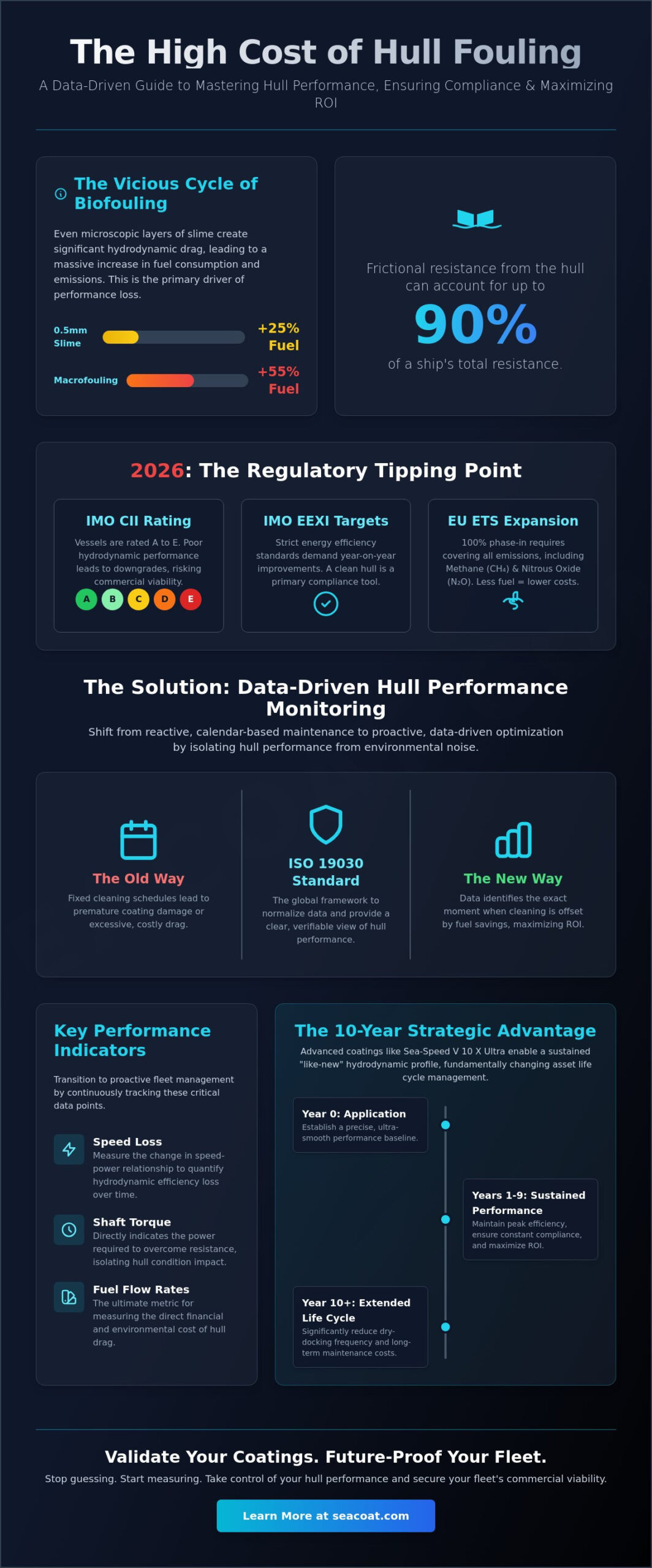
A mere 0.5 mm layer of slime on your vessel’s hull can increase fuel consumption by up to 25%, while advanced macrofouling can drive that penalty as high as 55%. You’re likely feeling the mounting pressure of the 2026 IMO CII and EEXI targets, alongside the 100% phase-in of the EU Emissions Trading System which now includes methane and nitrous oxide. It’s frustrating when environmental noise makes your data feel unreliable, leaving you unsure if your maintenance investments are actually yielding the hydrodynamic results you were promised.
This guide will help you master the technical frameworks of hull performance monitoring to validate the ROI of your coatings and ensure your fleet remains compliant with the latest MEPC 84 standards. We’ll examine how ISO 19030 remains the essential benchmark for measurement and how integrating advanced systems like Sea-Speed V 10 X Ultra can secure a ten-year life cycle for your assets. By shifting from reactive cleaning to data-driven optimization, you’ll learn how to achieve significant fuel mitigation and extend the intervals between your dry-docking cycles.
Key Takeaways
- Understand the critical correlation between hydrodynamic drag and regulatory compliance to protect your fleet’s commercial viability under 2026 CII and EU ETS mandates.
- Master the application of ISO 19030 frameworks to ensure your hull performance monitoring data remains accurate despite the complexities of environmental noise.
- Learn how to establish a precise performance baseline by evaluating the impact of initial surface roughness and advanced foul release technology on long-term efficiency.
- Identify the specific KPIs for speed loss and fuel flow needed to transition from reactive maintenance to a proactive, data-driven fleet management strategy.
- Discover the strategic advantage of maintaining a “like-new” hydrodynamic profile for over a decade to maximize your investment returns and reduce dry-docking frequency.
What is Hull Performance Monitoring and Why Does it Matter?
Hull performance monitoring is the scientific observation and analysis of a vessel’s hydrodynamic profile over time. It isn’t merely a periodic inspection; it’s the continuous tracking of how effectively a hull moves through the water by measuring the relationship between delivered power and speed. In an industry where frictional resistance can account for up to 90% of a ship’s total resistance, understanding the state of the submerged surface is critical. This process allows operators to quantify the exact impact of hull degradation on total fuel consumption, providing a data-driven foundation for every operational decision.
The primary driver of performance loss is the biological colonization of the hull. To appreciate the scale of this challenge, technical managers must understand what is biofouling and how the rapid accumulation of microorganisms, algae, and tubeworms creates turbulent flow. Even a light slime layer of just 0.5 mm can increase a vessel’s fuel consumption by up to 25%. When biofouling advances to macrofouling, that fuel penalty can escalate to 55%. Beyond the financial drain, this inefficiency directly contributes to global greenhouse gas emissions, making hull performance monitoring a cornerstone of both economic survival and environmental stewardship.
The Economic Imperative: Fuel and Maintenance
The financial consequences of neglect are stark. Research indicates that a 10% increase in average hull roughness can lead to a 2% to 3% increase in fuel consumption. For a large container vessel, this translates into hundreds of thousands of dollars in annual waste. Effective monitoring data allows owners to move away from fixed, calendar-based cleaning schedules that often result in either premature coating damage or excessive drag. Instead, data-driven strategies identify the precise moment when the cost of a hull cleaning is offset by the projected fuel savings, shifting the industry from reactive maintenance to proactive performance management.
Regulatory Compliance: CII and EEXI in 2026
In 2026, regulatory pressure has reached a tipping point. The IMO’s Carbon Intensity Indicator (CII) and the Energy Efficiency Existing Ship Index (EEXI) now demand year-on-year improvements in operational efficiency. A vessel’s CII rating, which ranges from A to E, is directly influenced by its hydrodynamic drag. Ships that fail to maintain high-performance hulls risk being downgraded, which limits their commercial viability and increases the likelihood of becoming “stranded assets.” With the EU Emissions Trading System (ETS) now requiring 100% coverage of verified emissions as of January 1, 2026, every ton of fuel saved through optimized hull performance is a direct mitigation of carbon allowance costs.
The Mechanics of Measurement: ISO 19030 and Data Acquisition
Accurate hull performance monitoring requires a shift from anecdotal observations to a rigorous, sensor-driven methodology. In the volatile environment of the open ocean, raw data is often obscured by external variables such as wind resistance, wave frequency, and changes in vessel displacement. To isolate the impact of hull condition on hydrodynamic efficiency, technical managers rely on a suite of high-frequency data points. These include speed through water, shaft torque, and fuel flow rates. Without a structured framework to normalize these variables, identifying a 1% or 2% drift in efficiency becomes nearly impossible, yet it’s precisely these small margins that dictate a fleet’s profitability in 2026.
The industry’s primary tool for this normalization is the ISO 19030 standard. Established to provide a transparent and reliable methodology, this framework allows operators to compare real-world performance against a validated baseline. By filtering out “noise”, the environmental factors that skew performance metrics, the standard enables a clear view of how the hull surface itself is performing. This level of precision is essential for validating the long-term ROI of high-performance coatings, ensuring that claims of drag reduction are backed by verifiable physics rather than marketing estimates.
Standardizing Performance with ISO 19030
The ISO 19030 standard is divided into three distinct parts to ensure broad applicability across different fleet types. Part one outlines the general principles and measurement requirements, while parts two and three detail the default and alternative methods for calculating speed loss. By defining “performance speed loss” as the primary metric, the standard provides a clear indicator of hull and propeller degradation. This transparency is crucial for 2026 reporting requirements, as stakeholders demand evidence-based proof of a vessel’s energy efficiency and carbon intensity mitigation.
Sensors and Telemetry: The Hardware of Monitoring
Modern data acquisition relies on sophisticated hardware that goes far beyond traditional noon reports. High-accuracy torsion meters are now standard equipment, providing real-time data on shaft power and torque with minimal margins of error. While manual reporting is prone to human bias and infrequent sampling, automated data logging systems capture thousands of data points daily. This high-frequency approach is the foundation for AI-driven predictive models that can forecast fouling patterns based on specific trade routes and water temperatures. For operators seeking to maximize these insights, integrating advanced foul release systems provides the stable, smooth baseline required for the most accurate performance modeling.
Analyzing the Impact of Coating Choice on Performance Data
The selection of a hull coating is the single most influential factor in determining the performance baseline for any hull performance monitoring program. While many operators view coatings as a commodity maintenance item, the initial surface roughness at the time of application sets the hydrodynamic limit for the entire service interval. Traditional biocidal coatings rely on a controlled depletion mechanism, which inherently increases surface turbulence as the film wears unevenly. In contrast, modern foul release systems utilize low surface energy to prevent attachment, maintaining a stable baseline that simplifies data normalization and trend analysis over the long term.
Monitoring the deterioration rate of a coating reveals the true cost of ownership. Toxic antifouling paints often show a sharp decline in efficiency after only 24 to 36 months as the active biocides are exhausted and the surface becomes physically compromised. A high-performance, non-toxic coating maintains its integrity, allowing the monitoring system to produce a “cleaner” data signal. This clarity is vital for distinguishing between actual hull degradation and external factors like propeller fouling or engine wear. Some may argue that a superior coating reduces the need for monitoring, but the reality is the opposite; precise data is what validates the extended 10-year life cycle of an advanced coating system.
Ablative vs. Hard Film Foul Release Systems
Traditional ablative paints present a significant roughness penalty because they’re designed to erode. As the biocide leaches out, the remaining resin matrix becomes increasingly porous and irregular, leading to a measurable rise in drag that complicates hull performance monitoring. By contrast, modern foul release coatings provide a hard, non-porous film that doesn’t rely on chemical depletion. While silicone-based systems offer initial slickness, they often lack the mechanical durability of silane-siloxane technologies. These advanced hybrids combine low surface energy with the physical toughness required to withstand frequent cleaning without degrading the performance profile.
Surface Roughness and Hydrodynamic Drag
The science of naval architecture confirms that skin friction accounts for 60% to 80% of a vessel’s total resistance. Consequently, even minor deviations in surface texture have profound impacts on propulsion efficiency. Monitoring validates the slickness of a coating by tracking power demand over time, providing proof of performance that a visual inspection can’t offer. Every 25-micron increase in average hull roughness results in approximately a 1% increase in required shaft power to maintain a constant speed. By quantifying these metrics, operators can see the direct correlation between a high-performance coating and the mitigation of long-term speed loss.
Implementing a Fleet-Wide Monitoring Strategy
Transitioning from individual vessel tracking to a fleet-wide hull performance monitoring strategy requires a systematic approach to data governance. It isn’t enough to simply install sensors; the value lies in the standardization of data across diverse asset classes. By 2026, the maturity of Maritime Fuel Efficiency AI, a market projected to reach $6.4 billion by 2034, has made it possible to integrate high-frequency sensor data directly into broader vessel management ecosystems. This integration ensures that technical managers don’t just see numbers, but actionable intelligence that correlates hydrodynamic drag with real-time carbon allowance costs under the EU ETS.
Successful implementation hinges on the human element as much as the hardware. Onshore performance teams and shipboard crew must be trained to interpret specific alerts, moving beyond the traditional reliance on noon reports. When the monitoring system flags a deviation from the expected power curve, the response should be governed by a pre-defined protocol. This structured communication prevents the common pitfall of “data fatigue,” where critical performance trends are ignored until they result in a significant CII rating downgrade.
Step 1: Baseline Establishment and Calibration
The foundation of any reliable performance model is the “out of dry-dock” reference period. Ideally, this baseline is established during sea trials conducted within the first 14 to 30 days following a fresh coating application. During this window, sensors must be calibrated to ensure the integrity of shaft power and torque measurements. Documenting the initial hull roughness in microns provides a physical benchmark that validates the “perfect” performance state. Without this rigorous start, any subsequent hull performance monitoring will lack the precision needed to satisfy the stricter reporting requirements anticipated for the IMO’s MEPC 84 session in May 2026.
Step 2: Continuous Data Analysis and Trigger Points
Operators must define specific “cleaning triggers” based on a percentage of speed loss or increase in fuel flow. For many high-utilization fleets, a speed loss of 1.5% to 2% serves as the optimal threshold for intervention. Advanced monitoring software can now distinguish between the light frictional increase of micro-slime and the more severe turbulence caused by macro-fouling. This distinction is vital for evaluating the effectiveness of in-water cleaning services; if a cleaning doesn’t return the vessel to within 0.5% of its baseline performance, it indicates either a failure in the cleaning process or a fundamental breakdown of the coating’s surface integrity. To ensure your fleet maintains this level of hydrodynamic precision, you should consult with Seacoat SCT, LLC to implement a high-performance foul release strategy that simplifies baseline management.
The Seacoat Advantage: Validating Sea-Speed V 10 X Ultra
The transition to the 2026 regulatory landscape necessitates a coating that acts as a stable hydrodynamic foundation. Seacoat SCT, LLC engineered Sea-Speed V 10 X Ultra to provide this exact baseline, offering a surface that remains consistent over a ten-year life cycle. Unlike traditional coatings that undergo chemical depletion or physical erosion, this silane-siloxane technology creates a permanent, non-leaching barrier. This stability is vital for accurate hull performance monitoring, as it ensures that any detected speed loss is a result of external fouling rather than the degradation of the coating film itself. By maintaining a “like-new” performance profile, operators achieve a sustained reduction in fuel consumption and a corresponding mitigation of carbon allowance costs.
Environmental stewardship is no longer a secondary concern; it’s a core component of operational efficiency. Seacoat SCT, LLC provides a biocide-free, zero VOC solution that eliminates the release of heavy metals and toxins into marine ecosystems. This non-toxic approach doesn’t just protect the environment; it validates the vessel’s carbon footprint reduction by ensuring the hull remains smooth without the “roughness penalty” associated with traditional ablative paints. Real-world data from fleet-wide implementations shows that vessels utilizing this technology maintain significantly lower drag coefficients, directly supporting the year-on-year improvements required for CII compliance.
Hard Film Durability and Data Stability
The mechanical toughness of hard film coatings is a critical differentiator in performance analysis. Soft silicone-based systems are often susceptible to mechanical damage during port operations or underwater cleanings, which creates “data noise” and complicates trend analysis. The silane-siloxane structure utilized by Seacoat SCT, LLC is inherently durable, resisting the abrasions that typically lead to increased surface roughness. This durability ensures that monitoring results reflect the true hull condition, providing technical managers with the reliable data needed to optimize maintenance intervals and validate long-term ROI.
Maximizing ROI with Sea-Speed V 10 X Ultra
Calculating the true return on investment requires a ten-year perspective that accounts for fuel savings, reduced dry-docking frequency, and regulatory compliance. Sea-Speed V 10 X Ultra supports EEXI requirements by providing sustained drag reduction that doesn’t taper off after the first 36 months of service. When combined with precise hull performance monitoring, this technology allows for a proactive management strategy that can extend the service life of the asset while minimizing total OPEX. To begin optimizing your fleet’s hydrodynamic profile, consult with Seacoat SCT, LLC for a fleet-wide performance analysis and secure your competitive advantage in the 2026 regulatory landscape.
Securing Hydrodynamic Excellence for the Next Decade
The evolution of maritime efficiency in 2026 is no longer a matter of incremental gain but of technical precision. Mastering hull performance monitoring allows operators to move beyond the limitations of traditional maintenance into a phase of validated hydrodynamic control. By aligning measurement methodologies with high-performance surface technologies, fleets can navigate the complexities of emissions trading and operational ratings with absolute confidence. This strategic alignment ensures that every decision, from cleaning intervals to long-term asset management, is backed by the physics of fluid dynamics rather than historical assumptions.
Seacoat SCT, LLC provides the necessary tools for this transformation through its specialized silane-siloxane technology. This non-toxic, biocide-free approach ensures that the pursuit of efficiency doesn’t come at the cost of marine ecosystem health. With a proven track record spanning over two decades, Seacoat SCT, LLC enables a ten-year performance cycle that maximizes asset value while ensuring long-term regulatory compliance. Optimize your fleet performance with Seacoat SCT, LLC solutions and establish a new standard for operational intelligence. The future of the maritime industry belongs to those who view their hull not just as a surface to be protected, but as a strategic asset to be optimized.
Frequently Asked Questions
How much fuel can hull performance monitoring actually save?
Proactive hull performance monitoring can reduce total fuel consumption by 10% to 15% by optimizing hull cleaning schedules. While unmanaged fleets often see fuel use rise by up to 25% due to fouling, management based on real-world data allows for precise intervention. This strategy ensures the cost of cleaning is always outweighed by the resulting fuel mitigation, protecting the vessel’s operational budget.
What is the difference between hull condition monitoring and performance monitoring?
Hull condition monitoring involves the physical inspection of the submerged surface, often using divers or Remotely Operated Vehicles (ROVs) to check for biofouling. In contrast, performance monitoring is a hydrodynamic analysis that uses sensors to track the vessel’s efficiency. It focuses on the relationship between power output and speed to quantify drag without requiring a visual inspection.
Is ISO 19030 mandatory for commercial shipping?
ISO 19030 isn’t legally mandatory, but it serves as the essential framework for transparent performance reporting in 2026. As financial institutions and regulators demand verified evidence of carbon intensity improvements, following this standard is the only way to provide credible data. It acts as a scientific bridge for stakeholders who require proof of a vessel’s energy efficiency.
Can hull performance monitoring detect micro-fouling?
Yes, advanced systems can detect the onset of micro-fouling by identifying subtle shifts in the power-to-speed ratio. Even a thin slime layer causes a measurable increase in frictional resistance, which high-frequency sensors capture as a drift from the baseline. Identifying these early changes is vital for maintaining the year-on-year efficiency gains required by the IMO’s 2026 targets.
How does a foul release coating affect the accuracy of monitoring data?
A foul release coating improves the accuracy of hull performance monitoring by providing a stable, non-ablative surface. Unlike traditional paints that wear unevenly and create data noise, these systems maintain a consistent texture over time. This stability allows analysts to isolate the impact of fouling from the degradation of the coating itself, leading to more reliable ROI calculations.
What are the most common sensors used for hull monitoring?
The most critical sensors include torsion meters for shaft power, mass flow meters for precise fuel consumption, and speed logs for speed through water. Anemometers and GPS units are also used to provide the environmental data needed to normalize for wind and sea state. Together, these tools create the high-frequency data stream required for modern hydrodynamic modeling.
How often should hull performance data be analyzed?
Data should be collected continuously via automated logging, but a comprehensive trend analysis should occur at least once per month. This frequency allows technical managers to identify speed loss trends before they impact the vessel’s CII rating. High-utilization fleets often perform weekly reviews to ensure that cleaning triggers are met at the most profitable moment.
Can monitoring help reduce dry-docking frequency?
Monitoring allows operators to safely extend intervals between dry-docking by providing continuous proof of the hull’s condition. When data confirms that a high-performance coating is maintaining its hydrodynamic profile, the need for a mid-term inspection is reduced. This approach supports the transition toward 10-year life cycles, significantly lowering long-term maintenance costs and vessel downtime.