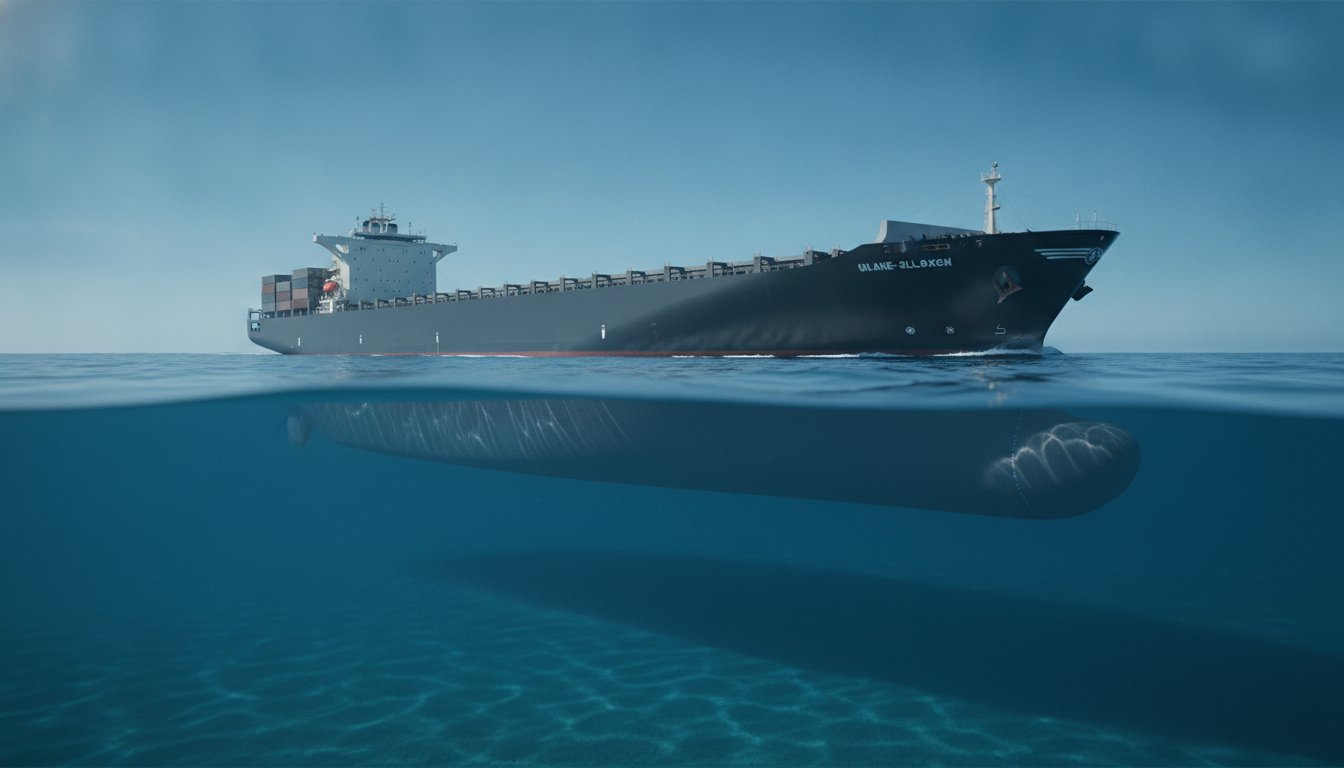
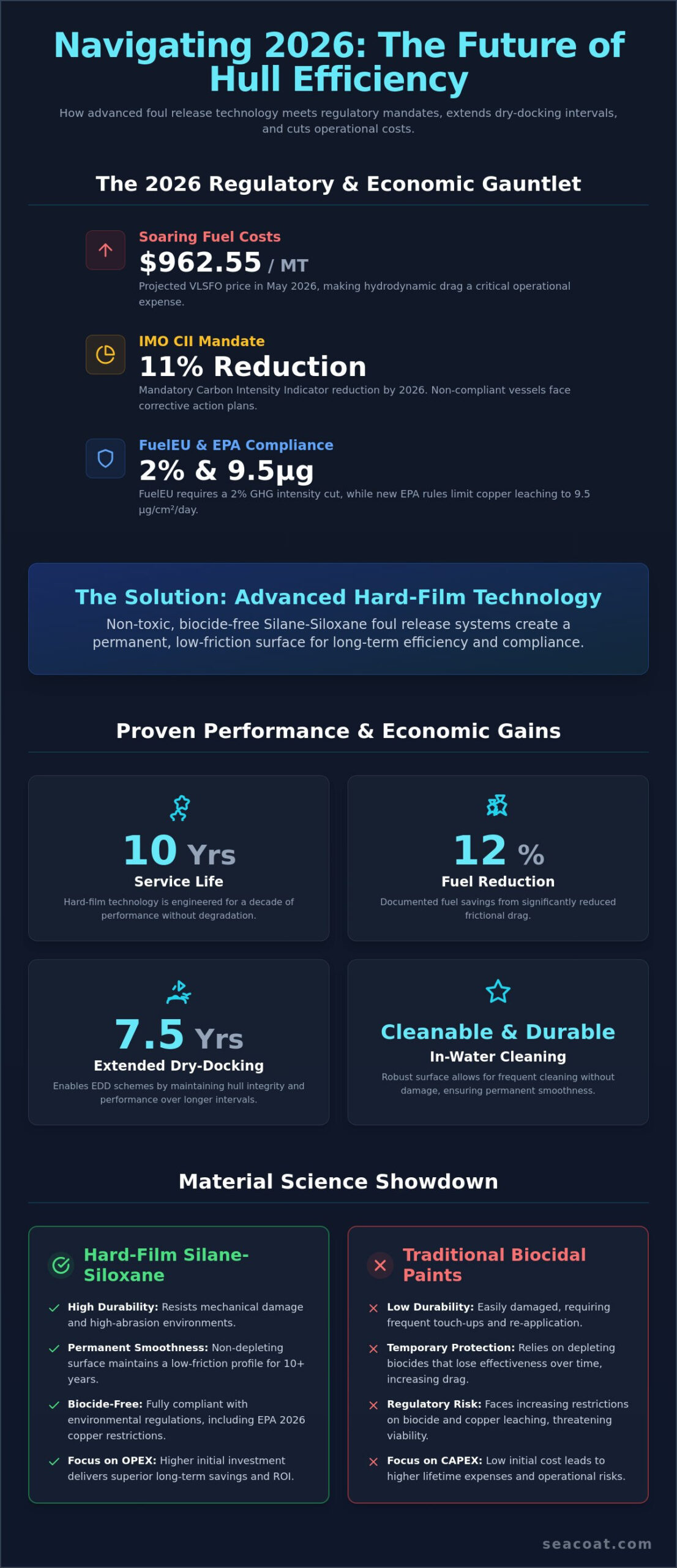
With Very Low Sulphur Fuel Oil (VLSFO) prices reaching $962.55 per metric ton in May 2026, every percentage point of hydrodynamic drag is a direct hit to your operational margins. You’re likely managing the dual pressure of the 11% IMO CII reduction mandate and the 2% FuelEU Maritime greenhouse gas intensity requirement. It’s a high-stakes environment where traditional biocidal paints often fail to provide the durability needed for modern fleet cycles. Consequently, many shipowners are now prioritizing extending dry-docking intervals with hull coatings that offer permanent surface smoothness rather than temporary chemical protection.
This guide explains how advanced hard-film foul release technology, specifically non-toxic silane-siloxane systems like Sea-Speed V 10 X Ultra, reduces frictional drag to meet 2026 maritime efficiency regulations and extend dry-docking intervals. You’ll learn how these biocide-free coatings achieve a 10-year service life while delivering a documented 12% reduction in fuel consumption. We’ll examine the material science that allows for frequent in-water cleaning without coating degradation, providing a strategic path toward both environmental stewardship and significant OPEX savings.
Key Takeaways
- Understand how hull surface efficiency acts as a primary lever for meeting 2026 CII and FuelEU maritime mandates.
- Learn the technical requirements for extending dry-docking intervals with hull coatings by leveraging 10-year service life and durable hard-film technology.
- Compare the mechanical durability of Silane-Siloxane systems against traditional soft silicone to ensure long-term resistance in high-abrasion environments.
- Shift your procurement strategy from initial product cost to a long-term OPEX model that focuses on total cost per service year.
- Discover how you’ll maintain vessel speed and reduce frictional drag using the technical specifications of Sea-Speed V 10 X Ultra.
Navigating the 2026 Maritime Efficiency Mandates and EDD Schemes
The maritime industry is entering a period of unprecedented regulatory scrutiny. By 2026, the transition from voluntary efficiency goals to mandatory operational constraints becomes absolute. Under the FuelEU Maritime regulation, vessels must achieve a 2% reduction in greenhouse gas intensity compared to 2020 levels. Simultaneously, the IMO Carbon Intensity Indicator (CII) reduction factor accelerates to 11% relative to the 2019 baseline. These aren’t just technical benchmarks; they’re financial gatekeepers. Ships that received an ‘E’ rating in 2025, or a ‘D’ rating for three consecutive years, face an April 30, 2026, deadline to submit a formal Corrective Action Plan. In this landscape, traditional antifouling paints that rely on depleting biocides aren’t just maintenance items; they’re operational liabilities that threaten a vessel’s commercial viability.
The Carbon Intensity Indicator (CII) represents the operational efficiency of a ship, specifically measuring the grams of CO2 emitted per unit of cargo capacity and distance traveled. Because hull performance directly dictates the energy required for propulsion, a fouled or rough hull can degrade a vessel’s rating from an ‘A’ to a ‘C’ or ‘D’ within a single season. This makes surface management a primary strategic concern for fleet managers who must justify their emissions profile to stakeholders and regulators alike.
The Impact of FuelEU and IMO 2030 Goals
The industry’s push toward a 55% emission reduction by 2030 requires immediate, scalable solutions. While alternative fuels are the long-term objective, high-performance hull coatings offer a passive energy-saving technology that delivers results today. By optimizing the hydrodynamic profile, these systems reduce the propulsion power required to maintain service speeds. This is a critical component for extending dry-docking intervals with hull coatings, as maintaining a low-friction surface over a multi-year cycle prevents the rating decay often seen with traditional ablative paints. When a hull’s surface remains smooth, the vessel consumes less fuel, directly preserving its CII rating without requiring expensive engine retrofits or speed reductions.
Future-Proofing Fleets with Sustainable Solutions
Regulatory pressure isn’t limited to carbon emissions. As of January 1, 2026, new EPA mandates restrict copper leaching from hull coatings to 9.5 micrograms per square centimeter per day. The problem of biofouling remains the primary driver of frictional drag, but the tools used to combat it are changing. Moving toward environmental marine coatings allows operators to sidestep the risks of biocide bans while improving asset longevity. This shift marks a transition from simple maintenance painting to performance engineering. By selecting a permanent, non-toxic system, shipowners can pursue Extended Dry-Docking (EDD) schemes that stretch intervals up to 7.5 years. This approach ensures the vessel remains a high-performing asset throughout its service window, rather than a liability struggling to meet tightening 2026 mandates. Ultimately, extending dry-docking intervals with hull coatings is only viable if the technology maintains its integrity against mechanical wear and biological attachment over the entire period.
The Physics of Surface Optimization: Reducing Drag to Extend Service Life
Fluid dynamics at the hull-water interface dictate the total energy efficiency of a vessel. When a hull’s surface is smooth, the turbulent boundary layer remains thin, allowing water to flow with minimal resistance. However, as biofouling accumulates, it introduces macro-roughness; these physical obstructions disrupt the flow, increasing the thickness of the boundary layer and forcing the propulsion system to compensate. By extending dry-docking intervals with hull coatings that maintain their low-profile finish, operators can mitigate the progressive increase in engine load that usually occurs between service windows.
There’s a critical distinction between macro-roughness and micro-roughness. Macro-roughness refers to visible biological growth like barnacles or tubeworms, which can increase drag by over 40% in severe cases. Micro-roughness, however, is the microscopic texture of the coating itself. While macro-roughness causes the most dramatic speed loss, micro-roughness is responsible for the steady, silent erosion of fuel efficiency. Traditional ablative paints often become rougher as they age and leach biocides, creating a “peel” effect that increases friction. Advanced systems are engineered to remain smooth at the micron level throughout their entire service life.
Surface Energy and Foul Release Mechanics
Foul release technology doesn’t rely on chemical toxicity to keep a hull clean. Instead, it uses low surface energy to prevent marine organisms from establishing a permanent bond. This chemical property creates a non-polar surface that is effectively “too slippery” for biological glues to adhere to. At operational speeds, the shear force of the water provides a self-cleaning effect, where any loosely attached growth is simply wiped away by the movement of the vessel. This results in immediate knots-per-ton gains, as the ship maintains its design speed with significantly lower power output.
Frictional Resistance vs. Engine Load
Frictional resistance is the primary component of total drag for most commercial vessels. High-performance marine coatings maintain their surface integrity far longer than standard ablatives, which typically degrade and roughen over a five-year cycle. The mathematical correlation is direct: as hull smoothness is preserved, the RPM requirements for a specific speed stay low, preventing the fuel-burn spikes associated with aged or fouled surfaces. By keeping the engine load within its optimal range, these coatings don’t just save fuel; they reduce wear on the entire propulsion train. For operators focused on long-term ROI, selecting durable foul release technology is a critical step in sophisticated performance engineering.
Material Science Showdown: Why Hard-Film Silane-Siloxane Outlasts Soft Silicone
The transition from sacrificial coatings to permanent surface films marks the most significant advancement in maritime material science this century. While the industry previously relied on the predictable erosion of biocidal layers, modern performance engineering focuses on long-term surface stability. Silane-Siloxane technology represents a fundamental departure from traditional foul release systems by creating a hard, glass-like matrix that is chemically bonded to the hull. Sea-Speed V 10 X Ultra represents a paradigm shift away from traditional ablative bottom paint, which relies on a sacrificial cycle of biocide depletion and physical erosion. By contrast, a hard-film system maintains its micron-level smoothness for years, providing the mechanical foundation necessary for extending dry-docking intervals with hull coatings.
Soft Silicone: The Durability Challenge
Soft silicone coatings have long been marketed as the high-end standard for foul release, yet they possess inherent mechanical vulnerabilities that limit their utility for commercial fleets. These elastomeric films are susceptible to tearing and delamination, particularly when vessels operate in debris-heavy coastal waters or encounter ice. A single physical strike can compromise the coating’s integrity, leading to peeling that increases frictional drag and creates sites for biological attachment. For high-utilization vessels, the fragility of soft silicone complicates in-water surveys (IWS); standard cleaning equipment can easily gouge the surface, necessitating premature dry-docking for repairs. This lack of durability often makes soft silicone a high-risk choice for operators targeting a 10-year service window.
The Silane-Siloxane Advantage
Silane-Siloxane technology provides a robust alternative by combining low surface energy with extreme mechanical hardness. This proprietary chemistry creates a cross-linked molecular structure that resists abrasion and impact far more effectively than silicone elastomers. Because the film is non-porous and incredibly dense, it does not absorb water or swell over time, preventing the blistering and underwater degradation common in inferior systems. This durability is the key to extending dry-docking intervals with hull coatings, as it allows for frequent, aggressive in-water grooming without any loss of film thickness or surface quality.
- Permanent Barrier: A non-leaching, biocide-free system that remains effective for over a decade.
- Mechanical Resilience: High resistance to scratching and impact, even in high-traffic ports or icy conditions.
- Cleaning Compatibility: Enables the use of automated hull cleaning robots and brushes without damaging the foul-release properties.
- Chemical Integrity: Superior bond strength that prevents the peeling and delamination associated with soft-film alternatives.
As an Expert Innovator in the field, Seacoat SCT, LLC has engineered Sea-Speed V 10 X Ultra to serve as a strategic asset rather than a temporary fix. By prioritizing the chemical and mechanical longevity of the coating, we provide shipowners with a reliable path toward long-term regulatory compliance and operational efficiency. The result is a hull that remains smooth, efficient, and protected for the duration of its extended service interval.
The Economic Case for 10-Year Intervals: ROI and OPEX Analysis
Procurement strategies in the maritime sector are undergoing a fundamental shift. For decades, the industry treated hull coatings as a commodity, evaluated primarily on the initial price per gallon. However, the introduction of carbon taxes and tightening emissions standards has forced a move toward life-cycle cost analysis. When evaluating the total cost of ownership, the focus moves from the upfront capital expenditure (CAPEX) to the long-term operational expenditure (OPEX). High-performance systems are no longer seen as a premium expense; they’re viewed as a strategic hedge against the escalating costs of fuel and regulatory non-compliance.
The financial burden of traditional hull maintenance is compounded by the frequency of the sacrificial cycle. Standard ablative systems require renewal every 30 to 60 months, necessitating expensive dry-docking fees and, more importantly, significant lost revenue from off-hire time. By extending dry-docking intervals with hull coatings that offer permanent surface integrity, operators can fundamentally restructure their maintenance budgets. The transition from a 2.5-year cycle to a 10-year cycle represents a massive reduction in cumulative labor and docking costs over the life of the asset.
Extending the Dry-Dock Interval
Maximizing vessel availability is the most direct path to improving profitability. Selecting a durable boat hull paint that maintains its hydrodynamic profile for over a decade allows shipowners to bypass multiple intermediate docking events. In a standard ten-year window, a vessel using traditional coatings might undergo three or four full reapplications, each requiring hull blasting and days of downtime. A single application of Sea-Speed V 10 X Ultra has a typical 10-year lifespan, providing a stable surface that requires only routine in-water grooming rather than complete replacement. This longevity converts what was once a recurring maintenance cost into a long-term capital asset.
Fuel Efficiency as a Strategic Fleet Asset
Fuel remains the single largest operational expense for any commercial fleet. While the physics of drag reduction was detailed earlier, the economic implications are even more profound. Documented fuel savings of up to 12% mean that a high-performance coating often pays for itself within the first several months of operation. These savings are amplified in a high-tax carbon environment, where every metric ton of fuel saved also reduces the cost of emissions allowances. Furthermore, the reduction in frictional resistance lowers the required torque from the main engine, leading to secondary savings in engine wear and reduced maintenance for the propulsion train. To see how these metrics apply to your specific fleet profile, you can calculate your potential fuel ROI with Seacoat SCT.
Ultimately, the economic case for advanced coatings is built on reliability. In an era of volatile fuel prices and shifting environmental laws, a hull that remains clean and efficient for ten years provides a level of predictability that traditional paints simply cannot match. It’s an investment in the long-term resilience of the fleet.
Strategic Fleet Asset: Maximizing Efficiency with Sea-Speed V 10 X Ultra
Sea-Speed V 10 X Ultra represents the pinnacle of surface engineering for the 2026 maritime efficiency era. As fleet managers face the immediate reality of FuelEU and IMO CII ratings, the strategy of extending dry-docking intervals with hull coatings has shifted from an optional goal to a regulatory necessity. Unlike temporary biocidal paints, this hard-film Silane-Siloxane system provides a stable, low-friction surface that doesn’t degrade over time. It’s the preferred choice for commercial, military, and cruise fleets because it bridges the gap between mechanical durability and hydrodynamic excellence. By treating the hull as a strategic asset rather than a maintenance burden, shipowners can secure predictable performance across a decade of service.
Transitioning a fleet to this technology is a streamlined process facilitated by high-build primers like Seapoxy 73. This epoxy system ensures long-term adhesion and provides a robust corrosion barrier, which is essential for the coating’s 10-year service life. The chemical bond established between the substrate and the coating prevents the blistering and delamination often seen in lower-quality systems. This reliability is critical for vessels operating in demanding environments where physical surface integrity is the only defense against increased drag.
Application and Performance Metrics
The versatility of the Sea-Speed line makes it a premier choice for diverse vessel types. It’s widely recognized as a high-performance solution and is often cited as the best boat paint for aluminum boats due to its non-conductive, biocide-free composition that eliminates the risk of galvanic corrosion. Real-world commercial applications have consistently demonstrated speed gains and fuel savings that align with the 12% benchmarks established in performance trials. These metrics aren’t just laboratory ideals; they’re the result of maintaining a permanent, glass-smooth finish that resists the accumulation of macro-fouling even during extended idle periods.
Environmental Stewardship without Compromise
Seacoat SCT has maintained a commitment to biocide-free technology since 2001. All products, including Sea-Speed V 10 X Ultra, are 100% non-toxic and contain no harmful additives that could leach into natural ecosystems. This commitment allows operators to meet and exceed the strictest global environmental standards for 2026 without sacrificing operational efficiency. By prioritizing a permanent solution, you’re not just maintaining a vessel; you’re future-proofing a fleet against the tightening restrictions on traditional coatings. Extending dry-docking intervals with hull coatings is only a viable long-term strategy when the technology itself is ecologically sound. Optimize your fleet efficiency with Sea-Speed V 10 X Ultra and secure a competitive advantage in the low-carbon shipping economy.
Securing Long-Term Performance in the 2026 Maritime Economy
The convergence of tightening carbon intensity mandates and rising fuel costs has transformed hull maintenance into a high-stakes performance engineering challenge. Achieving 2026 compliance requires a shift from sacrificial, biocidal paints toward permanent, hard-film Silane-Siloxane systems. These advanced technologies don’t just protect the substrate; they provide a stable hydrodynamic profile that resists biological attachment and mechanical wear. By prioritizing extending dry-docking intervals with hull coatings, operators can significantly reduce off-hire time while maintaining peak fuel efficiency across an industry-leading 10-year service life.
Seacoat SCT provides the technical foundation for this transition with 100% non-toxic, biocide-free technology that offers proven fuel savings and drag reduction metrics. Our Sea-Speed V 10 X Ultra technology ensures your assets remain compliant and profitable without compromising the health of natural ecosystems. It’s time to move beyond temporary maintenance and invest in a strategic asset that delivers a reliable return on investment.
Request a Technical Consultation for Your Fleet Efficiency Strategy to begin optimizing your vessel performance for 2026 and beyond. We’re here to help you navigate these complex regulatory shifts with technical precision and scientific confidence.
Frequently Asked Questions
How much fuel can advanced hull coatings actually save?
Sea-Speed V 10 X Ultra provides a documented 12% reduction in fuel consumption compared to traditional antifouling systems. This efficiency gain is achieved by minimizing the frictional drag that occurs at the hull-water interface. By maintaining a glass-smooth surface, the vessel requires significantly less propulsion power to maintain service speeds, resulting in immediate operational savings.
What is the difference between foul release and antifouling paint?
Antifouling paints rely on the continuous leaching of toxic biocides to kill marine organisms that attempt to settle on the hull. Foul release coatings use a low-surface-energy, non-toxic film that prevents biological glues from forming a permanent bond. This technology allows marine growth to wash away naturally once the vessel reaches operational speeds, providing a cleaner and more efficient surface.
Are non-toxic hull coatings as effective as traditional biocide paints?
Non-toxic coatings are often more effective over long service cycles because they don’t rely on a depleting chemical reservoir. While traditional biocide paints become rougher as they age and leach chemicals, hard-film systems maintain their micron-level smoothness for over a decade. This permanent surface integrity ensures consistent drag reduction that chemical-based paints cannot match.
How does a hull coating help with IMO CII and EEXI compliance?
Hull coatings are a primary lever for improving a vessel’s Carbon Intensity Indicator (CII) rating because they directly reduce the energy demand for propulsion. By lowering frictional resistance, the engine consumes less fuel and emits less CO2 per mile traveled. This optimization is critical for meeting the 11% CII reduction mandate required by 2026 maritime regulations.
What is the expected service life of a hard-film Silane-Siloxane coating?
A high-performance Silane-Siloxane system like Sea-Speed V 10 X Ultra typically offers a service life of 10 years or more. This exceptional durability is the technical foundation for extending dry-docking intervals with hull coatings, as it eliminates the need for the frequent sacrificial renewal cycles associated with traditional ablative paints.
Can Sea-Speed V 10 X Ultra be applied to aluminum hulls?
Sea-Speed V 10 X Ultra is an ideal solution for aluminum hulls because its composition is completely biocide-free and non-conductive. It provides superior protection without the risk of galvanic corrosion, which is a common failure point when copper-based antifouling paints are applied to aluminum substrates. This makes it a strategic choice for diverse commercial and military fleets.
How often does a foul release coating need to be cleaned?
Cleaning frequency depends on the vessel’s specific operating profile and time spent idle in high-fouling waters. However, the mechanical resilience of hard-film technology is a primary factor in extending dry-docking intervals with hull coatings. It allows for aggressive in-water grooming using automated robots or brushes without damaging the film thickness or compromising the foul-release properties.
Does a smoother hull really increase vessel speed?
Reducing surface roughness significantly increases vessel speed by thinning the turbulent boundary layer around the hull. When frictional resistance is minimized, the propulsion system can achieve higher knots at the same engine RPM. This improvement in hydrodynamic efficiency allows operators to either increase transit speeds or maintain current schedules with lower fuel consumption.