
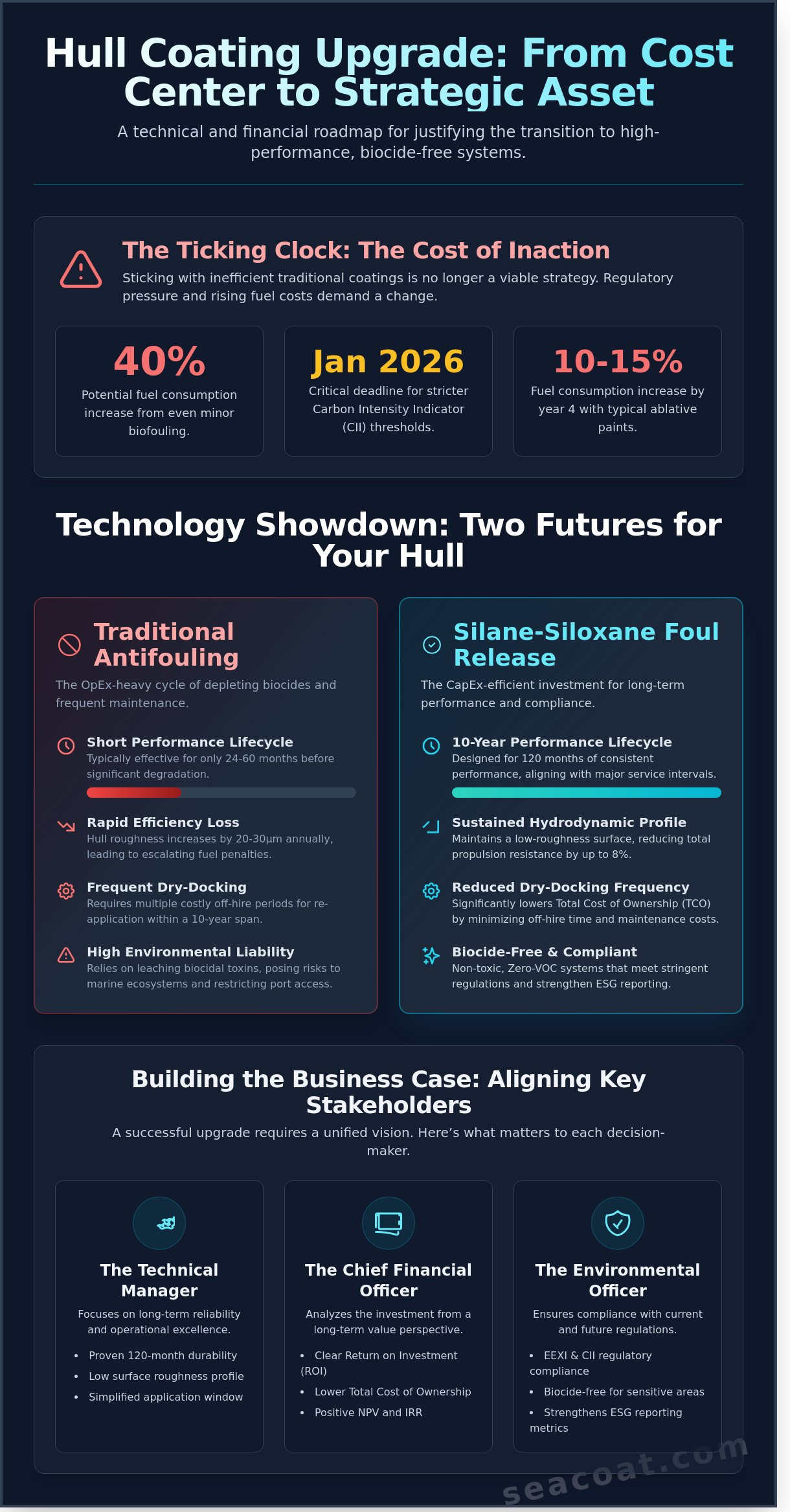
According to the International Maritime Organization, even minor biofouling can increase a vessel’s fuel consumption by 40% and its carbon emissions proportionally. By January 2026, as the Carbon Intensity Indicator (CII) thresholds become increasingly restrictive, the cost of sticking with inefficient traditional coatings will surpass the investment required for a transition. You’re likely already feeling the strain of rising fuel costs and the diminishing returns of biocidal systems that fail to prevent drag over extended periods. It’s clear that maintaining the status quo is no longer a viable strategy for fleet longevity.
This article provides a technical roadmap on how to write a business case for a hull coating upgrade that resonates with both technical directors and financial stakeholders. You’ll learn to quantify the hydrodynamic benefits of biocide-free siloxane technologies and calculate the precise ROI of shifting to a ten-year foul release cycle. We’ll examine the specific data points required to justify the initial expenditure by highlighting significant reductions in dry-docking frequency and total cost of ownership.
Key Takeaways
- Transform hull coatings from a recurring maintenance expense into a strategic asset by aligning vessel performance with 2026 EEXI and CII regulatory requirements.
- Learn how to write a business case for a hull coating upgrade by establishing a data-backed baseline that quantifies the efficiency gap created by traditional ablative paint degradation.
- Evaluate the technical and durability advantages of silane-siloxane foul release systems, which offer a 10-year performance lifecycle compared to conventional 24-month cycles.
- Utilize the Fuel Savings Formula and Total Cost of Ownership (TCO) modeling to project long-term ROI based on significant reductions in annual bunker consumption.
- Develop a persuasive executive roadmap that addresses risk mitigation and application complexity to justify the transition to high-performance, biocide-free systems.
The Strategic Shift: Why Hull Coatings Are No Longer Just Maintenance
In the 2026 maritime environment, the hull coating has evolved from a routine dry-dock expense into a high-performance strategic asset. Understanding how to write a business case for a hull coating upgrade begins with reclassifying these systems. Shipowners are moving away from OpEx-heavy maintenance cycles characterized by frequent reapplications of depleting biocides. Instead, they’re prioritizing CapEx-efficient performance systems that offer ten-year life cycles. This transition reflects a fundamental change in how technical teams value the underwater hull surface.
Regulatory pressures serve as the primary catalyst for this shift. The International Maritime Organization’s (IMO) Energy Efficiency Existing Ship Index (EEXI) and Carbon Intensity Indicator (CII) have reached critical enforcement thresholds in 2026. These regulations make hull efficiency a mandatory business priority rather than an optional optimization. Transitioning from traditional biocidal antifouling to non-toxic silane-siloxane technology is now a core risk mitigation strategy. This move eliminates the liability of leaching toxins while providing a smoother hydrodynamic profile.
The “Invisible Cost” of poor hull management is often the largest drain on a vessel’s profitability. Average hull roughness increases by 20 to 30 micrometers per year with conventional coatings, leading to a fuel consumption penalty of approximately 1% to 2% for every 10 micrometers of added roughness. By quantifying these losses, a business case demonstrates that the initial capital investment in advanced coatings is recovered through reduced annual fuel spend and extended service intervals. Data from 2025 fleet trials indicate that maintaining a low-roughness profile can reduce total propulsion resistance by up to 8%.
The Role of Coatings in Fleet Decarbonization
Advanced coatings function as a passive efficiency technology. They require no mechanical intervention or crew training to meet IMO targets. A high-performance foul-release system directly influences a vessel’s CII rating, which dictates its marketability and charter rates. Utilizing non-toxic, zero-VOC systems also strengthens ESG reporting frameworks. These metrics are increasingly scrutinized by financial institutions and cargo owners who prioritize decarbonized supply chains.
Stakeholder Alignment: Who Needs to Sign Off?
- The Technical Manager: Focuses on durability, application windows, and maintaining a low surface roughness profile over 120 months.
- The CFO: Analyzes the Net Present Value (NPV) and Internal Rate of Return (IRR) of the upgrade, weighing capital allocation against long-term fuel savings.
- The Environmental Officer: Evaluates biocide-free compliance and ensures the vessel meets stringent port entry permits in sensitive marine ecosystems.
Step 1: Establishing the Performance Baseline and Identifying the Efficiency Gap
The foundation of how to write a business case for a hull coating upgrade lies in empirical data. You cannot justify a capital expenditure without first quantifying the current operational deficit. This process starts with a comprehensive audit of fuel consumption relative to design speed across varying sea states. By comparing current telemetry against the vessel’s original sea trial baseline, you can pinpoint the exact percentage of power increase required to maintain operational speeds. Mastering these metrics is essential for anyone determining how to write a business case for a hull coating upgrade that survives rigorous financial scrutiny.
Identifying the “Problem Statement” is the next logical step. You must determine if the primary catalyst is escalating fuel spend, the risk of CII (Carbon Intensity Indicator) rating degradation, or the excessive maintenance costs associated with the “Sacrificial Cycle.” Traditional ablative paints rely on the constant shedding of layers; however, this degradation is rarely uniform. Over a 60-month dry-docking interval, the resulting increase in hydrodynamic drag often leads to a 10% to 15% increase in fuel consumption by year four. Quantifying these off-hire costs and the impact on your EEXI compliance provides the hard evidence needed for executive approval.
Analyzing Current Hull Roughness
Hydrodynamic efficiency is directly tethered to the physical state of the underwater hull. Average Hull Roughness (AHR) measurements should be conducted using digital gauges or underwater laser scanners during scheduled inspections. A 10-micron increase in roughness can lead to a 1% increase in fuel consumption. When a hull transitions from a smooth, newly applied coating to a weathered, fouled surface, the resulting fuel penalty can quickly exceed 20%. Understanding these metrics allows you to project the ROI of a high-performance siloxane solution over a ten-year lifecycle.
The Cost of Traditional Coating Failure
Traditional biocidal coatings present significant hidden liabilities. Beyond the fuel penalty, the expense of mid-cycle hull cleaning and the associated diver fees must be factored into your baseline. These costs are compounded by increasingly stringent global regulations. Ports in regions such as New Zealand and certain jurisdictions in California have implemented strict biofouling management standards that restrict the entry of vessels with visible growth. Many ports now ban the in-water cleaning of biocidal paints to prevent toxic leaching into the water column. These restrictions represent a tangible operational risk, as they can lead to forced deviations or denied port access, further inflating the total cost of ownership for legacy coating systems.
Step 2: Comparative Analysis: Hard-Film Foul Release vs. Conventional Antifouling
Quantifying the technical advantages of modern coatings is vital when learning how to write a business case for a hull coating upgrade. Traditional antifouling relies on a sacrificial mechanism where biocides leach into the water, a process that depletes the coating over 24 to 36 months. In contrast, silane-siloxane chemistry, utilized in Sea-Speed V 10 X Ultra, creates a non-depleting, hard-film foul release system. This technology forms a covalent bond with the substrate, resulting in a glass-smooth surface that physically prevents organisms from adhering without the use of toxic chemicals.
The operational impact of this chemistry is measurable through frictional drag reduction. A smoother hull profile allows a vessel to maintain target speeds at lower RPM, directly decreasing fuel consumption by up to 12 percent in many commercial applications. By eliminating the roughness associated with aging ablative paints, ship owners move from a cycle of performance decay to a baseline of sustained hydrodynamic efficiency. Key differences include:
- Lifespan: 10 years for hard-film systems vs. 2 to 3 years for ablative paints.
- Chemical Profile: Zero VOCs and biocide-free formulations vs. heavy metal leaching.
- Surface Texture: A permanent, hydrophobic glass-like finish vs. increasing roughness over time.
Durability and Resistance to Damage
Mechanical durability distinguishes hard-film systems from soft silicone alternatives. While silicone-based foul release coatings are easily torn by debris or fenders, silane-siloxane systems provide a robust shield suitable for military and commercial craft in high-traffic zones. It’s a critical distinction because Ablative Bottom Paint: Understanding the Sacrificial Cycle vs. Modern Alternatives highlights how traditional paints fail under mechanical stress. Sea-Speed V 10 X Ultra resists damage from ice, floating debris, and frequent in-water cleaning, ensuring the protective barrier remains intact for a full 10-year lifecycle.
Maintenance Requirements and Downtime
When you determine how to write a business case for a hull coating upgrade, downtime is a primary cost variable. Modern silane-siloxane systems offer a permanent solution that can save two to three dry-docking cycles over a decade. Application is streamlined with rapid curing times, allowing vessels to return to service faster than traditional multi-coat epoxy systems. Maintenance is simplified to routine wiping of the hull rather than aggressive scrubbing, which preserves the coating integrity and eliminates the need for frequent re-application. This shift from reactive maintenance to a long-term asset management strategy provides the regulatory future-proofing required for 2026 operations.
Step 3: Financial Modeling and the ROI of High-Performance Coating Upgrades
Building a compelling argument requires moving past the initial application cost. When learning how to write a business case for a hull coating upgrade, you must transition from a short-term procurement mindset to a 10-year Total Cost of Ownership (TCO) perspective. Traditional antifouling solutions often necessitate aggressive cleaning and full recoating every 60 months. In contrast, high-performance foul release systems are engineered for decade-long service lives. This longevity eliminates a complete dry-docking cycle and significantly reduces surface preparation time during mid-term surveys.
Fuel remains the largest variable expense in maritime operations. Data aligned with ISO 19030 standards suggests that maintaining a smooth, low-friction hull surface yields 5% to 12% reductions in annual bunker consumption. For a Capesize bulk carrier burning 30 tons of fuel daily, a 10% efficiency gain translates to over 1,000 tons of fuel saved annually. These savings are amplified by carbon tax mitigation. Under the EU Emissions Trading System (ETS), every ton of CO2 avoided represents direct cost savings, shielding the balance sheet from volatile carbon credit prices and increasing regulatory penalties.
NPV and IRR Calculations for Hull Upgrades
Structuring a 10-year Net Present Value (NPV) model allows stakeholders to account for the time value of money. You shouldn’t view a coating as a consumable expense; it’s a strategic asset. By discounting future fuel savings and avoided maintenance costs back to the present day, high-performance coatings often demonstrate an Internal Rate of Return (IRR) exceeding 25%. For a deeper dive into these metrics, consult The Definitive Guide to Boat Hull Paint, which outlines specific performance science and ROI frameworks. This approach ensures that capital allocated today is justified by the cumulative reduction in operational drag and maintenance frequency.
Quantifying Intangible Benefits
Financial models often overlook the strategic value of a “Green Fleet” designation. This reputation facilitates preferential access to “green” financing and enhances marketing positions in a decarbonizing market. Compliance also removes operational risk. Stricter IMO biofouling guidelines and local invasive species regulations can lead to port entry denials or mandatory underwater cleaning costs. High-performance coatings ensure your vessel maintains a superior Energy Efficiency Existing Ship Index (EEXI) rating, which directly correlates to higher daily charter rates and improved asset liquidity.
Finalizing the Business Case: The Executive Pitch and Implementation Roadmap
The final stage of learning how to write a business case for a hull coating upgrade involves synthesizing technical data into a decisive executive pitch. Decision-makers require a clear correlation between capital expenditure and measurable operational returns. Your executive summary should lead with the bottom-line impact: a projected 10% to 12% reduction in fuel consumption and the preservation of the vessel’s Carbon Intensity Indicator (CII) rating. By framing the upgrade as a strategic asset rather than a maintenance expense, you align the project with long-term corporate profitability and asset longevity.
Risk mitigation is a critical component of any high-stakes maritime proposal. You must address concerns regarding application complexity by highlighting the durability of hard-film siloxane technology. Unlike traditional self-polishing copolymers that degrade and thin over time, SeaCoat systems provide a stable, non-ablative surface. This reduces the risk of performance drop-off between dry-dock cycles. You should also present the “do nothing” alternative as a quantifiable financial risk. Maintaining the status quo leads to a cumulative increase in hydrodynamic drag, which can raise fuel costs by up to 15% over a five-year period while increasing the likelihood of regulatory penalties.
A successful implementation roadmap provides a clear timeline from procurement to the next scheduled dry-dock. This structured approach ensures that the transition doesn’t disrupt operational schedules. A typical timeline includes:
- Technical Audit: Fleet-wide analysis and baseline surface roughness measurements conducted 6 months prior to dry-dock.
- Procurement: Finalizing specifications for non-toxic, high-performance coatings 4 months in advance to ensure logistical readiness.
- Application: Specialized oversight during the dry-dock phase to ensure precise film thickness and surface profile.
- Post-Docking Verification: Monitoring onboard telemetry during the first 90 days to document baseline fuel efficiency gains.
Environmental Compliance as a Business Driver
Regulatory pressure is no longer a peripheral concern; it’s a primary driver for fleet modernization. Transitioning to environmental marine coatings simplifies port entry requirements and streamlines environmental permits in sensitive ecosystems like the Great Barrier Reef or the Baltic Sea. Sea-Speed V 10 X Ultra plays a vital role here. Its Zero VOC profile ensures that your fleet meets the most stringent corporate sustainability goals while eliminating the risk of heavy metal leaching. These biocide-free solutions protect both the marine environment and your company’s ESG standing.
Conclusion: Securing the Upgrade
Securing approval for a hull coating upgrade requires a balance of scientific evidence and financial logic. The 10-year value proposition offered by SeaCoat technology provides a level of stability that traditional coatings simply can’t match. For a deeper look at technical specifications and performance metrics, consult Marine Coatings: The Definitive Guide. Your next step is to initiate a technical fleet audit and surface roughness analysis. Contact SeaCoat SCT today to quantify the specific hydrodynamic advantages available for your vessels and begin the transition toward a more efficient, compliant future.
Transforming Your Fleet Strategy for 2026 and Beyond
Navigating the transition from traditional antifouling to high-performance foul release systems requires a fundamental shift in perspective. You’re no longer just managing a maintenance cycle; you’re optimizing a strategic asset for a decade of service. By establishing a rigorous performance baseline and comparing the 10-year lifecycle of hard-film technology against conventional options, you can quantify the exact efficiency gap within your fleet. Mastering how to write a business case for a hull coating upgrade is the critical step toward aligning your operational goals with modern environmental mandates. Since 2001, our technology has provided a proven roadmap for vessel owners to reduce drag and eliminate toxic biocides from their operations.
The financial modeling for these upgrades focuses on long-term ROI rather than short-term application costs. Utilizing a non-toxic, zero VOC formulation ensures that your vessels remain compliant with tightening international regulations while maintaining superior hydrodynamic profiles. This data-backed approach provides the executive team with the confidence to move forward with a sustainable, high-performance implementation plan. Ready to validate your specific fleet metrics? Download our Hull Performance ROI Calculator or Contact an Expert today to begin your technical assessment. Your fleet is ready for a more efficient, cleaner future on the water.
Frequently Asked Questions
What is the most important metric in a hull coating business case?
The most critical metric for any maritime investment is the Total Cost of Ownership (TCO) calculated over a 10-year horizon. While premium coatings require a higher initial capital expenditure, the combination of sustained fuel savings and reduced dry-docking frequency results in a lower TCO than traditional ablative paints. It’s essential to use this long-term perspective when you determine how to write a business case for a hull coating upgrade that prioritizes operational efficiency.
How much fuel can a high-performance foul release coating actually save?
High-performance silane-siloxane coatings like Sea-Speed V 10 X Ultra reduce fuel consumption by 5% to 12% depending on the vessel’s operational profile. This efficiency stems from maintaining a consistently low Average Hull Roughness (AHR) throughout the service life. By preventing the attachment of hard biofouling, the coating minimizes hydrodynamic drag. This ensures the engine doesn’t work harder to maintain target speeds, leading to measurable reductions in daily fuel burn.
Is the higher upfront cost of silane-siloxane coatings justified?
The higher initial investment is justified by the significant extension of the coating’s lifecycle. Traditional antifouling paints require full removal and reapplication every 24 to 36 months, incurring recurring labor and material costs. A hard-film silane-siloxane system provides 10 years of protection, allowing owners to avoid at least two full dry-docking coating cycles. This avoidance of future expenditures more than compensates for the upfront premium while reducing the vessel’s total environmental footprint.
How does a hull coating upgrade affect my vessel’s CII rating?
Upgrading your hull coating improves the Carbon Intensity Indicator (CII) rating by directly reducing hydrodynamic drag. Lower drag means the vessel consumes less fuel to achieve the same speed, which decreases CO2 emissions per capacity-mile. This technical optimization can shift a vessel from a “D” or “E” rating into a “C” category or higher. Maintaining a better rating preserves the asset’s charter value and ensures compliance with tightening IMO regulations.
What are the risks of switching from traditional antifouling to foul release?
The primary risk when transitioning to foul release systems is inadequate surface preparation. Silane-siloxane coatings require a precisely cleaned and profiled substrate to ensure optimal mechanical bonding. You can mitigate this risk by employing certified application teams and conducting a comprehensive technical audit of the hull before the upgrade begins. Proper execution ensures the coating achieves its full 10-year performance potential without the risk of premature delamination.
Can I include carbon credit savings in my business case?
You should include carbon credit savings in your financial projections as global mechanisms like the EU ETS continue to expand. A reduction in greenhouse gas emissions leads to lower carbon tax liabilities, which provides a direct financial benefit. Integrating these projected savings into your Net Present Value (NPV) model offers a more comprehensive view of the ROI when learning how to write a business case for a hull coating upgrade.
What is the typical payback period for a Sea-Speed V 10 X Ultra application?
The typical payback period for a Sea-Speed V 10 X Ultra application ranges from 12 to 24 months based on fuel savings alone. When the model accounts for the avoidance of the next scheduled dry-docking and full painting cycle, it’s common for the investment to become cash-flow positive even earlier. This rapid ROI makes the transition to biocide-free, hard-film technology a strategic financial decision for fleet managers focused on asset optimization.
How do I account for dry-docking intervals in my financial model?
Financial models should compare two distinct scenarios over a 10-year horizon to capture the full economic impact. Scenario A represents the status quo, including the costs of 4 to 5 dry-dockings with full paint removal and reapplication. Scenario B models the upgrade, featuring the initial premium application followed by only minor touch-ups during subsequent dockings. This comparison highlights the long-term savings in both material costs and expensive vessel off-hire time.