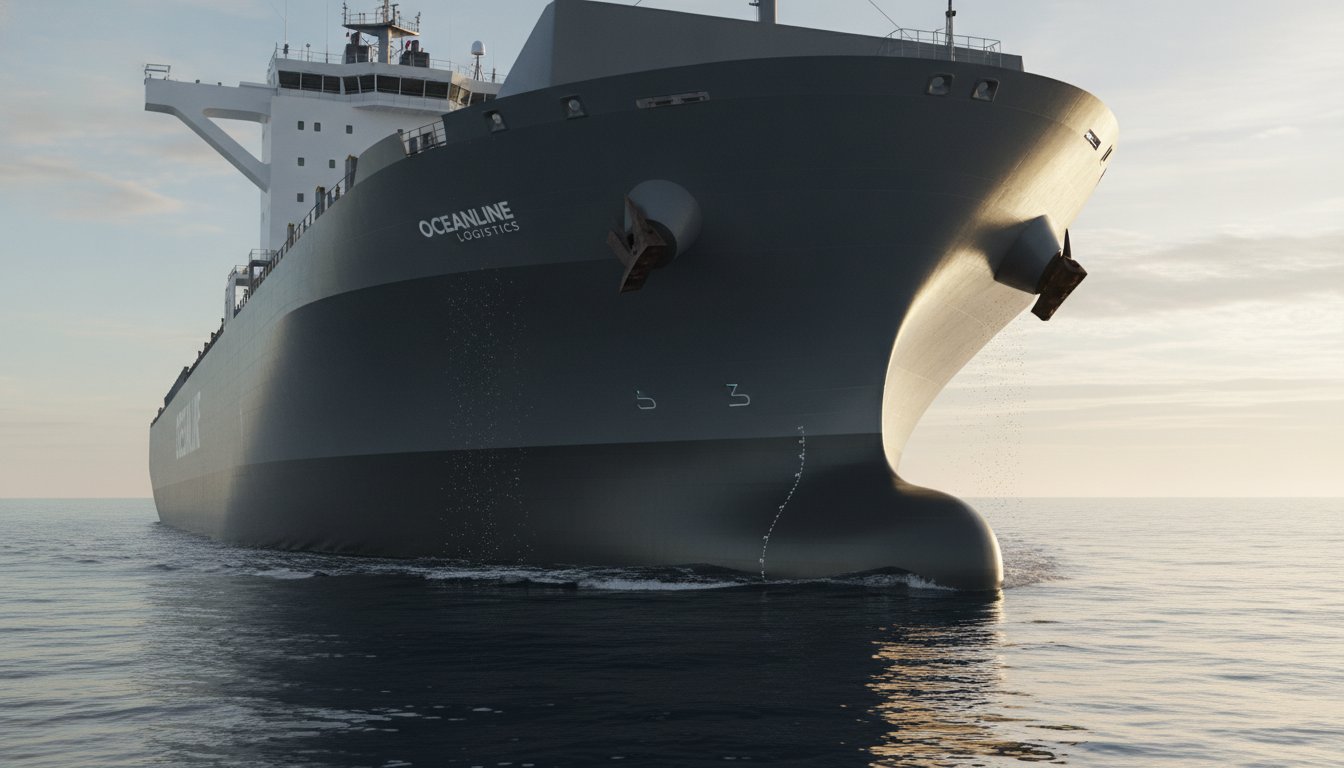
A multi-million dollar dry-docking event is often viewed as an unavoidable operational tax, but the reality is that your service interval is a variable choice rather than a fixed mandate. While 70% of maritime operators still adhere to a 2 to 5-year cycle, the secret to reducing vessel dry-docking frequency lies in the chemical integrity and durability of your hull’s surface. With the 2026 IMO Carbon Intensity Indicator (CII) reduction factor now at 11%, the pressure to maintain peak hull efficiency without constant downtime has never been more critical for your fleet’s commercial viability.
You’re likely familiar with the frustration of traditional biocidal paints failing long before the next scheduled survey, which forces a difficult choice between increased fuel consumption and early docking. We’ll show you how transitioning to advanced, hard-film silane-siloxane technology can safely extend your service window to 10 years while significantly lowering lifecycle maintenance costs. This guide examines how the intersection of operational intelligence and high-performance coatings like Sea-Speed V 10 X Ultra can help you secure a superior CII rating and maximize long-term asset ROI.
Key Takeaways
- Analyze the true economic burden of maintenance downtime, including lost charter opportunities and the rising mobilization fees expected in 2026.
- Contrast the limited lifespan of traditional ablative coatings with the long-term durability of hard-film, non-toxic alternatives.
- Learn the strategic benefits of reducing vessel dry-docking frequency through the adoption of silane-siloxane technology that prevents bio-attachment.
- Implement advanced operational strategies, such as In-Water Cleaning and Inspection (IWCI), to preserve hull speed without early docking.
- Evaluate the transition to a 10-year service window using Sea-Speed V 10 X Ultra to maximize your asset’s lifecycle return on investment.
The Economics of Vessel Dry-Docking: Why Frequency Matters in 2026
Dry-docking frequency represents the strategic interval between major out-of-water maintenance events, a cycle that dictates both the physical integrity of a hull and the financial health of a fleet. In the current maritime environment, this interval is no longer just a technical necessity; it’s a critical lever for operational profitability. For most operators, reducing vessel dry-docking frequency is the most direct path to reclaiming lost margin. To understand the gravity of these events, one must first grasp what is dry-docking in a modern context: it’s an intensive period where a vessel is removed from the water to address structural repairs, machinery overhauls, and essential coating applications that cannot be performed while afloat.
The financial impact extends far beyond the shipyard’s invoice. Hidden costs often eclipse the direct expenditure of the survey itself. Lost charter revenue during the off-hire period, mobilization fees to position the vessel at a capable yard, and significant yard overheads create a massive capital drain. In 2026, these pressures are compounded by the IMO’s Carbon Intensity Indicator (CII) reduction factor, which has moved to 11% relative to the 2019 baseline. A degraded hull surface directly correlates to poor EEXI and CII ratings, potentially forcing a vessel into a lower category that limits its commercial attractiveness. Consequently, the condition of the hull is now inextricably linked to regulatory compliance and the ability to operate in premium markets.
The True Cost of Downtime
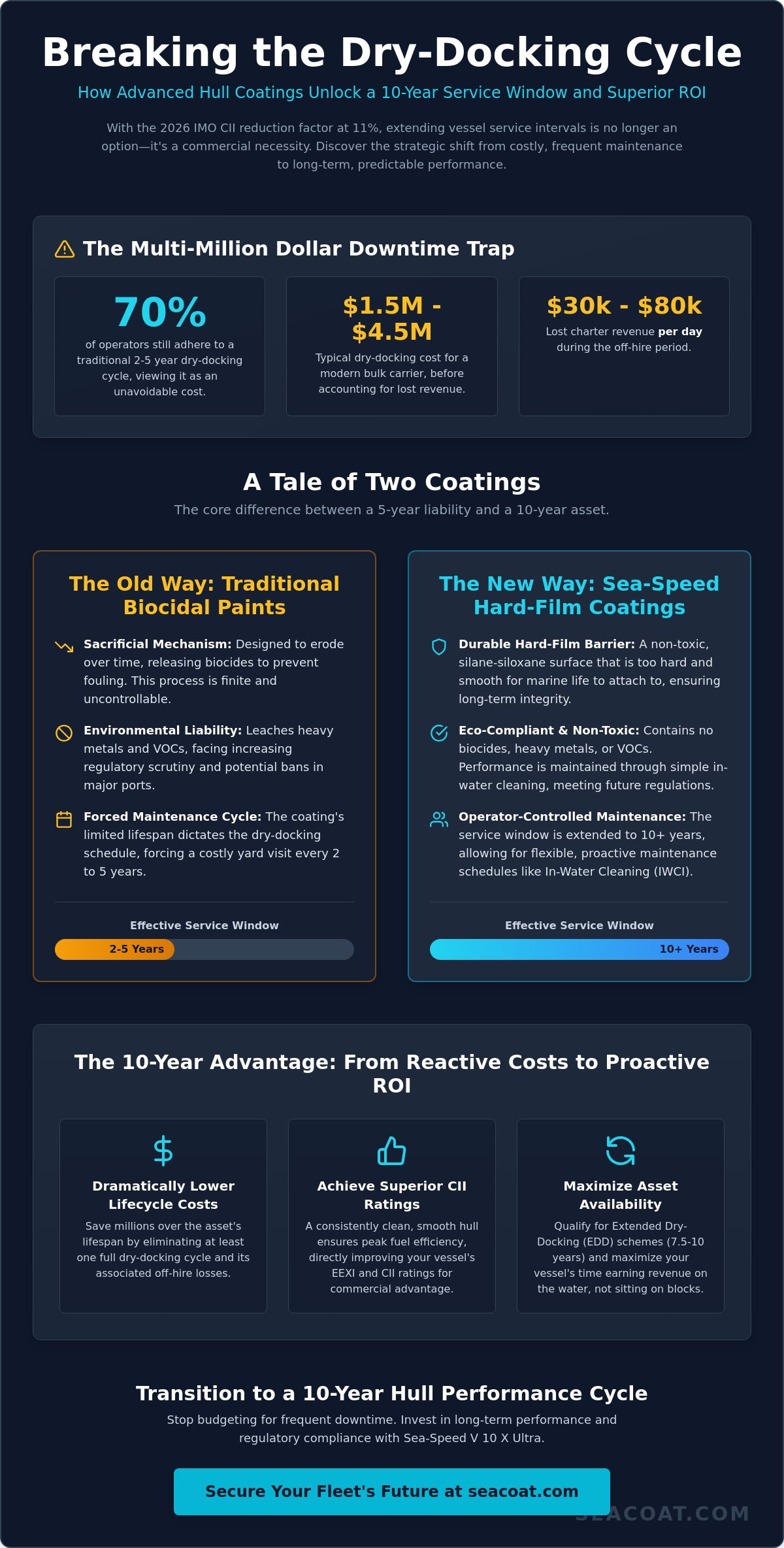
Downtime is the most expensive commodity in shipping. For a Suezmax tanker in 2026, a standard special survey dry-docking typically ranges from $800,000 to $1.2 million, while modern bulk carriers can see costs between $1.5 million and $4.5 million depending on the age of the hull and steelwork requirements. These figures don’t account for the daily opportunity cost, which can exceed $30,000 to $80,000 depending on market rates. Unplanned repairs and “change orders” discovered once the vessel is on the blocks often inflate the final bill by 15% or more. By successfully reducing vessel dry-docking frequency, an owner can effectively amortize these heavy capital outlays over a longer period, saving millions of dollars across a standard 20-year asset lifespan.
Regulatory Windows and Extended Dry-Docking (EDD)
The traditional five-year special survey cycle is evolving as class societies recognize the capabilities of modern material science. Achieving an Extended Dry-Docking (EDD) scheme, which allows for 7.5 or even 10-year intervals, requires more than just a request; it demands proof of asset integrity. To qualify, vessels must often demonstrate superior hull condition and utilize high-performance coatings that don’t rely on the “self-polishing” depletion seen in traditional paints. These advanced systems provide the durable barrier necessary to satisfy stringent class requirements for underwater examinations in lieu of dry-docking (UWILD), making the choice of coating a fundamental component of a long-term regulatory strategy.
Why Traditional Antifouling Paints Limit Your Service Window
Traditional maritime maintenance has long been tethered to the lifecycle of biocidal coatings. Ablative or self-polishing paints operate on a sacrificial mechanism; they’re engineered to erode over time to release active biocides. While this provides initial protection against marine growth, it creates a finite operational window. Once the polishing rate exceeds the remaining film thickness, the hull becomes vulnerable to catastrophic biofouling. This inherent obsolescence is the primary barrier to reducing vessel dry-docking frequency. If the paint is designed to disappear, the vessel is inevitably bound for the yard to replenish it.
Beyond the limited lifespan, these systems face increasing pressure from international biofouling regulations. As the IMO tightens standards to prevent the transfer of invasive aquatic species, the leaching of heavy metals and volatile organic compounds (VOCs) is coming under intense regulatory scrutiny. By 2026, many port authorities are considering stricter bans on biocidal discharge, making traditional paints a mounting liability. The industry is shifting away from these temporary, environmentally damaging solutions toward permanent surface technologies that offer a cleaner, more sustainable profile.
The Failure Cycle of Soft Coatings
Soft silicone foul-release systems were once touted as the solution, but they introduced a different set of vulnerabilities. These coatings are notoriously fragile. A single fender rub or a minor collision with floating debris can cause tearing or delamination. Unlike hard-film systems, soft silicones are difficult to repair in-water. They often require a full haul-out for even minor touch-ups. Additionally, these surfaces can’t withstand aggressive mechanical cleaning, which is often necessary when the vessel remains idle for extended periods. This fragility makes them an unreliable choice for operators seeking to extend their service windows.
Hull Roughness and Frictional Drag
The “Roughness Trap” is a phenomenon where repeated applications of traditional paint lead to a progressively degraded surface profile. Each new layer adds to the cumulative “peaks and valleys” on the hull, increasing the hydrodynamic resistance. This surface texture creates a permanent fuel penalty that grows with every docking cycle. For a deeper dive into how surface chemistry impacts your bottom line, consult The Definitive Guide to Boat Hull Paint: Performance, Science, and ROI. To optimize your fleet’s efficiency, it’s vital to break this cycle by choosing a coating that maintains its physical smoothness over the long term. You can explore how permanent hull solutions eliminate the need for frequent recoating by visiting our technology overview.
The Role of Hard-Film Silane-Siloxane Coatings in extending Service Life
The transition from traditional biocidal depletion to advanced material science marks a fundamental shift in how shipowners approach asset longevity. Silane-siloxane technology represents a departure from the “sacrificial” model of hull protection. Instead of relying on the leaching of toxins, these coatings utilize a non-toxic, hard-film structure that creates a low-energy surface. This molecular configuration makes it physically difficult for marine organisms to establish a permanent bond. Because the coating does not “polish” away or lose thickness during service, it provides a stable, permanent barrier that remains effective for years beyond the limits of conventional paints.
By decoupling protection from film depletion, this technology becomes the primary driver for reducing vessel dry-docking frequency. While standard epoxy and silicone systems often require reapplication or extensive repair every five years, a high-performance silane-siloxane system like Sea-Speed V 10 X Ultra is engineered to last a decade or longer. Its resilience against mechanical wear, including ice abrasion and the high-velocity friction found in fast-vessel applications, ensures that the hull remains protected in environments that would quickly strip away softer coatings. This durability allows operators to move past the mandatory five-year haul-out and explore extended docking cycles with confidence.
Hard Film vs. Soft Silicone: A Durability Comparison
Soft silicone foul-release coatings often fail due to their lack of physical toughness. They are susceptible to tearing from fender impact, docking blocks, and even minor debris in the water. In contrast, hard-film silane-siloxane coatings possess the structural integrity of a high-grade epoxy. They can withstand repeated mechanical scrubbing without any loss of film thickness or protective properties. This “cleanable” nature means that even if a vessel remains idle and accumulates light slime, the surface can be restored to its original state through simple in-water cleaning, reinforcing the permanent nature of the system.
Fluid Dynamics and Surface Slickness
The efficiency of a hull is determined by its drag coefficient, which is a direct function of surface energy and roughness. Silane-siloxane coatings achieve a “slicker” profile than traditional paints by creating an ultra-smooth, hydrophobic interface. This reduces the energy required to move the vessel through the water, leading to measurable gains in speed and fuel efficiency. For a technical breakdown of how these materials optimize hydrodynamic performance, see our article on Sea-Speed V 10 X Ultra. Maintaining this low-drag surface over a ten-year cycle is essential for meeting the stringent carbon intensity requirements of 2026.
Operational Strategies for Maximizing Time Between Dry-Docks
Extending the interval between major surveys requires more than just a superior coating; it demands a shift in operational philosophy. While the chemistry of a hard-film system provides the foundation, active management ensures the vessel remains at peak efficiency. By moving away from reactive, corrective repairs and adopting a preventative underwater maintenance schedule, operators can maintain the hydrodynamic profile established at the yard. This proactive approach is essential for reducing vessel dry-docking frequency while staying ahead of the 2026 CII reduction targets. It’s a strategy that treats the hull as a high-performance asset rather than a simple steel structure.
The key to success lies in the integration of specialized cleaning tools and remote performance monitoring. Traditional methods often wait for a noticeable drop in speed before taking action, but by then, the drag penalty has already impacted the bottom line. A modern strategy utilizes non-destructive cleaning tools specifically designed for hard-film foul release systems. These tools maintain the surface slickness without eroding the coating, allowing the vessel to stay in the water longer while preserving its original performance metrics. This methodology transforms maintenance from a disruptive event into a continuous process of optimization.
The Power of In-Water Hull Cleaning
High-performance silane-siloxane systems allow for more aggressive in-water cleaning and inspection (IWCI) programs than their soft-film counterparts. Because these coatings are physically robust and contain no biocides, they can be scrubbed or high-pressure washed without the risk of releasing toxic contaminants into the water column. Utilizing specialized robotic brushes removes light slime or bio-attachment before it can escalate into a more severe drag penalty. Regular inspections ensure that any minor mechanical damage is identified and addressed before it compromises the hull’s integrity. These clean hulls are a cornerstone of compliance with modern environmental marine coatings standards, which increasingly prioritize the prevention of invasive species transfer through rigorous hull hygiene.
Asset Intelligence and Performance Data
Modern fleet management relies on asset intelligence to justify maintenance decisions. By monitoring fuel flow and speed-power curves in real-time, operators can detect the subtle onset of hull drag that precedes visible fouling. This data-driven approach provides the evidence needed to demonstrate hull integrity to Class societies, often serving as the primary justification for deferring a scheduled dry-dock. Hull performance monitoring is the systematic analysis of a vessel’s speed, power, and fuel consumption data to quantify the impact of biological fouling on hydrodynamic efficiency. This transparency allows for a more surgical approach to maintenance, focusing resources only when and where they’re required to maintain a vessel’s carbon intensity rating. To begin implementing these data-driven strategies, you can explore our advanced hull management solutions.
Transitioning to a 10-Year Hull Performance Cycle with Sea-Speed
The move toward a 10-year hull performance cycle represents a fundamental shift from the “paint and repeat” mentality that has historically governed maritime maintenance. By positioning Sea-Speed V 10 X Ultra as the foundation of your long-term strategy, you’re not simply applying a coating; you’re installing a permanent underwater asset. This “one-and-done” philosophy is most effective when integrated into newbuild specifications, where the initial application sets the stage for a decade of optimal fluid dynamics. For retrofits, it provides a decisive exit from the roughness trap, allowing operators to halt the cycle of cumulative surface degradation and reclaim the vessel’s original design efficiency.
This strategic transition aligns perfectly with the intensifying environmental mandates of 2026. Sea-Speed V 10 X Ultra is engineered with zero volatile organic compounds (VOCs) and is entirely non-toxic. It doesn’t rely on the leaching of heavy metals or biocides to maintain a clean hull, which ensures that reducing vessel dry-docking frequency contributes directly to a lower corporate carbon footprint and improved ESG metrics. By extending the service window, you’re also significantly reducing the total volume of industrial waste generated by frequent yard visits, including contaminated grit-blasting media and chemical runoff.
Sea-Speed V 10 X Ultra: Engineered for Longevity
The longevity of this system is rooted in its high molecular density and exceptional bond strength. Unlike traditional epoxies that can become brittle over time or soft silicones that are prone to tearing, Sea-Speed V 10 X Ultra maintains its “slickness” through a stable, low-energy surface that doesn’t degrade under UV exposure or mechanical stress. Documented performance on both large-scale commercial tankers and high-speed military vessels has proven that the coating remains hydrodynamically efficient for 10 years or longer. This permanent surface efficiency is the primary mechanism for maintaining a high CII rating throughout the vessel’s entire lifecycle without the need for periodic recoating.
Next Steps for Fleet Managers
To move toward a 10-year cycle, fleet managers should specify Sea-Speed V 10 X Ultra during their next scheduled special survey. While the initial capital expenditure for a premium silane-siloxane system may differ from low-cost ablatives, the return on investment over a 10-year horizon is undeniable. When you factor in the total elimination of at least one mid-cycle dry-dock, the sustained fuel savings from reduced drag, and the avoidance of off-hire revenue loss, the economic case is clear. For a detailed assessment of your fleet’s potential savings and a roadmap for conversion, you should Contact Seacoat SCT, LLC for a Fleet Performance Analysis.
Securing the Future of Fleet Efficiency
The maritime industry stands at a pivotal junction where environmental accountability and operational profitability are finally inseparable. Moving beyond the limitations of sacrificial coatings isn’t just about avoiding the shipyard; it’s about establishing a permanent foundation for hydrodynamic excellence. By integrating advanced material science with proactive asset intelligence, reducing vessel dry-docking frequency becomes a tangible strategic advantage that protects your bottom line and the global ecosystem simultaneously. This shift allows you to amortize maintenance costs over a decade while staying ahead of stringent 2026 carbon intensity mandates.
Since 2001, our proprietary Silane-Siloxane technology has provided a non-toxic, 100% VOC-free solution for the world’s most demanding commercial and military applications. With a proven 10+ year service life, this system eliminates the need for frequent, costly recoating cycles while maintaining peak hull slickness. It’s time to transition from temporary maintenance fixes to a permanent, performance-enhancing asset. You can Optimize Your Fleet’s ROI with Sea-Speed V 10 X Ultra and secure your vessel’s competitive edge for the next decade of operations. Your fleet’s long-term resilience starts with the surface chemistry you choose today.
Frequently Asked Questions
Is it possible to skip a 5-year dry-docking under current regulations?
Yes, shipowners can extend the interval between out-of-water surveys by qualifying for an Extended Dry-Docking (EDD) program approved by their Class society. These schemes typically allow for a 7.5-year or 10-year cycle provided the vessel utilizes a high-performance coating and undergoes regular Underwater Inspections in Lieu of Dry-Docking (UWILD). This regulatory flexibility is a primary mechanism for reducing vessel dry-docking frequency while maintaining strict safety and structural standards.
How do hard-film coatings like Sea-Speed differ from traditional silicone foul release?
Sea-Speed V 10 X Ultra utilizes a hard-film silane-siloxane chemistry that differs fundamentally from the fragile, elastomeric nature of traditional silicone foul release systems. While soft silicones are prone to tearing and mechanical damage from fenders or debris, hard-film systems provide the structural integrity of a high-grade epoxy. This durability allows for aggressive mechanical cleaning without any loss of film thickness; a critical advantage for maintaining long-term hydrodynamic efficiency.
Will reducing dry-docking frequency affect my vessel’s insurance or Class status?
Reducing the frequency of dry-docking won’t negatively impact your insurance or Class status as long as the extension is formally approved and documented through an authorized EDD scheme. Class societies require evidence of hull integrity and the use of superior coating systems to grant these extensions. In fact, maintaining a cleaner, more efficient hull through advanced technology often demonstrates a lower risk profile to insurers concerned with asset longevity and regulatory compliance.
What are the environmental benefits of extending dry-docking intervals?
Extending the interval between shipyard visits significantly reduces the environmental footprint of vessel maintenance by minimizing the generation of industrial waste. Each dry-docking event produces tons of contaminated grit-blasting media and chemical runoff that must be processed. By reducing vessel dry-docking frequency, you decrease the cumulative volume of these pollutants while simultaneously lowering carbon emissions through sustained hull smoothness and fuel efficiency.
Can Sea-Speed V 10 X Ultra be applied to aluminum or composite hulls?
Sea-Speed V 10 X Ultra is engineered for high-performance adhesion across a wide range of substrates, including aluminum, steel, and composite materials. Its versatile chemical composition makes it an ideal choice for diverse fleets that include high-speed ferries, workboats, and naval vessels. The coating provides the same hard-film durability and low-energy surface regardless of the hull material, ensuring consistent protection and drag reduction across the entire asset.
How much fuel can advanced hull coatings actually save between docking cycles?
Advanced hull coatings can save a significant amount of fuel by preventing the progressive increase in drag that occurs as traditional paints degrade and accumulate bio-attachment. While a fouled hull can increase fuel consumption by 10% to 20%, a permanent silane-siloxane surface maintains the vessel’s original design speed and efficiency. This prevents the “roughness trap” where repeated painting layers create a permanent fuel penalty that grows over the life of the ship.
What kind of in-water cleaning equipment is compatible with hard-film coatings?
Hard-film coatings are compatible with a broad spectrum of in-water cleaning equipment, including robotic brush systems and high-pressure water jets. Unlike soft silicone coatings that can be easily gouged or stripped by mechanical contact, silane-siloxane systems are robust enough to withstand regular, thorough scrubbing. This allows operators to implement proactive hull hygiene programs that remove slime and early-stage fouling without compromising the physical integrity of the protective barrier.
Does extending the docking interval increase the risk of corrosion?
Extending the docking interval doesn’t increase the risk of corrosion if the underlying barrier coating remains intact and functional. Silane-siloxane technology creates a highly dense, hydrophobic barrier that is significantly more resistant to moisture permeation than standard marine epoxies. As long as the physical film isn’t breached, the hull remains protected from the corrosive effects of seawater; a task made easier by the coating’s high resistance to mechanical impact and abrasion.