
In 2026, the cost of carbon is no longer a theoretical projection. It’s a fixed line item on your balance sheet that can exceed €100 per tonne under the EU ETS. Many maritime professionals find themselves in a difficult position where they must meet the IMO 11% carbon intensity reduction mandate while facing internal resistance to high upfront capital expenditures. It’s common to feel the weight of executive skepticism regarding operational downtime and the long term reliability of new systems.
This guide provides a strategic framework on how to get buy-in for sustainable shipping tech by shifting the internal conversation from compliance costs to asset performance and fuel volatility hedging. You’ll learn how to present data-driven arguments that align environmental stewardship with the bottom line. We will examine how to leverage technical performance metrics, such as the 12% fuel savings offered by advanced silane-siloxane coatings like Sea-Speed V 10 X Ultra, to secure the budget needed for a resilient fleet. By the end of this guide, you’ll have the tools to transform sustainable technology from a regulatory burden into a permanent strategic asset.
Key Takeaways
- Align your fleet strategy with the 2026 IMO mandates and EU ETS carbon pricing to mitigate the immediate financial risks of regulatory non-compliance.
- Discover how to get buy-in for sustainable shipping tech by presenting a clear ROI based on measurable fuel savings and significantly extended dry-docking intervals.
- Evaluate the technical superiority of hard-film silane-siloxane coatings over fragile silicone alternatives to ensure operational reliability in demanding maritime environments.
- Utilize a five-step advocacy framework to map stakeholder priorities and present a data-driven case that resonates with both the CFO and the Fleet Manager.
- Shift your organizational perspective from viewing hull coatings as a recurring maintenance cost to treating them as a strategic asset for long-term performance.
The 2026 Regulatory Landscape: Why Sustainable Tech is No Longer Optional
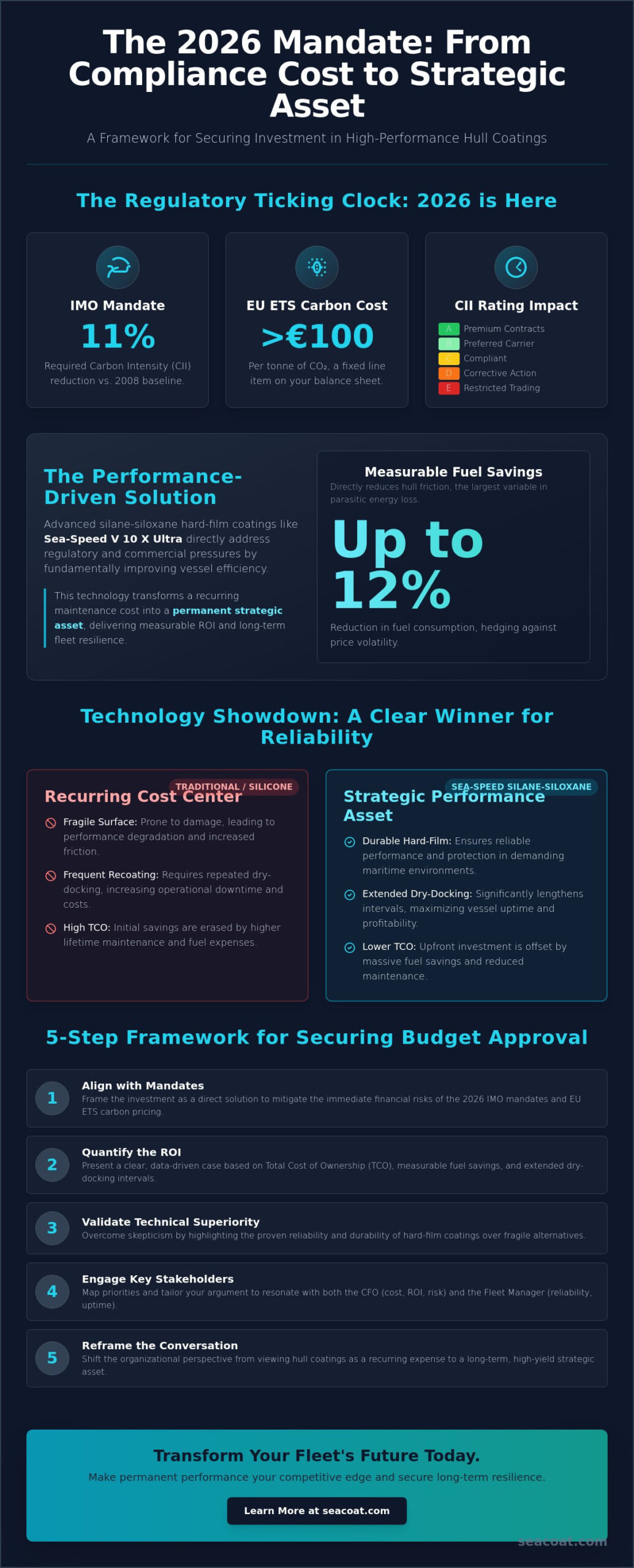
The maritime sector has transitioned into a period where efficiency is synonymous with survival. As of 2026, the International Maritime Organization (IMO) requires an 11% reduction in carbon intensity compared to 2008 baselines. This mandate, enforced through the Carbon Intensity Indicator (CII) and the Ship Energy Efficiency Management Plan (SEEMP) III, has fundamentally changed how vessel owners view their hardware. Sustainable shipping tech is no longer just about alternative fuels; it encompasses every component that influences energy consumption. From high-efficiency propulsion systems to advanced hull surfaces, every mechanical choice now carries a regulatory weight that determines a vessel’s commercial viability.
Understanding CII and EEXI in the 2026 Context
Hull friction remains one of the most significant variables in the annual efficiency ratio of any commercial vessel. A ship’s CII rating is a direct reflection of its operational efficiency, and even minor increases in drag can push a vessel from a compliant ‘C’ rating into the corrective action territory of a ‘D’ or ‘E’. The decarbonization of shipping relies heavily on minimizing these parasitic energy losses. When explaining how to get buy-in for sustainable shipping tech to stakeholders, you must emphasize that hull condition is the primary determinant of carbon intensity penalties. In 2026, the CII rating serves as the primary driver for hull technology investments because it directly dictates where a ship can trade and at what cost.
The Market Shift: Cargo Owners Demanding Green Solutions
The commercial landscape has evolved beyond regulatory compliance. Cargo owners, often referred to as ‘Frontrunners’ in the sustainability space, are increasingly auditing the carbon footprint of their supply chains. These stakeholders prioritize carriers that maintain ‘A’ or ‘B’ CII ratings to meet their own corporate ESG targets. Utilizing environmental marine coatings provides a visible and verifiable commitment to these standards. Maintaining a high rating isn’t just about avoiding fines; it’s about securing premium contracts in a market where efficiency is a competitive edge. It’s a shift from voluntary green talk to mandatory performance metrics.
Inaction leads to tangible commercial loss. In 2026, ships with poor efficiency ratings face restricted access to certain ports and significantly higher carbon taxes under the EU ETS. Understanding how to get buy-in for sustainable shipping tech requires a clear-eyed view of these risks. The transition from voluntary green initiatives to mandatory compliance is complete. Investing in permanent, hard-film hull solutions is the most logical path to preserving both the environment and the balance sheet. Efficiency isn’t a maintenance requirement; it’s a strategic asset for fleet-wide resilience.
Building the Economic Case: Metrics That Resonate with the C-Suite
Securing executive approval requires a fundamental shift in how we categorize sustainability investments. To understand how to get buy-in for sustainable shipping tech, one must translate fluid dynamics and carbon intensity into the language of the balance sheet. While traditional ablative paints are viewed as a recurring maintenance expense, advanced hard-film coatings operate as a high-yield financial asset. By reducing hull drag, these technologies directly lower fuel consumption, which typically accounts for 50% to 60% of a vessel’s total operating costs. Evidence-based performance metrics indicate that transitioning to a silane-siloxane system can reduce fuel consumption by up to 12%, providing a predictable hedge against rising operational expenses.
Total Cost of Ownership (TCO) vs. Initial CapEx
Focusing solely on the “sticker price” of materials is a strategic oversight that ignores the true cost of asset management. A comprehensive TCO analysis reveals that the initial investment in premium technology is offset by the elimination of frequent recoating cycles. When calculating the ROI on premium boat hull paint, stakeholders must account for the extended service window. Traditional systems often require dry-docking every 24 months for significant hull remediation. In contrast, hard-film solutions like Sea-Speed V 10 X Ultra are engineered for longevity, allowing operators to extend dry-docking intervals to 5 years or more. This reduction in downtime and labor costs transforms the coating from a liability into a performance-enhancing tool.
Fuel Volatility as a Risk Management Factor
Energy markets are notoriously unstable, and bunker prices remain a primary source of budget uncertainty. Implementing sustainable tech serves as a critical buffer against this volatility. By improving the hydrodynamic efficiency of the hull, operators reduce the total energy required to maintain transit speeds, effectively lowering the ship’s exposure to price spikes. For a standard commercial vessel, a 5% reduction in hull drag can save over six figures in annual fuel costs. Beyond direct savings, many jurisdictions now offer economic incentives for sustainability that include tax rebates or carbon credits for verified efficiency gains. These market-based mechanisms further accelerate the payback period of the investment.
The financial argument is clear: durability and efficiency are the new benchmarks for maritime profitability. If you’re looking to optimize your fleet’s long-term performance, exploring the technical specifications at seacoat.com can provide the data needed for your next stakeholder presentation. Moving away from the cycle of temporary fixes ensures that your capital is working toward permanent operational resilience. This approach mitigates the risks of both regulatory penalties and unpredictable fuel markets, positioning the fleet for sustained success.
Overcoming Technical Skepticism: Hard-Film Performance vs. Traditional Methods
Technical skepticism often stems from previous experiences with early-generation sustainable solutions that failed to meet the rigors of heavy industrial use. For many fleet managers, the term “foul release” is synonymous with soft silicone coatings that, while environmentally preferable to biocidal paints, lack physical robustness. These fragile surfaces are prone to tearing during fender contact or hull cleaning, which leads to premature failure and increased hydrodynamic drag. Understanding how to get buy-in for sustainable shipping tech requires addressing these mechanical concerns with evidence of operational resilience. Hard-film technology, specifically silane-siloxane compositions, represents the 2026 industry standard by offering a non-porous, glass-like surface that is virtually impenetrable by marine organisms and resistant to physical abrasion.
The Durability Gap: Hard Film vs. Soft Silicone
The transition away from traditional antifouling boat paint has historically been hampered by the durability gap. Soft silicone systems are effectively high-maintenance assets; they require gentle handling and are easily damaged by ice, debris, or frequent port calls in high-traffic areas. In contrast, hard-film foul-release systems provide a permanent solution that withstands the rigors of global trade. These coatings don’t rely on the gradual release of toxins to function. Instead, they utilize a low-energy surface that prevents biological adhesion. This mechanical approach ensures that even if a vessel remains stationary, the hull can be cleaned in-water using standard equipment without compromising the integrity of the coating.
Environmental Compliance Without Performance Trade-offs
Modern engineering has eliminated the need to choose between ecological safety and mechanical efficiency. By leveraging SCT’s silane-siloxane technology, operators can meet stringent global bans on harmful additives like copper or TBT without sacrificing speed or fuel economy. This technology supports “Zero-Carbon” shipping goals by maintaining a hydraulically smooth surface over the entire service life of the vessel. Performance metrics for Sea-Speed V 10 X Ultra in commercial fleets demonstrate that this mechanical efficiency translates to sustained fuel savings and reduced emissions. When you present this data, you demonstrate that the technology isn’t a compromise. It’s a superior engineering choice.
Securing executive approval is easier when the technology is framed as a risk-mitigation tool. By choosing a hard-film system, you eliminate the threat of environmental fines while simultaneously protecting the physical asset from the degradation associated with traditional methods. This dual-purpose benefit is a cornerstone of how to get buy-in for sustainable shipping tech in a high-stakes market. Reliability and compliance are no longer competing interests. They are now inseparable components of a modern fleet strategy. Efficiency is the ultimate form of protection.
The Internal Advocacy Framework: 5 Steps to Securing Budget Approval
Securing executive approval for large-scale fleet upgrades depends on your ability to navigate the varying priorities of internal decision-makers. Persuading a board of directors requires more than just environmental passion; it requires a structured business case that links technical efficiency to corporate resilience. This is how to get buy-in for sustainable shipping tech by aligning mechanical benefits with the specific financial and operational objectives of your organization. Success starts with mapping your stakeholders and benchmarking your current performance to create an undeniable baseline for improvement.
Communicating Value to Different Departments
Each department views a technology investment through a different lens, and your pitch must adapt accordingly. To gain traction, you should tailor your data to meet these specific concerns:
- Talking to the CFO: Focus on Net Present Value (NPV) and the Internal Rate of Return (IRR). Demonstrate how reducing fuel consumption by 10% to 12% and extending dry-docking intervals provides a predictable payback period that justifies the initial capital expenditure.
- Talking to the Fleet Manager: Focus on operational reliability and reduced maintenance windows. Emphasize the durability of hard-film coatings, which eliminate the need for frequent hull remediation and simplify in-water cleaning protocols.
- Talking to the CEO: Focus on brand reputation and ESG leadership. Position the investment as a strategic move to secure premium cargo contracts from “Frontrunner” clients who prioritize low-carbon carriers.
The Power of the Pilot Project
A 12-month performance trial on a single vessel is often the most effective way to overcome institutional inertia. This period allows for the collection of seasonal data and provides a localized proof of concept that can be extrapolated across the entire fleet. During the trial, focus on Key Performance Indicators (KPIs) such as speed-power trials and detailed hull inspections to verify that the technology performs as advertised in real-world conditions. Utilizing side-by-side performance data from a pilot vessel and a control ship effectively neutralizes internal skepticism by providing empirical proof of efficiency gains. This data-driven approach removes emotion from the decision-making process and replaces it with verifiable metrics.
The final pitch must align the technology investment with the company’s 5-year strategic goals, emphasizing risk mitigation through third-party certifications and performance guarantees. By presenting a solution that addresses both regulatory pressure and bottom-line profitability, you transform a technical proposal into a strategic necessity. To begin building your internal case with verified technical data and case studies, visit seacoat.com and access our comprehensive performance whitepapers. Transitioning to permanent, hard-film solutions is the final step in future-proofing your fleet against the uncertainties of the 2026 maritime market. How to get buy-in for sustainable shipping tech is ultimately about proving that efficiency is the most reliable path to longevity.
Strategic Partnership: Leveraging Seacoat for Long-Term Fleet Resilience
Selecting the appropriate technology is only the first stage of a successful fleet-wide transition. For maritime professionals, the challenge often lies in the execution of these upgrades across diverse vessel types and operational profiles. Seacoat (SCT) functions as more than a specialized manufacturer; we provide the technical consultation and engineering support necessary to ensure that sustainable investments deliver their projected returns. When you’re determining how to get buy-in for sustainable shipping tech, having a partner who can provide verified performance data and site-specific application protocols is a critical advantage. This collaborative approach ensures that the transition from traditional biocidal paints to permanent, hard-film solutions is seamless and data-driven.
The longevity of Sea-Speed V 10 X Ultra is a cornerstone of this strategic partnership. By moving to a one-time application model, operators eliminate the waste and recurring costs associated with biennial recoating cycles. This durability is supported by global availability and a robust support network that serves both the commercial and military maritime sectors. Whether managing a global container fleet or specialized naval assets, the requirement for reliability remains constant. SCT’s commitment to scientific precision ensures that every application is optimized for the specific fluid dynamics and environmental conditions the vessel will encounter.
Why Sea-Speed V 10 X Ultra is the Strategic Choice
The unique Silane-Siloxane hard-film advantage lies in its ability to maintain a hydraulically smooth surface without the use of depleting toxins. Traditional systems lose efficiency as they age, but Sea-Speed V 10 X Ultra retains its performance characteristics over multiple years. This stability is essential for vessels striving to meet EEXI and CII requirements, as it prevents the “efficiency drift” that often leads to regulatory penalties. To move your proposal forward, you can consult with SCT experts to build your business case for Sea-Speed and gain access to the technical metrics that resonate with executive stakeholders.
The Future of Your Fleet
The transition to sustainable shipping is a shift from reactive maintenance to proactive asset management. By 2026, the industry has reached a tipping point where the economic risks of inaction far outweigh the initial costs of technological adoption. Building a resilient fleet today is the only way to remain “future-proof” against the even more stringent 2030 regulations. A high-performance hull coating isn’t just a protective layer; it’s a performance-enhancing tool that provides a permanent competitive edge. How to get buy-in for sustainable shipping tech is ultimately about demonstrating that intelligence and stewardship are the most effective drivers of long-term profitability. 2026 is the year to secure that legacy.
Securing Your Fleet’s Performance for the Next Decade
The maritime industry has reached a pivotal juncture where the preservation of natural ecosystems and the operational efficiency of heavy industry are no longer at odds. By shifting the internal narrative from short-term compliance costs to long-term asset resilience, you can effectively demonstrate how to get buy-in for sustainable shipping tech to even the most skeptical stakeholders. The evidence is clear; hard-film foul release systems, which have been in commercial use since 2001, provide a permanent solution that eliminates toxic biocides while delivering proven drag reduction for both commercial and military vessels. This transition isn’t just about meeting 2026 mandates; it’s about building a fleet that’s smarter, cleaner, and more profitable.
You now have the strategic framework to map stakeholder priorities and leverage the technical superiority of silane-siloxane technology to secure your organization’s future. To take the next step in your advocacy journey, Download the SCT Technical Data Sheet to Support Your Internal Pitch and access the performance metrics required for a successful fleet-wide rollout. The path to a resilient, high-performance fleet starts with a single, data-driven decision. Your leadership today will define your operational success and environmental legacy for years to come.
Frequently Asked Questions
What is the primary barrier to getting buy-in for sustainable shipping tech?
The primary barrier is the perceived conflict between high initial capital expenditure and the immediate need for operational liquidity. Many stakeholders focus on the “sticker price” of materials rather than the multi-year lifecycle savings. To overcome this, focus on how to get buy-in for sustainable shipping tech by highlighting the reduction in recurring maintenance costs. Shifting the focus from a two-year dry-docking cycle to a ten-year asset management plan clarifies the long-term value proposition.
How do I calculate the ROI of a non-toxic marine hull coating?
Calculating ROI requires an analysis of fuel consumption, dry-docking labor, and downtime costs over the asset’s service life. You must benchmark current fuel expenditures against the projected 6% to 12% reduction provided by hard-film surfaces. Factoring in the elimination of multiple recoating events over a ten-year period provides a clear Net Present Value. This comprehensive approach demonstrates that premium coatings are a performance-enhancing tool rather than a maintenance expense.
Are sustainable coatings as effective as traditional antifouling paints?
Sustainable hard-film coatings are often more effective than traditional biocidal paints because they maintain a constant hydrodynamic profile. Unlike ablative paints that roughen as they wear, silane-siloxane surfaces remain glass-smooth throughout their service life. This mechanical efficiency prevents biological adhesion without the use of depleting toxins. The result is a more reliable foul-release system that withstands physical abrasion and in-water cleaning better than fragile silicone or traditional toxic alternatives.
How does hull tech impact my vessel’s CII rating in 2026?
Hull technology is the most direct way to influence your vessel’s Carbon Intensity Indicator (CII) rating by minimizing parasitic drag. Since the CII is a function of fuel consumed over distance traveled, any reduction in friction directly improves your annual efficiency ratio. In 2026, maintaining an ‘A’ or ‘B’ rating is essential for commercial access to low-carbon supply chains. Investing in advanced hull surfaces ensures your fleet remains compliant with IMO mandates without requiring expensive engine retrofits.
What are the most important financial metrics for a shipping tech pitch?
The most persuasive financial metrics for a technology pitch are Net Present Value (NPV), Internal Rate of Return (IRR), and Total Cost of Ownership (TCO). These figures allow the C-suite to compare sustainable investments against other capital projects on an equal footing. Highlighting the hedge against EU ETS carbon prices, which can exceed €100 per tonne, adds another layer of financial security. Using these metrics is a key strategy for how to get buy-in for sustainable shipping tech in 2026.
Can sustainable shipping tech really reduce fuel consumption by 10%?
Evidence-based studies and real-world commercial applications confirm that advanced hull coatings can reduce fuel consumption by up to 12%. This is achieved by creating a low-energy surface that significantly reduces the skin friction coefficient of the hull. For a standard commercial vessel, this level of efficiency translates to six-figure annual savings. These results are consistent across both commercial and military maritime sectors where high-speed transit and fuel economy are primary operational concerns.
What is the lifespan of a hard-film foul release coating compared to ablative paint?
A hard-film foul release coating like Sea-Speed V 10 X Ultra can last 10 years or more, whereas traditional ablative paints typically fail within 24 to 36 months. Ablative systems rely on the constant shedding of toxic layers, which necessitates frequent and costly remediation. Hard-film systems are permanent, non-depleting surfaces that don’t require total removal during dry-docking. This longevity reduces the frequency of major hull work, providing a more stable and predictable maintenance schedule for fleet managers.
How do I address concerns about the high upfront cost of green technology?
Address upfront cost concerns by framing the investment as a strategic hedge against fuel volatility and escalating regulatory penalties. While the initial CapEx is higher, the reduction in operational expenses over the first three years typically offsets the difference. Emphasize that sustainable technology is performance technology that protects the vessel’s commercial viability. Presenting the technology as a one-time application for multi-year protection helps stakeholders view the cost as a strategic asset rather than a recurring burden.