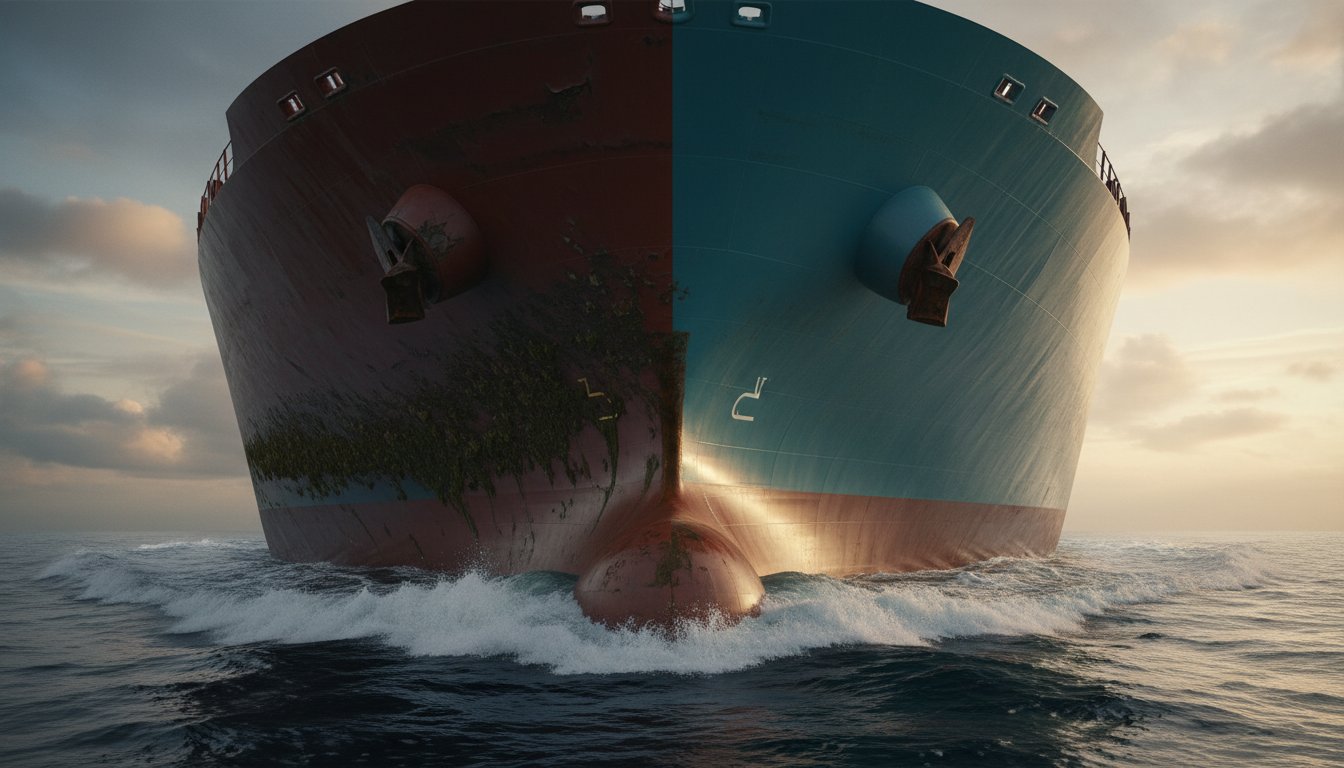
Treating your hull coating as a simple maintenance line item is no longer a viable business strategy; it’s a financial liability. You likely recognize that while “cheapest is best” was once the procurement standard, the 2026 IMO carbon intensity reduction goals and the expansion of the EU Emissions Trading System have fundamentally changed the math for fleet operations. You know a shift is necessary, but you’re likely facing the challenge of how to convince boss to invest in hull coating when the initial cost of premium siloxane technology exceeds that of traditional biocidal paints.
We understand that moving past a short-term budget mentality requires more than just environmental passion; it requires hard data and a structured ROI model. This guide provides a data-driven framework to help you build a compelling business case for premium foul release technology that secures executive buy-in. We’ll examine the financial impact of a 12% reduction in fuel consumption, detail how to navigate the January 2026 EPA copper-based paint bans, and demonstrate the long-term value of transitioning to a ten-year asset protection strategy with Sea-Speed V 10 X Ultra.
Key Takeaways
- Learn to quantify the “sacrificial cycle” of traditional paints, where degradation and surface roughness can create a 10% drag penalty over time.
- Discover a structured framework on how to convince boss to invest in hull coating by pivoting the executive pitch from initial CAPEX to decade-long OPEX optimization.
- Understand how to leverage EEXI and CII regulatory requirements to frame advanced foul release technology as a critical tool for decarbonization and asset value preservation.
- Evaluate the strategic benefit of a 120-month service life and hard-film durability, which eliminates the frequent dry-docking requirements of standard ablative coatings.
- Incorporate the operational advantages of biocide-free, zero VOC chemistry to ensure compliance with tightening global environmental standards and port regulations.
The Hidden Costs of Traditional Antifouling: Why Business as Usual is Failing
The traditional approach to hull maintenance often relies on a “maintenance commodity” mindset, but this perspective ignores the compounding financial drain inherent in ablative systems. If you’re looking for how to convince boss to invest in hull coating, you must first expose the hidden inefficiency of the sacrificial cycle. Traditional coatings function by eroding over time to release biocides; a process that inherently increases surface roughness and hydrodynamic resistance. This design flaw means your vessel’s performance is at its peak only on the day it leaves the dry dock, beginning a steady decline in efficiency immediately thereafter.
The science of antifouling paints reveals that these systems are essentially designed to deplete. As the active layers leach away, the hull surface becomes uneven, leading to increased turbulence and drag. This isn’t just a cosmetic issue. It’s a direct hit to your vessel’s operational efficiency. For a fleet manager, the “cheapest” paint often becomes the most expensive line item when you factor in the fuel required to overcome the resulting frictional resistance.
The Hydrodynamic Drag Penalty
Surface roughness isn’t static. As paint flakes, erodes, or suffers from mechanical damage, the microscopic peaks and valleys on the hull increase engine load. Research indicates that even a light layer of slime can increase fuel consumption by up to 10%. This drag penalty forces engines to work harder to maintain speed, accelerating wear on critical components. Soft silicone coatings often exacerbate this by failing to prevent micro-fouling in low-activity periods, creating a “slime paradox” where the coating itself becomes a substrate for drag-inducing organisms that are difficult to remove without damaging the film.
Regulatory and Environmental Risk
The maritime industry is facing a regulatory sea change that makes traditional biocides a liability. Effective January 1, 2026, the U.S. EPA will prohibit the application of copper-based paints with leach rates exceeding 9.5 micrograms on recreational vessels, and commercial restrictions continue to tighten globally. Simultaneously, the IMO’s 2026 carbon intensity goals and the expansion of the EU Emissions Trading System (ETS) place a direct price on carbon. Relying on high-VOC, biocide-heavy coatings is no longer just an environmental concern. It’s a significant operational risk that could lead to port entry denials or increased carbon taxes.
Beyond the fuel and fines, the “maintenance trap” of traditional antifouling disrupts your revenue-earning days. Frequent dry-docking for repainting every 24 to 36 months is a legacy of inferior chemistry. Transitioning to a hard-film solution like Sea-Speed V 10 X Ultra allows for extended service intervals, effectively turning maintenance downtime into operational uptime. This shift is a central pillar in how to convince boss to invest in hull coating by proving that premium protection pays for itself through increased asset availability and a reduced total cost of ownership.
The Science of ROI: Linking Hull Performance to Decarbonization
Modern maritime finance is increasingly dictated by carbon efficiency, making the hull surface a primary lever for operational profit. Part of the strategy for how to convince boss to invest in hull coating is shifting the focus from simple maintenance to asset value preservation. When a vessel’s performance is optimized, it doesn’t just save fuel; it secures a competitive advantage in a market where charterers prioritize low-emission fleets. This transition requires moving beyond the “paint” mindset and embracing advanced hydrodynamic solutions as a core component of the ship’s mechanical systems.
The Energy Efficiency Existing Ship Index (EEXI) and the Carbon Intensity Indicator (CII) have transformed technical performance into a regulated financial metric. A vessel with a poor CII rating faces mandatory corrective actions, which can include power limitations or expensive retrofits that diminish the asset’s marketability. By investing in superior surface technology, operators can maintain higher speeds without crossing emission thresholds, effectively protecting the vessel’s earning potential over its entire lifecycle.
Optimizing the Carbon Intensity Indicator (CII)
Hydrodynamics play a decisive role in determining a vessel’s annual CII grade. Traditional coatings often suffer from increased surface roughness as they age, which forces the propulsion system to consume more energy to maintain the same speed through water. Proprietary Silane-Siloxane technology creates an exceptionally smooth surface that reduces frictional resistance by up to 6%. This reduction in drag allows for a more favorable ratio of fuel consumed to cargo carried, ensuring the vessel stays within the “A” or “B” rating categories for longer periods. Sustaining these high ratings is essential for securing long-term contracts with environmentally conscious cargo owners.
Fuel Savings as a Direct Profit Center
Quantifying the eco-efficiency benefits of marine coatings allows technical managers to present fuel savings as a predictable revenue stream. Consider a hypothetical fleet consuming 50,000 metric tons of fuel annually. A conservative 5% reduction in drag, achieved through the application of premium marine coatings, results in 2,500 tons of fuel saved. At current bunker prices, this represents millions of dollars in annual OPEX reduction. This data-driven approach is essential when determining how to convince boss to invest in hull coating, as it highlights how the technology acts as a strategic hedge against volatile fuel markets.
Pressure from global cargo owners for net-zero supply chains means that shipping lines can no longer afford “standard” performance. High-performance coatings are now a fundamental operational requirement rather than a luxury. For those looking to optimize their fleet’s environmental footprint while maximizing bottom-line returns, exploring high-performance siloxane systems provides a clear path toward regulatory compliance and sustained profitability.
Foul Release vs. Antifouling: The 10-Year Asset Strategy
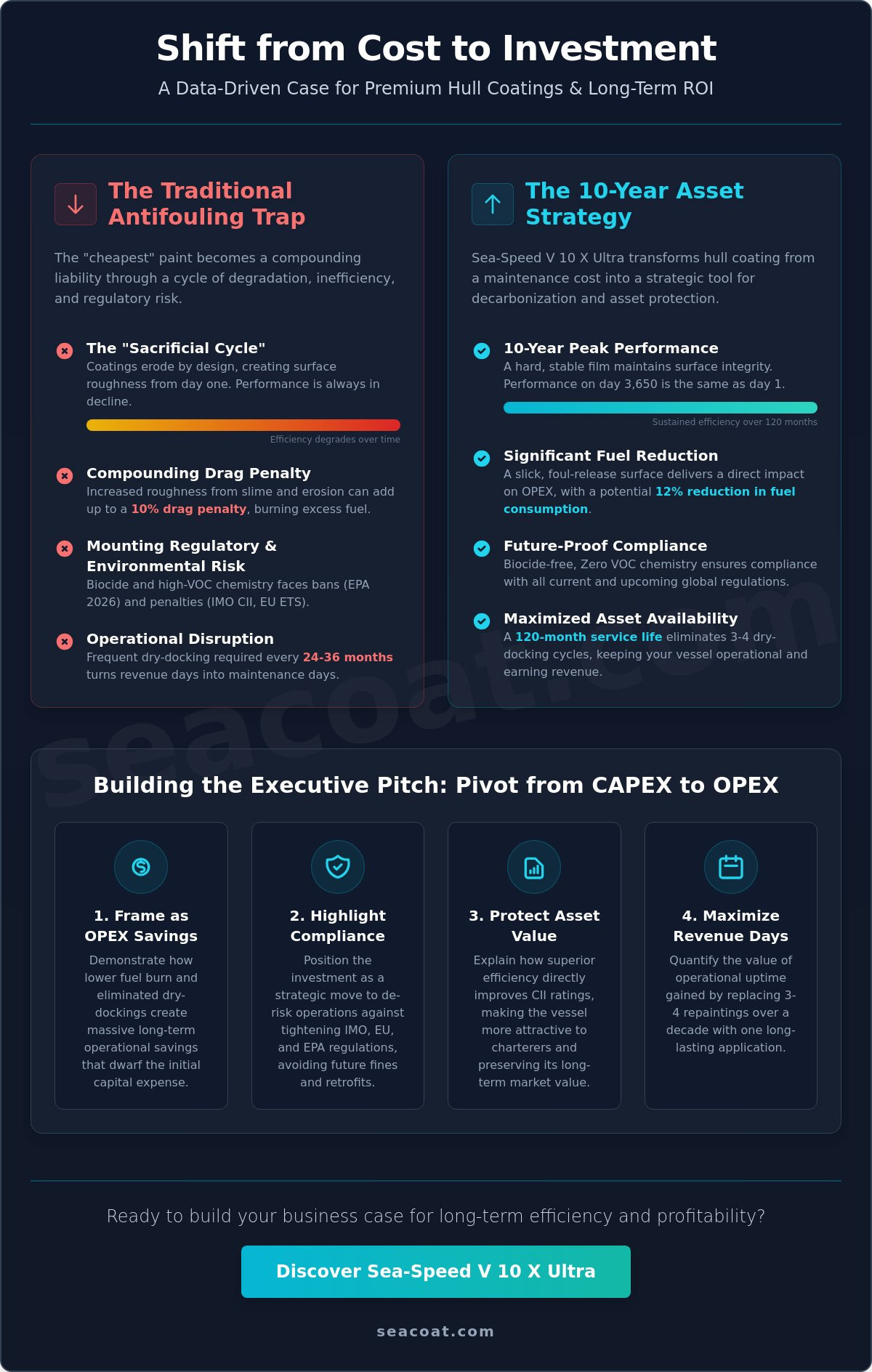
Procurement decisions often falter by focusing on the immediate invoice rather than the decade-long balance sheet. If you’re struggling with how to convince boss to invest in hull coating, you must present the 10-year asset strategy. Traditional ablative paints operate on a 24-month lifecycle, necessitating frequent, costly reapplications. Sea-Speed V 10 X Ultra provides a 120-month service life, effectively decoupling hull performance from the biennial dry-docking schedule. This shift moves the coating from a recurring maintenance expense to a long-term strategic investment in the vessel’s operational availability.
The chemical composition of Silane-Siloxane technology provides a “Hard Film” that resists the mechanical stresses of maritime operations. Traditional paints are designed to erode, which means they’re structurally weak and prone to premature failure. Sea-Speed systems create a permanent, non-leaching barrier that remains effective for the duration of the 10-year cycle. This surface is so smooth that biofouling detaches under the shear force of the vessel’s movement, typically at speeds as low as 8 to 10 knots. This “Easy-Clean” property is complemented by a zero-VOC profile; a stark contrast to the high-solvent content of conventional antifouling. Choosing a non-toxic, long-life coating isn’t just an environmental gesture. It’s a commitment to reducing the chemical burden on global ports while maintaining a pristine hull.
Breaking the Dry-Dock Cycle
A standard vessel might undergo four to five full repainting cycles over a ten-year period. Each event involves intensive surface preparation, material costs, and days of lost revenue. By utilizing a 120-month coating, you skip multiple repainting events entirely. The labor savings alone are substantial, as the ship only requires a light wash rather than a full blast and recoat during intermediate surveys. You can find more specific data on these longevity benchmarks in this definitive guide to boat hull paint. Reducing the frequency of these high-intensity maintenance windows directly increases the vessel’s annual earning potential and simplifies the long-term docking budget.
Hard Film Durability vs. Soft Silicone
Many stakeholders confuse foul release technology with soft silicone coatings. This is a critical distinction. Soft silicones are easily torn by ice, debris, or even standard in-water cleaning brushes, leading to expensive localized repairs. Silane-Siloxane is a rugged, high-adhesion alternative designed for commercial and military environments. Its thickness and chemical bond strength ensure it remains intact under extreme conditions. This durability prevents the “patchwork” hull often seen with softer alternatives, maintaining a consistent hydrodynamic profile year after year. When you discuss how to convince boss to invest in hull coating, emphasize that a hard film protects the underlying substrate better than any soft, sacrificial alternative.
Building the Executive Pitch: 4 Pillars of Persuasion
Securing approval for a premium coating requires moving beyond technical specifications and into the language of corporate strategy. Executives often view hull maintenance as an unavoidable commodity cost; your task is to reframe it as a high-yield investment. When researching how to convince boss to invest in hull coating, you must build your case on four foundational pillars. These pillars transform a simple maintenance request into a strategic asset management plan that aligns with the organization’s broader financial and environmental objectives.
- Technical Validation: Present third-party hydrodynamic data and independent test results to prove performance claims. Relying on verified metrics removes the “marketing fluff” and establishes scientific credibility.
- Financial Modeling: Shift the conversation from CAPEX to OPEX. Demonstrate how the initial investment is offset by sustained fuel savings and reduced maintenance frequency over a ten-year period.
- Risk Mitigation: Address the looming threat of environmental non-compliance. Highlight how transitioning to non-toxic systems prevents future fines and ensures access to restricted ports.
- Competitive Advantage: Focus on marketability. A vessel with a superior CII rating and lower fuel consumption is more attractive to charterers who are under pressure to decarbonize their own supply chains.
Step 1: The Data-Driven Fuel Audit
The most effective way to start the conversation on how to convince boss to invest in hull coating is with a transparent fuel audit. Begin by gathering baseline data on current fuel burn across your fleet. Use conservative projections of 4% to 6% efficiency gains to show the potential impact on the bottom line. For boards focused on ESG (Environmental, Social, and Governance) reporting, use environmental marine coatings to illustrate how technical upgrades directly support the company’s sustainability targets. This data proves that the coating is a performance-enhancing tool rather than a mere protective layer.
Step 2: Addressing the “Sticker Shock”
Premium coatings carry a higher initial price point, but this cost must be amortized over the product’s actual service life. Explain that spreading the cost over 10 years instead of the standard 2-year cycle reveals a much lower annual cost of ownership. Factor in the total elimination of multiple dry-docking events, full-hull blasting, and repainting labor. Additionally, emphasize that a hard-film siloxane coating protects the steel substrate from corrosion and mechanical damage better than sacrificial paints. This preserves the vessel’s structural integrity and increases its eventual resale value. To begin building your specific fleet ROI model, consult our technical team for performance data.
The Sea-Speed Solution: Why V 10 X Ultra is the Strategic Choice
Sea-Speed V 10 X Ultra represents the pinnacle of silane-siloxane innovation. It isn’t just a layer of protection; it’s a strategic asset for vessel management. When finalizing your plan on how to convince boss to invest in hull coating, emphasize that this proprietary chemistry from Seacoat SCT, LLC is the only solution that combines hard-film durability with a biocide-free, zero-VOC profile. This ensures your fleet remains compliant with tightening global regulations while simultaneously reducing the hydrodynamic drag that erodes profit margins. By choosing a non-toxic system, you eliminate the risk of future liability associated with leaching heavy metals and toxic chemicals.
The versatility of this technology allows for a unified coating strategy across diverse assets. Whether you’re managing a fleet of deep-sea tankers or specialized aluminum boats, the adhesion and performance characteristics remain consistent. For executive leadership, the ten-year performance guarantee serves as the ultimate de-risker. It provides the financial certainty required to move away from short-term fixes toward a decade of predictable, high-performance operation. This guarantee effectively shifts the burden of performance from the operator back to the technology itself.
Engineered for the Modern Fleet
Vessels today navigate increasingly complex environments. Sea-Speed V 10 X Ultra is engineered to maintain its integrity across varied salinity levels and extreme temperature profiles. Unlike the “self-polishing” myth that relies on the constant erosion of toxic material, Seacoat SCT, LLC provides a permanent slickness. This technology, pioneered under the leadership of CEO Dr. John Bowlin, carries a 20-year track record of proven success in the most demanding maritime sectors. It’s a mature, reliable solution that eliminates the performance decay associated with traditional antifouling systems. The surface remains glass-smooth for the life of the coating, ensuring that laminar flow is optimized from year one through year ten.
Taking the Next Step
The transition to premium foul release technology is a data-driven decision. We encourage you to reach out for a custom ROI calculation that reflects your fleet’s specific operational profile and fuel burn. When you are ready to present your case, ensure your formal procurement request includes technical specs such as zero VOC content, biocide-free certification, and a documented ten-year service life. These details reinforce the strategic nature of the investment and demonstrate how to convince boss to invest in hull coating by focusing on long-term asset value. To begin this process and secure the technical data you need for your pitch, Request a Technical Consultation for Your Fleet.
Securing Long-Term Operational Excellence
Mastering how to convince boss to invest in hull coating requires shifting the corporate narrative from a routine maintenance expense to a strategic performance upgrade. By highlighting the 120-month service life of Sea-Speed V 10 X Ultra and the resulting reduction in dry-docking intervals, you present a case built on fiscal responsibility. This transition isn’t just about physical protection; it’s about optimizing vessel hydrodynamics to meet the stringent CII and EEXI decarbonization targets that now define the maritime industry.
Since 2001, our proprietary Silane-Siloxane hard film technology has provided a biocide-free, zero VOC solution that outlasts traditional systems. This 20-year track record offers the technical validation necessary to satisfy even the most risk-averse executive boards. You’re not just proposing a new paint; you’re offering a permanent solution for fleet-wide efficiency and environmental stewardship. It’s time to move beyond temporary fixes toward a decade of reliable performance.
Download the Fleet Manager’s Guide to Hull Coating ROI and start transforming your vessel’s performance profile today. The path toward a more efficient, compliant fleet is within reach.
Frequently Asked Questions
How much fuel can advanced hull coatings actually save?
Sea-Speed V 10 X Ultra can reduce fuel consumption by up to 12% by minimizing hydrodynamic drag. This efficiency gain is achieved through a glass-smooth surface that optimizes laminar flow and reduces the engine load required to maintain speed. Unlike traditional paints that degrade over time, this performance remains consistent over the coating’s entire life cycle.
Are non-toxic coatings as effective as traditional antifouling paint?
Non-toxic foul release coatings are often more effective than traditional paints because they address the root cause of drag: surface roughness. While biocidal paints rely on chemical leaching to kill organisms, silane-siloxane technology creates a low-energy surface that prevents attachment. This results in a cleaner hull and better speed-through-water metrics without the environmental liability of toxic leachates.
What is the typical ROI period for a premium foul release coating?
The typical ROI period for a premium system is often between 12 and 24 months, depending on fuel prices and vessel activity. When determining how to convince boss to invest in hull coating, emphasize that the initial cost is offset by the elimination of multiple repainting cycles. The long-term savings in fuel and dry-docking labor far outweigh the initial investment.
How do these coatings help with EEXI and CII compliance?
These coatings are critical tools for improving a vessel’s Carbon Intensity Indicator (CII) rating. By reducing frictional resistance, the ship can maintain operational speeds with lower fuel consumption, which directly lowers carbon emissions per nautical mile. This helps keep vessels in the A or B rating categories, preserving asset value and ensuring regulatory compliance under the latest IMO standards.
Can foul release coatings be applied to aluminum or composite hulls?
Yes, Sea-Speed V 10 X Ultra is highly effective on aluminum and composite hulls. Because it is biocide-free and non-metallic, it doesn’t contain copper or other conductive materials that trigger galvanic corrosion on aluminum surfaces. This makes it a superior choice for high-speed ferries and patrol boats where structural integrity is a primary concern.
What happens if a hard-film coating is damaged during operation?
Hard-film coatings like Sea-Speed are exceptionally durable and resistant to mechanical impact. If localized damage occurs from ice or debris, the coating doesn’t “unzip” or peel like soft silicone alternatives. The affected area can be cleaned and touched up during the next scheduled maintenance window without requiring a full hull recoat, maintaining the overall hydrodynamic profile.
Do I need special equipment for in-water cleaning of these coatings?
Standard in-water cleaning equipment is sufficient for maintaining a foul release surface. Because biofouling can’t firmly bond to the silane-siloxane film, it can be removed with soft brushes or low-pressure water jets. This process is faster and less abrasive than the heavy scraping required for traditional antifouling paints, which protects the coating’s surface roughness profile over time.
How does the 10-year life cycle affect my dry-docking schedule?
A 10-year life cycle significantly streamlines your dry-docking schedule. Instead of a full blast and repainting every 24 to 36 months, you only need to perform light cleaning and minor touch-ups. This reduces the number of days the vessel is out of service and eliminates the recurring costs of heavy surface preparation and material application for a decade.