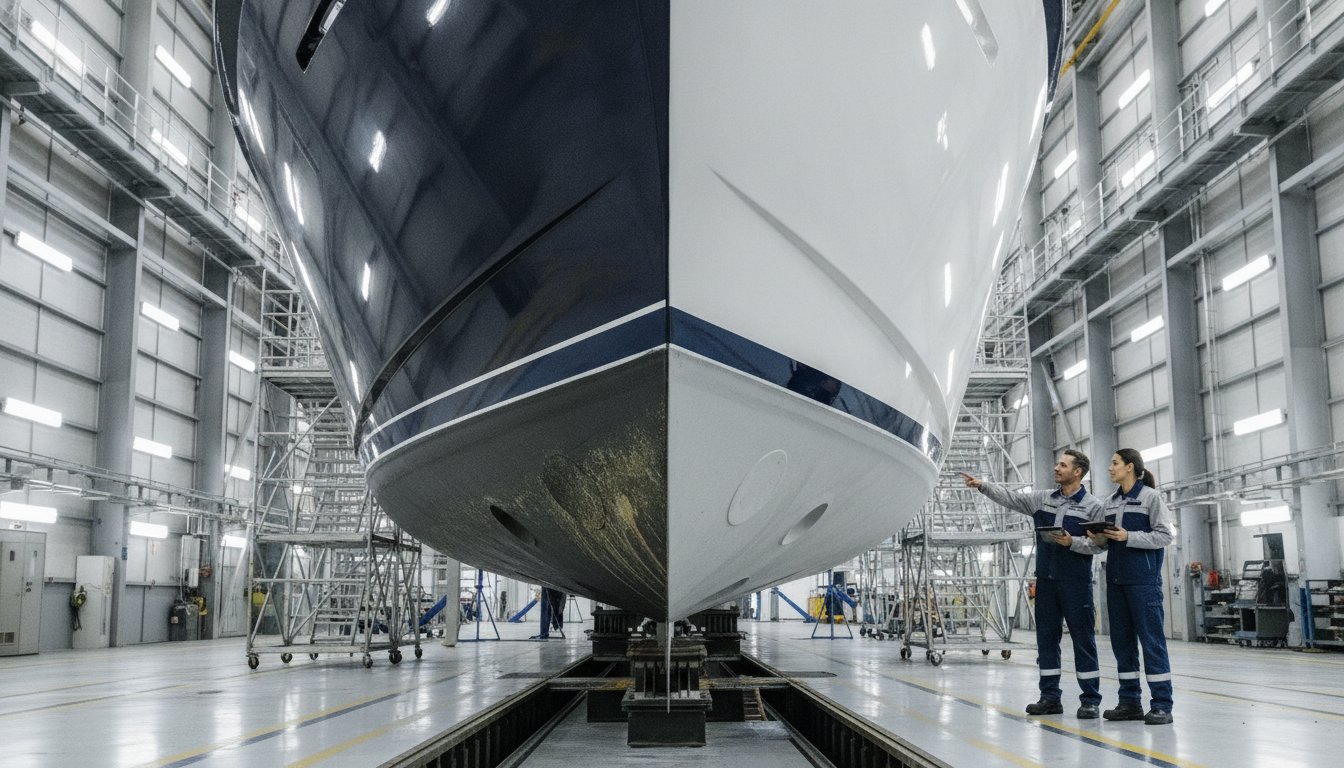
What if the annual haul-out was no longer a mandatory ritual of vessel ownership? For decades, the maritime industry accepted the sacrificial nature of ablative coatings as an unavoidable operational burden. However, as 2026 arrives, new EPA mandates limiting copper leach rates to 9.5 micrograms are forcing a critical re-evaluation of hull maintenance strategies. You are likely asking how often to bottom paint a boat to mitigate the 30% increase in fuel consumption caused by heavy biofouling; yet, the answer no longer requires the repetitive application of toxic biocides every season.
We recognize the high recurring costs of dry-docking and the growing demand for coatings that do not compromise natural ecosystems. This maintenance guide explores the technical factors that dictate your service schedule and how advanced silane-siloxane technology is extending the traditional painting cycle. You will discover how to align with modern environmental regulations while utilizing foul-release systems to improve fuel efficiency and secure a ten-year service window for your vessel.
Key Takeaways
- Understand why the 12 to 24 month maintenance benchmark is evolving in response to 2026 EPA mandates on copper leach rates.
- Identify how regional biofouling pressure and operational frequency determine how often to bottom paint a boat to prevent frictional drag.
- Differentiate between the sacrificial mechanics of ablative paints and the permanent surface profile of advanced hard-film foul release technology.
- Discover how non-abrasive in-water cleaning maintains hull efficiency without the environmental contamination caused by traditional biocidal leaching.
- Evaluate the long-term ROI of transitioning to engineered systems like Sea-Speed V 10 X Ultra to achieve a 10-year service life.
Understanding the Traditional Bottom Painting Cycle
Bottom paint serves as a biocidal or physical barrier specifically engineered to prevent marine organisms from colonizing a vessel’s hull. For decades, the maritime industry has relied on a maintenance cycle that dictates how often to bottom paint a boat, typically recommending a full reapplication every 12 to 24 months. This frequency is largely a byproduct of the chemical limitations inherent in conventional coatings. To gain a comprehensive perspective on the historical development and chemical evolution of these materials, Understanding the Traditional Bottom Painting Cycle provides foundational knowledge on how these industry standards were established.
Ablative paints operate on a sacrificial mechanism. These coatings consist of a resin matrix that slowly dissolves as the vessel moves through the water, constantly exposing fresh layers of biocide. While this “self-polishing” action prevents the accumulation of dead organisms, it also means the protective barrier literally disappears over time. Once the active layers have eroded, the hull is left vulnerable to colonization. The cycle repeats. This is a temporary fix, not a permanent solution.
The annual cycle introduces significant hidden costs that extend beyond the price of the paint itself. Haul-out fees and specialized labor represent a recurring financial drain, but the environmental toll is often more severe. As ablative paints wear away, they release heavy metals like copper directly into the water column. During the cleaning and reapplication process, toxic runoff and micro-flakes often enter the local ecosystem. This contributes to sediment contamination in marinas and sensitive coastal areas, a factor that is driving more stringent 2026 EPA mandates on copper leach rates.
Why Traditional Paints Require Frequent Reapplication
Most traditional coatings rely on high concentrations of cuprous oxide to prevent barnacle attachment. These biocides have a finite lifespan. Self-polishing copolymers are chemically programmed to erode at a specific rate to maintain effectiveness. If a boat is hauled out and left in the sun for an extended period, the paint can oxidize. This process hardens the surface and traps the biocides inside. It renders the coating ineffective when the vessel returns to the water.
Signs Your Boat Needs New Bottom Paint
Determining how often to bottom paint a boat also depends on visual and performance-based indicators. If you notice visible thinning or patchy areas where the primer is showing, the sacrificial layer is depleted. A measurable loss of top-end speed or a 10% to 15% increase in fuel consumption often suggests a layer of slime or bio-film has increased frictional drag. If hard growth like barnacles or mussels begins to anchor into the hull, the chemical barrier has failed. Mechanical cleaning at this stage will likely damage any remaining coating.
Key Factors That Determine Your Painting Frequency
The determination of how often to bottom paint a boat isn’t a static calculation. It’s a complex equation involving environmental variables and operational behavior. While the industry benchmark often suggests a two-year window, a vessel moored in the warm, nutrient-dense waters of the Gulf of Mexico faces significantly higher biofouling pressure than one in the colder North Atlantic. These regional differences dictate the rate at which biocides are depleted or surfaces are colonized. Understanding these variables is the first step toward moving away from reactive maintenance and toward a strategic asset management plan.
Storage methods also play a decisive role in the longevity of your hull protection. If you utilize dry-stacking or trailering, your hull is only immersed during active use. This drastically reduces the window for larval attachment and prevents the constant leaching of active ingredients. In contrast, permanent mooring in high-salinity environments requires a constant defense. Salinity levels in saltwater environments provide the necessary minerals and osmotic conditions for aggressive hard-fouling species, whereas freshwater environments typically see slower, more manageable growth rates.
The Impact of Water Temperature and Salinity
Temperature acts as a biological catalyst. In tropical regions, year-round warm water maintains high metabolic rates for organisms like barnacles and tubeworms, leading to rapid colonization. Boaters in New England or the Pacific Northwest may find their maintenance cycles extended by seasonal dormancy. Brackish water in estuaries presents a unique challenge; it often hosts resilient species that thrive in fluctuating salt levels. For owners operating in these high-pressure zones, switching to a high-performance foul release coating can provide the durability that traditional paints lack.
Operational Profile and Hull Friction
A vessel’s movement is its first line of defense. High-speed vessels generate significant shear forces across the hull surface. This can result in a “self-cleaning” effect where loosely attached slime is stripped away by fluid dynamics. Stationary vessels, however, allow a stable biofilm to develop. This initial layer of slime is the precursor to hard growth. Research indicates that even a thin layer of slime can increase fuel consumption by 10% to 15%, while heavy fouling can increase it by up to 30%. Managing this hydrodynamic drag through frequent use or advanced surface technology is essential for maintaining operational efficiency and reducing long-term fuel costs.
Ablative vs. Hard-Film Coatings: A Lifespan Comparison
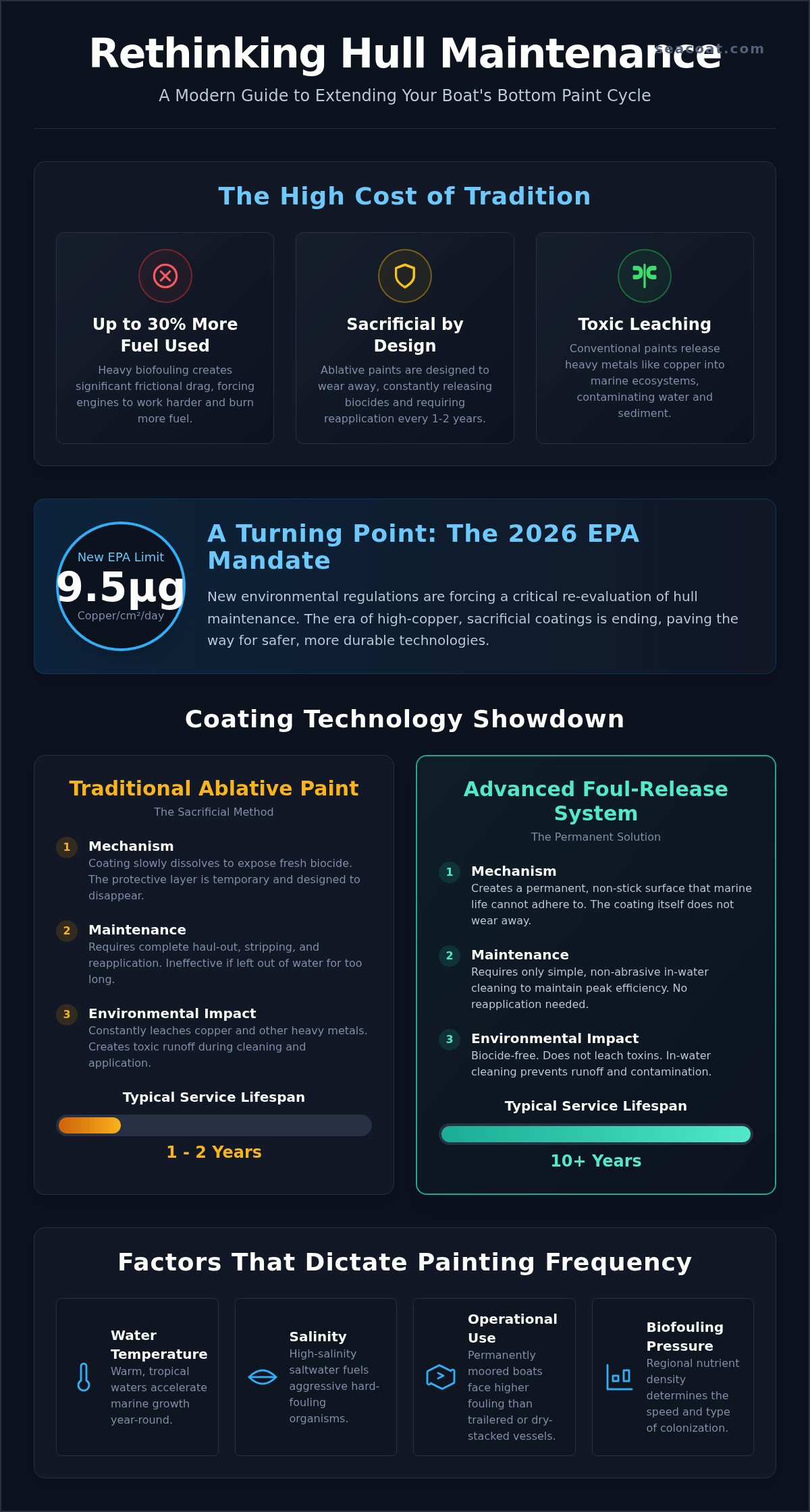
The decision regarding how often to bottom paint a boat is fundamentally a choice between a recurring maintenance liability and a long-term capital investment. Traditional ablative paints, while providing a lower initial entry cost, lock vessel owners into a sacrificial cycle that typically lasts only 12 to 24 months. These coatings rely on the constant erosion of the paint film to function, meaning the protection is designed to fail by design. For recreational and commercial operators alike, this necessitates frequent haul-outs, labor-intensive surface preparation, and the repetitive purchase of biocidal materials.
Standard hard antifouling paints offer a more durable surface profile, often favored by racing fleets for their ability to be burnished. However, their biocidal lifespan is still limited. Once the active ingredients leach out of the hard resin matrix, the coating remains on the hull but offers no protection against growth. In contrast, advanced foul release technology provides a 5 to 10 year service window. By shifting from a chemical-leaching model to a permanent physical barrier, these systems offer a significantly higher return on investment. The cost of a single application over a decade is vastly lower than the cumulative expense of ten annual ablative cycles.
The Science of Foul Release Systems
Foul release technology operates on a molecular level to create an ultra-low energy surface. While traditional antifouling focuses on killing marine life with toxins, silane-siloxane systems like Sea-Speed V 10 X Ultra focus on preventing attachment entirely. The coating creates a “non-stick” surface that organisms cannot mechanically bond to. Because these are hard-film systems, they do not wear away or “polish” off during transit. This allows for proactive in-water cleaning without any loss of coating thickness or environmental contamination. It’s a permanent asset rather than a temporary treatment.
Environmental and Regulatory Compliance
The maritime industry is currently navigating a significant transition toward sustainable hull performance. As global regulations tighten, including the 2026 EPA mandates on copper leach rates, the viability of traditional toxic paints is shrinking. Adopting biocide-free, long-lasting coatings is no longer just an ethical choice; it’s a requirement for meeting EEXI and carbon intensity targets. Reducing hull friction through superior surface smoothness directly correlates to lower emissions. For a deeper analysis of these regulatory trends, see our guide on Environmental Marine Coatings: The 2026 Shift Toward Sustainable Hull Performance.
How to Extend the Life of Your Hull Coating
Extending the interval between applications requires a shift from passive maintenance to active surface management. While environmental factors play a significant role in determining how often to bottom paint a boat, the longevity of any coating is ultimately governed by the integrity of its application and the methods used to maintain it. Proactive grooming prevents the transition from soft biofilm to calcified hard growth. By managing the hull surface before attachment becomes permanent, operators can preserve the hydrodynamic profile of the vessel and avoid the abrasive cleaning cycles that lead to premature coating failure.
Monitoring performance metrics is the most effective way to catch fouling before it becomes unmanageable. Small changes in shaft RPM or a slight decrease in top-end speed often indicate the early stages of colonization. When these signs are caught early, the surface can be restored through gentle cleaning rather than intensive mechanical scrubbing. This data-driven approach ensures that the protective barrier remains intact, maximizing the return on investment for high-performance systems.
Best Practices for In-Water Cleaning
Effective maintenance relies on using the least aggressive method possible to achieve the desired result. Soft brushes or microfiber cloths are typically sufficient to remove slime and light algae from hard-film surfaces. Unlike traditional materials that lose thickness during cleaning, engineered foul release systems are designed to withstand regular grooming without compromising the coating’s physical properties. To understand why this differs so significantly from conventional methods, read our analysis on Ablative Bottom Paint: Understanding the Sacrificial Cycle vs. Modern Alternatives. Using soft tools preserves the ultra-smooth finish that is critical for reducing frictional drag.
The Importance of Proper Application
The durability of a hull coating is fundamentally tied to the quality of the initial bond. Environmental controls during the application process, specifically temperature and humidity, must be strictly monitored to ensure proper chemical cross-linking. Achieving the correct Dry Film Thickness (DFT) is equally vital; a coating that is too thin will lack the necessary physical strength, while one that is too thick may experience internal stress. The foundation of this system is a high-quality primer. Utilizing a specialized epoxy like Seapoxy 73 provides the necessary adhesion to prevent delamination and osmotic blistering. This robust base layer ensures that the topcoat remains a permanent asset for years to come. For those looking to break the cycle of annual maintenance, you should explore our advanced coating specifications to ensure your next application is your last for a decade.
Beyond Annual Painting: The Advantage of Permanent Systems
Transitioning from traditional “paint” to an “engineered coating system” represents a fundamental paradigm shift in maritime asset management. No longer should owners ask how often to bottom paint a boat as a matter of annual routine. Instead, the focus moves toward the multi-year performance lifecycle of the hull surface. By utilizing advanced silane-siloxane technology, the traditional 12-month dry-docking requirement is replaced by a strategic 5 to 10-year service window. This evolution reduces operational downtime and lowers the total cost of ownership (TCO) for both commercial fleets and private vessels.
The historical reliance on sacrificial layers was a necessary response to the limitations of older material science. Modern stakeholders now favor permanent solutions that provide a strategic advantage beyond mere protection. Reducing the frequency of dry-docking preserves the mechanical integrity of the hull by eliminating the repetitive, aggressive abrasion associated with paint removal cycles. Ultimately, the decision rests on a comprehensive evaluation of your vessel’s mission and operational environment. Moving toward a permanent system allows for a customized management plan that prioritizes longevity and intelligence over temporary fixes.
Strategic Asset Management for Fleet Owners
Calculating the TCO over a 10-year period reveals the significant economic disparity between sacrificial and permanent systems. While the initial application of a premium foul release coating requires a precise technical investment, the absence of multiple haul-outs, labor charges, and material re-purchases creates a compelling ROI. Fuel efficiency gains remain a primary driver; because these coatings maintain a stable surface profile, they mitigate the drag typically caused by biofilm accumulation. For a deeper analysis of these technologies, consult The Definitive Guide to Antifouling Boat Paint and Foul Release Systems in 2026.
Why Sea-Speed V 10 X Ultra is the Modern Choice
Sea-Speed V 10 X Ultra combines extreme physical durability with an ultra-slick, low-friction finish that enhances hydrodynamic efficiency. Unlike soft silicone coatings that are prone to mechanical damage, this hard-film system provides a robust barrier that withstands heavy industrial use and frequent in-water cleaning. This performance is achieved without ecological compromise, as the coating is entirely non-toxic and contains no volatile environmental contaminants. It provides peace of mind for operators navigating strict global regulations while ensuring the preservation of natural ecosystems. Contact Seacoat SCT, LLC to optimize your vessel’s maintenance schedule today.
Advancing Toward a Permanent Hull Maintenance Strategy
The transition from sacrificial ablative paints to engineered foul release systems is a strategic necessity in the modern maritime sector. While environmental variables like temperature and salinity will always influence biofouling pressure, the fundamental question of how often to bottom paint a boat is now a choice between repetitive labor and long-term asset protection. By adopting a permanent surface profile, you eliminate the high recurring costs of annual dry-docking and ensure your vessel remains compliant with the tightening 2026 EPA mandates on toxic leaching.
Choosing a solution like Sea-Speed V 10 X Ultra provides a 100% biocide-free, non-toxic barrier that has been proven in commercial applications since 2001. This Silane-Siloxane technology delivers significant fuel savings through drag reduction, transforming your hull into a performance-enhancing tool rather than a maintenance liability. It’s time to move beyond temporary fixes and invest in the longevity of your vessel. Break the annual painting cycle with Sea-Speed V 10 X Ultra and secure the operational efficiency your fleet deserves.
Frequently Asked Questions
Is it necessary to bottom paint a boat every year?
Annual reapplication is generally only necessary if you are utilizing traditional ablative paints designed to wear away. These sacrificial coatings lose their biocidal effectiveness as the resin matrix erodes through use. If you transition to advanced foul release technology, you can extend the maintenance interval to five or even ten years, as these systems provide a permanent surface that doesn’t disappear over time.
How long does a typical bottom paint job last in saltwater?
Standard biocidal coatings typically maintain their integrity for 12 to 24 months in saltwater environments. The specific lifespan depends on the concentration of active ingredients and the local biofouling pressure. High-salinity and warm-water regions will deplete the protective chemical barrier faster than temperate zones, necessitating more frequent haul-outs to prevent hard growth attachment.
Can I wait two years between bottom paintings if I use my boat frequently?
Frequent vessel movement creates hydrodynamic shear that can help strip away soft slime, but it doesn’t stop the chemical depletion of traditional paints. When determining how often to bottom paint a boat that sees regular use, you might reach a two-year window with high-quality ablative products. However, waiting too long once the biocide is exhausted allows organisms to anchor into the hull, leading to increased drag.
What happens if I don’t bottom paint my boat for several years?
Neglecting hull protection leads to aggressive colonization by barnacles, mussels, and tubeworms, which can increase fuel consumption by up to 30%. Beyond the loss of efficiency, heavy fouling can cause physical damage to the gelcoat or metal substrates. Over several years, the absence of a protective barrier may also lead to osmotic blistering or severe corrosion in submerged components.
Does bottom paint expire or lose its effectiveness while sitting in the driveway?
Yes, many traditional biocidal paints “oxidize” when exposed to air for extended periods, which hardens the surface and prevents active ingredients from leaching. This means a boat sitting on a trailer may lose its antifouling properties even without being in the water. Modern hard-film systems don’t suffer from this expiration because they rely on surface energy rather than a chemical reaction to prevent growth.
How much does it cost to bottom paint a 30-foot boat in 2026?
The total expenditure for a 30-foot vessel is influenced by regional labor rates, haul-out fees, and the specific coating technology selected. While traditional biocidal paints have a lower initial material cost, they represent a recurring financial burden due to the frequent application cycles. Owners should evaluate the total cost of ownership over a ten-year period, where permanent systems often prove more economical by eliminating multiple dry-docking events.
Can I apply new bottom paint over the old layer?
New paint can be applied over existing layers only if the previous coating is compatible and remains well-adhered to the substrate. Ablative paints often allow for recoating after a thorough pressure wash, but hard-film coatings may require mechanical sanding to ensure proper mechanical bonding. If the old paint is thinning or flaking, applying new material over it often results in delamination and premature failure.
Are there any bottom paints that last for 5 years or more?
Yes, engineered foul release systems like Sea-Speed V 10 X Ultra are specifically designed to provide a service life of 10 years. By utilizing silane-siloxane technology, these coatings create a permanent, non-toxic barrier that doesn’t rely on sacrificial erosion. This allows vessel owners to break the annual cycle, significantly reducing the frequency of how often to bottom paint a boat while maintaining peak hydrodynamic efficiency.