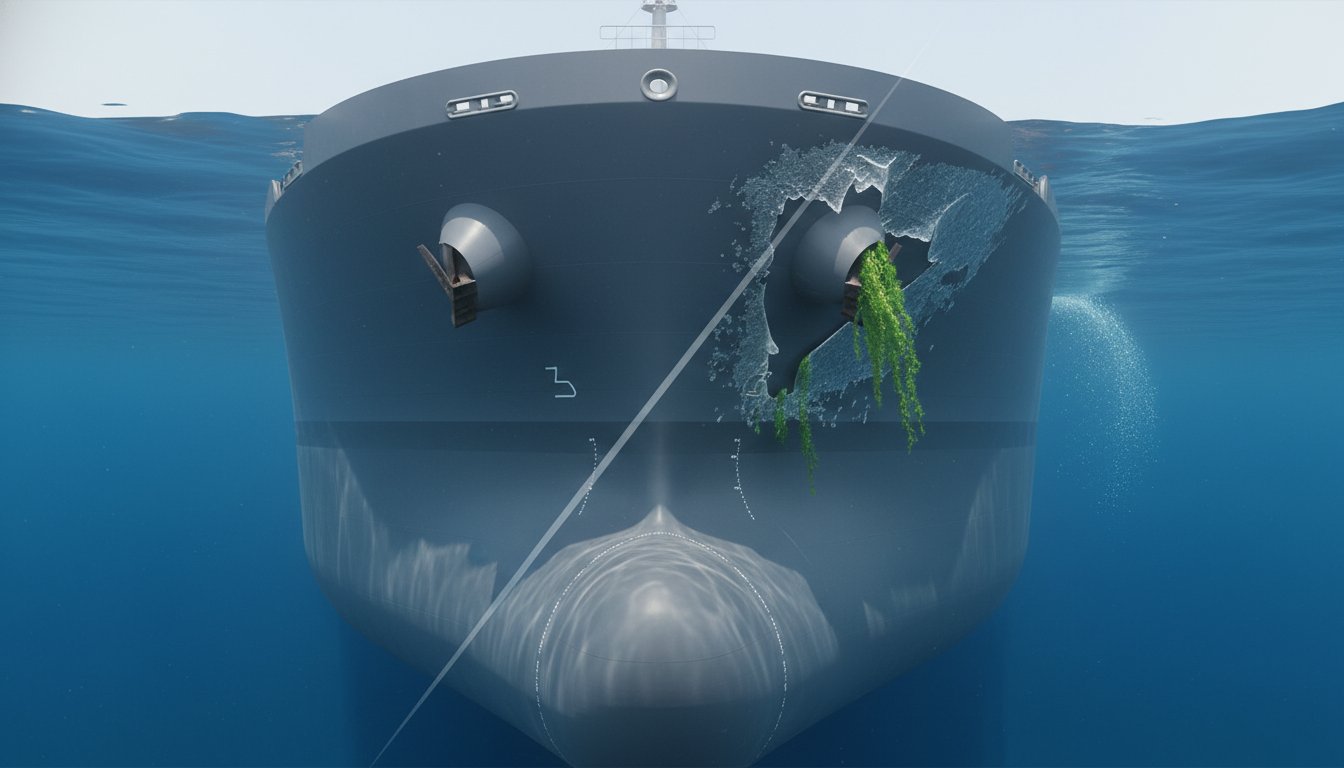
The very coating designed to protect your vessel’s efficiency might be the one increasing your long-term maintenance liabilities. While soft silicone systems are often praised for their low surface energy, their mechanical fragility frequently leads to tearing and peeling during routine operations or cleaning. When evaluating hard foul release vs soft silicone coating, the primary distinction lies in structural integrity. You need a solution that withstands high-speed transit and aggressive mechanical scrubbing without compromising its non-stick properties.
You likely recognize that moving away from traditional biocidal antifouling is a regulatory necessity under 2026 EPA and CARB VOC mandates, yet you shouldn’t have to sacrifice durability to achieve compliance. This guide explores the critical differences in durability, hydrodynamics, and return on investment between hard-film and soft silicone systems. We’ll examine how a transition to permanent, hard-film technology like Sea-Speed V 10 X Ultra can deliver a 10-year service life and measurable fuel savings of up to 12% compared to depleted traditional surfaces. By understanding the mechanical properties of silane-siloxane chemistry, you can optimize your fleet for both environmental stewardship and operational excellence.
Key Takeaways
- Analyze the molecular differences between elastomeric silicone and Silane-Siloxane technology to understand why soft coatings suffer from inherent mechanical fragility.
- Evaluate the performance of hard foul release vs soft silicone coating through the lens of ASTM abrasion resistance and the ability to withstand aggressive mechanical brushing.
- Learn the specific remediation protocols necessary to strip damaged silicone and successfully apply a permanent hard-film barrier like Sea-Speed V 10 X Ultra.
- Align your fleet management strategy with global EEXI and CII efficiency mandates by prioritizing surface smoothness and long-term hull integrity.
- Determine how non-toxic, hard-film systems reduce total cost of ownership by extending maintenance intervals and eliminating the release of micro-plastics.
The Foul Release Dilemma: Efficiency vs. Durability
The global maritime industry faces a persistent challenge in mitigating The Foul Release Dilemma; the accumulation of marine organisms on hull surfaces. Unlike traditional antifouling paints that rely on the continuous leaching of copper or other biocides to kill growth, foul release technology utilizes low surface energy to prevent permanent adhesion. This mechanical approach is more environmentally responsible, yet it has historically forced a compromise between hydrodynamic efficiency and physical durability. When comparing a hard foul release vs soft silicone coating, the choice often dictates whether a vessel remains efficient for a single season or an entire decade.
For decades, the industry viewed “slick” and “tough” as mutually exclusive properties. A surface slick enough to shed barnacles was typically too soft to survive a single encounter with a fender or a mechanical brush. This trade-off has become increasingly problematic as 2026 fuel efficiency standards and carbon intensity indicators (CII) place greater emphasis on hull performance. A coating that fails prematurely doesn’t just increase maintenance costs; it actively degrades the vessel’s hydrodynamic profile, leading to higher greenhouse gas emissions and wasted fuel.
The Evolution from Toxic Antifouling
The transition toward modern coatings accelerated following the International Maritime Organization’s 2008 ban on tributyltin (TBT). This regulatory shift forced a move toward biocide-free systems, and the industry first turned to soft silicone as a viable solution. These elastomeric films provided excellent non-stick properties, but their sacrificial nature created a new set of problems. Because these coatings are easily damaged, they often require frequent recoating cycles that negate their environmental benefits. Fleet managers are now recognizing that true sustainability requires a permanent solution rather than a series of temporary fixes. The debate of hard foul release vs soft silicone coating is ultimately a question of whether a coating can maintain its integrity under the mechanical rigors of heavy industry.
Why Surface Integrity Matters for ROI
Surface integrity is the primary driver of long-term return on investment. Scientific data indicates that even a 0.5mm biofilm layer can increase hydrodynamic drag by up to 20%. This resistance forces engines to consume more fuel to maintain speed, directly impacting the bottom line. While soft coatings might offer low surface energy initially, their susceptibility to abrasion leads to increased hull roughness over time. In contrast, hard-film systems like Sea-Speed V 10 X Ultra maintain a consistent, ultra-smooth profile that survives high-speed operations and mechanical cleaning. This durability ensures that the vessel’s speed and maneuverability remain optimized throughout the entire service window, providing a strategic asset for large-scale fleet management.
The Science of Surface: How Hard and Soft Coatings Differ
To accurately evaluate hard foul release vs soft silicone coating, one must examine the divergent chemical paths used to achieve low surface energy. Both systems aim to prevent the permanent adhesion of biofouling, yet they do so through entirely different mechanical frameworks. One relies on a flexible, “rubbery” surface that physically yields under pressure, while the other utilizes a rigid, permanent molecular bond to create a glass-like barrier. Understanding this distinction is vital for operators who prioritize long-term hull integrity over temporary fixes.
Soft Silicone: The Elastomeric Approach
Soft silicone coatings rely on a matrix of silicone polymers and unbonded silicone oils that migrate to the surface. This creates a “slip” layer that makes it difficult for marine organisms to secure a chemical or mechanical bond. However, this same elastomeric property makes the coating physically vulnerable. Because the material remains soft and flexible, it lacks the tensile strength to resist tearing. Contact with floating debris, dock fenders, or even the turbulence of high-speed transit can cause the coating to delaminate or peel away from the hull. Once the surface is compromised, the “slickness” is lost, and the exposed areas become magnets for fouling. The low surface energy of silicone makes localized repairs notoriously difficult, as new layers often fail to adhere to the existing contaminated surface.
Hard-Film Silane-Siloxane: The Structural Approach
In contrast, hard-film technology utilizes a Silane-Siloxane chemistry that creates a rigid, cross-linked molecular structure. This system bonds chemically to the primer, forming a high-density barrier that is essentially part of the hull’s surface. Silane-Siloxane is a biocide-free, permanent film with 10-year longevity that maintains ultra-low friction through surface energy rather than physical softness. This structural approach allows the coating to achieve a smooth finish comparable to glass, debunking the myth that “hard” coatings must be “rough.” While soft systems rely on a sacrificial or fragile surface, hard-film technology provides a durable, non-leaching alternative that withstands the mechanical stresses of maritime operations. For operators seeking a strategic asset to manage these trade-offs, exploring the technical specifications of Sea-Speed V 10 X Ultra provides a clear path toward long-term hull efficiency.
The optimal coating must balance surface energy with mechanical strength. Surface energy, measured in millinewtons per meter, determines how “sticky” a surface is. Soft silicones achieve low surface energy but fail the strength test. Modern Silane-Siloxane coatings achieve a surface energy of approximately 20 mN/m while maintaining the hardness of a high-end epoxy. This means they’re slick enough to shed organisms at speeds as low as 8-10 knots, yet tough enough to resist the abrasion of ice, sand, or mechanical cleaning tools. This balance allows a vessel to maintain its hydrodynamic profile without the frequent need for hauling and recoating, ensuring that performance gains are not lost to surface degradation.
Performance Benchmarks: Hard Foul Release vs. Soft Silicone
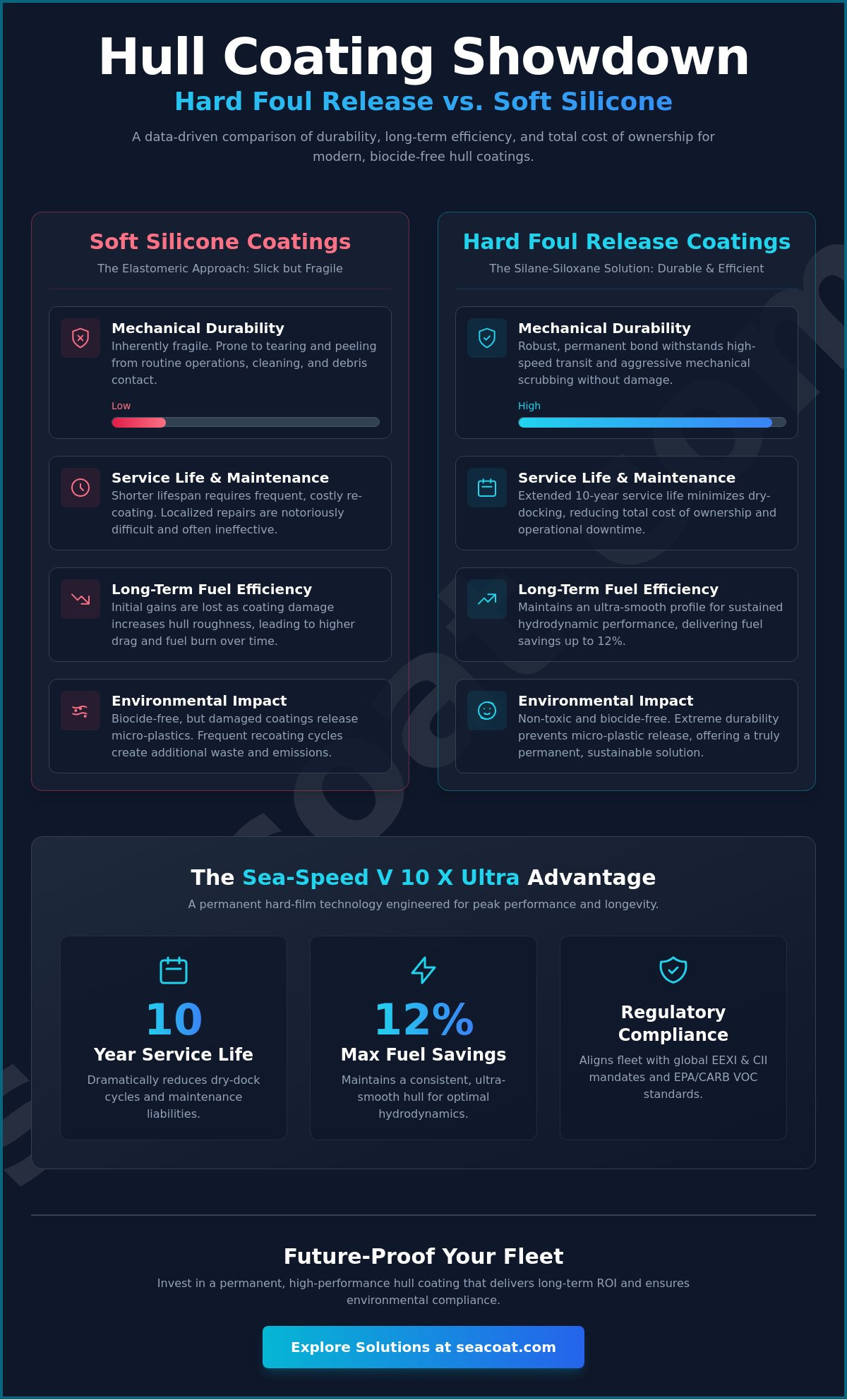
Quantifying the operational differences between hard foul release vs soft silicone coating requires a shift from laboratory surface energy metrics to real-world mechanical performance. While both technologies aim for a clean hull, their service life expectancies and resilience under stress are vastly different. Soft silicone systems typically offer a functional window of 2 to 3 years before physical degradation necessitates a full haul-out. In contrast, hard-film systems like Sea-Speed V 10 X Ultra are engineered for a service life exceeding 10 years. This longevity is rooted in the coating’s ability to maintain its hydrodynamic profile without the sacrificial loss of material common in elastomeric or biocidal systems.
One of the most misunderstood performance benchmarks is the “self-cleaning” speed. Many traditional soft silicone coatings require a vessel to consistently reach speeds of 20 knots or higher to generate enough hydrodynamic shear to shed marine growth. This makes them unsuitable for slow-steaming operations or vessels with high idle times. Modern hard-film siloxane technology has been shown in maritime trials to maintain a 95% clean hull surface during active operation, often shedding organisms at speeds as low as 8 to 10 knots. When growth does occur during static periods, the mechanical strength of the hard film allows for easy removal without the risk of coating failure.
Abrasion and Impact Resistance
Working harbors present a high-risk environment for hull coatings due to suspended debris, ice, and frequent fender contact. Soft silicone coatings fail the durability test in these scenarios because they lack the tensile strength to resist tearing. Once a silicone film is punctured, the damage propagates quickly, leading to large-scale peeling and delamination. Hard-film coatings provide superior abrasion resistance, meeting rigorous ASTM standards for impact and friction. This makes them the only logical choice for ice-class vessels and aluminum hulls, where physical protection is as critical as foul release. The hard surface remains intact even after heavy contact, preventing the corrosion that follows when a protective barrier is breached.
Maintenance and In-Water Cleaning
The ability to perform aggressive in-water cleaning is a primary differentiator for fleet managers. Maintenance of soft coatings is a delicate and expensive process; it requires specialized, gentle equipment to avoid destroying the fragile elastomeric layer. Hard-film systems simplify this requirement by allowing for the use of standard mechanical brushes and automated hull cleaning robots.
- Cleaning Resilience: Hard films can withstand repeated mechanical scrubbing cycles without thinning or losing non-stick properties.
- Calcareous Growth: Removing hard growth like barnacles from silicone often results in “plucking,” where the organism takes a piece of the coating with it. On a hard-film surface, these organisms are easily scraped away without affecting the underlying barrier.
- Intervals: Because the surface remains ultra-smooth (around 20 millinewtons per meter), cleaning intervals are extended, and the effort required for each session is significantly reduced.
This mechanical durability ensures that the 6% to 12% fuel efficiency gains provided by a clean hull are maintained over the entire 10-year lifecycle of the coating.
Transitioning Your Hull: How to Switch from Soft to Hard Systems
Transitioning a vessel from a failing elastomeric system to a permanent hard film requires a methodical approach to surface chemistry. The fundamental distinction between hard foul release vs soft silicone coating dictates that these two technologies cannot coexist on the same surface. Silicone is engineered to repel all substances. This inherent non-stick property makes it a major contaminant for any subsequent coating. If your current system shows signs of tearing, delamination, or persistent biofouling, you must strip the hull to the substrate or a stable, non-silicone primer to ensure the integrity of the new application.
Over-coating a soft silicone surface is a guaranteed failure mode. Even trace amounts of silicone oil can migrate through new layers, causing “fish-eyes” or total delamination. For fleet managers, the transition period is a strategic window to reset the maintenance clock. By removing the mechanical liabilities of soft coatings, you move toward a 10-year performance cycle that prioritizes structural durability and hydrodynamic efficiency.
Stripping Old Coatings Safely
Removing soft silicone or legacy biocidal layers requires precise chemical management to protect both the hull and the environment. Modern soy-based or water-borne stripping agents effectively lift old coatings without the high volatile organic compound (VOC) emissions associated with traditional solvents. Containment strategies are essential during this phase; specialized filtration and collection systems must prevent any residue from entering the marine ecosystem. Eco-friendly stripping is now a regulatory requirement in many 2026 jurisdictions. This shift ensures that the maintenance process aligns with global sustainability standards while preparing the surface for a superior, non-leaching alternative.
The Application Process for Hard-Film Systems
Once the hull is stripped and neutralized, the focus shifts to creating a robust molecular bond. The application of Seapoxy 73 is critical for Silane-Siloxane bonding. This specialized epoxy primer acts as a bridge between the substrate and the topcoat, providing the necessary surface profile for the hard film to anchor. Ambient condition controls are vital during this stage. Technicians must strictly monitor temperature and humidity to ensure a perfect chemical cure. Proper inspection protocols verify that the coating reaches its full density, securing the mechanical strength required for high-speed operations. This disciplined application process is the foundation of a 10-year service life, transforming the hull into a high-performance asset that resists the rigors of the maritime environment.
Future-Proofing Your Fleet with Sea-Speed V 10 X
Vessel operators are no longer just managing maintenance; they’re managing compliance. With the International Maritime Organization’s EEXI and CII requirements now in full effect, hull efficiency is a critical metric for operational viability. Choosing hard foul release vs soft silicone coating is a decision that directly impacts a vessel’s carbon rating. While soft systems degrade and increase drag over time, Sea-Speed V 10 X Ultra provides a permanent, ultra-smooth surface that remains consistent for over a decade. This stability is essential for maintaining the high efficiency scores required for modern maritime trade.
Calculating the 10-year ROI reveals the clear economic advantage of hard-film technology. Traditional soft systems require multiple haul-outs, frequent recoating, and specialized cleaning protocols that drive up the total cost of ownership. By contrast, a single application of Sea-Speed V 10 X Ultra eliminates the need for sacrificial coating cycles. When you factor in fuel savings of 6% to 12% and the significant reduction in dry-dock time, the hard-film approach becomes a strategic asset rather than a recurring expense. Commercial shipping case studies have demonstrated that hard-film performance holds steady even in high-fouling tropical waters, where soft coatings often fail due to mechanical damage or “plucking” during cleaning.
The Environmental and Regulatory Advantage
The transition to biocide-free systems is a global mandate. Sea-Speed V 10 X Ultra carries zero-biocide certification, ensuring unrestricted access to ports with the strictest environmental regulations. This non-leaching characteristic prevents the introduction of toxins into the water column, protecting sensitive marine ecosystems. By maintaining peak hydrodynamic efficiency, operators can reduce their carbon footprint by 10% or more, directly supporting corporate sustainability goals. To understand how these technologies align with current mandates, read more about Environmental Marine Coatings: The 2026 Shift Toward Sustainable Hull Performance.
Next Steps for Implementation
Adopting a hard-film strategy requires a technical audit of your existing fleet. Seacoat technical experts are available to evaluate hull conditions and provide guidance on the transition from legacy systems. For those looking to verify performance in specific operational environments, ordering sample kits for on-site testing is a practical first step. Transitioning to a permanent solution ensures that your fleet remains competitive in an increasingly regulated market. For a deeper technical dive into system selection, consult The Definitive Guide to Antifouling Boat Paint and Foul Release Systems in 2026.
Optimizing Long-Term Hull Efficiency and Fleet Compliance
The technical evaluation of hard foul release vs soft silicone coating clarifies that operational reliability depends on mechanical strength as much as surface energy. While soft systems offer a temporary reduction in drag, their inherent susceptibility to physical damage creates a cycle of frequent maintenance and performance loss. By adopting a structural approach with biocide-free Silane-Siloxane technology, you secure a surface that withstands the rigors of heavy industry while meeting the strictest environmental mandates. This transition provides a 10-year service life and ASTM-tested abrasion resistance, ensuring that your vessel’s hydrodynamic profile remains intact through every cleaning cycle and port call.
You’ve seen how surface integrity directly influences fuel consumption and regulatory compliance under 2026 standards. It’s time to move beyond sacrificial coatings toward a permanent strategic asset that protects both your bottom line and the marine ecosystem. Upgrade your hull performance with Sea-Speed V 10 X Ultra and take command of your fleet’s future efficiency today. We look forward to supporting your transition toward a more sustainable and profitable maritime operation.
Frequently Asked Questions
Is hard foul release more expensive than soft silicone?
Hard foul release systems typically require a higher initial investment compared to soft silicone coatings, but they offer a superior long-term return. This is because the durability of a hard film eliminates the need for frequent recoating every two or three years. When you calculate the expenses over a ten-year cycle, including dry-docking and material costs, the hard-film approach significantly reduces the total cost of ownership. It’s a strategic shift from recurring maintenance to a long-term asset.
Can I apply hard foul release over my existing silicone coating?
You cannot apply a hard foul release coating directly over an existing silicone surface. Silicone is a highly migratory contaminant that prevents the chemical bonding required for hard-film systems. To ensure proper adhesion, the hull must be stripped to the substrate or a stable, non-silicone primer like Seapoxy 73. This preparation is essential to prevent delamination and ensure the system reaches its full service life without failure.
Does hard-film foul release require a minimum speed to work?
Hard-film foul release coatings don’t require high speeds to remain effective, although hydrodynamic shear assists in shedding organisms. While many soft silicones require 20 knots to self-clean, Silane-Siloxane technology can shed biofouling at speeds as low as 8 to 10 knots. Even during static periods, the non-stick surface prevents permanent adhesion. This allows any accumulated growth to be removed easily once the vessel is underway or through routine mechanical cleaning.
How do I clean a hard-film foul release coating in the water?
In-water cleaning for hard-film coatings is performed using standard mechanical brushes or automated hull-cleaning robots. Unlike soft coatings that tear under pressure, hard-film surfaces are engineered to withstand aggressive scrubbing. This mechanical resilience allows divers or robotic systems to remove calcareous growth without damaging the integrity of the coating. Regular cleaning maintains the ultra-smooth profile necessary for peak fuel efficiency and optimal hydrodynamic performance.
Are hard-film coatings truly biocide-free and eco-friendly?
Modern hard-film coatings like Sea-Speed V 10 X Ultra are entirely biocide-free and environmentally responsible. They function through physical surface energy rather than chemical leaching, meaning they don’t release toxins into the water column. These systems also comply with 2026 EPA and CARB regulations regarding Volatile Organic Compounds (VOCs). By eliminating the release of micro-plastics and harmful additives, they provide a sustainable solution for sensitive marine ecosystems.
What is the expected service life of a Silane-Siloxane coating?
A Silane-Siloxane coating typically offers a service life exceeding 10 years when applied correctly. This longevity is a result of the coating’s high-density molecular structure and its resistance to UV degradation and mechanical abrasion. When evaluating hard foul release vs soft silicone coating, this durability is the primary differentiator. While soft systems often fail within 36 months, a hard-film system remains a permanent part of the hull’s protective barrier.
Can hard foul release be used on aluminum or steel hulls?
Hard foul release technology is highly compatible with both aluminum and steel hulls. The coating provides a non-conductive, high-dielectric barrier that helps mitigate galvanic corrosion, which is a primary concern for aluminum vessels. When paired with a robust primer, the system creates an impermeable seal that protects the metallic substrate from the corrosive effects of seawater. This ensures the hull remains structurally sound while maintaining a smooth, efficient surface.
How does hard foul release impact EEXI and CII ratings?
Hard foul release systems directly improve EEXI and CII ratings by reducing hydrodynamic drag and lowering fuel consumption. Data indicates that a clean, hard-film surface can improve fuel efficiency by 6% to 12% compared to an aged or fouled traditional surface. By maintaining a low hull roughness over a 10-year period, these coatings help vessel operators stay within compliant carbon intensity categories. This efficiency avoids the operational penalties associated with high-emission vessels.