The maritime industry operates at the intersection of immense operational pressure and escalating environmental stewardship. For decades, vessel operators have faced a critical trade-off: accept the mechanical vulnerability and frequent maintenance of soft foul release systems or rely on biocide-based antifouling paints that face increasing regulatory scrutiny. This dilemma is compounded by rising fuel costs, where even marginal increases in hull roughness directly impact voyage efficiency and the bottom line. This paradigm, however, is being fundamentally redefined by advancements in polymer science. The emergence of a robust, biocide-free hard film foul release coating represents a significant technological leap, engineered to provide superior hydrodynamic performance without compromising on durability.
This article delves into the science behind advanced silane-siloxane technology, explaining how its unique low-surface-energy, high-durability matrix eliminates biofouling adhesion and mitigates drag for over a decade. Discover how this innovation not only drives substantial fuel consumption reductions and extends service intervals but also provides a clear pathway to achieving compliance with critical EEXI and CII regulations, securing both the environmental and economic future of your fleet.
Key Takeaways
- Understand why traditional biocide-leaching strategies are failing and how non-toxic technologies provide a superior, compliant solution for hull protection.
- Learn how the specific molecular structure of silane-siloxane creates an ultra-low-friction surface that physically prevents marine biofouling.
- Evaluate the critical differences in mechanical resistance and operational durability between soft silicone and advanced hard film foul release coating systems.
- Calculate the direct impact of reduced hydrodynamic drag on your fleet’s fuel consumption, long-term ROI, and crucial environmental ratings like EEXI and CII.
Beyond Antifouling: The Shift to Hard Film Foul Release Technology
The maritime industry is undergoing a fundamental paradigm shift in hull protection, moving away from toxic antifouling strategies toward advanced, physically-driven solutions. At the forefront of this evolution is the hard film foul release coating: a non-biocidal, exceptionally low-friction surface engineered for high mechanical durability. Unlike traditional paints that poison marine organisms, this technology creates an inert, ultra-smooth barrier that prevents bio-adhesion through its physical properties alone, optimizing both environmental compliance and vessel performance for a ten-year operational cycle.
The Problem with Traditional Biocidal Coatings
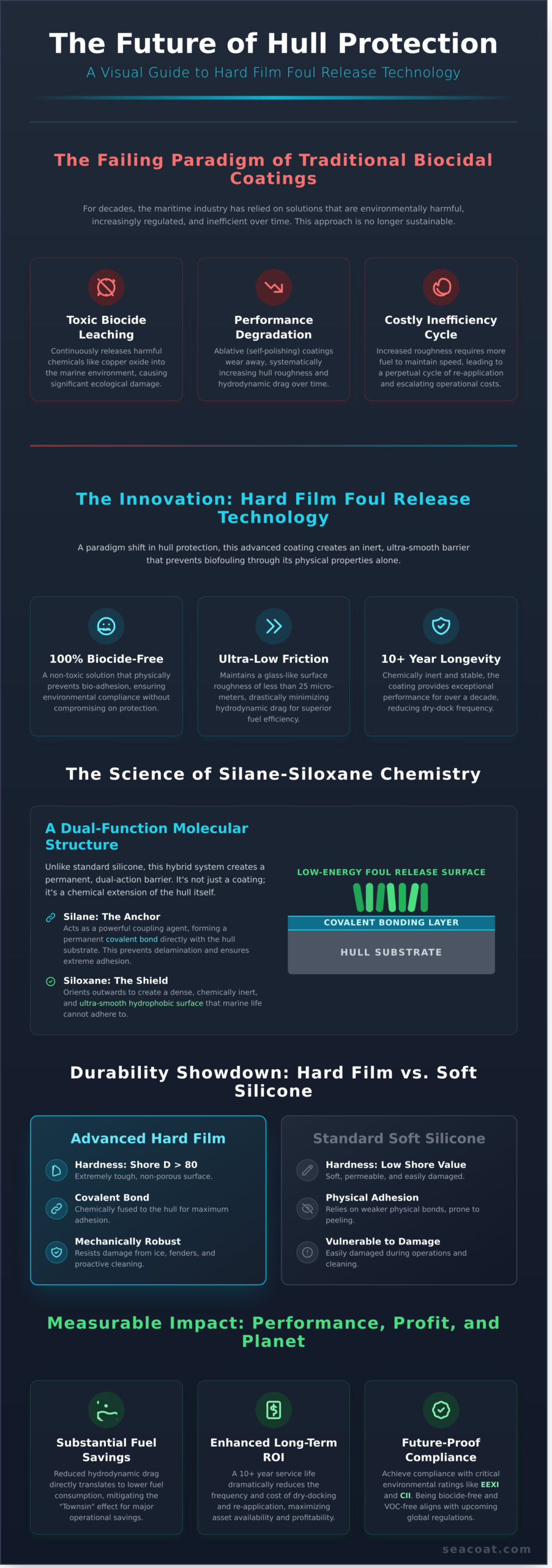
For decades, the primary defense against marine growth has been the continuous leaching of biocides like copper oxide into the aquatic environment. This method, while temporarily effective, comes with severe ecological consequences and growing regulatory scrutiny. The damage caused by heavy metals to marine ecosystems is well-documented, prompting international bodies to propose stricter regulations on their use by 2026. Furthermore, many of these coatings are “ablative” or self-polishing, a design that systematically increases hull roughness as the paint wears away. This degradation directly compromises hydrodynamic efficiency, leading to a perpetual cycle of re-application and escalating fuel consumption to mitigate the science of biofouling and its associated drag.
Defining the Hard Film Category
A true hard film foul release coating is distinguished by its unique chemistry and physical resilience. Formulated with silane-siloxane hybrid resins, it cures into a densely cross-linked, non-porous surface with exceptionally low surface energy-a stark contrast to the more permeable nature of standard marine epoxies. This “Hard” characteristic, often measured with a Shore D hardness exceeding 80, provides robust resistance to mechanical damage from fenders, ice abrasion, and, critically, proactive in-water hull cleaning. This durability ensures the coating’s slick surface remains intact for long-term performance. In essence, a Hard Film Foul Release is a non-toxic, high-durability barrier engineered to maintain a surface roughness of less than 25 micro-meters, thereby preventing bio-adhesion and minimizing hydrodynamic drag for the life of the vessel.
The Chemistry of Silane-Siloxane: Why It Outperforms Standard Silicone
The superior performance of a hard film foul release coating is fundamentally rooted in its advanced silane-siloxane polymer chemistry. Unlike standard silicone paints that rely on physical adhesion, this hybrid system creates a permanent, covalent bond directly with the hull substrate. The silane component acts as a powerful coupling agent, locking the coating to the vessel, while the siloxane component orients outwards, creating a dense, ultra-smooth, and chemically inert surface. This dual-function structure is the key to its longevity and unparalleled foul release capability.
This sophisticated chemistry delivers a non-toxic, biocide-free solution that prevents biofouling through physical means rather than chemical leaching. The resulting hydrophobic, low-energy surface is exceptionally “slick,” denying marine organisms the secure attachment points they need to colonize. Furthermore, the formulation is entirely free of Volatile Organic Compounds (VOCs), a critical factor for compliance with modern MARPOL regulations and for ensuring the safety of application specialists and the marine environment.
Hydrophobicity and Surface Roughness
The relationship between surface smoothness and hydrodynamic efficiency is a core principle of naval engineering. The siloxane-rich surface of the coating creates an exceptionally low-friction interface with water, which significantly reduces drag. According to the “Townsin” effect, even marginal increases in average hull roughness directly correlate to substantial penalties in fuel consumption. By maintaining a glass-like finish, our system mitigates this effect, translating molecular smoothness into measurable operational savings. This is where the synergy of the hybrid chemistry becomes critical: the silane ensures the coating stays bonded, while the siloxane provides the permanent, low-drag surface.
Longevity and Chemical Stability
Traditional anti-fouling systems degrade over time; they are designed to leach biocides, dry out, or ablate away, requiring frequent reapplication. In contrast, the cross-linked silane-siloxane matrix is inorganic and exceptionally stable. It does not contain volatile components that evaporate or active ingredients that are consumed. This exceptional stability, as detailed in a recent scientific study on hard fouling-release coatings, is fundamental to achieving a true 10-year performance cycle. The coating is inherently resistant to UV degradation and chemical pollutants in harbor waters, ensuring consistent efficacy across diverse global routes. As a single-component system, it also eliminates on-site mixing errors, guaranteeing a uniform and reliable application every time.
Hard Film vs. Soft Silicone: Solving the Durability Dilemma
While the foul release principle offers a significant advancement over biocide-based antifouling, not all systems are created equal. Traditional soft silicone coatings, though effective in their hydrodynamic properties, present a critical operational vulnerability: mechanical fragility. This inherent weakness has historically limited their application, creating a durability dilemma that the modern hard film foul release coating is engineered to solve.
Physical Resilience in Harsh Environments
Soft silicone systems are highly susceptible to physical damage. The low tensile strength of these elastomeric coatings means they can easily tear or gouge during routine operations such as docking, mooring, or even from contact with floating debris and fender friction. This damage compromises the entire system, creating sites for aggressive fouling growth and often leading to delamination, where the coating peels away from the hull substrate. The operational cost of such frequent repairs can be substantial.
In stark contrast, hard film systems are defined by their mechanical robustness. Quantified by a high Shore D hardness rating, these coatings exhibit exceptional resistance to abrasion, impact, and scratching. This resilience is not merely a surface-level attribute; it stems from a highly cross-linked polymer structure that forms a tenacious, integrated bond with the hull. For high-utilization assets like military frigates, commercial container ships, and ice-class vessels, this durability is non-negotiable, ensuring coating integrity in the most demanding marine environments.
In-Water Maintenance and Cleaning
The disparity in durability directly impacts maintenance protocols. Cleaning a soft silicone coating is a delicate procedure, often precluding the use of rotating brushes or high-pressure jets for fear of irreparable damage. Hard film coatings, however, are engineered to withstand aggressive in-water cleaning. This allows vessel operators to efficiently remove any accumulated slime layer or light fouling using standard hull cleaning equipment without risking the coating’s integrity, a critical advantage for maintaining optimal hydrodynamic performance.
This “easy-clean” property also addresses a common misconception: that foul release coatings only work on high-speed vessels. While water flow certainly facilitates self-cleaning, the extremely low surface energy of a hard film prevents marine organisms from forming a strong bond in the first place. This weak adhesion means that even on stationary vessels, fouling can be removed with minimal force, representing a key evolution in the field of environmentally friendly antifouling coatings. This makes the technology equally suitable for pleasure craft in a marina as it is for a frigate on patrol, offering a versatile solution for the entire maritime sector.
Operational Efficiency and ROI: The Economic Case for 2026
In the modern maritime sector, operational decisions are increasingly driven by a dual mandate: enhancing economic performance while adhering to stringent environmental regulations. The selection of a hull coating is no longer a simple maintenance expenditure but a strategic investment that directly impacts a vessel’s long-term profitability and regulatory standing. By 2026, the financial and compliance-related advantages of advanced hull technologies will become non-negotiable for competitive fleet management.
Fuel Consumption and Emission Reduction
The primary economic driver for adopting a superior hull coating is the sustained reduction in fuel consumption. Verified case studies demonstrate that vessels treated with a hard film foul release coating achieve fuel savings between 4% and 12% by mitigating hydrodynamic drag. This ultra-smooth, low-friction surface acts as a passive energy-saving device, maintaining near-optimal hull performance throughout its service life. This directly correlates to improved EEXI (Energy Efficiency Existing Ship Index) and CII (Carbon Intensity Indicator) ratings, positioning the vessel for preferential chartering and ensuring compliance with evolving IMO greenhouse gas (GHG) targets.
Life-Cycle Cost Analysis
A comprehensive 10-year cost analysis reveals the profound economic disparity between traditional antifouling paints and a single-application hard film system. While the initial investment may be higher, the total cost of ownership is significantly lower due to the elimination of re-coating cycles. This long-term stability translates into tangible savings:
This “invest once, save long-term” model is a key principle in many industries focused on efficiency. While the scale is different, it’s the same logic behind homeowners investing in high-performance insulation to reduce lifetime energy costs. For an example of this principle in the residential sector, you can discover The Cozy Penguin Insulation Company.
- Reduced Dry-Dock Frequency: A 10-year service life minimizes time and expense associated with scheduled hull maintenance, maximizing vessel availability.
- Elimination of Compliance Costs: As a biocide-free solution, it removes costs related to the disposal of contaminated materials and avoids future penalties for environmental non-compliance.
- Performance ROI: Sustained vessel speed and maneuverability prevent performance degradation, safeguarding voyage efficiency and profitability over the long term.
Beyond direct cost savings, this technology delivers a “Green Premium.” A fleet demonstrably committed to sustainable, non-toxic solutions gains a powerful marketing advantage, appealing to environmentally conscious charterers and stakeholders. This investment fortifies not only the vessel’s hull but also the operator’s brand reputation in an industry where sustainability is a measure of strategic foresight. Discover the full economic model at seacoat.com.
Implementing Sea-Speed V 10 X Ultra for Your Fleet
Transitioning from the technical principles of foul release technology to practical fleet-wide implementation requires a solution engineered for longevity, performance, and environmental compliance. Sea-Speed V 10 X Ultra stands as the premier hard film foul release coating, providing a strategic asset designed to optimize vessel efficiency and deliver a significant return on investment over a ten-year service life.
The Sea-Speed Difference
The entire Sea-Speed line is fundamentally non-toxic, biocide-free, and contains zero VOCs, representing a definitive move away from harmful legacy systems toward sustainable maritime operations. The V 10 X Ultra model is distinguished by its unique silane-siloxane formulation, which creates an exceptionally durable, inert, and low-energy surface. This advanced chemistry is validated by a proven track record across the most demanding operational theaters, including military naval vessels, commercial cargo fleets, and large-scale cruise ships where reliability is paramount.
Achieving the maximum performance from this advanced hard film foul release coating is contingent upon precise application protocols. The process begins with meticulous surface preparation, typically to an SA 2.5 near-white metal blast standard, to create the ideal foundation. The system is engineered for compatibility with a wide range of high-performance, approved anti-corrosive primers, ensuring seamless integration into existing dry-dock maintenance specifications.
For vessels migrating from traditional ablative or self-polishing copolymer (SPC) anti-fouling systems, the transition is a structured, definitive process:
- Step 1: Complete Removal. The legacy coating system is fully removed via abrasive blasting to expose the substrate.
- Step 2: Primer Application. A specified anti-corrosive primer system is applied to protect the hull and ensure superior adhesion.
- Step 3: Topcoat Application. Sea-Speed V 10 X Ultra is applied to the specified dry film thickness (DFT) to complete the system.
Our global technical support teams are available to ensure these specifications are met with precision at any dry-dock facility worldwide, guaranteeing consistent quality and performance for your entire fleet.
Next Steps for Fleet Managers
To quantify the potential fuel savings and operational benefits for your vessels, we recommend a comprehensive hull performance audit. Our specialists can analyze your fleet’s operational profile and develop a tailored coating specification designed to maximize efficiency and extend service intervals. For large-scale fleet conversions, please contact our team directly to discuss bulk industrial supply contracts. Consult with SeaCoat experts on your next dry-dock project to secure a sustainable, high-performance future for your assets.
Integrating a Strategic Asset for Decades of Hull Efficiency
The maritime industry’s evolution toward greater efficiency and environmental stewardship is no longer a future concept but a present-day operational imperative. The transition away from ablative antifouling is driven by the clear technical and economic advantages of advanced foul release systems. As detailed, the robust silane-siloxane chemistry of a hard film foul release coating provides unmatched durability and hydrodynamic performance, resolving the longevity issues inherent in softer silicone alternatives and delivering a quantifiable return on investment through significant fuel savings and minimized maintenance downtime.
Sea-Speed V 10 X Ultra embodies this next generation of hull protection. With technology in commercial use since 2001, our zero VOC and biocide-free formulations have become the trusted solution for military, cruise, and commercial shipping leaders worldwide. We invite you to make a strategic investment in the long-term performance and compliance of your assets.
Optimize your fleet performance with Sea-Speed V 10 X Ultra and secure a competitive advantage built on a foundation of scientific innovation and sustainable operations.
Frequently Asked Questions
What exactly is a hard film foul release coating?
A hard film foul release coating is an advanced, biocide-free surface technology engineered to prevent marine biofouling. Unlike soft silicone coatings, it cures to a smooth, extremely durable, low-energy surface. Based on silane-siloxane chemistry, it creates a non-stick finish to which marine organisms cannot firmly adhere. This physical mechanism provides a long-term, non-depleting solution for maintaining a clean, hydrodynamically efficient hull without releasing harmful toxins into the marine environment.
Is hard film foul release better than traditional antifouling paint?
A hard film foul release coating represents a superior strategic asset for vessel management. While traditional paints leach biocides that deplete over time and harm ecosystems, our foul release system provides a non-toxic, physical barrier. Its ten-year service life eliminates the frequent dry-docking cycles associated with ablative paints. This results in significantly lower lifetime costs, enhanced operational efficiency, and guaranteed regulatory compliance, making it the more intelligent, sustainable, and economically sound solution.
Does a vessel need to move at high speeds for foul release to work?
While hydrodynamic forces from vessel movement do accelerate the self-cleaning process, high speeds are not a prerequisite for efficacy. The coating’s extremely low surface energy intrinsically mitigates bio-adhesion, even on stationary or slow-moving vessels. Any soft fouling that may lightly attach is weakly adhered and can be removed with minimal effort, such as gentle in-water cleaning or periodic operational speeds, ensuring the hull remains hydrodynamically optimized across diverse operational profiles.
Can hard film coatings be applied over existing bottom paint?
No, proper surface preparation is critical to achieving the specified ten-year performance and adhesion. Applying a hard film system over existing, unstable antifouling paint would compromise the chemical bond to the substrate, leading to premature failure. For optimal results, the hull must be stripped to a sound, compatible tie-coat primer or the original gelcoat/steel. This foundational step ensures the coating’s longevity and maximizes the return on investment through unparalleled durability.
How long does a hard film silane-siloxane coating typically last?
A properly applied hard film silane-siloxane coating is engineered for an extended in-service period of ten years or more. Its durability stems from its chemically inert, non-depleting composition, which does not break down or leach components into the water. Unlike traditional antifouling paints that require reapplication every 2-3 years, this system provides a decade of consistent, reliable foul release performance and hydrodynamic efficiency, drastically reducing maintenance cycles and associated costs.
Are hard film coatings safe for aluminum hulls?
Yes, they are exceptionally safe and represent the ideal solution for aluminum hulls, pontoons, and drive units. Traditional antifouling paints often contain cuprous oxide, which causes destructive galvanic corrosion when applied to aluminum. Our hard film coatings are 100% biocide-free and contain no metallic compounds. This chemical inertness eliminates the risk of corrosion, providing superior foul release performance while preserving the structural integrity of the aluminum substrate for its full service life.
How much fuel can a ship save by switching to a hard film system?
Vessels converting to a hard film foul release coating system can expect fuel savings in the range of 4-8%, with data-backed reports showing even higher figures in some cases. This efficiency gain is a direct result of significant hydrodynamic drag reduction. The ultra-smooth, low-friction surface is maintained throughout the service life, unlike conventional paints that roughen over time. This sustained smoothness translates directly to lower fuel consumption, reduced emissions, and enhanced operational profitability.
Is underwater hull cleaning safe for these types of coatings?
Yes, in-water cleaning is not only safe but is a recommended component of maintaining peak performance. The robust, hard surface is highly resistant to abrasion from approved, non-aggressive cleaning techniques like soft-bristled rotary brushes or water jets. Unlike delicate soft silicone coatings or ablative paints that are damaged by cleaning, our hard film systems can be regularly and safely maintained in the water, ensuring optimal fouling control and hydrodynamic efficiency without compromising the coating’s integrity.