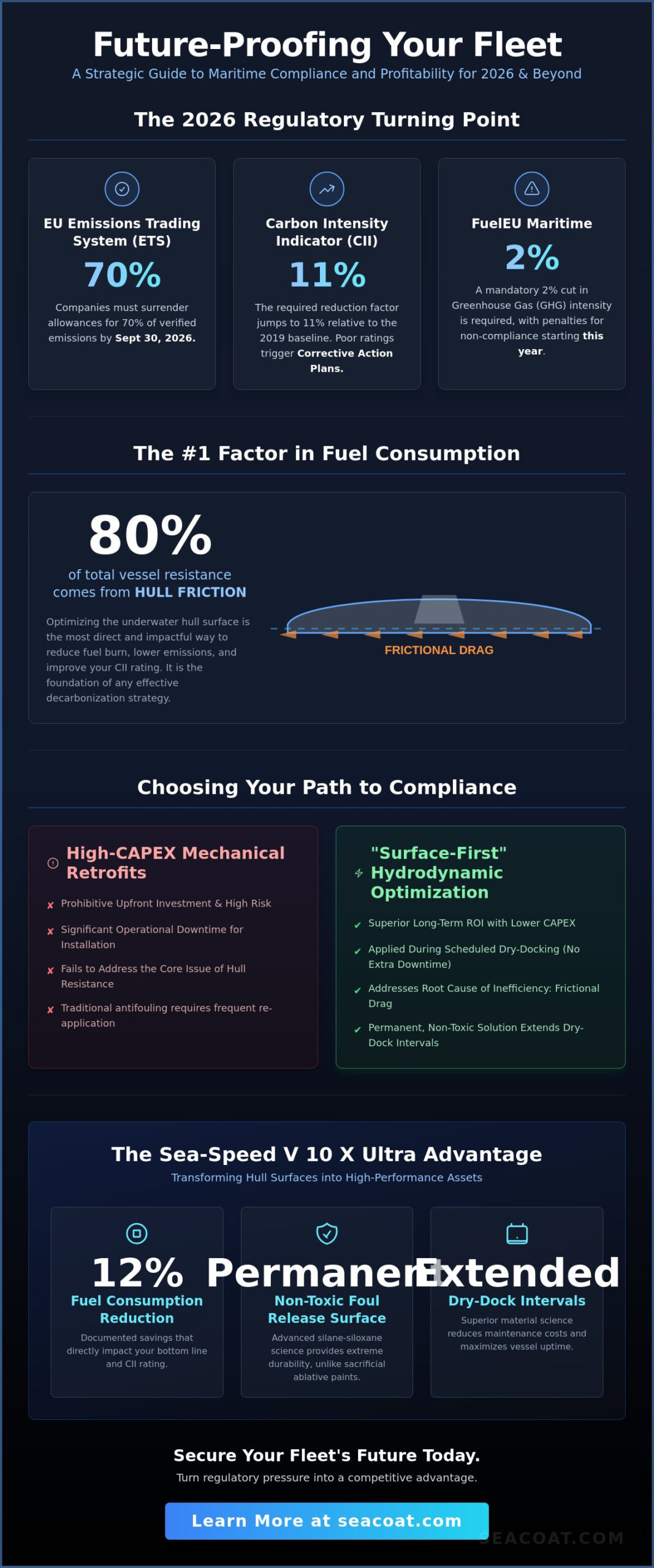
By September 30, 2026, the maritime industry faces a definitive fiscal shift as companies must surrender allowances for 70% of their verified emissions under the EU ETS. You’re likely managing the complex reality that regulatory compliance is no longer a secondary concern; it’s now a primary driver of asset valuation and charter attractiveness. With the IMO’s CII reduction factor jumping to 11% and FuelEU Maritime requiring a 2% GHG intensity cut this year, the pressure to find immediate, scalable efficiency is immense. You can achieve future proofing a shipping fleet without the prohibitive CAPEX of engine replacements or the high risk of unproven mechanical retrofits.
This guide demonstrates how maximizing hydrodynamic efficiency through advanced silane-siloxane surface engineering secures long-term compliance and extends vessel longevity. We’ll examine how permanent, non-toxic coatings like Sea-Speed V 10 X Ultra provide a documented 12% reduction in fuel consumption. This strategic approach allows your current vessels to meet 2026 standards while significantly lowering operational expenses and extending dry-dock intervals through superior material science. By focusing on the physics of the hull surface, you can transform your existing assets into a high-performance, compliant fleet ready for the 2030 targets and beyond.
Key Takeaways
- Understand how the 2026 regulatory milestones transform vessel efficiency from a legal requirement into a critical driver of commercial asset valuation.
- Explore the fluid dynamics of hull resistance and why mitigating frictional drag is the most cost-effective lever for improving Carbon Intensity Indicator (CII) ratings.
- Analyze the strategic trade-offs between high-CAPEX mechanical retrofits and the superior long-term ROI of advanced, non-toxic surface engineering.
- Learn a structured five-step roadmap for future proofing a shipping fleet by leveraging baseline performance data and targeted hydrodynamic optimization.
- Discover how material science merges extreme physical durability with environmental stewardship to extend dry-dock intervals and secure multi-year fleet resilience.
Navigating the Decarbonization Horizon: Why Future-Proofing is Mandatory in 2026
Future proofing a shipping fleet involves more than meeting the baseline requirements of the next inspection cycle; it’s a strategic alignment of multi-year asset longevity, operational profitability, and strict environmental compliance. In the current maritime climate, a vessel that isn’t actively improving its efficiency is rapidly becoming a financial liability. By September 30, 2026, the industry faces a definitive fiscal shift as companies must surrender allowances for 70% of their verified emissions under the EU ETS. This transition from voluntary reporting to mandatory financial accountability means that every tonne of carbon emitted has a direct, measurable impact on the bottom line.
The risk of “stranded assets” has moved from a theoretical concern to a commercial reality. Vessels that fail to meet evolving standards lose their charter value and see their resale potential plummet. 2026 marks a turning point where enforcement of existing regulations is tightening, and Port State Control inspections are increasingly focused on mandatory Corrective Action Plans for vessels with poor ratings. To mitigate this risk, owners are adopting a “surface-first” strategy. This approach prioritizes hydrodynamic optimization as the most accessible and cost-effective retrofit for existing fleets, providing a foundation that supports all other mechanical or fuel-based upgrades.
The Impact of EEXI and CII on Fleet Valuation
The Energy Efficiency Existing Ship Index (EEXI) sets the technical floor for your vessels, dictating the minimum hardware requirements for operation. However, the Carbon Intensity Indicator (CII) is a dynamic operational metric that dictates marketability through its A-E rating system. For 2026, the annual carbon intensity reduction factor has been increased to 11% relative to the 2019 baseline. Any ship that receives an E rating in 2025, or a D rating for three consecutive years, must submit a Corrective Action Plan by April 30, 2026. These poor ratings don’t just lead to operational restrictions; they often result in increased insurance premiums and reduced access to competitive financing under the Poseidon Principles.
Beyond 2026: Preparing for the Global Fuel Transition
While the industry continues to debate the eventual dominance of ammonia, methanol, or hydrogen, these future fuels share a common trait: they’re significantly more expensive and less energy-dense than traditional VLSFO. Regardless of which fuel type eventually wins the market, reducing total energy demand is the only universal hedge against rising costs. While traditional anti-fouling paint has historically been the standard for growth management, future-proofing requires a transition toward permanent, high-performance surfaces. Hydrodynamic efficiency is the essential foundation of any future fuel strategy. If a hull’s resistance isn’t optimized, the transition to expensive green fuels will be economically unsustainable for most operators.
The Hydrodynamic Foundation: Hull Efficiency as a Strategic Asset
Frictional resistance is the single most significant factor in vessel fuel consumption. It’s a physical reality that hull roughness accounts for up to 80% of total resistance as a ship moves through the water. While many operators focus on complex engine modifications or digital data signals, optimizing the underwater hull surface is the most immediate way to future-proof them. This is particularly vital since most of the 2030 fleet is already operational; we can’t wait for new hull designs to meet upcoming mandates. Improving the boundary layer flow isn’t just a maintenance task; it’s a strategic performance upgrade.
Strategic future proofing a shipping fleet requires moving beyond sacrificial methods. Traditional ablative antifouling relies on the continuous leaching of biocides, which degrades the coating’s physical profile over time and creates significant environmental hazards. In contrast, modern foul release systems utilize low surface energy to prevent biofouling attachment. This mechanism is purely physical, not chemical. By creating a surface that organisms cannot firmly grip, these coatings maintain their smooth profile throughout the docking cycle without releasing toxic contaminants into the marine ecosystem.
From Biocides to Hard-Film Foul Release Systems
Copper-based paints and biocide-heavy coatings are facing increasing regulatory scrutiny due to their cumulative impact on marine life. These systems also fail operationally because they’re soft and prone to damage during grooming or in-water cleaning. Hard-film systems built on silane-siloxane marine coatings offer a permanent solution. The silane-siloxane bond creates a chemically stable, non-leaching matrix that resists degradation for over 10 years. Because the film is hard and durable, it can be cleaned repeatedly without losing thickness or performance, ensuring the hull stays slick and efficient.
Quantifying the Impact of Surface Roughness
The Townsin hull roughness penalty illustrates the direct correlation between surface texture and fuel demand. As a hull ages and accumulates “peaks” from corrosion or old paint layers, the drag increases exponentially. Reducing average hull roughness by 10 microns typically translates to a 1% improvement in fuel efficiency, providing a measurable return on investment over the vessel’s operational cycle. Maintaining a “slick” hull surface directly reduces greenhouse gas (GHG) emissions by lowering the power required to maintain transit speeds. This surface-based approach ensures that your fleet remains competitive as fuel costs rise. For those seeking to optimize their current assets, exploring advanced hull performance metrics can reveal significant hidden efficiencies.
Strategic Retrofitting: Comparing Mechanical Upgrades to Advanced Coatings
Retrofitting decisions often center on high-CAPEX mechanical installations, yet these solutions frequently introduce new operational trade-offs. Scrubbers, while effective for sulfur compliance, add significant weight and parasitic power loads that can negatively impact a vessel’s overall efficiency profile. Similarly, Shaft Power Limitation (ShaPoLi) systems act as a defensive measure by capping engine output, which inherently reduces operational flexibility and transit speeds. When evaluating viable decarbonization pathways, it’s essential to prioritize passive efficiency gains that don’t compromise vessel performance.
Strategic environmental marine coatings represent an offensive approach to future proofing a shipping fleet. Unlike mechanical retrofits that require active energy or frequent maintenance, advanced surface engineering reduces the baseline hydrodynamic load. This creates a powerful synergy; by lowering the power required to move the hull, any secondary mechanical systems or alternative fuels can operate much more effectively. You aren’t just adding a component; you’re optimizing the entire platform for the 2026 regulatory landscape and beyond.
The Speed-Power Curve Advantage
Advanced coatings like Sea-Speed V 10 X Ultra shift the speed-power curve by minimizing frictional resistance. This allows vessels to maintain higher speeds at lower RPMs, providing a documented fuel reduction of up to 12%. Contrast this with “slow steaming,” which remains a common but commercially restrictive compliance method. By enhancing the hull’s slip, operators can maintain schedule integrity and charter party requirements while simultaneously reducing their Carbon Intensity Indicator (CII) footprint. It’s a method of achieving compliance through performance rather than limitation.
Longevity and Maintenance Cycles
Future proofing a shipping fleet also requires a shift in how we view maintenance timelines. Traditional ablative anti-fouling paint typically requires a 2-3 year replacement cycle, leading to frequent off-hire periods and high labor costs. In contrast, silane-siloxane systems offer a 10-year potential lifespan. This longevity significantly reduces dry-dock frequency and associated expenses. While “soft” silicone coatings are often marketed for foul release, they remain vulnerable to impact damage and require difficult, specialized repairs. A hard-film silane-siloxane matrix provides the necessary durability to withstand tug impact and debris while maintaining its low-friction properties over multiple years of service.
Fleet Implementation Roadmap: 5 Steps to Surface-Based Future-Proofing
Transitioning from reactive maintenance to a strategic performance model requires a structured methodology. Adopting a systematic approach ensures that the physical improvements made to the hull translate directly into measurable regulatory compliance and fuel savings. Future proofing a shipping fleet isn’t achieved through a single application but through a lifecycle management plan that prioritizes surface integrity and long-term hydrodynamic stability. This roadmap provides the technical framework necessary to move away from legacy coatings toward permanent, high-performance solutions.
Step 1-2: Data Baseline and Asset Selection
The foundation of any efficiency upgrade is a rigorous data baseline. Utilizing ISO 19030 standards allows operators to accurately measure changes in hull and propeller performance by analyzing primary frequency data and speed-power relationships. This empirical evidence identifies which vessels are experiencing the highest frictional penalties. When selecting candidates for a retrofit, prioritize high-utilization vessels where the reduction in fuel-over-ground provides the most rapid return on investment. You must also assess the remaining useful life (RUL) of the current coating system; if the existing layers are brittle or delaminating, a full remediation to the substrate is necessary to ensure the longevity of the new silane-siloxane matrix.
Step 3-5: Application and Performance Validation
Precision during the application phase is non-negotiable for achieving a 10-year service life. For optimal silane-siloxane adhesion, the hull must be grit blasted to an SA 2.5 standard to reveal a near-white metal finish with a specific anchor profile. This ensures a permanent chemical bond that resists the hydraulic pressures of high-speed transit. Unlike soft coatings that degrade under mechanical stress, these hard-film systems support a “grooming” rather than a “scrubbing” schedule. This proactive maintenance removes light slime before it transitions into hard macrofouling, preserving the original low-friction surface without damaging the coating itself. Automated hull cleaning robots now play a critical role in this process, providing consistent, non-abrasive maintenance that keeps future-proofed surfaces at peak efficiency between dry-dock intervals.
Post-application monitoring closes the loop on the investment. By integrating digital twins with onboard sensor data, technical managers can validate the real-world ROI against the initial baseline. This continuous feedback loop proves the efficacy of the surface-first strategy and provides the necessary documentation for CII rating improvements. To begin evaluating your fleet’s potential for these upgrades, you can consult our technical specifications for Sea-Speed systems to see how they align with your specific vessel profiles.
Seacoat SCT, LLC: Engineering Long-Term Fleet Resilience
Achieving authentic resilience requires a move away from transitional fixes toward engineered permanence. By integrating Sea-Speed V 10 X Ultra into a long-term management strategy, future proofing a shipping fleet becomes a quantifiable reality rather than a regulatory burden. Seacoat SCT, LLC represents the Expert Innovator approach, where advanced material science is harmonized with a deep commitment to environmental stewardship. Unlike sacrificial coatings that offer diminishing returns, these systems provide a stable, high-performance surface that maintains its hydrodynamic properties over multiple docking cycles. Evidence-based results from decades of commercial and military deployment confirm that silane-siloxane technology maintains its performance profile where traditional systems fail.
The strategic advantage of adopting a non-toxic, zero-VOC, and biocide-free fleet profile goes beyond immediate compliance. It positions your organization as a leader in the transition toward sustainable maritime operations, simplifying ESG reporting and enhancing your brand’s reputation with cargo owners and financiers. By eliminating the discharge of volatile contaminants and heavy metals into the world’s oceans, you’re not just protecting your assets; you’re preserving the ecosystems that sustain global trade. This synergy of physical durability and ecological safety is the hallmark of a truly future-proofed operation managed by Seacoat SCT, LLC.
Sea-Speed V 10 X Ultra: The Hard-Film Differentiator
The primary technical advantage of the Sea-Speed V 10 X Ultra system lies in its hard-film silane-siloxane matrix. This chemistry provides extreme chemical resistance and impact durability, allowing the coating to withstand the rigors of tug impacts, ice, and debris that often destroy soft silicone alternatives. For performance-critical applications, Sea-Speed V 10 X Ultra Clear offers a specialized solution that provides the same low-friction benefits without altering the visual profile of the substrate. Repairs are also significantly more straightforward; while silicone systems often require complete stripping upon damage, Sea-Speed can be spot-repaired with minimal surface preparation, reducing off-hire time and maintenance costs.
The Economic Argument for Seacoat Systems
The multi-year ROI of systems provided by Seacoat SCT, LLC is driven by a 10-year service life and a documented 12% reduction in fuel consumption. When you aggregate the savings from reduced fuel burn, the elimination of biennial repainting, and the reduction in dry-dock fees, the economic case becomes undeniable. Seacoat SCT, LLC acts as a strategic partner in your regulatory compliance journey, providing the technical data and surface efficiency needed to maintain superior CII ratings as targets tighten through 2030. It’s time to move beyond temporary maintenance and invest in a strategic asset that secures your fleet’s viability for the next decade. Consult with our technical team to future-proof your fleet.
Strategic Alignment for the 2026 Regulatory Shift
As the 2026 reporting deadlines for EU ETS and FuelEU Maritime approach, the industry must move beyond defensive compliance. Future proofing a shipping fleet requires a fundamental shift in how we manage underwater surfaces. By prioritizing hydrodynamic efficiency through advanced material science, you secure both the commercial viability of your assets and the preservation of marine ecosystems. This strategy provides a permanent hedge against rising fuel costs and tightening Carbon Intensity Indicator (CII) targets without the volatility of sacrificial coatings.
Seacoat SCT, LLC has pioneered proprietary Silane-Siloxane technology since 2001, delivering high-performance solutions that are entirely non-toxic, zero-VOC, and biocide-free. These formulations provide documented fuel savings and an extended 10-year service life, ensuring your vessels remain operational and efficient through the next decade of decarbonization milestones. By choosing a hard-film system that values durability and ecological safety, you transform maintenance into a strategic performance asset.
Secure your fleet’s future with Seacoat’s advanced marine coatings and ensure your operations are prepared for the high-stakes transition ahead. Your fleet’s resilience starts at the surface.
Frequently Asked Questions
What is the primary difference between future-proofing and simple maintenance?
Future-proofing is a strategic investment in long-term asset viability and regulatory resilience, whereas simple maintenance is a reactive cycle of temporary repair. While maintenance often involves reapplying sacrificial, toxic coatings every few years, future-proofing utilizes permanent materials like silane-siloxane to ensure compliance and efficiency for a decade. This proactive approach focuses on the multi-year performance cycle of the asset rather than immediate, short-term fixes.
How do advanced hull coatings help with EEXI and CII compliance?
Advanced coatings reduce frictional resistance, which directly lowers the power required to maintain transit speeds. This reduction in power output translates to lower fuel consumption and greenhouse gas emissions. Improving these metrics is a primary lever for future proofing a shipping fleet and securing favorable Carbon Intensity Indicator (CII) ratings, especially as reduction targets increase to 11% by 2026. Lower emissions also reduce the financial burden of surrendering EU ETS allowances.
Can a non-toxic coating really be as effective as traditional antifouling?
Yes, non-toxic foul release systems utilize low surface energy to prevent biofouling attachment physically rather than through chemical leaching. While traditional antifouling relies on biocides that lose potency over time, a hard-film silane-siloxane surface remains effective as long as the film is intact. It provides a consistent, high-performance boundary layer that doesn’t degrade, offering superior long-term resistance to growth without the environmental damage associated with heavy metals.
What is the expected lifespan of a silane-siloxane coating system?
A high-performance silane-siloxane system like Sea-Speed V 10 X Ultra is engineered for a 10-year service life. This longevity is achieved through a permanent chemical bond with the substrate and a durable, hard-film matrix that resists mechanical damage from tugs or debris. This extended lifecycle significantly reduces the frequency of full repainting cycles during dry-docking, allowing for simple grooming rather than aggressive scrubbing or replacement.
Is it possible to apply Sea-Speed coatings over existing hull paint?
Sea-Speed coatings require a substrate prepared to SA 2.5 standards for optimal chemical adhesion and long-term performance. Applying these advanced systems over legacy layers isn’t recommended because the performance would be limited by the weakest underlying coating. A clean, grit-blasted surface ensures the silane-siloxane matrix achieves its full 10-year durability and low-friction potential, preventing delamination and ensuring a smooth hydrodynamic profile.
How does hull roughness impact the fuel consumption of a large container ship?
Hull roughness increases the thickness of the turbulent boundary layer, creating significant frictional drag that accounts for the majority of total resistance. Scientific data indicates that a 10-micron increase in average hull roughness can lead to a 1% increase in fuel demand. For a large container ship, these cumulative losses result in substantial operational cost increases and higher carbon intensity, making surface smoothness a critical factor in economic performance.
Are there specific regulations banning toxic antifouling paints in 2026?
While a total global ban on all biocidal paints isn’t scheduled for 2026, regional and international bodies are tightening restrictions on specific additives like cybutryne and various copper compounds. The IMO’s AFS Convention and the EU’s Biocidal Products Regulation continue to phase out harmful substances. Transitioning to biocide-free systems now is a proactive measure for future proofing a shipping fleet against the inevitable expansion of these environmental restrictions.
What is the payback period for a premium foul release coating?
The payback period typically occurs within 12 to 18 months of operation, depending on vessel utilization and fuel prices. This return on investment is driven by documented fuel savings of up to 12% and the elimination of intermediate repainting costs. Beyond direct fuel savings, the reduction in potential EU ETS carbon penalties and the ability to maintain higher charter rates through better CII ratings further accelerate the financial recovery of the investment.