By 2026, the annual carbon intensity reduction factor has escalated to 11% relative to the 2019 baseline, placing unprecedented pressure on maritime operators to optimize hull performance immediately. You’re likely feeling the tightening grip of the EU Emissions Trading System, which now requires surrendering allowances for 70% of verified emissions by September 30, 2026. The traditional reliance on toxic biocidal leaching or fragile soft silicones no longer suffices in a landscape where every fraction of a knot impacts your bottom line and regulatory standing. High fuel costs and the threat of E-rated CII scores demand a shift toward more permanent, scientifically robust fuel saving marine coatings.
Discover how advanced silane-siloxane technologies, such as Sea-Speed V 10 X Ultra, utilize high-performance foul release properties to minimize frictional drag and ensure full compliance with EEXI and CII standards. We’ll examine the technical shift from temporary chemical leaching to permanent surface energy optimization. This transition doesn’t just protect the marine environment; it extends dry-docking intervals and delivers documented fuel consumption reductions of up to 12%. This guide provides a strategic overview of how to transform your hull from a maintenance liability into a high-efficiency asset for the 2026 operational cycle.
Key Takeaways
- Understand how skin friction accounts for the vast majority of total vessel resistance and why managing surface energy is the most effective way to optimize performance.
- Learn how silane-siloxane technology creates a permanent low-energy barrier, positioning fuel saving marine coatings as a strategic asset for long-term operational efficiency.
- Distinguish between fragile soft silicone options and durable hard-film foul release systems that provide high-strength protection without the use of toxic biocides.
- Identify the direct correlation between hydrodynamic efficiency and improved EEXI and CII ratings to ensure your fleet remains compliant with 2026 emissions standards.
- Discover the long-term ROI of the “Apply Once” philosophy found in Sea-Speed V 10 X Ultra, which replaces recurring maintenance cycles with a permanent performance solution.
The Hydrodynamic Impact: How Hull Roughness Drives Fuel Consumption
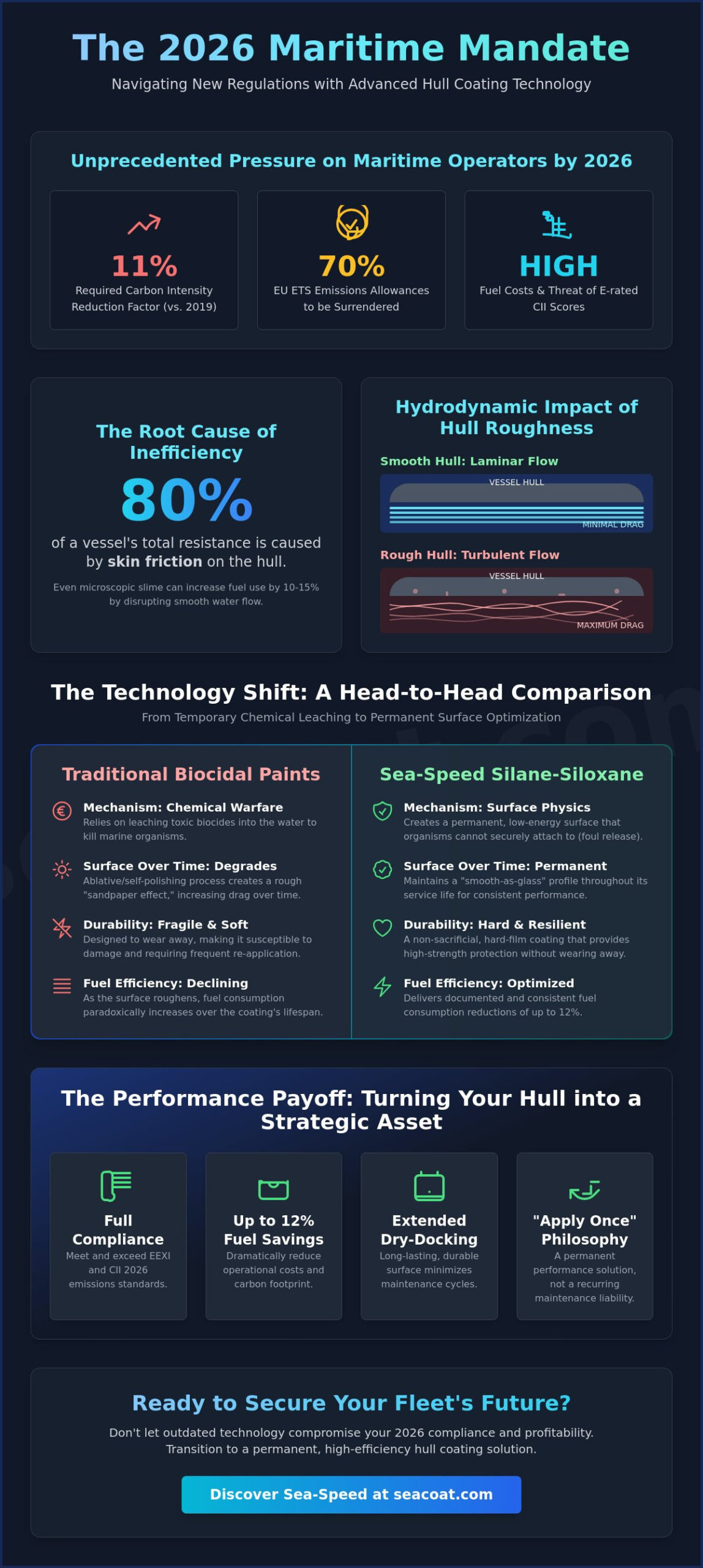
In naval architecture, the efficiency of a hull is dictated by its ability to move through water with minimal resistance. Skin friction, or frictional drag, isn’t just a minor factor; it typically accounts for up to 80% of a vessel’s total resistance. When the hull surface is compromised by roughness, the energy required to maintain speed increases exponentially. This is why the selection of fuel saving marine coatings has shifted from a maintenance choice to a critical engineering decision. In the context of 2026 decarbonization mandates, reducing this drag is no longer an optional optimization. It’s a regulatory necessity for any operator aiming to meet the 11% carbon intensity reduction factor required this year.
The Physics of Frictional Drag
The interaction between the hull and the surrounding water occurs within the boundary layer. When a surface is smooth, the water flows in a predictable, laminar fashion. However, even microscopic disruptions can cause turbulence that pulls energy away from the propulsion system. To understand the scale of the problem, one must first define what is biofouling and how it alters the hull’s profile. Frictional resistance is the tangential force exerted by a fluid against the wetted surface of a hull, creating a drag that must be overcome by increased engine power. Even a thin layer of microscopic slime, which often goes unnoticed during casual inspections, can increase fuel consumption by 10% to 15% by disrupting the laminar flow and thickening the boundary layer.
Ablative vs. Non-Ablative Surfaces
Traditional self-polishing copolymers (SPCs) and ablative paints are designed to leach biocides by slowly wearing away. While this prevents growth in the short term, the process itself creates a “sandpaper effect.” As the paint layers erode unevenly, the surface roughness increases over time, which paradoxically raises fuel costs while the coating is supposedly working. In contrast, permanent, non-leaching surfaces maintain a smooth-as-glass profile throughout their service life. This fundamental difference in surface topography is explored in detail in our definitive guide to boat hull paint, which highlights how surface energy optimization outperforms sacrificial chemical leaching. By 2026, the transition to hard-film fuel saving marine coatings like Sea-Speed V 10 X Ultra represents the only logical path for operators who value both hydrodynamic precision and long-term return on investment. By focusing on micro-roughness rather than just visible growth, operators can mitigate the exponential rise in fuel consumption that occurs as traditional paints degrade.
The Science of Fuel Saving: Silane-Siloxane vs. Traditional Biocides
Understanding the physics of drag leads directly to the chemical composition of the hull surface. While traditional systems rely on the active release of toxins to manage growth, modern fuel saving marine coatings utilize advanced material science to alter the surface energy of the vessel itself. Silane-siloxane technology represents a fundamental departure from the reactive maintenance of the past, offering a proactive, permanent solution. It’s not just about killing organisms; it’s about engineering a surface that prevents their attachment through physical properties rather than chemical warfare. This expert innovator approach ensures the hull remains clean and hydrodynamically efficient without the need for sacrificial layers.
Surface Energy and Foul Release Mechanisms
The core of this technology lies in achieving a specific “critical surface tension.” This metric determines how easily a liquid or a biological adhesive can wet a surface. Silane-siloxane creates a molecular bond that is both hydrophobic and oleophobic, resulting in a surface energy so low that marine organisms simply cannot form a secure attachment. This mechanism is the foundation of “foul release,” where any growth that settles while the ship is stationary is easily shed once the vessel reaches a minimal speed. Unlike soft silicone coatings, which are prone to tearing and physical degradation, silane-siloxane provides a hard, resilient film that maintains its low-energy properties. This surface energy optimization significantly improves “slip,” allowing water to glide over the hull with reduced friction.
The End of Biocidal Dependency
The maritime industry is navigating a period of intense regulatory scrutiny regarding the use of heavy metals and toxins. By 2026, the phase-out of copper and TBT-based legacy systems has accelerated due to their documented impact on marine ecosystems. Data from the American Coatings Association on eco-efficiency highlights how moving away from these harmful additives doesn’t just protect the ocean; it actually enhances operational performance. Traditional self-polishing copolymers lose their effectiveness as their leaching rate slows or their active layers deplete, leading to the “sandpaper effect” that increases drag. Conversely, the static performance of Sea-Speed ensures consistent hydrodynamic efficiency for up to a decade without the environmental cost of leaching poisons.
This transition represents a broader shift toward sustainable hull performance that aligns environmental stewardship with corporate profitability. By eliminating the performance gap found in older coatings, operators can achieve reliable, multi-year fuel savings. If you’re evaluating how these chemical advancements can protect your fleet’s margins, exploring a solution from Seacoat SCT, LLC is the logical next step for modern, large-scale vessel management. This technology provides a strategic asset that balances physical durability with ecological safety, ensuring your assets remain both efficient and compliant.
Hard-Film Foul Release: Why Durability is a Fuel-Saving Metric
A common misconception in maritime asset management is that all foul release systems are inherently fragile. Many shipowners, accustomed to the physical vulnerability of soft silicone, assume that high-efficiency surfaces can’t withstand the rigors of commercial operations. However, the true value of fuel saving marine coatings isn’t just found in their initial smoothness, but in their ability to maintain that profile under mechanical stress. When a coating tears or peels, it creates localized turbulence that destroys hydrodynamic efficiency. In the high-stakes environment of 2026, where profit margins are tied to carbon intensity ratings, physical durability has become a primary fuel-saving metric.
Overcoming the Soft Silicone Flaw
Traditional soft silicone coatings often suffer from “peeling” or “delamination” in high-velocity areas, such as the bow or around the propeller wash. They’re also notoriously sensitive to fender contact and debris impact. Sea-Speed V 10 X Ultra solves this structural weakness by providing the hardness of a high-build epoxy with the low surface energy of a foul release system. This hard-film silane-siloxane technology creates a resilient barrier that doesn’t sacrifice slip for strength. While standard ablative paints require repainting every 2 to 3 years, this advanced chemistry provides a service life exceeding 10 years. This longevity ensures that the hull’s “as-applied” efficiency remains intact for a decade, preventing the gradual drag increase associated with coating degradation.
Maintenance and In-Water Cleaning
The ability to perform routine maintenance without compromising the coating’s integrity is a critical advantage for modern fleets. Hard-film surfaces allow for proactive “grooming,” where light bio-growth is removed through simple wiping or low-pressure cleaning. Unlike ablative systems that lose thickness during cleaning or soft silicones that risk tearing under a brush, silane-siloxane maintains its dry film thickness (DFT) regardless of how often it’s cleaned. Research regarding the impact of hull roughness on drag demonstrates that maintaining a clean hull between dry-dock cycles is essential for hitting EEXI targets.
Effective fuel saving marine coatings must support these operational realities by offering:
- Resistance to mechanical damage from tugs, fenders, and debris.
- The structural density required for high-speed cavitation resistance.
- A non-porous surface that prevents organisms from “rooting” into the film.
- The capability for frequent, non-destructive in-water cleaning.
By investing in a hard-film solution, operators secure a permanent hydrodynamic advantage. This eliminates the “sawtooth” fuel consumption pattern where efficiency peaks after dry-docking and rapidly declines as the coating wears or fouls. Instead, the vessel maintains a steady, low-drag profile that directly supports long-term regulatory compliance and reduced operational expenditure.
Compliance and ROI: Meeting EEXI and CII Standards
The maritime industry’s transition toward decarbonization has moved from voluntary participation to rigid enforcement. By 2026, the Carbon Intensity Indicator (CII) reduction factor has increased to 11% relative to the 2019 baseline, creating a high-stakes environment where hull performance is a primary lever for compliance. Ships that failed to achieve an acceptable rating in 2025 must submit a Corrective Action Plan by April 30, 2026. In this context, fuel saving marine coatings are no longer just a way to reduce operational costs; they’re a strategic necessity for maintaining a vessel’s license to operate. A high-performance hull surface allows an existing ship to meet more stringent Energy Efficiency Existing Ship Index (EEXI) targets without resorting to drastic engine power limitations that can compromise schedule reliability.
Navigating IMO 2026 Regulations
Modern foul release coatings significantly lower the vessel speed/power ratio by minimizing the frictional resistance that typically increases as a coating ages. When a hull’s surface energy is optimized, the propulsion system requires less energy to overcome drag, which directly impacts the carbon intensity of every voyage. If a vessel falls into a D or E rating, it faces operational restrictions that can severely limit its marketability and charter value. The reduction in hull roughness achieved by silane-siloxane technology directly correlates to a decrease in hull resistance, which significantly lowers CO2 emissions per nautical mile by reducing the engine power required to maintain transit speeds. This efficiency is critical for meeting the September 30, 2026, deadline for surrendering emissions allowances under the EU ETS, which now covers 70% of verified emissions from the previous year.
Long-Term Financial Modeling
Calculating the true return on investment for fuel saving marine coatings requires looking beyond the initial application cost to the total cost of ownership over a 10-year cycle. While traditional ablative paints require frequent repainting and hull cleaning, a permanent silane-siloxane solution like Sea-Speed V 10 X Ultra eliminates these recurring expenses. For a Panamax or a large cruise ship, a fuel consumption reduction of up to 12% translates into millions of dollars in saved bunkers over the life of the coating. Beyond fuel, the “Green Premium” is becoming a tangible reality in 2026; vessels with superior efficiency ratings and documented low-drag profiles command higher charter rates and enjoy preferential access to ports with strict environmental standards.
This financial shift is detailed in our definitive guide for vessel protection, which explores how durability and efficiency act as synergistic drivers of profitability. By investing in a technology that lasts a decade, operators don’t just save on fuel; they gain a permanent competitive advantage in an increasingly regulated market. If you’re looking to secure your fleet’s future against rising emissions costs, implementing Sea-Speed V 10 X Ultra is the most effective way to align your operational efficiency with global environmental mandates.
Sea-Speed V 10 X Ultra: A Strategic Asset for Fleet Efficiency
Sea-Speed V 10 X Ultra represents the apex of silane-siloxane material science, engineered specifically for the rigorous demands of global maritime logistics. While the industry has historically accepted a cycle of degradation and repainting, this technology introduces a permanent “Apply Once” philosophy to hull management. By creating a hard, non-leaching barrier that remains effective for over a decade, it transforms the hull from a recurring maintenance liability into a long-term strategic asset. This shift is critical for operators navigating the economic pressures of 2026, where the performance of fuel saving marine coatings directly dictates a vessel’s operational viability and market competitiveness.
The versatility of the product range offered by Seacoat SCT, LLC allows for seamless integration across diverse sectors. From high-speed military interceptors that require extreme cavitation resistance to massive commercial bulk carriers focused on multi-year drag reduction, the chemical foundation remains the same. It provides a reliable, evidence-based solution for stakeholders who value technical precision and environmental stewardship. Transitioning your fleet to this system eliminates the need for toxic biocides while securing a permanent hydrodynamic advantage that traditional paints simply cannot replicate.
Unrivaled Performance Metrics
The efficacy of this technology is grounded in verified data from real-world commercial operations. Case studies have consistently demonstrated fuel consumption reductions of up to 12%, a figure that has profound implications for fleet-wide carbon intensity ratings. For high-performance applications where surface clarity and maximum slip are paramount, Sea-Speed V 10 X Ultra Clear offers a specialized advantage, ensuring the hull maintains its optimal profile even in the most challenging environments. These results are achieved with zero VOCs and a complete absence of toxins, meeting the strictest global environmental standards without compromising on physical durability or protective strength. Because the film does not lose thickness over time, the “as-applied” performance remains the standard for the duration of the 10-year service life.
Implementation and Global Support
Transitioning to a sophisticated silane-siloxane system requires a methodical approach to procurement and application. Seacoat SCT, LLC maintains worldwide availability to support bulk industrial supply contracts, ensuring fleet managers can coordinate transitions during any scheduled dry-docking window. Integrating Sea-Speed into your maintenance cycle is a straightforward process that yields immediate dividends in fuel efficiency and reduced cleaning requirements. Unlike proprietary monitoring systems that require ongoing service fees, the value of fuel saving marine coatings from Seacoat SCT, LLC is built directly into the physical properties of the coating itself.
To begin optimizing your fleet’s hydrodynamic profile and ensuring long-term regulatory compliance, the first step is a technical evaluation of your current hull performance. You can Consult with Seacoat SCT, LLC’s technical team for a fleet efficiency audit to determine the specific ROI and fuel-saving potential for your assets. By adopting coatings that prioritize permanent surface energy optimization, you secure a future-proof solution that balances industrial efficiency with the preservation of natural ecosystems.
Securing Long-Term Efficiency Through Advanced Material Science
The transition from temporary chemical leaching to permanent surface energy optimization has become a strategic requirement for the 2026 operational cycle. Achieving the mandatory 11% carbon intensity reduction requires a hull that maintains its as-applied smoothness for the long term. Hard-film fuel saving marine coatings provide the only viable path to balancing physical durability with the stringent environmental standards of the modern era. By utilizing proprietary silane-siloxane technology, you eliminate the fragility of soft silicones and the toxicity of traditional paints. This approach yields a proven 10+ year service life, ensuring your vessel remains a high-performing asset through multiple dry-dock cycles.
Our zero-toxic, zero-VOC formulations represent a commitment to both operational efficiency and ecological stewardship. It’s time to move beyond temporary fixes and invest in the enduring precision of advanced material science. Optimize your fleet’s fuel efficiency with Sea-Speed V 10 X Ultra today and secure a permanent hydrodynamic advantage for your entire fleet. Your path to regulatory compliance and reduced operational expenditure starts with a surface engineered for the future of global shipping.
Frequently Asked Questions
How much fuel can advanced marine coatings actually save?
Advanced coatings can reduce fuel consumption by 8% to 15% depending on the vessel type and operational profile. Sea-Speed V 10 X Ultra specifically demonstrates savings of up to 12% by maintaining a low-drag surface energy profile. These efficiencies are sustained because the hard-film technology doesn’t degrade or roughen like traditional ablative systems. It provides a consistent hydrodynamic advantage that lasts through multiple operational years.
What is the difference between foul release and traditional antifouling paint?
Foul release technology uses low surface energy to prevent biological attachment physically, whereas traditional antifouling paint relies on the chemical leaching of biocides. Traditional paints create a “sandpaper effect” as they erode, which increases hull roughness and fuel costs over time. Silane-siloxane coatings provide a permanent, non-leaching surface that maintains hydrodynamic precision without the environmental damage or performance decay typical of biocidal systems.
Are non-toxic marine coatings as effective as copper-based paints?
Non-toxic foul release systems often outperform copper-based paints by providing a smoother, more durable surface that organisms can’t easily grip. Unlike biocidal paints that lose efficacy as their active ingredients deplete, silane-siloxane technology remains effective for over a decade. This ensures consistent hull performance without the environmental degradation associated with heavy metals. It’s a scientifically superior approach that aligns vessel efficiency with ecological preservation.
How does a hull coating help with EEXI and CII compliance?
Hull coatings assist compliance by lowering the total energy demand per nautical mile. For the 2026 cycle, where the annual carbon intensity reduction factor has increased to 11%, reducing drag is essential. By fuel saving marine coatings lowering the power-to-speed ratio, operators can achieve better EEXI scores and maintain higher CII ratings without significantly reducing vessel transit speeds or operational capacity.
Can hard-film coatings like Sea-Speed be cleaned underwater?
Hard-film coatings are designed for safe in-water cleaning without damaging the film or losing thickness. Because the coating is non-ablative and physically resilient, divers or robotic systems can remove light slime with simple wiping. This allows for proactive hull grooming that maintains optimal hydrodynamic performance between dry-dockings. You won’t risk the tearing or peeling issues common with soft silicone foul release options.
What is the expected service life of a silane-siloxane coating?
The expected service life of a high-quality silane-siloxane coating exceeds 10 years. This longevity is achieved through a permanent molecular bond that doesn’t rely on sacrificial layers or chemical depletion. It represents a shift toward long-term asset management rather than the 2-3 year repainting cycles typical of traditional marine paints. This durability ensures that the initial fuel-saving benefits don’t vanish as the coating ages.
Is Sea-Speed V 10 X Ultra suitable for aluminum hulls?
Sea-Speed V 10 X Ultra is highly effective for aluminum hulls because it’s non-metallic and non-conductive. It eliminates the risk of galvanic corrosion often caused by copper-based antifouling paints on aluminum surfaces. This makes it a preferred choice for military craft, high-speed ferries, and performance yachts requiring both protection and efficiency. It provides a hard, slick barrier that protects the substrate while maximizing speed.
How do fuel-saving coatings impact the carbon footprint of a vessel?
These coatings directly decrease the carbon footprint by reducing the amount of fuel required for propulsion. In 2026, with the EU ETS requiring allowances for 70% of emissions, every ton of fuel saved has significant environmental and financial value. Using fuel saving marine coatings that are also zero-toxic ensures that the vessel’s efficiency doesn’t come at the cost of marine ecosystem contamination or biocide leaching.