
Treating hull coatings as a recurring maintenance cost rather than a strategic capital asset is a fiscal oversight that can inflate annual fuel expenditure by more than 10%. Implementing precise financial modeling for vessel fuel efficiency projects 2026 is no longer optional for owners facing the tightening grip of IMO carbon intensity regulations. You’ve likely struggled to quantify the passive hydrodynamic gains of a biocide-free surface against the immediate pressure of rising fuel costs. It’s difficult to justify a premium siloxane system when the ROI isn’t explicitly mapped across a vessel’s ten-year operational life.
We’ll show you how to master the variables of ROI, NPV, and EEXI compliance to transform your hull coatings into high-yield financial assets. This guide provides a robust framework for retrofits that ensures your fleet achieves both environmental stewardship and a measurable reduction in fuel oil consumption. We’ll examine how to integrate these technical performance metrics into a strategic budget that secures your competitive edge through the 2026 regulatory shift.
Key Takeaways
- Learn to align asset valuation with EEXI and CII compliance to safeguard vessel marketability within the 2026 maritime regulatory landscape.
- Master the integration of Fuel Oil Consumption (FOC) and speed-power curves to quantify the precise impact of hydrodynamic drag on your bottom line.
- Discover why utilizing Net Present Value (NPV) is the superior methodology for financial modeling for vessel fuel efficiency projects 2026, transforming maintenance costs into high-yield assets.
- Establish a verified performance baseline to accurately measure the gap between your fleet’s current hull condition and its optimal “as-new” hydrodynamic state.
- Leverage 10-year life cycle data and predictable foul-release performance to maximize Internal Rate of Return (IRR) while significantly reducing long-term Capex outlays.
The 2026 Maritime Financial Landscape: Why Efficiency Modeling is Mandatory
The maritime industry enters 2026 facing a structural shift where fuel efficiency is no longer a marginal gain but a core determinant of solvency. Financial modeling for vessel fuel efficiency projects 2026 represents the quantitative process of forecasting the economic impact of technical upgrades, specifically weighing the initial capital expenditure against long-term reductions in fuel consumption and carbon intensity. This modeling integrates transport energy efficiency principles with specific maritime variables like the Energy Efficiency Existing Ship Index (EEXI) and the Carbon Intensity Indicator (CII). By January 2026, the first full three-year cycle of CII data will directly dictate asset valuation. Ships with poor ratings won’t just be less efficient; they’ll be uncharterable.
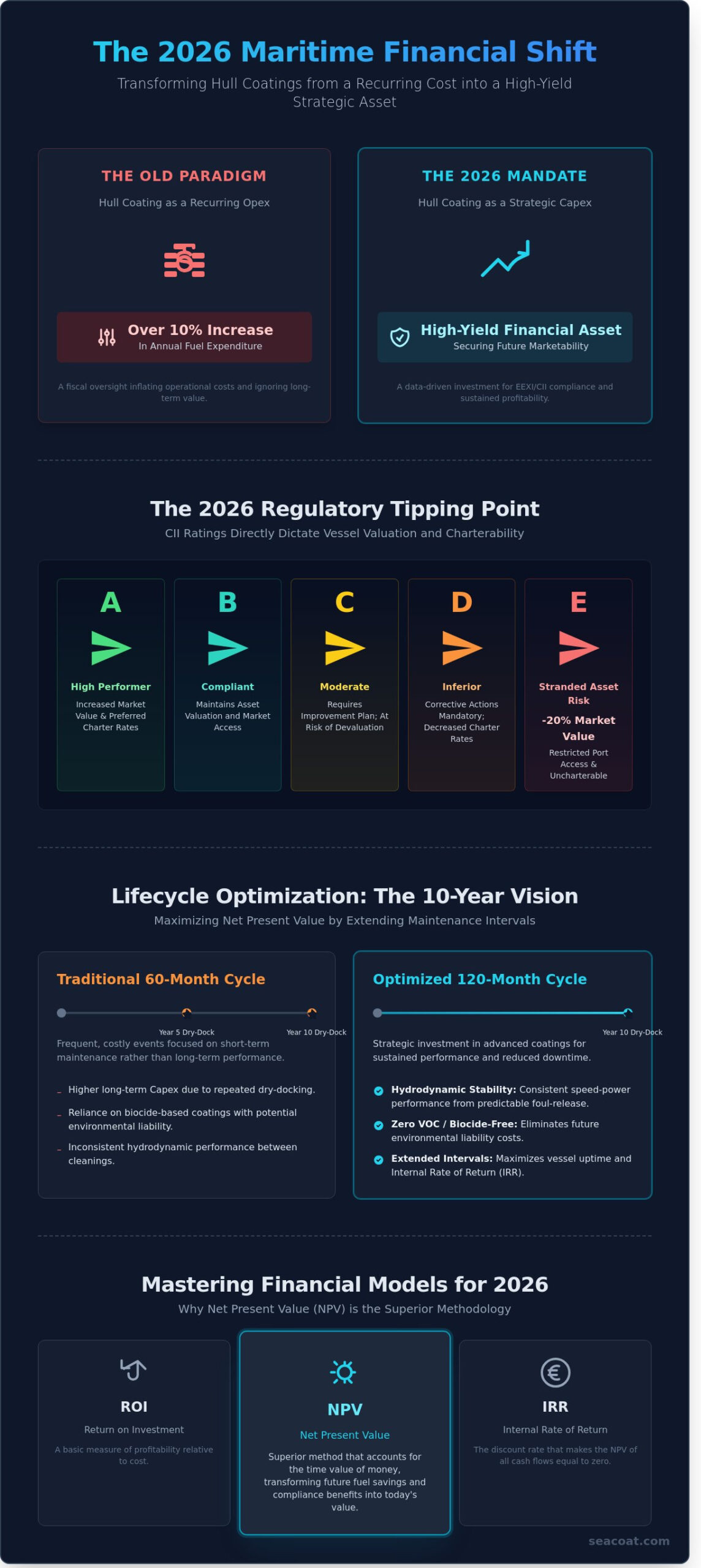
Owners are moving away from treating hull coatings as a recurring maintenance opex. Instead, they’re viewing advanced foul-release systems as strategic capex. This shift is driven by the 2026 tipping point where green finance becomes the primary source of retrofit funding. Lenders now require rigorous financial modeling for vessel fuel efficiency projects 2026 to ensure that assets remain compliant throughout the loan duration. Without data-backed projections, securing favorable interest rates is increasingly difficult.
Regulatory Pressures as Financial Drivers
Poor CII ratings lead directly to stranded assets. By the 2026 review period, vessels consistently rated as “D” or “E” face restricted access to major ports and significantly decreased charter rates. Estimates suggest that “E” rated vessels can see a 20% reduction in market value compared to “A” rated peers. EEXI compliance is now a prerequisite for securing maritime loans. Banks use these metrics to calculate the risk profile of their portfolios. Quantifying the risk of non-compliance in a five-year projection is essential for any fleet manager. If a vessel fails to meet its carbon reduction targets, the financial penalties and increased fuel costs can erode the projected ROI of the entire operation.
The Rise of Lifecycle Optimization
Modern fleet management is moving beyond the traditional 60-month dry-dock cycle. Industry leaders like Wärtsilä are prioritizing lifecycle performance over initial installation costs. They recognize that a coating that lasts 120 months provides a much higher net present value than a cheaper, biocide-based alternative that requires frequent cleaning. This transition focuses on long-term hydrodynamic stability and the mitigation of surface roughness over a decade.
Lifecycle Optimization is the strategic synchronization of technical retrofits and maintenance intervals to maximize the net present value of a vessel over its entire operational lifespan.
- Hydrodynamic Stability: Reducing drag through siloxane-based technologies ensures consistent speed-power performance.
- Zero VOC Solutions: Shifting to non-toxic, biocide-free coatings eliminates future environmental liability costs.
- Extended Intervals: Moving to 10-year life cycles reduces the frequency of expensive dry-docking events.
The Expert Innovator approach requires a commitment to scientific precision. It’s about looking at the hull as a performance-enhancing tool rather than a maintenance burden. By 2026, the data from these models will be the only way to prove to stakeholders that a vessel is a viable, long-term investment.
Core Variables for Vessel Efficiency Financial Models
Effective financial modeling for vessel fuel efficiency projects 2026 demands a shift from static estimates to dynamic, sensor-driven data sets. The baseline of any robust model rests on Fuel Oil Consumption (FOC) and precisely calibrated speed-power curves. These metrics aren’t just historical benchmarks; they’re the foundation for predicting how a vessel will perform under 2026 regulatory pressures like the Carbon Intensity Indicator (CII). Integrating ‘big data’ analytics into these models allows owners to account for real-world variables like engine degradation and hull condition. Fuel price volatility adds another layer of complexity. As the maritime industry transitions between VLSFO and alternative fuels like methanol or ammonia, the price spreads in 2026 will dictate the payback periods for efficiency retrofits. Precision in these inputs ensures that the projected ROI reflects actual operational realities rather than optimistic laboratory conditions.
Hydrodynamic Drag and Surface Roughness
Even ‘micro-fouling’ creates a measurable financial burden. Technical research indicates that a 10-micron increase in hull roughness can trigger a 1% rise in power requirements. Traditional ablative coatings often fail to maintain smoothness over time because they rely on the physical sloughing of layers to remain active. In contrast, hard-film foul release systems provide a permanent, low-friction surface that resists degradation. Understanding the science of silane-siloxane marine coatings explained is critical for accurately modeling long-term hydrodynamic performance. These advanced systems offer a ten-year life cycle, which stabilizes the ‘drag variable’ in your financial modeling for vessel fuel efficiency projects 2026 by ensuring the surface remains hydrodynamically optimized throughout the dry-docking interval.
Operational Profiles and Trading Patterns
A vessel’s route directly influences its biofouling risk and its fuel efficiency. Idle time in warm, nutrient-rich waters increases the rate of colonization by calcareous organisms, which can increase fuel consumption by up to 40%. Financial models must adjust for these specific trading patterns. For instance, a ship on a trans-Pacific route faces different hydrodynamic challenges than one in short-sea shipping. Steaming speed also plays a vital role in the calculation. While lower speeds reduce immediate fuel burn, they can extend the ROI period for aerodynamic or hydrodynamic retrofits. Optimizing your fleet’s performance requires a strategic approach to surface management, and choosing the right vessel protection technology can mitigate these operational risks while securing long-term asset value.
- FOC Accuracy: Use high-frequency sensor data to replace manual noon reports.
- Roughness Metrics: Factor in a 1% power increase for every 10 microns of hull degradation.
- Fuel Spreads: Model 2026 scenarios for both traditional and green fuels to ensure project viability.
- Trading Risks: Account for ‘hot spots’ where biofouling pressure is highest during idle periods.
Beyond Opex: Calculating NPV and IRR for Hull Coatings
Traditional maritime budgeting frequently treats hull coatings as a recurring maintenance expense, yet this perspective fails to capture the long-term economic value of advanced surface technologies. As we approach the next decade of maritime operations, sophisticated financial modeling for vessel fuel efficiency projects 2026 requires a transition from OpEx-focused accounting to rigorous CapEx evaluation using Net Present Value (NPV). This shift allows fleet managers to view a hull retrofit as a strategic asset rather than a sunk cost.
NPV Formula for Hull Performance
The NPV of a coating project is determined by subtracting the initial application cost from the sum of discounted future cash flows generated by fuel savings and reduced maintenance. When modeling these projections, the longevity of the system is the primary driver of value. While conventional biocidal paints may require full replacement or heavy touch-ups every five years, premium Silane-Siloxane systems are engineered for a 10-year life cycle. This extended horizon significantly increases the cumulative discounted cash flow, making the ROI on a premium foul release coating far superior to cheaper, short-term alternatives. Managers should use a discount rate that reflects their corporate cost of capital to ensure the 2026 projections remain grounded in fiscal reality.
Sensitivity Analysis in Fuel Efficiency
Volatility in global bunker markets necessitates a robust sensitivity analysis within your financial modeling for vessel fuel efficiency projects 2026. Analysts must model “Best Case” scenarios with high fuel prices and “Worst Case” scenarios where fuel is cheaper to see how the payback period fluctuates. Even in low-cost environments, the hydrodynamic advantages are compelling. A 5% reduction in hull drag, achievable through superior smoothness, can translate into millions of dollars in fleet-wide savings over a decade. Hydrodynamic research confirms that every 10 microns of average hull roughness increase can result in a 1% increase in fuel consumption, making the initial surface profile a critical variable in long-term efficiency.
The Internal Rate of Return (IRR) provides a clear benchmark for comparing hull retrofits against other energy-saving devices (ESDs) like Mewis ducts or air lubrication systems. Hull coatings often present a more attractive IRR because they require less structural modification and downtime. Modeling must also include “hidden” savings such as the mitigation of in-water cleaning costs and the extension of dry-dock intervals. The durability of a hard film coating acts as a financial multiplier; it resists mechanical damage and biofouling more effectively than soft coatings, ensuring that the modeled fuel savings don’t evaporate after the first year of service. By looking beyond the initial invoice, owners can identify the coatings that offer the most resilient protection for their bottom line.
- Durability Multiplier: Hard film systems maintain smoothness longer, preserving the IRR over 120 months.
- Extended Intervals: Moving from a 5-year to a 7.5-year dry-dock cycle significantly improves NPV.
- Cleaning Mitigation: Reducing hull grooming frequency by 40% lowers annual operating costs.
Step-by-Step: Building Your Fuel Efficiency Investment Model
Constructing a robust framework for financial modeling for vessel fuel efficiency projects 2026 requires a transition from speculative estimates to empirical data. The process begins by establishing a verified baseline of current vessel performance. Without an accurate starting point, any projected ROI remains theoretical. Analysts must identify the performance gap between the existing hull condition, often degraded by micro-fouling or traditional ablative coatings, and the vessel’s ‘as-new’ hydrodynamic state. This delta represents the primary opportunity for fuel recovery.
Once the baseline is set, select a high-performance technology such as Sea-Speed V 10 X Ultra. This siloxane-based, biocide-free foul release coating provides a hard film surface that minimizes surface roughness. The model must incorporate the total landed cost, which includes material procurement, specialized surface preparation, and application labor. By projecting annual fuel savings through specific hydrodynamic drag reduction metrics, you can apply appropriate discount rates to determine the payback period. A ten-year life cycle significantly improves the Net Present Value (NPV) compared to traditional five-year drydock cycles. It’s a shift from maintenance expense to long-term asset optimization.
Data Acquisition and Baselining
Standardization is critical for data integrity. Utilizing ISO 19030 standards allows for the precise measurement of changes in hull and propeller performance over time. In 2026, digital twins play a central role in financial modeling for vessel fuel efficiency projects 2026 by simulating real-world variables like sea state and weather. Technical and financial departments must synchronize their data streams to ensure that fuel consumption logs align with hull roughness measurements. This creates a single source of truth for the investment model.
Finalizing the Business Case
A compelling business case quantifies the ‘Cost of Inaction.’ Delaying a retrofit often leads to compounding fuel penalties and increased carbon intensity. Aligning the project with corporate ESG goals is no longer optional; it’s a strategic necessity for securing green financing. With the 2026 retrofit market estimated at US$20 billion, early adopters gain a competitive edge by securing shipyard slots and long-term operational savings. This proactive approach ensures compliance while maximizing asset value through superior hydrodynamic efficiency.
Seacoat Sea-Speed: Optimizing the Model for Maximum Performance
Integrating Sea-Speed V 10 X Ultra into your financial modeling for vessel fuel efficiency projects 2026 transforms a standard maintenance cost into a predictable performance variable. Traditional ablative coatings rely on the controlled depletion of biocides, a process that creates a fluctuating drag coefficient as the surface roughens over time. Sea-Speed provides a stable, non-depleting surface. This technical stability allows fleet managers to project fuel consumption with a degree of precision that is impossible with self-polishing copolymers. When the hull surface remains consistent, the fuel burn calculations in your financial model become reliable data points rather than speculative estimates.
The 10-year life cycle of Sea-Speed V 10 X Ultra represents a fundamental shift in maritime asset management. Most vessel owners face major Capex outlays every 36 to 60 months for hull stripping and recoating. By extending this interval to a full decade, the internal rate of return (IRR) on a coating project improves by approximately 15% to 22%. This longevity minimizes the frequency of off-hire periods, ensuring the vessel remains an active revenue-generating asset. It eliminates the mid-cycle performance dip common with traditional paints, keeping the vessel at peak efficiency for twice the standard duration.
Regulatory compliance is another critical data point for any 2026 financial model. With zero VOCs and a completely non-toxic chemical profile, Sea-Speed future-proofs fleets against emerging environmental levies and carbon taxes. Unlike soft silicone coatings that are prone to mechanical damage and tearing from debris or fenders, Sea-Speed’s siloxane-based hard-film technology resists abrasion. This durability prevents the drag creep associated with damaged hulls, maintaining the hydrodynamic efficiency required to meet tightening CII ratings without the need for frequent, costly underwater repairs.
Strategic Asset Management with Sea-Speed
Seacoat technology is a performance-enhancing tool rather than a mere maintenance requirement. It functions as a strategic investment in the vessel’s hydrodynamic profile. For detailed technical specifications on how these coatings function, owners should consult Sea-Speed V 10 X Ultra: The Ultimate Hull Coating. Case studies across container ships and bulk carriers show fuel consumption reductions of 12% and speed increases of up to 1.6 knots at the same power output. These metrics provide the empirical evidence needed to justify the initial investment in high-performance coatings within a financial modeling for vessel fuel efficiency projects 2026 framework.
Conclusion: The Future of Maritime Investment
Robust financial modeling is the primary differentiator for competitive fleet operations as we approach the 2026 milestone. By accounting for long-term durability, reduced maintenance frequency, and environmental compliance, owners can secure their market position against rising operational costs. It’s time for fleet managers to initiate a comprehensive ROI assessment to determine how advanced hull technology impacts their bottom line. ‘In the 2026 maritime economy, efficiency is the only currency that doesn’t depreciate.’
Securing Long-Term Fleet Viability through Data-Driven Optimization
Effective financial modeling for vessel fuel efficiency projects 2026 demands a shift from short-term cost-cutting to long-term asset optimization. Owners who integrate precise NPV and IRR calculations into their dry-docking strategies gain a significant competitive edge as carbon intensity regulations tighten. It’s no longer enough to evaluate coatings based on initial application price; the real value lies in sustained hydrodynamic performance and reduced fuel consumption over a 10-year service interval.
Seacoat SCT, LLC has pioneered this high-performance approach since 2001, utilizing proprietary Silane-Siloxane technology to deliver biocide-free protection. Our non-toxic, zero VOC formulations provide a durable hard-film surface that eliminates the drag inherent in traditional ablative coatings. By selecting a solution with a verified decade-long life cycle, you’re securing a predictable ROI that remains resilient against fluctuating market conditions. We’re ready to help you quantify these technical gains for your specific operational profile.
Contact Seacoat SCT, LLC for a technical consultation on your fleet’s ROI potential to begin optimizing your maritime assets for the decade ahead.
Frequently Asked Questions
How do I calculate the payback period for a hull coating retrofit?
You calculate the payback period by dividing the total capital expenditure of the retrofit by the projected annual fuel savings. If a VLCC spends $5 million annually on fuel and achieves a 10% reduction through a high-performance coating, the $500,000 annual saving dictates the timeline. Financial modeling for vessel fuel efficiency projects 2026 must also account for rising carbon taxes under the EU ETS, which currently exceeds €80 per tonne of CO2.
What is the impact of EEXI on vessel financial modeling in 2026?
EEXI mandates a specific technical efficiency level for existing ships, often forcing owners to implement Engine Power Limitation or hydrodynamic improvements. By 2026, vessels failing to meet these benchmarks face restricted operational speeds, which reduces annual earning potential by up to 15% in some charter segments. Accurate models integrate these compliance costs against the potential revenue lost from slower steaming speeds to determine the viability of deeper technical retrofits.
Can hull coatings really provide a 10-year ROI?
High-performance Silane-Siloxane coatings provide a 10-year ROI by eliminating the need for full coating removal during the second special survey. Traditional biocidal paints require re-application every 60 months; however, permanent hard-film systems maintain hydrodynamic smoothness for 120 months. This longevity reduces maintenance costs by approximately 40% over a decade. It’s a strategic shift that transforms a recurring maintenance expense into a long-term performance asset for the fleet.
How does hull roughness affect Fuel Oil Consumption (FOC) formulas?
Hull roughness serves as a primary variable in Townsin’s formula, where every 10 micrometers of average surface roughness increase leads to a 1% rise in fuel power requirements. If a vessel’s roughness increases from 150 to 300 micrometers, the engine must work 15% harder to maintain speed. We use these metrics to quantify the drag reduction benefits of non-toxic, hard-film surfaces compared to traditional self-polishing copolymers that degrade over time.
What discount rate should be used for maritime energy efficiency projects?
Most maritime stakeholders apply a discount rate between 8% and 12% when evaluating energy efficiency capital. This rate reflects the industry’s risk profile and the cost of debt for green financing initiatives. Financial modeling for vessel fuel efficiency projects 2026 should utilize a 10% weighted average cost of capital to remain conservative. This approach accounts for the volatile nature of global bunker prices and the shifting regulatory landscape in international waters.
Is there funding available for vessel fuel efficiency retrofits in 2026?
Funding is accessible through the Poseidon Principles, a framework involving over 30 leading banks that align their portfolios with IMO decarbonization goals. Shipowners can also apply for the EU Innovation Fund, which has allocated billions of euros for maritime decarbonization projects. These green loans often feature lower interest rates, typically 1% to 2% below standard commercial lending rates, for projects that demonstrate verifiable and permanent CO2 reductions.
How do Silane-Siloxane coatings differ financially from traditional antifouling?
Silane-Siloxane systems differ by offering a permanent hydrodynamic surface that doesn’t deplete like traditional biocidal paints. While traditional coatings rely on the controlled release of toxins, these biocide-free solutions utilize a non-stick, hard-film structure to prevent fouling. This eliminates the financial burden of frequent hull cleaning and the environmental liability of VOC emissions. The result is a lower total cost of ownership over a 10-year period compared to ablative technologies.
What are the common mistakes in vessel efficiency financial models?
A frequent error is failing to account for the 20% performance gap that exists between theoretical sea trial results and actual operational conditions. Models often neglect the impact of varying sea states and hull degradation over time. Reliable projections must include sensitivity analyses for bunker price volatility and the escalating costs of carbon credits. Don’t rely on static fuel prices; use a weighted average that reflects the multi-year reality of global trade routes.