
In the high-stakes environment of 2026 maritime operations, the difference between a high-performance hull and a costly operational liability often comes down to a few microns of profile. You’re likely feeling the mounting pressure from the IMO’s PSPC-2026 standards and the expanded EU ETS regulations to move away from traditional biocidal systems. Achieving the necessary hydrodynamic efficiency requires a shift in perspective; surface preparation for foul release coating is no longer a routine maintenance task, but a precise engineering requirement.
We understand that the high costs of coating failure and the confusion surrounding AMPP standards for non-toxic systems can make these transitions feel risky. This guide provides the technical clarity you need to master the protocols necessary for maximum adhesion and a zero-fail application. We’ll examine the rigorous technical requirements and the specific chemical mechanisms that drive long-term return on investment through measurable reductions in fuel consumption and extended dry-dock intervals. By aligning mechanical preparation with fluid dynamics, you can transform your hull into a strategic asset that preserves both natural ecosystems and your bottom line.
Key Takeaways
- Understand why rigorous surface preparation for foul release coating is the primary determinant of long-term adhesion and hydrodynamic efficiency compared to traditional ablative methods.
- Learn the specific mechanical anchor profiles and surface energy requirements necessary to ensure optimal wetting and bonding for advanced silane-siloxane systems.
- Identify the critical risks associated with over-coating legacy paints and why achieving a Near-White Metal Blast (SSPC-SP 10) is mandatory for maximum performance.
- Master the precise application sequence using Seapoxy 73 as the essential tie-coat to secure the Sea-Speed V 10 X Ultra system to the substrate.
- Explore how engineering a low-friction hull through proper preparation leads to measurable fuel savings and significantly extended dry-dock intervals.
Why Surface Preparation Dictates Foul Release Coating Success
Surface preparation for foul release coating represents the critical foundation upon which all subsequent engineering successes are built. In the context of high-performance marine systems, this process is defined as the systematic elimination of all surface contaminants, including chlorides, oils, and previous coating residues, followed by the creation of a precise mechanical profile. Unlike traditional ablative paints that function through a sacrificial cycle, advanced systems such as Sea-Speed V 10 X Ultra are engineered as durable, hard-film barriers. These modern technologies require significantly higher preparation standards because they lack the chemical forgiveness of biocidal coatings. If the substrate is compromised by even trace amounts of salt or poor profile consistency, the coating can’t achieve its intended service life.
The relationship between substrate integrity and long-term durability is absolute. In high-shear environments where vessels operate at sustained speeds, the hydrodynamic forces acting upon the hull are immense. Cutting corners during the preparation phase often results in catastrophic delamination, leading to expensive unscheduled dry-docking and complete system failure. Understanding The Physics of Biofouling is essential here; organisms seek any irregularity or weak bond to gain a foothold. A flawless preparation ensures that the coating remains a permanent strategic asset rather than a temporary fix.
The Functional Difference in Adhesion Mechanisms
While older technologies rely primarily on basic mechanical anchoring, Sea-Speed V 10 X Ultra utilizes sophisticated Silane-Siloxane technology to interact with a properly prepared substrate. This requires a balance between the mechanical tooth created by abrasive blasting and the chemical readiness of the metal or composite. Surface energy is the quantitative measure of the disruptive forces at a material’s surface that determines its ability to attract or repel organic attachment. By managing this energy through precise preparation and the application of Seapoxy 73, we create a surface that is fundamentally inhospitable to marine growth.
The Impact of Surface Profile on Hydrodynamic Drag
The technical rigor of surface preparation directly influences the vessel’s eventual fuel consumption. Adhering to strict AMPP and SSPC standards ensures that the final slickness of the hull isn’t compromised by underlying peaks or valleys in the substrate. A smoother preparation phase allows the foul release system to level effectively, creating an ultra-low-friction interface with the water. By reducing skin friction through rigorous substrate leveling, operators can achieve measurable improvements in hydrodynamic efficiency. It’s a process that turns a standard maintenance requirement into a performance-enhancing tool.
The Physics of Adhesion: Surface Energy and Mechanical Anchor Profiles
Adhesion in the maritime sector is often misunderstood as a simple physical bond. In reality, it’s a sophisticated interaction between the coating’s chemistry and the substrate’s physical state. For high-performance systems like Sea-Speed V 10 X Ultra, the success of the application depends on “wetting.” This occurs when the liquid coating spreads across the surface, filling every microscopic void. If the surface energy is too low or contaminants are present, the coating will bead, leading to poor bond strength and eventual failure. Mastering the surface preparation for foul release coating ensures that the material achieves total contact with the substrate.
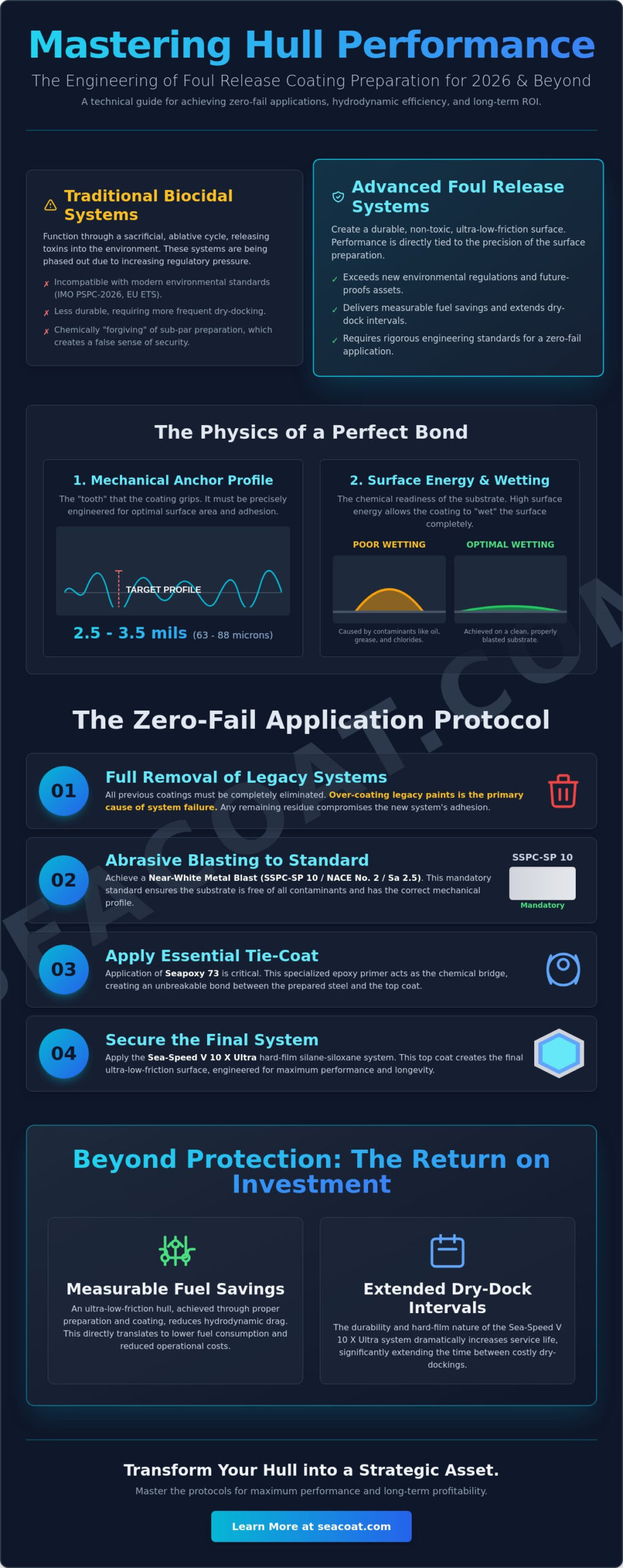
The mechanical anchor profile provides the necessary “tooth” for the coating to grip. For industrial foul release systems, engineers typically target a profile of 2.5 to 3.5 mils (63 to 88 microns). While height matters, the surface roughness (Ra) is equally vital. This metric describes the frequency and shape of the peaks and valleys. A surface that’s too jagged might create stress points, while one that’s too smooth won’t provide enough surface area for the bond. Common contaminants like chlorides, oils, and dust are the primary enemies of low surface energy coatings. Rigorous surface preparation for foul release coating eliminates these barriers to molecular interaction. Even microscopic salt crystals can draw moisture through the coating, causing osmotic blistering.
Measuring Anchor Profiles for Industrial Applications
Precision is non-negotiable during the inspection phase. Technicians rely on Testex replica tape to capture a physical mold of the surface, which is then measured with a micrometer. Digital profilometers offer a more modern approach, providing real-time data on peak density and Ra values. While steel hulls require a robust profile to counteract their inherent density, aluminum hulls demand a more nuanced approach to avoid over-thinning the metal. Maintaining a consistent peak-to-valley height across the entire hull is the only way to prevent localized delamination in high-shear zones. Inconsistent profiles lead to uneven coating thickness, which directly impacts the vessel’s hydrodynamic profile.
Managing Substrate Surface Energy
Grit blasting does more than just clean; it fundamentally alters the reactivity of the metal surface by exposing fresh, unoxidized atoms. This increased surface energy is short-lived, making the timing of the primer application critical. To verify cleanliness in the field, the “water break” test is a reliable method. If water sheets off the surface without beading, it indicates the absence of hydrophobic oils. When transitioning from legacy toxic paints, neutralizing the surface is a mandatory step to ensure no residual biocides interfere with the new system. Understanding these variables is key to moving away from the inefficiencies of ablative bottom paint and toward a more sustainable, high-performance future.
Removing Legacy Systems: Preparing the Hull for a Silane-Siloxane Transition
Transitioning a vessel from traditional biocidal systems to modern Silane-Siloxane technology is a fundamental shift in asset management. It’s not a simple matter of high-pressure washing and over-coating. Attempting to apply a high-performance system directly over old ablative bottom paint is a critical mistake that compromises the entire project. Ablative paints are engineered to erode over time; they possess low structural integrity and are designed to be sacrificial. When a hard-film, high-tension coating like Sea-Speed V 10 X Ultra is applied over these soft layers, the resulting “sandwich” effect leads to shearing at the weakest point. The legacy paint eventually delaminates from the substrate, taking the premium foul release system with it.
To ensure maximum performance, the industry standard for surface preparation for foul release coating is a Near-White Metal Blast (SSPC-SP 10). This protocol requires the removal of all visible oil, grease, dust, dirt, mill scale, rust, and previous coatings, leaving only minor streaks or discolorations. According to industry reports on coating failures, the presence of residual contaminants is the primary catalyst for premature system degradation. Chemical incompatibility also plays a significant role. Copper-based biocides can leach into the interface of new coatings, disrupting the molecular cross-linking of the silane-siloxane film. This often manifests as “ghosting,” where the profile of the old system becomes visible through the new coating, or as localized failures where the bond strength is neutralized by chemical interference.
Ablative vs. Hard Film Prep Requirements
The surface roughness requirements for sacrificial systems are significantly less demanding than those for permanent films. While ablative paints can often adhere to a loosely prepared surface, foul release systems require a stable, non-eroding foundation to withstand high-velocity hydrodynamic shear. As detailed in the definitive guide to boat hull paint, the long-term return on investment is only achievable when the coating becomes a permanent part of the hull’s structure. Surface preparation for foul release coating must prioritize this structural permanence over temporary convenience.
Environmental Protocols for Coating Removal
The removal of legacy TBT or copper paints involves strict regulatory compliance to prevent toxic biocide dust and runoff from entering the marine ecosystem. Containment strategies, such as full vacuum blasting or hydro-blasting with water filtration, are mandatory in modern shipyards. These rigorous cleaning protocols are the first step in meeting environmental marine coatings standards. By treating the stripping process with the same technical precision as the application, operators protect both their assets and the surrounding environment from volatile contaminants.
The Technical Protocol: Cleaning, Blasting, and Priming with Seapoxy 73
Executing a successful surface preparation for foul release coating requires more than just mechanical effort; it demands strict adherence to a specific environmental window. Technicians must monitor substrate temperature to ensure it remains at least 5°F (3°C) above the dew point, while relative humidity should stay below 85%. These conditions prevent the formation of microscopic moisture films that lead to “flash rust” on newly blasted steel. The interval between the final blast and the first coat of primer is a critical engineering window. If this period is extended beyond four hours in high-humidity environments, the surface energy of the metal begins to degrade, necessitating a re-sweep of the hull to restore the required profile.
Managing the time-to-prime interval is a race against atmospheric oxidation. Even a high-quality blast won’t compensate for a substrate that has begun to chemically stabilize before the primer is applied. By maintaining a tight protocol, we ensure that the primer interacts with the most reactive state of the metal, creating a bond that can withstand years of operational stress. This methodical approach is what separates a professional application from a temporary maintenance fix.
Step 1: Solvent Cleaning and Degreasing
The protocol begins with SSPC-SP 1 solvent cleaning to eliminate non-visible contaminants like grease, oil, and soluble salts. High-pressure washing is a necessary first step, but it’s insufficient for industrial foul release systems. Water cannot effectively emulsify deeply embedded petroleum products. In pitted steel or aged hulls, oils often hide within the microscopic topology of the metal. If these aren’t chemically removed, they’ll migrate to the surface during the curing phase, causing localized delamination of the primer. We use specialized solvents to ensure the substrate is chemically neutral before any abrasive media touches the surface.
Step 2: Abrasive Blasting to SSPC Standards
Selecting the correct abrasive media is vital for achieving the angular profile required for Seapoxy 73 adhesion. For steel hulls, coal slag or garnet is typically used to reach an SSPC-SP 10 Near-White Metal Blast, which requires the surface to be free of all visible oil, grease, dust, dirt, mill scale, rust, and previous coatings. When working with boat paint for aluminum boats, softer media like crushed glass or aluminum oxide should be used to prevent warping or excessive metal loss while still creating a sharp, consistent anchor profile. The goal is a uniform 2.5 to 3.5 mil profile that provides the maximum surface area for the epoxy bond.
Step 3: Application of Seapoxy 73 Primer
Seapoxy 73 serves as the indispensable tie-coat that bridges the gap between the metallic substrate and the foul release film. As a high-solids epoxy, it requires precise mixing ratios and a mandatory induction time to ensure the chemical reaction is fully initiated before application. Achieving the target Dry Film Thickness (DFT) is essential; too thin, and the corrosion protection is compromised; too thick, and the primer may solvent-trap or crack. Once the Seapoxy 73 has reached its specified tack-free state, the overcoat window for Sea-Speed V 10 X Ultra opens, ensuring a primary chemical bond between the epoxy and the silane-siloxane layers. To secure the long-term integrity of your vessel, order Seapoxy 73 as part of your coating system.
Beyond Protection: Achieving Operational ROI with Sea-Speed V 10 X Ultra
The culmination of a rigorous surface preparation for foul release coating is not merely a protected hull, but a high-performance hydrodynamic surface. While physical durability is vital, the primary driver for modern fleet managers is the measurable impact on operational expenditure. Sea-Speed V 10 X Ultra is engineered to provide an ultra-smooth finish that significantly reduces skin friction. Evidence-based performance metrics indicate that this system can reduce frictional drag by up to 10%, a figure that translates directly into substantial fuel savings across long-haul routes. By treating the hull as a performance-enhancing tool rather than a maintenance burden, operators transform a sunk cost into a strategic asset.
This efficiency is increasingly critical as the maritime industry faces tighter regulatory oversight. Compliance with the International Maritime Organization’s Energy Efficiency Existing Ship Index (EEXI) and the Carbon Intensity Indicator (CII) greenhouse gas regulations requires a multifaceted approach to emissions reduction. Hard-film coatings like Sea-Speed V 10 X Ultra play a pivotal role in these strategies by lowering the energy required for propulsion. Unlike soft silicone or ablative paints, this technology maintains its smooth profile over multiple service years, ensuring that carbon intensity ratings remain favorable throughout the vessel’s operational cycle.
The Economic Impact of Surface Smoothness
The correlation between Average Hull Roughness (AHR) and fuel consumption is well-documented in fluid dynamics. Every 10 microns of additional roughness can result in a measurable increase in fuel demand. A high-quality surface preparation for foul release coating ensures that the initial AHR is as low as possible, providing a baseline for decade-long efficiency. Because Sea-Speed V 10 X Ultra is a non-depleting, hard-film system, a service life of 10 years or more is entirely achievable with proper initial preparation. This longevity drastically reduces dry-dock frequency, allowing vessels to remain in service for extended windows and maximizing the return on investment for the initial application.
Regulatory Compliance and Environmental Stewardship
The shift away from biocidal antifouling is no longer optional; it’s a regulatory mandate. With global bans on toxic additives and increasing restrictions on copper leaching, non-biocidal systems are the only viable path forward. Hard-film coatings offer a distinct advantage in protected marine sanctuaries and environmentally sensitive areas where the discharge of heavy metals is strictly prohibited. By choosing a biocide-free solution, fleet managers demonstrate a serious commitment to preserving natural ecosystems while simultaneously protecting their operational bottom line. To optimize your asset’s performance and ensure compliance with 2026 standards, consult with Seacoat experts for your fleet-wide coating strategy.
Engineering the Future of Fleet Efficiency
Achieving decadal performance in the maritime sector requires a fundamental shift from temporary maintenance to precise surface engineering. The success of any advanced foul release system is built upon the structural integrity of the substrate and the exactness of the mechanical profile. By prioritizing a Near-White Metal Blast and utilizing high-solids tie-coats like Seapoxy 73, you eliminate the risks of delamination and ensure your hull remains a low-friction asset.
Proper surface preparation for foul release coating is the only reliable way to meet the stringent EEXI and CII standards of 2026 while protecting sensitive marine ecosystems. Our proprietary Silane-Siloxane technology has been in commercial use since 2001, providing a proven, biocide-free alternative to traditional toxic paints. These non-toxic formulas are fully compliant with global regulations and offer a sustainable path toward measurable fuel efficiency.
To see how these engineering standards translate into real-world results, explore the Sea-Speed V 10 X Ultra technical specifications and case studies. Transitioning to a high-performance, hard-film system is a strategic investment in the longevity and intelligence of your maritime operations.
Frequently Asked Questions
What is the required SSPC standard for foul release coating application?
For commercial vessels, the required benchmark is SSPC-SP 10, also known as a Near-White Metal Blast. This protocol ensures the removal of all visible rust, mill scale, and previous coatings, leaving only minor streaks on the metal surface. Achieving this level of cleanliness is vital for the adhesion of hard-film systems. Without meeting this standard, the bond strength of your foul release system may be compromised under high-shear hydrodynamic forces.
Can I apply Sea-Speed V 10 X Ultra over my existing antifouling paint?
You shouldn’t apply Sea-Speed V 10 X Ultra over existing antifouling paint. Traditional ablative coatings are engineered to erode, making them an unstable foundation for a permanent, hard-film system. Over-coating leads to delamination as the old layers shear away from the hull over time. Complete removal of legacy systems ensures the new coating achieves its full service life and maximum hydrodynamic efficiency while preventing chemical interference.
Why is the anchor profile so critical for silane-siloxane coatings?
The anchor profile is critical because it provides the mechanical tooth necessary for the coating to grip the substrate effectively. For silane-siloxane systems, a profile of 2.5 to 3.5 mils is typically required to maximize the surface area for bonding. This specific roughness is essential for low-surface-energy films to resist peeling. Proper surface preparation for foul release coating ensures the material doesn’t delaminate under heavy operational loads or high-speed transit.
How do I test for chloride contamination before applying the primer?
Technicians should use a Bresle patch test to measure soluble salt concentrations on the substrate before any primer is applied. High chloride levels can lead to osmotic blistering and premature coating failure if they aren’t properly neutralized. We recommend keeping chloride levels below 3 µg/cm² for industrial applications. If levels are high, the hull must be pressure washed with deionized water before the final abrasive blast and priming phase begin.
What primer should be used with Seacoat foul release systems?
Seapoxy 73 is the mandatory primer and tie-coat for all Sea-Speed systems. This high-solids epoxy is specifically formulated to bond with metallic substrates while providing a chemically receptive surface for the silane-siloxane finish. It acts as the primary corrosion barrier and the structural bridge for the entire coating system. Using an unapproved primer can lead to chemical incompatibility and catastrophic failure of the foul release topcoat.
Is abrasive blasting necessary for aluminum hulls, or can I use power tools?
Abrasive blasting with non-metallic media like crushed glass is strongly preferred over power tools for aluminum hulls. While power tools can clean a surface, they often fail to create the uniform angular profile required for industrial adhesion. Blasting ensures a consistent mechanical tooth without the risk of polishing the metal or leaving it too smooth. It’s essential to use softer abrasives to prevent warping the aluminum plating while achieving the target profile.
What happens if the overcoat window for the primer is missed?
If you miss the overcoat window for the Seapoxy 73 primer, the surface may become too hard and inert for a chemical bond to occur. In this scenario, the primer must be lightly abraded or sweep blasted to restore mechanical reactivity before applying the Sea-Speed V 10 X Ultra. Following the manufacturer’s specified timing is the most efficient way to ensure a primary bond between the epoxy and the foul release layers.
How does surface preparation affect the fuel efficiency of the vessel?
The quality of the surface preparation for foul release coating directly impacts fuel efficiency by determining the final Average Hull Roughness. A smoother, more level substrate allows the coating to form a perfectly slick interface with the water, reducing skin friction. This can lower fuel consumption by up to 10% during sustained operations. Precise engineering at the preparation stage turns the hull into a performance-enhancing tool rather than an operational liability.