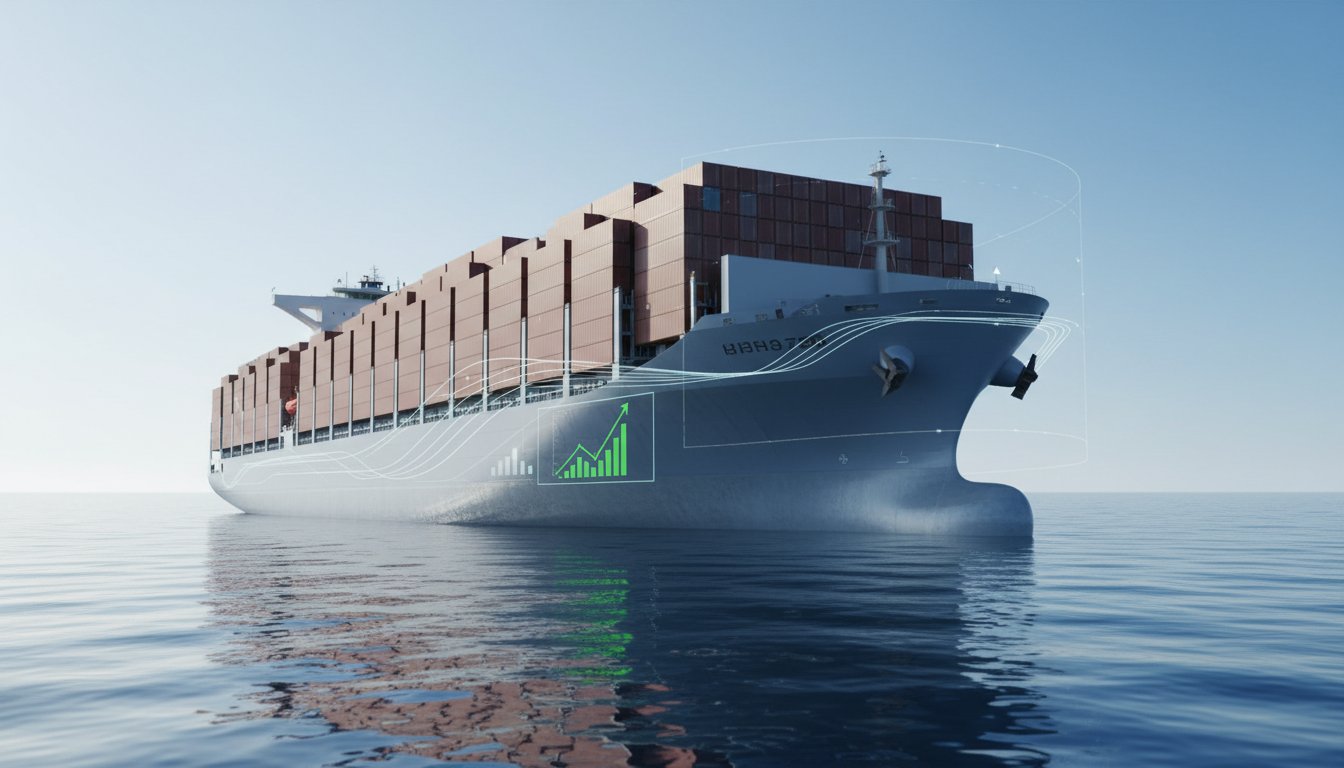
Engine Power Limitation is an incomplete and commercially restrictive answer to the EEXI mandate. For fleet managers and vessel owners, the prospect of sacrificing operational speed for regulatory compliance creates an immediate conflict with charter-party agreements and profitability. This dilemma is compounded by the significant capital expenditure and downtime required for mechanical retrofits, which often fail to address the fundamental variable of hydrodynamic drag that accounts for up to 10% of a vessel’s total fuel consumption.
This analysis details a more intelligent, non-mechanical pathway to decarbonization. We will demonstrate how advanced, biocide-free siloxane coatings function as one of the market’s most effective EEXI compliance solutions, directly mitigating greenhouse gas emissions by systematically optimizing a vessel’s hydrodynamic profile. By examining the data that connects ultra-low surface roughness to sustained fuel efficiency, you’ll discover how to preserve propulsive power and extend dry-dock intervals to ten years, delivering a superior long-term return on investment.
Key Takeaways
- Understand the critical link between IMO GHG reduction targets and the upcoming 2026 EEXI enforcement deadline for existing vessels.
- Evaluate the direct impact of frictional resistance and hull roughness on your EEXI rating to identify key areas for efficiency gains.
- Compare the long-term ROI of advanced hull coatings against the operational limitations of mechanical retrofits like Engine Power Limitation (EPL).
- Formulate a strategy using non-mechanical EEXI compliance solutions that preserve operational speed while delivering a superior return on investment.
Understanding EEXI Compliance Solutions in 2026
The Energy Efficiency Existing Ship Index (EEXI) represents a pivotal, non-negotiable shift in maritime regulation. Mandated by the International Maritime Organization (IMO), EEXI is a technical design index that requires existing vessels over 400 GT to meet a specific energy efficiency standard. While the initial compliance deadline was January 1, 2023, the year 2026 marks a critical juncture where the efficacy of initial measures will be scrutinized against the IMO’s aggressive long-term greenhouse gas (GHG) reduction targets, including the goal of a 40% reduction in carbon intensity by 2030 compared to 2008 levels. The core challenge isn’t just achieving a compliant number on paper; it’s implementing strategic EEXI compliance solutions that enhance, rather than hinder, a vessel’s operational and commercial viability.
Many operators initially chose the path of least resistance: Engine Power Limitation (EPL) or Shaft Power Limitation (ShaPoLi). This approach mechanically restricts engine output to meet the required EEXI value. While technically compliant, this strategy often introduces significant speed loss, transforming a regulatory challenge into a persistent operational handicap. True compliance requires a holistic view that integrates three distinct pillars of efficiency: mechanical, digital, and hydrodynamic optimization.
The Regulatory Deadline and Requirements
Compliance is verified through a rigorous documentation process. Each vessel must have an updated EEXI Technical File containing its calculated attained EEXI value, which is then verified by the flag state or a recognized organization. Upon successful verification, the vessel is issued a new International Energy Efficiency Certificate (IEEC). The framework for these requirements falls under Annex VI of the International Convention for the Prevention of Pollution from Ships, better known as the MARPOL 73/78 regulations. Non-compliance carries severe penalties, including potential detention by Port State Control, invalidation of insurance, and rejection by charterers, effectively rendering a vessel commercially unviable in global shipping lanes.
Why Power Limitation is Not Always the Answer
Relying solely on EPL is a flawed strategy with cascading consequences. Commercially, it creates a direct conflict with charter party agreements that stipulate specific service speeds. A vessel that cannot maintain its warranted speed due to power limitations is a vessel in breach of contract, exposing owners to performance claims and significant financial losses. Operationally, the safety implications are profound. IMO guidelines (MEPC.335(76)) specify minimum propulsion power requirements to maintain maneuverability in adverse weather. An over-limited engine may lack the reserve power needed to navigate heavy seas, compromising the safety of the crew, vessel, and cargo. This speed reduction also has a macroeconomic impact, extending transit times and disrupting finely tuned global supply chains that depend on predictable vessel schedules.
A vessel’s efficiency is not static. It’s a dynamic equation influenced by engine performance, operational parameters, and, critically, hydrodynamic resistance. To move beyond the limitations of simple power reduction, forward-thinking owners are adopting a multi-faceted approach. This strategy leverages a combination of solutions:
- Mechanical Solutions: Engine modifications, waste heat recovery systems, and fuel system upgrades.
- Digital Solutions: Advanced weather routing, voyage optimization software, and real-time performance monitoring.
- Hydrodynamic Solutions: Propeller upgrades, air lubrication systems, and advanced hull coatings that minimize frictional drag.
By optimizing the hull’s interaction with water, operators can achieve the required efficiency gains without sacrificing the power essential for safe and commercially competitive operations.
The Hydrodynamic Lever: How Hull Roughness Affects EEXI
A vessel’s journey through water is a constant battle against resistance, and the dominant force in this conflict is frictional resistance. This hydrodynamic drag, generated by the friction between the hull surface and the water, can account for up to 80% of a ship’s total resistance at design speed. This physical reality is encoded directly into the EEXI formula, where the engine power required to propel the vessel is a critical input. An increase in hull friction necessitates more power to maintain a given speed, directly degrading the ship’s Attained EEXI and pushing it closer to non-compliance. Therefore, managing the hull surface isn’t just a matter of maintenance; it’s a primary lever for controlling a vessel’s certified energy efficiency.
Drag Calculation and Vessel Performance
Hydrodynamic efficiency is determined at the micron level. A seemingly smooth surface can possess a texture that creates turbulent boundary layers, trapping water and dramatically increasing drag. An increase in Average Hull Roughness (AHR) from a near-perfect 75 microns to a more typical 150 microns can elevate fuel consumption by 6-8%. Traditional ablative anti-fouling paints contribute to this problem over their lifecycle. Their mechanism of releasing biocides involves the paint film itself eroding away, which systematically increases surface roughness and creates a compounding drag penalty that worsens with each year of service. Modern computational fluid dynamics (CFD) can now model these effects with remarkable precision, predicting the specific reduction in resistance and corresponding fuel savings achievable with advanced, low-friction coatings.
Biofouling as a Compliance Risk
The threat to a vessel’s EEXI rating begins almost immediately upon entering the water. A microbial slime layer, often invisible to the naked eye, can form within 72 hours of a vessel being stationary, yet it can increase total vessel resistance by as much as 20%. Traditional biocidal paints are designed to combat this, but their effectiveness wanes as the biocides leach out over 24-36 months. This leaves a rough, depleted surface that becomes a prime substrate for aggressive colonization by algae and animal fouling. Hydrodynamic friction is the resistive force generated as a vessel’s hull displaces water, a value directly influenced by surface roughness and bio-adhesion that dictates the engine power required to maintain the EEXI Vref.
The link between biofouling and fuel consumption is severe and well-documented. IMO-commissioned studies confirm that even a light slime can increase GHG emissions by 10-15%, while heavy calcareous fouling from barnacles can impose a fuel penalty exceeding 40%. This catastrophic loss of efficiency makes long-term EEXI compliance impossible and runs counter to the global push for decarbonization. This challenge is central to international maritime policy, with bodies like the EPA on MARPOL Annex VI detailing the stringent enforcement of emissions standards that make operational efficiency a regulatory necessity. To address this, the industry relies on two fundamentally different technologies:
- Anti-fouling systems operate on a chemical principle. They are formulated with biocides, such as cuprous oxide, that slowly leach into the surrounding water to poison and kill marine organisms that attempt to attach. This method is finite, has a defined service life, and introduces toxic substances into the marine environment.
- Foul release systems operate on a physical principle. They create an ultra-smooth, low-surface-energy coating, typically using siloxane-based chemistry. This non-stick surface makes it extremely difficult for organisms to gain a secure foothold. The vessel’s own movement through the water, usually above 8 knots, generates enough hydrodynamic force to wash away any loosely attached organisms.
Ultimately, a vessel’s hull condition is a direct reflection of its operational and environmental performance. The transition from finite chemical deterrents to permanent physical barriers represents one of the most effective EEXI compliance solutions available to shipowners today. By investing in a surface that remains smooth and resists fouling for a decade or more, operators secure a predictable and optimized level of hydrodynamic efficiency. Explore the technical specifications of biocide-free coatings to see how this technology provides a stable foundation for long-term regulatory adherence and fuel savings.
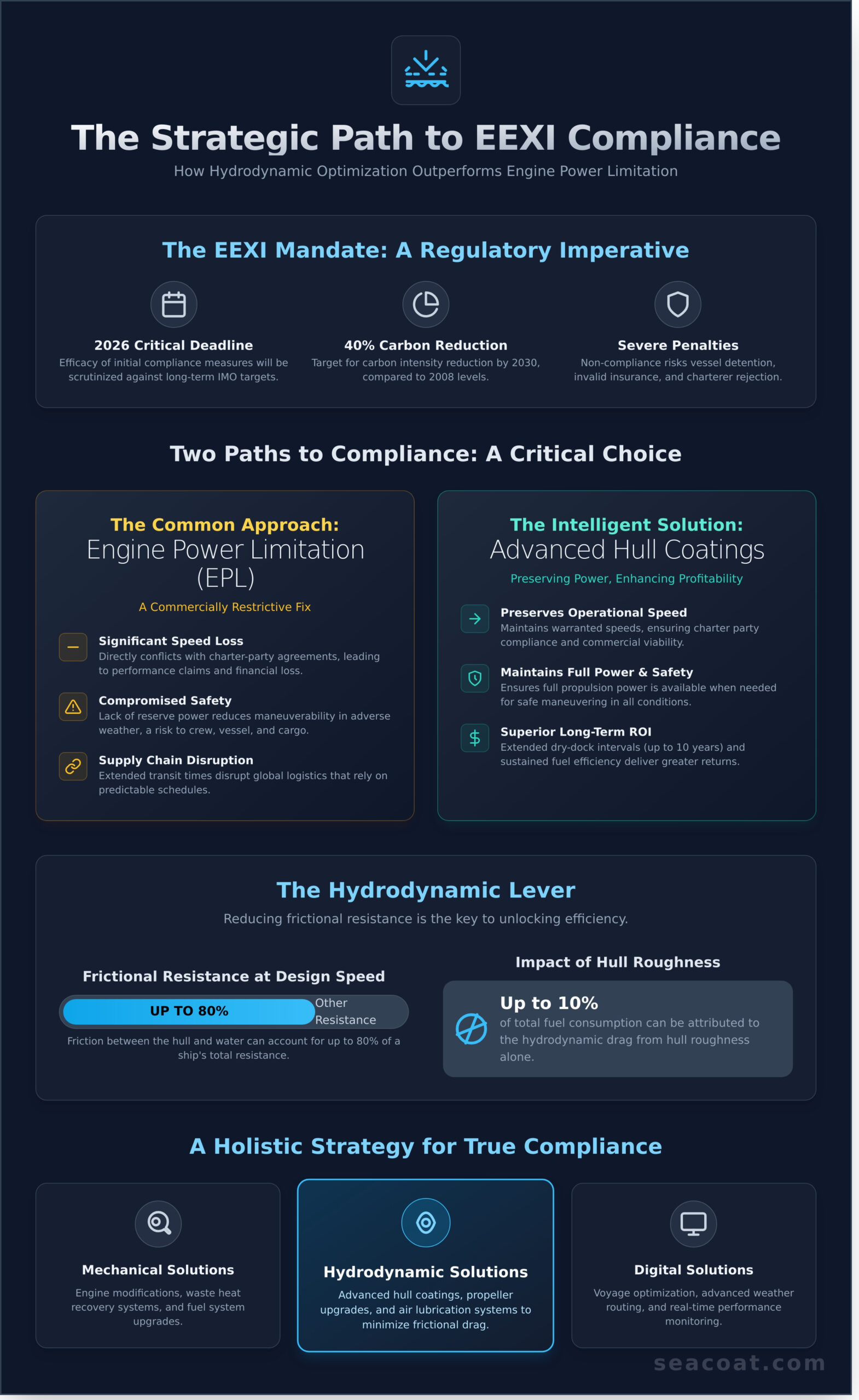
Comparing Compliance Strategies: Coatings vs. Mechanical Retrofits
The strategic path to EEXI compliance presents a critical divergence for shipowners: a choice between immediate, low-capital mechanical fixes and long-term, performance-enhancing investments. Engine Power Limitation (EPL) or Shaft Power Limitation (ShaPoLi) represent the most direct route. They are relatively inexpensive to install and satisfy the regulation on paper. However, this approach institutionalizes inefficiency by permanently capping a vessel’s power output, imposing a significant ‘speed-loss tax’ that directly impacts operational flexibility and earning potential.
A high-performance, foul-release coating system, such as a premium silane-siloxane, tackles the root cause of inefficiency: hydrodynamic drag. By creating an ultra-smooth, low-friction hull surface, these systems reduce the power required to propel the vessel through water. This isn’t a limitation; it’s an optimization. The vessel becomes fundamentally more efficient at every speed, satisfying EEXI requirements while simultaneously unlocking substantial operational and financial gains. The decision isn’t merely about compliance; it’s about defining the asset’s commercial viability for the next decade.
Evaluating ROI for Technical Directors
A comprehensive cost-benefit analysis reveals the stark contrast between these strategies. For a VLCC, the application of a 10-year silane-siloxane system may represent a capital expenditure of approximately $850,000. Yet, by delivering a sustained 5-7% reduction in fuel consumption, the payback period is often less than 18 months, based on VLSFO prices from Q4 2023. These fuel savings provide a direct and powerful synergy for the Carbon Intensity Indicator (CII), often improving a vessel’s rating from a ‘C’ to a ‘B’ without any further operational changes. This makes advanced coatings one of the most effective dual-purpose EEXI compliance solutions available.
Furthermore, the extended 10-year service life of such a system eliminates the need for a mid-cycle dry-docking for hull coating reapplication. This single avoided event saves an estimated $1.8 million in direct costs and prevents approximately 22 days of off-hire, delivering a quantifiable return far beyond the initial investment.
Operational Flexibility and Chartering
In the charter market, flexibility is value. A vessel constrained by an EPL cannot respond to urgent schedule changes or capitalize on “speed-up” clauses, making it a less attractive asset. A hydrodynamically efficient vessel, however, retains its full speed capabilities. It can meet compliance targets at its normal operational profile while holding the capacity to increase speed when commercially required. This capability regularly commands a 5-8% premium on time charter equivalent (TCE) rates.
This distinction creates two very different classes of compliant assets:
- The Limited Vessel (EPL/ShaPoLi): Meets EEXI by sacrificing performance. Its operational envelope is permanently shrunk, which can lead to a 10-15% reduction in its secondhand market valuation according to 2023 broker analyses.
- The Optimized Vessel (Foul-Release Coating): Meets EEXI by enhancing performance. It burns less fuel, emits less CO₂, and retains its full commercial potential, securing its long-term asset value and charter appeal.
Ultimately, choosing an efficiency-based path over a power-limiting one transforms a regulatory burden into a competitive advantage, future-proofing the vessel against rising fuel costs and tightening environmental standards.
Implementing a High-Performance Coating Strategy
A vessel’s hull coating is not merely a maintenance item; it is a strategic asset for operational efficiency and regulatory compliance. Implementing a comprehensive coating strategy transforms the hull from a passive surface into an active tool for reducing hydrodynamic drag. This process is methodical, data-driven, and delivers a quantifiable impact on a ship’s attained EEXI value. The entire approach hinges on a five-step lifecycle that begins long before the first coat is applied and extends for a decade of service.
The process starts with a baseline hull roughness and performance audit to establish a clear benchmark. Before dry-docking, precise measurements of the existing hull’s Average Hull Roughness (AHR) are taken, providing a concrete starting point. This data, when correlated with the vessel’s historical performance metrics, quantifies the existing drag penalty. With this baseline established, the selection of an appropriate coating system becomes a technical decision, not a procurement guess. A biocide-free, hard-film siloxane foul release system is specified for its dual benefits: it creates an ultra-smooth, low-friction surface and eliminates the environmental risks associated with toxic biocides, ensuring compliance with increasingly stringent port regulations worldwide.
Surface Preparation and Application Excellence
The foundation for a 10-year coating lifespan is uncompromising surface preparation. Achieving a grit-blasted surface to SA 2.5 standards is a non-negotiable prerequisite, as it creates the optimal surface profile for maximum coating adhesion. Unlike single-layer alternatives that compromise between adhesion and foul-release properties, a multi-coat system provides specialized performance. An epoxy anti-corrosive primer protects the steel, a tie-coat chemically bonds the primer to the topcoat, and the siloxane topcoat delivers the ultra-low friction surface. This systematic layering ensures long-term integrity. Critically, our specified systems are formulated with zero Volatile Organic Compounds (VOCs), protecting both the application crew and the marine environment.
Long-Term Maintenance and In-Water Cleaning
A key advantage of a hard-film foul release coating is its resilience to in-water maintenance. Unlike softer silicone coatings that are easily damaged, a durable siloxane surface allows for proactive, non-destructive grooming to manage slime layers before they develop into hard fouling. This regular, gentle cleaning maintains the ‘as-applied’ hull roughness, keeping it below 80 microns and preserving fuel efficiency for the entire service interval. This durability is the enabler for extending dry-dock cycles. By eliminating the performance degradation common with traditional anti-fouling paints, shipowners can confidently transition from a 5-year to a 10-year dry-docking schedule, a move validated by class societies that drastically reduces operational expenditures and vessel downtime.
Finally, all performance gains are integrated directly into the ship’s EEXI Technical File. Automated data collection and performance monitoring, aligned with ISO 19030 standards, provide verifiable proof of reduced fuel consumption attributable to the hull coating. This documented efficiency improvement serves as powerful evidence of compliance, making a high-performance coating one of the most effective and permanent EEXI compliance solutions. It closes the loop, turning a physical upgrade into a certified regulatory advantage. To see how this process is executed in a real-world dry-dock scenario, download our technical specifications and application protocol guide.
Sea-Speed V 10 X Ultra: The Strategic Asset for EEXI and CII
Meeting immediate EEXI mandates while preparing for the escalating demands of the Carbon Intensity Indicator (CII) requires more than temporary efficiency gains. It demands a strategic, long-term asset. Sea-Speed V 10 X Ultra is engineered as precisely that: a foundational technology for sustained vessel performance. Its proprietary Silane-Siloxane chemistry creates a hard, non-depleting foul release surface that delivers what we term ‘permanent’ smoothness. Unlike traditional coatings that roughen and lose effectiveness over a 3-5 year cycle, Sea-Speed maintains its ultra-low friction profile for a full 10-year operational period, guaranteed. This stability provides a predictable and powerful economic advantage, directly reducing the fuel consumption that underpins both EEXI and CII calculations.
This long-term performance also aligns your fleet with critical Environmental, Social, and Governance (ESG) objectives. The coating is entirely biocide-free and non-toxic, eliminating the release of heavy metals into marine environments. By choosing Sea-Speed, vessel owners don’t just invest in one of the most effective EEXI compliance solutions; they invest in a technology that positions their fleet as a leader in sustainable maritime operations, securing a competitive edge as environmental regulations inevitably tighten.
Technological Differentiators: Hard Film vs. Soft Silicone
The operational resilience of a hull coating is paramount. Sea-Speed’s hard film technology provides superior durability against the mechanical damage, fender rub, and abrasion that soft silicone coatings cannot withstand. This robustness minimizes the need for in-service repairs and ensures the hydrodynamic surface remains intact. The result is a consistent, low-friction interface with the water, engineered to reduce drag and deliver sustained fuel savings of up to 10% or more. Furthermore, its Zero VOC formulation protects crew and applicators while eliminating the leaching of harmful compounds entirely.
The Logical Conclusion for Vessel Owners
Adopting Sea-Speed V 10 X Ultra marks a transition from reactive maintenance cycles to proactive asset optimization. Instead of planning for performance degradation and repeated dry-docking for coating renewal, you lock in a decade of peak hydrodynamic efficiency. This strategic approach reduces lifetime operational costs, simplifies maintenance schedules, and ensures your vessels consistently achieve favorable CII ratings year after year, avoiding the commercial risks of a declining grade.
With global availability and a dedicated technical support network, integrating Sea-Speed into international fleet operations is a streamlined and reliable process. Secure your vessel’s long-term compliance and operational excellence. Consult with Seacoat SCT, LLC experts on your EEXI compliance strategy to quantify the performance and financial benefits for your specific fleet.
Secure Your Fleet’s Future: A Strategic Approach to EEXI Compliance
Navigating the 2026 EEXI framework isn’t just about meeting a deadline; it’s about fundamentally re-evaluating vessel performance. The critical takeaway is that hydrodynamic efficiency, governed by hull surface condition, is the most powerful lever for achieving and maintaining compliance. While mechanical retrofits offer a one-time fix, advanced coatings present a continuous, long-term advantage. Choosing the right EEXI compliance solutions means investing in technology that addresses the root cause of inefficiency: hydrodynamic drag. Sea-Speed V 10 X Ultra provides a definitive path forward, transforming your vessel’s hull into a strategic asset.
With a 10-year life cycle performance, our zero VOC and biocide-free technology doesn’t just meet regulations; it delivers a proven 6-12% reduction in fuel consumption based on commercial trials. It’s a single investment that pays dividends in both operational savings and environmental stewardship.
Optimize your fleet’s EEXI performance with SeaCoat’s advanced coatings and secure your operational advantage for the decade ahead.
Frequently Asked Questions About EEXI Compliance
Can a hull coating really help my vessel achieve EEXI compliance?
Yes, an advanced hull coating directly contributes to EEXI compliance by improving a vessel’s hydrodynamic efficiency. A low-friction surface, like that provided by Sea-Speed, reduces the Average Hull Roughness (AHR). This reduction enhances the vessel’s reference speed (Vref) in the EEXI calculation. A higher Vref results in a more favorable Attained EEXI value, helping the vessel meet its required technical efficiency standards without more drastic operational changes.
What is the difference between EEXI and CII in terms of coating impact?
The primary difference lies in their measurement timeframe. EEXI is a one-time technical design certification, where the coating’s initial performance and its effect on the ship’s reference speed are paramount. In contrast, the Carbon Intensity Indicator (CII) is an annual operational rating. For CII, a coating’s long-term performance and durability are critical, as sustained low friction is necessary to maintain fuel efficiency and a high operational rating (A, B, or C) year after year.
How does hull roughness (AHR) specifically factor into the EEXI calculation?
Average Hull Roughness (AHR) is a key variable used to calculate the vessel’s reference speed (Vref) under the guidelines of MEPC.334(76). A smoother hull, such as one with an AHR of 50-70 microns achieved with Sea-Speed, experiences less hydrodynamic drag. This lower drag results in a higher calculated Vref. Since the Attained EEXI is inversely proportional to Vref, a higher reference speed directly improves the ship’s final EEXI score, simplifying compliance.
Will I still need an Engine Power Limitation (EPL) if I use Sea-Speed?
Applying Sea-Speed can significantly reduce or even eliminate the need for an Engine Power Limitation (EPL) or Shaft Power Limitation (ShaPoLi). By optimizing hydrodynamic efficiency by 5-8%, the coating often brings a vessel’s Attained EEXI within its required limit. For vessels on the compliance borderline, it can decrease the required power reduction from a substantial 20% to a more manageable 5-10%, thereby preserving the vessel’s operational flexibility and commercial value.
How long does a silane-siloxane foul release coating last compared to traditional paint?
Sea-Speed V 10 X Ultra is engineered for a 10-year service life with minimal performance degradation. Its hard, non-depleting silane-siloxane surface resists marine fouling without leaching biocides. This contrasts sharply with traditional self-polishing copolymer (SPC) or ablative anti-fouling paints, which typically function for only 3 to 5 years before their biocide release mechanism is exhausted, necessitating a complete re-application in dry-dock.
Is Sea-Speed V 10 X Ultra compliant with all current marine environmental regulations?
Yes, Sea-Speed V 10 X Ultra meets and exceeds all current global marine environmental standards, including the IMO’s Anti-Fouling System (AFS) Convention. As a 100% biocide-free, non-toxic coating with zero Volatile Organic Compounds (VOCs), it doesn’t leach harmful chemicals into marine ecosystems. This ensures full compliance in the world’s most stringently regulated ports and special environmental areas, future-proofing your assets against upcoming legislation.
What is the typical ROI for a premium hull coating upgrade for EEXI?
The Return on Investment (ROI) for a Sea-Speed application is typically achieved within 18-24 months, driven by direct fuel savings. For a vessel consuming 40 tons of VLSFO daily, a 6% fuel efficiency gain results in annual savings over $380,000 (at a VLSFO price of $650/ton). This rapid ROI makes it one of the most cost-effective EEXI compliance solutions, transforming a regulatory requirement into a profitable operational upgrade.
Can Sea-Speed be applied to all vessel types, including aluminum and steel?
Yes, Sea-Speed’s advanced formulation is designed for superior adhesion across diverse marine substrates. Following correct surface preparation and primer system application, it can be applied to steel, aluminum, and fiberglass (GRP) hulls with equal effectiveness. This makes it a versatile, high-performance solution for mixed fleets, including commercial tankers, container ships, high-speed aluminum ferries, and naval patrol vessels, ensuring consistent protection and efficiency.