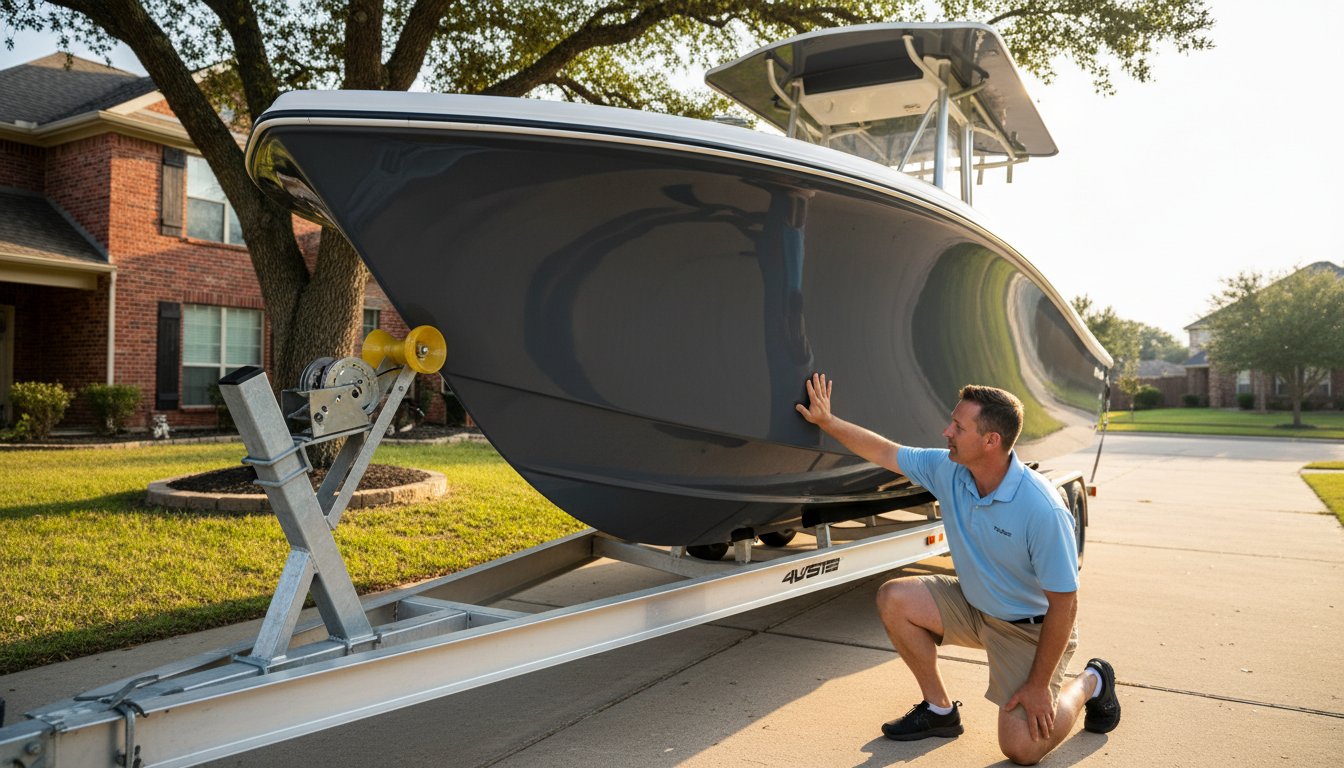
The very paint designed to protect your hull is likely failing the moment it makes contact with your trailer bunks. Most boaters don’t realize that traditional ablative coatings are engineered for constant submersion; when exposed to air during driveway storage, these sacrificial chemistries “chalk” and lose their chemical potency. If you’ve ever scrubbed paint transfer off your trailer or repainted your hull every season due to mechanical abrasion, you’ve experienced why traditional products aren’t a durable bottom paint for trailered boats. As the global marine coatings market is projected to reach $12.8 billion by the end of 2026, the industry is pivoting toward permanent, hard-film solutions that prioritize mechanical durability over sacrificial loss.
You understand that annual repainting is an inefficient use of resources and a risk to the marine ecosystems you enjoy. This article explains how silane-siloxane technology, specifically the Sea-Speed V 10 X Ultra system, provides a non-toxic, “one-and-done” coating that lasts for multiple seasons. You’ll learn how this biocide-free foul release solution offers a 10-year life cycle and zero VOCs, making it safe for both your driveway and the water. We’ll examine how transitioning to a hard-film coating improves hydrodynamics and reduces drag, turning your hull protection into a long-term strategic asset that improves performance and operational ROI.
Key Takeaways
- Identify the specific chemical and mechanical reasons why traditional sacrificial coatings lose their efficacy when stored on a trailer.
- Learn how silane-siloxane technology creates a high-impact surface that qualifies as a truly durable bottom paint for trailered boats.
- Review the application protocols for bunk placement and hull preparation that ensure 100% coverage and maximum coating longevity.
- Understand the long-term ROI of switching to a biocide-free, foul-release system that offers a 10-year service life.
- See how reducing hull roughness directly translates to improved fuel economy and higher cruising speeds for your vessel.
The Unique Challenges of Bottom Paint for Trailered Boats
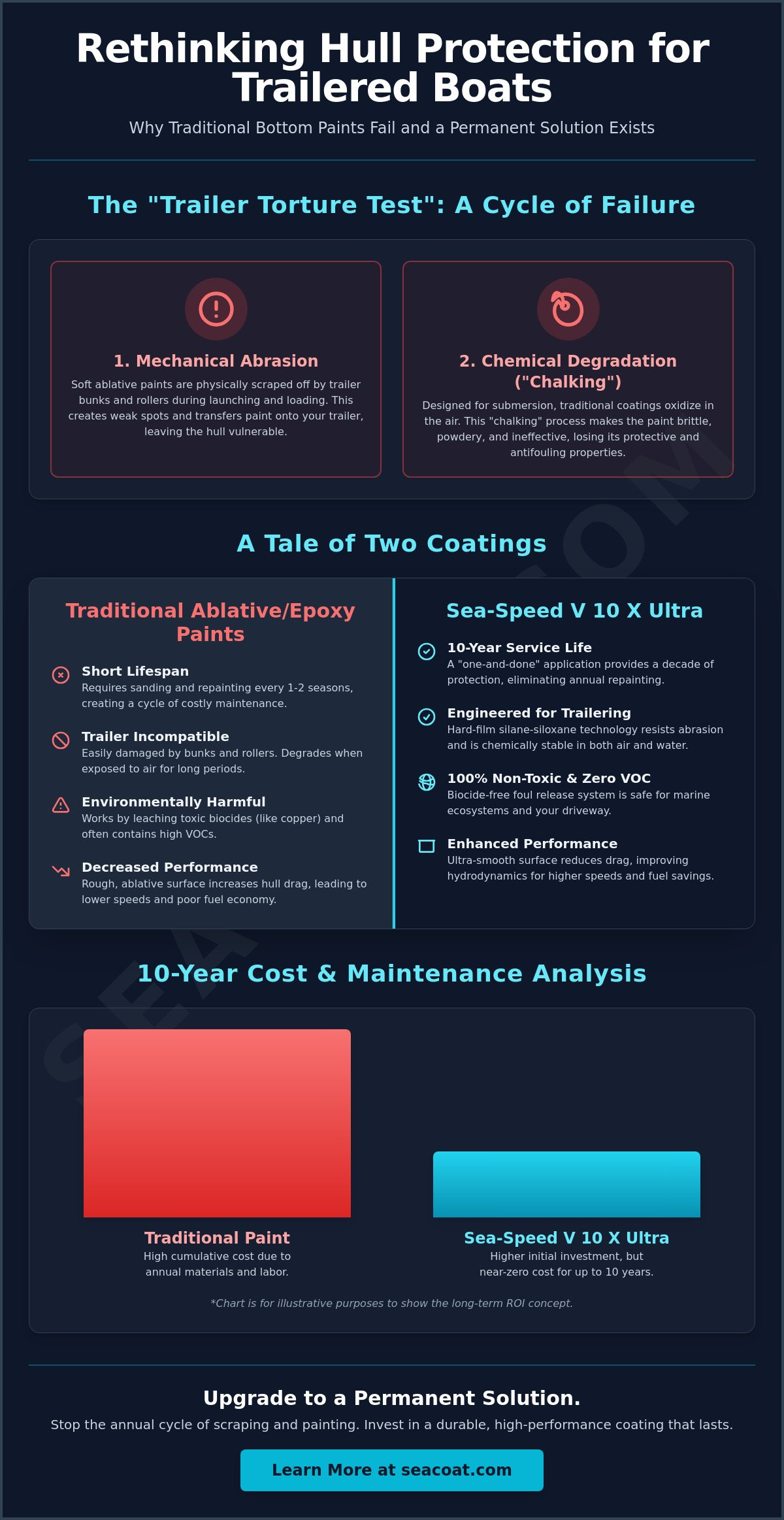
Vessel maintenance protocols often assume a boat remains submerged for the duration of the season. However, trailered assets face what we call the “trailer torture test.” This cycle involves rapid transitions between immersion and dry storage, intense UV exposure, and significant mechanical friction. Most Anti-fouling paint is formulated to leach biocides while submerged; it’s a sacrificial chemistry that relies on water movement to function. When you pull a boat out of the water, this process doesn’t just stop; it degrades the coating itself. Finding a truly durable bottom paint for trailered boats requires moving away from these reactive chemistries toward stable, inert surfaces that treat the trailer as a manageable variable rather than a destructive force.
Traditional coatings are engineered for ships that stay at sea. For the trailered boat owner, the primary failure points aren’t just barnacles or algae, but the very equipment used to transport the vessel. Bunk abrasion and roller impact create localized pressure that peels away soft coatings. This leaves the gelcoat vulnerable to osmotic blistering and fouling. You need a hard-film solution that provides mechanical resistance without the brittleness of standard epoxies. By prioritizing surface hardness and chemical stability, you transform your hull coating into a long-term strategic asset that withstands the rigors of the road.
Air Exposure and the Problem of “Chalking”
Ablative paints are designed to wear away over time to reveal fresh biocide. When these coatings are exposed to the atmosphere during driveway storage, they oxidize rapidly, leading to a phenomenon known as “chalking.” The surface becomes brittle and powdery, losing its structural integrity. This results in a persistent blue or black residue that transfers onto trailer bunks, rollers, and your vehicle. Beyond the aesthetic mess, a chalked coating is a compromised coating. It no longer provides uniform protection once the vessel is relaunched, often requiring a full scrub to reactivate the biocide layer. Foul release systems remain chemically stable in both air and water, ensuring the hull is ready for deployment without secondary maintenance or environmental runoff in your driveway.
Mechanical Abrasion from Bunks and Rollers
The act of launching and loading a vessel creates significant localized shear forces. Traditional soft coatings are frequently “sacrificed” to the friction of carpeted bunks before the boat ever hits the water. These abrasive forces cause coating migration, where the paint is physically pushed away from high-pressure areas. Surface hardness is the only effective defense against this mechanical failure. A hard-film solution, such as Sea-Speed V 10 X Ultra, uses a robust silane-siloxane matrix to resist impact and friction. This ensures the coating stays on the hull rather than rubbing off on the trailer. Maintaining a consistent hydrodynamic profile across multiple seasons reduces drag and optimizes fuel efficiency, providing a measurable operational ROI for your trailered asset.
Why Traditional Ablative and Epoxy Paints Fail on Trailers
Traditional antifouling systems rely on a controlled release of biocides to prevent marine growth. This mechanism requires constant submersion to function effectively. For trailered assets, this chemical process is frequently interrupted, leading to premature coating failure. Most copper-based paints oxidize when they hit the air, forming a hard, inactive shell that prevents the biocide from leaching once the vessel is relaunched. This is why many manufacturers mandate a strict relaunch window of 24 to 72 hours after painting. If your boat sits in a driveway for weeks, the paint essentially becomes a dead layer of heavy metals. To achieve a truly durable bottom paint for trailered boats, you must look beyond these moisture-dependent chemistries.
While some retailers suggest hard modified epoxies for trailers, these coatings present their own set of challenges. Hard epoxies are notoriously brittle. They don’t handle the micro-flexing of a hull during high-speed highway transport, which often leads to hairline fractures and eventual delamination. Additionally, these “hard” paints still require seasonal sanding and re-application to maintain their efficacy. This creates a perpetual cycle of maintenance costs and labor that fails to provide a long-term return on investment. Choosing a superior surface management strategy means moving away from these temporary fixes toward a permanent, hard-film solution.
The Limitations of Ablative Antifouling
The core philosophy of ablative bottom paint is based on a sacrificial cycle. These coatings are designed to wear away like a bar of soap, constantly shedding layers to reveal fresh biocide. On a trailered boat, this “self-polishing” feature becomes self-destructive. The mechanical friction from trailer bunks accelerates the shedding process in localized areas, leaving the hull patchy and unprotected. This inefficiency forces owners to re-coat every season, as the paint literally rubs off on the trailer before it ever sees the water. This results in wasted material, increased drag from uneven surfaces, and higher fuel consumption.
The Toxicity Factor in Residential Areas
Storing a boat in a residential driveway introduces an environmental liability that many owners overlook. Every time you wash down a hull coated with traditional antifouling, you’re releasing heavy metals like copper and zinc into your local soil and storm drains. Regulatory bodies are increasingly focused on these runoff risks. For instance, the European Union banned the biocide cybutryne as of January 1, 2023. In the United States, Washington State is currently studying the environmental impact of copper paints with a report due to the legislature by June 30, 2029, while California has suspended some enforcement until January 1, 2028, to reevaluate regulatory methods. Transitioning to environmental marine coatings isn’t just about sustainability; it’s a strategic move to future-proof your asset against tightening regulations. A non-toxic, biocide-free hard film ensures that your driveway maintenance doesn’t contribute to local ecosystem degradation.
The Science of Hard-Film Foul Release for Trailerable Hulls
The shift from sacrificial biocides to foul release technology represents a fundamental change in marine engineering. Silane-siloxane technology functions as a hybrid, combining the extreme hardness required for mechanical durability with a low-surface-energy profile that prevents marine organisms from adhering. Unlike traditional coatings that rely on chemical leaching, this hard-film solution creates a permanent barrier. It’s a critical component for anyone seeking a durable bottom paint for trailered boats. By utilizing a non-porous matrix, the coating eliminates the microscopic anchor points that barnacles and biofilm need to secure themselves to your hull.
This technology provides a significant hydrodynamic advantage. Traditional paints often increase hull roughness as they age and chalk, which creates drag. In contrast, silane-siloxane coatings maintain a smooth, glass-like finish that optimizes water flow. Industry data suggests that reducing hull roughness can lead to fuel savings of 5% to 12% depending on vessel speed and hull design. This efficiency doesn’t just save money at the pump; it reduces the overall carbon footprint of your maritime operations. You’re not just protecting a hull; you’re optimizing a high-value asset for peak performance.
Silane-Siloxane vs. Traditional Chemistry
The molecular structure of silane-siloxane allows it to form a covalent bond with the substrate, creating a surface that is essentially inseparable from the hull. Traditional paints merely sit on top of the gelcoat, held by mechanical adhesion. This is why they eventually peel or flake. Because this technology is biocide-free and non-reactive, it doesn’t wear away or require activation through water movement. For a deeper analysis of these technical specifications and the resulting ROI, refer to our definitive guide to boat hull paint. This permanent nature is what enables a 10-year service life, effectively ending the annual maintenance cycle.
Impact and Abrasion Resistance
A common misconception in the boating community is that all foul release coatings are soft, fragile silicones. While soft silicones are easily torn by trailer bunks, silane-siloxane is a hard-film system. It offers high impact resistance that withstands the localized pressure of trailer rollers and the abrasive friction of carpeted bunks. This hardness is achieved without the brittleness found in traditional epoxies, allowing the coating to flex with the hull during transport. The inherent slickness of the surface also simplifies the launching and loading process, as the hull slides effortlessly off the trailer. This mechanical resilience ensures your protection remains intact through hundreds of launch cycles without the need for touch-ups.
Maximising Longevity: Application and Trailer Considerations
Achieving a ten-year service life with a durable bottom paint for trailered boats requires more than just a superior product; it demands a precise application protocol. Because hard-film foul release coatings like Sea-Speed V 10 X Ultra form a permanent bond with the substrate, the quality of your surface preparation determines the long-term ROI of the system. You must transition from a mindset of covering the hull to engineering a new surface. This process begins with the complete removal of legacy toxic layers, ensuring the hull is free of the oxidized chalk characteristic of old ablative paints. A clean, profiled surface is the only way to ensure the silane-siloxane matrix achieves its intended mechanical bond.
The most common error in trailered boat maintenance is neglecting the areas of the hull hidden by the trailer itself. To ensure 100% coverage, you must utilize boat stands or hydraulic jacks to safely lift the vessel off the trailer during the application process. Alternatively, many operators shift the boat several inches on the trailer after the first coat has cured to address the bunk-contact points. This attention to detail prevents the localized gelcoat exposure that leads to osmotic blistering and fouling. Once the system is applied, you can order Sea-Speed V 10 X Ultra to begin your transition toward a maintenance-free hull.
The Application Process for Sea-Speed
Successful application in May 2026 requires strict adherence to environmental parameters. You should only apply the coating when the relative humidity is below 85% and the ambient temperature is at least 5 degrees above the dew point. For the base layer, Seapoxy 73 provides the necessary structural foundation and adhesion. While the coating may feel dry to the touch within hours, full mechanical curing takes longer. You should wait at least 72 hours before allowing the hull to settle back onto trailer bunks or rollers. This ensures the film has reached its maximum Shore D hardness, allowing it to withstand the high-pressure point-loading inherent in trailer transport.
Trailer Bunk and Roller Optimization
While a hard-film coating is designed for abrasion resistance, optimizing your trailer hardware further extends the life of the system. Replacing traditional carpeted bunks with high-density polyethylene (HDPE) covers significantly reduces friction during launching. These covers complement the slickness of the foul release surface, allowing the boat to slide effortlessly without the “grabbing” effect of wet carpet. If your trailer uses rollers, ensure they’re adjusted to distribute the vessel’s weight evenly across the hull; this prevents localized stress that can lead to hull flexing. Maintenance for this system is remarkably simple. Because the surface energy is so low, you don’t need heavy scrubbing or harsh chemicals. A soft sponge and fresh water are sufficient to remove any road grime or light biofilm accumulated during a day on the water.
Transitioning to Sea-Speed V 10 X Ultra: The Permanent Solution
The traditional model of seasonal hull maintenance is an obsolete practice that relies on sacrificial chemistry and repetitive labor. Transitioning to Sea-Speed V 10 X Ultra represents a strategic shift from temporary mitigation to a permanent surface management solution. By utilizing a hard-film silane-siloxane matrix, you eliminate the need for the destructive sanding and re-painting cycles that characterize standard ownership. This technology provides the most durable bottom paint for trailered boats by ensuring the protective layer remains intact through hundreds of launch and load cycles. It’s a long-term asset that offers a verified 10-year life cycle, providing a level of reliability that traditional coatings cannot match.
Choosing a high-performance coating is a decision that impacts the entire operational life of your vessel. SeaCoat has established itself as a pioneer in antifouling boat paint innovation by proving that durability and environmental safety aren’t mutually exclusive. This system doesn’t just protect the hull from fouling; it preserves the structural integrity of the gelcoat by preventing the osmotic pressure and mechanical wear associated with traditional maintenance. The result is a vessel that maintains its value and performance over a decade, rather than one that degrades with every passing season.
Operational Efficiency and Fuel Savings
The economic benefits of a hard-film foul release system are most visible at the fuel dock. Traditional paints increase their surface roughness as they age, which creates significant hydrodynamic drag. Surface roughness is the measurable presence of microscopic peaks and valleys on the hull’s wetted surface that disrupt laminar water flow and increase skin friction. By maintaining an ultra-smooth finish, Sea-Speed V 10 X Ultra optimizes the vessel’s Average Hull Roughness (AHR), allowing for higher cruising speeds at lower RPMs. For boats with small or mid-sized engines, this efficiency is critical, as it reduces the strain on the propulsion system and extends the range of every tank of fuel.
Environmental Stewardship for the Modern Boater
Environmental responsibility is no longer a secondary concern; it’s a regulatory and ethical requirement. While Washington State has postponed its copper-based paint restrictions until June 30, 2029, and California is currently reevaluating its guidelines, the global trajectory toward biocide-free hulls is undeniable. The European Union’s January 1, 2023, ban on cybutryne is a clear indicator of the legislative future. By opting for a zero-VOC, non-toxic coating today, you’re future-proofing your asset against upcoming environmental mandates. You can take pride in a hull that doesn’t leach heavy metals into your driveway or the local waterways. It’s time to move beyond temporary fixes and invest in a system that respects both your time and the marine ecosystem. Upgrade your trailered boat with Sea-Speed today and experience the standard of modern hull performance.
Future-Proofing Your Hull for a Decade of Performance
Transitioning from sacrificial, toxic coatings to a permanent silane-siloxane system is a strategic investment in your vessel’s operational future. By choosing a hard-film solution, you eliminate the repetitive labor and environmental liability of seasonal repainting. This technology provides a 10-year expected life cycle and is a completely non-toxic, zero-VOC formula. It’s the definitive choice for a durable bottom paint for trailered boats, offering the mechanical resilience needed to survive the trailer torture test without compromising on hydrodynamic efficiency.
Beyond simple protection, this system offers proven drag reduction that increases fuel efficiency by optimizing your hull’s surface roughness. You can finally step away from the cycle of chemical leaching and mechanical failure. It’s time to equip your boat with a surface that performs as well in the driveway as it does on the water. Request a Quote for Sea-Speed V 10 X Ultra and take the first step toward a more efficient, sustainable boating experience. Your hull deserves a solution that lasts as long as your passion for the water.
Frequently Asked Questions
Does Sea-Speed V 10 X Ultra rub off on trailer bunks?
Sea-Speed V 10 X Ultra does not rub off on trailer bunks because it is a hard-film, non-ablative coating. Unlike traditional paints that rely on a sacrificial cycle, this technology forms a permanent, abrasion-resistant surface. This makes it a highly durable bottom paint for trailered boats that maintains its structural integrity even under the mechanical friction of carpeted bunks. You won’t see the typical paint transfer or chalking residue on your trailer equipment during transport.
Can I apply a hard-film foul release coating over my old bottom paint?
You cannot apply hard-film foul release coatings directly over existing antifouling paint. The silane-siloxane matrix requires a covalent bond with a clean, profiled substrate to ensure long-term adhesion. Applying it over old, unstable layers of ablative or epoxy paint will lead to delamination. Proper preparation involves removing all legacy coatings down to the gelcoat and applying Seapoxy 73 as a structural foundation before the final finish.
Is this coating safe for aluminum trailered boats?
This coating is exceptionally safe for aluminum hulls because it is entirely biocide-free and non-conductive. Traditional copper-based paints can trigger galvanic corrosion when applied to aluminum, leading to rapid hull degradation. Sea-Speed V 10 X Ultra acts as an inert barrier, providing superior protection without the risk of electrolysis. This makes it an ideal solution for aluminum fishing boats and pontoons that require a durable bottom paint for trailered boats.
How long does a hard-film coating last on a boat that is trailered 90% of the time?
A hard-film coating is engineered for a 10-year service life, even for vessels that spend 90% of their time on a trailer. Unlike ablative paints that oxidize and lose potency when exposed to air, silane-siloxane technology remains chemically stable in dry storage. The coating does not chalk or degrade under UV exposure. Your hull remains protected and ready for immediate deployment regardless of how long it sits in your driveway.
Do I need to clean the hull differently if it has a foul-release coating?
Cleaning a foul-release surface requires significantly less effort and no harsh chemicals. Because the coating utilizes low surface energy to prevent adhesion, a simple wipe with a soft sponge and fresh water is usually sufficient to remove biofilm. You should avoid stiff brushes or abrasive pads that could micro-scratch the surface. Maintaining the smooth finish is essential for maximizing the hydrodynamic benefits and ensuring the long-term slickness of the hull.
Will a slick coating make my boat slide off the trailer too easily?
The increased surface slickness does require a slight adjustment to your launching and loading procedures. Because the hull slides more easily than one coated with traditional paints, you must keep the winch strap and safety chain connected until the vessel is positioned over the water. This slickness is a distinct advantage during loading, as it reduces the force required to pull the boat onto the bunks, but safety protocols should reflect the reduced friction.
Is Sea-Speed V 10 X Ultra environmentally friendly for driveway storage?
Sea-Speed V 10 X Ultra is the safest option for driveway storage due to its zero-VOC and biocide-free formulation. When you wash your boat at home, there is no risk of heavy metals like copper or zinc leaching into your soil or local storm drains. This allows you to comply with increasingly strict environmental regulations while ensuring your maintenance routine doesn’t negatively impact the local ecosystem. It’s a responsible choice for residential areas.