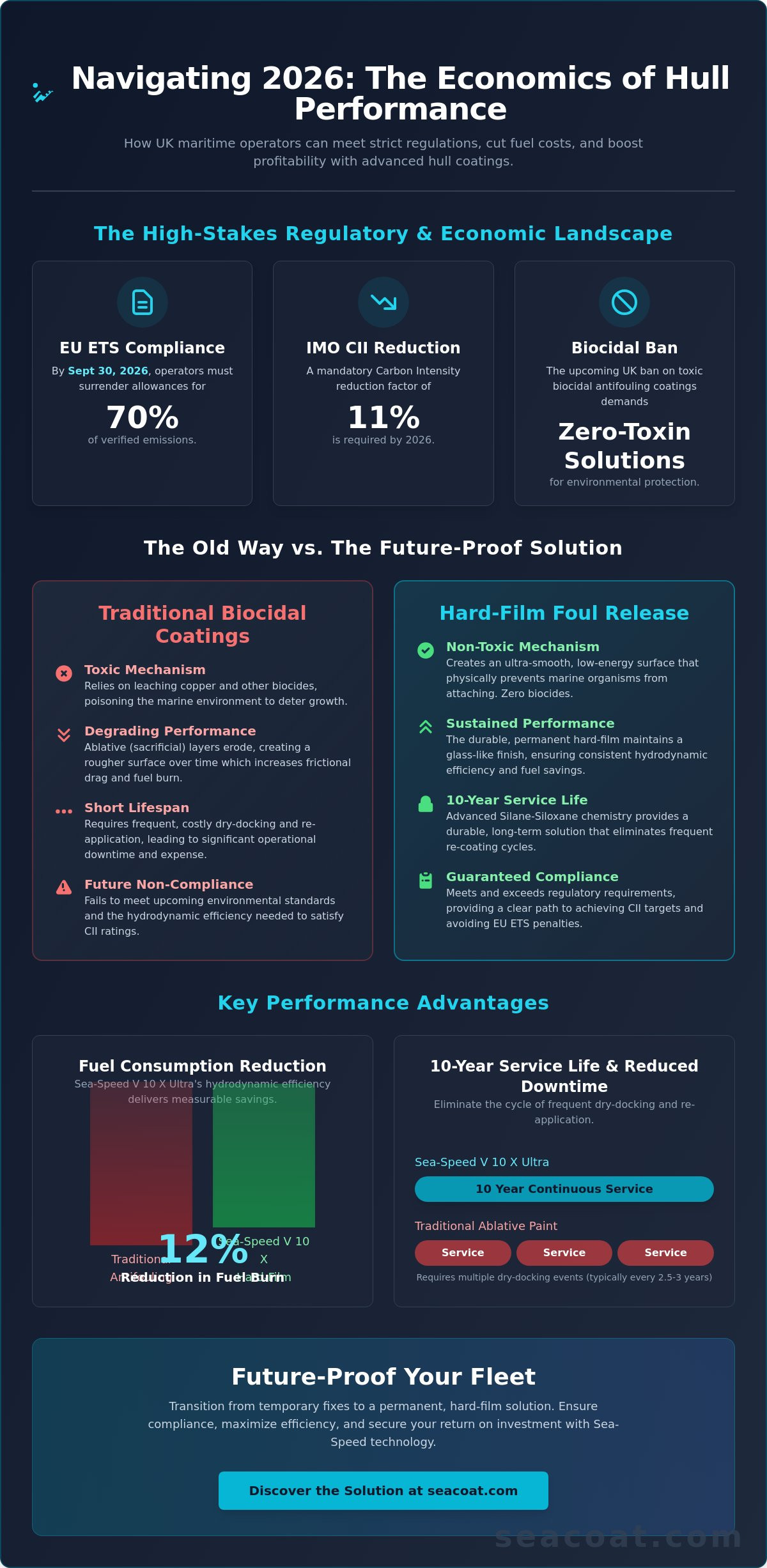
Did you know that by September 30, 2026, UK maritime operators must surrender allowances for 70% of their verified emissions under the EU ETS? This regulatory deadline transforms hull maintenance from a routine task into a high-stakes financial strategy. Adopting a non-toxic foul release hull coating for commercial ships UK is no longer just a sustainability goal; it’s a critical operational requirement for maintaining profitability in a tightening market.
We understand that rising fuel costs and the 11% carbon intensity reduction factor required by the IMO for 2026 are putting unprecedented pressure on your margins. Traditional biocidal paints often fail to deliver the hydrodynamic efficiency needed to avoid the corrective action plans required for poor CII ratings. This guide explores how advanced silane-siloxane technology, like Sea-Speed V 10 X Ultra, can deliver a 12% reduction in fuel consumption and ensure full compliance with the UK’s upcoming ban on biocidal antifouling. You’ll discover how to transition from temporary fixes to a permanent, hard-film solution that extends service life and maximizes your return on investment.
Key Takeaways
- Understand how modern hull maintenance has transitioned from a cosmetic expense into a strategic engineering asset that directly influences vessel hydrodynamics and operational margins.
- Compare the mechanical advantages of hard-film technologies over traditional soft silicones, specifically regarding their resilience against physical impact and abrasive cleaning protocols.
- Learn why a non-toxic foul release hull coating for commercial ships UK is the most effective path to meeting 2026 IMO CII reduction factors and avoiding EU ETS financial penalties.
- Identify the rigorous technical standards required for successful application in UK shipyards, focusing on precision surface preparation and atmospheric control.
- Discover how the 10-year service life of Sea-Speed V 10 X Ultra provides a permanent solution that eliminates the need for frequent dry-docking while maintaining zero-biocide compliance.
The Evolving Landscape of Commercial Ship Painting in the UK
Commercial ship painting has transitioned from a maintenance chore into a performance-critical engineering task. In 2026, the hull’s surface is the primary lever for managing fuel efficiency and carbon intensity. The UK maritime sector is rapidly shifting toward sustainability, not just for environmental stewardship, but as a core requirement for operational survival. For vessels navigating the North Sea, The problem of biofouling is a constant threat to speed and profitability. High-nutrient waters promote rapid colonization, which quickly destroys the hydrodynamic profile of an unprotected vessel. This has led to the rise of the Hull Performance System, a strategy that prioritizes long-term surface integrity over the temporary fix of traditional paints.
By choosing a non-toxic foul release hull coating for commercial ships UK, owners are investing in a strategic asset that aligns with the 11% carbon intensity reduction factor required by the IMO this year. This approach moves away from the “apply and forget” mentality of the past. Instead, it focuses on maintaining a low-friction surface that remains consistent throughout the entire docking cycle, ensuring that fuel savings are realized from day one through year ten.
Why Traditional Antifouling is Failing UK Fleets
Traditional copper-based biocidal paints are struggling to keep pace with modern regulatory and performance demands. These coatings rely on the continuous leaching of toxins into the marine environment, a process that’s increasingly restricted in UK waters ahead of the 2027 biocidal ban. Beyond environmental concerns, the physical mechanism of ablative bottom paint is inherently flawed for modern efficiency. As these coatings erode to release biocides, they develop a microscopic roughness that increases frictional drag. This sacrificial cycle creates a “roughness penalty” that compounds over time, leading to higher fuel costs and the need for more frequent, expensive dry-docking intervals to restore hull smoothness.
The Shift to Non-Toxic Foul Release Systems
Foul release technology represents a fundamental departure from chemical poisoning. Instead of killing organisms, these systems use mechanical properties to prevent adhesion. A non-toxic foul release hull coating for commercial ships UK creates an ultra-smooth, low-energy surface that makes it physically difficult for marine life to attach. The breakthrough for 2026 is the widespread adoption of Silane-Siloxane chemistry, such as that found in Sea-Speed V 10 X Ultra. Unlike soft silicones that are easily damaged during port operations or hull scrubbing, these hard-film coatings provide a durable, glass-like finish. This chemistry offers a permanent, non-depleting surface that maintains its hydrodynamic efficiency for up to a decade, providing a clear path to both regulatory compliance and measurable economic returns.
Hard-Film Foul Release vs. Traditional UK Antifouling Systems
Selecting a non-toxic foul release hull coating for commercial ships UK requires a thorough understanding of the mechanical differences between available technologies. Standard ablative paints rely on a sacrificial wear cycle that inherently increases hull roughness as the layers erode. Conversely, soft silicone coatings offer low friction but lack the structural integrity to withstand heavy industrial use. Hard-film foul release systems, utilizing advanced Silane-Siloxane chemistry, provide a superior alternative. These coatings create a permanent, glass-smooth barrier that remains intact regardless of operational stress, effectively eliminating the “roughness penalty” associated with traditional methods.
The friction-reduction capabilities of Sea-Speed V 10 X Ultra are documented to provide a 12% reduction in fuel consumption compared to standard biocidal coatings. This efficiency stems from a surface energy so low that marine organisms cannot form a permanent bond. Unlike ablative systems that degrade over time, this hard-film technology maintains its hydrodynamic profile over a 10-year service life. This longevity transforms the coating from a recurring maintenance expense into a long-term strategic asset.
Durability in Harsh North Sea Environments
UK coastal routes present significant mechanical challenges, including floating debris and potential ice contact in northern latitudes. Soft silicone coatings often fail in these conditions, suffering from “tearing” or delamination that exposes the substrate. Hard-film coatings are engineered for impact resistance. They withstand the rigors of tug impact and fender contact during cargo operations, ensuring the protective barrier remains functional in the diverse salinities and temperatures typical of the North Sea. This physical resilience is essential for high-utilisation vessels that cannot afford unplanned downtime due to coating failure.
Maintenance and In-Water Cleaning Standards
Traditional coatings pose environmental risks during maintenance because scrubbing the hull releases biocides directly into the water column. Compliance with UK anti-fouling regulations is becoming increasingly stringent to prevent this type of chemical contamination. Hard-film surfaces allow for aggressive in-water cleaning without any loss of coating thickness or release of toxins. This durability facilitates extended dry-docking intervals of up to 10 years. Ship owners can maintain peak performance through simple mechanical cleaning, avoiding the costly re-application cycles associated with traditional paints. For long-term asset protection, Sea-Speed V 10 X Ultra represents the pinnacle of modern hull engineering.
Regulatory Compliance and Economic ROI for UK Fleets
The maritime industry is currently facing a paradigm shift where environmental stewardship and financial viability are no longer separate agendas. For UK ship owners, the International Maritime Organization (IMO) Carbon Intensity Indicator (CII) and the Energy Efficiency Existing Ship Index (EEXI) have turned hull performance into a measurable financial metric. In 2026, the annual carbon intensity reduction factor is set at 11% relative to the 2019 baseline. Failing to meet these standards doesn’t just damage the environment; it leads to “D” or “E” ratings that require mandatory corrective action plans. Investing in a non-toxic foul release hull coating for commercial ships UK is the most direct method to improve these ratings without undergoing expensive engine retrofits.
The economic impact is further intensified by the EU Emissions Trading System (ETS). By September 30, 2026, companies must surrender allowances for 70% of their verified emissions. This turns every tonne of fuel saved into a direct reduction in carbon taxes. Advanced environmental marine coatings provide the technical foundation for this efficiency by maintaining a low-drag profile that traditional paints simply cannot match. It’s an engineering solution that addresses both the atmospheric and aquatic footprints of heavy industry.
UK REACH and Environmental Standards in 2026
Navigating the complexities of UK REACH and regional biocide restrictions requires a forward-thinking approach to material science. The UK is set to ban many biocide-containing antifouling paints starting from December 31, 2027. Operators who switch to non-toxic systems now are effectively future-proofing their fleets against these looming prohibitions. Beyond simple compliance, the adoption of green shipping technologies enhances the reputational standing of UK commercial operators in a market that increasingly values transparency and ecological responsibility. It’s a transition from being a reactive participant to a proactive leader in maritime sustainability.
Fuel Efficiency: The Bottom Line Benefit
The correlation between surface roughness and fuel consumption is a matter of fluid dynamics. Even microscopic biofouling can increase drag by 20%, leading to a significant spike in fuel burn. By utilizing a non-toxic foul release hull coating for commercial ships UK, vessels can achieve documented fuel savings of 12%. These savings are the result of a permanent, non-depleting surface that stays smooth throughout the docking cycle. When calculating the ROI of boat hull paint, the payback period for premium silane-siloxane systems like Sea-Speed V 10 X Ultra is often under 18 months. This rapid return is driven by the combination of reduced fuel expenditure, the avoidance of carbon penalties, and the elimination of frequent, abrasive hull cleanings that degrade traditional coatings.
Technical Implementation: Application Standards in UK Shipyards
The operational success of a non-toxic foul release hull coating for commercial ships UK is governed by the precision of its application. While the chemistry of silane-siloxane systems provides the performance, the bond between the coating and the substrate determines the longevity of the asset. In 2026, the industry standard for surface preparation remains an SA 2.5 “Near White” metal blast. This process removes all mill scale, rust, and foreign matter, creating a specific anchor profile that ensures mechanical adhesion. For UK vessels operating in brackish or high-salinity waters, salt removal protocols are non-negotiable. Chlorides must be measured and mitigated to prevent osmotic blistering, which can compromise the hull’s hydrodynamic efficiency over time.
Managing the application environment is a significant challenge within the UK’s maritime climate. Successful installation requires strict control over humidity and steel temperature to prevent “flash rust” or moisture entrapment. Modern shipyard specifications now mandate that the steel temperature remain at least 3 degrees Celsius above the dew point throughout the process. Quality control isn’t just a final check; it’s a continuous monitoring of Dry Film Thickness (DFT) and surface profile metrics to ensure the system meets the manufacturer’s performance specifications. A high-solids epoxy like Seapoxy 73 serves as the critical foundation, providing superior corrosion protection and a stable interface for the foul-release topcoat.
The Application Process Step-by-Step
The process begins with a comprehensive hull inspection to assess the condition of existing coatings and identify areas of localized corrosion. Once the hull is cleaned of biofouling, precision abrasive blasting to SA 2.5 standards is performed. Following the blast, the surface is tested for soluble salts. The multi-coat system is then applied, starting with the Seapoxy 73 primer to seal the substrate. This is followed by a tie-coat designed to bridge the primer and the final non-toxic foul release hull coating for commercial ships UK. Each layer must meet specific overcoat windows to ensure chemical bonding between the coats.
Working with UK Painting Contractors
When specifying Sea-Speed V 10 X Ultra to your chosen shipyard, it’s essential to verify that the painting contractors are familiar with hard-film application techniques. These systems require a different approach than traditional ablative paints, particularly regarding spray equipment settings and tip sizes. We recommend providing the shipyard with a detailed technical data sheet and requesting a pre-job meeting to align on quality control expectations. Evaluating a contractor based on advanced marine coatings standards ensures that the installation team understands the high-stakes nature of modern hull performance. To ensure your fleet meets these rigorous standards, request a technical specification for your next dry-docking.
Future-Proofing UK Maritime Assets with Sea-Speed Technology
The maritime industry’s reliance on sacrificial, biocidal chemistry is nearing its end as the 2027 UK ban approaches. For fleet managers, the 2026-2030 cycle represents a critical window to transition toward permanent hull solutions. Adopting a non-toxic foul release hull coating for commercial ships UK ensures that your vessels remain compliant with tightening environmental standards while preserving the underlying steel substrate for decades. This isn’t a temporary patch; it’s a strategic decision to lock in hydrodynamic efficiency and protect long-term asset value in an increasingly competitive market.
As the industry explores alternative fuels like green ammonia or hydrogen, the importance of hull smoothness will only grow. These fuels often possess lower energy densities than current heavy fuel oils, making every percentage of drag reduction vital for maintaining vessel range and speed. Sea-Speed V 10 X Ultra provides the necessary surface energy profile to complement these future zero-emission propulsion systems. By reducing frictional resistance now, you’re preparing your fleet for the technical realities of the next decade’s fuel transition.
Why Sea-Speed V 10 X Ultra is the 2026 Industry Leader
Sea-Speed V 10 X Ultra distinguishes itself by offering a non-depleting, glass-like finish that eliminates the need for the frequent re-painting cycles associated with traditional systems. This technology creates a durable, high-performance barrier that maintains its integrity even under the mechanical stress of industrial operations. Silane-Siloxane is defined as a non-sacrificial, hard-film barrier that prevents marine adhesion through mechanical surface properties rather than toxic leaching. It’s a single-application solution that simplifies maintenance and ensures consistent fuel savings across the entire docking interval.
Next Steps for Fleet Managers
The first step toward modernizing your hull performance is a detailed audit of your current fleet’s fuel burn and drag metrics. This data provides the baseline for calculating the return on investment when switching to a non-toxic foul release hull coating for commercial ships UK. Reviewing upcoming dry-docking schedules allows you to integrate these advanced specifications into your shipyard contracts well in advance. Planning now avoids the rush as the 2027 biocidal ban nears and ensures your vessels are optimized for the 2026 carbon intensity standards.
Your fleet’s transition to modern hull science requires technical precision and expert oversight. Contact Seacoat SCT, LLC for a technical consultation and bulk industrial supply to begin your performance audit. Securing your fleet’s future starts with an evidence-based approach to surface engineering.
Securing Long-Term Efficiency in the 2026 Maritime Market
Transitioning to a non-toxic foul release hull coating for commercial ships UK is more than a compliance measure; it’s a fundamental shift toward sustainable profitability. We’ve detailed how hard-film technology addresses the inherent flaws of traditional ablative paints by providing a permanent, low-friction barrier. This approach ensures your fleet meets the 11% carbon intensity reduction factor required this year while significantly extending the operational life cycle of your assets.
Our Silane-Siloxane technology has been proven in the field since 2001, delivering up to a 12% reduction in fuel consumption through superior hydrodynamic performance. With a zero-VOC and non-toxic formulation, Sea-Speed V 10 X Ultra allows you to navigate tightening UK environmental regulations with complete confidence. It’s time to move beyond temporary maintenance cycles and invest in a strategic engineering solution that protects both your margins and the marine ecosystem.
Request a technical specification for your commercial fleet today to optimize your next dry-docking window. Your fleet’s future performance starts with the right surface science. We look forward to helping you achieve a more efficient and compliant operation.
Frequently Asked Questions
What is the difference between commercial ship painting and yacht painting?
Commercial ship painting prioritizes hydrodynamic efficiency and long-term durability over the aesthetic gloss typically sought in the yachting sector. While yachts focus on visual finish, commercial assets require coatings that can withstand extreme mechanical stress and high-utilisation cycles. These industrial systems are engineered to maintain low surface energy across thousands of nautical miles, ensuring that fuel consumption remains stable regardless of the vessel’s scale or operational profile.
How much fuel can a commercial ship save with foul release coatings in the UK?
A commercial vessel can achieve a documented fuel saving of up to 12% when utilizing advanced silane-siloxane technology. This reduction is achieved by eliminating the frictional drag caused by biofouling and the microscopic roughness inherent in traditional ablative paints. By maintaining a glass-smooth surface, the engine operates at a lower load for the same speed, directly translating to lower fuel burn and reduced carbon emissions under current UK maritime standards.
Are non-toxic hull coatings as effective as traditional antifouling in the North Sea?
Non-toxic coatings are often more effective than traditional biocides in the North Sea because they rely on mechanical properties rather than depleting chemicals. High-nutrient coastal waters in the UK promote rapid fouling, which traditional paints struggle to manage as their leaching rate fluctuates. A non-toxic foul release hull coating for commercial ships UK creates a permanent, low-energy surface that prevents adhesion altogether, providing consistent protection that doesn’t degrade over time.
How long does a Sea-Speed V 10 X Ultra coating last on a commercial vessel?
Sea-Speed V 10 X Ultra is engineered to provide a 10-year service life on commercial hulls. Unlike sacrificial coatings that require re-application every three to five years, this hard-film system remains chemically stable and physically intact. Its non-depleting nature means the thickness of the coating doesn’t decrease over time, allowing fleet managers to extend dry-docking intervals and significantly reduce the total lifecycle cost of the vessel’s hull maintenance.
What are the UK regulations regarding toxic antifouling paint in 2026?
UK maritime regulations in 2026 are increasingly focused on the transition away from biocidal contaminants. The UK is scheduled to ban many biocide-containing antifouling paints starting December 31, 2027, following earlier bans on substances like cybutryne. Additionally, the 11% carbon intensity reduction required by the IMO for 2026 makes high-efficiency, non-toxic coatings a strategic necessity for operators who must comply with the Carbon Intensity Indicator (CII) and UK environmental standards.
Can Sea-Speed be applied over existing hull paint?
Sea-Speed technology cannot be applied directly over existing antifouling paints because the underlying coating’s instability would compromise the system’s performance. Achieving the necessary mechanical bond requires the removal of all previous layers to expose the substrate. This ensures that the non-toxic foul release hull coating for commercial ships UK is anchored to a stable, prepared surface, preventing delamination and ensuring the coating maintains its low-friction properties for the full 10-year duration.
What is the required surface preparation for a hard-film marine coating?
The technical standard for surface preparation is an abrasive blast to SA 2.5 “Near White” metal. This process creates a specific surface profile, typically between 2.5 and 3.5 mils, which is essential for the adhesion of specialised primers like Seapoxy 73. Proper preparation also includes the rigorous removal of soluble salts and contaminants, as any residual chlorides can lead to osmotic blistering and premature failure of the hard-film system in harsh marine environments.
Does commercial ship painting in the UK require specific environmental permits?
Commercial painting operations in the UK are subject to strict environmental controls regarding VOC emissions and waste containment. While the application of non-toxic coatings like Sea-Speed V 10 X Ultra reduces the risk of chemical leaching, shipyards must still comply with local environmental permits for blasting and application processes. Operators should verify that their chosen facility adheres to current UK REACH standards and has the necessary infrastructure to manage industrial waste responsibly during the refit process.