
The most stable technical lever for CII compliance through 2030 is not a change in fuel type, but the optimization of a vessel’s baseline hydrodynamic efficiency. For vessel managers facing the mandatory 11% reduction factor that took effect this year, the margin for error in fuel consumption modeling has effectively vanished. You likely recognize that relying on operational speed reductions alone is a diminishing strategy that risks pushing your assets into the D or E rating categories, necessitating immediate and costly corrective action plans. The industry requires a more rigorous, evidence-based approach to calculating CII rating improvement from hull coatings to ensure long-term operational viability.
This technical guide provides a precise framework for quantifying the impact of advanced silane-siloxane foul release systems on your fleet’s carbon intensity. By focusing on the scientific link between surface roughness and drag reduction, we’ll demonstrate how hard-film solutions like Sea-Speed V 10 X Ultra can achieve up to a 12% reduction in power requirements. We’ll outline a reliable method to predict these improvements, helping you secure regulatory compliance through 2030 while significantly reducing greenhouse gas emissions. Our analysis moves from the fluid dynamics of ultra-smooth surfaces to the practical integration of performance data into your SEEMP Part III implementation plan.
Key Takeaways
- Analyze the 2026 IMO regulatory shift and why mitigating hydrodynamic drag is essential for vessels at risk of D or E ratings.
- Explore the relationship between boundary layer physics and Average Hull Roughness to predict how surface texture impacts your vessel’s fuel consumption.
- Master a structured 4-step framework for calculating CII rating improvement from hull coatings using empirical drag reduction data.
- Compare the durability and performance retention of silane-siloxane systems against traditional ablative and soft silicone alternatives.
- Quantify the strategic value of hard-film, non-depleting coatings in securing long-term compliance and operational efficiency through the 2030 targets.
The 2026 CII Regulatory Landscape: Why Drag is the Primary Enemy
The 2026 Carbon Intensity Indicator (CII) thresholds represent a critical inflection point for global shipping. As the industry enters Phase 2 of the regulation, the required reduction factor has tightened to 11% relative to the 2019 baseline. This narrowing corridor of compliance leaves little room for the operational buffers that many managers relied on during the initial implementation years. While slow steaming and route optimization provided early gains, these measures have reached a plateau of diminishing returns. To maintain a C rating or higher, technical interventions that address the vessel’s physical efficiency are now mandatory requirements rather than optional upgrades.
Hydrodynamic drag is the primary driver of excess fuel consumption. When a hull surface degrades through fouling or mechanical damage, the resulting frictional resistance forces the engine to work harder to maintain speed. This increased load translates directly into higher CO2 emissions. Under the MARPOL Annex VI amendments, the industry is moving toward stricter technical oversight, making the choice of protective systems more significant than ever. Adhering to international anti-fouling regulations is just the baseline; the goal is now to actively minimize the drag-induced fuel penalty through superior surface engineering.
The AER Formula: Breaking Down the Numerator
The Annual Efficiency Ratio (AER) is the fundamental metric for most commercial vessels. It’s calculated by dividing the total annual CO2 emissions by the product of the ship’s deadweight tonnage and the total distance traveled. In this equation, the denominator is largely fixed by commercial demand and asset capacity. This makes fuel consumption, and consequently carbon emissions, the only variable in the numerator that managers can actively control. By focusing on calculating CII rating improvement from hull coatings, technical teams can isolate the specific percentage of fuel saved through reduced resistance. Every kilogram of fuel not burned due to a smoother hull is a direct reduction in the AER numerator.
Commercial Consequences of Rating Erosion
A vessel’s CII rating is no longer just a regulatory metric; it’s a commercial certificate of viability. Ships that fall into D or E categories face immediate market devaluation. Charterers increasingly prioritize A and B rated vessels to satisfy their own Scope 3 emission targets; meanwhile, financial institutions link green financing terms to these performance tiers. Sustaining a high rating requires a transition toward Environmental Marine Coatings: The 2026 Shift Toward Sustainable Hull Performance. Without a technical strategy to manage hull roughness, the risk of mandatory corrective action plans and restricted port access becomes a tangible threat to asset return on investment.
The Physics of Hull Roughness and CII Numerator Reduction
Fluid dynamics dictate that the interaction between the hull and the surrounding water is the single most significant factor in energy expenditure. Within the boundary layer, which is the thin region of water immediately adjacent to the hull, the transition from laminar to turbulent flow is governed by surface texture. Even minor deviations in smoothness trigger micro-vortices that increase the drag coefficient. This is not a marginal issue; frictional resistance accounts for a substantial portion of total vessel drag, typically ranging between 60% and 90% depending on vessel type and speed. When the hull surface is compromised, the energy required to overcome this resistance increases exponentially.
Average Hull Roughness (AHR) serves as the primary metric for assessing this resistance. There is a direct, measurable correlation between AHR and fuel consumption. For every 25 to 30 microns of increased roughness, a vessel typically incurs a fuel consumption penalty of approximately 2% to 3%. When calculating CII rating improvement from hull coatings, managers must account for this “Roughness Penalty” as a direct multiplier of the AER numerator. Silane-Siloxane technology is a non-migratory hard-film system that maintains ultra-low AHR by providing a chemically stable, hydrophobic surface that resists the mechanical and biological degradation common in traditional systems.
Silane-Siloxane vs. Frictional Resistance
Sea-Speed V 10 X Ultra utilizes a unique chemical structure to create a surface with exceptionally low roughness, often measured at less than five microns. Unlike ablative paints that rely on the gradual leaching of biocides, this hard-film system remains physically intact throughout its service life. This stability prevents “roughness creep,” the phenomenon where the hull surface becomes progressively more turbulent as the coating wears away. Scientific research on anti-fouling systems confirms that maintaining this surface integrity is vital for long-term energy efficiency and regulatory compliance. By minimizing the drag coefficient ($C_d$), these coatings ensure that the engine’s energy is used for propulsion rather than overcoming self-generated turbulence.
Impact on the Total Fuel Consumption ($FC$) Variable
Modeling the delta in fuel consumption ($FC$) requires a predictable baseline. Hard-film coatings offer a distinct advantage over soft silicones, which are prone to mechanical tearing and “drag spikes” if the surface is compromised. When calculating CII rating improvement from hull coatings, the predictability of a hard-film surface allows for more accurate multi-year fuel consumption modeling. This data-driven approach ensures that the vessel’s CII rating remains stable, rather than fluctuating due to coating degradation. For a deeper understanding of how surface science translates into long-term asset value, consider reviewing our Definitive Guide to Boat Hull Paint. If you’re looking to optimize your fleet’s hydrodynamic profile, exploring Sea-Speed V 10 X Ultra is a logical first step toward sustained compliance.
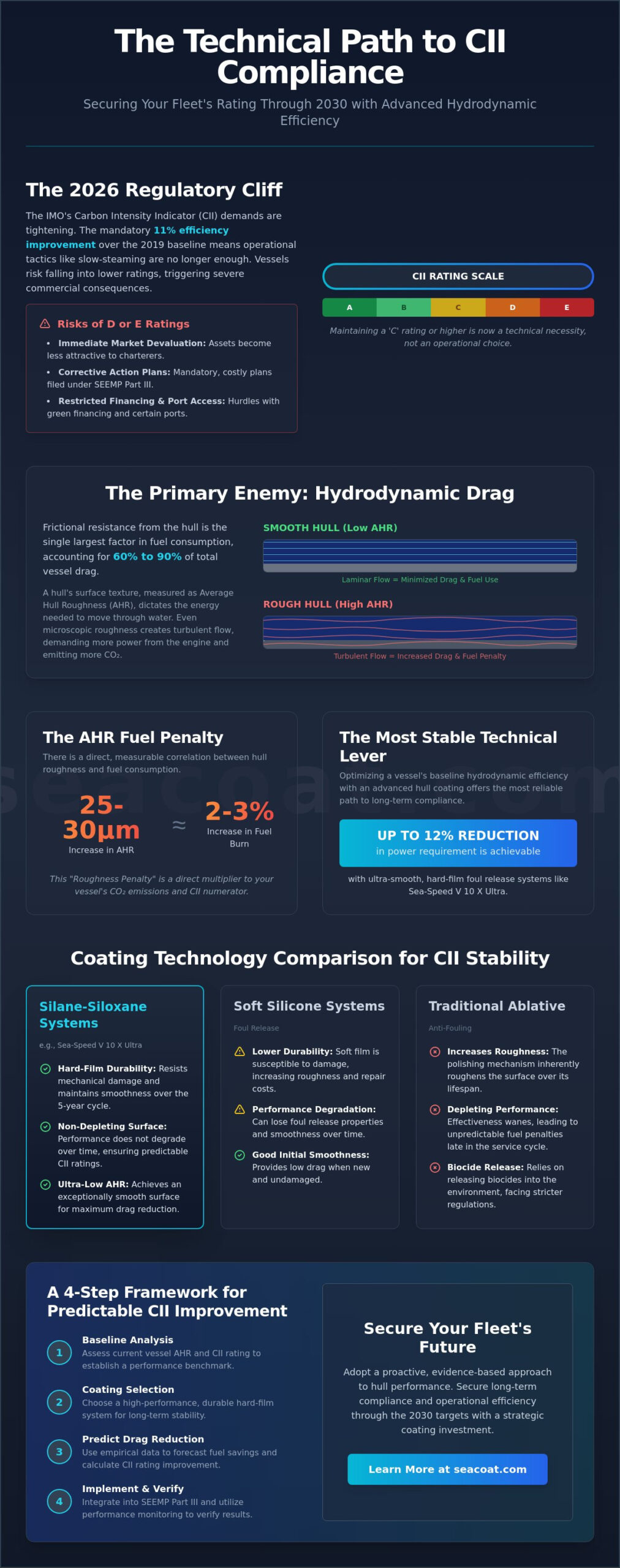
Comparing Coating Technologies: CII Stability Over the 5-Year Cycle
A vessel’s CII rating is an annual assessment, meaning the efficiency gains realized immediately after dry-docking must be sustained across the entire five-year service interval. Most conventional coatings exhibit a performance decay curve that complicates the process of calculating CII rating improvement from hull coatings. If the surface roughness increases or the coating integrity fails mid-cycle, the vessel risks a rating slip from a compliant C to a non-compliant D. Understanding the lifecycle behavior of different technologies is essential for multi-year regulatory planning.
Ablative antifouling systems operate through a sacrificial process where layers of the coating gradually wear away to release biocides. This “polishing” effect inherently increases surface roughness over time, leading to a steady rise in frictional resistance. Similarly, soft silicone foul-release coatings, while offering low surface energy, are highly susceptible to mechanical damage. Fenders, tug impacts, or even floating debris can cause “tearing,” which creates localized turbulence and significant drag spikes. In contrast, silane-siloxane systems like Sea-Speed V 10 X Ultra provide a hard-film surface that remains physically unchanged, ensuring the hydrodynamic baseline stays consistent from year one through year five.
The “Maintenance Gap” further distinguishes these technologies. While all hulls eventually accumulate a slime layer that requires in-water cleaning, the impact of this maintenance on the coating’s CII contribution is often overlooked. Scrubbing an ablative surface accelerates biocide depletion and roughness, while cleaning soft silicones often results in permanent surface scarring. Hard-film coatings can be cleaned repeatedly using standard equipment without degrading the film or increasing drag, preserving the vessel’s calculated efficiency gains.
Durability and Surface Integrity
Physical durability is a prerequisite for long-term CII compliance because any loss of surface smoothness directly increases the AER numerator. When managers evaluate ablative bottom paint, they must account for the sacrificial cycle’s impact on fuel consumption. Every micron of thickness lost to polishing contributes to a more turbulent boundary layer. Sea-Speed V 10 X Ultra eliminates this variable by maintaining its original film thickness and ultra-low roughness profile, providing a stable platform for sustained carbon intensity reductions.
Environmental Compliance and Non-Toxic Advantages
Adopting non-toxic, biocide-free coatings future-proofs a fleet against tightening international environmental standards and potential regional biocide bans. There is a strong synergy between EEXI (Energy Efficiency Existing Ship Index) technical compliance and low-friction hull systems. By choosing a hard-film silane-siloxane system, operators avoid the “regulatory trap” of using toxic additives to solve carbon issues. This approach ensures that the strategy used for calculating CII rating improvement from hull coatings remains valid even as global environmental regulations evolve toward total ecosystem preservation.
A 4-Step Framework for Calculating CII Improvement
To move beyond speculative efficiency gains, vessel managers must adopt a rigorous mathematical approach to performance forecasting. General checklists often fail to account for the specific hydrodynamic variables that determine a ship’s carbon intensity. By following a structured framework, technical teams can isolate the impact of surface conditions and make data-driven decisions about their coating specifications. This process ensures that calculating CII rating improvement from hull coatings is based on empirical evidence rather than manufacturer estimates.
- Step 1: Baseline Data Collection. Establish your current Annual Efficiency Ratio (AER) using high-frequency data from the previous 12 months.
- Step 2: Calculating Potential Drag Reduction. Use Average Surface Roughness (ASR) deltas to estimate the reduction in frictional resistance.
- Step 3: Applying the Fuel Saving Factor. Project the total CO2 reduction by applying the drag-to-fuel ratio to your AER numerator.
- Step 4: Validation. Implement ISO 19030 monitoring protocols post-application to verify that real-world performance matches your initial models.
Establishing the Baseline AER
The first step involves gathering 12 months of fuel consumption, distance traveled, and capacity data. It’s vital to isolate operational variables like weather, sea state, and route deviations to identify the ‘hull health’ baseline. This clean data set allows you to see the vessel’s current CII rating position relative to the tightening 2026 to 2030 thresholds. Without an accurate baseline, any subsequent calculations of improvement will lack the precision required for regulatory reporting. This data serves as the foundation for all technical interventions in your SEEMP Part III.
Projecting the CII Shift
Once you have a baseline, apply the expected fuel saving percentage to the existing CII value. The formula $CII_{new} = CII_{old} times (1 – text{Expected Fuel Saving %})$ provides a clear projection of your new rating. For example, industry data indicates that a 10% reduction in drag can successfully move a vessel from a borderline D rating to a solid B rating. This shift is often the difference between mandatory corrective actions and commercial preference. You should also factor in the ‘Cleaning Effect,’ as foul-release systems like Sea-Speed V 10 X Ultra allow for easier removal of biofouling, maintaining the efficiency gains between dry-docking intervals.
Long-term ROI and Asset Valuation
Translating these technical improvements into financial outcomes is the final stage of the framework. A higher CII rating often commands a charter rate premium and reduces the risk of ‘carbon costs’ associated with poor performance. Coating longevity is a critical part of this equation; a system that lasts ten years avoids the efficiency dip seen in shorter-cycle products. Sea-Speed extends the window of peak CII performance by eliminating the surface degradation common in sacrificial coatings. To see how these metrics apply to your specific vessel type, you can evaluate the performance specifications of Sea-Speed V 10 X Ultra for your next dry-docking cycle.
Sea-Speed V 10 X Ultra: A Strategic Asset for CII Compliance
As the 2026 reduction factors tighten the margin for compliance, the selection of a hull coating moves from a maintenance expense to a strategic asset. Sea-Speed V 10 X Ultra serves as a technical solution to the complex regulatory problem of carbon intensity. By providing a permanent, non-depleting surface, this silane-siloxane system eliminates the performance decay inherent in traditional technologies. Managers calculating CII rating improvement from hull coatings find that the stability of a hard-film surface is the most reliable way to avoid the rating erosion that threatens the commercial viability of older vessels.
The scientific advantage of this technology lies in its molecular structure. Unlike soft silicones or ablative paints, Sea-Speed creates a durable, glass-like finish that is fundamentally hydrophobic. This surface doesn’t just reduce drag; it actively prevents the attachment of biofouling without the use of toxic biocides. Evidence-based performance metrics indicate that vessels can achieve a substantial reduction in power requirements due to a surface roughness of less than five microns. This efficiency gain is a direct reduction in the AER numerator, streamlining the path toward an ‘A’ rating with the expertise of Seacoat SCT, LLC.
Technical Specifications for Fleet Managers
Transitioning to a hard-film system is a straightforward process for modern fleets. Sea-Speed V 10 X Ultra is compatible with most existing high-quality epoxy primer systems, allowing for efficient application during scheduled dry-docking. One of its most significant operational benefits is its extreme resistance to mechanical damage. While soft coatings often tear during in-water cleaning, this hard-film system can withstand aggressive mechanical scrubbing. This durability ensures the hull remains at peak efficiency throughout the service cycle. Additionally, the complete absence of VOCs and toxic additives ensures unrestricted access to global ports with the strictest environmental standards.
Next Steps for CII Optimization
Successful regulatory management requires vessel-specific data. We recommend consulting with Seacoat engineers to perform detailed modeling of your fleet’s hydrodynamic profile. By integrating these hull performance metrics into your Ship Energy Efficiency Management Plan (SEEMP Part III), you create a transparent and verifiable roadmap for compliance through 2030. Calculating CII rating improvement from hull coatings is not a one-time exercise but a continuous part of asset management. Requesting a comprehensive CII impact analysis for your fleet today will provide the technical foundation needed to secure your vessels’ operational future in an increasingly regulated landscape.
Securing Fleet Viability Through Hydrodynamic Excellence
The transition to Phase 2 of the IMO carbon intensity regulations demands a shift from operational compromises to technical precision. The narrowing corridor for compliance through 2030 leaves no room for the performance decay inherent in sacrificial coatings. By systematically calculating CII rating improvement from hull coatings, managers can isolate the specific fuel savings derived from a stable, ultra-smooth boundary layer. This data-driven approach ensures that your assets remain commercially attractive while avoiding the risks of mandatory corrective actions or rating erosion.
Since 2001, our hard-film silane-siloxane technology has provided a proven alternative to traditional systems. These solutions contain zero toxic biocides or heavy metals, aligning your fleet’s operational efficiency with global environmental stewardship. To move from theoretical modeling to empirical results, Request a CII Impact Analysis for Your Fleet today. Our technical team is ready to help you quantify the exact hydrodynamic gains available for your specific vessel profiles. It’s time to turn regulatory challenges into a clear competitive advantage for your maritime operations.
Frequently Asked Questions
How much can a hull coating realistically improve my CII rating?
Realistically, a high-performance coating can achieve up to a 12% reduction in fuel consumption by minimizing hydrodynamic drag. When managers are calculating CII rating improvement from hull coatings, this percentage often represents the difference between a non-compliant D rating and a commercially viable B rating. Because the CII is an annual metric, the stability of the coating’s surface over the entire year is the critical factor in these calculations.
Is there a specific ISO standard for measuring hull coating performance?
ISO 19030 is the primary international standard used to measure and report changes in hull and propeller performance. It provides a standardized methodology for analyzing data from onboard sensors to isolate the impact of hull condition on energy efficiency. Using this standard allows technical teams to verify that the projected improvements in carbon intensity are being met in real-world operational conditions.
Can a high-performance coating prevent a vessel from falling into a D or E rating?
Advanced coatings are a primary technical measure to prevent vessels from falling into D or E categories. Since operational measures like slow steaming have reached a plateau, reducing the physical resistance of the hull is the most effective way to lower the AER numerator. Maintaining a superior hydrodynamic profile ensures the vessel stays within the narrowing compliance corridor mandated by the IMO through 2030.
How does hull roughness (ASR) impact the Annual Efficiency Ratio (AER)?
Average Surface Roughness (ASR) has a direct, linear impact on the Annual Efficiency Ratio (AER) because it dictates the amount of fuel required to maintain a specific speed. Every 25 to 30 microns of added roughness typically results in a 2% to 3% increase in fuel consumption. By keeping ASR low, you reduce the total CO2 emissions, which is the only controllable variable in the AER numerator.
Do non-toxic coatings perform as well as traditional antifouling for CII purposes?
Non-toxic silane-siloxane coatings frequently outperform traditional antifouling because they don’t rely on a sacrificial leaching process that increases surface roughness. While biocidal paints degrade and become more turbulent over time, hard-film non-toxic systems maintain a consistent, ultra-smooth finish. This longevity is essential when calculating CII rating improvement from hull coatings over a multi-year regulatory cycle.
What is the difference between foul release and antifouling in terms of fuel savings?
Traditional antifouling uses chemical biocides to kill marine growth, while foul-release coatings use low surface energy to prevent organisms from adhering. In terms of fuel savings, foul-release systems provide a smoother initial profile and maintain that smoothness longer. This results in more predictable and sustained fuel savings compared to the performance decay curve seen in ablative antifouling products.
How often should I clean a Sea-Speed coated hull to maintain its CII rating?
Cleaning frequency for a Sea-Speed coated hull depends on your vessel’s idle time and specific trade routes, but the hard-film nature of the coating allows for cleaning as often as necessary. Unlike soft silicones that can tear or ablative paints that wear away during scrubbing, Sea-Speed V 10 X Ultra is physically durable. Regular, non-destructive grooming ensures the hull stays at its baseline ASR and maintains its peak CII rating.
Can I apply Sea-Speed over my existing hull coating to improve efficiency?
Sea-Speed V 10 X Ultra can’t be applied directly over existing antifouling paints because the sacrificial nature of those coatings prevents a permanent bond. To achieve maximum efficiency and long-term durability, the old coating must be removed to the primer or bare substrate. This ensures the silane-siloxane film has a stable foundation to provide the decade-long performance required for sustained regulatory compliance.