
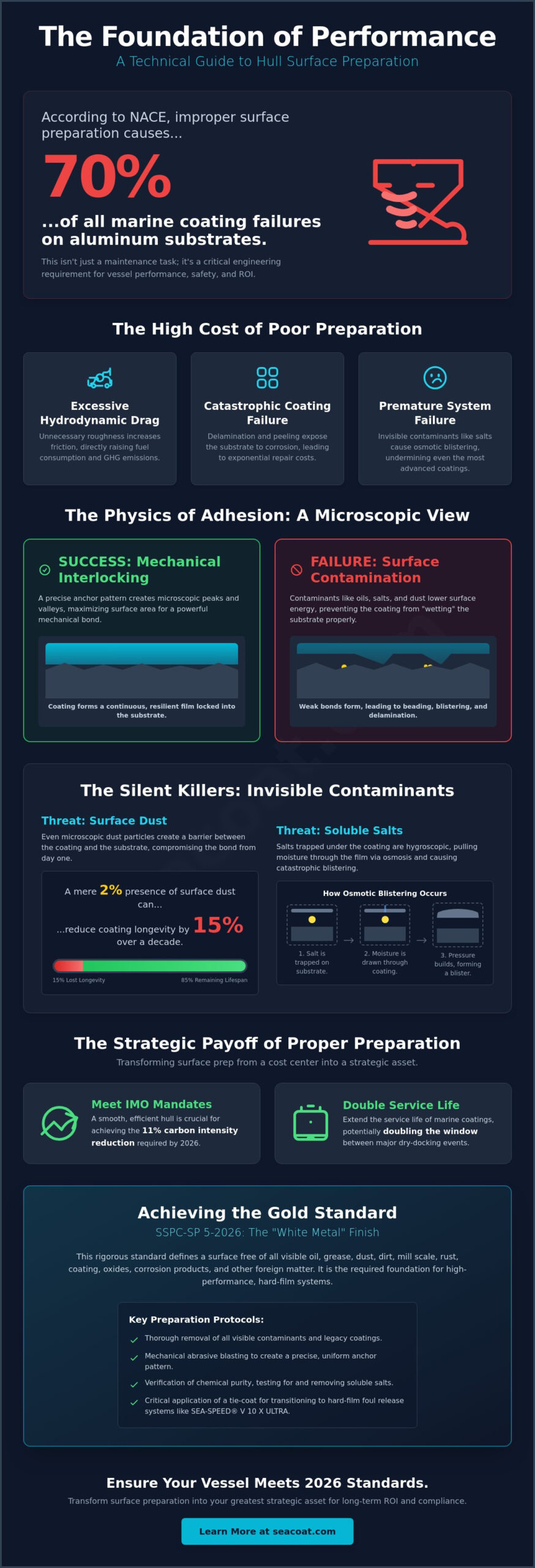
According to the National Association of Corrosion Engineers, 70% of marine coating failures on aluminum substrates result from improper surface preparation. This statistic underscores why adhering to best practices for hull surface preparation isn’t just a maintenance task; it’s a critical engineering requirement for vessel performance. You likely understand that even the most sophisticated silane-siloxane systems can’t perform if the substrate is compromised. It’s a recurring challenge in heavy industry to see high-performance assets undermined by premature coating detachment or excessive hydrodynamic drag that drives up fuel consumption.
This article provides the technical roadmap to ensure your vessel meets the latest 2026 standards for adhesion and efficiency. You’ll learn the specific mechanical processes required to achieve the white metal finish defined by SSPC-SP 5-2026 and understand why a mere 2% presence of surface dust can reduce coating longevity by 15% over a decade. We’ll preview the rigorous protocols needed to achieve the 11% carbon intensity reduction mandated by the IMO, focusing on the specialized requirements for non-toxic systems like SEA-SPEED® V 10 X ULTRA CLEAR. By the end, you’ll have the data-driven insights necessary to transform surface prep into a strategic asset for long-term ROI.
Key Takeaways
- Understand how a precise anchor pattern serves as the mechanical foundation for advanced hydrodynamic coatings.
- Identify and mitigate the risks of invisible contaminants like soluble salts to prevent osmotic blistering and premature coating failure.
- Evaluate the best practices for hull surface preparation through a comparison of abrasive blasting methods and media selection for specific substrates.
- Align your maintenance cycles with evolving environmental regulations by mastering containment strategies for toxic waste and legacy antifouling materials.
- Discover the technical requirements for transitioning to hard-film foul release systems like Sea-Speed V 10 X Ultra, including the critical tie-coat application process.
The Strategic Importance of Hull Surface Preparation
Hull surface preparation is defined as the deliberate mechanical and chemical modification of a vessel’s substrate to create a receptive environment for a protective system. It isn’t a mere cleaning task; it’s a precision engineering phase that determines the success or failure of the entire dry-docking cycle. Implementing best practices for hull surface preparation involves more than removing biofouling. It requires the creation of a specific anchor pattern, consisting of microscopic peaks and valleys that provide the necessary surface area for mechanical interlocking. Without this profile, the risk of delamination becomes a certainty. This leads to catastrophic coating failure where the material peels away in sheets, exposing the substrate to corrosive seawater and increasing repair costs exponentially.
Modern standards focus on achieving a surface smoothness measured in microns. Every micron of unnecessary roughness contributes to frictional drag, which directly correlates with increased fuel consumption and elevated greenhouse gas emissions. Precision in this phase is the primary safeguard against operational inefficiency. By controlling the substrate profile, operators can ensure that advanced coatings achieve their intended hydrodynamic performance, effectively turning the hull into a high-efficiency surface rather than just a protected one.
The Physics of Adhesion and Surface Tension
Adhesion in marine environments relies on a combination of mechanical interlocking and chemical bonding. While traditional ablative bottom paint systems are designed to erode and may tolerate less stringent prep, advanced hard-film systems require absolute substrate purity. These silane-siloxane technologies rely on high surface energy to ensure proper wetting. Wetting occurs when the liquid coating spreads across the substrate rather than beading up. If contaminants like oils or salts remain, they lower the surface energy, preventing the coating from forming a resilient, continuous bond. Hard-film systems demand a level of precision that traditional methods often overlook, making the mechanical profile the single most important factor in longevity.
Impact on Vessel ROI and Fuel Economy
The financial implications of surface preparation are profound. A smooth hull reduces the power required to maintain cruising speeds, which is essential for meeting the IMO’s 11% carbon intensity reduction targets compared to the 2019 baseline. Adhering to best practices for hull surface preparation extends the service life of the marine coatings system, often doubling the window between major maintenance events. While some operators consider In-water surface cleaning methods as a temporary fix, they can’t replace the foundational integrity established during a full dry-dock prep. Viewing preparation costs as a capital expenditure reduces long-term operational expenses and enhances the global environmental footprint of heavy industry operations.
Evaluating Substrate Integrity and Contamination Removal
Substrate evaluation is the diagnostic phase where the invisible becomes quantifiable. While visible marine growth and spent antifouling biocides are obvious targets for removal, the most insidious threats are microscopic. Soluble salts, hydrocarbons, and residual chemical markers from legacy coatings can remain trapped within the surface profile even after heavy mechanical cleaning. Adhering to best practices for hull surface preparation requires a shift from visual cleanliness to chemical purity. It’s not enough to simply strip the surface; you must ensure the underlying material is chemically receptive to the new system.
Pressure washing often fails to reach the base of the surface profile. It might remove loose debris, but it can actually drive soluble salts deeper into metal or fiberglass pores. These salts are hygroscopic; they pull moisture through the coating via osmosis. This leads to osmotic blistering, a primary cause of premature system failure. A thorough inspection must also identify structural defects like pitting or electrolysis damage. These localized corrosion sites indicate deeper electrical or material issues that require remediation before any coating application begins. If you don’t address these underlying problems, even the most advanced coating will eventually fail.
Salt and Chemical Decontamination Protocols
Testing for chloride levels is a non-negotiable step in modern maritime maintenance. Using Bresle patches or specialized conductivity meters allows technicians to measure the concentration of soluble salts on the substrate. Most high-performance specifications require salt levels to be below 5 µg/cm² before the primer is applied. If levels exceed this threshold, high-pressure water blasting must be combined with chemical salt removers. These agents break the ionic bond between the salt and the substrate, ensuring a neutral surface. Referencing SSPC standards for hull repair provides a clear framework for these technical thresholds, ensuring that your preparation meets federal and international quality benchmarks.
Degreasing and Solvent Cleaning Standards
Hydrocarbon contamination from fuel spills or hydraulic leaks creates a barrier that prevents coating adhesion. Following SSPC-SP 1 standards for solvent cleaning is essential. Technicians must avoid the common error of “spreading” grease. Using a single cloth to wipe a large area simply redistributes the oil. A two-cloth method, one to apply solvent and one to lift the dissolved grease, is the only way to ensure total removal. It’s vital that these degreasers are chemically compatible with the next layer of the system. For instance, ensuring a clean, oil-free surface is the prerequisite for the superior bonding of Seapoxy 73, which acts as a robust corrosion barrier. By integrating these best practices for hull surface preparation, you transform a vulnerable substrate into a stable, high-performance foundation.
Mechanical Preparation Standards and Methods
Mechanical preparation represents the physical execution of the engineering standards required for long-term coating success. While the previous section focused on chemical purity, the mechanical phase is responsible for creating the physical architecture of the substrate. Adhering to best practices for hull surface preparation involves selecting a method that balances aggressive profile creation with environmental containment. Dry abrasive blasting remains the industry standard for speed and efficiency on large steel hulls, yet vapor blasting is increasingly favored in sensitive maritime environments. Vapor blasting uses a pressurized mixture of water and media to suppress up to 92% of airborne dust, making it a superior choice for yards under strict regulatory oversight.
Media selection is equally critical and must be tailored to the specific substrate. Garnet is often preferred for its high density and low friability, which produces a clean, sharp anchor pattern without the heavy dusting associated with coal slag. For aluminum hulls, non-ferrous media like crushed glass or aluminum oxide are essential to prevent galvanic corrosion. Manufacturer specifications for the Sea-Speed V 10 X Ultra system require a precise mechanical bond, typically achieved through sanding with 180-220 grit sandpaper for smaller applications or controlled blasting for large-scale projects. Power tool cleaning, classified under SSPC-SP 3, is generally insufficient for full hull maintenance; it often polishes the metal rather than creating the sharp micro-peaks necessary for interfacial adhesion.
Industrial Blasting Standards (SSPC/NACE)
The maritime industry recognizes SSPC-SP 10, also known as Near-White Metal Blast, as the standard for high-performance protective systems. While SSPC-SP 6 (Commercial Blast) is more economical, it allows for significantly more staining and mill scale, which compromises the longevity of advanced silane-siloxane coatings. A Near-White Metal Blast finish is a surface that, when viewed without magnification, is free of all visible oil, grease, dust, dirt, mill scale, rust, coatings, oxides, corrosion products, and other foreign matter, except for very light shadows, very slight streaks, or slight discolorations. Investing in this higher standard ensures the substrate is optimized for maximum chemical and mechanical bonding.
Profile Measurement and Quality Control
Verification is the final step in best practices for hull surface preparation. Technicians use Testex replica tape or digital surface profile gauges to confirm that the anchor pattern meets the specified depth, usually between 50 to 75 microns for heavy-duty primers. Measurements should be taken at regular intervals across the entire hull to ensure uniformity. Precision is vital because a 2% presence of surface dust can decrease the longevity of a coating by 15% over a ten-year period. Once the profile is verified, the first coat of a system like Seapoxy 73 must be applied immediately. This prevents “flash rust,” a rapid oxidation that occurs on bare steel when exposed to humidity, which can undermine the entire preparation effort.
Environmental Compliance and Containment Strategies
The most significant logistical challenge in modern dry-docking is the management of legacy waste. Transitioning away from traditional biocidal systems requires stripping layers of old material that often contain heavy metals like copper or tin. Adhering to best practices for hull surface preparation today means accounting for the complete containment of these toxic residues. Shipyards are rapidly moving toward a zero-discharge model; every liter of runoff and every kilogram of spent abrasive must be captured and processed. This shift is driven by a serious commitment to preventing heavy metal contamination in local marine ecosystems, which can have devastating long-term effects on biodiversity and local water quality.
By shifting to non-toxic, hard-film systems, operators effectively eliminate the regulatory burden of toxic waste containment for all future maintenance cycles. Once a vessel is coated with a biocide-free solution, subsequent preparation involves only the removal of organic biofouling rather than hazardous chemical layers. This foresight transforms environmental stewardship from a compliance cost into a long-term operational efficiency. It’s a strategic move that aligns vessel management with the increasing global pressure on heavy industry to reduce its ecological footprint.
Regulatory Landscape: IMO and EPA Standards
The International Convention on the Control of Harmful Anti-fouling Systems on Ships (AFS Convention) has fundamentally changed how waste is handled during hull prep. Documented waste management is now a prerequisite for commercial fleet compliance, particularly as global standards tighten around the discharge of wash water. Adopting environmental marine coatings simplifies this process by removing the source of the contamination at the substrate level. Vessels that utilize non-leaching technologies are better positioned to navigate the evolving legal landscape, ensuring that their multi-year performance cycles aren’t interrupted by sudden regulatory changes or port-state control issues.
Practical Containment and Filtration Techniques
Execution of best practices for hull surface preparation requires advanced containment hardware. Vacuum-shrouded tools and full-hull shrouding are essential for capturing airborne particulates during dry blasting. Alternatively, hydro-blasting has emerged as a cleaner alternative; it uses ultra-high-pressure water to strip coatings without the dust associated with traditional media. This method requires sophisticated water filtration systems to separate the solid coating chips from the effluent before the water is treated or recycled. Proper disposal protocols for biocide-contaminated media must be strictly followed, as many regions now classify this waste as hazardous material requiring specialized incineration. To ensure your vessel meets these rigorous standards while maximizing hydrodynamic efficiency, consider the sustainable performance of Sea-Speed V 10 X Ultra.
Optimizing the Substrate for Sea-Speed V 10 X Ultra
Achieving the full performance potential of Sea-Speed V 10 X Ultra and Armor-Sil R/G requires a substrate that is both physically textured and chemically inert. While previous phases established the mechanical profile, the final optimization ensures that the silane-siloxane chemistry can form a permanent bond. This involves a meticulous final walk-through to confirm the absence of any shadowing or residual contamination that could impede the wetting process. Implementing best practices for hull surface preparation at this stage means verifying that the surface energy is maximized for the primer. Seapoxy 73 serves as the critical intermediary here, providing a high-build corrosion barrier that is compatible with steel, aluminum, and fiberglass. Its versatility makes it the preferred foundation for heavy industry assets where material consistency varies across the hull.
The tie-coat process is the bridge between the prepared substrate and the hard-film topcoat. It’s not merely another layer; it’s a specialized application that ensures the topcoat doesn’t just sit on the surface but becomes part of a unified protective system. Before this application, technicians must execute a final checklist to prevent localized failures. This includes a 100% dust removal pass using oil-free compressed air and a final solvent wipe-down if required by the technical data sheet. These steps ensure that the 10-year warranty parameters are fully met, providing the vessel with a decade of hydrodynamic efficiency.
Transitioning from Ablative to Hard-Film Systems
Moving from traditional systems to a modern foul-release solution requires the 100% removal of all old ablative paint. You can’t simply overcoat legacy materials. Sandwiching old, soft paint between the hull and a high-performance topcoat like Sea-Speed V 10 X Ultra creates a structural weakness. As the old paint inevitably degrades, it will pull the new system away from the hull, leading to delamination. Readers seeking a deeper understanding of these material trade-offs should consult the definitive guide to boat hull paint for a full analysis of performance science.
The Sea-Speed Application Advantage
The primary benefit of this rigorous preparation is the drastic reduction in future maintenance intensity. Because Sea-Speed creates a hard, non-porous film, it doesn’t require the aggressive strip-and-recoat cycles typical of toxic antifouling. The easy-clean nature of the film means that organic biofouling can be removed with minimal effort, often during routine operations. This durability minimizes the total cost of ownership by extending service windows. Fleet owners and managers looking to optimize their assets should consult with Seacoat SCT, LLC for technical specifications that align with best practices for hull surface preparation.
- Confirm surface profile depth matches the 50 to 75 micron specification.
- Verify soluble salt levels remain below 5 µg/cm² using a Bresle test.
- Ensure the substrate temperature is at least 3°C above the dew point.
- Perform a final visual inspection for flash rust or hydrocarbon spots.
- Check that all masking and containment shielding is secure and intact.
Securing Long-Term Vessel Efficiency through Precision Engineering
Securing a vessel’s hydraulic profile begins long before the first liter of coating is applied. The transition from basic cleaning to precision engineering requires a rigorous focus on mechanical anchor patterns and the total elimination of invisible chemical contaminants like soluble salts. Adhering to best practices for hull surface preparation is the only way to mitigate the risks of osmotic blistering and ensure the long-term adhesion of advanced foul-release systems. By integrating documented waste management and strict industrial blasting standards, operators can transform a routine dry-docking event into a strategic investment in vessel longevity and regulatory compliance.
Since 2001, our Silane-Siloxane technology has offered a proven, non-toxic, and biocide-free alternative to traditional hull treatments. These systems are designed to significantly reduce frictional drag and fuel costs while drastically extending service windows. This approach proves that physical durability and ecological safety are inseparable components of modern maritime operations. To optimize your asset performance and ensure compliance with the latest IMO standards, Request a Technical Specification for Your Vessel Fleet. Investing in a superior foundation today ensures a more profitable and sustainable operational cycle for years to come.
Frequently Asked Questions
What is the best method for removing old antifouling paint?
Dry abrasive blasting or hydro-blasting are the most effective methods for removing legacy antifouling layers. Dry blasting provides speed, while hydro-blasting or vapor blasting offers superior dust containment for shipyards under strict environmental oversight. The choice depends on the substrate material and the complexity of containing toxic biocide runoff. Regardless of the method, the goal is to reach the original substrate to ensure a stable foundation for the new system.
How clean does a hull need to be before applying a foul release coating?
A hull must reach a “Near-White Metal” standard, equivalent to SSPC-SP 10, before application. This means the surface is 95% free of all visible contaminants, including rust and old coatings. Additionally, chemical purity is vital; soluble salt levels should be verified below 5 µg/cm² to prevent osmotic blistering. These rigorous standards are part of the best practices for hull surface preparation required for advanced silane-siloxane technologies.
Can I apply Sea-Speed V 10 X Ultra over my existing bottom paint?
No, Sea-Speed V 10 X Ultra cannot be applied over existing ablative bottom paint. Traditional paints are designed to erode, making them a structurally unstable foundation for a permanent hard-film system. Applying a high-performance topcoat over soft, sacrificial layers will lead to catastrophic delamination as the underlying paint degrades. Total removal of the old system is a non-negotiable requirement for long-term coating integrity.
What is the difference between SSPC-SP 6 and SSPC-SP 10?
The primary difference lies in the allowable percentage of surface staining. SSPC-SP 6, or Commercial Blast, allows for up to 33% staining from rust or old mill scale. In contrast, SSPC-SP 10, or Near-White Metal Blast, restricts staining to only 5% of the surface area. High-performance systems require the tighter tolerances of SP 10 to ensure maximum mechanical bonding and prevent localized corrosion under the film.
How do I test for salt contamination on a ship’s hull?
Salt contamination is tested using the Bresle method, which involves applying a specialized patch to the hull to extract soluble salts. Technicians inject deionized water into the patch to dissolve surface chlorides, then measure the conductivity of the resulting solution. This provides a quantifiable metric of salt concentration. It’s a critical step since invisible chlorides are a leading cause of coating failure in marine environments.
Does the surface profile really affect a vessel’s fuel consumption?
Yes, surface profile directly impacts a vessel’s fuel consumption by altering its frictional drag. A rougher hull requires more power to maintain speed, which increases fuel burn and emissions. Advanced silane-siloxane systems can reduce frictional drag by 6% to 12% compared to traditional coatings. These efficiencies are only achievable when best practices for hull surface preparation are followed to create an ultra-smooth, low-friction surface.
What happens if I apply a coating over flash rust?
Applying a coating over flash rust will severely compromise the bond between the substrate and the primer. Flash rust acts as a physical barrier that prevents the coating from wetting the metal surface, leading to premature detachment. Because rust is hygroscopic, it can also trap moisture under the film, causing osmotic blisters to form shortly after the vessel returns to service. Immediate application after cleaning is essential.
Are there specific prep requirements for aluminum hulls vs. steel hulls?
Aluminum hulls require non-ferrous abrasive media, such as garnet or crushed glass, to prevent galvanic corrosion caused by embedded steel particles. Steel hulls typically need a more aggressive anchor pattern of 50 to 75 microns to ensure mechanical interlocking. For aluminum, it’s also necessary to perform a thorough de-waxing and sand the surface with 180-220 grit sandpaper to remove the oxide layer before applying a specialized primer like Seapoxy 73.