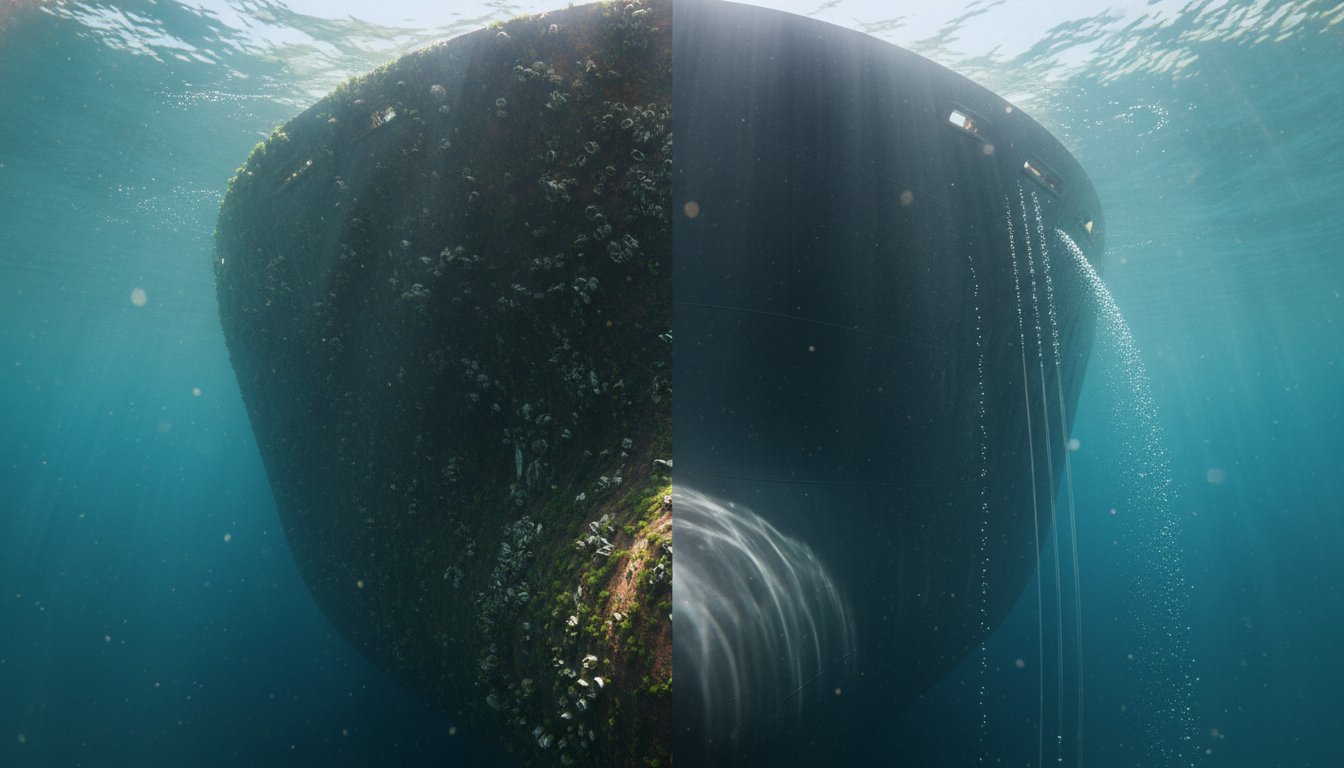
Relying on increasingly toxic biocides to combat tropical fouling is a strategy of diminishing returns that ignores the fundamental physics of marine adhesion. In environments where water temperatures consistently exceed 25°C, the metabolic rate of barnacles and slime accelerates beyond the leaching capacity of even the highest-copper paints. You’ve likely found that searching for the best hull coating for warm waters often leads to a cycle of frequent, expensive haul-outs and rising fuel costs due to frictional drag.
This guide demonstrates how a transition to hard-film, biocide-free technology provides a definitive 10-year solution for vessel protection. By utilizing advanced silane-siloxane coatings like Sea-Speed V 10 X Ultra, operators can achieve up to a 12% increase in fuel efficiency through superior hull optimization. We’ll analyze the technical shift from chemical toxicity to surface-energy mitigation and explain how these non-toxic systems meet the rigorous environmental standards of 2026 while maximizing long-term ROI.
Key Takeaways
- Understand how tropical temperatures accelerate biocide depletion in traditional paints, often rendering them ineffective within months of application.
- Learn why hard-film silane-siloxane technology is the best hull coating for warm waters by utilizing low surface energy to prevent organism attachment.
- Analyze the economic impact of shifting to a 10-year coating lifecycle, which significantly reduces haul-out frequency and long-term maintenance overhead.
- Explore the regulatory advantages of biocide-free systems that meet the stringent 2026 environmental standards in global maritime hubs like Singapore.
- Discover how Sea-Speed V 10 X Ultra optimizes vessel hydrodynamics to deliver sustained fuel savings of up to 12% over its operational life.
The Warm Water Challenge: Why Tropical Fouling is Different
Warm water isn’t just a different climate; it’s a completely different chemical and biological arena. In regions like the Gulf Coast or Southeast Asia, water temperatures frequently exceed 25°C. This heat doesn’t just invite more organisms; it fundamentally changes how they behave and how coatings react. The problem of biofouling becomes an exponential challenge rather than a linear one. Finding the best hull coating for warm waters requires moving beyond the “more biocide” mentality that has dominated the industry for decades.
Metabolic Acceleration in Tropical Ecosystems
Marine biology follows the 10-degree rule: for every 10°C increase in temperature, biological activity and metabolic rates roughly double. In tropical ecosystems, organisms like hard corals, barnacles, and calcareous tubeworms reach maturity in half the time they’d take in temperate zones. Biofouling pressure represents the quantifiable rate of organic colonization on a submerged surface, dictated by the synergy of thermal energy, nutrient availability, and species density. This constant pressure means a hull can be colonized within hours of becoming stationary. Traditional solutions struggle because they cannot keep pace with this rapid reproductive cycle.
The Failure of Traditional Biocides
Traditional ablative paints rely on the controlled release of toxins, usually copper, into the surrounding water. However, chemical solubility is temperature-dependent. In warm waters, these active ingredients leach 2 to 3 times faster than intended. This leads to “leach rate exhaustion,” where the coating looks intact but has lost its defensive chemical payload. This accelerated leaching also poses a significant threat to sensitive coral reef zones; high copper concentrations disrupt local marine equilibrium. Heavy loading of biocides to compensate often makes the paint film brittle, resulting in premature cracking and delamination.
This chemical instability is often followed by the “Slime Paradox.” This occurs when specific copper-resistant algae strains thrive because the biocides have eliminated their natural competitors. The result is a thick, stubborn layer of biofilm that increases drag and fuel consumption. An effective tropical coating must prioritize chemical stability and surface energy over toxic leaching. It needs a hard, slick surface that resists the mechanical grip of barnacles while remaining inert in high-salinity environments. Reliability in these conditions is about maintaining hydrodynamic efficiency for a full 10-year cycle, not just surviving the first six months of a season.
Evaluating Coating Technologies: Antifouling vs. Foul Release
The maritime industry is currently undergoing a paradigm shift as regulatory bodies accelerate the phase-out of biocide-laden coatings. Traditional antifouling depends on a sacrificial layer that poisons the immediate environment; it’s a method that is increasingly restricted in biodiversity-rich tropical waters. In contrast, foul release technology offers a mechanical rather than chemical solution. By focusing on the physical properties of the hull surface to mitigate attachment, these systems provide a more stable and sustainable alternative. Determining the best hull coating for warm waters involves understanding that toxicity is no longer the most effective defense against rapid bio-colonization.
The Mechanics of Low Surface Energy
Silane-siloxane technology operates by lowering the surface energy of the hull, making it physically impossible for the proteins secreted by marine organisms to establish a permanent bond. While traditional paints are microscopically rough to facilitate biocide leaching, modern slick films provide a uniform, hydrodynamic profile. This reduction in surface roughness can lower the drag coefficient significantly, often resulting in fuel savings of up to 12% over the vessel’s operational life. For a deeper technical comparison of these mechanisms, you can explore The Definitive Guide to Antifouling Boat Paint and Foul Release Systems in 2026.
Durability and Impact Resistance
A critical distinction within foul release technology exists between soft silicone and hard-film systems. Soft silicones are notorious for their lack of mechanical durability; they often peel or tear during standard docking maneuvers or when encountering floating debris. This “silicone weakness” makes them a liability for vessels in high-traffic warm water ports where physical impacts are common. Hard-film technology, such as silane-siloxane, provides the necessary impact resistance to withstand mechanical scrubbing and operational wear without sacrificing its foul-release properties.
Scientific institutions like the Pacific Northwest National Laboratory continue to research advanced solutions to biofouling, confirming that hard-film coatings maintain their integrity even when vessels remain stationary for extended periods. This durability allows for regular in-water cleaning without the risk of releasing toxic plumes or damaging the coating itself. It’s a strategic asset for vessel management that ensures the hull remains optimized for performance throughout its 10-year lifecycle. If you’re looking to upgrade your fleet’s efficiency, consider how a transition to advanced foul release systems can reduce your long-term maintenance overhead.
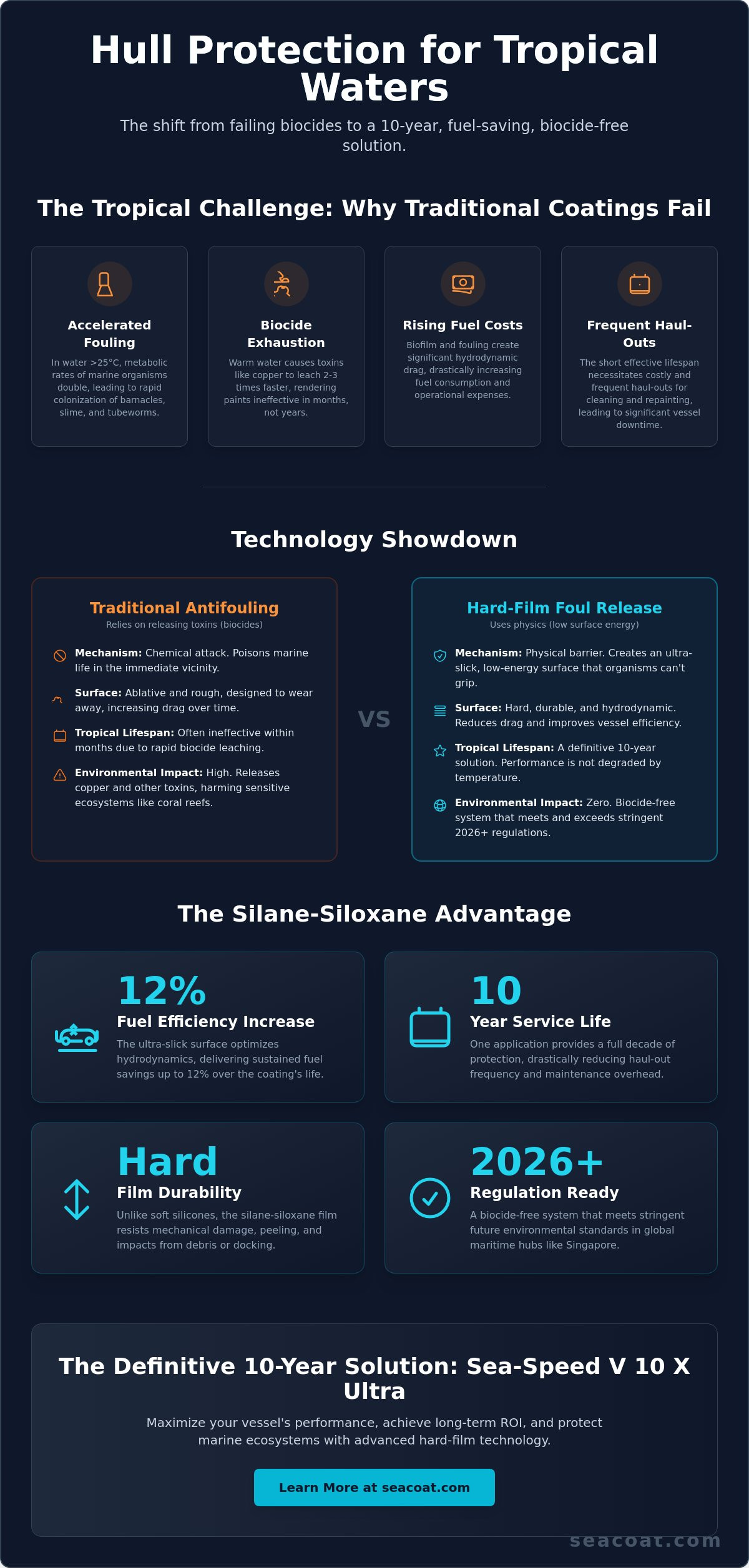
Why Hard-Film Silane-Siloxane Wins in the Tropics
Silane-siloxane technology represents a fundamental departure from the fragile nature of soft silicone coatings. It’s a hard-film solution that achieves a covalent bond with the hull substrate, creating a cross-linked molecular matrix. This architecture ensures the coating doesn’t merely sit on the surface; it becomes a structural component of the vessel’s protection. When evaluating the best hull coating for warm waters, the focus must shift from temporary toxicity to permanent molecular stability. This hard-film approach allows for a 10-year lifecycle, effectively ending the outdated “haul-out every two years” mentality that plagues tropical fleet management.
Chemical Stability in High Salinity
Tropical environments are characterized by aggressive salinity levels that accelerate the oxidation of traditional metals. Copper-based paints frequently undergo a chemical transformation in these conditions, turning green and losing their biocide efficacy as the surface becomes “case-hardened.” Silane-siloxane remains chemically inert, meaning it doesn’t react with saltwater or UV radiation. Inert surfaces prevent the initial biofilm “handshake” by denying marine organisms the chemical cues and polarized surface charges they require for initial attachment. This stability is critical for maintaining performance in the high-fouling waters of the Caribbean and the Indo-Pacific.
The Hydrodynamic Advantage
Surface roughness, measured as Rt, is a primary driver of frictional drag. Traditional antifouling paints are inherently porous and rough to allow for biocide leaching, which creates turbulence at the boundary layer. Hard-film foul release systems provide a microscopically smooth surface that optimizes water flow. According to the U.S. Department of Transportation’s report on Vessel Biofouling Prevention and Management Options, effective management requires solutions that can withstand diverse environmental stressors while maintaining hull efficiency.
Vessel owners often see immediate improvements in speed and a 4% to 10% reduction in fuel consumption after transitioning to these systems. These savings are not just theoretical; they’re the result of a lower drag coefficient that remains consistent over the coating’s life. For a comprehensive breakdown of these financial metrics and the science behind surface smoothness, consult the Definitive Guide to Boat Hull Paint. Furthermore, these coatings are Zero VOC compliant, meeting the most stringent 2026 environmental standards in maritime hubs like Singapore and Australia. This ensures that your vessel remains operationally ready and regulatorily compliant in any global port.
Implementation & ROI for Tropical Vessel Management
Vessel management in tropical regions requires a fundamental transition from reactive maintenance to proactive asset optimization. While traditional paints necessitate frequent haul-outs that disrupt operational schedules, a hard-film system represents a strategic shift in Total Cost of Ownership (TCO). By investing in the best hull coating for warm waters, operators can extend dry-dock intervals to a 10-year cycle, effectively amortizing the initial application cost over a decade of sustained performance. This longevity is supported by a move away from the cycle of “sanding back” every season toward a permanent primer system that simplifies future maintenance requirements.
The 10-Year Maintenance Schedule
Achieving a decade of protection depends on a disciplined three-step application and maintenance protocol that prioritizes substrate integrity and surface energy. This process ensures the coating remains a functional asset rather than a deteriorating layer. The schedule includes:
- Step 1: Thorough hull preparation followed by the application of Seapoxy 73. This permanent epoxy primer creates a high-strength bond that prevents delamination in high-salinity environments.
- Step 2: Precision application of a dual-coat system of Sea-Speed V 10 X Ultra. This creates the hard-film foul release surface necessary for hydrodynamic efficiency.
- Step 3: Implementation of routine in-water wiping. Because the film is hard rather than soft silicone, divers can wipe away light slime using soft materials without removing product or creating toxic plumes.
Calculating Fuel and Emissions Savings
The financial justification for advanced coatings is rooted in the quantifiable reduction of engine load. A smoother hull profile directly correlates with lower fuel consumption, typically yielding a 4% to 10% reduction in operational costs for most vessel types. For commercial fleets, this optimization is no longer optional; it’s essential for meeting Energy Efficiency Existing Ship Index (EEXI) and Carbon Intensity Indicator (CII) requirements. By reducing frictional drag, vessels maintain higher speeds at lower RPMs, which significantly lowers Greenhouse Gas (GHG) emissions.
This alignment of economic and environmental goals is a core pillar of Environmental Marine Coatings, where regulatory compliance in 2026 is increasingly driven by sustainable hull performance. Commercial operators can leverage these performance metrics to fulfill Corporate Social Responsibility (CSR) targets while protecting their bottom line. To begin your fleet’s transition toward a more efficient and compliant future, evaluate our advanced foul release solutions for your specific vessel requirements.
The Seacoat SCT, LLC Solution: Sea-Speed V 10 X Ultra for Warm Waters
Sea-Speed V 10 X Ultra represents the definitive shift from temporary antifouling to permanent foul release technology. As a hard-film silane-siloxane coating developed by Seacoat SCT, LLC, it provides a level of durability and chemical stability that traditional paints cannot replicate in tropical climates. It’s engineered to serve as the best hull coating for warm waters by maintaining its low surface energy profile for a full 10-year lifecycle. This longevity has been validated through extensive performance data in high-fouling zones, including the Gulf of Mexico and the coastal waters of Southeast Asia. In these environments, where biological pressure is constant, Sea-Speed V 10 X Ultra prevents the mechanical adhesion of calcareous organisms without releasing a single gram of toxic biocide into the ecosystem.
The versatility of this system is a primary advantage for diverse fleet management. Because the coating is chemically inert and non-conductive, it provides an ideal barrier for multiple substrates. It’s particularly effective for aluminum boats, where traditional copper-based paints would trigger devastating galvanic corrosion. Whether applied to fiberglass, steel, or alloy hulls, the hard-film finish remains resilient against impact and mechanical wear, ensuring that the hull’s hydrodynamic profile isn’t compromised by standard operational activities.
Engineered for Performance
The “Ultra” formulation is specifically calibrated for high-heat, high-growth environments where the metabolic rates of marine life are at their peak. For operators prioritizing aesthetics or a competitive edge, Sea-Speed V 10 X Ultra Clear offers a transparent, glass-smooth finish that minimizes the drag coefficient to its absolute limit. This is especially critical for racing hulls and high-speed ferries where every fraction of a knot translates to significant operational gains. Owners of specialized vessels can also consult the Seacoat SCT, LLC technical resource on the best boat paint for aluminum boats to understand how silane-siloxane prevents the specific corrosion challenges associated with light-alloy hulls.
Global Support and Procurement
Seacoat SCT, LLC supports the global maritime industry through a robust logistics network designed for rapid deployment. We maintain strategic logistics hubs in Tomball, Texas, and Singapore to ensure that commercial fleets and recreational boaters have immediate access to our technology. We offer bulk industrial contracts for fleet-wide transitions, providing the technical documentation and product volume required for large-scale dry-docking operations. This global presence ensures that no matter where your vessel is stationed, a 10-year, zero-VOC solution is within reach. You can optimize your vessel with Sea-Speed V 10 X Ultra today to secure a decade of hydrodynamic efficiency and environmental compliance.
Securing Long-Term Operational Efficiency in Tropical Waters
Selecting the best hull coating for warm waters isn’t merely a maintenance choice; it’s a strategic investment in the long-term viability of your maritime assets. By prioritizing hard-film silane-siloxane technology over traditional biocides, you eliminate the cycle of rapid biological colonization and frequent haul-outs. This transition ensures that your vessel maintains a consistent hydrodynamic profile while adhering to the strictest zero VOC and non-toxic standards.
Our solutions have earned the trust of military and commercial fleets globally because they deliver a 10-year expected life cycle without the fragility of soft silicones. This durability translates to sustained fuel savings and full compliance with 2026 carbon intensity ratings. You’ll move beyond temporary fixes and adopt a permanent solution that protects both your bottom line and the marine ecosystem. We’re committed to providing the intelligence and technology required for modern vessel management.
Request a Technical Specification for Your Vessel and begin optimizing your fleet’s performance today.
Frequently Asked Questions
Is foul release coating effective in high-fouling tropical waters?
Yes, foul release technology is exceptionally effective in tropical environments because it addresses the physical mechanics of adhesion rather than relying on chemical leaching. Unlike biocides that deplete rapidly in heat, the silane-siloxane surface remains chemically stable. Organisms like barnacles simply cannot establish a permanent bond to the low-energy film. This makes it the best hull coating for warm waters where biological pressure is constant and aggressive.
Can I clean a hard-film coating while the boat is in the water?
You can safely perform in-water cleaning on hard-film coatings without damaging the product or the environment. Because Sea-Speed V 10 X Ultra is a durable, non-ablative surface, divers can use soft materials to wipe away biofilm. This process doesn’t release toxic plumes, which is a critical requirement for compliance in many sensitive marine protected areas and commercial ports in 2026.
How much fuel can I realistically save with a silane-siloxane coating?
Real-world data indicates that vessel operators can achieve fuel savings between 4% and 12% after switching to the best hull coating for warm waters. These savings result from the significant reduction in surface roughness and frictional drag. By maintaining a smooth, hydrodynamic profile over a 10-year period, the coating allows the engine to maintain cruising speeds at lower RPMs, directly lowering operational costs.
What happens if a hard-film coating gets scratched or damaged?
If a hard-film coating is scratched, the damage remains localized and doesn’t lead to the widespread peeling seen in soft silicone systems. Repairs can be handled by cleaning the affected area and applying a touch-up of Sea-Speed V 10 X Ultra. The high impact resistance of the film protects the hull from typical docking incidents and floating debris common in high-traffic tropical ports.
Is Sea-Speed V 10 X Ultra compliant with the 2026 IMO biocide regulations?
Sea-Speed V 10 X Ultra is fully compliant with all 2026 IMO regulations and local biocide restrictions. Since the formulation is 100% biocide-free and contains Zero VOCs, it exceeds the environmental standards currently enforced in Singapore, Australia, and the European Union. This ensures your vessel remains operationally ready for global transit without the risk of regulatory fines or port entry denials.
Can Sea-Speed be applied over existing bottom paint?
Sea-Speed cannot be applied directly over existing ablative or self-polishing bottom paints. To ensure a successful 10-year application, the hull must be stripped to the original substrate before applying the Seapoxy 73 primer. This preparation is necessary to facilitate the covalent bonding required for the silane-siloxane topcoat to remain stable and effective in aggressive, high-salinity warm water environments.
How long does a foul release coating last compared to ablative paint?
A high-quality foul release coating provides a 10-year operational lifecycle, while traditional ablative paints often require replacement every 12 to 24 months.
In tropical climates, biocides leach 2 to 3 times faster than in temperate zones, leading to premature failure. The hard-film foul release approach provides a more durable, permanent solution that eliminates the need for frequent, expensive haul-outs and repainting cycles.
Is this coating safe for aluminum hulls in warm saltwater?
This technology is completely safe and highly recommended for aluminum hulls in saltwater environments.
Because Sea-Speed V 10 X Ultra contains no cuprous oxides or metallic biocides, it eliminates the risk of galvanic corrosion that occurs when copper-based paints are applied to aluminum. It provides a non-conductive, protective barrier that preserves the integrity of the alloy while preventing heavy marine growth.