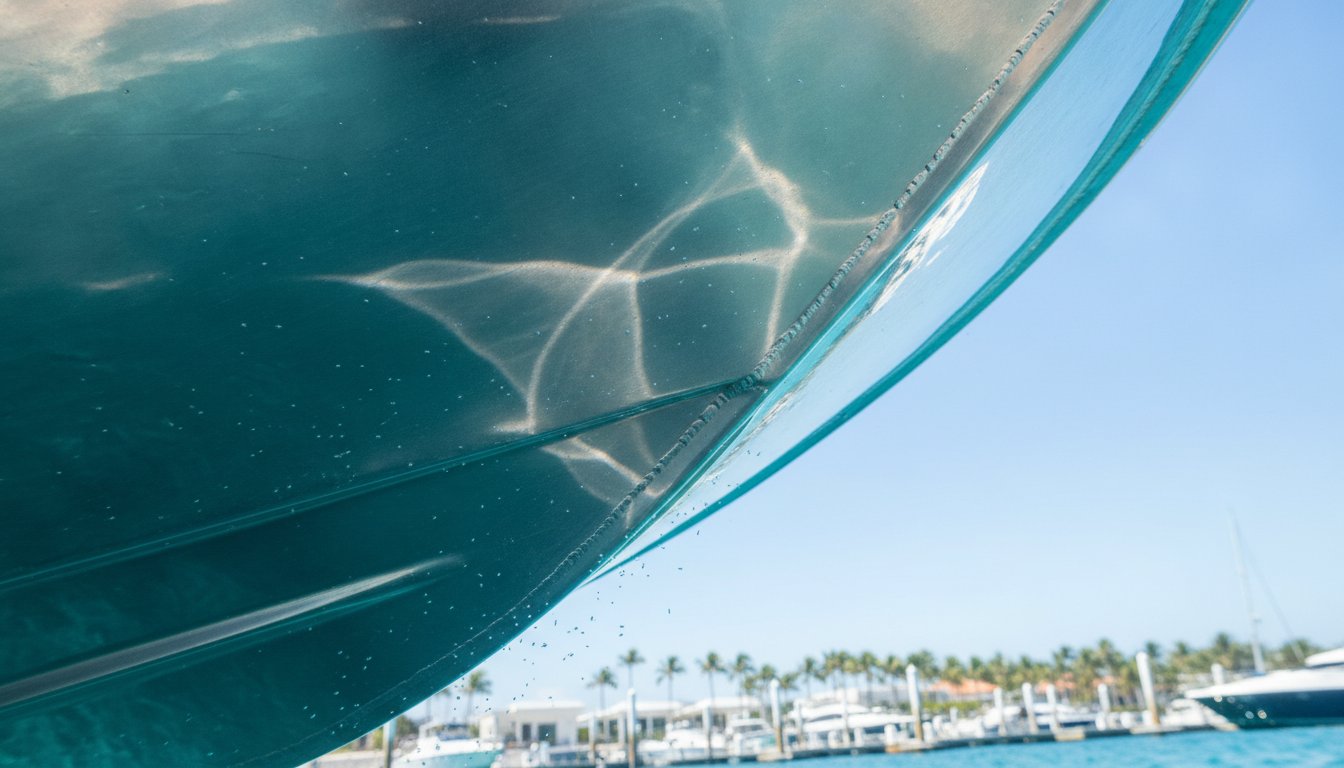
The best hard bottom paint for your aluminum boat isn’t a paint at all. If you’ve been searching for a non-toxic bottom coating for aluminum boats that actually solves the corrosion problem rather than temporarily masking it, the answer lies in hard-film foul release technology, a category that traditional antifouling paints were never designed to compete with.
You already know the cycle. You apply a copper-based ablative, watch it wear thin within a season, and haul the boat again to repeat the process, all while worrying whether the biocides are accelerating the very galvanic corrosion they’re supposed to work around. Those concerns are well-founded. Copper-based coatings and aluminum hulls are a metallurgically problematic combination, and tightening environmental regulations are steadily narrowing the window for biocide-dependent products in many jurisdictions.
This guide cuts through the noise. You’ll learn why hard-film foul release systems built on Silane-Siloxane chemistry represent a fundamentally different approach to hull protection, how they eliminate both fouling drag and corrosion risk without a single toxic biocide, and what to look for when selecting a coating engineered specifically for aluminum construction. A multi-year solution exists. Here’s the science behind it.
Key Takeaways
- Copper-based antifouling paints are metallurgically incompatible with aluminum hulls, accelerating galvanic corrosion rather than preventing it – understanding why requires a look at where aluminum sits in the galvanic series.
- The best non-toxic bottom coating for aluminum boats operates on a fundamentally different principle than traditional antifouling: Silane-Siloxane hard-film foul release systems use surface chemistry, not biocides, to deny fouling organisms a mechanical foothold.
- Surface preparation and a compatible epoxy barrier primer are not optional steps – they are the foundation that determines whether any hard coating will bond correctly to an aluminum substrate and deliver its full service life.
- Hard-film foul release technology functions as a permanent dielectric shield, eliminating the electrochemical pathway that makes galvanic corrosion possible in the first place – a protection mechanism ablative paints cannot replicate.
- A properly applied hard-film system represents a multi-year strategic asset, not an annual maintenance cost, shifting the economics of hull protection from recurring expenditure to long-term return on investment.
The Challenge of Aluminum Hulls: Why Traditional Bottom Paint Fails
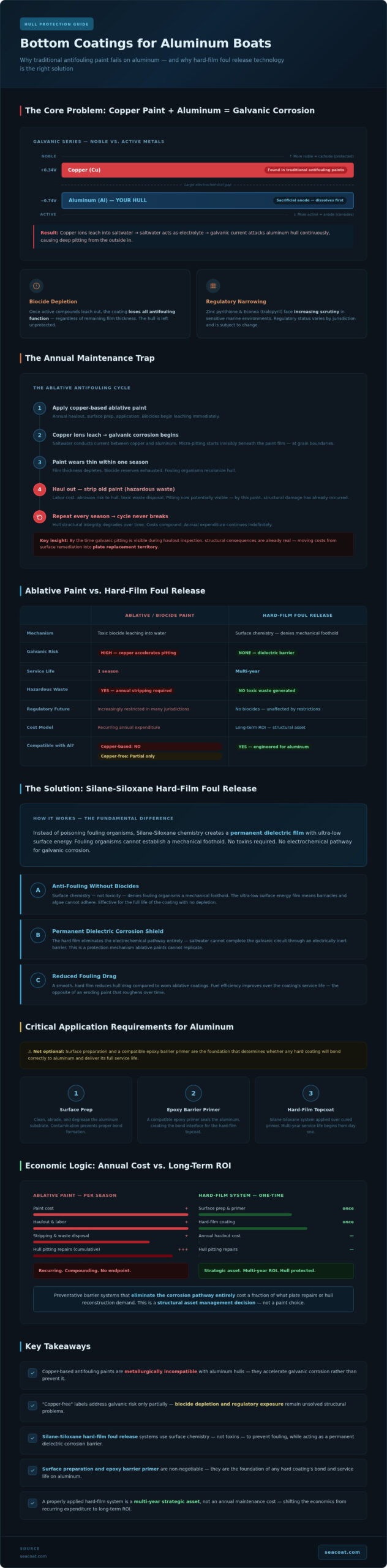
Aluminum sits near the active end of the galvanic series, which means it carries a strong electrochemical drive to oxidize when placed in electrical contact with a more noble metal in a conductive medium. That single fact explains why the marine coatings industry’s default solution, copper-based antifouling paint, is precisely the wrong choice for an aluminum hull. Copper sits significantly higher on the galvanic series than aluminum, making the two metals a textbook galvanic couple. Introduce saltwater as the electrolyte, and you’ve completed a corrosion circuit that attacks the aluminum substrate continuously, not occasionally.
The electrolyte piece is critical and frequently underexplained. Saltwater is an exceptionally efficient ionic conductor. When copper ions leach from a traditional antifouling paint into the surrounding water and make contact with the aluminum hull beneath, the current flows freely. The aluminum, acting as the anode in this electrochemical cell, sacrifices itself. The result isn’t surface discoloration. It’s accelerating pitting that penetrates inward, compromising the structural matrix of the hull from the outside in.
The Hidden Cost of Galvanic Pitting
Galvanic corrosion in marine aluminum hulls is the electrochemical dissolution of the base metal driven by contact, direct or ionic, with a more noble material in the presence of a conductive electrolyte. Micro-pitting begins invisibly, beneath the paint film, and progresses through the aluminum’s grain boundaries before it’s detectable during a routine haul-out inspection. By the time pitting is visible, the structural consequences are already real. Hull repairs at this stage move quickly from surface remediation into plate replacement territory, a cost category that dwarfs any savings from choosing a cheaper annual paint.
The financial logic is straightforward. Preventative barrier systems that eliminate the corrosion pathway entirely cost a fraction of what plate repairs or hull reconstruction demand. Selecting the right non-toxic bottom coating for aluminum boats isn’t a maintenance decision; it’s a structural asset management decision.
Why ‘Copper-Free’ is Only Half the Solution
Copper-free labeling addresses galvanic risk, but it doesn’t resolve the fundamental design limitation of biocide-dependent antifouling technology. Zinc pyrithione and Econea (tralopyril) are the most common copper substitutes in aluminum-compatible paints, and both operate on the same leaching principle: the coating releases toxic compounds into the water column to deter fouling organisms. That mechanism has two unavoidable failure modes.
- Biocide depletion: Once the active compounds have leached out, the coating loses its antifouling function entirely, regardless of how much film thickness remains.
- Regulatory narrowing: Zinc pyrithione and Econea face increasing scrutiny in sensitive marine environments, and their regulatory status varies by jurisdiction and is subject to change.
The coating then requires mechanical removal, which adds labor cost, generates hazardous waste, and exposes the hull surface to the risk of abrasion damage during stripping. Reapplication restarts the same cycle. This is the structural inefficiency that non-leaching, permanent barrier systems are engineered to eliminate, replacing the annual expenditure cycle with a multi-year protective film that denies fouling a foothold through surface chemistry rather than toxicity. That’s the core principle behind the category of hard-film foul release coatings that represent a genuinely different approach to non-toxic bottom coating for aluminum boats.
Hard Bottom Paint vs. Ablative: Which is Best for Aluminum?
The debate between hard bottom paint and ablative systems is frequently framed as a question of preference. For aluminum hulls, it’s a question of physics. Ablative coatings are engineered to erode, releasing biocides as the paint film wears away through water friction. That self-polishing mechanism works reasonably well on fiberglass displacement vessels moving at moderate speeds. On aluminum workboats and high-performance craft, it creates a compounding set of problems that ablative advocates rarely address directly.
The erosion rate of an ablative coating is velocity-dependent. The faster the vessel moves, the faster the coating wears. For aluminum boats operating above 25 knots, this means a season’s worth of antifouling protection can be consumed in a fraction of the time the manufacturer’s service estimate assumes. What’s left is a depleted, irregular film with inconsistent thickness, compromised adhesion, and zero remaining antifouling function. The solution then requires mechanical removal, which introduces abrasion risk to the aluminum substrate, followed by reapplication. The cycle is inefficient by design.
Hard-film systems operate from a fundamentally different principle. The coating doesn’t wear away. It maintains a consistent, smooth surface profile across the full service window, which is precisely why it’s the technically correct choice for speed-sensitive aluminum applications and the only rational category of non-toxic bottom coating for aluminum boats where multi-year performance is the objective.
Performance at Speed: Why Hard Coatings Win
Surface texture is a direct determinant of frictional drag. At displacement speeds, the difference between a smooth and a degraded hull surface is measurable but not dramatic. At planing speeds, the relationship becomes non-linear. A hard, ultra-smooth film minimizes the boundary layer turbulence that converts engine output into heat and wake rather than forward motion. Ablative coatings, even when freshly applied, introduce micro-texture variability that compounds as the film erodes unevenly. A hard-film system like Sea-Speed V 10 X Ultra maintains its hydrodynamic profile precisely because it doesn’t sacrifice film integrity to deliver its protective function.
Trailerability and Storage Considerations
Trailered aluminum boats expose a specific vulnerability in ablative chemistry: the mechanism requires continuous immersion to function correctly. Ablative paints are activated by water contact and hydrolysis; dry storage interrupts that process and can cause the surface to harden unevenly, reducing re-immersion effectiveness and accelerating cracking at the film layer. Hard coatings have no such dependency. They’re inert when dry, impervious to impact and abrasion in shallow or rocky launch environments, and structurally stable across wet-dry cycles without performance penalty.
The build-up problem with traditional hard paints is also real: successive annual coats accumulate film thickness until the system becomes brittle and prone to delamination, particularly at stress points on an aluminum hull that flexes under load. The answer isn’t more layers of the same product. It’s selecting a hard-film architecture engineered for longevity from the first application. Exploring hard-film foul release systems for aluminum hulls is the logical starting point for owners ready to move past the annual recoat cycle.
Beyond Traditional Paint: The Hard-Film Foul Release Advantage
Biocide-based antifouling operates on a single premise: poison the water immediately surrounding the hull to deter organisms from settling. It’s a premise that has driven the marine coatings industry for decades, and it has a fundamental ceiling. Once the biocide is gone, the protection is gone. Hard-film foul release technology abandons that premise entirely, replacing chemical deterrence with a physical one rooted in molecular surface engineering.
The distinction matters enormously when you’re selecting a non-toxic bottom coating for aluminum boats. You’re not choosing between two versions of the same mechanism. You’re choosing between two entirely different philosophies of hull protection.
The Science of Low Surface Energy
Silane-Siloxane chemistry achieves its antifouling effect through surface energy manipulation rather than toxicity. When applied and cured, the silane component forms a covalent bond with the substrate at the molecular level, while the siloxane network creates an exceptionally smooth, hydrophobic surface film. The result is a surface energy so low that barnacle cyprids and biofilm-forming bacteria cannot generate sufficient adhesion force to anchor themselves permanently. They make contact; they don’t grip.
Vessel movement amplifies this effect. At operational speeds, hydrodynamic shear forces across the hull surface are sufficient to dislodge early-stage fouling organisms that haven’t achieved full adhesion. The coating doesn’t need to kill them. It simply doesn’t give them anything to hold onto. For vessels that operate regularly, this creates a near self-cleaning dynamic that biocide-dependent systems cannot replicate, because their protection is static rather than kinetic.
Durability is the other variable competitors rarely address honestly. Hard-film Silane-Siloxane coatings are engineered to resist mechanical cleaning tools, including hull scrubbers and soft-bristle brushes, without sacrificing surface integrity or releasing contaminants into the water column. The film remains intact. The low-energy surface property is structural, not a surface treatment that wears off with maintenance contact.
Fuel Efficiency and Hydrodynamics
Surface roughness and frictional drag have a direct, measurable relationship. A degraded or fouled hull surface increases resistance through the water column, forcing the engine to work harder to maintain speed and consuming more fuel in the process. Industry research into hull coating performance has documented frictional drag reductions in the range of 5 to 12 percent for smooth hard-film systems compared to fouled or degraded hull surfaces, though specific figures vary by vessel type, speed profile, and baseline condition. For commercial aluminum fleets operating daily, that efficiency delta compounds into significant fuel savings and a proportional reduction in greenhouse gas emissions across the operational year.
This is precisely why the definitive guide to boat hull paint performance and ROI frames hard-film systems as performance assets rather than maintenance expenditures. The fuel savings alone, measured against the multi-year service window of a properly applied hard-film coating, reframe the investment calculation entirely. In 2026, with EEXI compliance requirements placing measurable pressure on commercial operators to reduce energy intensity per voyage, a coating that delivers both zero biocide discharge and quantifiable drag reduction isn’t a niche alternative. It’s the technically rational choice.
That’s the competitive gap biocide-focused manufacturers haven’t closed: their products address fouling as a biological problem. Hard-film foul release systems address it as a physics problem, and physics doesn’t require regulatory exemptions.
Preparing and Applying Hard Coatings to Aluminum Hulls
Surface preparation is where multi-year coating performance is won or lost. The chemistry of a Silane-Siloxane hard-film system is sophisticated, but it cannot compensate for a contaminated or poorly profiled substrate. Aluminum presents a specific challenge that fiberglass applicators frequently underestimate: the metal oxidizes almost instantaneously on exposure to air, forming an aluminum oxide layer that actively resists adhesion. That oxide layer must be removed and kept removed through a tightly controlled preparation sequence. Skipping steps here doesn’t save time; it transfers the cost forward into premature delamination and an unscheduled haul-out.
Step-by-Step Aluminum Hull Prep
Abrasive blasting is the preferred method for commercial aluminum hulls and larger vessels where surface consistency across a wide area is critical. Aluminum oxide or fine garnet media at controlled pressure creates a uniform anchor profile without introducing ferrous contamination that can seed corrosion beneath the coating. For smaller aluminum boats where blasting isn’t practical, mechanical sanding with 80-grit aluminum oxide paper achieves a comparable surface profile, provided the sanding sequence is disciplined and the surface is not left open for more than a few hours before priming.
Decontamination follows immediately after abrasion. Solvent wipe with a clean, lint-free cloth removes machining oils, trailering lubricants, and salt residue that abrasion alone won’t eliminate. Work in one direction; back-and-forth wiping redistributes rather than removes contamination. Allow the solvent to flash off completely before proceeding.
The primer stage is non-negotiable. Seapoxy 73 is the correct barrier primer for aluminum substrates before applying a hard-film foul release topcoat. It creates the dielectric barrier that interrupts the electrochemical pathway between the aluminum hull and the water column, and it provides the mechanical adhesion foundation the topcoat requires. Two coats, applied within the manufacturer’s recoat window, deliver the film build necessary for long-term barrier integrity. Rushing this stage is the single most common error in aluminum hull coating projects.
Professional Application vs. DIY
For individual aluminum boats, a disciplined DIY application is achievable with the right equipment. High-volume low-pressure (HVLP) spray systems give the atomization control needed to lay down a consistent, thin film without runs or dry-spray texture that would compromise the hydrodynamic surface. Airless sprayers move faster and suit large commercial fleet applications where coverage rate matters, but they require experienced operators to manage film thickness across complex hull geometries.
Commercial fleet operators managing multiple aluminum workboats should evaluate professional application seriously. The preparation sequence, environmental controls, and application precision required to deliver a genuine non-toxic bottom coating for aluminum boats at scale are not variables to manage casually. Temperature must remain between 50°F and 90°F during application, and relative humidity should stay below 85 percent; outside these windows, cure chemistry is compromised regardless of product quality.
For a detailed breakdown of coating selection and application considerations specific to aluminum construction, the best boat paint for aluminum boats guide covers the decision framework in full. Once the system is applied and cured, maintenance is straightforward: periodic cleaning with a soft-bristle brush or hull scrubber removes early-stage biofilm without damaging the low-energy surface. No solvents, no abrasives, no biocide contact. The coating stays intact; the protective function stays active. Explore hard-film coating systems engineered for aluminum hulls to understand what a properly specified application looks like from substrate to topcoat.
Why Sea-Speed V 10 X Ultra is the Best Hard Coating for Aluminum
Selecting Sea-Speed V 10 X Ultra represents a shift from reactive maintenance to strategic asset management. While traditional biocide-based paints like Trilux 33 remain the industry’s legacy default, they don’t address the fundamental hydrodynamic and electrochemical requirements of modern aluminum vessels. Sea-Speed V 10 X Ultra is a non-toxic bottom coating for aluminum boats that functions as a high-performance, hard-film foul release system. It provides a permanent dielectric shield that isolates the aluminum substrate from the surrounding electrolyte, effectively neutralizing the risk of galvanic corrosion that biocide-active coatings can inadvertently accelerate.
The technical superiority of this Silane-Siloxane technology lies in its durability. Unlike soft silicone foul release coatings that are easily damaged during transport or cleaning, Sea-Speed V 10 X Ultra cures to a glass-hard finish. This makes it exceptionally versatile, providing total protection for everything from recreational pontoons and Jon boats to heavy-duty commercial workboats and high-speed military craft. When applied over a properly prepared base of Seapoxy 73, a 10-year service life is not just a theoretical target; it’s an achievable operational window supported by evidence-based maintenance protocols.
The ‘Expert Innovator’ Choice for 2026
The maritime industry is moving away from the sacrificial cycle of ablative paints. In that legacy model, the coating’s effectiveness is tied to its destruction. Sea-Speed V 10 X Ultra replaces this with a performance cycle where the coating remains intact and functional year after year. For commercial and military operators, this translates directly to reduced dry-dock frequency and minimized operational downtime. You don’t haul the boat to replace the paint; you haul it for mechanical inspection, knowing the hull’s protective barrier remains structurally sound.
Operators of aluminum vessel fleets report that the transition to a hard-film system simplifies logistics. The coating doesn’t degrade during dry storage, making it ideal for vessels that are trailered or kept in stack storage. It’s a reliable, no-nonsense solution for stakeholders who prioritize long-term return on investment over the perceived low cost of annual recoating.
Integrating Sea-Speed into Your Fleet Management
The financial logic for adopting a non-toxic bottom coating for aluminum boats is anchored in quantified efficiency. When you calculate the ROI of a hull coating, the initial application cost is only one variable. The more significant metrics are the 5 to 12 percent fuel savings achieved through drag reduction and the elimination of recurring labor costs for paint stripping and reapplication. These operational cost efficiencies make Sea-Speed V 10 X Ultra a strategic asset rather than a maintenance line item.
Environmental compliance is the other pillar of the value proposition. As “Green Port” initiatives and global environmental regulations tighten, the discharge of copper, zinc, and other biocides into sensitive waterways is becoming a significant liability. Sea-Speed V 10 X Ultra is biocide-free and contains no volatile environmental contaminants, ensuring your fleet remains compliant with both current and projected ecological standards. It’s the visionary choice for an industry that no longer accepts the trade-off between physical durability and ecological safety.
Contact Seacoat for a technical consultation on your aluminum vessel to evaluate how our hard-film technology can be integrated into your specific operational profile.
The Case for Permanent Hull Protection is Already Made
The evidence points in one direction. Copper-based antifouling accelerates the very corrosion it’s supposed to work around, ablative systems erode fastest on the hulls where performance matters most, and biocide-dependent coatings face a regulatory environment that’s only moving one way. The right non-toxic bottom coating for aluminum boats doesn’t compromise between durability and ecological responsibility; it delivers both through surface chemistry that doesn’t depend on toxicity to function.
Sea-Speed V 10 X Ultra is trusted by military and commercial fleets worldwide precisely because its proprietary Silane-Siloxane technology solves the problem at the physics level, not the biological one. Zero toxic biocides, zero heavy metals, and a hard-film service window that reframes hull protection as a long-term asset rather than an annual cost.
Your aluminum hull deserves a coating engineered specifically for it. Upgrade to Sea-Speed V 10 X Ultra: The Ultimate Hard Coating for Aluminum and put the recoat cycle behind you for good.
Frequently Asked Questions
Is hard bottom paint better than ablative for aluminum boats?
For aluminum boats, hard-film systems are the technically superior choice, not a matter of preference. Ablative coatings erode through water friction, meaning faster vessels consume their antifouling protection faster. Once the biocide depletes, the coating fails entirely and requires mechanical removal, which risks abrasion damage to the aluminum substrate. Hard-film systems maintain a consistent, intact surface profile across their full service window regardless of vessel speed.
The structural argument is equally clear. Ablative removal generates hazardous waste and resets the protection cycle annually. A properly applied hard-film foul release coating eliminates that cycle, functioning as a long-term barrier rather than a consumable product that needs replacing each season.
Can I use copper-based paint on an aluminum boat if I use a good primer?
No primer eliminates the fundamental risk. Copper sits significantly higher on the galvanic series than aluminum, which means any ionic contact between copper leachate and the aluminum substrate completes a corrosion circuit that actively attacks the hull. Even with a barrier primer, pinholes, abrasion points, and edge exposure create pathways for galvanic activity. The primer reduces direct contact; it doesn’t neutralize the electrochemical driving force between the two metals in a saltwater electrolyte.
The correct approach isn’t a better primer under the wrong paint. It’s selecting a coating that doesn’t introduce a galvanically incompatible metal into the system at all. Copper-free hard-film foul release systems remove the problem at the source rather than trying to manage it downstream.
How long does a hard-film foul release coating last on aluminum?
When applied over a properly prepared aluminum substrate with a compatible barrier primer like Seapoxy 73, a hard-film Silane-Siloxane foul release system such as Sea-Speed V 10 X Ultra can achieve a service window measured in years rather than seasons. A 10-year service life is a realistic operational target under evidence-based maintenance protocols, which primarily consist of periodic soft-bristle cleaning to remove early-stage biofilm.
Longevity depends heavily on surface preparation quality. An aluminum hull that’s correctly abraded, decontaminated, and primed before topcoat application gives the Silane-Siloxane chemistry the adhesion foundation it needs to deliver its full service window. Shortcuts in preparation transfer the cost forward into premature delamination.
Does hard bottom paint increase the speed of an aluminum boat?
A hard-film coating doesn’t increase speed beyond the vessel’s design parameters, but it does recover and preserve the hydrodynamic efficiency the hull was built to deliver. Surface roughness has a direct relationship with frictional drag. A fouled or degraded hull surface forces the engine to work harder to maintain speed, consuming more fuel in the process. A smooth, intact hard-film surface minimizes boundary layer turbulence and keeps drag at its lowest achievable value for that hull geometry.
The practical outcome is that a vessel running on a clean hard-film system reaches its design speed at lower throttle settings than the same vessel with a degraded or fouled bottom. For aluminum boats operating at planing speeds, that efficiency difference is measurable at the fuel dock across a full season of operation.
Is Sea-Speed V 10 X Ultra safe for freshwater and saltwater use?
Sea-Speed V 10 X Ultra contains no toxic biocides, copper compounds, or heavy metals, which means its protective mechanism doesn’t depend on leaching substances into the surrounding water. That chemistry is environmentally neutral in both freshwater and saltwater environments. The coating functions through low surface energy physics rather than chemical discharge, so it doesn’t introduce contaminants into sensitive freshwater ecosystems the way biocide-dependent antifouling products do.
This is particularly relevant for aluminum boats that operate across both environments or in jurisdictions where biocide discharge restrictions are tighter in freshwater bodies. A non-toxic bottom coating for aluminum boats that performs identically across water types removes a significant compliance variable for owners who trailer between locations.
What happens if I don’t use bottom paint on my aluminum boat?
An uncoated aluminum hull is exposed to two simultaneous threats: biofouling accumulation and electrochemical corrosion. Fouling organisms attach to bare metal readily, building from biofilm into barnacles and hard growth that increases drag, reduces fuel efficiency, and can mechanically damage the hull surface during removal. In saltwater, uncoated aluminum also faces accelerated pitting from galvanic activity with any dissimilar metal in the vicinity, including hardware, through-hulls, and mooring fittings.
For boats stored in the water rather than trailered, an uncoated hull will typically show measurable fouling growth within weeks in warm water. The cost of fouling removal and hull remediation compounds quickly relative to the cost of a correctly applied protective coating applied at the outset.
How do I remove old bottom paint from an aluminum hull without damaging it?
Chemical strippers formulated for aluminum are the safest option for removing old antifouling without abrading the substrate. Avoid aggressive mechanical grinding, which can remove material and introduce surface irregularities that compromise subsequent coating adhesion. Soda blasting is another aluminum-safe method that strips paint without the ferrous contamination risk associated with steel grit media. Whichever method is used, the stripped surface must be solvent-wiped immediately to remove residual contamination before the aluminum oxide layer reforms.
Timing matters after stripping. Aluminum oxidizes rapidly on air exposure, and that oxide layer actively resists adhesion. Priming should follow decontamination within a few hours, not days. A compatible epoxy barrier primer applied to a clean, freshly prepared surface is the foundation on which the subsequent hard-film topcoat’s long-term performance depends.
Is there a non-toxic hard bottom paint for aluminum?
Traditional hard antifouling paints aren’t genuinely non-toxic; they use biocides that are simply less reactive with aluminum than copper, not absent of environmental impact. A true non-toxic bottom coating for aluminum boats operates on a different mechanism entirely. Hard-film Silane-Siloxane foul release systems like Sea-Speed V 10 X Ultra contain no biocides, no copper, and no heavy metals. Their antifouling function is physical, not chemical: the cured film’s low surface energy denies fouling organisms a mechanical foothold rather than poisoning the water around the hull.
This distinction is significant for regulatory compliance and environmental stewardship. Because no toxic compounds are discharged, these coatings aren’t subject to the biocide-specific restrictions that are progressively narrowing the approval window for traditional antifouling products in sensitive marine and freshwater environments.