
In certain jurisdictions, violating volatile organic compound limits can result in penalties as high as $2,500 per gallon per hull. As of January 1, 2026, the U.S. has enforced a strict copper leach rate limit of 9.5 micrograms per square centimeter per day, making many traditional coatings obsolete overnight. You likely recognize that avoiding fines for marine paint regulations is no longer just a maintenance task; it’s a high-stakes operational necessity. The fear of port-state control detention or the massive expense of stripping non-compliant paint in dry-dock is a valid concern for any fleet manager in the current regulatory climate.
This guide provides the technical clarity needed to align your fleet with the latest international and local laws, including Brazil’s NORMAM-401 regime and the tightening EU Biocidal Products Regulation. You’ll learn how transitioning to biocide-free silane-siloxane technology eliminates environmental risk while significantly improving vessel performance through optimized fluid dynamics. We’ll analyze how strategic assets like Sea-Speed V 10 X Ultra and Armor-Sil R/G offer a path to total compliance, reduced fuel consumption, and extended service life between applications.
Key Takeaways
- Identify the critical differences between international IMO standards and localized mandates to ensure your fleet maintains unrestricted access to global ports.
- Recognize the specific chemical compounds, including Cybutryne and high-leach copper, that trigger immediate financial penalties and operational detentions under 2026 standards.
- Master a systematic five-step audit process for avoiding fines for marine paint regulations across diverse operating regions and trade routes.
- Evaluate how biocide-free silane-siloxane coatings like Sea-Speed V 10 X Ultra provide a permanent regulatory shield by eliminating VOCs and harmful leachable additives.
- Gain insight into the long-term economic advantages of foul-release technology, where compliance directly correlates with improved hull efficiency and extended service intervals.
Navigating the Global Marine Coating Regulatory Landscape in 2026
The maritime industry’s shift toward ecological accountability has transformed hull maintenance from a routine overhead into a critical compliance strategy. Managing a global fleet in 2026 requires more than a passing familiarity with the International Convention on the Control of Harmful Anti-fouling Systems on Ships (AFS Convention). While the IMO provides the foundational framework, regional mandates in the United States and Europe often introduce more aggressive timelines and lower toxicity thresholds. This decentralized approach to environmental law makes avoiding fines for marine paint regulations a complex task that demands technical precision in coating selection.
Successful operators understand that regulatory compliance isn’t just a legal checkbox; it’s a performance metric. There’s a direct correlation between coating integrity and the Carbon Intensity Indicator (CII). A fouled hull increases hydrodynamic drag, forcing the propulsion system to work harder and increasing carbon emissions. If a vessel’s CII rating drops due to poor surface efficiency, the resulting operational restrictions can be far more costly than a standard fine. By choosing advanced silane-siloxane systems, owners can simultaneously satisfy environmental auditors and optimize fuel efficiency.
The IMO AFS Convention and 2026 Standards
The AFS Convention remains the primary global instrument for controlling harmful substances. Following the 2023 ban on Cybutryne, 2026 marks a significant enforcement milestone where all vessels must either be free of this biocide or have an approved sealer coat applied to prevent leaching. Port-state control inspectors have increased the frequency of coating audits, utilizing sampling techniques to verify compliance. Failure to provide a valid International Anti-fouling System Certificate during an inspection can lead to immediate vessel detention and mandatory dry-docking, causing catastrophic delays in cargo delivery schedules.
Regional Mandates: US EPA and EU REACH
National and state-level regulations often set the pace for global change, frequently superseding international norms. In the United States, the EPA’s Vessel General Permit dictates strict discharge standards for biocides, while state-specific laws in Washington and California have introduced even tighter controls. It’s vital to track these specific mandates:
- US Copper Limits: As of January 1, 2026, it’s illegal to apply marine paints with a copper leach rate exceeding 9.5 micrograms per square centimeter per day in regulated jurisdictions.
- EU REACH: The European Union’s Biocidal Products Regulation continues to implement stricter approval requirements for copper-based coatings, impacting all Mediterranean operations.
- State Enforcement: California’s Department of Pesticide Regulation enforces high penalties for VOC violations, which can reach $2,500 per gallon per hull.
These overlapping layers of legislation mean that traditional biocidal solutions are becoming an operational liability. Moving toward a non-toxic, biocide-free approach is the only permanent solution for a fleet operating across diverse international waters.
Prohibited Substances and the Financial Impact of Non-Compliance
The financial burden of non-compliance is rarely limited to the initial citation. While a fine for a VOC violation in California can reach $2,500 per gallon per hull, the cascading costs of vessel detention often dwarf the legal penalty. Port-state control authorities are increasingly sophisticated in their screening of the Global Marine Coating Regulatory Landscape, focusing on specific biocidal markers that indicate prohibited substances. Proactive fleet management involves more than reactive maintenance; it’s about avoiding fines for marine paint regulations by eliminating hazardous materials before they reach the dry-dock.
Beyond the immediate “ticket,” operators must account for cargo loss and the logistical nightmare of off-hire time. If a vessel is detained for a coating violation, the cost of emergency stripping and re-application can be five times higher than a scheduled application. Furthermore, the maritime sector’s shift toward Environmental, Social, and Governance (ESG) reporting means that environmental negligence can lead to higher insurance premiums and the loss of preferred-charter status. Reliability in 2026 is measured by a fleet’s ability to operate without regulatory friction.
The Cybutryne (Irgarol) Ban: A 2026 Critical Check
Cybutryne, often marketed as Irgarol, was banned globally in 2023 due to its acute toxicity to non-target aquatic life, particularly coral reefs and seagrasses. 2026 represents a critical enforcement milestone. Vessels found with Cybutryne-based coatings must either remove the offending layers or apply an IMO-certified sealer coat to prevent further leaching. Identifying these substances requires a thorough review of past Material Safety Data Sheets (MSDS). If your records are incomplete, chemical testing of hull scrapings is often the only way to ensure compliance before entering strictly regulated waters.
Calculating the Cost of Regulatory Fines
The economic impact of a regulatory dispute extends deep into the balance sheet. In major global ports, environmental non-compliance fines are structured to be punitive rather than administrative. When a vessel is placed under detention, the daily operational loss can range from tens of thousands to hundreds of thousands of dollars, depending on the vessel class. Vessels utilizing biocide-free solutions mitigate these risks entirely while enhancing long-term asset value. Most standard hull insurance policies do not cover fines resulting from environmental negligence, leaving the owner to bear the full weight of the penalty and the subsequent dry-docking expenses. Avoiding these outcomes requires a shift from traditional biocidal paints to permanent, non-toxic coating assets.
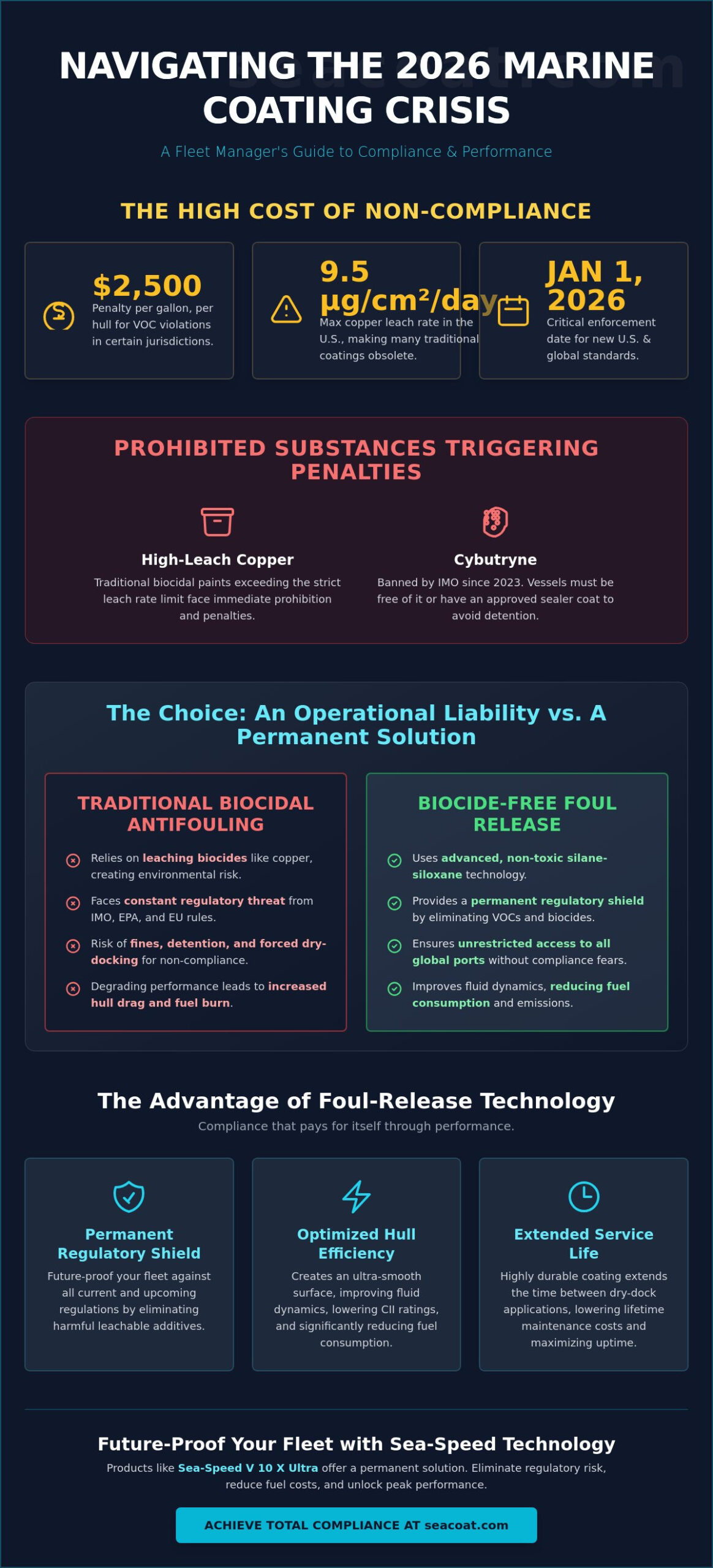
Biocide-Free vs. Traditional Antifouling: Choosing for Compliance
The decision between traditional antifouling and modern foul release systems has evolved into a strategic pivot for avoiding fines for marine paint regulations. Traditional coatings function through the “killing” of organisms, utilizing the controlled release of biocides like copper or zinc. While “low-leach” variants currently satisfy the 9.5 microgram limit enforced in 2026, they represent a temporary bridge in an environment moving toward total biocide prohibition. In contrast, silane-siloxane technology focuses on preventing attachment through mechanical surface properties. By creating a low-friction, hydrophobic barrier, these systems deny organisms the ability to adhere to the hull without the use of toxic additives.
Operating with ablative paints creates a cycle of environmental risk and maintenance overhead. These coatings are engineered to erode over time, constantly shedding material into the water column to expose fresh biocides. This erosion process inherently releases heavy metals, which invites scrutiny from port authorities. A permanent hard-film system like Sea-Speed V 10 X Ultra provides a stable, non-leaching surface that remains intact over multiple service cycles. This shift from a consumable chemical layer to a durable technical asset provides the reliability required for high-stakes maritime operations.
Evaluating Long-Term Regulatory Risk
The legislative framework for antifouling boat paint is notoriously volatile. Chemicals that are permitted today are often targeted for phase-outs tomorrow, as seen with the global ban on Cybutryne. Adopting environmental marine coatings eliminates this uncertainty. Because silane-siloxane systems contain zero biocides and zero VOCs, they’re inherently immune to the chemical restrictions that frequently disrupt fleet scheduling. This regulatory stability simplifies global port entry, ensuring a vessel remains compliant across North American, European, and Brazilian waters without the need for localized coating adjustments.
Performance Metrics: Fuel Savings and EEXI
Technical compliance in 2026 is inextricably linked to the Energy Efficiency Existing Ship Index (EEXI). This design index requires vessels to meet CO2 emission standards based on their technical specifications, where hull efficiency plays a primary role. High-performance foul release coatings reduce hull roughness, which minimizes hydrodynamic drag. A smoother hull allows the propulsion system to maintain speed with lower power output, directly reducing fuel consumption. Internal case studies for Sea-Speed systems indicate that moving away from traditional biocidal paints can lead to fuel savings of 10% or more. This synergy ensures that avoiding fines for marine paint regulations also serves to optimize the bottom line through enhanced surface efficiency.
A 5-Step Strategy for Eliminating Regulatory Risk in Fleet Maintenance
Transitioning a fleet to a non-toxic coating standard requires a methodical engineering approach rather than a reactive maintenance fix. This strategy ensures that avoiding fines for marine paint regulations becomes an integrated part of your operational lifecycle. By moving beyond temporary chemical solutions, owners can secure their assets against the increasingly aggressive global enforcement landscape. A structured five-step framework provides the technical path to permanent compliance and optimized surface efficiency.
- Step 1: Conduct a comprehensive audit of current hull coating types and ages across the entire fleet.
- Step 2: Review upcoming regional port regulations for your specific trade routes, focusing on 2026 enforcement milestones.
- Step 3: Evaluate the ROI of stripping old toxic layers versus over-coating, considering the long-term cost of potential port detentions.
- Step 4: Select a biocide-free, silane-siloxane system like Sea-Speed V 10 X Ultra to future-proof the asset against emerging chemical bans.
- Step 5: Document all coating specifications and certifications to streamline port-state control inspections and ESG reporting.
Step 1 & 2: Auditing and Route Planning
Operators must begin by analyzing dry-dock records to verify the chemical composition of existing layers. It’s critical to identify legacy biocides, such as Cybutryne, that may trigger immediate detention in strictly monitored jurisdictions. Identifying “Red Zone” ports with aggressive environmental enforcement, such as those in California, Washington, and the European Union, allows for targeted maintenance scheduling. A five-year regulatory forecast is essential for fleet planning, ensuring that vessels don’t enter high-risk regions with non-compliant coatings. This proactive auditing process is the foundation for avoiding fines for marine paint regulations while maintaining global mobility.
Step 3 & 4: Implementation and Product Selection
The technical requirements for transitioning from ablative bottom paint to hard-film systems involve a shift from sacrificial erosion to permanent surface integrity. Unlike ablative coatings that shed material, silane-siloxane technology provides a durable, non-leaching shield that remains effective over multiple service cycles. Selecting the right primer system is equally vital for this transition. Utilizing Seapoxy 73 ensures maximum adhesion to the substrate, creating a stable foundation for the topcoat. This combination of high-performance epoxy and foul-release technology offers the most durable regulatory shield available. To begin your fleet transition, evaluate our biocide-free coating specifications for your next dry-dock cycle.
Step 5: Documentation and ESG Reporting
The final step involves the rigorous documentation of all hull maintenance activities. Maintaining a clear Biofouling Record Book and keeping updated Material Safety Data Sheets (MSDS) on board simplifies the verification process during port-state control audits. This transparency doesn’t just prevent fines; it strengthens a company’s ESG profile, demonstrating a serious commitment to environmental stewardship. Reliable data on coating longevity and fuel efficiency gains also provides evidence-based metrics for stakeholders concerned with long-term return on investment.
Future-Proofing with Sea-Speed: The Permanent Solution to Marine Paint Fines
Adopting a reactive maintenance strategy is no longer viable in a maritime economy defined by aggressive decarbonization and strict chemical prohibitions. While the previous sections detailed the risks of traditional coatings, the path to avoiding fines for marine paint regulations requires a shift toward permanent technical assets. Sea-Speed V 10 X Ultra represents this shift, providing a high-performance, silane-siloxane standard that moves beyond the limitations of sacrificial biocidal systems. By utilizing a non-toxic, hard-film foul release mechanism, operators can ensure their vessels remain compliant across all global jurisdictions without the need for frequent chemical re-evaluations.
The primary advantage of Sea-Speed V 10 X Ultra lies in its fundamental composition. It contains zero biocides and zero volatile organic compounds (VOCs), making it inherently immune to the evolving bans on copper leach rates and specific biocidal agents like Cybutryne. Because the coating doesn’t rely on leaching chemicals to function, its efficacy doesn’t degrade over time. This stability allows for a 10-year service life, which significantly reduces the frequency of dry-docking and the associated costs of regulatory re-certification. It’s a strategic asset that provides long-term reliability and environmental stewardship in a single application.
The Science of Sea-Speed V 10 X Ultra
The technical superiority of Sea-Speed V 10 X Ultra is rooted in its advanced material science. Unlike soft silicone coatings that are susceptible to tearing and mechanical damage, this silane-siloxane technology creates a durable, glass-like surface. This hard-film finish is highly resistant to mechanical impact and can withstand rigorous in-water cleaning protocols without releasing harmful contaminants into the water column. The ultra-smooth surface reduces hydrodynamic drag, which translates to a fuel efficiency improvement of 10% or greater. These performance gains are documented through evidence-based studies, providing the metrics necessary to support CII and EEXI compliance goals. The certifications associated with the Sea-Speed line simplify the regulatory paperwork required for port-state control inspections, ensuring seamless global transit.
Taking the Next Step Toward Compliance
Transitioning a fleet to a biocide-free standard is a complex undertaking that requires precise ROI calculations and technical support. Seacoat SCT, LLC provides the expertise needed to navigate this transition, assisting fleet managers in evaluating the long-term economic benefits of switching from traditional antifouling to Sea-Speed systems. With global availability and specialized support for industrial applications, our team ensures that your fleet is equipped with the most advanced protective technology available. Reliability in 2026 is about more than just avoiding penalties; it’s about optimizing the multi-year performance cycle of your assets. To secure your fleet’s future and eliminate regulatory friction, contact Seacoat SCT, LLC for a compliance consultation today.
Securing Fleet Longevity Through Technical Compliance
The 2026 regulatory environment is unforgiving, yet it offers a clear path for operators who prioritize technical precision. By understanding the intersection of IMO standards and regional mandates, fleet managers can transform a compliance burden into a competitive edge. Avoiding fines for marine paint regulations requires moving beyond the sacrificial cycle of toxic biocides toward permanent, hard-film solutions. We’ve demonstrated that the transition to biocide-free technology isn’t just a legal necessity; it’s an investment in long-term asset value and operational reliability.
Silane-Siloxane technology has been utilized commercially since 2001, providing a proven track record of durability and ecological safety. With a Zero Biocide and Zero VOC formulation, Sea-Speed V 10 X Ultra eliminates the risk of chemical bans while delivering documented fuel savings of 10% or more. This synergy of performance and protection allows your fleet to operate with total confidence in any jurisdiction. Eliminate regulatory risk with Sea-Speed V 10 X Ultra and set a new standard for your maritime operations. Your commitment to sustainable performance ensures a resilient future for both your fleet and the global marine ecosystem.
Frequently Asked Questions
What are the current IMO regulations for marine paint in 2026?
The primary focus for 2026 is the full enforcement of the ban on Cybutryne-based coatings under the AFS Convention. Vessels currently carrying this substance on their hulls must have either removed the coating or applied an approved sealer coat to prevent leaching. Port-state control authorities now utilize standardized sampling methods to verify that no prohibited biocides are being released into the marine environment during port stays.
Can I be fined for having copper-based paint on my boat in Washington or California?
Vessel owners can face substantial penalties for non-compliance in these jurisdictions. Washington and California have implemented strict leach rate limits for copper-based coatings to protect sensitive local water quality. Avoiding fines for marine paint regulations in these regions requires ensuring your hull coating doesn’t exceed the 9.5 microgram per square centimeter per day limit. Non-compliant vessels may face administrative fines and operational restrictions in these major trade hubs.
What is Cybutryne and why is it being banned from marine coatings?
Cybutryne is a biocide used in antifouling paints to inhibit the growth of algae and other organisms. It’s being banned globally because it is a persistent pollutant that causes significant damage to non-target aquatic life, particularly coral reefs and seagrasses. The IMO’s 2026 enforcement milestones ensure that this herbicide is completely phased out of the maritime supply chain to prevent further ecological degradation.
How does a non-toxic hull coating help with EEXI and CII compliance?
Non-toxic foul release systems improve a vessel’s Carbon Intensity Indicator (CII) rating by maintaining a smooth, low-friction hull surface. Reduced surface roughness minimizes hydrodynamic drag, which allows the ship to maintain speed while consuming less fuel. This mechanical efficiency directly lowers CO2 emissions per ton-mile, helping older vessels meet the stringent Energy Efficiency Existing Ship Index (EEXI) standards without major engine modifications.
What happens if port-state control finds a banned substance on my hull?
If an inspection reveals prohibited substances, the vessel is typically placed under immediate detention. You’ll likely be required to move the ship to a dry-dock facility for mandatory stripping and re-application of a compliant coating. The resulting off-hire time and emergency maintenance costs often represent a much larger financial loss than the initial environmental fine itself.
Is it more expensive to switch from antifouling to a biocide-free foul release system?
While the initial application costs for technical foul-release systems are higher than traditional paint, the total cost of ownership is significantly lower. Avoiding fines for marine paint regulations is just one component of the economic benefit; the reduction in fuel consumption and the elimination of frequent dry-docking provide a rapid return on investment. Seacoat SCT, LLC provides lifecycle cost analyses to help fleet managers evaluate the multi-year savings generated by transitioning away from sacrificial coatings.
How long does a compliant silane-siloxane coating last compared to traditional paint?
A high-performance silane-siloxane coating is a permanent technical asset designed to last 10 years or more with proper maintenance. Traditional ablative antifouling paints are sacrificial and usually require full re-application every 2 to 5 years as the biocide-loaded layers erode. This extended service life reduces the frequency of dry-docking cycles and ensures your fleet remains compliant with international environmental standards for a decade.
Do I need to strip my old paint before applying a compliant non-toxic coating?
To ensure a permanent bond, it’s technically necessary to remove old, ablative layers before applying a silane-siloxane system. Traditional antifouling is designed to erode, which makes it an unstable foundation for a durable hard-film coating. A clean substrate allows the new system to achieve its full service life. Seacoat SCT, LLC recommends a full blast to a specific profile to guarantee the mechanical adhesion required for high-performance maritime operations.