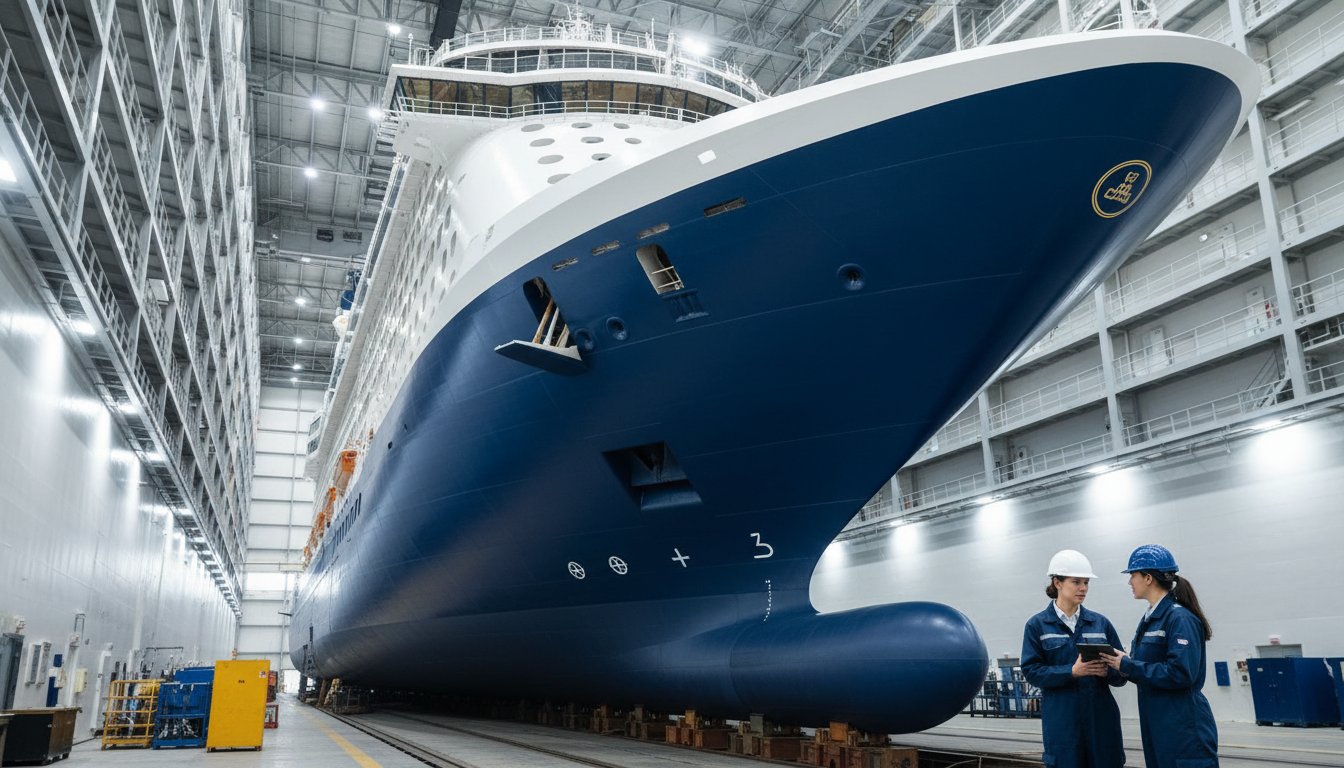
The convergence of volatile fuel expenditures, stringent IMO 2026 mandates, and the immense financial drain of frequent dry-docking cycles creates an unsustainable operating environment for today’s cruise fleets. The subsequent impact of biofouling-from compromised schedules to increased hydrodynamic drag-directly erodes profitability and vessel efficiency. In this high-stakes landscape, a reactive posture is a liability; a sophisticated, proactive strategy for cruise ship hull maintenance is now the critical determinant of long-term commercial viability and environmental stewardship.
This guide delineates a modern maintenance framework engineered to address these precise challenges. It details how the adoption of advanced, biocide-free foul release coatings transforms hull upkeep from a recurring cost center into a strategic asset. We will explore the technical and financial mechanics of minimizing surface roughness to optimize fuel efficiency, extend dry-docking intervals toward a ten-year horizon, and secure a future-proof solution for regulatory compliance. The result is a clear pathway to reduced operational expenditures and a superior, predictable return on investment for your fleet.
Key Takeaways
- Understand the strategic shift from reactive cleaning to a proactive protection model that mitigates the unique biofouling risks of modern cruise itineraries.
- Access a clear framework for evaluating advanced foul release coating technologies based on hydrodynamic performance and long-term asset value.
- Transition your approach to cruise ship hull maintenance from a cost center to a profit driver with a step-by-step guide for calculating ROI.
- Discover how a durable, biocide-free hard film coating can future-proof your fleet by delivering a 10-year performance life cycle with minimal upkeep.
The Unique Hull Maintenance Demands of Modern Cruise Fleets
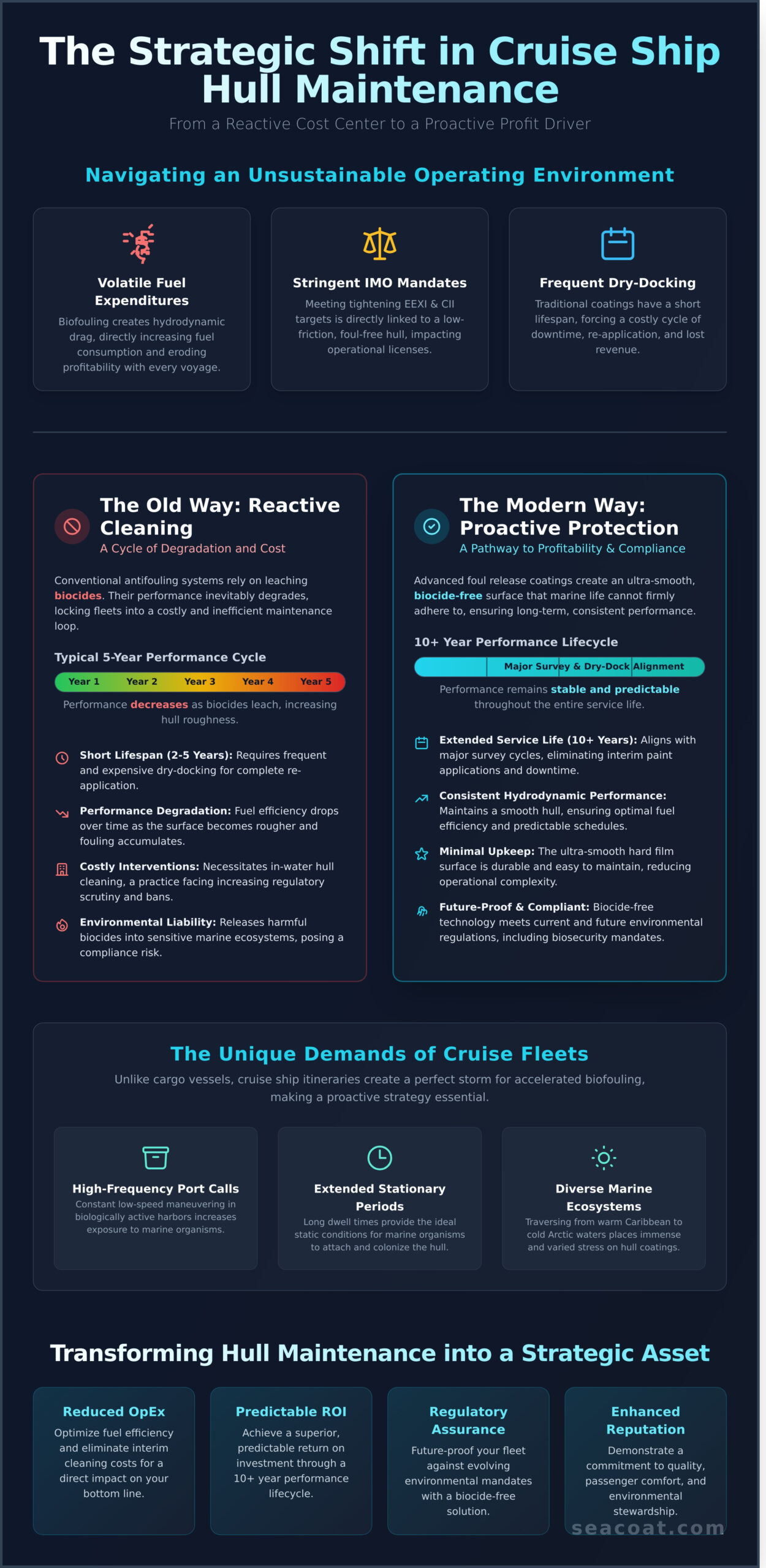
Unlike cargo vessels that follow predictable, long-haul routes, modern cruise ships operate on a complex and demanding cycle that fundamentally alters the approach to hull performance. The operational profile of a passenger vessel is characterized by high-frequency port calls, extended stationary periods in biologically active harbors, and itineraries that traverse diverse marine ecosystems-from the warm, fouling-rich waters of the Caribbean to the cold, abrasive conditions of the Arctic. This constant variation places immense stress on hull coatings and magnifies the consequences of performance degradation.
Effective cruise ship hull maintenance is not merely a matter of operational efficiency; it is a strategic imperative that directly impacts passenger experience, brand reputation, and regulatory standing. A pristine hull is a visible extension of a cruise line’s commitment to quality, while a hydrodynamically smooth surface is critical for mitigating vibration and engine noise, ensuring superior passenger comfort. Any compromise in hull integrity leads to immediate and tangible consequences.
This same commitment to brand reputation is reflected in a cruise line’s digital presence. A professional website and effective online marketing are essential for attracting passengers and communicating the quality of the onboard experience. To see examples of how this is achieved, you can visit Digitalix.
Operational & Itinerary Challenges
The frequent low-speed maneuvering and static dwell times in port create ideal conditions for marine organisms to attach and colonize. This constant exposure to different biological pressures exacerbates The Problem of Biofouling, where the accumulation of slime, algae, and barnacles rapidly increases hydrodynamic drag. For an industry built on rigid schedules and punctuality, the immense financial penalties associated with performance-related delays or unscheduled dry-docking make proactive hull management a non-negotiable priority.
Environmental and Regulatory Compliance
The regulatory landscape for cruise operators is increasingly stringent, demanding a sophisticated approach to environmental stewardship. Adherence to global and regional mandates is critical for maintaining market access and operational licenses. Key compliance drivers include:
- IMO Regulations: Meeting the progressively tightening targets for the Energy Efficiency Existing Ship Index (EEXI) and achieving favorable Carbon Intensity Indicator (CII) ratings are directly linked to a low-friction, foul-free hull.
- Regional Biosecurity: Navigating strict anti-fouling and biosecurity laws in environmentally sensitive regions, such as Australia and New Zealand, requires advanced, non-toxic coating solutions that prevent the translocation of invasive aquatic species.
- Shift from Biocides: The industry-wide transition away from traditional biocidal coatings necessitates the adoption of innovative foul-release technologies that offer long-term performance without leaching harmful substances into marine environments.
Reactive Cleaning vs. Proactive Protection: A Strategic Shift
The management of a cruise ship’s hull condition has traditionally been a reactive process, dictated by fixed schedules and degrading coating performance. This approach, however, is being superseded by a more strategic, proactive methodology that prioritizes long-term efficiency and environmental stewardship. The choice between these two philosophies represents a critical decision point, shifting the focus from short-term cost mitigation to a long-term investment in vessel performance and sustainability.
The Cycle of Traditional Antifouling
Conventional antifouling systems rely on the controlled release of biocides to deter marine growth. This mechanism has a finite operational window, typically 2-5 years, necessitating frequent and costly dry-docking for reapplication. As the biocides leach out, the coating’s effectiveness diminishes, leading to increased hull roughness and a corresponding fuel penalty. This reactive loop is a well-documented challenge within established hull inspection and maintenance systems, forcing operators into a cycle of performance degradation followed by costly interventions like in-water hull cleaning, a practice facing increasing regulatory scrutiny worldwide.
The Benefits of a Proactive Foul Release System
In contrast, a proactive strategy centered on advanced, biocide-free foul release coatings fundamentally alters the operational calculus. These sophisticated siloxane-based systems create an ultra-smooth, low-friction surface to which marine organisms cannot firmly adhere. With a service life of 10+ years, these coatings align perfectly with major survey and dry-docking cycles, eliminating interim paint applications. The result is consistent hydrodynamic performance, a significant reduction in cleaning requirements, and the mitigation of associated vessel downtime and operational costs.
.comp-table { width: 100%; border-collapse: collapse; margin: 2em 0; }
.comp-table th, .comp-table td { border: 1px solid #ddd; padding: 12px; text-align: left; }
.comp-table th { background-color: #f2f2f2; font-weight: bold; }
.comp-table tr:nth-child(even){background-color: #f9f9f9;}
| Metric | Reactive Antifouling | Proactive Foul Release |
|---|---|---|
| Upfront Cost | Lower initial application cost. | Higher initial investment. |
| Lifespan | 2-5 years, requiring multiple applications over a 10-year period. | 10+ years, typically a single application between major surveys. |
| Fuel Efficiency | Performance degrades over time, increasing fuel consumption. | Maintains a smooth, low-drag surface for consistent fuel savings. |
| Environmental Impact | Continuous release of biocides into the marine environment. | Biocide-free and non-toxic, minimizing ecological footprint. |
| Maintenance Needs | Frequent, often abrasive, in-water cleaning and regular re-coating. | Minimal cleaning required; often self-cleans with vessel speed. |
Ultimately, optimizing cruise ship hull maintenance requires moving beyond the traditional cycle of repainting and cleaning. Adopting a proactive foul release system is a strategic investment that delivers compounding returns through superior fuel efficiency, reduced operational expenditure, and demonstrable environmental compliance over the entire service life of the vessel.
Evaluating Modern Hull Coating Technologies for Cruise Ships
The selection of a hull coating is one of the most consequential decisions in a vessel’s operational lifecycle, directly impacting fuel consumption, environmental compliance, and dry-docking intervals. A comprehensive strategy for cruise ship hull maintenance must therefore begin with a clear understanding of the available coating technologies. Evaluating these systems requires a framework that assesses not only initial performance but also long-term durability, cleanability, and regulatory viability. Below, we analyze the three principal categories of marine hull coatings relevant to the cruise industry.
Biocidal Antifouling Paints
These traditional coatings function by releasing toxic compounds, primarily copper oxides, into the surrounding water. This creates a micro-environment that is lethal to marine organisms, preventing their attachment to the hull. While historically the industry standard, their efficacy is directly tied to the rate of biocide depletion, leading to a finite service life and declining performance over time. The continuous leaching of toxins also raises significant ecological concerns. Regulatory bodies are increasingly scrutinizing the environmental impacts of cruise ship discharges, making reliance on biocide-based systems a growing liability.
- Pros: Lower initial material cost and widespread familiarity among applicators.
- Cons: Proven environmental harm, diminishing effectiveness as the coating ages, and an increasingly restrictive regulatory landscape.
Soft Silicone Foul Release Coatings
Representing a significant step away from toxic methodologies, soft silicone coatings create an ultra-smooth, low-surface-energy, non-stick surface. The mechanism is physical rather than chemical; the slickness of the silicone makes it difficult for fouling organisms to gain a firm foothold. Any biofouling that does attach can often be dislodged by the vessel’s movement through the water. However, the inherent softness of the material makes these coatings highly susceptible to mechanical damage from abrasion or contact, and aggressive in-water cleaning can easily compromise the surface, reducing its effectiveness and lifespan.
- Pros: A completely non-toxic and biocide-free solution with good performance when new.
- Cons: Poor mechanical durability, vulnerability to damage during routine operations, and complex, delicate cleaning requirements.
Hard-Film Silane-Siloxane Foul Release (Sea-Speed)
This advanced category combines the non-toxic, low-surface-energy properties of foul release technology with extreme mechanical strength. The silane-siloxane chemistry cross-links to form a tightly bound, non-porous hard film. This surface is not only difficult for marine life to adhere to but is also robust enough to withstand rigorous in-water cleaning with brushes without sustaining damage. This durability is the key differentiator, enabling a service life that exceeds 10 years and ensures performance is maintained through simple, repeatable cleaning cycles. This approach transforms cruise ship hull maintenance from a recurring capital expense into a long-term strategic asset for performance optimization.
- Pros: Extreme durability, a 10+ year lifespan, non-toxic composition, and amenability to simple and effective in-water cleaning.
- Cons: Higher initial application cost, which is systematically offset by profound long-term savings in fuel and maintenance.
The Business Case: Calculating the ROI of an Advanced Hull Coating
While the hydrodynamic and chemical properties of an advanced hull coating are technically compelling, its true value is measured in financial performance and operational resilience. A strategic investment in a superior foul release system transcends routine cruise ship hull maintenance; it becomes a significant driver of profitability. The following framework provides a clear, data-driven method for fleet managers to calculate the tangible return on investment (ROI) for their vessels.
Step 1: Quantifying Fuel Savings
The primary operational expenditure impacted by hull condition is fuel consumption. Unchecked biofouling can increase hydrodynamic drag to such a degree that a vessel’s fuel consumption may rise by up to 40%. In contrast, a premium foul release coating maintains a consistently smooth, low-friction surface, delivering a conservative and sustainable 5-10% gain in fuel efficiency. The calculation is straightforward:
- Annual Fuel Cost × Fuel Efficiency Gain (%) = Annual Savings
For a vessel with an annual fuel budget of $10 million, a 7% efficiency gain translates directly to $700,000 in savings each year.
Step 2: Valuing Extended Dry-Dock Intervals
A critical component of ROI is the extension of service intervals. Traditional antifouling coatings typically require dry-docking every five years for reapplication. Advanced siloxane-based systems, engineered for longevity, extend this cycle to ten years. This effectively eliminates one full dry-docking event per decade. The savings are not limited to the direct costs of shipyard services; they include the immense opportunity cost of lost revenue while the vessel is out of service-a figure that can run into millions of dollars for a modern cruise ship.
Beyond hull coatings, managing the overall material condition of the vessel is key to maximizing these extended service periods. When minor issues inevitably arise, having options to explore On-site surface damage repair can prevent them from escalating into problems that require premature dry-docking.
Step 3: Factoring in Reduced Cleaning & Compliance Costs
Comprehensive ROI calculations must also account for ancillary costs. Biocidal coatings often require frequent in-water cleaning to remain effective, representing a recurring operational expense. Furthermore, in an era of tightening regulations, arriving in ports with strict biosecurity measures can lead to mandated cleanings or significant fines. A durable, biocide-free foul release system mitigates these risks, reducing both scheduled maintenance costs and the financial threat of non-compliance. To understand the full financial impact on your specific operations, we invite you to request a customized ROI analysis for your fleet.
Implementing a Future-Proof Maintenance Program with Sea-Speed V 10 X
The preceding analysis of operational efficiency, regulatory pressures, and long-term asset value logically culminates in the selection of an advanced, hard-film hull coating. Sea-Speed V 10 X represents the pinnacle of this technology, engineered specifically to convert the challenges of modern cruise operations into performance advantages. Its proven 10-year performance record provides the foundation for a truly strategic and cost-effective approach to vessel upkeep, moving beyond the limitations of traditional ablative antifouling systems.
Why Sea-Speed is the Optimal Choice for Cruise Fleets
The unique operational tempo of cruise vessels-characterized by frequent port calls, varying speeds, and extended static periods-demands a solution that conventional coatings cannot provide. Sea-Speed’s hard, non-porous siloxane-polyurethane surface is exceptionally durable, easily withstanding mechanical in-water cleaning without degradation or the release of biocides. This ensures a consistently low surface roughness for optimal hydrodynamic performance, while its smooth, resilient finish upholds the pristine aesthetic crucial to a premium brand image. Critically, its zero-VOC, non-toxic composition guarantees full compliance with the most stringent environmental mandates worldwide, future-proofing the fleet against regulatory shifts.
The Path to Implementation
Transitioning to a superior cruise ship hull maintenance strategy is a methodical process designed for minimal disruption and maximum return on investment. Our technical team collaborates directly with your superintendents to ensure a seamless integration. The pathway includes:
- Initial Consultation: A comprehensive analysis of vessel operational data, trading routes, and existing maintenance schedules to establish a precise performance baseline.
- System Specification: Engineering the correct primer and Sea-Speed V 10 X coating system tailored to the substrate and specific requirements of your fleet.
- Application Oversight: Close coordination with designated shipyards to manage surface preparation and application during a scheduled dry-docking, ensuring adherence to strict quality standards.
- Long-Term Maintenance Protocol: Development of a simplified, proactive in-water cleaning and inspection plan that leverages the coating’s 10-year lifespan to dramatically reduce future dry-docking costs and complexity.
Adopting Sea-Speed V 10 X transforms hull maintenance from a recurring operational cost into a long-term strategic investment in fuel efficiency, environmental compliance, and asset preservation. It marks the definitive shift from reactive recoating cycles to a decade of optimized performance. To begin a technical consultation for your fleet, contact a Seacoat SCT, LLC specialist today.
Elevating Fleet Strategy: The Future of Hull Performance Management
The operational landscape for modern cruise fleets demands a fundamental departure from traditional, reactive maintenance cycles. As we have explored, the transition to proactive, long-term protection is no longer an option but a strategic imperative, driven by the dual pressures of economic efficiency and environmental stewardship. A successful cruise ship hull maintenance program is now defined by its ability to deliver sustained hydrodynamic performance and regulatory certainty. Technologies like Sea-Speed V 10 X exemplify this future, providing a hard-film durability ideal for high-activity vessels, a proven 10+ year service life, and a non-toxic, Zero VOC formulation that ensures full global compliance.
The data is clear: superior hull coatings are a strategic asset, not a simple operational expense. To quantify the specific impact on your fleet’s fuel consumption, dry-docking intervals, and overall profitability, we invite you to take the next step. Request a technical consultation to analyze your fleet’s performance potential. Embrace a maintenance strategy that protects your assets, your bottom line, and our marine ecosystems for the decade ahead.
Frequently Asked Questions
How often does a cruise ship hull need to be cleaned?
The frequency of hull cleaning is dictated by the coating system, operational routes, and water conditions. Vessels with traditional antifouling paints often require cleaning every 6-12 months to mitigate performance loss. In contrast, advanced foul release and hard-film coatings are designed for longer service intervals and can be maintained with proactive in-water cleaning, preserving optimal hydrodynamic efficiency and extending the time between major dry-dock interventions.
What is the average lifespan of traditional antifouling paint on a cruise ship?
The effective lifespan of conventional copper-based antifouling paints is typically limited to three to five years. These ablative coatings function by slowly leaching biocides, a process that inherently degrades their performance over time. This necessitates complete re-application during scheduled dry-dockings to restore fouling protection, representing a significant recurring operational expense and environmental liability for the vessel operator.
How does biofouling impact a cruise ship’s fuel consumption and speed?
Biofouling introduces significant hydrodynamic drag, which directly compromises vessel performance. Even a light slime layer can increase fuel consumption by over 10%, while heavier calcareous fouling can result in fuel penalties exceeding 40%. This increased resistance necessitates greater engine power to maintain scheduled speeds, leading to substantial financial costs, elevated emissions, and potential difficulties in meeting tight operational itineraries.
Are non-toxic foul release coatings as effective as copper-based antifouling paints?
Yes, and in many operational parameters, they are superior. While biocidal paints rely on a finite, leaching toxin, non-toxic foul release systems create an ultra-smooth, low-energy surface that marine organisms cannot firmly adhere to. Their effectiveness does not diminish over time and can be restored with simple cleaning. This provides consistent, long-term performance without releasing harmful substances into the marine environment, ensuring both efficiency and regulatory compliance.
What is the typical cost difference between a foul release system and traditional paint for a cruise ship?
While the initial application cost for a premium foul release system is higher than for traditional antifouling paints, the total cost of ownership (TCO) is substantially lower. The extended service life, often exceeding ten years, dramatically reduces dry-docking frequency. When combined with persistent fuel savings from optimized hydrodynamics and the avoidance of biocide-related regulatory costs, the return on investment becomes a compelling financial argument for advanced coating technology.
How does hull condition affect a cruise ship’s Carbon Intensity Indicator (CII) rating?
A vessel’s CII rating is a direct measure of its carbon efficiency, which is heavily influenced by fuel consumption. A fouled hull increases drag, forcing the main engines to work harder and burn more fuel, thus elevating CO2 emissions and worsening the CII rating. A comprehensive cruise ship hull maintenance strategy, centered on a low-friction, foul-resistant coating, is a critical tool for mitigating this drag and ensuring the vessel remains compliant with tightening IMO regulations.
Can hard-film coatings like Sea-Speed be cleaned underwater?
Yes, one of the primary operational advantages of inert, hard-film coatings is their exceptional durability, which permits proactive in-water cleaning. Unlike soft, biocide-leaching paints that are easily damaged by mechanical cleaning, these robust surfaces can be regularly cleaned by divers or ROVs without abrasion or the release of toxic substances. This allows for the consistent maintenance of a hydrodynamically smooth hull, maximizing fuel efficiency between dry-dock cycles.