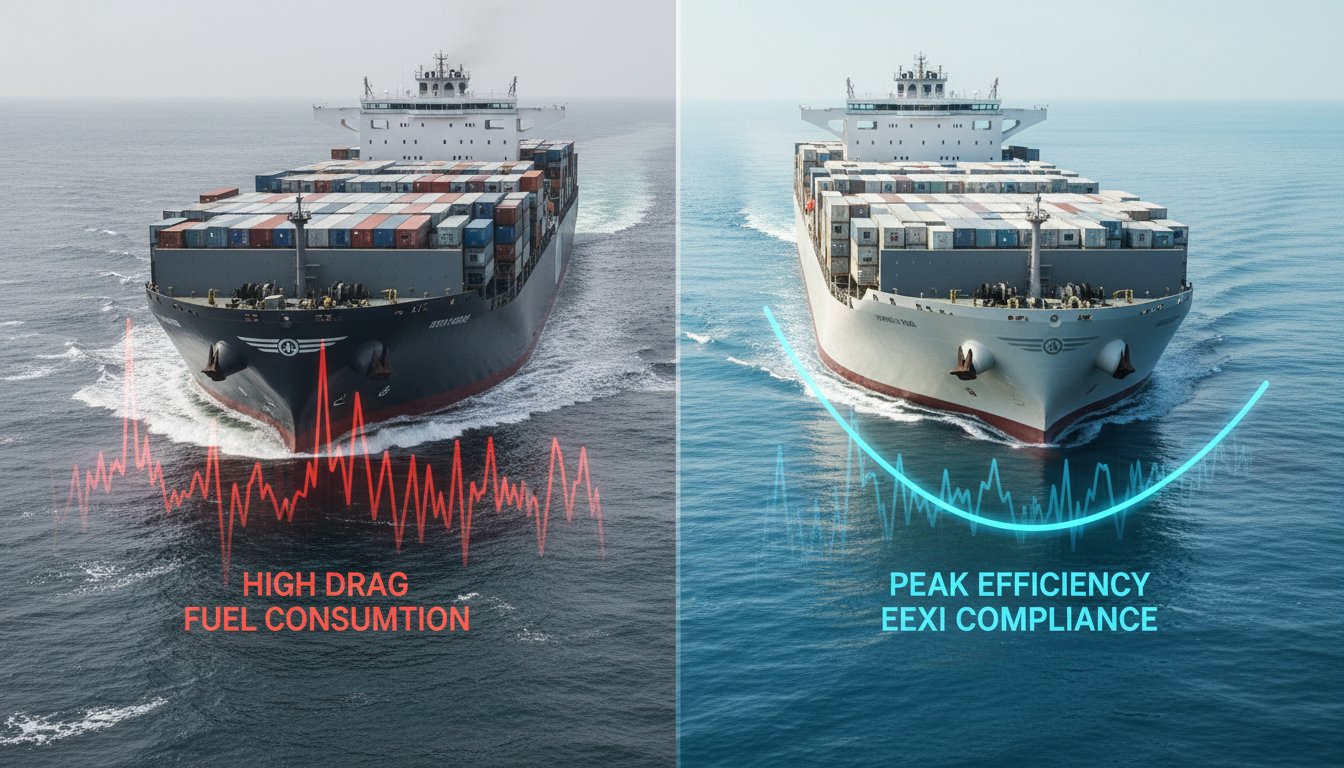
Forcing a vessel to operate at 70% of its designed engine power might satisfy a regulator, but it fundamentally compromises the commercial viability of your fleet. You’ve likely felt the mounting pressure of MARPOL Annex VI as the 2026 deadlines loom, realizing that Shaft Power Limitation often leads to missed schedules and higher fuel consumption per nautical mile. We agree that maintaining your service speed is non-negotiable for long-term ROI and operational reliability. Achieving EEXI compliance doesn’t have to mean throttling your performance; instead, you’ll discover how advanced foul release coatings provide a strategic path to compliance without sacrificing operational efficiency.
This article details the scientific shift from traditional biocidal antifouling to biocide-free siloxane technologies that reduce hull drag by 10% or more. We’ll examine how this hydrodynamic optimization allows for a 10-year dry-docking cycle while significantly mitigating greenhouse gas emissions. We’re moving beyond temporary fixes toward a permanent, performance-enhancing asset for your fleet management. By focusing on surface roughness and drag reduction, you can transform a maintenance requirement into a high-stakes strategic advantage.
Key Takeaways
- Examine the 2026 regulatory shift under MARPOL Annex VI and its direct implications for global fleet valuations and long-term asset management.
- Understand the physics of the EEXI formula to identify why reference speed ($V_{ref}$) is the most critical variable for maintaining operational flexibility.
- Compare the hidden operational costs of Engine Power Limitation (EPL) against the performance gains of hydrodynamic optimization and energy-saving devices.
- Discover how high-performance silane-siloxane technology provides a scientific path to EEXI compliance without the need for permanent power reductions.
- Learn to leverage baseline hull roughness surveys and biocide-free solutions to achieve a decade of optimized efficiency and environmental stewardship.
The EEXI Regulatory Landscape in 2026: Why Compliance is Evolving
The Energy Efficiency Existing Ship Index (EEXI) has transitioned from a looming regulatory requirement to a fundamental driver of maritime asset value. Established under MARPOL Annex VI, EEXI measures the technical design efficiency of vessels over 400 gross tonnage. It serves as a one-time “birth certificate” of efficiency, yet its implications in 2026 are far from static. As the global fleet matures, the distinction between a vessel’s design capability and its actual marketability has sharpened. Owners can’t rely on the certifications of 2023; they must now account for how technical design limits operational flexibility in a high-cost fuel environment.
It’s vital to distinguish EEXI from the Carbon Intensity Indicator (CII). While EEXI focuses on the physical design and installed equipment of the ship, CII tracks annual operational performance. However, these two metrics are inextricably linked. A vessel with a poor EEXI rating often requires significant Engine Power Limitation (EPL) to meet the required threshold. This technical restriction directly hampers the ship’s ability to maintain competitive speeds, which eventually degrades its CII rating. By 2026, EEXI compliance has become the baseline for entry into the premium chartering market, where cargo owners prioritize vessels that don’t need to sacrifice speed for efficiency.
Technical efficiency isn’t just about engine output. Optimizing the hull form and propeller efficiency is fundamental to The Physics of Marine Propulsion, as these factors determine the energy required to maintain transit speeds. For many operators, the initial 2023 certification was achieved through the easiest route, often via power limitations. In 2026, this “quick fix” approach is proving insufficient. Modern fleet management requires a deeper look at hydrodynamic optimization to ensure that technical compliance doesn’t come at the cost of operational utility.
The Core Objectives of MARPOL Annex VI
The primary mandate of MARPOL Annex VI is a 40% reduction in greenhouse gas emissions intensity by 2030, compared to a 2008 baseline. By 2026, every applicable vessel must carry a valid International Energy Efficiency Certificate (IEEC). Port State Control (PSC) inspections now routinely include the verification of the EEXI Technical File. Non-compliance results in more than just fines; it triggers immediate detention and creates insurmountable barriers for chartering. Major charterers are increasingly filtering fleets based on technical efficiency, effectively devaluing ships that barely meet the minimum legal requirements.
Attained vs. Required EEXI: The Critical Gap
The “Required EEXI” is a tightening baseline that varies by ship type and size. The “Attained EEXI” is the actual calculated value for your specific vessel. Identifying outlier vessels is now a priority for 2026 review cycles. If the gap between attained and required values is narrow, any increase in hull roughness or mechanical degradation can push a vessel into a non-competitive bracket. Data from 2025 indicates that ships relying solely on EPL to close this gap have seen a 12% decrease in their market flexibility. Successful operators are instead focusing on permanent technical improvements, such as advanced foul release coatings, to improve the attained EEXI without throttling engine capacity. This strategic intervention ensures the technical file reflects a high-performance asset rather than a restricted one.
The Physics of EEXI: How Hull Performance Dictates the Index
The Attained EEXI calculation is a rigid mathematical representation of a vessel’s environmental efficiency. It fundamentally weighs the carbon output against the ship’s capacity and velocity. While engine power limitation (EPL) is a common quick fix, it often compromises operational schedules. This makes the Vref variable the most critical factor for sustainable EEXI compliance. Reference speed isn’t a static number; it’s a direct reflection of hydrodynamic efficiency. If the hull surface is compromised, the vessel must burn more fuel to maintain the same velocity, or conversely, it must slow down to stay within its carbon budget.
A rough hull requires more power to overcome resistance. Under EEXI rules, Vref is determined at 75% of the limited power. If frictional drag increases due to poor coating performance, the recorded Vref decreases. Because Vref sits in the denominator of the EEXI formula, any reduction in speed mathematically inflates the vessel’s EEXI score. Traditional antifouling paints contribute to this decay through a “Penalty Factor.” These coatings use a sacrificial chemical process that typically increases surface roughness by 20 to 30 microns every year. Over a five-year dry-dock cycle, this cumulative roughness significantly degrades the vessel’s efficiency profile.
Hydrodynamics and the Vref Calculation
A vessel’s speed at a constant power output depends on the total resistance it encounters. Biofouling and physical coating degradation create turbulent flow, which saps kinetic energy and slows the ship. Silane-siloxane technology, utilized in Sea-Speed, achieves an ultra-low Surface Roughness Average (SRA) of less than 70 microns. This smoothness is a permanent feature, unlike ablative paints that roughen as they leach biocides. A 10% reduction in total hydrodynamic drag results in an approximate 3% to 5% improvement in the Attained EEXI value. This allows ship owners to meet regulatory targets without relying solely on drastic power cuts that hinder commercial competitiveness.
Frictional Resistance vs. Wave-Making Resistance
For slow-moving vessels like bulk carriers or tankers, frictional resistance accounts for 80% to 90% of total drag. This resistance occurs in the boundary layer where water meets the hull. Traditional ablative paints are soft and develop “peaks and valleys” that disrupt laminar flow. In contrast, hard film foul release coatings maintain a glass-like surface. This ensures the water remains in a laminar state for longer periods across the hull’s length. Sea-Speed creates a non-permeable barrier that prevents the “leached layer” common in SPC paints, which can increase drag by 15% even in the absence of heavy fouling.
Transitioning to a performance-based hull coating provides a strategic advantage for a 10-year life cycle. By optimizing the hydrodynamic profile, operators secure better EEXI ratings while lowering fuel costs. This isn’t just a maintenance choice; it’s a technical engineering upgrade that protects the asset’s value in an increasingly regulated market. Relying on outdated chemical leaching methods is no longer a viable path to long-term EEXI compliance success.

Countermeasures Compared: EPL vs. Hydrodynamic Optimization
Achieving EEXI compliance often presents a fork in the road for shipowners; they must choose between restrictive power limits or investing in hydrodynamic efficiency. While Engine Power Limitation (EPL) offers a low-cost, immediate path to meeting regulatory requirements, it functions as a blunt instrument that reduces the operational ceiling of the vessel. In contrast, hydrodynamic optimization through Energy Saving Devices (ESDs) and advanced hull coatings addresses the root cause of carbon intensity: drag. It’s a choice between simply slowing down or becoming fundamentally more efficient.
The maritime industry relies on operational flexibility. When a vessel’s reference speed (Vref) is artificially suppressed by EPL, its marketability to charterers plummets. Charter parties typically demand specific speed and consumption guarantees that an underpowered vessel cannot meet. By focusing on technical countermeasures like ducts, fins, or high-performance coatings, owners preserve their engine’s power reserve while lowering the ship’s resistance. This ensures the vessel remains competitive in a market where 2026 schedule reliability will be a primary differentiator for top-tier operators.
The Downside of Engine Power Limitation
EPL relies on slow steaming, which introduces systemic risks to fleet management. By 2026, the cumulative effect of slower transit speeds is projected to exacerbate port congestion by 12% as vessels struggle to meet narrow berthing windows. Safety is another critical concern. Underpowered vessels face significant maneuvering challenges in heavy weather, where the ability to deploy full engine torque is essential for maintaining steerage. Crucially, EPL can sabotage a vessel’s Carbon Intensity Indicator (CII) rating; slower speeds extend voyage durations, which often offsets the fuel savings and results in a lower annual efficiency grade.
Coatings as a Permanent Technical Countermeasure
There is a common misconception that hull coatings are merely maintenance items. Under IMO guidelines, the application of a high-performance foul release system qualifies as a “major conversion” for EEXI compliance re-certification because it permanently alters the vessel’s hydrodynamic profile. Unlike soft silicone coatings that degrade quickly under mechanical stress, SeaCoat’s hard film siloxane technology provides a durable, low-friction surface that lasts for 10-year cycles. This technology is a strategic asset, not a consumable. It’s the difference between a temporary fix and a permanent technical upgrade.
The performance data is clear. A 2023 fleet analysis demonstrated that transitioning from traditional biocidal antifouling to a hard-film siloxane system reduced hull drag by 8.5% on average. This reduction translates directly into a higher Vref in the EEXI formula, allowing many vessels to achieve compliance without necessitating severe engine power restrictions. This approach maximizes both technical efficiency and long-term ROI by ensuring zero VOC emissions and eliminating the need for frequent, toxic hull cleanings. By optimizing the hull, owners don’t just meet a mandate; they improve the asset’s fundamental value.
- Vref Preservation: Maintains the vessel’s maximum commercial speed for charterer requirements.
- CII Synergy: Lower drag improves fuel efficiency across all speed ranges, supporting better annual ratings.
- Mechanical Resilience: Hard film siloxane resists damage from tug contact, fenders, and light ice.
- Environmental Stewardship: Biocide-free formulations protect sensitive marine ecosystems while meeting zero-discharge standards.
Strategic Implementation: Integrating Advanced Coatings into Your EEXI Plan
Achieving EEXI compliance requires a fundamental shift from reactive maintenance to proactive hydrodynamic management. Shipowners should initiate this process by conducting a baseline hull roughness survey during the next scheduled dry-dock. This survey establishes a performance datum, which is essential for calculating the vessel’s attained EEXI. By measuring the Average Hull Roughness (AHR), technical teams can quantify the drag penalty of the existing coating system and project the gains achievable through high-performance remediation. This data-driven approach allows for a precise recalibration of the vessel’s energy efficiency profile.
Calculating the ROI of advanced coatings involves weighing the cost of application against the severe penalties of non-compliance. Vessels failing to meet the required EEXI must often implement an Engine Power Limitation (EPL). Data indicates that an EPL can reduce a vessel’s operational speed by 12% to 18%, significantly impacting its commercial competitiveness and annual revenue. In contrast, a hard-film siloxane coating can reduce hull friction by 6% or more, often offsetting the need for aggressive power limitations. This ensures the vessel remains profitable while meeting IMO 2023 requirements. After application, it’s vital to coordinate with Class Societies like DNV or ABS to update the EEXI Technical File. Providing verified data on surface smoothness ensures the vessel’s rating reflects its improved efficiency.
Selecting the Right Coating for Your Vessel Type
Bulk carriers and containerships have distinct operational profiles that influence EEXI compliance strategies. Bulkers often face long idle periods where biofouling accumulates rapidly; they require coatings with high static resistance. Containerships, operating at higher speeds, benefit more from the ultra-smooth surfaces of biocide-free foul release systems. For aluminum or stainless steel hulls, specialized non-toxic systems are mandatory to avoid the galvanic corrosion associated with copper-based paints. Moving toward zero VOC requirements is no longer optional for future-proof fleets. Sea-Speed V 10 X Ultra provides a 0% VOC solution, meeting the strictest environmental mandates while delivering superior hydrodynamic performance.
The Dry-Docking Advantage
Modern coating technology streamlines the dry-docking process, which is often the most expensive phase of vessel management. Single-coat, high-build systems allow for faster application, potentially reducing time in dock by 48 to 72 hours. Unlike traditional ablative paints, Sea-Speed V 10 X Ultra doesn’t require full sandblasting to bare metal every five years. Its durable, hard-film structure remains intact, requiring only a light wash and localized touch-ups. This technology extends the major maintenance cycle to a full 10 years, providing a decade of regulatory stability and operational efficiency. It’s a strategic asset that transforms the hull from a maintenance liability into a performance driver.
SeaCoat SCT: The Expert Solution for EEXI and Environmental Stewardship
Sea-Speed V 10 X Ultra represents the current apex of silane-siloxane technology in the maritime sector. It’s not a standard sacrificial coating; it’s a high-performance, permanent foul release system engineered to minimize the skin friction that hampers vessel efficiency. For technical directors preparing for the 2026 regulatory reviews, this technology offers a robust solution to the hydrodynamic drag issues that complicate EEXI compliance. Commercial fleet data indicates that transitioning from traditional biocidal coatings to Sea-Speed can reduce total hull drag by 6% to 10%. This reduction allows vessels to maintain operational speeds at lower power outputs, providing a vital margin for ships that would otherwise face heavy engine power limitations.
The environmental profile of Sea-Speed is as critical as its performance metrics. It’s 100% biocide-free and contains zero Volatile Organic Compounds (VOCs), which ensures it meets the most stringent global air quality and water discharge standards. While traditional anti-fouling paints rely on the controlled leaching of copper or other toxins, Sea-Speed uses a non-toxic physical barrier. This eliminates the risk of heavy metal accumulation in sensitive port ecosystems. By choosing a zero-VOC solution, fleet managers don’t just meet current IMO standards; they future-proof their assets against tightening environmental legislation expected later this decade.
The Science of Sea-Speed
Most foul release systems on the market rely on “soft” silicone technologies that are easily damaged by fenders, tug impact, or ice. Sea-Speed V 10 X Ultra differs by utilizing a hard-film chemistry that creates a durable, glass-like finish. This surface is tough enough to withstand mechanical cleaning and physical abrasion that would strip a standard silicone coating to the primer. Because the film is non-ablative, it doesn’t thin out or lose its effectiveness over time. Sea-Speed maintains its hydrodynamic profile for 10+ years because its non-depleting chemical structure prevents the surface degradation and increased roughness typical of self-polishing copolymers.
Your Partner in Maritime Decarbonization
Seacoat SCT, LLC provides global technical support and application supervision to ensure every hull in a fleet achieves maximum efficiency during dry-docking. Our team works directly with shipyards to manage the application process, ensuring that the 10-year lifecycle benefits are realized from day one. As the industry moves toward 2030 decarbonization targets, our technology serves as a critical bridge between current mechanical constraints and future efficiency requirements. We help you align corporate ESG goals with mandatory IMO regulations through proven, data-backed chemistry. Improving your EEXI compliance doesn’t have to be a compromise between power and speed when the hull’s hydrodynamic efficiency is optimized.
This focus on environmental stewardship is just one component of a comprehensive ESG strategy. For companies sourcing goods internationally, ensuring social compliance within their supply chain is equally critical. To see how this applies at the manufacturing level, you can discover The Inspection Company.
Optimize your fleet’s EEXI with Seacoat SCT, LLC
The strategic choice for 2026 is clear. Technical directors who prioritize long-term ROI and environmental stewardship are moving away from temporary, toxic fixes. By implementing Sea-Speed V 10 X Ultra, you’re investing in a decade of reduced fuel consumption, lower maintenance costs, and a significantly smaller carbon footprint. It’s a professional-grade asset for a high-stakes industry that demands reliability and scientific precision.
Securing Fleet Longevity Through Hydrodynamic Efficiency
Navigating the 2026 regulatory shift requires a move away from restrictive engine power caps toward sophisticated hull management. While power limitation often compromises operational schedules, optimizing hydrodynamic flow improves the attained index without sacrificing vessel speed. Since 2001, SeaCoat’s siloxane technology has proven that reducing surface roughness is the most reliable path to sustained EEXI compliance.
Deploying a biocide-free, zero VOC solution isn’t just an ethical choice; it’s a strategic financial move. SeaCoat SCT systems deliver a documented 10-year life cycle performance, which significantly reduces the maintenance intervals and chemical costs associated with traditional coatings. By prioritizing these advanced materials, operators secure a high-performance asset that protects both marine ecosystems and long-term ROI. Your fleet’s transition to a high-efficiency future is well within reach.
Request a Technical Consultation for Your Fleet’s EEXI Strategy
Frequently Asked Questions
What is the difference between EEDI and EEXI?
EEDI and EEXI differ primarily in their application timeline and vessel status. EEDI has governed new ship designs since January 1, 2013, while EEXI extends similar efficiency requirements to the existing global fleet as of January 1, 2023. Both metrics calculate CO2 emissions per cargo ton-mile, but EEXI requires older vessels to meet modern efficiency benchmarks through technical modifications or power limitations.
Does EEXI compliance apply to all existing ships in 2026?
EEXI compliance already applies to most existing commercial vessels over 400 gross tonnage as of the first annual survey after January 1, 2023. By 2026, every ship within the MARPOL Annex VI framework must possess a valid International Energy Efficiency Certificate. This isn’t a future deadline but an active requirement that 100% of applicable vessels must maintain to continue legal operations in international waters.
How do hull coatings specifically improve the Attained EEXI value?
Hull coatings improve the Attained EEXI value by reducing the hydrodynamic resistance of the vessel’s underwater surface. A siloxane-based coating like Sea-Speed creates an ultra-smooth profile with surface roughness measurements often below 50 microns. This reduction in friction directly lowers the power required to maintain transit speeds, which is a critical factor in achieving EEXI compliance for older hulls with inefficient legacy coatings.
Can I avoid Engine Power Limitation (EPL) by using a foul release coating?
You can’t always avoid Engine Power Limitation entirely, but a high-performance foul release coating reduces the degree of limitation required. If a vessel improves its hydrodynamic efficiency by 6% through coating optimization, the technical file can reflect a higher speed at lower power. This allows the ship to maintain a more competitive operational profile while still meeting the mandatory CO2 reduction targets set by the IMO.
What are the consequences if my vessel fails to meet the Required EEXI?
Vessels that fail to meet the Required EEXI lose their authority to operate, as they won’t receive an updated International Energy Efficiency Certificate. Under MARPOL Annex VI Regulation 25, port state control can detain ships lacking this certification. Beyond legal grounding, non-compliant vessels face a 15% to 20% reduction in market value because they’re ineligible for most charter party agreements in the current regulatory climate.
Is silane-siloxane technology considered ‘non-toxic’ under current regulations?
Silane-siloxane technology is classified as non-toxic because it relies on physical properties rather than chemical leaching to prevent fouling. Sea-Speed contains zero biocides and zero VOCs, meeting the strictest 2024 environmental standards. Unlike traditional ablative paints that release 50 kilograms of copper per year on average, this technology uses a hard, non-leaching film that’s safe for sensitive marine ecosystems and internal port regulations.
How often does a Sea-Speed coated hull need to be cleaned to maintain EEXI performance?
A Sea-Speed coated hull typically requires mechanical cleaning every 18 to 24 months to maintain peak performance, though this varies by fouling pressure. Because the film is a durable, hard-finish siloxane, it doesn’t degrade during grooming like soft silicone coatings do. Regular cleaning ensures the surface roughness stays consistent, preserving the 4% to 10% fuel savings achieved at the start of the ten-year life cycle.
Can EEXI re-certification be requested after applying an energy-saving coating?
Owners can request a re-certification of the Attained EEXI after applying an energy-saving coating during a scheduled dry-docking. By providing documented proof of improved hydrodynamic performance, such as sea trial data or verified surface roughness reports, the technical file is updated to reflect better EEXI compliance margins. This re-calculation is governed by the MEPC.333(76) guidelines, allowing vessels to prove their enhanced efficiency to regulators and charterers.
Communicating these complex technical advantages and compliance strategies to a global market requires a robust digital platform. Specialized B2B companies, much like the ones discussed here, rely on a professional online presence to detail their value proposition. For firms seeking to build such a platform, expert services in areas like Webdesign Handewitt can be crucial for translating technical expertise into compelling digital experiences.