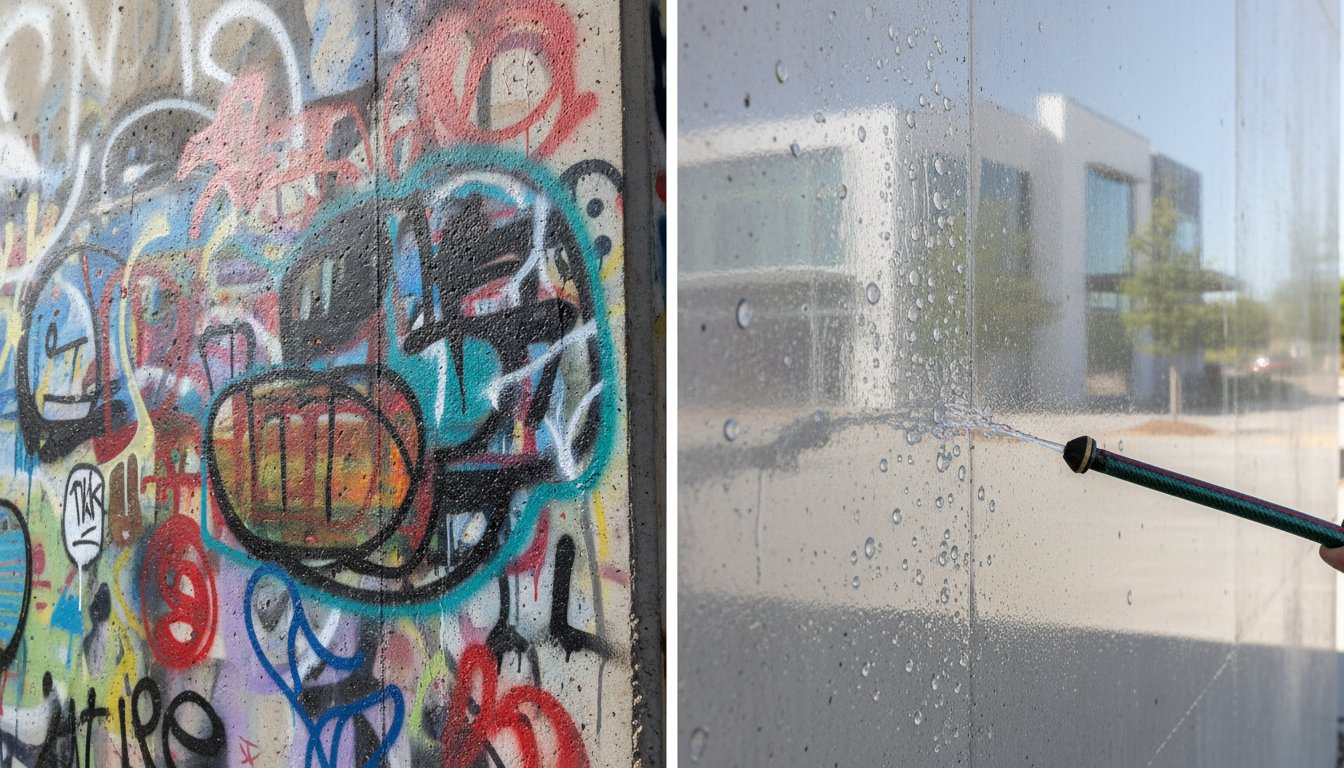
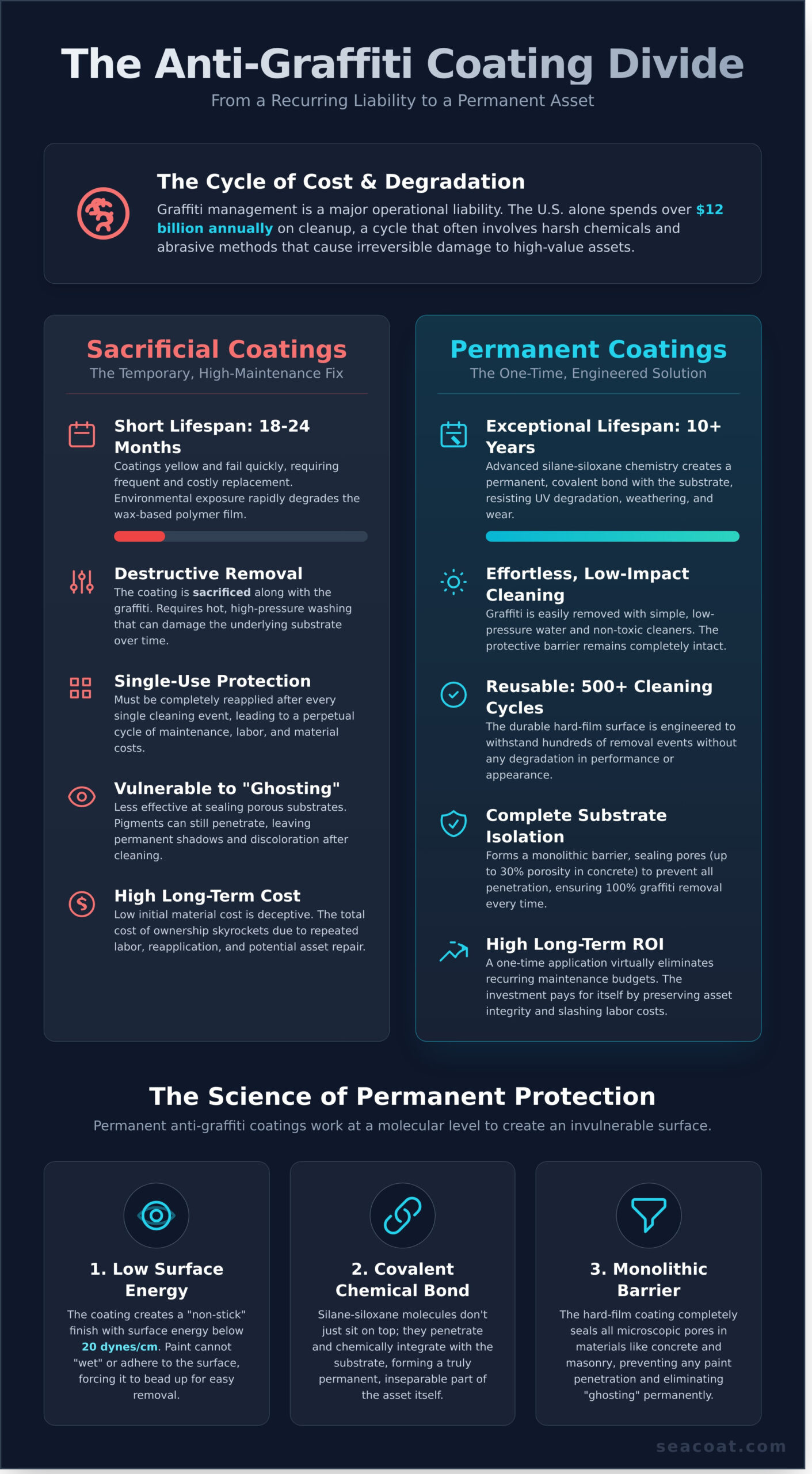
The cycle of spray, scrub, and repeat isn’t just a maintenance task; it’s a significant, recurring operational liability that degrades high-value assets over time. For asset managers, the direct costs are clear; a 2022 report by the U.S. Department of Justice estimates public graffiti cleanup costs exceed $12 billion annually. The indirect costs, however, are often more damaging, from irreversible substrate damage caused by abrasive cleaning to the rapid degradation of sacrificial coatings that yellow and fail within just 18-24 months. This cycle of costly, short-term fixes is no longer a necessary operational expense.
This focus on sustainable materials is a growing trend in building technology. While this article focuses on exterior protection, similar eco-conscious principles are applied to interior surfaces for functions like sound dampening, where specialists like Sonaspray use recycled cellulose to create acoustic treatments.
This article moves beyond temporary mitigation to detail the chemistry of a permanent, non-sacrificial anti-graffiti coating. We will demonstrate how advanced, zero-VOC silane-siloxane technology creates a covalent bond with the substrate, forming a permanent, non-toxic barrier that renders surfaces impervious to vandalism and environmental wear for over a decade. You’ll discover the scientific principles that enable simple, low-pressure water cleaning, see the long-term ROI data, and understand why this one-time application is engineered to preserve both your asset’s integrity and your maintenance budget.
Key Takeaways
- Understand the core principle of low surface energy, which prevents pigment adhesion and simplifies graffiti removal to a low-impact cleaning process.
- Discover how silane-siloxane chemistry creates a chemically cross-linked, breathable barrier that protects the substrate without trapping damaging moisture.
- Differentiate between sacrificial waxes and non-sacrificial systems to select an anti-graffiti coating that aligns with your asset’s life cycle and maintenance budget.
- Identify the correct surface preparation protocols for various substrates to ensure optimal coating performance and durability in corrosive environments.
- Assess the long-term ROI of a permanent hard-film system by analyzing its 10+ year life cycle and significantly reduced maintenance requirements.
What is an Anti-Graffiti Coating and How Does It Work?
An anti-graffiti coating is not merely a layer of paint; it’s an engineered surface treatment designed to provide a permanent, impermeable barrier against vandalism. Its primary function is to prevent the adhesion of foreign materials, including spray paints, permanent markers, and environmental grime, to a protected substrate. The core technology hinges on a fundamental principle of material science: creating a surface with extremely low surface energy. This property effectively transforms a vulnerable wall or structure into a non-stick surface, forcing liquid paints to bead up and preventing them from forming a chemical or mechanical bond.
This “foul-release” mechanism is the key to effortless cleaning. Instead of requiring harsh chemical strippers or abrasive blasting that damages the underlying asset, graffiti can be removed with simple, low-pressure washing and non-toxic cleaners. The industry broadly categorizes these systems into two primary types, as detailed in comprehensive resources on anti-graffiti coating technology: sacrificial and non-sacrificial.
- Sacrificial Systems: These are typically clear, wax-based polymers that form a film over the surface. When vandalized, the coating itself is removed along with the graffiti using hot water, requiring reapplication after each incident.
- Non-Sacrificial (Permanent) Systems: These advanced coatings, often based on siloxane or polyurethane chemistry, form a durable, permanent hard film. The graffiti does not bond to the coating, allowing for repeated cleaning cycles—often exceeding 500 removal events—without degrading the protective barrier.
Looking ahead, the market is undergoing a critical evolution. Driven by heightened environmental regulations and a demand for sustainable asset protection, the industry is seeing a decisive shift toward non-toxic, biocide-free formulations. By 2026, zero-VOC (Volatile Organic Compound) coatings will become the performance standard for public infrastructure and high-value commercial projects, aligning operational integrity with ecological responsibility.
The Role of Surface Tension in Vandalism Prevention
For paint to adhere, it must first “wet” the surface, meaning its liquid molecules must spread out and make intimate contact with the substrate. Our coatings are engineered with a surface energy below 20 dynes/cm, which is significantly lower than that of typical aerosol paints. This differential prevents wetting entirely. The advanced, highly cross-linked siloxane-based films create a slick, non-stick finish where contaminants simply can’t get a foothold. Surface energy is the measure of molecular attraction at the interface of a material, directly dictating its resistance to adhesion and long-term coating durability.
Why Traditional Paint Fails Against Vandalism
Standard architectural paints and unprotected substrates like concrete and masonry are inherently vulnerable due to their porous nature. Common concrete can have a porosity of up to 30%, creating a network of microscopic voids. When spray paint is applied, its pigments and solvents are drawn deep into these pores via capillary action. Surface cleaning is ineffective, leaving behind a permanent discoloration known as “ghosting” or “shadowing.” In stark contrast, a professional-grade coating creates a monolithic, hard-film barrier that completely seals the substrate, preventing any penetration and ensuring 100% of the graffiti is removed from the surface every time.
The Chemistry of Protection: Silane-Siloxane Technology
The long-term performance of any protective coating is determined at the molecular level. Unlike conventional acrylic or epoxy systems that form a simple film on a surface, SeaCoat’s technology is engineered using a sophisticated silane-siloxane hybrid chemistry. This advanced formulation doesn’t just cover an asset; it chemically integrates with it, creating a permanent, high-performance barrier that fundamentally alters the surface properties to repel contaminants and withstand extreme environmental stress.
At the core of this technology is a dual-function molecular structure. It’s this precise chemical engineering that delivers a truly permanent anti-graffiti coating solution, capable of performing for over a decade in the harshest marine and coastal conditions without degradation.
Silane vs. Siloxane: A Synergistic Relationship
The system’s resilience originates from the distinct roles of its two primary components. Silanes, with their extremely small molecular size, act as the penetrating anchor. They migrate deep into the microscopic pores of the substrate, where they react with ambient moisture and mineral surfaces to form strong, covalent chemical bonds. This deep-rooted adhesion is the key to preventing the peeling and delamination that plagues surface-level coatings subjected to hydrostatic pressure or thermal cycling.
Siloxanes form the larger polymer backbone that remains at the surface. These molecules create a tightly cross-linked, low-energy film that is exceptionally hydrophobic and oleophobic. It’s this siloxane layer that provides the slick, non-stick properties, preventing paint, markers, and other contaminants from gaining a foothold. Together, they create a unified system that is anchored from within and protected from without.
Upon application, these components initiate a cross-linking polymerization process. The molecules organize into a dense, three-dimensional matrix that is impermeable to liquid water, chlorides, and chemical agents, yet remains micro-porous enough to allow water vapor to escape. This breathability is critical for preventing moisture entrapment, which can lead to corrosion, spalling, and structural failure in concrete and steel assets. The U.S. Department of Transportation has conducted extensive research into effective Anti-Graffiti Protection Systems, highlighting the need for durable, well-bonded barriers that protect the underlying substrate, a principle central to our chemistry.
This molecular architecture is also inherently UV stable. The silicon-oxygen (Si-O) bonds that form the siloxane backbone possess a bond energy of approximately 452 kJ/mol, significantly higher than the 346 kJ/mol of the carbon-carbon (C-C) bonds found in organic polymers like polyurethanes. This superior bond strength ensures the coating doesn’t yellow, chalk, or degrade under relentless solar radiation, a non-negotiable requirement for assets with a 10-year service life expectation in exposed coastal environments.
Zero VOCs and Environmental Compliance
Modern asset protection demands performance that doesn’t come at an environmental cost. Our silane-siloxane technology is a water-borne system, formulated with zero Volatile Organic Compounds (VOCs). This eliminates the release of harmful solvents during application, ensuring compliance with stringent air quality regulations from bodies like the EPA and safeguarding the health of application crews and the public. This commitment to sustainable, biocide-free chemistry is a core tenet of our development process. You can review the precise material safety and performance metrics in our technical data sheets.
Sacrificial vs. Non-Sacrificial Coatings: A Comparative Analysis
Selecting the optimal anti-graffiti solution requires a precise understanding of the two primary coating classifications: sacrificial and non-sacrificial. The distinction isn’t merely chemical; it defines the long-term maintenance protocol, lifecycle cost, and ultimate performance for any protected asset. The choice between them represents a strategic decision between a recurring operational expense and a one-time capital investment.
Sacrificial systems are engineered as a clear, permeable barrier, often formulated from waxes or acrylic polymers. When a surface is vandalized, the coating is “sacrificed.” The entire layer is removed, typically with a high-pressure hot water wash, taking the graffiti with it. The surface must then be recoated. In contrast, non-sacrificial (or permanent) coatings are dense, non-porous films, frequently based on robust polyurethane or polysiloxane chemistries. These systems form an impenetrable surface to which paint cannot effectively bond. Graffiti is simply wiped away with a specified solvent, leaving the protective coating intact and ready to defend against the next incident. A single application can withstand hundreds of cleaning cycles.
Aesthetic outcomes also diverge significantly. Sacrificial coatings are valued for their ability to provide a nearly invisible, matte finish that preserves the natural texture of historic stone or porous brick. Permanent systems typically impart a satin or gloss finish, which can enhance the color of a substrate but permanently alters its appearance.
Lifecycle Cost and ROI for Large-Scale Infrastructure
For asset managers overseeing public infrastructure, the total cost of ownership (TCO) is the critical metric. A 10-year maintenance analysis for a transit hub reveals the financial divergence. While a permanent anti-graffiti coating may have an initial application cost that is 150-200% higher than a sacrificial one, industry data shows it reduces the 10-year TCO by up to 40% by eliminating reapplication labor and material costs. A significant risk with sacrificial systems is “shadowing,” where repeated cleanings leave faint outlines of old tags, degrading the asset’s aesthetic value over time.
Performance in High-Traffic Zones
Permanent coatings demonstrate superior resilience in environments with high abrasion and chemical exposure. The selection criteria for an effective coating depend heavily on the substrate and expected environmental stressors, a point detailed in a comprehensive University of Illinois study on graffiti mitigation techniques. Non-sacrificial polysiloxane films resist not only spray paint and markers but also withstand aggressive cleaning solvents, UV radiation, and airborne pollutants. This durability is why permanent systems are the standard for military assets and commercial maritime vessels, where performance failure is not an option. The same chemical architecture that protects a bridge from vandalism is engineered to protect a ship’s hull from the harsh marine environment. (Discover the parallels in our guide to Military-Grade Hull Coating).
Application and Maintenance in Harsh Environments
The operational effectiveness of any advanced coating is intrinsically linked to its application protocol and long-term maintenance strategy, particularly in environments defined by high humidity and salinity. Coastal and marine settings present a unique combination of challenges; persistent moisture, airborne chlorides, and intense UV radiation work synergistically to accelerate the degradation of conventional paint systems. These factors don’t just cause cosmetic failure; they compromise the substrate itself by promoting corrosion and material decay. A successful deployment of a high-performance anti-graffiti coating depends on a scientifically grounded approach that mitigates these environmental aggressors from the very first step of surface preparation.
Surface Preparation: The Key to Longevity
The ten-year performance cycle of SeaCoat systems begins with meticulous surface preparation. All existing contaminants, including oils, soluble salts like chlorides and sulfates, and any failing paint systems must be completely removed according to SSPC-SP1 standards to ensure a chemically clean surface. For the silane-siloxane chemistry to achieve its covalent bond with the substrate, moisture content must be verified at less than 5% using an electronic moisture meter. A precisely prepared substrate profile, typically between 2-3 mils, creates the optimal anchor pattern for the coating to achieve a tenacious mechanical bond.
The application of Armor-Sil R/G is a methodical process designed for efficiency and maximum durability. Once the substrate has been verified as clean, dry, and properly profiled, the application can proceed under specific environmental controls, with ambient temperatures between 50°F (10°C) and 95°F (35°F).
- Step 1: Final Inspection. A final visual and instrumental check confirms the substrate is free of any dust, debris, or moisture that may have accumulated prior to coating.
- Step 2: Equipment Setup. The single-component system is ready for application without thinning. For large surfaces, an airless sprayer with a .015-.019″ tip is recommended to achieve a uniform film.
- Step 3: Film Application. A single, even coat is applied to a wet film thickness (WFT) of 4-6 mils. This ensures a final dry film thickness (DFT) of 2-3 mils, the optimal thickness for creating an impenetrable, non-porous barrier.
- Step 4: Curing. The coating becomes tack-free in approximately 4 hours at 77°F (25°C) and achieves full chemical and abrasion resistance within 5-7 days.
Cleaning Protocols for Coated Surfaces
Once cured, the Armor-Sil R/G system transforms asset maintenance. The ultra-dense, low surface energy film prevents graffiti agents like spray paint and permanent markers from penetrating or bonding to the surface. Removal is radically simplified, requiring only a low-pressure wash between 800-1200 PSI with clean water. For stubborn agents, a mild, pH-neutral detergent is sufficient. The era of abrasive scrubbing, sandblasting, or the use of harsh chemical solvents is over, protecting both the asset and the environment.
This streamlined maintenance protocol is a direct result of the coating’s hard-film, non-porous structure. Unlike sacrificial or semi-permanent coatings that degrade with each cleaning cycle, our permanent anti-graffiti coating withstands hundreds of cleanings with no degradation in performance or film thickness. This ensures your high-value assets remain pristine and protected for their full service life, drastically reducing long-term labor and material costs. To ensure your team is equipped with the correct specifications, download the complete Armor-Sil R/G Technical Data Sheet for detailed application parameters.
Armor-Sil R/G: The Professional Choice for Permanent Protection
The preceding sections have detailed the scientific principles and economic imperatives behind effective graffiti mitigation. The logical conclusion for asset managers and public works directors is to move beyond temporary, sacrificial layers toward a permanent, high-performance solution. Armor-Sil R/G represents this strategic evolution. It isn’t just a coating; it’s a long-term asset preservation system engineered to provide uncompromising protection for critical infrastructure.
At the core of Armor-Sil R/G’s performance is its durable, hard-film siloxane chemistry. This technology delivers a verified 10+ year life cycle, creating a dense, non-porous barrier that paint, markers, and other contaminants cannot penetrate. Once cured, the surface is chemically inert and highly resistant to UV degradation, abrasion, and harsh cleaning cycles. This eliminates the costly and disruptive reapplication schedules associated with waxes and softer acrylics. Your maintenance shifts from a reactive, recurring expense to a predictable, one-time capital investment with a clear decade-long return.
A primary operational advantage of Armor-Sil R/G is its exceptional substrate versatility. The system is engineered for tenacious adhesion across a diverse range of materials common in public and commercial infrastructure, making it a unified solution for complex projects. Its proven applications include:
- Masonry: Porous surfaces like concrete, brick, and natural stone are sealed completely, preventing paint from wicking into the substrate.
- Metals: It provides a non-stick, easily cleanable barrier for steel, aluminum, and galvanized metal structures such as bridges and transit vehicles.
- Painted Surfaces: Armor-Sil R/G can be applied over existing, well-adhered coatings like epoxies and polyurethanes, upgrading their performance without requiring a full strip-down.
Beyond its physical durability, Armor-Sil R/G is formulated with an unwavering commitment to environmental and public safety. The system contains zero Volatile Organic Compounds (VOCs), ensuring it meets and exceeds the most stringent air quality regulations globally, including California’s SCAQMD standards. This non-toxic composition makes it the ideal anti-graffiti coating for use in high-traffic public spaces, transportation hubs, and school districts where public health is a primary concern.
Why SeaCoat SCT Leads the Industry
Our expertise in surface protection wasn’t developed overnight. The core siloxane technology behind Armor-Sil R/G has been proven in continuous commercial use for over 20 years, first protecting high-value marine hulls from the extreme corrosive and fouling pressures of the open ocean. We leveraged that deep scientific knowledge to engineer a solution for land-based infrastructure. We don’t just sell coatings; we are material scientists who solve difficult surface protection challenges.
Getting Started with Your Protection Strategy
Implementing a permanent protection strategy begins with a precise technical evaluation of your assets. For large-scale municipal or industrial projects, our team provides technical consultations to define the optimal application protocols and supply logistics. While we primarily offer bulk industrial supply, individual kits are available for specialized or smaller-scale applications. To begin engineering a durable future for your assets, Contact SeaCoat for a custom Armor-Sil R/G quote.
Transition to Permanent Asset Protection
Effective asset preservation hinges on understanding the fundamental distinction between sacrificial layers and permanent, non-porous barriers. Advanced silane-siloxane technology doesn’t just form a surface film; it creates a chemically bonded, low-energy surface that prevents adhesion. This molecular-level defense ensures that contaminants can be removed repeatedly without degrading the substrate, directly impacting long-term maintenance cycles and operational costs.
Choosing the right anti-graffiti coating is a strategic decision, not just a maintenance task. With over 25 years of specialized expertise in silane-siloxane chemistry, SeaCoat’s Armor-Sil R/G represents the apex of this technology. Our non-toxic, Zero VOC formulations are trusted by organizations where failure isn’t an option, including military and commercial shipping fleets.
Protect your assets with Armor-Sil R/G technology. It’s time to invest in a solution engineered for the entire life cycle of your assets.
Frequently Asked Questions
Is anti-graffiti coating permanent?
Yes, non-sacrificial coatings are designed for permanent protection. Unlike sacrificial systems that are removed with the graffiti, a non-sacrificial coating creates a durable, permanent barrier. These advanced polysiloxane or polyurethane systems can withstand hundreds of cleaning cycles without degrading. This performance ensures the asset is protected for a service life that often exceeds 10 years, providing a long-term return on investment by eliminating the need for reapplication after each vandalism incident.
How do you remove graffiti from a coated surface?
Graffiti removal from a non-sacrificial coated surface is a simple, low-pressure process. The coating’s low surface energy prevents strong adhesion, so spray paint and markers can typically be wiped away using a manufacturer-approved, biodegradable solvent and a soft cloth. No abrasive scrubbing or high-pressure washing is required. This cleaning method can be performed within minutes by standard maintenance crews, drastically reducing asset downtime and specialized labor costs by over 90% compared to traditional removal methods.
Will an anti-graffiti coating change the appearance of my building?
No, a high-performance anti-graffiti coating is engineered to be optically clear and will not alter the original appearance of your asset. These systems are available in various finishes, including matte, satin, and gloss, to match the substrate’s existing aesthetic. Applied at a dry film thickness of less than 50 microns, the coating is virtually invisible. It protects the underlying color and texture of materials like historic brick, precast concrete, or painted metal without causing a “wet” or plastic look.
Can you apply anti-graffiti paint over existing paint?
Yes, you can apply our coating systems over existing paint, provided the underlying layer is fully cured and demonstrates excellent adhesion. The substrate must be clean and structurally sound, with no flaking or peeling. For optimal performance, we recommend application over high-quality, two-component epoxy or polyurethane paints. A cross-hatch adhesion test (per ASTM D3359) is always performed on a small test area to verify system compatibility before full-scale application proceeds.
How much does professional anti-graffiti coating cost per square foot?
Professional application costs range from $1.50 to $7.00 per square foot, contingent on system selection and substrate condition. Sacrificial systems represent a lower initial cost, typically between $1.50 and $3.00 per square foot. Permanent non-sacrificial systems require a higher initial investment of $4.00 to $7.00 per square foot. This premium reflects their superior durability, often exceeding a 10-year service life and delivering a significantly lower long-term maintenance expenditure and overall lifecycle cost.
Are anti-graffiti coatings environmentally friendly?
Yes, modern formulations are engineered with environmental compliance as a core principle. Leading systems are water-based, non-toxic, and contain zero or ultra-low Volatile Organic Compounds (VOCs), meeting stringent air quality standards like California’s SCAQMD Rule 1113. Furthermore, their functional benefit is inherently eco-friendly. They enable graffiti removal with non-hazardous, biodegradable cleaners, eliminating the need for harsh chemical strippers or sandblasting that release harmful particulates into the environment.
What is the difference between a sealer and an anti-graffiti coating?
A sealer’s primary function is to penetrate porous substrates like concrete or masonry to block moisture and salt ingress, offering minimal defense against vandalism. An anti-graffiti coating, however, is a non-porous, film-forming material engineered at a molecular level. It creates a low-energy surface that is both hydrophobic and oleophobic. This specific property prevents paint and ink from forming a chemical bond, ensuring contaminants rest on the surface for easy, residue-free removal.
How long does a non-sacrificial coating last in coastal environments?
A high-performance, non-sacrificial coating engineered from polysiloxane or fluoropolymer chemistry is warrantied for a 10-year service life in aggressive coastal environments and can perform for up to 20 years. These systems exhibit superior UV stability and resistance to salt spray, chloride, and chemical degradation. Their dense cross-linked structure prevents corrosion and aesthetic failure, making them the optimal solution for protecting high-value infrastructure like bridges, port facilities, and coastal buildings from both vandalism and environmental decay.