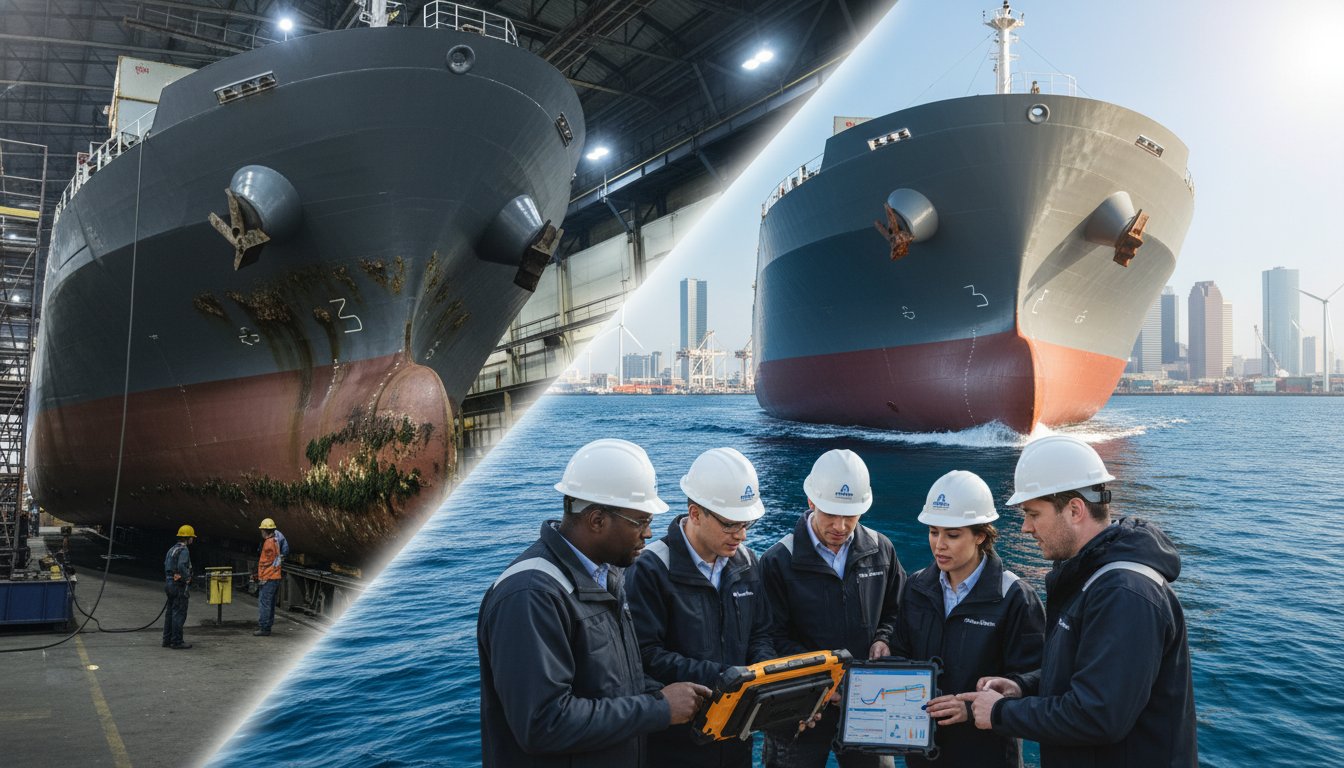
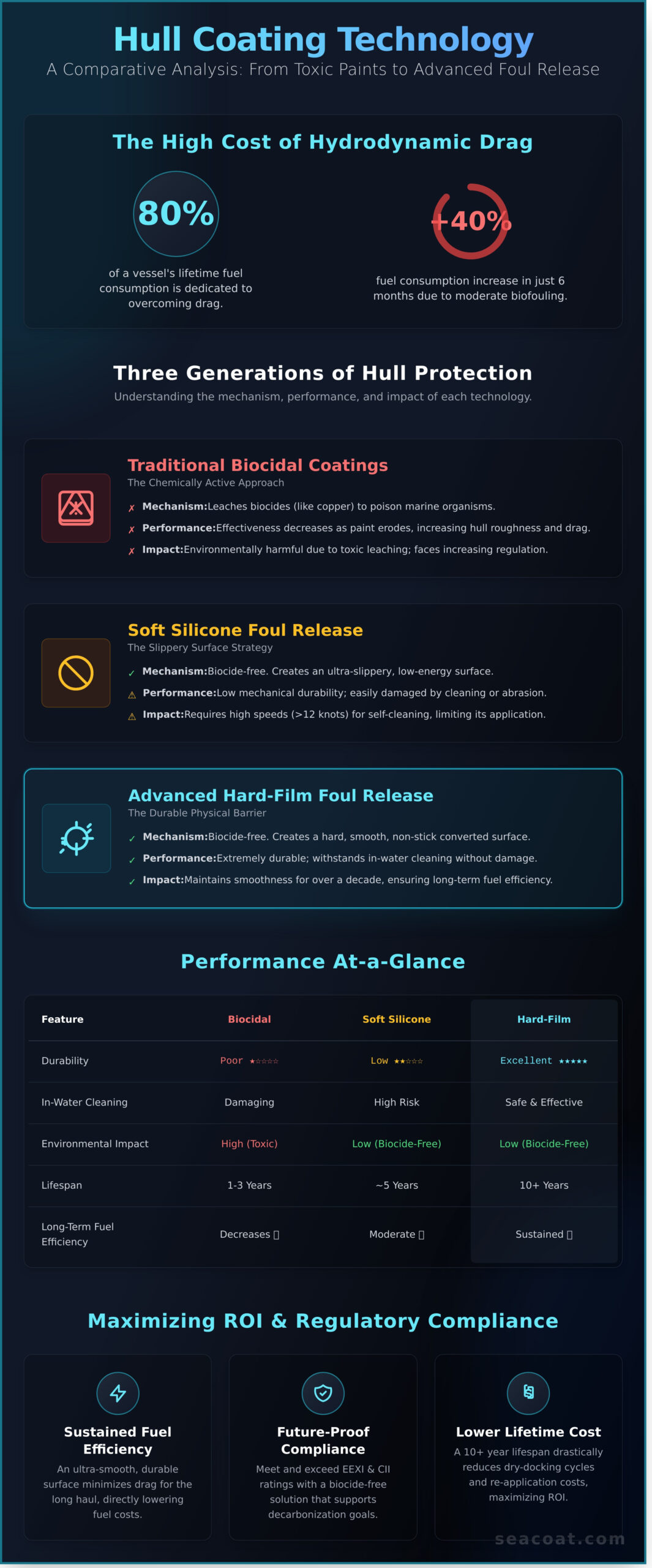
As much as 80% of a vessel’s lifetime fuel consumption is dedicated to overcoming hydrodynamic drag, a figure that can escalate by up to 40% in just six months due to moderate biofouling. This operational reality has driven a decades-long reliance on traditional antifouling solutions, where industry-standard ppg bottom paints have played a significant role in mitigating bio-adhesion through controlled biocide release. For fleet managers and vessel owners, the cycle of frequent maintenance and volatile fuel costs is a familiar, and costly, challenge.
This guide provides a critical technical analysis, directly comparing the performance of these established coatings against the quantifiable advantages of advanced, biocide-free hard-film foul release systems. We will dissect the
Key Takeaways
- Distinguish between the two primary marine coating technologies-biocidal antifouling and foul release-to select the appropriate system for your operational profile.
- Analyze the chemical mechanisms of traditional ppg bottom paints to understand how modern, non-toxic silane-siloxane films provide a more durable physical barrier.
- Evaluate the critical durability differences between soft silicone coatings and advanced hard-film technologies that permit in-water hull cleaning without damage.
- Calculate the direct impact of hull coating smoothness on fuel efficiency and your vessel’s EEXI and CII ratings for long-term regulatory compliance and ROI.
Understanding PPG Bottom Paints: Antifouling vs. Foul Release
The portfolio of ppg bottom paints is fundamentally structured around two distinct biofouling mitigation strategies: biocidal antifouling and biocide-free foul release. These technologies, primarily developed under PPG’s globally recognized Sigma and Amercoat lines, represent a critical choice for vessel operators balancing operational efficiency with environmental stewardship. The divergence between these two approaches reflects the maritime industry’s evolution from chemically active solutions to physically repellent, hydrodynamic surfaces.
Biocidal antifouling coatings function by creating a chemically hostile surface. They release minute, controlled quantities of active substances, such as cuprous oxide or specialized photodegradable biocides, which are toxic to marine organisms like barnacles and algae. This process prevents fouling from attaching and proliferating on the hull. For a comprehensive overview of antifouling paint and its chemical mechanisms, historical context is essential to understanding its modern application. In contrast, foul release systems are biocide-free and operate on a principle of low surface energy. These advanced coatings, typically based on silicone or siloxane chemistry, create an exceptionally smooth, non-stick surface. Fouling organisms have extreme difficulty establishing a firm grip and are typically dislodged by the vessel’s movement through water.
Underpinning the development of both coating types is the non-negotiable requirement for regulatory compliance. Global and regional authorities, including the IMO and U.S. EPA, have imposed strict limits on Volatile Organic Compounds (VOCs) to reduce air pollution. Consequently, PPG’s modern formulations are engineered as high-solids products, maximizing protective film build while minimizing solvent emissions during application.
The Legacy of Biocidal Antifouling
Traditional hard coatings, such as those in the Amercoat 214 family, rely on a controlled-depletion mechanism. The paint film is designed to slowly leach biocides into the water-film boundary layer, creating a toxic barrier. While effective for decades, this methodology faces increasing scrutiny due to the environmental impact of biocidal leaching, particularly the accumulation of copper in harbors, estuaries, and other sensitive marine ecosystems. The industry-wide ban of organotin (TBT) compounds in 2008 set a precedent for this heightened regulatory focus.
The Emergence of PPG SigmaGlide and Silicone Systems
The PPG SigmaGlide series epitomizes the industry’s shift toward biocide-free solutions. Its mechanism is rooted in advanced silicone-hydrogel technology, which creates an ultra-slippery surface that fouling cannot adhere to. These systems are engineered for high-activity vessels, where water flow exceeding 12-15 knots provides the necessary force for self-cleaning. The primary trade-off is mechanical durability; silicone coatings are inherently softer than hard epoxies and require specialized cleaning protocols to avoid physical damage during maintenance.
Technical Comparison: Biocidal Mechanisms vs. Silane-Siloxane
The maritime industry is undergoing a critical chemical transition, moving away from coatings that function by leaching toxins toward advanced systems that create a physical barrier to marine growth. For decades, the primary defense against biofouling has been biocidal antifouling paints, which release copper oxides or other toxic compounds to poison organisms that attempt to attach. This mechanism, however, is fundamentally finite and environmentally problematic. The modern alternative is foul release technology, which creates a low-energy, non-stick surface that organisms cannot easily adhere to, and which can be easily cleaned.
This shift has produced two distinct technological paths: soft silicone-based coatings and hard-film silane-siloxane systems. While both are biocide-free, their chemical structures and performance characteristics are vastly different. Soft coatings, like some foul release options in the ppg bottom paints portfolio, rely on a thick, pliable layer of silicone oils. This creates a slippery surface, but its lack of durability makes it highly susceptible to mechanical damage during cleaning or from operational abrasion. A 2022 study on silicone foul-release coatings highlights their environmental benefits over biocides, but their physical softness remains a significant operational constraint. Sea-Speed’s silane-siloxane technology represents a different paradigm. It isn’t a soft layer; it’s a chemical conversion of the hull’s surface, creating an incredibly hard, durable, and smooth finish that maintains its foul release properties for over a decade.
How Traditional Antifouling Fails Over Time
Conventional ablative or self-polishing coatings are engineered to fail. Their entire mechanism relies on the paint film slowly eroding to expose fresh layers of biocide. This “polishing” effect, while effective initially, eventually degrades the hull’s hydrodynamic profile by creating a progressively rougher surface. A mere 10-micron increase in average hull roughness can elevate fuel consumption by up to 1%. As the paint film thins and biocide concentration drops, late-cycle performance plummets, requiring a complete and costly re-application every 3 to 5 years.
The Silane-Siloxane Advantage
Unlike coatings that sit on top of a substrate, a silane-siloxane system initiates a chemical reaction, forming a permanent covalent bond with the hull material. This creates a unified, non-porous surface that doesn’t deplete, erode, or leach any substances. Silane-siloxane is a biocide-free, hard-film foul release system that optimizes hydrodynamic efficiency. This immunity to depletion is critical; it guarantees consistent performance and ensures compliance with increasingly stringent global regulations, such as the EU’s Biocidal Products Regulation, which are phasing out harmful chemicals used in traditional ppg bottom paints and similar products. The performance data from over two decades of applications demonstrates this longevity; you can review our documented case studies to see the results.
Durability Analysis: Hard Film vs. Soft Silicone Coatings
The selection of a hull coating is a critical operational decision, extending far beyond initial application costs to directly influence a vessel’s maintenance schedule, fuel consumption, and overall service life. While soft silicone foul-release coatings and hard-film coatings both aim to mitigate biofouling, their fundamental physical properties create a stark divergence in real-world durability and maintainability. A coating’s ability to withstand mechanical stress is the primary determinant of its long-term economic viability, and it’s here that the two technologies fundamentally differ.
Soft silicone systems rely on a low-energy, non-stick surface that is inherently fragile. Hard-film coatings, conversely, present an inert, highly durable surface engineered for high-contact environments. This distinction is the core reason why hard-film systems like Sea-Speed V 10 X Ultra are designed for proactive in-water cleaning, while soft coatings are not.
The Hidden Costs of Soft Coatings
The primary vulnerability of soft silicone coatings is their extreme susceptibility to mechanical damage. These pliant films can be easily torn, abraded, or gouged by routine operational contact with fenders, tugboats, mooring lines, or floating debris. Repairing such damage isn’t a simple touch-up; it requires specialized surface preparation and controlled application conditions, often necessitating an unscheduled and costly dry-docking. This fragility introduces a significant operational risk, particularly for vessels in high-traffic ports. In these environments, operators report premature coating failures in up to 30% of soft-coating applications due to physical damage, completely negating any projected fuel savings.
Furthermore, these coatings are prone to “delamination,” a catastrophic failure where the film peels away from the hull. This is most common in high-shear areas like the bow, rudder, and bilge keels, where hydrodynamic forces are most intense. Consequently, while a soft coating may carry a 5-year performance estimate, its functional lifespan in commercial service is frequently cut short to just 24-36 months, failing to deliver its promised return on investment.
Hard-Film Performance in Harsh Environments
Hard-film coatings are engineered for the physical realities of the maritime industry. Their exceptional abrasion resistance allows vessels to operate in harsh conditions, from navigating ice channels to maneuvering in silt-heavy estuaries, without compromising the coating’s integrity. This resilience is what enables the use of standard, cost-effective in-water cleaning equipment. The robust, non-porous surface can be safely cleaned with rotating brushes and other conventional tools, which would instantly destroy a soft silicone film. This capability transforms hull maintenance from a reactive, dry-dock-dependent problem into a proactive, operational task.
Unlike ablative or traditional soft foul-release systems, including some commercial ppg bottom paints, a hard-film coating’s physical structure is not compromised by routine maintenance. This ensures long-term surface profile stability. A smooth hull is a fuel-efficient hull. A hard coating maintains an exceptionally low surface roughness for its entire service life, which can exceed 10 years. This focus on lasting surface integrity aligns with advanced industry research, as detailed in a European Commission report on low-emission antifouling coatings, which underscores the need for durable, non-toxic marine surfaces to achieve sustainable operational efficiency. The result is a predictable and sustained reduction in hydrodynamic drag, delivering measurable fuel savings year after year without the risk of sudden, catastrophic coating failure that plagues softer alternatives.
Maximizing ROI: Fuel Savings and Regulatory Compliance
A vessel’s hull coating is no longer a simple maintenance item. It’s a strategic technical asset that directly influences profitability and regulatory viability. The shift from traditional anti-fouling to advanced, non-toxic hard coatings represents a fundamental recalculation of a vessel’s operational and financial performance over its entire lifecycle. This isn’t just about preventing biofouling; it’s about optimizing hydrodynamic efficiency to achieve quantifiable returns and secure a competitive advantage in a market defined by stringent environmental standards.
The core principle is simple: a smoother hull creates less frictional drag. By maintaining a slick, foul-release surface, a vessel can achieve its service speed with significantly lower engine power. This directly translates into fuel savings ranging from 10% to 20%, a figure validated across multiple vessel types in commercial service since 2020. This performance gain is the key to extending dry-docking intervals from a standard 3-year cycle to a 10-year horizon, fundamentally altering the economics of vessel ownership.
Energy Efficiency and Carbon Intensity
Under IMO 2023 regulations, a high-performance hull coating serves as a critical “technical measure” for improving a vessel’s Energy Efficiency Existing Ship Index (EEXI) and its annual Carbon Intensity Indicator (CII) rating. A 2022 analysis of a Panamax bulk carrier fleet demonstrated that the application of a premium siloxane coating improved the vessels’ CII rating from a C to a B grade within the first year. This improvement stems directly from the reduction in greenhouse gas emissions per ton-mile, a metric that is now central to a vessel’s commercial appeal.
Life Cycle Costing vs. Initial Application Price
Evaluating a hull coating based on its initial price per liter is a flawed approach. A comprehensive life cycle cost analysis reveals the true value. While a premium hard coating may have an initial application cost 50-70% higher than some conventional ablative ppg bottom paints, its total cost of ownership over a decade is substantially lower. This calculation must factor in:
- Reduced Fuel Consumption: A 15% fuel saving on a vessel consuming 40 tons of VLSFO per day can yield over $3.5 million in savings over a 5-year period at current fuel prices.
- Eliminated Dry-Docking Cycles: Extending the service interval to 10 years eliminates at least two full dry-docking events. This saves not only the direct costs of blasting and repainting (upwards of $400,000 per event) but also an estimated 40-60 days of lost operational revenue.
- Vessel Resale Value: A hull with a documented 10-year, high-performance coating system and low surface roughness readings consistently commands a 3-5% higher valuation on the secondhand market.
When these factors are combined, the initial premium investment delivers a return that is often more than 3x the initial cost differential. This transforms the coating from an expense into a high-yield capital improvement. Moreover, operating a vessel certified with a non-toxic, biocide-free system provides a powerful marketing tool, attracting charterers like major oil and retail corporations who mandate sustainable supply chains. Don’t just meet compliance; lead the market. Calculate the precise 10-year ROI for your fleet.
Showcasing such technological advantages is crucial, and maritime trade shows and exhibitions are a primary venue for demonstrating this market leadership. A professional presentation at these events can amplify a company’s message of sustainability and efficiency. For those planning their presence, industry suppliers such as Coker Exhibition Systems Ltd (CokerExpo) offer specialized solutions to create impactful displays.
The Strategic Choice: Why Sea-Speed is the Modern Alternative
While effective in-water cleaning is critical for any hard coating, the selection of the coating itself determines the long-term operational and financial viability of a vessel. Traditional systems, including many reputable ppg bottom paints, have served the industry for decades by relying on biocidal agents or ablative surfaces. Sea-Speed V 10 X Ultra represents a fundamental technological evolution. It moves beyond temporary chemical deterrents to a permanent, science-driven solution engineered for peak hydrodynamic performance and environmental stewardship. This is not simply another paint; it’s a strategic asset for vessel management.
Our approach is rooted in providing a non-toxic, exceptionally durable, foul-release surface that maintains its integrity for over a decade. The core technology is a proprietary siloxane-polyurethane hybrid that creates an inert, extremely low-friction finish. Unlike coatings that leach toxins, Sea-Speed presents a surface to which marine organisms cannot effectively adhere, allowing for simple removal through water friction or minimal cleaning effort. This shift from toxic antifouling to non-toxic foul-release directly benefits commercial, military, and recreational stakeholders by delivering quantifiable fuel savings, drastically reduced maintenance cycles, and guaranteed regulatory compliance.
Beyond the hull, total vessel protection is key for these stakeholders. For instance, while the focus here is on hydrodynamics, protecting the superstructure is also vital. Specialized services for marine environments, such as the professional window tinting provided by Dad Auto Care, contribute to asset longevity by reducing UV damage to interiors and improving operational conditions by cutting glare.
Engineered for Longevity
The Sea-Speed system is defined by its unparalleled durability and forward-thinking chemistry. Our 10-year life cycle guarantee is a testament to its resilience, offering fleet managers unprecedented control over operational expenditures (OPEX) by minimizing the need for frequent dry-docking and recoating. This longevity is complemented by its environmental credentials:
- Future-Proof Compliance: With a Zero VOC (Volatile Organic Compound) and 100% biocide-free formulation, Sea-Speed already meets the most stringent environmental regulations anticipated in the coming years. This mitigates the risk of costly retrofits or operational restrictions.
- Global Support Network: Recognizing the demands of global shipping and naval operations, Seacoat SCT, LLC provides worldwide availability and dedicated technical support, ensuring consistent application standards and performance for industrial-scale projects in any major port.
Next Steps for Vessel Owners
Transitioning from legacy systems like conventional ppg bottom paints to the Sea-Speed platform is a structured process designed to maximize ROI. The initial step is a comprehensive hull performance audit, which analyzes existing fuel consumption data, speed loss metrics, and current coating maintenance costs to establish a precise baseline. This data-driven approach allows for accurate projections of the fuel efficiency gains and OPEX reductions achievable with Sea-Speed. We offer tailored solutions, from pre-measured kits for pleasure craft to bulk supply logistics for entire commercial fleets, ensuring the right scale for any operation. To begin quantifying the advantages for your specific assets, Consult with a Seacoat SCT, LLC expert to optimize your hull performance.
Charting a Course Beyond Traditional Coatings
The maritime industry’s operational and regulatory landscape is evolving. While biocidal coatings like many ppg bottom paints have historically addressed biofouling, the future demands a more sophisticated approach. The critical shift is from temporary, toxic antifouling mechanisms to permanent, non-toxic foul release systems that deliver both environmental compliance and a superior return on investment. This transition isn’t just an option; it’s an operational necessity driven by regulations like EEXI and the pursuit of greater fuel efficiency.
Sea-Speed V 10 X Ultra embodies this necessary evolution. It’s a hard film, silane-siloxane coating proven across more than 20 years of demanding commercial use. Its zero VOC and biocide-free technology not only eliminates environmental harm but also creates an ultra-low friction surface. This significant drag reduction is a direct pathway to achieving EEXI compliance and realizing substantial fuel savings over a 10-year service life.
It’s time to move beyond the cycle of re-application and environmental liability. Upgrade your vessel efficiency with Sea-Speed V 10 X Ultra and invest in a permanent, high-performance solution for your fleet.
Frequently Asked Questions
Is PPG bottom paint better than non-toxic foul release coatings?
Non-toxic foul release coatings represent a more advanced and sustainable technology compared to traditional biocidal options like many PPG bottom paints. Instead of releasing copper biocides into the marine environment, hard-film foul release systems create an ultra-smooth, low-energy surface that prevents marine organisms from attaching firmly. This approach not only eliminates toxic leaching but also provides superior long-term fuel efficiency through a significant reduction in hydrodynamic drag, offering a clear operational and environmental advantage.
Can Sea-Speed be applied over existing PPG bottom paints?
Applying Sea-Speed directly over existing PPG bottom paints is not recommended as it compromises system integrity and performance. For guaranteed adhesion and the coating’s full 10-year lifespan, all previous coatings must be completely removed to achieve a clean, profiled substrate. Alternatively, a manufacturer-approved tie-coat can be used to seal the existing paint. This critical preparation step ensures the chemical bond required for the hard-film system’s durability and foul release properties.
How much fuel can I really save by switching to a hard-film foul release system?
Vessels can achieve a verified fuel savings of 6% to 9% by switching to a hard-film foul release system. This efficiency gain is a direct result of minimizing hydrodynamic drag. The exceptionally smooth surface, with an average roughness profile of less than 20 microns, prevents the performance degradation seen with conventional antifouling paints. Over a vessel’s operational lifetime, these fuel savings provide a substantial return on investment that far exceeds the initial application cost.
Are silicone-based coatings like PPG SigmaGlide durable enough for commercial ships?
While modern silicone coatings offer good foul release properties, they often lack the mechanical durability required for the demanding operational tempo of commercial vessels. Silane-siloxane hard-film coatings provide a more robust solution, demonstrating up to 40% greater abrasion resistance in standardized ASTM D4060 Taber testing. This superior toughness makes them highly resistant to damage from sea ice, fendering, and routine in-water cleaning, ensuring performance integrity throughout a 10-year service cycle.
What are the current global regulations regarding copper-based antifouling?
Global regulations are increasingly restricting the use of copper-based antifouling paints. Following the IMO’s 2001 ban on organotins, regions like Washington state (USA) and countries including Sweden and the Netherlands have implemented stringent limits on copper leaching rates. As of 2023, the European Chemicals Agency (ECHA) continues its review of copper compounds under the Biocidal Products Regulation (BPR), signaling a clear international trend toward adopting biocide-free alternatives to ensure environmental compliance.
How does the maintenance of a hard-film coating differ from ablative paint?
The maintenance protocol for a hard-film coating is fundamentally different from that of an ablative paint. Ablative coatings are designed to wear away, making them unsuitable for cleaning and requiring reapplication every 2-3 years. In contrast, a durable hard-film system is inert and designed for proactive in-water cleaning. Regular, non-abrasive grooming every 9-12 months removes slime layers, maintains hydrodynamic efficiency, and ensures the coating achieves its full 10-year operational lifespan.
What is the expected lifespan of a silane-siloxane hull coating?
A properly applied and maintained silane-siloxane hull coating is engineered for a service life of 10 years. This longevity is a core design feature, contrasting sharply with the 2-3 year repaint cycle of traditional antifouling systems. Achieving this decade-long performance is contingent upon correct surface preparation, adherence to the specified application process, and a commitment to a proactive in-water cleaning schedule. This provides vessel operators with predictable, long-term asset protection and operational efficiency.
Is a biocide-free coating effective in high-fouling tropical waters?
Yes, a biocide-free hard-film coating is highly effective in high-fouling tropical waters when supported by an appropriate maintenance plan. The technology’s effectiveness isn’t based on killing marine life but on preventing its firm adhesion. In aggressive fouling zones, this requires a more frequent cleaning interval, typically every 6-8 months, to remove the biofilm before complex organisms can colonize. This proactive grooming maintains a hydrodynamically smooth surface and ensures peak fuel efficiency year-round.