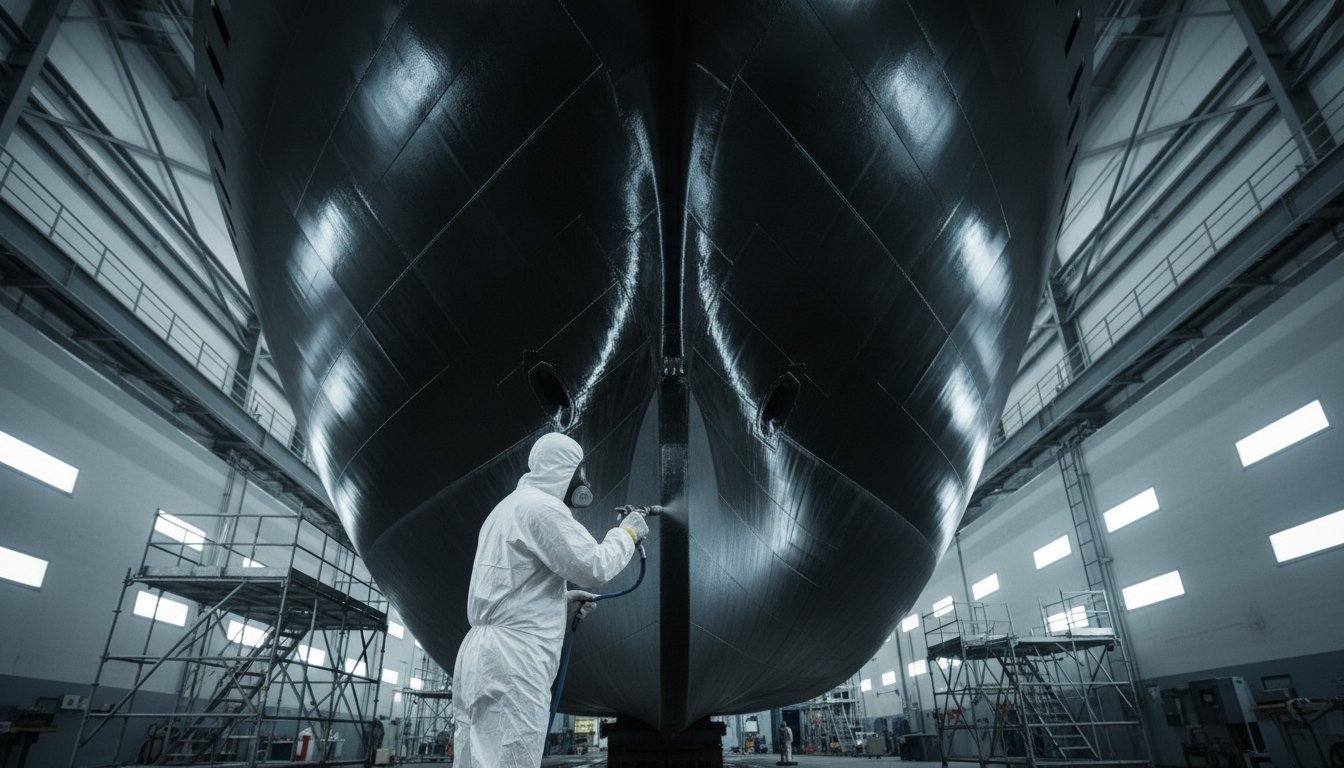
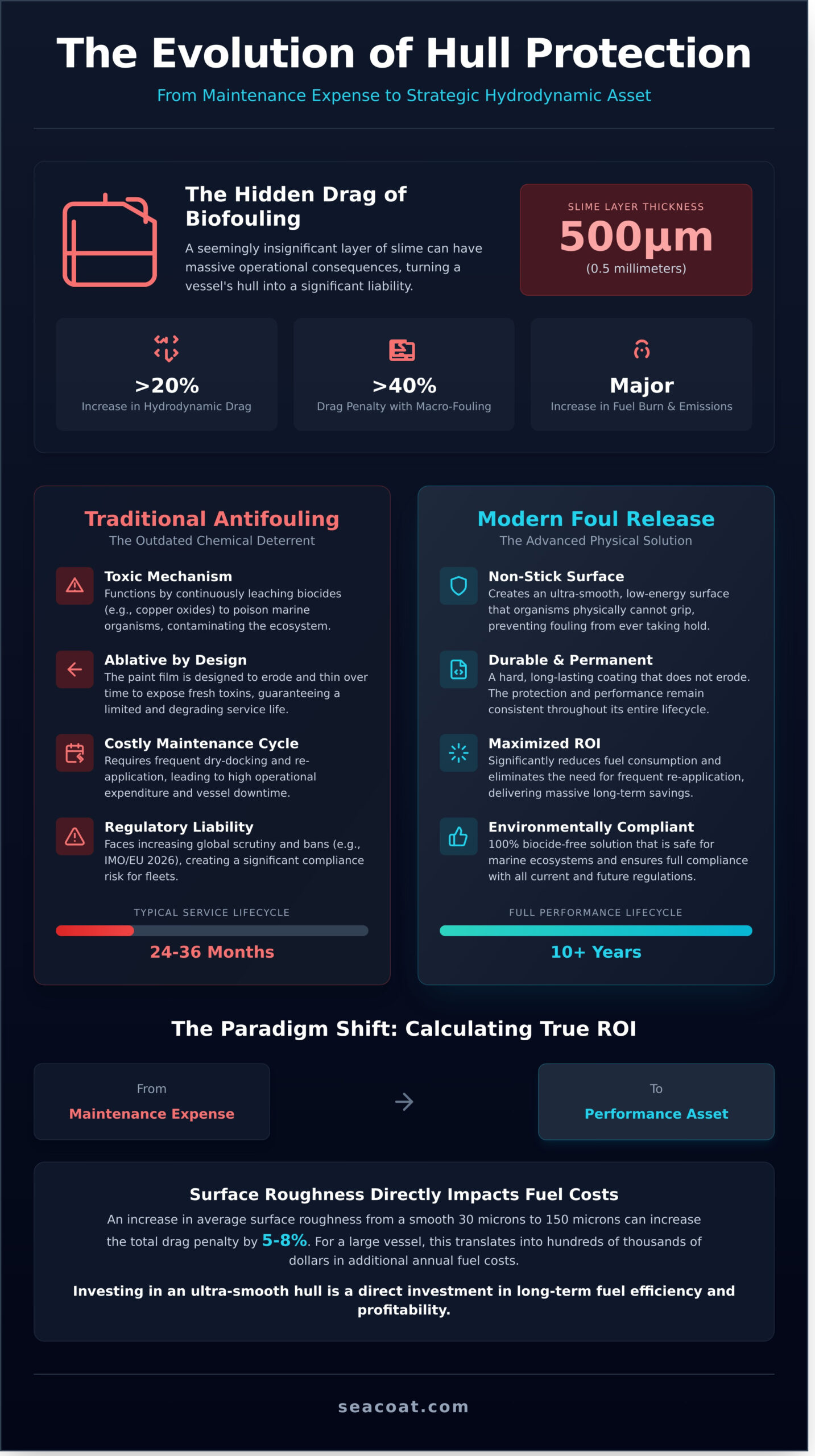
A seemingly negligible layer of slime, just 500 micrometers thick, can increase a vessel’s total hydrodynamic drag by over 20%, directly impacting fuel consumption and operational expenditure. For too long, the maritime industry has been locked in a costly cycle of frequent dry-docking intervals and the reapplication of ablative, biocide-leaching coatings; a cycle that presents both a significant financial drain and a growing regulatory liability.
This guide moves beyond that outdated model. We will detail precisely how advanced foul release coatings transition the concept of boat hull paint from a simple maintenance item to a strategic hydrodynamic asset. You’ll gain a clear understanding of the material science that delivers verifiable reductions in fuel costs, ensures compliance with increasingly stringent global environmental standards, and secures a full 10-year hull protection lifecycle. We’ll explore the covalent bonding of modern polymer technologies, quantify the relationship between surface roughness and fuel efficiency, and present the definitive ROI case for specifying a truly biocide-free solution for your fleet.
Key Takeaways
- Re-evaluate hull coatings as performance-enhancing assets that reduce hydrodynamic drag, rather than simply as a maintenance expense.
- Differentiate between traditional biocide-leaching antifouling and modern, non-stick foul release systems to determine the most effective long-term solution.
- Move beyond initial price per gallon to calculate the true ROI of your boat hull paint based on quantifiable fuel savings and extended maintenance intervals.
- Identify the critical performance metrics needed to select the optimal coating for specific vessel operations, from commercial shipping to high-speed naval applications.
Understanding Boat Hull Paint: Protection vs. Performance
A vessel’s hull coating serves a dual mandate: preserving the structural integrity of the asset through corrosion prevention and optimizing its operational performance by mitigating biofouling. Historically, these functions were treated as separate maintenance concerns. This perspective is now obsolete. The microscopic texture of a hull’s surface, its “roughness,” is a primary driver of hydrodynamic drag, directly impacting fuel expenditure and engine lifecycle. With environmental regulations tightening ahead of 2026, traditional bottom paints are transitioning from a necessary expense to a significant operational and compliance liability. The industry is therefore shifting from a cycle of reactive maintenance to a strategy of proactive surface optimization.
The Impact of Biofouling on Vessel Operations
Biofouling represents a multi-billion dollar operational challenge for the global fleet. The initial colonization by microbial slime, often dismissed as insignificant, disrupts the laminar flow across the hull, increasing frictional resistance by up to 18%. As algae and macro-foulers like barnacles attach, this drag penalty can escalate to over 40%, forcing engines to operate at higher loads to maintain service speed. This sustained strain directly correlates to increased fuel burn, elevated emissions, and a quantifiable reduction in engine longevity.
For decades, the maritime industry’s primary defense against this has been the application of biocidal coatings. These paints function by continuously leaching toxic compounds, typically copper oxides, into the surrounding water to poison marine organisms. While effective to a degree, the science of antifouling coatings reveals a dependency on chemical ablation that is environmentally unsustainable. As global standards, including anticipated IMO and EU regulations for 2026, move toward a near-total ban on leachable biocides, reliance on this technology creates a critical compliance risk for fleet operators.
Surface Energy and Hydrodynamics
The physics of hydrodynamic efficiency is governed by surface energy. A truly “slick” or low-friction surface is one that prevents strong molecular adhesion. When average surface roughness increases from a baseline of 30 microns to 150 microns, the corresponding drag penalty can increase by 5-8%. For a large vessel, this seemingly small percentage translates directly into hundreds of thousands of dollars in additional annual fuel costs. This is where foul release technology diverges; it’s a physical, not chemical, solution designed to create an ultra-smooth, low-energy surface that organisms simply cannot secure a grip on.
The paradigm has fundamentally changed. An advanced boat hull paint is no longer just a protective film; it is a performance-enhancing technology. The decision to invest in a coating is now a strategic calculation of long-term ROI, weighing initial application cost against a decade of fuel savings, reduced maintenance cycles, and guaranteed regulatory compliance. Proactive surface optimization isn’t just best practice. It’s a competitive necessity.
The Evolution of Hull Protection: Antifouling vs. Foul Release
For decades, the primary strategy for managing marine biofouling has been rooted in toxicology. Traditional antifouling paints operate as a deterrent by continuously leaching biocides, such as cuprous oxide, into the surrounding water. This approach, while effective in the short term, is fundamentally a consumable and environmentally taxing solution. A paradigm shift is underway, moving from this chemical warfare to a sophisticated physical defense: foul release technology. This evolution isn’t just about environmental compliance; it’s about adopting a more resilient, efficient, and permanent solution for vessel hull protection.
Traditional Antifouling: A Declining Standard
Conventional antifouling systems, particularly ablative paints, are designed to fail. Their mechanism relies on the paint film slowly eroding to expose fresh layers of biocide, a process that inherently ensures the coating thins over its 24 to 36-month service life. This controlled degradation directly releases copper and other toxins into marine ecosystems, contributing to sediment contamination and harming non-target organisms. The maritime industry has already witnessed the global ban of highly toxic organotins like TBT, and copper is facing similar regulatory scrutiny. As governments globally tighten environmental standards, understanding the latest antifouling paint regulations is critical for fleet managers planning for compliance beyond 2026. This unsustainable cycle necessitates frequent dry-docking for re-application, driving up operational costs and vessel downtime.
Foul Release Technology: The Hard-Film Advantage
Foul release coatings represent a completely different philosophy. Instead of poisoning marine organisms, they create an ultra-slick, low-surface-energy hull that prevents them from attaching firmly. Advanced hard-film systems utilize Silane-Siloxane chemistry, which doesn’t just sit on the hull; it forms a covalent bond with the substrate at a molecular level. This creates an inert, non-toxic, and exceptionally durable surface. The primary benefit is a dynamic, self-cleaning effect. Once a vessel reaches cruising speeds, typically 8-10 knots, the hydrodynamic forces are sufficient to wash away any weakly attached slime or algae. This maintains a smooth hull, directly mitigating the frictional drag that increases fuel consumption.
This durability marks a critical distinction from older, soft silicone-based foul release coatings, which are susceptible to mechanical damage. A hard-film Silane-Siloxane surface can withstand routine high-pressure cleaning up to 4,000 PSI without damage, whereas softer silicones often tear or delaminate under such pressures. This resilience ensures a ten-year performance life cycle, eliminating the need for frequent re-coating associated with traditional boat hull paint.
Ultimately, the choice between antifouling and foul release is a choice between a short-term, polluting fix and a long-term, performance-enhancing asset. As environmental regulations inevitably render biocide-based solutions obsolete, biocide-free technology is the only future-proof path to operational efficiency and environmental stewardship. The transition to inert, hard-film systems is a fundamental upgrade in vessel management, and you can analyze the technical specifications of these advanced coatings to verify their durability benchmarks.
Calculating the Real ROI: Fuel Savings and Maintenance Intervals
A sophisticated analysis of vessel operational costs moves far beyond the initial price per gallon of a coating. This traditional procurement metric is a fallacy, obscuring the far greater financial impacts of fuel consumption, dry-dock frequency, and regulatory compliance. The true value of a high-performance boat hull paint is not found on the purchase order, but in the vessel’s performance logs and maintenance budgets over a ten-year operational window. Calculating the total cost of ownership (TCO) reveals that a premium, durable coating represents a strategic investment with a quantifiable and substantial return.
Fuel Efficiency and Carbon Footprint
The hydrodynamic resistance of a hull is directly proportional to its fuel consumption. A hard-film, foul release coating creates an ultra-smooth surface that can reduce frictional drag by 10-12% compared to conventional anti-fouling paints. For a vessel with an annual fuel expenditure of $2.5 million, this translates into potential savings of $250,000 to $300,000 per year. The science is precise; extensive fluid dynamics research confirms that even a 20-micron reduction in average hull roughness can yield up to 1% in fuel savings. This optimization is no longer a luxury; it’s a necessity for achieving favorable EEXI (Energy Efficiency Existing Ship Index) and CII (Carbon Intensity Indicator) compliance ratings, which directly impact a vessel’s commercial viability. A recent case study on a Panamax bulk carrier documented an 11.2% decrease in fuel consumption in the 12 months following the application of a siloxane-based hard coating, validating these performance metrics under real-world operational conditions.
Long-Term Maintenance Savings
The financial calculus extends dramatically when evaluating maintenance intervals. Traditional ablative or self-polishing coatings require a complete re-application every two to three years, a cycle that consumes capital, labor, and valuable operational time. A durable hard-film coating, in contrast, is engineered for a 10-year service life with minimal in-water cleaning. This extended lifecycle fundamentally alters the maintenance equation.
- Conventional Ablative Paint (10-Year Period): Requires 4-5 full dry-docking cycles for “sand and paint” overhauls. Each cycle incurs costs for yard rental, surface preparation, material application, and hazardous waste disposal.
- Sea-Speed Hard Film (10-Year Period): Requires a single application. The need for repeated, labor-intensive surface blasting and recoating is eliminated, which also reduces the release of volatile organic compounds (VOCs) and helps fleets align with strict environmental regulations like the EPA standards for boat manufacturing.
This operational shift doesn’t just cut direct costs; it maximizes vessel uptime. By eliminating three to four dry-docking events over a decade, a vessel gains an additional 30 to 45 days at sea. For a commercial vessel, these are days of revenue generation, not expense. When you combine sustained fuel efficiency with a near-elimination of recoating cycles, the initial investment in an advanced boat hull paint is repaid multiple times over, delivering a clear and compelling return on investment.
Selection Guide: Matching Coatings to Vessel Type
The optimal hull coating isn’t a universal solution; it’s a strategic selection dictated by a vessel’s specific operational profile, hull material, and regulatory environment. A coating engineered for a slow-moving tanker would fail on a high-speed patrol craft, just as a system for a fiberglass yacht is unsuitable for an aluminum workboat. Selecting the correct system is fundamental to maximizing asset performance, ensuring regulatory compliance, and achieving a projected 10-year return on investment.
For military and coast guard vessels operating at speeds consistently above 30 knots, traditional ablative paints erode too quickly, creating drag and requiring premature dry-docking. A hard, non-ablative siloxane-based coating provides a durable, low-friction surface that withstands high-pressure water flow. This ensures sustained speed capabilities and offers superior impact resistance against floating debris, a critical factor in patrol and interception missions.
Commercial and Industrial Applications
The operational demands of commercial fleets require coatings that deliver quantifiable economic and environmental benefits. For bulk carriers and tankers on long-haul voyages, consistent hydrodynamic performance is paramount. A clean, smooth hull maintained by a premium foul-release system can reduce fuel consumption by 6-9% over a five-year period compared to conventional biocidal antifouling. This translates directly to lower operational expenditures and reduced CO2 emissions. Cruise lines face a dual challenge: maintaining a pristine hull appearance for passenger satisfaction while adhering to the world’s most stringent environmental regulations, such as the EPA’s Vessel General Permit (VGP). A non-toxic, zero-VOC foul-release coating satisfies both requirements, preventing biofouling without leaching harmful biocides into sensitive marine ecosystems like the Alaskan Inside Passage or Caribbean coral reefs. Offshore support vessels, often stationary for extended periods, are highly susceptible to aggressive hard fouling. Our hard film technology creates a surface so slick that organisms cannot firmly attach, ensuring the hull remains clean even in static conditions, a scenario where soft silicone coatings often fail.
Recreational and Performance Boating
In the recreational sector, the choice of boat hull paint is driven by performance, aesthetics, and a growing environmental consciousness. For competitive sailing, every fraction of a knot counts. Racing yachts coated with Sea-Speed V 10 X Clear benefit from a certified 4-6% reduction in surface drag, providing a measurable hydrodynamic advantage. For the eco-conscious boater, navigating the increasing number of “no-discharge” zones and regulated marinas is a primary concern. Biocide-free, foul-release coatings are the definitive solution for meeting these local requirements, ensuring unrestricted access to protected waterways. The easy-to-clean surface also means less time spent scrubbing at the slipway and more time enjoying the water.
Aluminum hulls present a unique and critical challenge: galvanic corrosion. Applying a common copper-based antifouling paint to an aluminum boat creates an electrical circuit in saltwater, which rapidly corrodes the hull material and can lead to catastrophic failure. Biocide-free coatings are chemically inert and contain no metallic compounds, completely eliminating the risk of galvanic corrosion. When applied over our specialized two-part epoxy primer system designed for aluminum adhesion, this system provides the safest and most durable protection available for metal-hulled vessels.
Matching the coating technology to the vessel is not just about maintenance; it’s about optimizing performance and safeguarding your asset for the long term. Find the precise coating system for your vessel’s operational profile.
The Seacoat Solution: Sea-Speed V 10 X Ultra
While many coatings offer incremental improvements, Sea-Speed V 10 X Ultra represents a fundamental shift in marine asset protection. It is the culmination of decades of research in Silane-Siloxane chemistry, engineered to deliver a permanent, high-performance solution that transcends the limitations of traditional antifouling paints. The system creates an exceptionally hard, inert, and non-porous surface that doesn’t rely on biocides or ablative action. Instead, it alters the hydrodynamic profile of the hull itself to mitigate biofouling and optimize vessel efficiency.
The core of its performance lies in a triad of engineered characteristics:
- Zero VOCs and Non-Toxic Formulation: Sea-Speed V 10 X Ultra is a 100% solid, zero-VOC (Volatile Organic Compound) coating. This eliminates airborne pollutants during application, ensuring full compliance with the most stringent port authority regulations globally and protecting the health of application crews. Its biocide-free composition means it doesn’t leach harmful chemicals, preserving marine ecosystems at every port of call.
- Exceptionally Low Surface Roughness: With a certified surface roughness profile measuring below 20 microns, the coating dramatically reduces the frictional drag between the hull and water. This hydrodynamic efficiency translates directly into verified fuel consumption reductions of 8-12%, a critical factor in optimizing operational expenditures and reducing carbon emissions.
- The “Apply Once” Philosophy: This advanced boat hull paint is engineered for a service life exceeding 10 years. A single, properly executed application provides a decade of consistent protection and performance. This approach fundamentally changes hull maintenance from a recurring operational cost, with dry-docking every 3-5 years, into a single capital investment that maximizes vessel availability and long-term return on investment.
Technical Specifications and Certifications
System integrity is paramount. Maximum adhesion is achieved using our specified tie-coat primer, Seapoxy 73, which creates an impermeable, covalent bond between the hull substrate and the Sea-Speed topcoat. All our products are supported by comprehensive Environmental Safety Data Sheets and hold key maritime certifications, including Lloyds Register Type Approval. The coating’s inert chemical structure guarantees stable foul-release performance in water temperatures from -30°C to 50°C and across all salinity levels.
Implementing Sea-Speed in Your Fleet
Transitioning your vessels from legacy antifouling to a modern foul release system is a structured process. It requires the complete removal of old coatings, surface preparation to a Sa 2.5 near-white metal blast standard, and the precise application of the Seacoat system. To ensure flawless execution, we provide a global network of certified applicators and on-site technical supervision for every project, guaranteeing your fleet realizes the full performance and longevity benefits of our technology.
Understanding the precise economic impact on your operations is the critical next step. Contact Seacoat SCT, LLC today for a customized fuel-savings analysis and let our engineers quantify the long-term value of a permanent hull solution for your fleet.
Secure Your Vessel’s Ten-Year Performance Horizon
The maritime industry’s approach to hull protection is undergoing a fundamental shift. We’ve moved beyond the limitations of traditional biocidal coatings toward a new paradigm of hydrodynamic optimization. This evolution in boat hull paint technology redefines ROI, calculating value not in application cost but in measurable fuel savings and dramatically extended maintenance intervals. It’s a strategic decision that directly impacts operational efficiency and regulatory compliance.
Sea-Speed V 10 X Ultra exemplifies this new standard. Its zero VOC, non-toxic Silane-Siloxane technology delivers a hard, slick surface that mitigates biofouling and can reduce fuel consumption by up to 12%. With a proven 10-year life cycle on demanding commercial and military vessels, it represents a long-term investment in asset integrity and environmental stewardship.
Every vessel has a unique operational profile. To understand the specific performance and economic benefits for your fleet, we invite you to Request a Technical Consultation for Your Vessel. Your commitment to a more efficient and sustainable maritime future begins today.
Frequently Asked Questions
How long does Sea-Speed V 10 X Ultra last compared to traditional bottom paint?
Sea-Speed V 10 X Ultra is engineered to last for a minimum of 10 years, a significant increase over traditional ablative or self-polishing paints. Conventional antifouling coatings typically require reapplication every 18 to 36 months, incurring repeated dry-docking costs. Our hard-film siloxane technology provides a durable, non-depleting surface that maintains its integrity for over a decade, eliminating up to five re-coating cycles and delivering a superior long-term return on investment.
Is foul release coating more expensive than standard antifouling?
The initial application cost for a premium foul release coating is higher than that of standard antifouling paint; however, the lifecycle cost is substantially lower. This initial investment is offset by eliminating re-coating expenses for at least 10 years, which can reduce total coating-related costs by up to 40% over the decade. Documented fuel savings, averaging between 6-12% due to reduced drag, further enhance the overall economic benefit and accelerate the return on investment.
Can I apply Sea-Speed over my existing boat hull paint?
No, Sea-Speed V 10 X Ultra cannot be applied directly over existing antifouling or incompatible boat hull paint. For optimal performance and to guarantee the 10-year system life, the existing coating must be completely removed down to the substrate. The surface must then be prepared to an Sa 2.5 near-white metal standard before applying the specified primer system and the Sea-Speed topcoat. This meticulous preparation ensures the tenacious bond required for long-term hydrodynamic efficiency.
Does a slick hull coating actually improve boat speed?
Yes, a slick, low-friction hull coating directly improves vessel speed and fuel efficiency by minimizing hydrodynamic drag. Sea-Speed V 10 X Ultra creates an exceptionally smooth surface with an average roughness of less than 20 microns, which reduces the frictional resistance between the hull and water. This allows the vessel to achieve the same speed with less power output. Independent case studies have documented speed increases of up to 5% at constant engine RPMs.
Are non-toxic hull paints as effective at preventing barnacles?
Yes, advanced biocide-free coatings prevent marine growth through a physical mechanism that is equally, if not more, effective over the long term. Instead of leaching toxins, Sea-Speed’s foul release technology creates an ultra-slick, low-surface-energy film. Organisms like barnacles cannot form a strong bond to this surface and are dislodged by the vessel’s movement through water, typically at speeds above 7 knots. This physical deterrence is a permanent, non-depleting feature of the coating.
What maintenance is required for a hard-film foul release coating?
Maintenance for a hard-film coating like Sea-Speed is minimal and primarily involves periodic in-water cleaning. Unlike soft antifouling paints which are easily damaged, our durable siloxane surface can be safely cleaned with non-abrasive tools like rotating brushes or water jets. For most commercial vessels, cleaning is only required every 12-24 months to remove any accumulated slime layer, ensuring the hull remains hydrodynamically optimized without the need for premature dry-docking.
Is Sea-Speed V 10 X Ultra safe for aluminum boats?
Yes, Sea-Speed V 10 X Ultra is completely safe and highly recommended for aluminum hulls. As a 100% biocide-free coating, it contains no copper compounds or other metallic pesticides that cause destructive galvanic corrosion on aluminum vessels. Traditional antifouling paints often rely on cuprous oxide, which can rapidly degrade an aluminum hull. Our non-conductive, inert formula provides robust fouling protection without introducing any risk of electrochemical damage, making it the superior choice for aluminum craft.
How does hull paint affect my vessel’s EEXI or CII rating?
A high-performance hull coating significantly improves a vessel’s Energy Efficiency Existing Ship Index (EEXI) and Carbon Intensity Indicator (CII) rating. By reducing hydrodynamic drag, Sea-Speed V 10 X Ultra lowers fuel consumption by an average of 6-12%. This direct reduction in fuel burn translates to a proportional decrease in CO2 emissions, the primary metric for CII calculations. This enhanced efficiency helps vessels meet or exceed the IMO’s 2023 regulatory requirements, improving their operational rating.