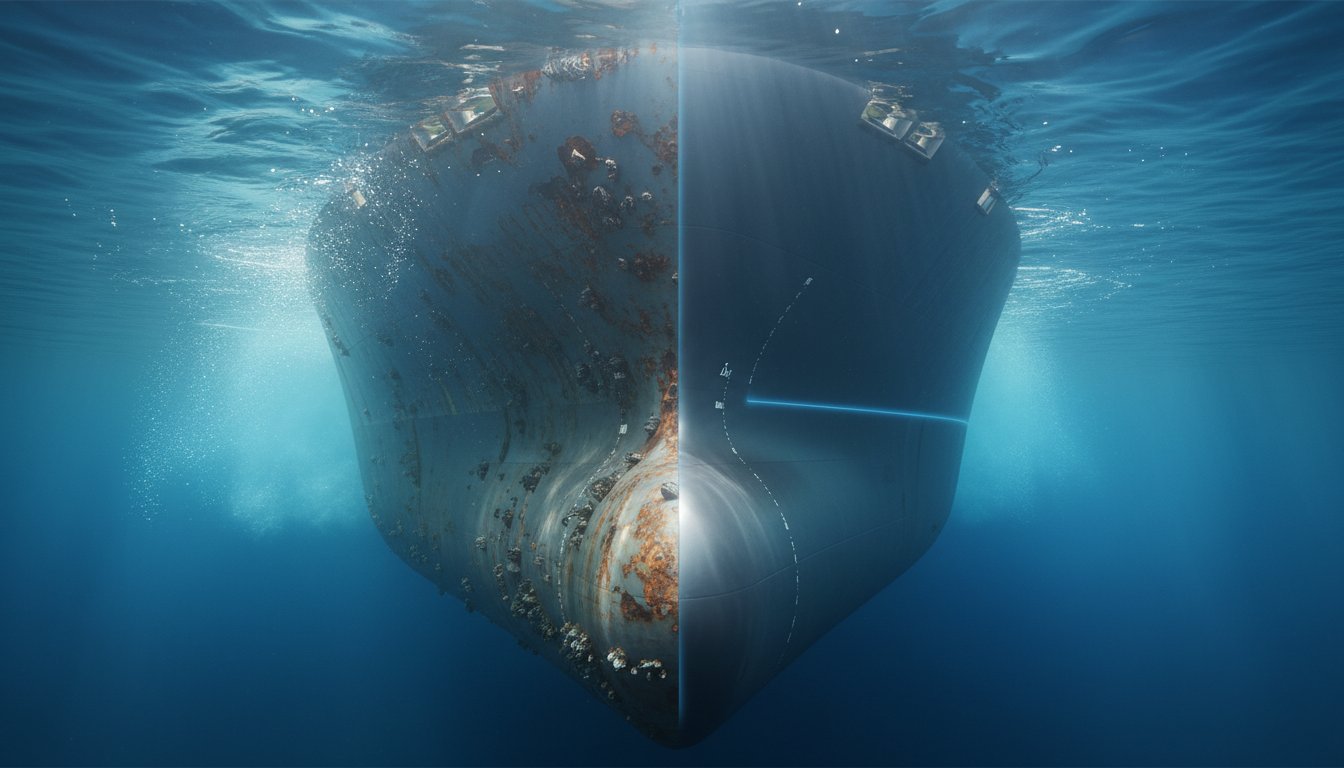
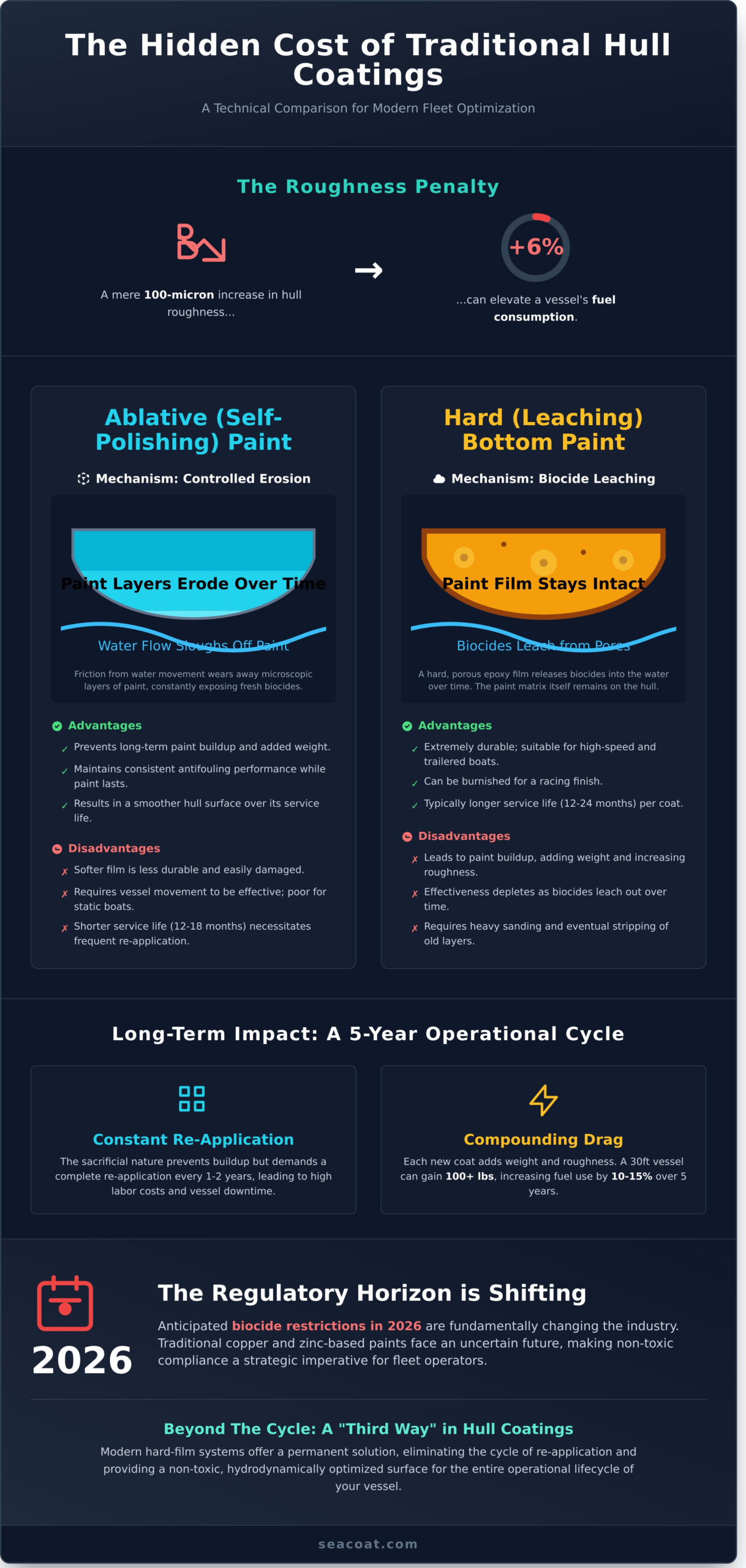
A mere 100-micron increase in hull roughness, a common consequence of paint buildup, can elevate a vessel’s fuel consumption by up to 6%. For a global fleet, the annual operational cost of this drag is staggering, often reaching into the millions. It’s a performance penalty that many operators have reluctantly accepted as an unavoidable consequence of traditional antifouling methods.
For decades, the maritime industry has relied on the predictable, yet inefficient, sacrificial cycle of copper-based coatings. The high cost of annual haul-outs, the labor-intensive repainting process, and the steady performance degradation between applications have been accepted as operational norms. This article will masterfully deconstruct the technical mechanisms of traditional ablative bottom paint versus hard film alternatives, providing the critical data you need to understand why modern maritime regulations, including the anticipated 2026 biocide restrictions, are fundamentally shifting the industry toward non-toxic, performance-oriented solutions.
We will analyze the hydrodynamic and economic impacts of each coating type, offering a clear pathway to optimizing your fleet for both future regulatory compliance and a ten-year operational lifecycle.
Key Takeaways
- Differentiate between the controlled erosion of ablative bottom paint and the leaching mechanism of hard coatings to anticipate long-term maintenance cycles and buildup issues.
- Quantify the “Roughness Penalty” by understanding how a sacrificial coating’s erosion directly increases hydrodynamic drag and operational fuel costs.
- Prepare your fleet for the 2026 regulatory landscape by identifying which traditional biocides are being phased out and why non-toxic compliance is now a strategic imperative.
- Evaluate a “third way” in hull coatings that operates as a permanent, hard-film system, eliminating the cycle of re-application inherent to sacrificial paints.
What is Ablative Bottom Paint?
Ablative bottom paint represents a category of antifouling coatings engineered to wear away, or “ablate,” at a controlled rate. Often described as self-polishing, this technology functions through a process of controlled erosion. As a vessel moves through the water, the friction systematically sloughs off microscopic layers of the paint, continuously exposing a fresh, potent surface of biocides. This dynamic mechanism prevents marine organisms from gaining a permanent foothold on the hull.
The primary operational advantage of this system is its consistent performance throughout its service life, which typically spans 12 to 18 months. Unlike hard bottom paints that can lose efficacy as the surface biocides deplete, an ablative coating maintains a smooth, foul-free surface as long as the paint film remains. This makes it a preferred solution for recreational and commercial vessels that are used frequently, especially those operating in high-fouling coastal waters where bio-growth is aggressive and persistent. However, its effectiveness is entirely dependent on its sacrificial nature; once the paint film has eroded, the hull is left unprotected, necessitating a complete re-application.
Single-Season vs. Multi-Season Ablatives
An ablative is a sacrificial coating that relies on constant erosion to maintain its anti-fouling efficacy. The distinction between single and multi-season formulations lies in the chemical composition of their resin binders and the concentration of their biocide load. Multi-season paints utilize more durable copolymer resins and feature a higher percentage of cuprous oxide, often exceeding 50% by weight. This robust formulation allows the coating to withstand haul-outs and subsequent re-launching without losing its protective properties, a critical advantage for boats stored on land during the off-season.
The Role of Biocides in Ablative Systems
The anti-fouling action of ablative bottom paint is driven by the release of biocidal agents. The most common active ingredient is cuprous oxide, a highly effective agent against hard-shelled organisms such as barnacles and mollusks. To combat soft growth like algae and slime, manufacturers often incorporate “booster” biocides like Zinc Pyrithione. As the paint film erodes, these toxic compounds are released directly into the marine ecosystem. This controlled release is the core function of most traditional Anti-fouling paint systems, but it comes at a significant environmental cost. A critical limitation of this technology is its dependence on movement; in static conditions, such as a boat moored for weeks in a calm marina, the lack of hydrodynamic friction halts the polishing process, allowing a biofilm to form and fouling to commence.
Ablative vs. Hard Bottom Paint: A Technical Comparison
The fundamental distinction between traditional antifouling systems lies in their mechanism of biocide delivery. Hard bottom paints, typically epoxy-based, function through a process of leaching. They consist of a hard, porous film impregnated with biocides like cuprous oxide. As water flows over the hull, these active agents leach out from the paint’s microscopic pores, creating a toxic boundary layer that deters marine growth. The paint film itself, however, remains intact.
In direct contrast, an ablative bottom paint operates on a principle of controlled erosion. Its softer resin is engineered to wear away at a calculated rate, continuously exposing fresh layers of biocide to the water. This “self-polishing” action is designed to maintain a consistently effective antifouling surface throughout its service life. This core difference in chemical engineering dictates each coating’s unique maintenance profile, durability, and long-term impact on vessel performance.
The operational consequences are significant. As a hard paint’s biocides are depleted, typically after 12-24 months, the inert paint matrix is left behind. Each subsequent re-coating adds another layer, leading to a cumulative paint buildup that can add over 100 pounds of useless weight to a 30-foot vessel. This increased mass and surface roughness creates significant hydrodynamic drag, directly increasing fuel consumption by as much as 10-15% over a 5-year period. Conversely, the sacrificial nature of an ablative bottom paint prevents this buildup, but its inherent softness presents a different set of operational challenges.
When to Choose Traditional Hard Paint
The superior physical durability of hard epoxy paints makes them the default choice for specific high-stress applications. High-speed racing vessels, where a hard, burnishable surface is required to minimize friction, cannot tolerate the slightly higher surface roughness of an ablative coating. Similarly, boats stored on trailers or lifts benefit from a hard paint’s resistance to abrasion from bunks, rollers, and straps. The downside is the inevitable maintenance cycle; after 5-7 years of buildup, the layers become unstable, crack, and require complete removal via costly media blasting.
The Maintenance Reality of Ablative Coatings
The term “self-polishing” can be misleading. While water flow does erode the paint surface to expose new biocide, it doesn’t equate to “self-cleaning” in static, high-foul environments like marinas. Growth can still attach. The critical issue is that aggressive in-water cleaning with a diver’s scrub pad doesn’t just remove the slime; it physically removes the paint itself, accelerating the depletion of your antifouling protection. Each scrub literally strips away a portion of the coating’s lifespan, complicating the calculation of its true annual cost beyond just materials and haul-out fees.
Both systems represent a compromise, forcing vessel owners into a cycle of re-application and eventual remediation. Their reliance on releasing active biocides also places them under increasing scrutiny from international and EU regulations governing marine pollutants. This recurring cycle of cost, labor, and environmental impact is precisely what prompts many fleet operators to evaluate long-term, biocide-free foul-release technologies that break this traditional trade-off.
The Hidden Cost of Hull Roughness and Drag
While traditional antifouling paints focus on a single objective—preventing marine growth—they often ignore a critical performance variable: hydrodynamic drag. The very mechanism that makes an ablative bottom paint effective is also its greatest liability. As the paint’s surface erodes to release biocides, it develops an increasingly uneven texture. This degradation introduces micro-turbulence along the hull, creating a “roughness penalty” that silently and consistently compromises vessel efficiency. This penalty manifests as a direct increase in frictional resistance, forcing the propulsion system to work harder just to maintain speed.
For decades, the maritime industry’s primary concern was simply killing biofouling. The complex decision process of Choosing the Best Bottom Paint revolved almost exclusively around biocide efficacy in specific water conditions. This myopic focus on chemical warfare against barnacles and algae completely overlooks the physical reality of the hull’s surface. A coating that becomes rougher over time is, by definition, an inefficient coating. It actively works against the vessel’s performance, creating a constant drag that is far more costly than the biofouling it was designed to prevent.
Hydrodynamics and Surface Texture
Every vessel moves through the water surrounded by a thin “boundary layer.” When the hull is exceptionally smooth, this layer flows in a laminar, low-friction state. However, as surface roughness increases, the flow becomes turbulent, dramatically increasing frictional resistance. This roughness is scientifically quantified in microns (μm) as Average Hull Roughness (AHR). A freshly applied ablative paint might start with an AHR of 100-120 μm, but degradation can push that figure past 200 μm within 24 months. In stark contrast, Sea-Speed V 10 X Ultra’s hard, non-porous siloxane surface maintains an AHR below 20 microns throughout its 10-year service life.
Fuel Efficiency and Carbon Footprint
The relationship between drag and fuel consumption is unforgivingly direct. An increase in hull friction necessitates a proportional increase in engine power to maintain a given speed, leading directly to higher fuel burn and greater greenhouse gas emissions. This isn’t a theoretical problem; it’s a measurable operational cost with significant regulatory consequences.
- Performance Degradation: Internal data from a 3-year analysis of a coastal freighter using a leading ablative bottom paint revealed an average speed loss of 1.8% at constant power over a 12-month dry-dock cycle, directly attributable to coating erosion and increased AHR.
- Emission Escalation: This performance loss corresponds to a 5.4% increase in CO2 emissions for the same journey, a metric that directly impacts the vessel’s Carbon Intensity Indicator (CII) rating.
- Regulatory Compliance: For fleet managers preparing for 2026 and beyond, this built-in inefficiency makes achieving and maintaining compliance with the Energy Efficiency Existing Ship Index (EEXI) a significant and recurring challenge.
Optimizing the hull surface is a primary lever for operational efficiency. A 10-micron reduction in average hull roughness can yield significant fuel savings, typically between 0.5% and 1.5%, a figure that translates into substantial financial and environmental returns over a vessel’s lifetime. This transforms hull coating from a simple maintenance item into a strategic asset for enhancing performance and ensuring long-term regulatory viability.
Environmental Regulations and the Shift to Non-Toxic Systems
The operational model of traditional antifouling coatings, which relies on chemical warfare against marine life, is becoming operationally and legally untenable. This approach, defined by the constant leaching of biocides from a sacrificial paint matrix, is now colliding with a global regulatory framework designed to protect fragile marine ecosystems. The problem is systemic. Biocides like cuprous oxide don’t just deter barnacles; they are non-discriminatory toxins that inflict widespread collateral damage. This is precisely why the maritime industry is pivoting from chemical deterrence to physical exclusion.
The core issue with biocide-based systems, including most ablative bottom paint formulations, is bioaccumulation. Studies from the Port of San Diego have documented copper concentrations in marina basins exceeding 19.8 micrograms per liter, a level more than six times the state’s chronic water quality standard. These dissolved metals settle in sediment, poison filter-feeding organisms like oysters and mussels, and inhibit the growth of vital seagrass beds. The shift away from these coatings isn’t a niche preference; it’s a legal and ecological necessity.
This paradigm shift is best understood by contrasting the two fundamental approaches to managing biofouling:
- Antifouling: A chemical process where the coating’s surface is toxic. It kills or repels organisms by continuously releasing biocides into the water as the paint slowly wears away.
- Foul Release: A physical process. The coating creates an ultra-smooth, low-surface-energy film. Organisms find it difficult to gain a firm foothold, and any that do are typically washed away by hydrodynamic forces once the vessel reaches speeds of 8-10 knots. The solution is rooted in physics, not toxicology.
Global Compliance Standards (IMO & EPA)
Following the International Maritime Organization’s 2008 global ban on organotin compounds (TBT), regional authorities have intensified their scrutiny of copper. Washington State’s HB 1644, for example, mandates a complete phase-out of copper-based antifouling paints on recreational vessels by January 1, 2026. Similarly, the European Union’s Biocidal Products Regulation (BPR 528/2012) imposes a rigorous environmental risk assessment that has already restricted certain biocides. Adopting a biocide-free Silane-Siloxane system isn’t just about meeting today’s standards; it’s a strategic decision to de-risk assets from inevitable future regulations.
The Ethics of Marine Stewardship
SeaCoat SCT technology embodies this necessary transition toward sustainable maritime operations. Our Zero VOC (Volatile Organic Compound) formulations directly address shipyard safety by eliminating harmful solvent vapors, creating healthier work environments and simplifying compliance with OSHA air quality standards. For fleet owners, this commitment becomes a tangible asset for corporate ESG (Environmental, Social, and Governance) goals. With over 40% of institutional investors citing ESG performance as a primary factor in their decisions, adopting a non-toxic coating is a direct, measurable action that strengthens a company’s environmental credentials.
The evidence is clear. Reliance on sacrificial, biocide-leaching coatings is a growing liability in the modern maritime sector. The future belongs to durable, high-performance systems that protect vessels without poisoning waterways. Future-proof your fleet and ensure global regulatory compliance with SeaCoat’s proven foul release technology.
Beyond Ablatives: The Sea-Speed V 10 X Ultra Solution
The maritime industry has long operated on a binary choice for hull protection: hard paints that leach biocides or ablative coatings that slough off into the marine environment. Sea-Speed V 10 X Ultra introduces a third, more advanced approach engineered through silane-siloxane chemistry. This is not a paint; it’s a permanent, hard-film coating that fundamentally changes the relationship between a vessel’s hull and the water. Unlike sacrificial coatings designed to wear away, Sea-Speed V 10 X Ultra cures into an inert, non-porous surface that becomes an integral part of the hull itself. Its operational lifespan exceeds 10 years, effectively ending the costly and environmentally taxing annual haul-out and reapplication cycle.
This durability is matched by superior hydrodynamic performance. The coating creates an exceptionally low-friction surface that mitigates drag. Verified operational data from commercial vessels has demonstrated a sustained reduction in fuel consumption of up to 12% compared to hulls protected with traditional anti-fouling systems. This isn’t a temporary benefit that degrades over time. It’s a persistent state of operational efficiency locked in for the coating’s entire service life.
The Hard-Film Foul Release Advantage
Sea-Speed’s mechanism is not toxic, it’s physical. The siloxane chemistry creates an ultra-slick, low-energy surface to which marine organisms cannot gain a secure foothold. This biocide-free “foul release” technology prevents adhesion, meaning any light bio-fouling that does occur is easily removed by the vessel’s own movement through water or with simple, non-abrasive in-water cleaning. The coating’s superior hardness and abrasion resistance also make it the definitive choice for high-demand applications, including ice-class vessels, military craft, and workboats where hull integrity is paramount.
Calculating ROI: Sea-Speed vs. Traditional Ablatives
A true cost assessment extends beyond the initial price per gallon. When analyzing the 10-year Total Cost of Ownership (TCO), the economic case for a permanent hard-film system becomes undeniable. A vessel using a conventional ablative bottom paint incurs repeated expenses that Sea-Speed eliminates entirely. Consider the cumulative financial impact of:
- Zero Reapplication Costs: Eliminates a decade of material and labor costs for repainting.
- Reduced Dry-Dock Time: Minimizes non-operational days, preserving revenue and optimizing fleet availability.
- Sustained Fuel Efficiency: Locks in fuel savings that compound annually, directly impacting your bottom line.
- Environmental Compliance: Avoids future regulatory costs associated with biocidal coatings and VOC emissions.
The upfront investment in Sea-Speed V 10 X Ultra is systematically offset by these operational savings, delivering a clear and compelling return. To understand the precise financial benefits for your assets, contact SeaCoat for a custom ROI analysis on your fleet.
This focus on long-term ROI is not limited to the maritime industry. On land, for instance, property owners find that a professional vinyl flooring installation Singapore provides similar benefits in durability and reduced lifecycle costs.
Optimize Your Fleet for the Next Decade
The maritime industry is at a critical inflection point. The traditional cycle of applying sacrificial ablative bottom paint, which inevitably increases hull roughness and operational costs, no longer meets the demands of modern commerce or environmental regulation. The future of hull performance isn’t about temporary protection; it’s about permanent efficiency and verifiable stewardship. This requires a strategic shift away from biocide-leaching coatings toward advanced, non-toxic systems that optimize hydrodynamics for the entire service life of a vessel.
Sea-Speed V 10 X Ultra represents this evolution. Built on a proprietary Silane-Siloxane technology with over 20 years of proven performance, its zero VOC, biocide-free formulation ensures global regulatory compliance. This hard, slick surface is proven to reduce frictional drag and fuel consumption by up to 12%. It’s time to stop the cycle of repainting and start investing in a strategic asset for your fleet.
Discover the Sea-Speed V 10 X Ultra: The Non-Toxic, 10-Year Hull Solution and equip your vessels for a more profitable and sustainable future.
Frequently Asked Questions About Hull Coatings
Is ablative bottom paint better than hard bottom paint for my boat?
No, one is not inherently superior; the optimal choice depends entirely on your vessel’s operational profile. Ablative paints are engineered for vessels in consistent use, as their self-polishing mechanism requires hydrodynamic friction. Hard paints or advanced foul-release coatings provide a durable, non-sacrificial surface ideal for high-speed craft or vessels that remain stationary for extended periods. The decision should be driven by operational tempo, maintenance cycles, and long-term performance objectives.
How often does ablative bottom paint need to be reapplied?
Ablative coatings typically require reapplication every 1 to 3 years. This re-coating interval is directly influenced by water conditions, vessel speed, and the specific formulation’s biocide leach rate. This cycle of erosion and reapplication contrasts with modern biocide-free, hard foul-release coatings, which are engineered for a 10-year service life. The cumulative operational cost of frequent haul-outs for ablative maintenance often exceeds the initial investment in a more durable, long-term solution.
Can I apply ablative paint over existing hard bottom paint?
Yes, applying an ablative coating over a hard epoxy paint is technically feasible, but it demands meticulous surface preparation to ensure proper adhesion. The existing hard paint must be thoroughly sanded to create a sufficient mechanical profile. Failure to properly abrade the surface and remove all oxidized material will likely result in delamination within 12 months. For guaranteed system integrity, a complete removal of the old coating is the recommended procedure.
What happens if I don’t use my boat enough with ablative paint?
If a vessel with ablative bottom paint remains stationary, the coating’s antifouling efficacy is significantly compromised. The paint relies on water flow to polish away spent layers and expose fresh biocides. Without this friction, the outer layer becomes inert and develops a biofilm, which serves as a substrate for hard fouling. Vessels with low operational tempos, spending over 60% of their time moored, will experience diminished performance and are better candidates for non-sacrificial technologies.
Are there non-toxic alternatives to ablative bottom paint that actually work?
Yes, high-performance, biocide-free alternatives like siloxane foul-release coatings are proven to be highly effective. Instead of leaching toxins, these systems create an ultra-low-friction surface to which marine organisms cannot easily adhere. Independent and in-situ testing has demonstrated over 95% effectiveness in preventing hard fouling over a 10-year service life, meeting both performance metrics and pending environmental regulations without releasing harmful compounds into marine ecosystems.
Does bottom paint affect the speed and fuel efficiency of my vessel?
Yes, the hull coating’s condition and type directly impact a vessel’s hydrodynamic performance. Even a minor increase in surface roughness from biofouling can elevate frictional drag by up to 40%, causing a significant rise in fuel consumption. Smooth, hard foul-release coatings are engineered to minimize surface friction, which translates to optimized speed and documented fuel savings of 5-8% compared to the inherently rougher surfaces of traditional ablative paints.
Is copper-based bottom paint being banned in 2026?
While there isn’t a global ban, regional regulations are tightening significantly. Washington State’s legislation (RCW 77.150.070) will ban the sale of new recreational vessels with copper-based paint starting January 1, 2026. Similar restrictions are under active review in California and within the European Union under the Biocidal Products Regulation (BPR). Proactive fleet managers are already transitioning to biocide-free technologies to ensure future regulatory compliance and operational continuity.
How do I know when my ablative paint has worn off?
The depletion of an ablative coating becomes visually apparent when the underlying barrier coat or primer shows through the paint film. This wear is typically most pronounced along the waterline, bow, and leading edges of keels and rudders where water flow is greatest. Some multi-season ablative paints use a different color for the base coat as a visual indicator, signaling that the sacrificial layers are exhausted and a haul-out for reapplication is required.