The industry standard of reapplying ablative bottom paint every 24 months is no longer a maintenance necessity; for the modern fleet operator, it’s a strategic liability. You’re right to scrutinize the escalating operational costs tied to this cycle. The recurrent dry-docking, labor, and material expenses are compounded by the growing pressure of biocide regulations from governing bodies like the IMO, which are set to tighten further.
This guide provides the technical data to shift from this costly cycle to a decade of peak performance. We will demonstrate how advanced, biocide-free foul-release coatings deliver a validated 10-year service life, proving that the superior bottom paint for a boat doesn’t just protect the hull; it actively optimizes its hydrodynamic efficiency. The result is a measurable reduction in fuel consumption, with documented case studies showing savings between 6-8%. Prepare to dissect the siloxane-polyurethane chemistry behind these gains, calculate the long-term ROI against traditional antifouling systems, and map out a clear pathway to ensuring your assets meet and exceed global environmental standards for 2026 and beyond.
Key Takeaways
- Discover how the surface texture of traditional antifouling paints creates hydrodynamic drag, directly increasing your vessel’s fuel consumption.
- Understand the scientific distinction between outdated biocidal coatings and modern foul-release systems to assess their long-term performance and environmental impact.
- Learn how to evaluate your hull’s condition to determine the correct preparation protocol, ensuring maximum adhesion and a 10-year service life for your new coating.
- Calculate the total cost of ownership for a premium bottom paint for a boat by factoring in the elimination of annual haul-outs, sanding, and repainting.
The Evolution of Bottom Paint for a Boat: Moving Beyond Toxicity
The primary function of a vessel’s hull coating extends far beyond aesthetics; it is a critical system for optimizing hydrodynamic performance, mitigating fuel consumption, and preserving the structural integrity of the hull. For decades, the industry standard has been biocidal antifouling paints, which function by actively killing marine organisms. This approach, however, has come at a significant environmental cost, leading to widespread contamination of marine ecosystems with heavy metals like copper. As regulatory bodies and vessel owners alike recognize the unsustainability of this model, the industry is undergoing a fundamental shift. The future of hull protection isn’t about creating a toxic barrier. It’s about engineering a surface so slick that marine life simply cannot attach.
The Problem with Traditional Antifouling
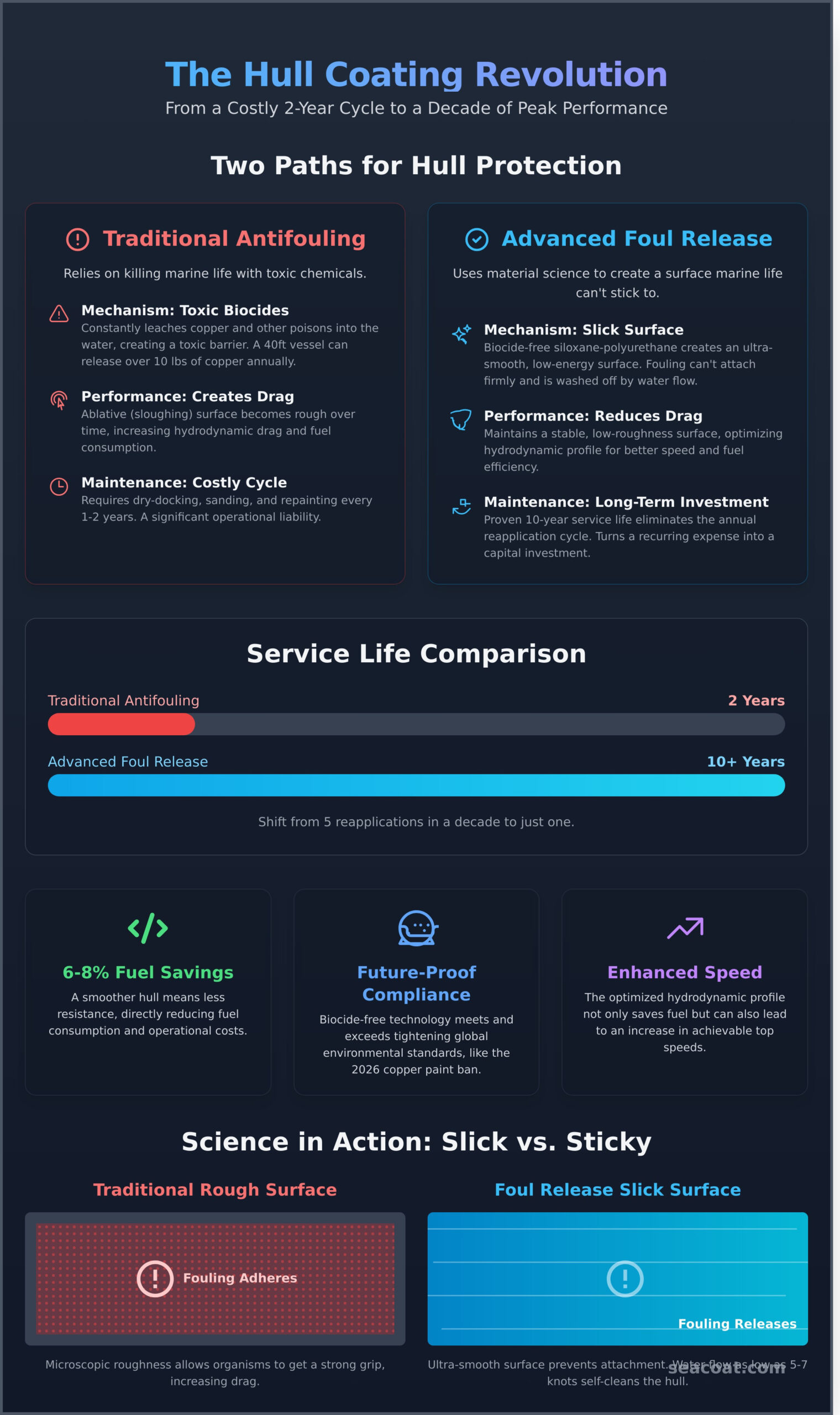
Conventional ablative paints are engineered to continuously slough off, or “ablate,” a microscopic layer of the coating. This process intentionally leaches biocides, most commonly cuprous oxide, into the water column to poison nearby marine organisms. A single 40-foot recreational vessel can release over 10 pounds of copper into the marine environment annually. This constant leaching not only harms non-target species but also creates a “self-polishing” surface that, contrary to its name, develops a microscopic roughness that increases hydrodynamic drag. This inefficiency is compounded by the high-maintenance cycle, requiring annual haul-outs for sanding and repainting, a costly and labor-intensive process that perpetuates the cycle of toxic discharge.
The impending regulatory changes, such as Washington State’s law banning copper-based bottom paint for a boat on recreational vessels starting January 1, 2026, signal a definitive end to this era. This legislative action is a clear harbinger of a global trend, compelling the industry to adopt superior, sustainable alternatives. The reliance on traditional Anti-fouling paint is no longer a viable long-term strategy for responsible vessel management.
Introducing Foul Release Technology
Foul release technology represents a paradigm shift from chemical warfare to advanced materials science. Instead of relying on toxins, these coatings utilize low-surface-energy chemistry, typically based on siloxane-polyurethane formulations, to create an exceptionally smooth, non-stick surface. Organisms like barnacles, algae, and mussels have difficulty achieving a strong bond to this ultra-slick surface. Any minimal fouling that does occur is typically dislodged by the vessel’s own movement through the water at speeds as low as 5-7 knots.
Foul release is a biocide-free antifouling method that relies on the physical properties of an ultra-slick, low-energy surface to prevent marine growth adhesion, rather than on chemical toxicity to kill organisms. This “slicker” surface directly translates to enhanced performance. By minimizing the friction between the hull and the water, these coatings significantly reduce hydrodynamic drag. This reduction is not a marginal gain; it’s a direct enhancement of the vessel’s hydrodynamic profile, translating to documented fuel efficiency improvements of 5-8% and an increase in achievable top speeds. It’s a solution that aligns operational efficiency with environmental stewardship.
Antifouling vs. Foul Release: A Scientific Comparison
The selection of a bottom paint for a boat involves a critical choice between two fundamentally different technologies: traditional antifouling and advanced foul release. Antifouling coatings operate on a chemical principle, slowly leaching biocides like cuprous oxide into the water to poison and deter marine organisms. This mechanism is inherently sacrificial; the coating depletes itself over a typical 12 to 24-month service life, requiring frequent and costly reapplication.
In contrast, foul release systems like Sea-Speed V 10 G operate on a physical principle. They create an ultra-smooth, low-energy surface to which marine life cannot firmly attach. Any organisms that do settle are easily dislodged by the vessel’s movement through the water or by simple in-water cleaning. This non-depleting mechanism provides a durable, biocide-free solution with a proven 10-year performance life cycle, fundamentally shifting hull maintenance from a recurring expense to a long-term capital investment.
This difference directly impacts a vessel’s hydrodynamic profile. The constant leaching and sloughing of ablative antifouling paints increase the hull’s Mean Surface Roughness (MSR) over time, creating parasitic drag that compromises speed and fuel efficiency. A foul release coating provides a stable, low-MSR surface that maintains its smoothness for years. The result isn’t just a clean hull; it’s a hydrodynamically optimized one. As the maritime industry moves to meet stricter environmental mandates, the transition away from toxic solutions is accelerating. Technologies that comply with future standards, such as the evolving international regulations on harmful anti-fouling systems, offer a decisive operational and regulatory advantage for vessel owners preparing for 2026 and beyond.
Hard Film vs. Soft Silicone Coatings
Early-generation foul release coatings utilized soft silicone, a material highly susceptible to mechanical damage from boat lifts, trailer bunks, and even aggressive marine growth. Sea-Speed’s advanced silane-siloxane chemistry creates a robust “hard film” finish that overcomes this critical vulnerability. This durable surface is engineered to withstand routine scrubbing and in-water cleaning without compromising its foul release properties, ensuring long-term integrity where softer coatings would fail.
Fuel Efficiency and Greenhouse Gas Mitigation
The link between hull smoothness and operational cost is direct and quantifiable. A mere 15-micron increase in surface roughness can elevate fuel consumption by as much as 1.5%. Sea-Speed V 10 G’s exceptionally low surface energy and smooth finish reduce frictional drag, directly mitigating fuel burn and associated greenhouse gas emissions. In a commercial shipping case study, a ro-ro cargo vessel coated with our technology recorded a sustained 12% reduction in fuel consumption over a 36-month period, demonstrating a significant return on investment through operational savings alone.
This evolution in marine coating science represents a strategic shift from passive protection to active performance enhancement. For owners of recreational boats and yachts, this choice of bottom paint for a boat directly translates to lower fuel costs, higher speeds, and a decade of reliable, eco-compliant performance. Vessel operators can review the hydrodynamic data to quantify the direct impact on their specific operational profile.
Hydrodynamic Optimization: Why Your Hull Surface Matters
A vessel’s hull is more than a structural boundary; it is a dynamic interface with the water. Optimal performance hinges on maintaining laminar flow, where water moves in smooth, parallel layers across the hull surface. Any disruption to this flow introduces turbulence, creating hydrodynamic drag that directly penalizes speed and fuel efficiency. The very texture of your boat’s bottom paint dictates this critical interaction.
Conventional ablative or hard epoxy paints, when magnified, reveal a micro-texture akin to an “orange peel.” This surface roughness, often measuring between 75 and 150 microns, is a significant source of frictional resistance. As the hull moves, these microscopic peaks and valleys trip the boundary layer of water from a laminar to a turbulent state. This forces the engines to expend additional power simply to overcome the friction created by the paint itself.
The physics of the hull surface also governs its resistance to marine growth. Bio-adhesion is fundamentally linked to surface energy; organisms require a high-energy surface to establish a secure attachment. Traditional antifouling paints don’t address this physical principle. Instead, they rely on leaching toxic biocides, a methodology whose environmental consequences are extensively documented in studies like the EPA Ecological Risk Assessment of Copper Antifouling Paints. Seacoat SCT, LLC’s technology operates on a different principle entirely, engineering a surface so slick that organisms cannot gain a foothold.
The financial impact of this parasitic drag is substantial. For a recreational yacht burning 40 gallons per hour at a cruising speed of 25 knots, a 5% increase in total resistance from a rough hull surface translates to an additional 2 gallons of fuel consumed every hour. Over a 100-hour season, that’s 200 gallons of wasted fuel. For commercial operators, this “Cost of Drag” directly inflates operational expenditures by tens of thousands of dollars annually per vessel.
Silane-Siloxane: The Expert Innovator’s Choice
Sea-Speed V 10 G utilizes a proprietary silane-siloxane polymer matrix to create a fundamentally different hull surface. The silane component forms a covalent bond with the hull substrate for unparalleled adhesion, while the siloxane component orients outward, creating a permanent, non-migratory barrier with extremely low surface energy. This advanced chemistry provides a hard, slick, foul-release surface that contains zero Volatile Organic Compounds (VOCs), ensuring safety for applicators and compliance with the most stringent environmental regulations.
Performance Metrics: Speed and Acceleration
The quantifiable results of this hydrodynamic optimization are immediate. Performance hulls coated with Sea-Speed V 10 G have documented top-end speed increases of 3-5%. At cruising speeds, operators report a consistent reduction in engine load, evidenced by lower exhaust gas temperatures and reduced RPMs required to maintain speed. It’s a well-established principle in naval architecture that reducing average hull surface roughness by just 20 microns can yield a 1-2% improvement in fuel efficiency, a metric our technology consistently exceeds. This makes it the intelligent choice for any owner seeking the best performing bottom paint for a boat.
Application Guide: Preparing Your Boat for a Modern Coating
Achieving the documented 10-year service life of Sea-Speed V 10 G is contingent upon meticulous substrate preparation and controlled application. This is not a conventional coating; it’s a high-performance, permanent siloxane system engineered for maximum hydrodynamic efficiency. The initial investment in proper preparation directly translates into a decade of optimized fuel consumption and zero biocide leaching. The process is precise because the results are permanent.
This commitment to a precise, expert process for superior results is a hallmark of quality in any industry; for a fascinating example from the world of specialty coffee, you can visit Compound Coffee Co..
The first critical decision involves assessing the hull’s current state. If the vessel has layers of old, failing copper-based antifouling paint, a complete strip to the original substrate is non-negotiable. Overcoating compromised layers will result in delamination and premature failure. However, if the hull is protected by a stable, well-adhered epoxy system, a light sanding to create a surface profile may be sufficient after a thorough solvent wipe. The objective is to create a chemically and mechanically sound foundation for the Seapoxy 73 primer system, which is the key to long-term adhesion.
Hull Preparation and Priming
Transitioning from a traditional ablative bottom paint for a boat requires neutralizing the substrate to remove residual biocides that can impede the epoxy bond. After stripping old coatings, the hull must be pressure washed at a minimum of 3,000 PSI and de-greased. Proper surface profiling is essential to create the mechanical “tooth” for the primer. We specify a 3-4 mil (75-100 micron) angular profile, typically achieved through sandblasting or grinding with 36-grit discs. This profile provides the optimal surface area for the Seapoxy 73 primer to achieve a tenacious, 10-year bond.
Application Best Practices
Environmental conditions during application directly impact the coating’s final integrity and finish. The ideal surface and ambient temperature range for applying Sea-Speed V 10 G is between 60°F and 90°F (15°C to 32°C), with relative humidity below 85%. For the smoothest, “mirror” finish that maximizes drag reduction, a professional airless spray application is recommended. However, excellent results are achievable with a 1/4″ nap, solvent-resistant roller, provided the applicator maintains a wet edge to prevent lap marks. Following application, the system requires a minimum curing time of 24 hours at 77°F (25°C) before the vessel can be launched.
Once cured, Sea-Speed V 10 G is a durable, hard-film foul release coating that fundamentally changes your maintenance protocol. Gone are the days of costly annual haul-outs for repainting. Instead, maintenance involves simple in-water cleaning. For light slime, a soft cloth or sponge is sufficient. For more significant growth after stationary periods, cleaning can be done with a soft-bristled brush or a pressure washer set below 2,500 PSI. This simple regimen keeps the hull hydrodynamically smooth, ensuring performance and efficiency for its entire service life. For a complete guide with substrate-specific instructions for aluminum, fiberglass, and steel hulls, download the complete Sea-Speed V 10 G Technical Data Sheet.
Strategic Asset Management: The ROI of Sea-Speed V 10 X Ultra
Selecting a hull coating extends far beyond seasonal maintenance; it is a critical decision in the strategic financial management of your vessel. While conventional antifouling paints present a lower initial expense, their true cost accumulates significantly over time through a relentless cycle of haul-outs, stripping, sanding, and repainting. A comprehensive analysis of the 10-year Total Cost of Ownership (TCO) reveals the profound economic advantage of a durable, long-life foul release system like Sea-Speed.
Consider the typical 10-year maintenance schedule for a 45-foot yacht. A traditional ablative or hard bottom paint for a boat requires replacement every 1-2 years. This recurring process involves substantial operational costs:
- Annual Haul-Out & Labor: Costs often range from $2,500 to $4,000 per cycle, including yard fees, pressure washing, sanding, and application labor.
- Material Costs: Multiple gallons of biocide-laden paint are required for each application.
- Cumulative Expense: Over a decade, these recurring expenses can easily exceed $30,000, not including the vessel’s costly downtime.
In contrast, Sea-Speed V 10 X Ultra is a single-application solution engineered for a service life of 10 years or more. The initial investment completely eliminates the cycle of annual stripping and repainting. This paradigm shift not only generates direct cost savings of over 60% in TCO but also enhances your vessel’s value. A hull protected by a premium, long-duration coating is a significant asset during a pre-purchase survey, signaling superior maintenance and eliminating a major future expense for a potential buyer.
Commercial and Military Grade Reliability
The world’s most demanding maritime operators, including global navies and commercial fleets, are transitioning to non-toxic, hard foul release coatings. This shift is driven by the need for maximum fleet availability and compliance with stringent environmental regulations like the EEXI and CII. By minimizing dry-dock intervals for hull recoating and reducing hydrodynamic drag for lower fuel consumption, Sea-Speed technology is proven to optimize operational readiness and mitigate carbon intensity.
The SeaCoat Advantage for Pleasure Craft
This same robust technology is precisely tailored for the recreational market in our Sea-Speed V 10 G formulation. As a hard, inert, and non-toxic siloxane coating, it allows for simple in-water cleaning with a soft brush or automated systems without releasing biocides or harmful paint particles into sensitive marine ecosystems. This makes it the superior bottom paint for a boat in marinas and anchorages with strict environmental controls. You gain a perpetually clean hull and peak performance, sustainably. Optimize your hull performance with Sea-Speed V 10 X Ultra and transform your approach to vessel maintenance.
Optimize Your Vessel for the Next Decade of Performance
The era of choosing a bottom paint for a boat based on its biocide content is over. The industry’s evolution toward non-toxic, foul-release coatings is driven by a clear operational imperative: optimizing hydrodynamic efficiency to reduce fuel consumption. A superior hull coating isn’t just a defensive measure; it’s a strategic investment in performance and longevity. With technology proven in commercial use since 2001, SeaCoat’s zero VOC, biocide-free formulations deliver a durable, slick surface engineered for a proven 10-year life cycle on commercial hulls.
This transition from temporary protection to long-term asset management is critical for any serious operator. Let our experts analyze your vessel’s specific requirements. Request a Technical Consultation for Your Vessel to quantify the ROI and performance gains for your fleet.
Protect your asset, optimize your performance, and lead the charge toward a more sustainable maritime future.
Frequently Asked Questions About Sea-Speed V 10 G
Is non-toxic bottom paint as effective as traditional copper paint?
Yes, advanced non-toxic coatings like Sea-Speed demonstrate superior and more consistent performance. Traditional copper paints function by sloughing off biocides, a process that inherently degrades their effectiveness over a 1-2 year period. In contrast, Sea-Speed’s siloxane-polyurethane foul release technology creates a permanent, low-surface-energy film that marine growth cannot adhere to. This mechanism provides consistent hydrodynamic efficiency and a service life that is 5 to 10 times longer than ablative copper paints.
How long does Sea-Speed V 10 X Ultra actually last on a boat?
Sea-Speed V 10 X Ultra is engineered to provide a minimum service life of 10 years. This longevity is achieved through its non-depleting, hard-film composition that resists mechanical damage and doesn’t rely on biocides that leach out over time. Documented case studies on commercial vessels show the coating maintaining its foul release properties well beyond a decade with only minimal periodic maintenance. This durability eliminates the 1-2 year haul-out and repaint cycle, delivering a significant return on investment.
Can I apply Sea-Speed over my existing bottom paint?
No, Sea-Speed cannot be applied directly over existing traditional bottom paint for optimal performance. For proper adhesion, the hull must be prepared to a clean, profiled substrate, free of all previous coatings. Traditional antifouling paints are designed to be soft and ablate, which creates an unstable foundation for a hard, long-lasting coating like Sea-Speed. Proper surface preparation is a critical step to achieving the coating’s intended 10-year performance and hydrodynamic benefits.
Does a slicker bottom paint really increase my boat speed?
Yes, a smoother, low-friction hull surface directly improves vessel speed and fuel efficiency. Sea-Speed V 10 G creates an exceptionally smooth surface that reduces hydrodynamic resistance by up to 8%. For a typical recreational yacht, this drag reduction can result in a speed increase of 4-6% or a corresponding fuel savings of 5-10% at cruising speeds. Its foul release properties maintain this slick surface, preventing the biofouling that degrades performance.
Is foul release coating suitable for boats that sit in the water for long periods?
Yes, foul release coatings are highly effective for boats that remain static for extended periods. While the self-cleaning effect is most pronounced when the vessel is moving at speeds above 7 knots, any light slime that accumulates while stationary is easily removed with a soft cloth or a brief run at cruising speed. Unlike ablative paints that become less effective when static, Sea-Speed’s surface properties remain constant, ensuring protection regardless of the vessel’s activity level.
What are the environmental regulations regarding bottom paint in 2026?
By 2026, regulations in key maritime regions, including Washington State and the European Union, will further restrict or ban copper-based antifouling paints. These legislative actions, such as Washington’s HB 1644, are driven by data showing copper’s toxic impact on marine ecosystems. Sea-Speed V 10 G is a zero-VOC, biocide-free solution that already complies with the most stringent current and anticipated future standards. Choosing a compliant bottom paint for a boat now mitigates future regulatory risks.
How do I clean my hull if I have a foul release coating?
Hull cleaning for a Sea-Speed coated vessel requires only non-abrasive methods. The low-energy surface prevents marine organisms from forming a strong bond, so cleaning typically involves soft materials like microfiber cloths, non-abrasive pads, or low-pressure water jets. It’s critical to avoid abrasive tools like stiff brushes or scrapers, as they can damage the coating’s smooth finish. For most boaters, periodic light wiping or the vessel’s own movement is all that’s required to maintain a clean hull.
Can Sea-Speed be used on aluminum boats without causing electrolysis?
Yes, Sea-Speed is an ideal coating for aluminum hulls because it’s completely inert and free of metallic compounds. Unlike copper-based paints that create a galvanic cell when applied to aluminum and cause rapid corrosion, Sea-Speed contains no metals. It forms a durable, non-conductive barrier that isolates the aluminum from the seawater, preventing both biofouling and electrolysis. This makes it a superior choice for protecting aluminum vessels, pontoons, and outdrives without extensive barrier coats.