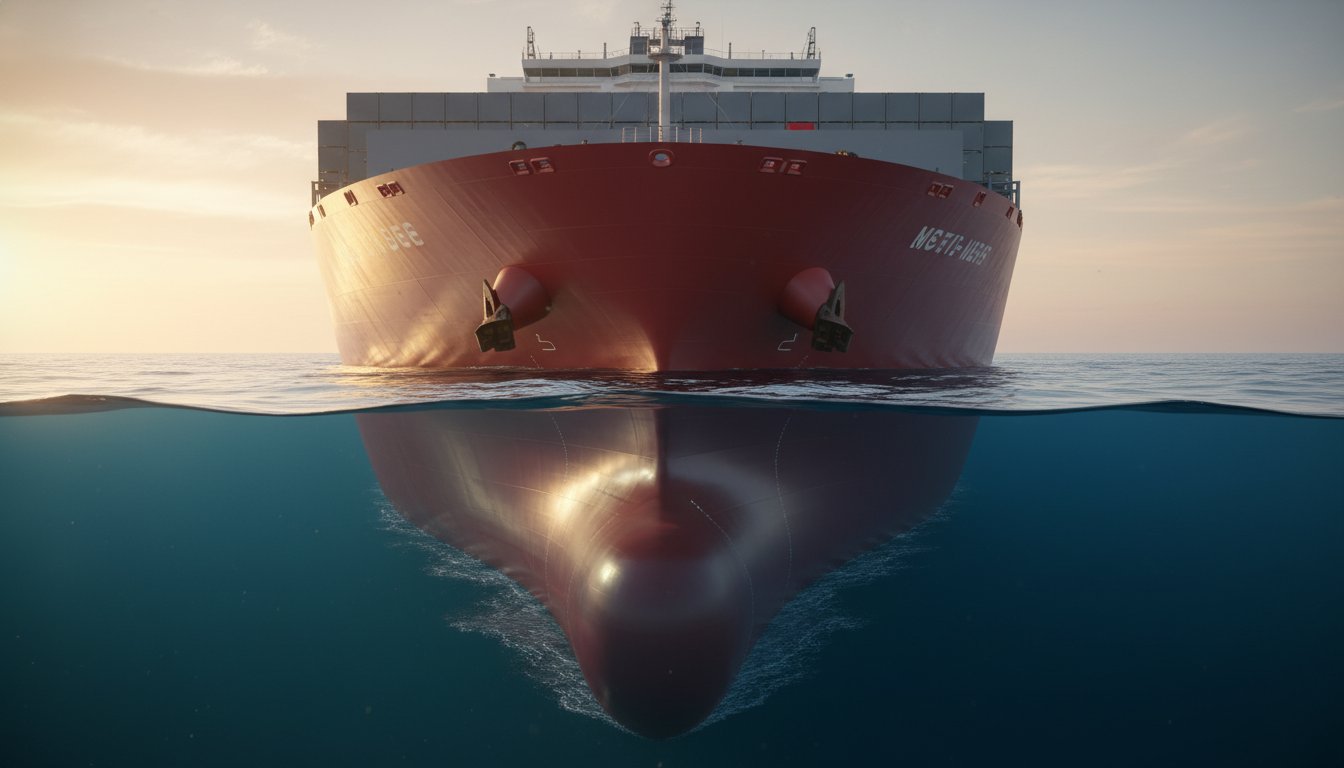
By 2026, a mere 0.5mm layer of slime biofouling could increase a vessel’s fuel consumption by as much as 25%, a financial and regulatory liability that few operators can afford. For fleet managers and technical superintendents, the pressure to mitigate these losses is immense; you’re already grappling with volatile bunker fuel prices and the stringent EEXI and CII regulations that leave no room for operational inefficiency.
This guide moves beyond temporary fixes to detail the definitive strategies that answer the critical question of how to reduce ship fuel consumption for long-term ROI. We will explore how advanced hull coatings and optimized vessel hydrodynamics can directly lower your operational expenditure, improve your Carbon Intensity Indicator rating, and extend dry-docking intervals to a ten-year cycle. From biocide-free foul release systems to proactive hull maintenance protocols, we’ll examine the data-backed solutions that deliver measurable performance gains.
Key Takeaways
- Understand the critical link between 2026 EEXI/CII compliance and operational expenditures to protect your fleet’s long-term profitability.
- Discover how mitigating hydrodynamic drag, specifically skin friction caused by biofouling, is a fundamental step in any effective fuel reduction strategy.
- Evaluate the ROI of operational tactics like slow steaming against technical upgrades to determine the optimal framework for how to reduce ship fuel consumption for your specific vessel.
- Shift from short-term maintenance cycles to a 10-year hull performance strategy by analyzing the Total Cost of Ownership (TCO) of advanced foul release coatings.
The Economics of Maritime Efficiency: Why Reducing Ship Fuel Consumption is Critical in 2026
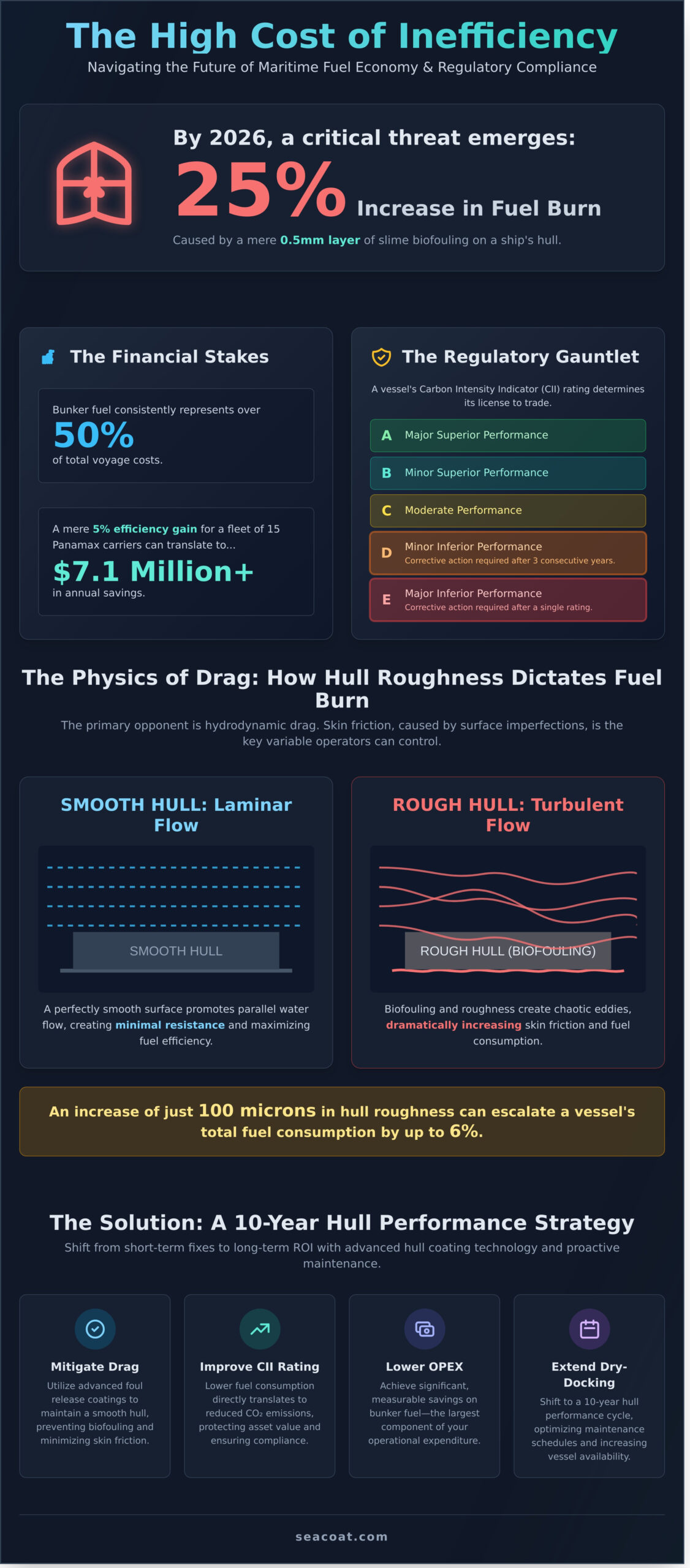
In the high-stakes maritime sector, operational expenditure (OPEX) is perpetually under scrutiny, with bunker fuel consistently representing over 50% of total voyage costs. The price volatility of Very Low Sulphur Fuel Oil (VLSFO), which has fluctuated between $550 and $800 per metric ton since early 2024, transforms fuel efficiency from a line-item saving into a primary driver of profitability. Yet, the financial calculus extends far beyond the bunker invoice. By 2026, the convergence of stringent regulations, carbon pricing, and heightened ESG expectations will make a vessel’s hydrodynamic and operational efficiency a definitive measure of its commercial viability.
The financial leverage of incremental gains is immense. For a fleet of 15 Panamax bulk carriers, each consuming 40 tonnes of fuel daily, a mere 5% improvement in fuel efficiency translates into a direct annual saving of over $7.1 million, assuming an average VLSFO price of $650 per tonne. This demonstrates why the strategic question for every operator has become how to reduce ship fuel consumption through technically sound, long-term solutions. It’s no longer a matter of marginal improvement; it’s a matter of competitive survival.
Managing this financial risk is as critical as optimizing physical consumption, and many sophisticated operators turn to the futures market to hedge against fuel price volatility. For those exploring how modern AI-driven tools can provide an edge in this complex financial environment, you can check out Quantum Navigator.
The Regulatory Push: EEXI and CII Explained
The International Maritime Organization (IMO) has mandated a dual-pronged regulatory framework that directly links a vessel’s technical and operational efficiency to its license to trade. The Energy Efficiency Existing Ship Index (EEXI) establishes a technical design standard that existing vessels must meet, while the Carbon Intensity Indicator (CII) provides an annual operational rating from A (major superior) to E (major inferior). A vessel receiving a D rating for three consecutive years or a single E rating faces mandatory corrective action, severely diminishing its charter value and risking its status as commercially un-charterable.
The Hidden Cost of Greenhouse Gas Emissions
Beyond IMO compliance, direct carbon pricing mechanisms like the EU’s Emissions Trading System (ETS) have converted greenhouse gas emissions into a tangible operating expense. As of 2024, shipowners must purchase and surrender carbon allowances for voyages within the EU, creating a direct financial penalty for inefficiency. This economic pressure is amplified by the development of ‘Green Shipping Corridors’ on major trade routes, which will require vessels to meet superior efficiency benchmarks to gain preferential access. In this new paradigm, every metric of performance matters. For a typical Panamax vessel, a 1% reduction in hydrodynamic drag directly correlates to an annual mitigation of over 1,200 tonnes of CO2 emissions.
For deeper insights into the evolving business and policy landscape shaping these maritime trends, particularly at the intersection of key trade regions, the journalism at Gulf–ASEAN Exchange provides valuable context.
This complex interplay of market forces and regulatory oversight has elevated the importance of sophisticated Marine fuel management from a best practice to a non-negotiable component of fleet strategy. Optimizing fuel consumption is now inextricably linked to asset value, regulatory compliance, and a corporation’s commitment to its ESG goals. The following sections will detail the specific operational and technical strategies required to achieve these critical efficiency gains.
The Physics of Hydrodynamic Drag: How Hull Roughness Dictates Fuel Burn
To understand how to reduce ship fuel consumption, one must first grasp the fundamental forces working against a vessel in motion. The primary opponent is hydrodynamic drag, a complex resistance that can be separated into two key components: pressure drag and skin friction drag. While pressure drag is largely determined by the vessel’s fixed hull form, skin friction is a dynamic variable directly influenced by the texture of the hull’s submerged surface. It’s this variable that presents a significant opportunity for fuel efficiency optimization.
Every vessel moving through water is surrounded by a thin “boundary layer” of fluid. A perfectly smooth hull surface promotes laminar flow, where this water layer moves in smooth, parallel streams, creating minimal resistance. However, any surface imperfection, no matter how small, can disrupt this delicate state. It trips the boundary layer into turbulent flow, a chaotic state of eddies and vortices that dramatically increases frictional resistance. The consequences are not trivial; extensive research into the impact of hull roughness validates that an increase of just 100 microns in average hull roughness can escalate a vessel’s total fuel consumption by up to 6%. This is a direct and measurable penalty for an imperfect surface.
Skin Friction: The Silent Fuel Thief
The relationship between surface texture and fuel burn is unforgiving. Traditional ablative or self-polishing copolymer (SPC) paints, which function by slowly eroding to release biocides, inherently increase surface roughness over their service life. This degradation creates a pockmarked, uneven surface that continuously elevates skin friction. This problem is compounded by speed, as the force of drag increases exponentially with the vessel’s velocity. A seemingly minor increase in hull roughness at 12 knots becomes a major fuel penalty at 18 knots, relentlessly taxing the main engine.
Biofouling and Its Impact on Fuel Efficiency
Biofouling represents the most severe form of hull roughness, imposing a staggering fuel penalty. This threat exists in two forms:
- Micro-fouling: A biofilm or slime layer, often just 0.5mm thick, can increase frictional resistance by 20-25%.
- Macro-fouling: The colonization by organisms like barnacles, tubeworms, and algae can increase frictional resistance by over 80% in severe cases.
This isn’t just a matter of friction. The engine must expend immense energy to propel the literal tons of added mass from accumulated marine growth. Mitigating this requires a proactive strategy. For a deeper analysis of this challenge, see our comprehensive guide on Marine Biofouling: The Problem and Modern Solutions.
The physics are clear: a smooth, foul-free hull is the most direct path to mitigating hydrodynamic drag. This is why the maritime industry’s shift toward advanced, biocide-free foul release coatings is a strategic imperative. By creating a durable, non-toxic, and exceptionally low-friction surface, these systems prevent the adhesion of marine life and maintain their smoothness for years, directly protecting both marine ecosystems and your operational bottom line.
Operational vs. Technical Measures: A Comprehensive Efficiency Framework
Effectively managing a vessel’s fuel economy requires a dual-pronged strategy that addresses both immediate operational adjustments and long-term technical investments. Operational measures offer low-cost, high-impact savings that can be implemented rapidly, while technical upgrades demand capital expenditure but deliver sustained, structural efficiency gains. A successful strategy for how to reduce ship fuel consumption integrates both, creating a resilient framework for performance and regulatory compliance.
The most widely adopted operational measure is slow steaming. The relationship between a vessel’s speed and its fuel consumption is not linear; it’s cubic. A 10% reduction in speed can decrease daily fuel consumption by approximately 27%. However, this strategy carries commercial implications, including longer voyage times and potential conflicts with charter party agreements. It also necessitates careful engine management to avoid operating at sub-optimal loads for extended periods.
Beyond speed, route optimization has evolved from a simple shortest-distance calculation into a complex, data-driven science. Modern weather routing systems leverage AI and machine learning to analyze terabytes of meteorological and oceanographic data, plotting a course that minimizes resistance from wind, waves, and currents. These hybrid models, as examined in a comprehensive review of fuel consumption methods, consistently identify voyage plans that yield fuel savings of 3-5% over conventional routes. Complementing these strategies are next-generation propulsion improvements like wind-assisted systems and air lubrication. Technologies such as Flettner rotors can reduce fuel use by 5-10% under favorable wind conditions, while air lubrication systems create a carpet of microbubbles across the hull, reducing frictional drag by a documented 5-9%.
The successful implementation of these data-heavy strategies often depends on sophisticated digital platforms for analysis and visualization. To this end, many maritime tech companies partner with web development experts like Xell Technology to build the custom dashboards and management systems needed to turn raw data into actionable fuel-saving insights.
For instance, a vessel’s journey might involve navigating through crucial maritime chokepoints like the Suez Canal, a hub of global trade located in Egypt. While the focus for fleet managers is purely on efficient transit, the country itself is a premier travel destination, and for those whose work or interests bring them to the region, local arrangements can be handled by experts such as Sola Travel.
Operational Strategies for Immediate Savings
Immediate fuel savings are achievable through meticulous operational discipline. Optimizing a vessel’s trim and ballast for its current draft and sea conditions can reduce hydrodynamic resistance by 1-3%. Similarly, adopting Just-In-Time (JIT) arrival protocols, facilitated by port collaboration, eliminates the inefficient “sail fast, then wait” practice, directly mitigating fuel waste during anchorage. Finally, investing in continuous crew training for energy-efficient engine room and navigation management consistently yields fuel savings between 2-4% by ensuring all onboard systems are operated at their peak design efficiency.
Technical Investments for Long-Term ROI
While operational tactics provide ongoing benefits, technical modernizations secure a vessel’s long-term competitive and regulatory standing. The implementation of Engine Power Limitation (EPL) systems has become a primary method for complying with the IMO’s Energy Efficiency Existing Ship Index (EEXI) regulations, acting as a permanent cap on excessive fuel burn. Further gains are realized through technologies like Waste Heat Recovery Systems, which convert thermal energy from exhaust gases into electricity, offsetting auxiliary engine load and reducing total fuel consumption by another 3-5%. Yet, among all technical upgrades, advanced hull coatings represent the most cost-effective investment for sustained drag reduction. A state-of-the-art, biocide-free siloxane foul-release coating minimizes surface roughness to a degree that can decrease frictional resistance by up to 9%, translating into a direct 5-8% reduction in fuel consumption. This single investment provides a foundational layer of efficiency that enhances the ROI of all other measures for its entire ten-year service life.
Implementing a 10-Year Fuel Reduction Strategy through Hull Maintenance
The maritime industry’s standard five-year dry-docking schedule, often punctuated by a two-year intermediate inspection, is an operational paradigm rooted in the limitations of traditional antifouling paints. This reactive cycle perpetuates significant costs in vessel downtime, material waste, and inconsistent fuel efficiency. A strategic shift towards a 10-year maintenance interval, anchored by advanced hull coatings, transforms hull upkeep from a recurring expense into a long-term performance asset. This approach demands a holistic evaluation of the Total Cost of Ownership (TCO), where the initial coating investment is weighed against a decade of fuel savings, eliminated dry-docking fees, and maximized fleet availability.
The foundation of this strategy is a durable, high-performance coating that maintains its hydrodynamic integrity through proactive in-water cleaning. Unlike soft, ablative paints that leach biocides and degrade with every cleaning, advanced hard-film coatings are engineered to withstand regular, non-abrasive grooming. This maintains a slick, foul-free surface with minimal drag, which is the most direct answer to how to reduce ship fuel consumption over the long term. Validating these gains requires precise, continuous monitoring. Onboard systems like shaft power torque meters and Coriolis fuel flow meters provide the empirical data needed to quantify efficiency improvements, moving performance discussions from projection to proven reality.
Of course, collecting this data is only half the battle. For reliable ship-to-shore communication and the scalable IT infrastructure needed to process and analyze this performance data, many operators partner with specialized providers; you can check out SolaaS LTD to see how tailored solutions support modern fleet management.
The ROI of Premium Foul Release Systems
A premium siloxane foul release system delivers a payback period that is typically under 24 months, driven by direct fuel savings that can exceed 8% compared to a biocidal antifouling coating in its third year of service. While a traditional coating’s performance degrades as its biocide layer depletes, a foul release system maintains a consistently smooth, low-friction surface. This sustained efficiency compounds savings year after year, fundamentally reshaping the vessel’s operational expenditure profile. Calculate the ROI on a premium foul release coating for your vessel.
Extending Dry-Dock Intervals
Durable, hard-film foul release coatings are the enabling technology for extending dry-dock intervals to 10 years. Their robust composition resists mechanical damage and eliminates the need for full hull stripping at each cycle, a process that can add weeks to a dry-docking event. The exceptional durability of a hard-film system prevents the “sandwich effect,” where layers of old, degraded paint are repeatedly coated over, creating a rough, inefficient surface that must eventually be blasted off. By avoiding just two dry-docking cycles, a vessel can gain over 45 days of revenue-generating service.
Ultimately, adopting a 10-year hull maintenance strategy is a decisive step in operational optimization. It’s a plan that directly addresses the core challenge of how to reduce ship fuel consumption by leveraging superior materials science and proactive upkeep. This isn’t just about painting a hull; it’s about engineering a decade of predictable, high-efficiency performance.
Advanced Silane-Siloxane Technology: The Seacoat Advantage
While operational adjustments and route optimization offer incremental gains, the most significant and lasting impact on fuel efficiency originates at the hull-water interface. Advanced foul release coatings represent a paradigm shift in this critical area. Seacoat SCT, LLC’s proprietary Silane-Siloxane technology moves beyond the temporary, toxic solutions of the past to deliver a durable, non-toxic, hard-film surface that fundamentally alters a vessel’s hydrodynamic profile. This isn’t just another layer of paint; it’s an engineered surface designed for peak operational efficiency and a ten-year performance lifecycle.
The science behind our foul release system is rooted in surface energy and smoothness. Unlike biocide-leaching antifouling paints that kill marine life, our technology creates an inert, extremely low-energy surface. Marine organisms have immense difficulty gaining a secure foothold on this ultra-slick film. Any organisms that do manage to attach are typically dislodged by the vessel’s own movement through the water at speeds as low as 7 knots. This self-cleaning property ensures the hull remains free of performance-degrading biofouling, directly addressing the core question of how to reduce ship fuel consumption over the long term.
Our flagship product, Sea-Speed V 10 X Ultra, exemplifies this principle. By achieving an exceptionally low average surface roughness, this coating minimizes frictional drag, leading to a direct and measurable 0.5% reduction in fuel consumption from surface smoothness alone. This stands in stark contrast to soft silicone coatings, which are highly susceptible to mechanical damage, require specialized and often costly cleaning protocols, and degrade over time. The robust, hard-film nature of Seacoat SCT, LLC’s technology is engineered for the realities of commercial and military operations, withstanding abrasion and regular in-water hull grooming without compromising its foul release properties. This durability ensures performance doesn’t just start strong; it stays strong.
The Sea-Speed Performance Edge
Seacoat SCT, LLC’s formulations achieve the lowest surface roughness in the industry, creating a near-perfect hydrodynamic surface. This ultra-slick hull minimizes frictional resistance, which translates directly into improved vessel speed, better acceleration, and enhanced maneuverability. By mitigating the drag that plagues conventionally coated vessels, Sea-Speed unlocks a vessel’s true performance potential. For a complete technical breakdown, explore our guide to Sea-Speed V 10 X Ultra: The Ultimate Hull Coating.
Sustainability without Compromise
Our commitment to environmental stewardship is absolute. Seacoat SCT, LLC systems are 100% biocide-free and contain zero Volatile Organic Compounds (VOCs), ensuring full compliance with global regulations, including the IMO’s ban on TBT and other toxic substances. By choosing a non-toxic solution that also lowers fuel burn, fleet operators actively reduce the carbon footprint of their vessels. This is the future of responsible maritime operations. Request a technical consultation for your fleet to quantify the economic and environmental benefits.
Navigating the Future: A Strategic Approach to Fleet Efficiency
As we approach 2026, the connection between hydrodynamic efficiency and your bottom line has never been more direct. Mitigating hull roughness is the most impactful technical measure for long-term fuel savings, far outweighing temporary operational adjustments. The strategic question of how to reduce ship fuel consumption is answered not through incremental changes, but through a decade-long commitment to advanced surface technology that fundamentally alters the physics of drag.
SeaCoat’s proprietary Silane-Siloxane technology, proven in the field since 2001 and holding certifications from DNV and Lloyd’s Register, offers a definitive solution. Our non-toxic, zero VOC, and biocide-free formulation provides a durable, foul-release surface that minimizes drag for a guaranteed 10-year lifecycle. Optimize your fleet’s fuel efficiency with Sea-Speed V 10 X Ultra and implement a strategy built on proven performance and environmental stewardship.
The path to a more profitable and sustainable maritime future is clear. It’s time to make it your reality.
For companies at the forefront of these maritime solutions, communicating such technical advantages is a critical business challenge. To effectively reach fleet managers and decision-makers, many partner with industry-specific marketing experts; to learn more about this approach, you can visit Aquatic SEO.
Frequently Asked Questions
How much fuel can a ship save by using advanced hull coatings?
Advanced hull coatings can reduce a ship’s fuel consumption by 5% to 15%, depending on the vessel type and operational profile. A high-performance, biocide-free foul release system minimizes hydrodynamic drag by creating an ultra-smooth surface that marine organisms can’t adhere to. For a vessel consuming 150 tons of VLSFO daily, even a conservative 8% reduction in drag translates into substantial operational savings and a lower carbon footprint over a ten-year service interval.
What is the difference between antifouling and foul release coatings for fuel efficiency?
Antifouling coatings actively deter marine life by leaching biocides like cuprous oxide into the water, a process that degrades over time. In contrast, foul release systems create a low-friction, hydrophobic surface that prevents organisms from attaching firmly. This physical barrier, often based on siloxane technology, maintains its hydrodynamic integrity for up to ten years without releasing toxic substances. The result is more predictable, long-term fuel efficiency and complete compliance with environmental regulations.
Does slow steaming really save money when considering schedule delays?
Yes, slow steaming remains a highly effective strategy for fuel savings due to the cubic relationship between vessel speed and engine power. A speed reduction of just 10% can lower daily fuel consumption by approximately 27%, a saving that typically outweighs the operational costs of a longer voyage. While logistical planning is critical to manage schedules, the direct fuel cost mitigation is so substantial that it’s a foundational tactic for optimizing voyage expenses and improving operational efficiency.
How does biofouling affect a vessel’s Carbon Intensity Indicator (CII) rating?
Biofouling directly degrades a vessel’s CII rating by increasing hydrodynamic drag. This added resistance requires more engine power and higher fuel consumption to maintain a given speed, thereby increasing CO2 emissions per transport work. According to IMO data, even a thin slime layer can raise fuel use by 10%, directly impacting the Annual Efficiency Ratio (AER) used for CII calculations. A clean hull is therefore a non-negotiable prerequisite for achieving and maintaining a favorable A, B, or C rating.
Are non-toxic hull coatings as effective as traditional biocidal paints?
Yes, advanced biocide-free foul release coatings often deliver superior and more consistent performance than traditional biocidal paints. While biocidal paints degrade as their active ingredients leach out over 3 to 5 years, premium siloxane foul release systems maintain their ultra-smooth, low-drag surface for service intervals of up to ten years. This ensures predictable, long-term fuel efficiency and eliminates the environmental risks associated with releasing toxic heavy metals into marine ecosystems.
What are the most cost-effective ways to meet EEXI compliance in 2026?
The most cost-effective paths to EEXI compliance by 2026 are typically Engine Power Limitation (EPL) or Shaft Power Limitation (ShaPoLi). These solutions limit the maximum power output of the main engine to meet the required efficiency index. However, integrating this with a high-performance hull coating that reduces drag by 5-15% is a strategic enhancement. This allows for a less severe power limitation, preserving more operational flexibility and speed capability for the vessel when it’s needed most.
Can hull coatings be applied to all types of vessels, including aluminum and steel?
Yes, modern hull coating systems are designed for application on all common marine substrates, including steel, aluminum, and fiberglass composites. The key is the use of a substrate-specific primer system that ensures optimal adhesion and prevents corrosion. For aluminum hulls, for instance, a specialized tie-coat is applied to create an inert barrier, allowing for the safe and effective application of the foul release topcoat without compromising the integrity of the underlying metal.
How often should a ship’s hull be cleaned to maintain peak fuel efficiency?
Hull cleaning frequency should be determined by performance monitoring data rather than a fixed schedule. For vessels with premium foul release coatings, proactive cleaning is typically considered when performance data indicates a 1-2% loss in speed or increase in fuel consumption. Depending on trading routes and idle periods, this could range from every 18 months to every 3 years. This data-driven approach is fundamental to understanding how to reduce ship fuel consumption and ensures cleaning is performed only when economically justified.